
Types of BPO Services in 2026: A Practical Guide to Choosing the Right Outsourcing Model
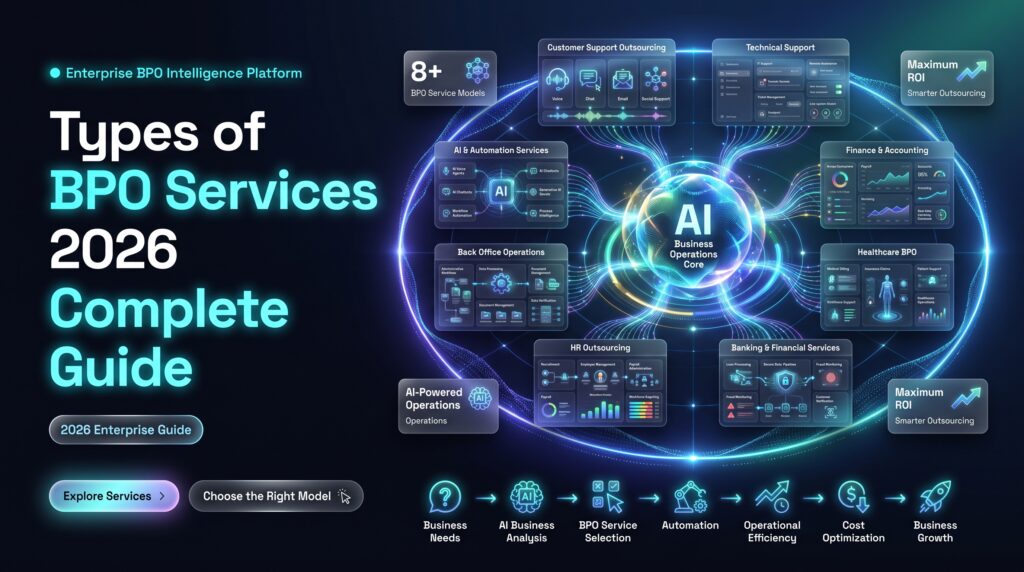
AI Overview
If you’re evaluating outsourcing in 2026, you’re likely asking one of these questions:
- What are the actual types of BPO services available, and which one fits my business?
- Should I use AI, human agents, or both for customer support?
- Who are the best BPO companies in India, and how do I actually evaluate them (not just compare price sheets)?
- What does outsourcing really cost, and where does ROI come from?
- What happens after the contract is signed — and what goes wrong?
This guide answers all five, with frameworks, benchmarks, and a case study you can use in your own vendor evaluation process. We wrote it the way we wish someone had written it before we onboarded our first enterprise client — without the sales gloss.
There’s a moment almost every growing company hits. Support tickets are piling up faster than the team can clear them. Response times are slipping. Your best people are spending half their week answering the same five questions instead of building the business. And somewhere in a leadership meeting, someone finally says the word: outsource.
What happens next usually goes one of two ways.
Either the company outsources too fast, hands off a messy process to the cheapest vendor, and spends the next year cleaning up the fallout — or it outsources too cautiously, spends six months evaluating options, and loses ground to competitors who moved first.
We’ve sat on both sides of this decision — as operators building support programs and as the outsourcing partner brought in to fix what wasn’t working. This guide is written from that vantage point. Not a vendor pitch dressed up as an “ultimate guide,” but an honest walkthrough of what BPO actually looks like in 2026, how AI has changed the customer support conversation, and how to evaluate a partner — Indian or otherwise — without getting sold a story.
If you’re a founder, COO, or head of support trying to make this decision well, this is the guide we wish existed when we were making it ourselves.
What “BPO” Actually Means Today
Business Process Outsourcing used to mean one thing: hire a company overseas to do the same job you were doing, for less money. That definition hasn’t disappeared, but it’s incomplete.
In 2026, outsourcing is really two different conversations happening under the same name.
The first is traditional BPO — labor arbitrage. You need people to answer phones, process orders, or manage data entry, and it’s cheaper to have a partner in India, the Philippines, or Eastern Europe do it than to hire locally. This model still works well for a lot of back-office functions.
The second is what’s now being called AI-augmented outsourcing, or contact center intelligence — where the vendor isn’t just supplying headcount, they’re supplying a system: AI handling the repetitive volume, trained humans handling everything that needs judgment, and analytics turning every conversation into something the business can actually use.
Confusing these two models is where most bad outsourcing decisions start. A company that needs the second model often gets sold the first one, dressed up with the word “AI” somewhere in the proposal.
Every Type of BPO Service, and Where It Actually Fits
Not every business function belongs in the same outsourcing bucket. Here’s the full landscape as it stands today.
Front-Office BPO
This is customer-facing work — inbound support, live chat, outbound sales, retention calls, social media response. It’s the highest-visibility category because it touches your customers directly, which also makes it the highest-risk if done poorly. Our guide on customer support outsourcing goes deeper into how this specific category has evolved.
Back-Office BPO
Data entry, payroll, accounting, order processing, document management. Nobody sees this work happening, which is exactly why it’s usually the safest place to start an outsourcing relationship — low customer risk, high potential for cost savings.
Knowledge Process Outsourcing (KPO)
Market research, financial modeling, actuarial work, business analysis. You’re paying for expertise here, not hours, and the pricing reflects that.
Legal Process Outsourcing (LPO)
Contract review, legal research, litigation support. AI-assisted document review has sped this category up considerably, but human legal oversight is still non-negotiable.
IT Process Outsourcing (ITO)
App development, infrastructure management, cybersecurity monitoring, technical helpdesk — often built on AWS, Azure, or Google Cloud infrastructure.
Healthcare BPO
Medical billing, claims processing, and patient appointment scheduling. This is one of the most heavily regulated categories in outsourcing, and we’ve written a full breakdown of it in our healthcare BPO services guide for U.S. hospitals and clinics.
Collections & Recovery
Payment reminders and receivables management, where tone and timing directly affect how much of the debt is actually recovered.
Recruitment Process Outsourcing (RPO)
High-volume sourcing, screening, and onboarding support — common in retail, logistics, and outsourcing itself.
Industry-Vertical BPO
The category growing fastest right now. Generalist providers who can technically handle any industry are losing ground to partners who deeply understand your industry’s specific workflows — a claims adjuster’s process in insurance looks nothing like a returns process in retail, and treating them the same produces mediocre results in both.
AI-Native Outsourcing
The newest and fastest-growing layer — providers who build AI directly into how tickets get resolved, not as a chatbot bolted onto an old process, but as the first line of resolution with human agents handling the escalations that actually need them.
AI vs. Human Customer Support: The Question Every Leadership Team Is Actually Wrestling With
Let’s address this directly, because it’s the question we get asked in nearly every sales conversation, usually somewhere around minute ten: “Should we just replace our support team with AI?”
The honest answer is no — and the more interesting answer is that the companies asking this question are usually asking the wrong one.
The real question isn’t AI versus human. It’s: which 60–70% of your ticket volume should never require a human at all, and how fast does the remaining 30% get to someone who can actually solve it?
Here’s how the two approaches actually compare when you strip away the marketing:
| Pure AI | Pure Human | Hybrid (AI + Human) | |
|---|---|---|---|
| Cost per resolution | Lowest | Highest | Low to moderate |
| Speed on simple requests | Instant | Minutes to hours | Instant |
| Handling of complex or emotional issues | Weak — loops, frustration | Strong, if agents are trained well | Strong — AI defers early |
| Availability | Always on | Shift-dependent | Always on, with backup |
| Consistency | Very high | Varies by agent | High |
| Risk during failure | Customer gets stuck with no way out | Human error, but recoverable | Lowest — built-in failover |
Every vendor demo you’ll see shows the AI handling a simple question flawlessly. What almost none of them show you is what happens when the AI doesn’t know the answer — because that’s the moment that actually determines whether your customer stays or leaves. A bot that traps a frustrated customer in a loop with no way to reach a person does more brand damage in five minutes than a slow human response does in a day.
That’s the part that rarely makes it into a pricing deck: the cost of AI-only support isn’t the technology. It’s what happens at the edges, when the handoff to a human fails or doesn’t exist.
This is exactly why, in our own delivery model, AI is built to assist and triage — drafting responses, surfacing customer history, resolving the repetitive 60% — while anything involving money, emotion, or risk routes to a trained person automatically. It’s a small architectural decision that has an outsized effect on customer retention.
Where AI genuinely wins, industry by industry
| Industry | AI handles well | Humans are still essential |
|---|---|---|
| Banking & Financial Services | Balance checks, transaction alerts | Fraud disputes, loan discussions |
| Insurance | Policy status, document requests | Claims denials |
| Healthcare | Appointment scheduling, reminders | Diagnosis-related concerns, billing disputes |
| Retail & eCommerce | Order tracking, return initiation | Damaged goods, VIP complaints |
| Telecom | Plan details, SIM activation | Outage complaints, contract disputes |
| Logistics | Shipment tracking | Lost or damaged shipment claims |
The pattern across every industry is the same: AI is excellent at information retrieval, and humans remain essential wherever there’s judgment, emotion, or financial stakes involved. Build your routing around that distinction, not around how impressive the AI demo looked.
Why Support Quality Shows Up on Your Revenue Line, Not Just Your Cost Line
Most finance teams still categorize customer support as a pure cost center — a number to minimize. That framing misses something important: support quality is one of the biggest hidden levers on retention, and retention is one of the biggest levers on revenue.
Here’s the connection most companies never formally track:
A customer who has to contact support twice for the same unresolved issue is measurably more likely to churn than one whose issue gets resolved on the first contact. A customer who has a genuinely good support experience is more likely to expand their spend with you. A support team that’s drowning in ticket volume can’t catch the early warning signs — the frustrated tone, the “I’m considering switching” comment — that a well-resourced team would flag to your retention or sales team immediately.
Multiply any of this across a few thousand monthly interactions, and it stops being a soft metric. It becomes a number your CFO should care about.
We call this dynamic Support-Led Revenue Growth — the idea that customer support isn’t downstream of the business, it’s actively shaping how much revenue the business retains and generates. It shows up in the churn numbers, the CLV numbers, and — for companies that bother to measure it — in forecast accuracy, since support ticket sentiment is one of the earliest available signals of a customer about to leave.
What Poor Support Is Actually Costing You (Even If You Haven’t Measured It)
Here’s a diagnostic we walk clients through before any outsourcing conversation even starts, because most companies genuinely don’t know the answer until they run the numbers.
Revenue leakage from support shows up in four places:
- Direct costs — refunds and chargebacks tied to service failures
- Churn — customers who leave within 90 days of a bad support experience
- Referral loss — the word-of-mouth value you never get from a frustrated customer
- Repeat-contact cost — the wasted time and money spent on customers contacting you multiple times for the same unresolved issue
Add these together as a percentage of your support-influenced revenue, and you get a number worth paying attention to:
- Under 3% — your support function is genuinely contributing to growth
- 3–8% — functional, but not optimized; there’s real money on the table
- Above 8% — support is actively working against your growth, and most companies don’t discover this until they measure it directly
If you’ve never run this calculation, that’s usually the finding itself. Nine times out of ten when we run this exercise with a new client, the repeat-contact number alone is higher than leadership expected.
Are You Actually Ready to Outsource?
This is the question that gets skipped in almost every outsourcing conversation, because vendors have no incentive to ask it — but it’s the single biggest predictor of whether the relationship works.
Rate your operation honestly on these five dimensions:
| Dimension | Where you likely stand |
|---|---|
| Process documentation | Is your workflow written down clearly enough to hand to a new hire? |
| Volume predictability | Do you know your monthly ticket volume within a reasonable range? |
| Data/CRM readiness | Is your customer data structured and accessible, or scattered across spreadsheets and inboxes? |
| Escalation clarity | Does every team member know exactly when and how to escalate a difficult issue? |
| Compliance documentation | Do you have your regulatory requirements written down, or does one person “just know” them? |
If most of these are shaky, outsourcing won’t fix them — it will scale them. We’ve seen this play out repeatedly: a company outsources a messy, undocumented process expecting the vendor to bring order to it, and instead spends the first three months just building the documentation that should have existed before the handoff.
The companies that get outsourcing right almost always do this groundwork first. It’s not glamorous, but it’s the difference between a 60-day ramp-up and a 6-month one.
What the Pricing Comparisons Usually Get Wrong
Almost every outsourcing pitch leads with a number: “cut your support costs by 40–60%.”
That statistic is usually true — and usually misleading, because of how it’s calculated. Most companies compare vendor pricing against their internal salary line alone. They don’t factor in benefits, tools, hiring costs, attrition, management time, or office overhead. Compared against salary alone, outsourcing looks like a slam dunk. Compared against your true, fully loaded internal cost, the savings are often real but considerably smaller than the headline number suggests.
There’s also a cost that almost never makes it onto the comparison sheet at all: vendor management. Someone on your team needs to own quality assurance, review escalations, and check in on performance — that person’s time isn’t free, and companies that skip budgeting for it are often surprised, six months in, by quietly declining service quality that nobody was actively watching.
Our recommendation before comparing quotes: calculate your true internal cost per ticket (salary + benefits + tools + management time + hiring/attrition costs), and budget roughly 8–12% of any outsourcing contract for internal oversight. Vendors who present pricing without acknowledging this aren’t being dishonest, necessarily — they’re just not showing you the whole picture, and it’s on you to fill in the gap.
What outsourcing actually costs, by model
| Pricing Model | Typical Range | Best Suited For |
|---|---|---|
| Dedicated FTE (offshore, India) | $1,200–$2,800/month | Predictable, high-volume, ongoing support |
| Shared team, hourly | $8–$18/hour | Lower or variable volume |
| Per-resolution/outcome-based | $0.80–$3.50 per ticket | Companies wanting cost tied directly to results |
| Hybrid (base fee + AI resolution) | Base fee + micro-cost per AI resolution | Predictable base cost with flexible overflow |
| Onshore (US/UK) | $25–$45/hour | High-compliance, high-empathy interactions |
A quick way to estimate your monthly investment
For an 8,000-tickets-a-month operation with roughly 55% AI resolution:
- AI-resolved tickets (4,400 × $0.90) ≈ $3,960
- Human-resolved tickets (6 agents × $1,800) ≈ $10,800
- Onboarding amortization ≈ $500
- Estimated monthly investment: ~$15,260 (roughly $1.91 per ticket)
Compare that against your true internal cost per ticket — for most mid-market companies, once management overhead is included, that number sits between $3.50 and $6.00.
Offshore vs. Onshore: The Comparison Nobody Explains Well
| Factor | Offshore (India) | Onshore |
|---|---|---|
| Cost | 50–70% lower | Baseline |
| 24/7 coverage | Naturally strong across time zones | Requires shift premiums |
| Cultural fit | Strong for global English-speaking markets with proper training | Native by default |
| Compliance | Manageable with certified providers | Sometimes simpler for domestic-only rules |
| Scaling speed | Fast, large talent pool | Slower, more expensive to scale |
Offshore is the stronger default for most cost-conscious, scalable operations — provided the provider has real compliance certifications and a documented QA process, not just a low quote. Onshore still makes sense for a narrow set of high-stakes, low-volume, relationship-driven accounts.
How to Actually Evaluate a BPO Vendor (Not Just Compare Their Rate Card)
Here’s a scorecard we use ourselves when benchmarking against competitors, and one we’d encourage you to run against anyone you’re evaluating — including us.
| What to Evaluate | Why It Matters | What to Actually Ask |
|---|---|---|
| Industry-specific experience | Generalist agents miss industry nuance | Ask for reference clients in your exact vertical |
| AI/automation maturity | Determines real cost efficiency | What % of tickets resolve without human review? How is that measured? |
| Compliance certifications | Non-negotiable for regulated industries | ISO 27001, SOC 2, HIPAA/PCI-DSS/GDPR as applicable |
| Tech stack compatibility | Prevents manual, error-prone workarounds | Do they integrate with Salesforce, Zendesk, Freshdesk, HubSpot? |
| Escalation & QA process | Predicts failure-mode behavior | Ask for a live demo of an escalation, not a slide about one |
| Pricing transparency | Avoids hidden charges later | Are outcome-based options available? |
A vendor that scores well across most of these but loses on price is usually a better long-term bet than one that wins purely on price. The cheapest quote in outsourcing is rarely the cheapest outcome once attrition, quality erosion, and escalation failures are factored in.
The single best filter we’d recommend: insist on a 30–60 day paid pilot before signing an annual contract. Any vendor unwilling to prove themselves on real tickets before asking for a long-term commitment is telling you something.
A Quick Maturity Check for Your Own Support Operation
Before deciding whether to outsource, it’s worth honestly rating where your current operation stands:
| Pillar | Reactive | Managed | Intelligent |
|---|---|---|---|
| Channels | Phone/email only | Omnichannel, siloed | Omnichannel, unified view |
| Resolution model | Human-only | Basic bot + human | AI triage + agent-assist + escalation |
| Data usage | Tickets closed and forgotten | Basic CSAT tracking | Feeds product, sales, and finance decisions |
| Scalability | 4–6 week hiring cycles | Some surge capacity | Instant AI absorption + trained overflow |
Most mid-market companies land around “Managed” — stable day to day, but not extracting much long-term value from the data their support team is generating every single day. The jump to “Intelligent” rarely requires more headcount. It usually requires better instrumentation of what’s already happening.
Industry Benchmarks Worth Knowing
| Metric | Typical Average | High Performers |
|---|---|---|
| First Contact Resolution | 68–72% | 85%+ |
| Average Handle Time (voice) | 6–8 minutes | 4–5 minutes with agent-assist |
| CSAT | 78–82% | 90%+ |
| Cost per resolution (hybrid model) | $2.50–$4.50 | $1.20–$2.00 |
| AI resolution rate (tier-1) | 35–45% | 60–70% |
| Agent attrition (offshore BPO) | 30–45% annually | Under 20% |
| Repeat contact rate | 15–22% | Under 8% |
Compiled from aggregated industry data and operational benchmarks across BFSI, retail, and healthcare accounts.
The gap between average and high-performing isn’t achieved with cheaper labor. It’s achieved through better AI-human handoffs, disciplined workforce management, and — critically — lower attrition, which itself comes from how well the operation is run rather than what agents are paid.
A Real Example: What Happens When Volume Triples Overnight
One retail brand we worked with was handling around 3,000 tickets a month with a lean three-person internal team — manageable, until a seasonal promotion tripled their volume within two weeks. Response times stretched from two hours to over 24. CSAT dropped from 84% to 61% in a single month. Refund requests spiked as frustrated customers gave up waiting for answers.
The root problem wasn’t headcount. It was routing. Nearly half of their ticket volume — 47% — was simple order-status and shipping questions being manually answered one by one, alongside genuinely complex disputes that needed careful handling. Everything went through the same queue at the same priority.
We deployed an AI triage layer to instantly resolve the repetitive order-status and shipping questions, freeing the human team to focus entirely on disputes, damaged items, and higher-value customer escalations. A trained overflow bench was ready before their next seasonal spike, integrated directly with their existing Shopify and Zendesk setup.
Ninety days later:
- First response time dropped from 24 hours to under 8 minutes
- CSAT recovered to 91%, above their pre-spike baseline
- 58% of total ticket volume resolved by AI, with no human involvement needed
- Repeat contact rate fell from 19% to 6%
- Refund requests declined 34% quarter-over-quarter
The lesson wasn’t “AI is better than humans.” It was that fixing the routing architecture mattered more than adding more people to a broken process — more agents working the old system would have simply scaled the cost, not the outcome.
You can see more outcomes like this in our BPO case studies, or read how we approach scale specifically for high-volume support operations handling 10,000+ monthly tickets.
Industry Use Cases Worth Knowing Before You Choose a Partner
| Industry | What Gets Outsourced Most | Compliance to Watch |
|---|---|---|
| Banking & Financial Services | Account inquiries, fraud alerts, collections | RBI guidelines, PCI-DSS |
| Insurance | Policy servicing, claims support | IRDAI regulations |
| Healthcare | Scheduling, billing, revenue cycle management | HIPAA |
| Retail & eCommerce | Order support, returns, live chat | PCI-DSS |
| Automotive & EV | Service scheduling, warranty support | Regional safety/recall rules |
| Telecommunications | Billing, troubleshooting | TRAI (India) |
| Logistics | Shipment tracking, claims | Cross-border compliance |
For anyone in healthcare specifically, our detailed breakdown on healthcare BPO services for U.S. hospitals covers cost and compliance in far more depth than we can here.
The Technology a Modern BPO Should Already Work With
A capable partner in 2026 should slot into your existing systems, not ask you to rebuild around theirs. That means native compatibility with:
CRM & Helpdesk: Salesforce, Zendesk, Freshdesk, HubSpot
Cloud Infrastructure: AWS, Microsoft Azure, Google Cloud
Contact Center Platforms: Genesys, Five9, Talkdesk, NICE CXone
Collaboration: Slack, Microsoft Teams
Workflow: ServiceNow
Commerce: Shopify, WooCommerce
Payments: Stripe, PayPal
Conversational AI: OpenAI, Google Gemini, Claude, Copilot
Messaging: Intercom
If a vendor can’t demonstrate native integration with the platforms you already use, expect manual data handoffs — and manual handoffs are where errors and delays quietly creep in. Our approach to this is outlined further in our overview of automating business processes.
Security and Compliance Basics You Shouldn’t Skip
Before signing anything, confirm:
- ISO 27001 certification for information security
- SOC 2 Type II for data handling and operational controls
- Industry-specific compliance — HIPAA, PCI-DSS, GDPR, or regional equivalents like RBI, IRDAI, and TRAI
- Clarity on where your data is physically stored and who has access to it
- A documented incident response process
The most common mistake here isn’t skipping the check entirely — it’s checking once at signing and never again. Compliance should be a yearly conversation, not a one-time box to tick.
Why India Still Leads Global Outsourcing — and How to Actually Choose Among Providers
India’s dominance in this industry isn’t accidental. It comes down to a genuinely large English-speaking, technically capable workforce; time-zone coverage that naturally supports 24/7 operations; real cost efficiency without the quality tradeoffs that existed a decade ago; and — increasingly — AI talent embedded directly inside delivery teams rather than added as an afterthought.
Search “best BPO companies in India” and you’ll find dozens of lists, most of them ranking providers purely by size. Size tells you almost nothing about fit. A more useful way to think about it:
| Provider Type | Where They’re Strong | Best Fit |
|---|---|---|
| Large diversified BPOs | Massive scale, multi-country coverage | Global enterprises standardizing operations across many markets |
| IT-integrated BPOs | Technology + process outsourcing combined | Enterprises needing IT and BPO under one contract |
| AI-native, mid-market specialists (this is where we sit) | Fast implementation, hybrid AI-human design, direct access to decision-makers | Growing businesses that need to move quickly without enterprise-level bureaucracy |
If you’re running a global operation across 15 markets, the scale of a large diversified provider genuinely matters. But if you’re a growing business that needs to go live in weeks — not quarters — with a partner who integrates cleanly into tools like Shopify, Zendesk, or Salesforce and builds AI into the support model from day one, that’s a fundamentally different evaluation. It’s the specific gap we built MasCallNet around.
You can learn more about our approach as an AI-powered BPO company in India, or see our 24/7 contact center operations out of Noida NCR supporting global clients across time zones.
The Comparisons You’ll Actually Need to Make
In-house vs. outsourced — In-house gives you full control but costs more once fully loaded, and it’s slow to scale. Outsourcing trades some control for speed and cost efficiency. Keep in-house for functions that genuinely differentiate you; outsource the rest.
Build vs. buy your AI support layer — Building takes 6–12 months and an ongoing engineering team. Buying a managed solution takes 3–6 weeks. Build only if support AI is a core product feature, not just an operational necessity.
Dedicated team vs. shared team — Dedicated costs more but delivers consistency; shared works fine for seasonal or low, variable volume.
Traditional BPO vs. AI-augmented BPO — Traditional providers compete on labor cost alone. AI-augmented providers compete on cost and the intelligence generated from every interaction — feeding retention, product, and revenue decisions instead of discarding the data the moment a ticket closes. For any function tied to customer retention or revenue, the latter is worth the premium.
What Can Actually Go Wrong
| Risk | How Likely | How to Prevent It |
|---|---|---|
| Data security breach | Low with certified vendors | Verify ISO 27001/SOC 2, audit yearly |
| Quality drifting over time | Moderate | Ongoing QA scoring, not just onboarding checks |
| High vendor attrition disrupting service | Moderate-high in traditional models | Ask about attrition rates upfront |
| Compliance gaps | Low-moderate | Documented training, regular audits |
| Inconsistent brand voice | Moderate | Structured onboarding, calibration calls |
| Escalation failures | Moderate-high if undesigned | Map and stress-test your escalation matrix before go-live |
Where This Is All Heading
A few shifts worth watching over the next 12–18 months:
Agent-assist tools — AI drafting responses for human review — are becoming the default rather than a premium add-on. Voice AI is maturing well past basic IVR, handling more natural phone interactions for scheduling and order updates. Predictive analytics are starting to flag at-risk customers before they even contact support, based on usage and sentiment patterns. And support data is increasingly feeding directly into revenue forecasting — support conversations becoming a genuine input into how finance teams plan, not just a customer service metric reported separately.
Pricing is shifting too. Outcome-based models — paying for resolutions, not hours — are on track to become the dominant structure for new BPO contracts within the next few years, replacing the per-seat pricing that’s defined this industry for decades.
A Simple Way to Decide
If your process isn’t documented and stable, fix that first — outsourcing will scale a broken process, not solve it.
If your volume is a short-term spike rather than sustained demand, a flexible AI-assisted surge model makes more sense than a long-term contract.
If the process carries real compliance exposure, prioritize vendors with relevant certifications and proven vertical experience over the lowest quote.
If you don’t have internal capacity to manage vendor oversight, choose a partner who builds governance and reporting into the relationship rather than one who just executes and disappears.
And once you’ve cleared those questions, evaluate vendors on the criteria that actually predict long-term performance — not the rate card alone.
Before You Sign Anything
- Calculate your true, fully loaded internal cost (not just salaries)
- Document your core process clearly enough for a stranger to follow it
- Define your escalation matrix for high-stakes interactions
- Verify compliance certifications directly, don’t just take a vendor’s word for it
- Confirm technology compatibility with your existing tools
- Ask for real AI resolution and escalation failure data, not marketing figures
- Insist on a structured pilot before a long-term commitment
- Assign someone internally to own vendor oversight
- Define success beyond cost — CSAT, resolution rate, and retention impact
- Make sure you retain visibility into the conversation data, not just the resolution count
Common Questions We Get Asked
What are the main types of BPO services available today?
Front-office (customer support, sales), back-office (data entry, finance, HR), knowledge process outsourcing, legal process outsourcing, IT outsourcing, healthcare BPO, and the fast-growing AI-native layer that now overlays most of these categories.
Is AI actually replacing human customer support agents?
Not replacing — absorbing the repetitive, low-complexity volume so human agents can focus on the interactions that genuinely need judgment and empathy. Companies that remove humans from the loop entirely tend to see CSAT and NPS decline on anything beyond simple requests.
How do I find the right BPO company in India for my business, not just the biggest one?
Match the provider to your scale and speed needs. Large diversified BPOs suit multinational enterprises needing standardized coverage across many countries. AI-native, mid-market specialists suit growing businesses that need fast implementation, tighter tech integration, and direct access to the people running their account — without a six-month onboarding cycle.
What does outsourced customer support typically cost?
Anywhere from $0.80–$3.50 per resolution for outcome-based pricing to $1,200–$2,800 per month for a dedicated offshore agent. Hybrid AI-human models generally bring the blended cost down to $1.20–$2.00 per resolution.
Offshore or onshore — which is actually better?
Offshore, typically India-based, offers a 50–70% cost advantage with strong round-the-clock coverage, provided the vendor has proper certifications. Onshore still makes sense for a narrow set of high-stakes, relationship-heavy accounts where a local presence genuinely matters.
How long does it realistically take to get an outsourced support operation running?
A company with well-documented processes can go live with a specialized AI-native provider in as little as 3–6 weeks. Larger, more traditional BPO engagements often take 3–6 months.
What’s the single biggest mistake companies make when outsourcing?
Handing off a process that was never clearly documented internally and expecting the vendor to sort it out. Outsourcing scales whatever discipline already exists in a process — good or bad.
Where We Fit Into This Picture
We built MasCallNet for the specific gap this guide describes — businesses that have outgrown a small internal support team but don’t need (or want) the scale and bureaucracy of a massive global BPO. Our model pairs AI-first ticket triage with trained human escalation and integrated conversation analytics, and we can typically get a program live in weeks rather than quarters.
If you’re comparing customer support outsourcing options, evaluating outsource call center services for a scaling operation, or simply trying to figure out whether a customer support outsourcing company in India is the right move for your business right now, we’d genuinely rather run a small pilot on your real tickets than send over another proposal.
If you’re still working through whether you’re ready to outsource at all, that’s a completely reasonable place to be. We offer a short, no-obligation readiness assessment using the framework in this guide — about 20 minutes, and it’ll give you a clearer picture before you talk to any vendor, including us.
→ Request a free readiness assessment
The Bottom Line
The question “what are the types of BPO services” has a fairly simple answer — front-office, back-office, KPO, LPO, ITO, healthcare, industry-vertical, and the newer AI-native layer sitting across all of them. The harder, more important question is whether you’re outsourcing the work while keeping ownership of the outcome — because that distinction is what actually separates outsourcing relationships that compound value over years from the ones that quietly erode quality until someone finally notices.
Whether you handle this in-house, through a large global BPO, or through a specialist like MasCallNet, the frameworks in this guide should give you enough to make that call clearly — and to know, six months in, whether it was the right one.