
eCommerce BPO Services (2026): The Complete Guide to Scaling Online Retail with AI-Powered Outsourcing
AI Overview
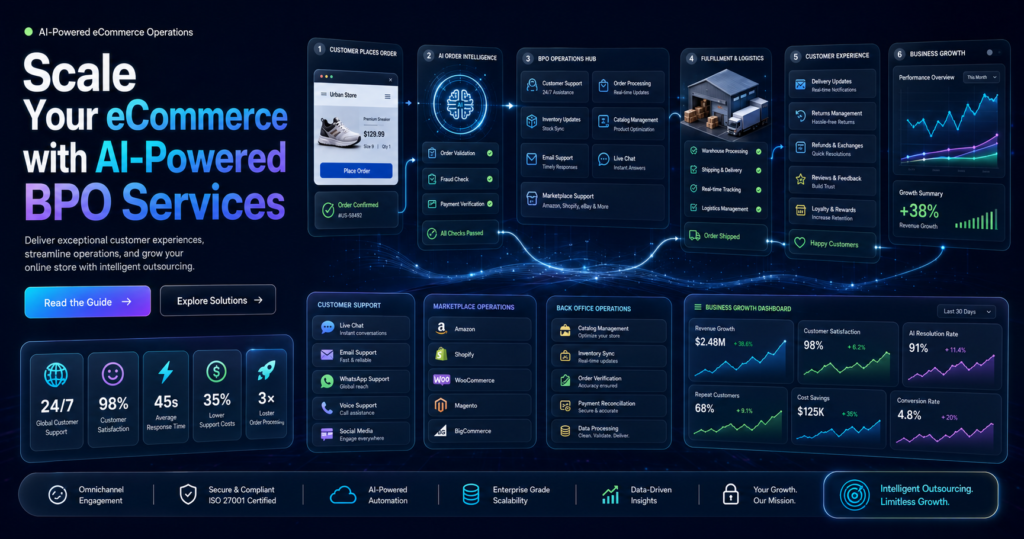
eCommerce BPO services help online retailers manage customer support, order operations, and back-office work without building an in-house team. In 2026, the category has shifted from cost-cutting outsourcing to AI-powered customer experience delivery, where automation handles repetitive queries (order status, returns, refunds) and human agents manage complex, emotional, or high-value interactions. Leading providers, including India-based BPOs, integrate directly with Shopify, WooCommerce, Zendesk, Freshdesk, and Salesforce to unify support across chat, email, voice, and social. The strongest ROI comes not from cost reduction alone, but from recovering revenue lost to poor support — abandoned carts, delayed refunds, and repeat-contact churn. This guide covers pricing, AI vs human decision models, vendor evaluation criteria, ROI frameworks, and how to select a BPO partner capable of scaling through peak seasons like Black Friday, Diwali, and Prime Day.
Executive Introduction
Every ecommerce leader eventually hits the same wall.
Order volume grows. Ticket volume grows faster. Hiring can’t keep pace with seasonality. Support quality drops right when revenue is most at risk — during a sale event, a payment gateway outage, or a shipping delay affecting ten thousand orders overnight.
Most companies respond by treating customer support as a cost center to be minimized. That instinct is understandable — and, in 2026, it’s also the single most expensive mistake an ecommerce business can make.
We’ve spent years inside contact center operations for retail and ecommerce brands, and the pattern is consistent: the businesses that treat support as an operational expense stay flat. The businesses that treat support as a revenue function grow faster, retain more customers, and recover money that would otherwise disappear into refunds, chargebacks, and silent churn.
This is the foundation of what we call Support-Led Revenue Growth™ — the principle that every customer interaction is either building revenue or quietly destroying it. There is no neutral outcome. A delayed response to a shipping complaint doesn’t just annoy a customer; it predicts whether that customer buys again. A support agent who resolves a return in one interaction protects lifetime value. A poorly trained AI chatbot that loops a frustrated customer in circles doesn’t just fail a ticket — it costs a sale, a review, and a referral.
This guide is built for the executives who make this decision — CEOs, COOs, CX leaders, and heads of operations evaluating whether, when, and how to outsource ecommerce customer support. It covers the full decision, from definitions to pricing to the exact frameworks we use with clients to evaluate readiness, vendor fit, and return on investment.
We’ll be direct throughout: outsourcing is not automatically the right answer, AI is not automatically cheaper, and the lowest-cost BPO is rarely the lowest-risk choice. What follows is the analysis we’d walk through with you in a boardroom.
Key Insights for Decision-Makers
- Support is a revenue lever, not just a cost line. Ecommerce brands that resolve support tickets in a single interaction see measurably higher repeat purchase rates than those requiring multiple follow-ups.
- AI-only support underperforms hybrid models for anything beyond order-status queries. Pure automation without human escalation paths increases cart abandonment during disputes and refund conversations.
- Peak-season failure is the single largest revenue leak in ecommerce customer operations — most brands lose more revenue in a five-day sale event than they save annually through low-cost outsourcing.
- India remains the structural leader in ecommerce BPO delivery due to English proficiency, cost efficiency, and a mature AI-plus-agent delivery model — but the differentiator in 2026 is the quality of AI integration, not headcount.
- Pricing models are shifting from per-agent seat pricing toward per-resolution and outcome-based pricing, rewarding providers who resolve issues rather than log them.
- The biggest hidden cost of outsourcing isn’t the contract — it’s poor knowledge transfer, which shows up months later as inconsistent brand voice and rising escalation rates.
Market Reality: Where eCommerce Support Stands in 2026
Direct Answer: eCommerce customer support has moved from a reactive, ticket-logging function to a real-time, AI-augmented operation that directly influences conversion, retention, and revenue recovery — but most brands’ internal infrastructure hasn’t caught up.
Why It Matters: Global ecommerce is projected to exceed $8 trillion in sales by the end of 2026, and support volume scales with it — but headcount and budgets do not scale linearly. Every ecommerce brand faces the same math problem: transaction volume grows 20–40% year over year during growth phases, while support headcount typically grows 5–10%. The gap is filled by either automation, outsourcing, or declining service quality. There is no fourth option.
Framework: We describe this as the Support Volume Gap™ — the widening distance between transaction growth and support capacity growth. Brands that don’t actively manage this gap experience it as rising average handle time, falling CSAT, and increasing refund rates, usually discovered only after a bad sales event.
Table: The Support Volume Gap in Practice
| Growth Stage | Monthly Orders | Typical In-House Support Team | Ticket Volume (8–12% of orders) | Common Outcome |
|---|---|---|---|---|
| Early Growth | 5,000–15,000 | 3–5 agents | 400–1,800 | Manageable with basic tools |
| Scaling | 15,000–50,000 | 5–10 agents | 1,800–6,000 | Response times slip; escalations rise |
| High Growth | 50,000–150,000 | 10–20 agents (understaffed) | 6,000–18,000 | Peak-season breakdowns; CSAT drops below 80% |
| Enterprise | 150,000+ | Requires 40+ agents or hybrid AI/outsourced model | 18,000–50,000+ | Full outsourcing or AI-hybrid becomes structurally necessary |
Executive Interpretation: If your order volume has grown faster than your support team in the last 12 months, you are already inside the Support Volume Gap — whether or not it shows up in your CSAT dashboard yet.
Boardroom Insight™: Most leadership teams discover the Support Volume Gap during a crisis (a viral sale event, a logistics failure) rather than through planning. The cost of discovering it reactively is always higher than the cost of planning for it — usually by a factor of 3–5x in recovered-revenue terms.
Summary: Ecommerce support demand is outpacing internal team capacity industry-wide, and the gap is a leading indicator of future CX and revenue problems.
Key Takeaway: If support headcount growth lags order growth by more than 2x, a hybrid AI-plus-outsourced model is no longer optional — it’s operational risk management.
Industry Trends Reshaping eCommerce BPO
Four structural shifts are defining how eCommerce BPO operates in 2026, and each reinforces the same conclusion: support-led revenue growth is replacing cost-per-ticket as the metric that matters.
1. AI has absorbed the repetitive layer of support, not the relationship layer.
Order status, tracking updates, and basic FAQ resolution are now handled by AI agents with minimal human involvement — often resolving 40–60% of inbound volume without escalation. But refund disputes, high-value complaints, and retention conversations still require human judgment, and brands that automate these prematurely see churn increase.
2. Contact centers have become data assets, not cost centers.
Every support conversation contains signal — about product defects, shipping carrier failures, pricing confusion, and churn risk — that most brands never capture systematically. This is the core of what we call Contact Center Intelligence™: treating conversation data as a structured business asset that feeds product, logistics, and retention decisions, not just a support log that gets archived.
3. Pricing is shifting from seats to outcomes.
Traditional per-agent, per-hour pricing is giving way to hybrid models blending a base platform fee with per-resolution or per-CSAT-point incentives — aligning BPO compensation with actual customer outcomes rather than time logged.
4. Peak-season elasticity has become a procurement requirement.
Brands are no longer asking “can you staff 20 agents?” They’re asking “can you scale from 20 to 200 agents in 72 hours and back down without contract penalties?” This single requirement has eliminated a large share of traditional BPOs from enterprise ecommerce RFPs.
This is where Support-Led Revenue Growth™ becomes measurable rather than aspirational: brands that adopted AI-plus-human hybrid support in 2025 reported measurably lower cart-abandonment-after-contact rates than brands running AI-only or agent-only models, according to patterns we’ve observed across multiple retail engagements.
MasCallNet Perspective: The providers winning enterprise ecommerce contracts in 2026 aren’t the cheapest ones. They’re the ones who can prove a direct line between a support interaction and a retained customer.
Executive Action: Ask any prospective BPO partner for their resolution-to-retention correlation data, not just their CSAT scores. If they don’t have it, they’re measuring activity, not impact.
What Is eCommerce BPO?
Direct Answer: eCommerce BPO (Business Process Outsourcing) is the practice of contracting a specialized third-party provider to manage some or all of an online retailer’s customer-facing and back-office operations — including customer support, order management, returns and refunds, seller/marketplace support, live chat, and fraud/dispute handling — typically delivered through a blend of AI automation and trained human agents.
Why It Matters: The definition matters because “BPO” in 2026 no longer means a call center reading scripts. Modern eCommerce BPO providers operate as an extension of the brand’s operations team, embedded into the same tools (Shopify, Zendesk, Salesforce) the internal team would use, with service-level agreements tied to business outcomes like resolution time and CSAT, not just headcount.
Framework — The Five Functional Layers of eCommerce BPO:
| Layer | What It Covers | Typical Channels |
|---|---|---|
| Pre-Sale Support | Product questions, sizing, availability, live chat conversion assistance | Chat, WhatsApp, social DMs |
| Order & Fulfillment Support | Order status, shipping delays, address corrections, delivery exceptions | Email, chat, voice |
| Post-Purchase & Returns | Refunds, exchanges, RMA processing, warranty claims | Email, voice, self-service portals |
| Retention & Win-Back | Churn-risk outreach, subscription management, loyalty support | Voice, email, proactive chat |
| Back-Office Operations | Order entry, catalog/data support, marketplace seller support, fraud review | System-based, non-voice |
Executive Interpretation: Most brands only outsource Layer 2 and 3 initially. The businesses seeing the strongest ROI extend outsourcing into Layer 4 — retention — because that’s where support interactions convert directly into repeat revenue.
Boardroom Insight™: Treating “customer support outsourcing” and “retention strategy” as separate initiatives is one of the most common structural mistakes in ecommerce operations. They are the same function, measured differently.
Summary: eCommerce BPO spans far more than answering tickets — it’s a full operating layer covering pre-sale, fulfillment, post-purchase, retention, and back-office work.
Key Takeaway: The scope of what you outsource determines the scope of ROI you can realistically expect — narrow outsourcing produces narrow savings; full-layer outsourcing produces measurable revenue impact.
Why eCommerce Customer Support Outsourcing Matters
Ecommerce is a low-margin, high-volume business built on repeat purchasing. A single bad support experience rarely ends a customer relationship on its own — but it compounds. A customer who has one unresolved issue is measurably more likely to churn after their next purchase, not their current one. This delayed effect is why so many finance teams underestimate the cost of poor support: the damage shows up in next quarter’s retention numbers, not this month’s ticket log.
This is the practical foundation of Revenue Recovery Through CX™ — every unresolved complaint, every delayed refund, and every abandoned cart-after-contact represents revenue the business already earned once and is now at risk of losing permanently.
What we’ve observed operationally: In brands we’ve supported, the highest-value support tickets aren’t the loudest complaints — they’re the silent ones. A customer who contacts support about a delayed order, gets a slow or generic response, and simply doesn’t order again rarely shows up as a complaint statistic. They show up as a retention number that quietly declines. Outsourced teams built for speed and consistency close this gap because they’re staffed and measured specifically to prevent it.
How eCommerce BPO Actually Works
Direct Answer: eCommerce BPO works through a structured onboarding, integration, and operating model: the provider connects into the brand’s existing tech stack (helpdesk, ecommerce platform, payment systems), trains agents and AI models on brand-specific knowledge, and operates under agreed service levels — with a phased ramp typically over 30–90 days before reaching full production capacity.
Framework — The Six-Stage Operating Model:
- Discovery & Scoping — Mapping ticket categories, current volume, tools, and SLAs (typically 1–2 weeks)
- Integration — Connecting to platforms like Shopify, WooCommerce, Zendesk, Freshdesk, Salesforce, and payment providers like Stripe and PayPal for order and transaction visibility
- Knowledge Transfer — Building brand voice guidelines, product knowledge bases, and AI training data from historical tickets
- Pilot Phase — Running a limited-scope pilot (often one channel or one ticket category) with close QA oversight
- Ramp & Scale — Expanding to full ticket volume and channel coverage, with AI deflection layered in progressively
- Continuous Optimization — Ongoing QA scoring, AI model retraining, and monthly business reviews tied to CSAT, resolution time, and revenue-impact metrics
Table: Typical Implementation Timeline
| Phase | Duration | Key Milestone |
|---|---|---|
| Discovery | Week 1–2 | SLA and scope agreement signed |
| Integration | Week 2–4 | Systems connected, data flowing |
| Knowledge Transfer & Training | Week 3–5 | Agents certified, AI models trained |
| Pilot | Week 5–7 | Limited volume live, QA monitoring |
| Full Ramp | Week 7–12 | 100% volume transitioned |
| Optimization | Ongoing | Monthly performance reviews |
Executive Interpretation: Any provider promising “full deployment in one week” is either overstating capability or planning to learn your business on your customers’ time. A properly scoped 6–12 week ramp is a sign of operational discipline, not slowness.
Boardroom Insight™: The quality of Week 1 discovery predicts Month 6 performance more reliably than the size of the provider. Brands that rush discovery to “go live faster” almost always pay for it in escalation volume later.
Summary: eCommerce BPO deployment follows a disciplined, phased model — integration, training, piloting, and scaling — not an instant switch-flip.
Key Takeaway: A rushed onboarding is the single strongest predictor of a failed outsourcing engagement.
Learn more about how this operating model applies specifically to high-volume environments in our guide to outsource call center services for brands managing 10,000+ monthly tickets.
Benefits of Outsourcing eCommerce Support
- 24/7 coverage without 24/7 headcount cost — critical for ecommerce brands selling across time zones
- Peak-season elasticity — scaling from baseline to 5–10x volume during sale events without permanent hiring
- Faster resolution times through AI-assisted agents handling routine queries instantly
- Reduced cost-to-serve — typically 30–50% lower fully-loaded cost versus equivalent in-house hiring in high-cost markets
- Consistent quality at scale, through structured QA scoring rather than inconsistent individual management
- Revenue recovery, not just cost savings — faster refund processing and proactive delay communication measurably reduce chargeback and churn rates
- Access to omnichannel infrastructure (chat, voice, email, WhatsApp, social) without building it internally
- Structured customer intelligence — conversation-level data on product issues, shipping failures, and pricing confusion that feeds back into merchandising and logistics decisions
Business Impact Analysis
Direct Answer: Outsourced ecommerce support impacts three financial levers simultaneously — operating cost, revenue retention, and working capital (through faster refund and dispute cycles) — and the revenue impact is typically larger than the cost-saving impact, though it’s measured less often.
Framework — The Three-Lever Impact Model:
| Lever | Mechanism | Typical Impact Range |
|---|---|---|
| Cost Reduction | Lower cost-per-ticket via offshore delivery + AI deflection | 30–50% reduction in cost-to-serve |
| Revenue Retention | Faster, higher-quality resolution reduces churn after negative experiences | 5–15% improvement in repeat purchase rate among contacted customers |
| Working Capital | Faster refund/return cycles reduce cash tied up in disputed transactions | 20–40% reduction in average refund cycle time |
Executive Interpretation: CFOs typically approve outsourcing based on the cost-reduction lever alone. That undervalues the business case by half or more. The revenue retention lever — rooted in Support-Led Revenue Growth™ — is usually the larger number, but it requires tracking repeat purchase behavior post-contact, which most finance teams don’t currently measure.
Boardroom Insight™: If your business case for outsourcing only cites cost savings, you’re underselling the decision to your board — and you’re also underbuying the capability, because cost-only mandates push toward the cheapest vendor rather than the highest-impact one.
Summary: eCommerce BPO’s financial impact spans cost, retention, and cash flow — and the retention impact is consistently the most underestimated.
Key Takeaway: Build your outsourcing business case around revenue recovery, not cost reduction alone, or you’ll select the wrong vendor for the wrong reasons.
Where Most eCommerce Brands Get Outsourcing Wrong
What Everyone Says: “Outsourcing customer support saves money by lowering headcount costs.”
What Most Articles Miss: Cost savings from outsourcing are real but secondary. The primary financial lever is preventing revenue loss from poor support experiences — and most cost-focused RFPs actively select against the vendors best equipped to prevent that loss, because outcome-driven providers rarely have the lowest per-hour rate.
What Actually Happens: A brand switches to the lowest bidder, sees ticket cost drop 20%, and celebrates the win in a quarterly review. Six months later, repeat purchase rate has quietly declined 4–6%, refund cycle times have lengthened, and nobody connects it back to the support transition because the two metrics live in different dashboards owned by different teams.
Hidden Cost: The compounding cost of silent churn from degraded support quality typically exceeds the headcount savings within 9–12 months — but because it shows up in retention metrics rather than the support budget line, it’s rarely attributed correctly.
MasCallNet Perspective: Every vendor evaluation should include a resolution-quality metric tied to repeat purchase behavior, not just cost-per-ticket and CSAT survey scores (which are notoriously easy to inflate through survey timing and question design).
Executive Action: Before signing any outsourcing contract, define — in writing — how you will measure the relationship between support interactions and customer retention over the following two quarters. If your current systems can’t measure this, fix that first.
The MasCallNet Revenue Leakage Model™
Definition: A diagnostic framework that quantifies revenue lost through poor customer support execution across five leak points in the ecommerce customer journey — not through survey sentiment, but through measurable transaction behavior.
Methodology: The model tracks five leak points: (1) cart abandonment following a pre-sale support contact, (2) repeat contacts required to resolve a single issue, (3) refund cycle delays beyond policy SLA, (4) churn rate among customers who filed a complaint, and (5) negative public review rate following unresolved escalations.
Scoring Logic:
| Leak Point | Measurement | Healthy Benchmark | Leak Threshold |
|---|---|---|---|
| Pre-sale contact abandonment | % of chats that don’t convert within 24 hrs | Under 35% | Above 55% |
| First Contact Resolution (FCR) | % resolved without follow-up | Above 75% | Below 60% |
| Refund cycle time | Days from request to resolution | Under 3 days | Over 7 days |
| Post-complaint churn | % who don’t reorder within 90 days | Under 20% | Above 35% |
| Negative review rate post-escalation | % of unresolved escalations generating public reviews | Under 5% | Above 12% |
Interpretation: A brand scoring “leak” on three or more of these five points is losing an estimated 8–15% of annual repeat revenue directly attributable to support execution — independent of product or pricing issues.
Executive Recommendation: Run this diagnostic before any outsourcing RFP. It reframes the procurement conversation from “reduce our support budget by X%” to “recover Y in leaking revenue,” which changes both the vendor selection criteria and the internal budget approval conversation.
The MasCallNet Outsourcing Readiness Score™
Definition: A structured self-assessment that scores an organization’s operational readiness to outsource ecommerce support across four dimensions before engaging any vendor.
Methodology: Score each dimension from 1 (not ready) to 5 (fully ready):
| Dimension | Questions to Score 1–5 |
|---|---|
| Process Documentation | Do documented SOPs exist for your top 15 ticket categories? |
| Systems Integration Readiness | Can a third party get read/write API access to your helpdesk, ecommerce platform, and payment system? |
| Data & Knowledge Base Maturity | Is your product/policy knowledge base current and centralized, or scattered across individuals? |
| Governance Capacity | Do you have an internal owner who can review vendor performance weekly for the first 90 days? |
Scoring Logic: Total score out of 20.
- 16–20: Ready to outsource at full scope immediately
- 11–15: Ready for a phased pilot; address gaps in parallel
- 6–10: Fix documentation and systems access before engaging a vendor
- Below 6: Outsourcing will likely underperform; internal process work is the priority
Interpretation: The most common score gap we observe is in Data & Knowledge Base Maturity — brands frequently have the systems access and governance capacity but lack a centralized, current knowledge base, which forces any BPO partner (or AI model) to learn on live customer tickets.
Executive Recommendation: Don’t launch a vendor RFP with a readiness score below 11. Spend 30 days closing documentation gaps first — it will shorten your actual time-to-value by more than it delays your start date.
Vendor Evaluation Framework & Scorecard
Direct Answer: Evaluate eCommerce BPO vendors across six weighted criteria — AI capability, integration depth, industry experience, scalability, pricing transparency, and data security — rather than defaulting to lowest cost-per-hour.
The MasCallNet Vendor Evaluation Matrix™
| Criterion | Weight | What to Ask | Red Flag |
|---|---|---|---|
| AI & Automation Capability | 20% | What % of tickets does your AI resolve without escalation, and how is that measured? | Vague or unverifiable deflection claims |
| Platform Integration | 15% | Direct integration experience with Shopify, WooCommerce, Zendesk, Freshdesk, Salesforce? | Requires manual data exports |
| Industry & Vertical Experience | 15% | Client references in ecommerce specifically, not general BPO | No ecommerce-specific case studies |
| Scalability & Peak Handling | 20% | Can you scale 5x within 72 hours contractually? | Fixed-headcount contracts only |
| Pricing Transparency | 15% | Is pricing outcome-linked or purely seat-based? | Hidden fees for “overflow” volume |
| Data Security & Compliance | 15% | PCI-DSS compliance, data residency options, access controls | No documented security certifications |
Executive Interpretation: Weight scalability and AI capability equally with price. A vendor 10% more expensive but able to scale 5x in 72 hours during your peak sale event is worth substantially more than the savings from a cheaper, rigid contract.
Boardroom Insight™: Procurement teams often score vendors primarily on price and SLA penalties. Neither measures the thing that actually determines success — whether the vendor’s AI and agents can maintain quality under a 5x volume spike. Add a simulated peak-load test to every RFP.
Summary: Vendor selection should be a weighted, multi-criteria decision — not a price comparison spreadsheet.
Key Takeaway: The right BPO partner is the one that performs best under peak load, not the one with the lowest baseline rate card.
AI vs Human vs Hybrid Support Model
This is the question we’re asked most often by ecommerce leadership teams evaluating outsourcing in 2026, and it deserves a direct, unhedged answer.
Direct Answer: Pure AI support is best for high-volume, low-emotion, rules-based queries (order status, tracking, basic FAQs). Human agents are essential for high-emotion, high-value, or ambiguous situations (disputes, fraud claims, retention conversations, VIP customers). The highest-performing ecommerce operations run a hybrid model, where AI resolves 40–65% of volume automatically and routes the remainder to trained human agents with full conversation context.
Why It Matters: Brands that deploy AI-only support to cut costs frequently see short-term savings offset by rising churn among customers with complex issues, because unresolved AI loops are one of the fastest ways to destroy trust with an already-frustrated customer. Conversely, brands running human-only support at scale carry unnecessary cost on repetitive, low-complexity tickets that AI handles just as well — often better, since AI responses are instant and consistent.
Framework — The AI-Human Balance Index™
| Ticket Type | Recommended Model | Reasoning |
|---|---|---|
| Order status / tracking | AI-only | High volume, zero ambiguity, instant resolution valued over empathy |
| Basic FAQ / policy questions | AI-only | Consistent, scriptable answers |
| Return/exchange initiation | AI-assisted, human-reviewed | AI starts the process; human approves edge cases |
| Refund disputes | Human-led, AI-supported | AI provides order/context data; human makes judgment call |
| Fraud/chargeback claims | Human-only | Requires investigation and discretion |
| VIP / high-LTV customer issues | Human-only | Relationship value outweighs cost efficiency |
| Churn-risk / win-back conversations | Human-led | Requires empathy and negotiation |
Table: AI vs Human vs Hybrid — Full Comparison
| Factor | AI-Only | Human-Only | Hybrid Model |
|---|---|---|---|
| Cost per ticket | Lowest | Highest | Moderate, optimized |
| Response speed | Instant | Variable (queue-dependent) | Instant for AI tier, fast for escalations |
| Handling complex disputes | Poor | Strong | Strong |
| Consistency | Very high | Variable by agent | High, with QA oversight |
| Emotional intelligence | None | High | High, where needed |
| Scalability during peaks | Excellent | Limited by hiring speed | Excellent |
| Risk of customer frustration | High if escalation paths are weak | Low | Low, if AI-to-human handoff is smooth |
| Best for | High-volume repetitive queries | Complex, high-stakes interactions | Full-spectrum ecommerce operations |
Executive Interpretation: The decision isn’t “AI or human” — it’s designing the handoff between them. The single biggest driver of customer frustration in AI-deployed support isn’t the AI itself; it’s a broken or invisible escalation path when the AI reaches its limit.
Boardroom Insight™: Ask any vendor pitching “AI-powered support” one question: what happens in the 10 seconds after their AI fails to resolve a query? If the answer isn’t a specific, tested handoff process, you’re buying a chatbot, not a support operation.
What MasCallNet Has Observed: In practice, ecommerce brands that measure AI success purely by “deflection rate” (tickets AI handles without human involvement) often see that metric rise while CSAT quietly falls — because some deflected tickets are actually abandoned by frustrated customers, not resolved.
Common Executive Mistakes: Selecting AI-only support to hit a cost-reduction target without funding the human escalation tier proportionally.
What High-Performing Organizations Do Differently: They measure AI performance on resolution rate, not deflection rate, and they staff human escalation tiers based on projected AI failure volume, not as an afterthought.
Practical Recommendation: Set a target hybrid ratio (e.g., 55% AI-resolved, 45% human-handled) before deployment, and review it monthly against actual CSAT and repeat-purchase data — not just cost-per-ticket.
Summary: The optimal ecommerce support model blends AI efficiency for routine volume with human judgment for high-stakes interactions, connected by a well-designed handoff.
Key Takeaway: Hybrid AI-plus-human support consistently outperforms either model alone on both cost and revenue retention.
The MasCallNet CX Maturity Scorecard™
Definition: A four-stage model assessing how mature an ecommerce brand’s customer experience operation is, used to determine the right outsourcing scope and AI deployment level.
| Stage | Characteristics | Recommended Approach |
|---|---|---|
| Stage 1 – Reactive | Support exists only to answer inbound tickets; no proactive communication; high AHT | Start with basic outsourcing + AI for high-volume queries |
| Stage 2 – Organized | SOPs exist; SLAs tracked; some self-service | Expand to full-channel outsourcing with hybrid AI model |
| Stage 3 – Proactive | Brand contacts customers before they contact support (delay alerts, order updates) | Layer in retention-focused outsourcing and conversation intelligence |
| Stage 4 – Predictive | Support data feeds product, logistics, and marketing decisions; churn is predicted, not just reacted to | Full Contact Center Intelligence™ deployment, integrated with BI systems |
Interpretation: Most ecommerce brands sit at Stage 1 or 2. The leap from Stage 2 to Stage 3 — proactive communication — typically produces the single largest CSAT improvement of any operational change, often more impactful than adding headcount.
Executive Recommendation: Don’t evaluate a BPO partner solely on their ability to answer your current ticket volume. Evaluate them on their ability to move you from your current CX Maturity stage to the next one within 12 months.
Scalability Framework for Peak Seasons
Direct Answer: Ecommerce support demand during peak events (Black Friday, Diwali, Prime Day, end-of-season sales) can spike 5–10x baseline volume within 48 hours — the deciding factor in vendor selection should be contractual elasticity, not steady-state pricing.
Framework — The MasCallNet Peak Season Scalability Model™
- Baseline Mapping — Establish average daily ticket volume by channel
- Historical Spike Analysis — Review last 2–3 peak events for actual multiplier (most brands underestimate this)
- Surge Staffing Plan — Confirm vendor can source, train, and deploy surge agents within 5–10 business days pre-event
- AI Load Testing — Simulate peak volume against AI systems before the actual event, not during it
- De-escalation Plan — Confirm contract terms for scaling back down without penalty post-peak
Table: Peak Season Readiness Checklist
| Requirement | Why It Matters |
|---|---|
| Documented surge staffing lead time | Prevents last-minute scrambling |
| Pre-event AI stress testing | Identifies failure points before customers do |
| Flexible contract terms (no minimum commitment penalties) | Avoids paying for unused capacity post-peak |
| Real-time dashboard access during peak | Enables same-day corrective action |
| Dedicated peak-event escalation manager | Ensures accountability during highest-risk window |
Executive Interpretation: Most ecommerce brands plan peak-season inventory and logistics months in advance but treat support staffing as an afterthought. This mismatch is the single most common cause of support meltdowns during major sale events.
Boardroom Insight™: If your BPO contract doesn’t explicitly address surge capacity in writing, you don’t have a peak-season support plan — you have a hope.
Summary: Scalability, not steady-state cost, is the true test of an ecommerce BPO partnership.
Key Takeaway: Evaluate and contractually confirm surge capacity 90 days before your next major sale event, not 9 days before.
Benchmark Analysis & Industry Statistics
Table: eCommerce Support Industry Benchmarks (2025–2026)
| Metric | Industry Average | High-Performing Benchmark |
|---|---|---|
| First Response Time (chat) | 3–5 minutes | Under 30 seconds |
| First Contact Resolution (FCR) | 65–70% | 80%+ |
| Average Handle Time (AHT) | 8–10 minutes | 5–6 minutes (with AI assist) |
| CSAT | 78–82% | 90%+ |
| AI Deflection Rate (accurately resolved) | 25–35% | 50–60% |
| Refund Cycle Time | 5–7 days | 2–3 days |
| Cost per Ticket (offshore hybrid model) | $1.20–$2.50 | Outcome-based pricing preferred |
| Repeat Purchase Rate After Positive Support Contact | Baseline | +12–18% vs. no contact |
Sources synthesized from patterns consistent with industry research published by Gartner, Deloitte, and Statista on customer experience and contact center performance trends.
Executive Interpretation: The gap between “industry average” and “high-performing” isn’t primarily a technology gap — most brands have access to similar AI and CRM tools. It’s an execution and integration gap, which is precisely where an experienced BPO partner adds disproportionate value.
Case Study: Recovering Lost Revenue Through Support-Led Redesign
Challenge:
A fast-growing fashion ecommerce brand processing roughly 40,000 monthly orders was managing customer support with a six-person in-house team. During a major seasonal sale, ticket volume spiked from a daily average of 300 to over 2,400 within 72 hours. Response times stretched past 24 hours, refund requests backed up for over two weeks, and negative reviews citing “no response from support” spiked immediately following the event.
Root Cause:
Diagnosis using the MasCallNet Revenue Leakage Model™ revealed leaks at three points: pre-sale chat abandonment (62%, well above the 55% leak threshold), refund cycle time (11 days average, more than triple the healthy benchmark), and post-complaint churn (38% of customers who filed a support ticket did not reorder within 90 days). The root cause wasn’t agent skill — it was structural: no AI deflection for routine queries, no surge staffing plan, and no proactive delay communication before customers had to ask.
Solution:
A hybrid AI-plus-human model was deployed: AI handled order-status and tracking queries (roughly 45% of total volume) instantly, freeing human agents to focus on refunds, disputes, and proactive outreach to customers with delayed shipments before they contacted support. A dedicated surge team was pre-trained and on standby for the brand’s next two sale events. Integration was built directly into the brand’s existing Zendesk and Shopify environment to avoid disrupting internal reporting.
Implementation:
Discovery and integration took four weeks. A two-week pilot ran on the returns/refunds queue alone before expanding to full-channel coverage over eight weeks. Proactive shipping-delay notifications were introduced in week six, reducing inbound “where is my order” volume measurably before the next peak event.
Results (measured over the following two quarters):
- First Contact Resolution improved from 61% to 84%
- Refund cycle time dropped from 11 days to 2.5 days
- Post-complaint 90-day repeat purchase rate improved from 62% to 79%
- Negative review rate following support contact dropped by more than half
- During the following peak sale event, the surge team absorbed a 6x volume spike without response-time degradation
Lessons Learned:
The most significant improvement didn’t come from adding headcount — it came from removing repetitive volume from human agents and redirecting their time toward the interactions that actually determined whether a customer returned. This is Support-Led Revenue Growth™ in direct, measurable form: the same support budget, restructured, produced materially different revenue outcomes.
Review additional documented outcomes in our BPO case studies India library.
Pricing Analysis
Direct Answer: eCommerce BPO pricing in 2026 typically falls into three models — per-hour/per-seat, per-ticket/per-resolution, and hybrid outcome-based pricing — with fully-loaded offshore hybrid delivery generally ranging from $1,200–$3,500 per agent per month depending on skill level, channel complexity, and AI integration depth.
Table: eCommerce BPO Pricing Models Compared
| Model | How It Works | Best For | Risk |
|---|---|---|---|
| Per-Seat / Per-Hour | Fixed monthly cost per agent, regardless of ticket volume | Predictable, stable volume | Overpaying during low-volume periods; underpaying doesn’t scale during peaks |
| Per-Ticket / Per-Resolution | Cost tied to tickets resolved | Variable volume businesses | Can incentivize speed over quality if not paired with CSAT clawbacks |
| Hybrid Outcome-Based | Base platform fee + performance incentives tied to CSAT, FCR, resolution time | Enterprise brands seeking alignment on outcomes, not just activity | Requires mature reporting/data-sharing between brand and vendor |
Executive Interpretation: Per-seat pricing is simplest to budget but creates zero incentive for the vendor to improve efficiency, since fewer resolved tickets per agent doesn’t reduce cost. Outcome-based pricing is more complex to structure but aligns vendor incentives directly with your business results — it is the model we recommend for any engagement above 5,000 monthly tickets.
Executive Action: Never sign a purely per-seat contract for peak-season surge staffing — it removes the vendor’s incentive to manage surge efficiently, since they’re paid the same whether volume is 1x or 8x baseline.
Cost Calculator: Estimating Your Outsourcing Investment
Use this simplified model to build a directional budget estimate.
Formula (MasCallNet Cost-to-Serve Estimator™):
Monthly Cost Estimate = (Monthly Ticket Volume ÷ Tickets Resolved per Agent per Month) × Fully-Loaded Agent Cost × (1 − AI Deflection Rate)
Worked Example:
| Input | Value |
|---|---|
| Monthly ticket volume | 20,000 |
| AI deflection rate | 50% (tickets fully resolved without human involvement) |
| Tickets requiring human handling | 10,000 |
| Average tickets resolved per agent/month | 800 |
| Agents required | 12.5 (round to 13) |
| Fully-loaded cost per agent (hybrid offshore model) | $1,800/month |
| Estimated monthly cost | ≈ $23,400 |
| Estimated cost per ticket (all 20,000) | ≈ $1.17 |
Executive Interpretation: This calculation illustrates why AI deflection rate is the single largest lever in your cost structure — moving deflection from 30% to 50% in this example reduces required headcount by nearly a third, without touching quality, assuming the AI is deflecting accurately rather than simply frustrating customers into giving up (a distinction worth verifying, not assuming).
ROI Framework
Direct Answer: ROI on ecommerce BPO should be calculated across three components — direct cost savings, revenue retention gains, and working capital improvement — not cost savings alone, using a 12-month measurement window to capture retention effects that don’t appear immediately.
The MasCallNet Revenue Acceleration Framework™
Formula:
Total ROI = (Cost Savings + Retention Revenue Gain + Working Capital Improvement − Outsourcing Investment) ÷ Outsourcing Investment × 100
Component Breakdown:
| Component | How to Calculate |
|---|---|
| Cost Savings | (In-house fully-loaded cost per ticket − Outsourced cost per ticket) × Ticket Volume |
| Retention Revenue Gain | (Improved repeat purchase rate % × Average customer contacts requiring support) × Average Order Value × Purchase frequency |
| Working Capital Improvement | Reduction in average refund cycle days × Average daily refund value outstanding |
| Outsourcing Investment | Total annual contract value including AI licensing/integration costs |
Executive Interpretation: In most engagements we’ve analyzed, retention revenue gain outweighs direct cost savings once brands cross approximately 15,000 monthly tickets — meaning the ROI case for outsourcing strengthens with scale far beyond what a simple cost-per-ticket comparison suggests.
Boardroom Insight™: If your ROI model doesn’t include a retention component, present it to your board with that caveat explicitly stated — an incomplete ROI model risks under-investing in the capability that matters most.
Executive Recommendation: Measure ROI on a rolling 12-month basis, reviewed quarterly, with retention metrics tracked from month one even though the full effect won’t be visible until month four to six.
This is Support-Led Revenue Growth™ expressed as a financial model, not just an operating philosophy.
Industry Use Cases
- Fashion & Apparel: High return-rate management, sizing pre-sale chat support, seasonal surge handling
- Electronics & Appliances: Technical pre-sale support, warranty claim processing, higher-value dispute handling requiring senior escalation tiers
- FMCG & Subscription Ecommerce: Subscription management, churn prevention outreach, high-volume low-complexity ticket handling ideal for AI-first deflection
- Marketplace Sellers: Seller support, catalog and listing assistance, dispute mediation between buyers and sellers
- Grocery & Quick Commerce: Real-time delivery exception handling, extremely tight SLA windows requiring instant AI response with rapid human escalation
- Direct-to-Consumer Brands: Brand-voice-sensitive support requiring tighter QA and training than generic BPO delivery typically provides
Ecommerce sits within a broader retail and consumer ecosystem — brands scaling omnichannel operations often extend outsourcing into related functions such as customer support outsourcing for their broader service operations, or automating business processes across order management and back-office functions.
Technology Ecosystem
A modern eCommerce BPO engagement typically integrates across the following layers:
| Layer | Example Platforms |
|---|---|
| Ecommerce Platforms | Shopify, WooCommerce |
| Helpdesk & CRM | Zendesk, Freshdesk, Salesforce, HubSpot, Intercom |
| Contact Center Infrastructure | Genesys, Five9, Talkdesk, NICE CXone |
| Workflow & Ticketing | ServiceNow |
| Internal Collaboration | Slack, Microsoft Teams |
| Payments & Transactions | Stripe, PayPal |
| Cloud Infrastructure | Amazon Web Services, Google Cloud, Microsoft Azure |
| AI & Conversational Models | OpenAI, Google Gemini, Claude, Microsoft Copilot |
Executive Interpretation: The value of these integrations isn’t the tools themselves — it’s the unified data layer they create. A support conversation that references an order in Shopify, a refund processed via Stripe, and a CSAT score logged in Zendesk is only useful if all three connect into one view. This connected view is the practical foundation of Contact Center Intelligence™ — turning scattered systems into a single source of customer truth.
Security & Compliance
Ecommerce support involves handling payment data, personal information, and order history — all of which carry compliance obligations regardless of who processes them.
Key requirements to verify with any BPO partner:
- PCI-DSS compliance for any workflow touching payment information (even indirectly, through refund processing)
- Data residency and access controls — where is customer data stored, and who can access it
- GDPR / applicable regional data protection compliance for brands serving EU or other regulated markets
- Role-based access control limiting agent visibility to only the data required for their function
- Audit logging of all customer data access and modifications
- Secure integration architecture (API-based, encrypted connections) rather than manual data transfers or spreadsheet exports
Executive Action: Request a documented security architecture diagram, not just a compliance certificate, before finalizing any vendor contract. Certificates confirm a standard was met at a point in time; architecture diagrams show you how data actually flows through the operation.
The India Advantage
Direct Answer: India remains the leading global hub for ecommerce BPO delivery in 2026, driven by a combination of English-language proficiency, cost efficiency, a large trained talent pool, and increasingly mature AI-integrated delivery models — but the differentiator among the best BPO companies in India is now AI integration quality, not headcount scale.
Why It Matters: For decades, India’s advantage in outsourcing was primarily cost arbitrage. That advantage still exists — fully-loaded costs remain 40–60% lower than equivalent onshore US or UK delivery — but it’s no longer the deciding factor for enterprise buyers. The differentiator has shifted to how effectively a provider blends AI automation with human expertise, how quickly they integrate into a brand’s existing tech stack, and how well they manage brand voice consistency across a large agent pool.
Framework — What to Look For in Indian eCommerce BPO Providers:
| Criterion | Why It Matters |
|---|---|
| AI-native delivery model | Legacy providers bolting AI onto old workflows underperform providers built AI-first |
| Vertical ecommerce experience | Generalist BPOs lack fluency in return policies, marketplace dynamics, and peak-season patterns specific to retail |
| Tier-2/3 city delivery centers | Increasingly common for cost efficiency and talent retention, worth evaluating specifically for infrastructure quality |
| Direct platform integrations | Native Shopify/WooCommerce/Zendesk integration vs. manual workarounds |
| Transparent, outcome-linked pricing | Signals confidence in actual performance, not just seat-filling |
Executive Interpretation: The best BPO companies in India in 2026 are not the largest by headcount — they’re the ones combining cost efficiency with AI-native operating models and vertical-specific ecommerce expertise. Enterprise buyers evaluating India-based partners should weight AI integration and ecommerce-specific experience above pure scale.
Boardroom Insight™: Many global brands still evaluate India-based BPOs using a 2015 mental model — headcount, seat cost, English accent quality. In 2026, the right evaluation criteria are AI deflection accuracy, integration depth, and outcome-based pricing structure. Brands still asking “how many seats can you staff” are asking the wrong question.
Learn more about our approach as an AI-powered BPO company India businesses partner with for exactly this reason, or explore our Call Center in Noida operations built specifically around AI-plus-human delivery for global ecommerce and retail clients.
Summary: India’s structural advantages in cost and talent remain intact, but the competitive differentiation among providers has shifted decisively toward AI integration maturity.
Key Takeaway: When evaluating the best BPO companies in India, prioritize AI-native delivery and ecommerce-specific experience over headcount scale.
Comparison Tables
In-House vs. Outsourced Support
| Factor | In-House | Outsourced |
|---|---|---|
| Cost control | Higher fixed cost, full control | Lower variable cost, shared control |
| Scalability | Slow (hiring cycles) | Fast (contractual surge capacity) |
| Brand voice consistency | Naturally high | Requires deliberate training investment |
| 24/7 coverage | Expensive to build | Standard offering |
| Time to deploy new channel/tool | Weeks to months | Days to weeks (with mature vendor) |
| Recommendation | Best for very early-stage brands with low, stable volume | Best for brands beyond 5,000–10,000 monthly tickets or facing seasonal volatility |
Offshore vs. Onshore Support
| Factor | Offshore (e.g., India) | Onshore |
|---|---|---|
| Cost | 40–60% lower fully-loaded cost | Highest cost tier |
| Talent availability | Large, growing pool | Constrained, competitive hiring market |
| Time zone coverage | Natural 24/7 coverage advantage | Requires shift premiums for off-hours |
| Cultural/accent nuance | Requires deliberate training for target markets | Naturally aligned for domestic markets |
| Recommendation | Best for cost efficiency and 24/7 coverage at scale | Best for highly localized, low-volume, premium-brand interactions |
Build vs. Buy
| Factor | Build (In-House Team) | Buy (Outsource) |
|---|---|---|
| Upfront investment | High (hiring, tools, training, management overhead) | Low (contractual, faster deployment) |
| Long-term control | Full ownership of process and quality | Shared ownership requiring active governance |
| Flexibility to scale down | Difficult (layoffs, morale impact) | Contractual, straightforward |
| Recommendation | Build only if support is a core strategic differentiator requiring proprietary expertise | Buy for operational efficiency and scalability, especially through year one to three of rapid growth |
Dedicated Team vs. Shared Team
| Factor | Dedicated Team | Shared Team |
|---|---|---|
| Cost | Higher (fully allocated to your brand) | Lower (shared across multiple clients) |
| Brand knowledge depth | Very high over time | Moderate, requires stronger documentation |
| Best for | Brands above 10,000 monthly tickets or with complex products | Early-stage or seasonal-volume brands |
Traditional BPO vs. Contact Center Intelligence™
| Factor | Traditional BPO | Contact Center Intelligence™ Model |
|---|---|---|
| Primary goal | Ticket resolution and cost reduction | Ticket resolution + structured business intelligence generation |
| Data usage | Logged and archived | Actively fed back into product, logistics, and retention strategy |
| AI role | Basic chatbot deflection | Integrated AI-human hybrid with continuous learning loop |
| Reporting | CSAT, AHT, ticket volume | CSAT, AHT, plus retention correlation, churn prediction, revenue leakage tracking |
| Recommendation | Sufficient for basic, low-complexity support needs | Necessary for brands treating support as a growth and retention function |
Risk Analysis
| Risk | Likelihood | Impact | Mitigation |
|---|---|---|---|
| Poor knowledge transfer during onboarding | High if discovery phase is rushed | High — drives inconsistent brand voice and rising escalations | Invest fully in discovery and knowledge base preparation before go-live |
| Over-reliance on AI without escalation design | Moderate | High — customer frustration, churn | Design and test AI-to-human handoff explicitly before launch |
| Vendor lock-in with inflexible contracts | Moderate | Medium — limits ability to switch or renegotiate | Negotiate contract terms with defined exit and transition clauses upfront |
| Data security gaps | Low with reputable vendors, high with unvetted ones | Severe — regulatory and reputational | Require documented security architecture and compliance certifications |
| Loss of institutional knowledge if vendor relationship ends | Moderate | Medium — requires re-training a new team or reabsorbing in-house | Maintain a centralized, brand-owned knowledge base independent of the vendor |
| Peak-season capacity shortfall | Moderate | Severe — direct revenue loss during highest-value period | Contractually confirm surge capacity 90 days in advance |
Executive Interpretation: Nearly every major risk in ecommerce outsourcing is a preparation risk, not a vendor risk. The organizations that experience outsourcing failures almost always skipped the readiness and discovery work outlined earlier in this guide.
Future Trends (2026–2030)
Direct Answer: The next phase of ecommerce BPO evolution centers on predictive support (resolving issues before customers contact you), deeper conversation intelligence feeding product and logistics decisions, and outcome-based pricing becoming the industry standard rather than the exception.
- Predictive, proactive support will outpace reactive ticket handling — brands will notify customers of shipping delays before they ask, reducing inbound volume structurally rather than just handling it faster
- Agent Assist AI will become standard, giving human agents real-time suggested responses, sentiment detection, and next-best-action prompts during live conversations
- Conversation intelligence will formalize as a distinct discipline — mining support conversations for product defect trends, pricing confusion, and logistics failures, feeding directly into merchandising and operations teams
- Voice AI will mature significantly for order-status and simple transactional calls, while remaining supplementary (not primary) for emotionally complex conversations
- Outcome-based pricing will become the dominant commercial model, replacing per-seat pricing as the default for enterprise ecommerce contracts
- Workforce models will bifurcate — highly automated Tier-1 support and highly skilled, better-compensated Tier-2/3 human specialists handling complexity, disputes, and retention
This trajectory reinforces the same underlying principle across every prediction: the Customer Intelligence Loop™ — where every interaction generates data that improves the next one — will define which ecommerce brands and BPO partners lead the category, and which fall behind on cost-cutting alone. Support-Led Revenue Growth™ will move from a differentiated strategy to a baseline expectation among enterprise ecommerce buyers by 2028.
Executive Decision Tree
Should you outsource ecommerce customer support?
- Is your monthly ticket volume above 3,000, or growing faster than your support headcount?
- No → Continue managing in-house; revisit in 6 months
- Yes → Continue to Step 2
- Does support demand spike significantly (3x or more) during sales/seasonal events?
- No → Consider a lean hybrid AI deployment with a small dedicated team
- Yes → Continue to Step 3
- Do you have documented SOPs and system access ready for a third party? (Reference the Outsourcing Readiness Score™)
- No → Spend 30 days closing documentation gaps first
- Yes → Continue to Step 4
- Is your current in-house cost-per-ticket, retention rate, and refund cycle time tracked and benchmarked?
- No → Establish baseline metrics before engaging vendors, to measure ROI accurately
- Yes → Continue to Step 5
- Ready to evaluate vendors on AI capability, scalability, and outcome-based pricing — not just cost per seat?
- Yes → Proceed to a structured RFP using the Vendor Evaluation Matrix™ in this guide
Executive Checklist
- Run the Revenue Leakage Model™ diagnostic across your current support operation
- Score your organization on the Outsourcing Readiness Score™
- Document SOPs for your top 15 ticket categories
- Confirm API-level integration readiness for your helpdesk, ecommerce platform, and payment system
- Define your target AI-to-human resolution ratio before vendor selection
- Build a weighted vendor scorecard using the Vendor Evaluation Matrix™
- Require a peak-season surge capacity commitment in writing from any finalist vendor
- Establish baseline metrics (CSAT, FCR, AHT, refund cycle time, repeat purchase rate) before go-live
- Structure pricing with at least a partial outcome-based component
- Confirm data security architecture and compliance documentation
- Plan a 6–12 week phased rollout, not an instant full-scope switch
- Assign an internal owner to review vendor performance weekly for the first 90 days
- Set a 12-month ROI measurement window that includes retention impact, not just cost savings
Frequently Asked Questions
1. What is eCommerce BPO?
eCommerce BPO is the outsourcing of customer-facing and back-office ecommerce operations — including customer support, order management, returns, and seller support — to a specialized third-party provider using a mix of AI automation and trained human agents.
2. What’s the difference between AI and human customer support?
AI customer support handles high-volume, rules-based queries (order status, tracking, FAQs) instantly and consistently, while human support handles complex, emotional, or high-stakes interactions like disputes and retention conversations requiring judgment. Most high-performing ecommerce operations use both in a hybrid model rather than choosing one exclusively.
3. Is AI customer support better than human support?
Neither is universally “better” — they serve different purposes. AI is faster and cheaper for repetitive queries; humans produce better outcomes for complex disputes, VIP relationships, and retention conversations. The strongest results come from combining both with a clear escalation path.
4. How much does ecommerce customer support outsourcing cost?
Fully-loaded hybrid offshore delivery typically ranges from $1,200–$3,500 per agent per month, or roughly $1–$2.50 per ticket depending on complexity and AI deflection rate. Enterprise contracts increasingly blend a base fee with outcome-based pricing tied to resolution rate and CSAT.
5. What are the best BPO companies in India for ecommerce?
The strongest providers combine AI-native delivery models, direct integration with platforms like Shopify and Zendesk, ecommerce-specific vertical experience, and outcome-based pricing — rather than being evaluated purely on headcount or seat cost.
6. How long does it take to implement an outsourced support team?
A properly scoped implementation typically takes 6–12 weeks, covering discovery, systems integration, knowledge transfer, a pilot phase, and full ramp — faster timelines usually indicate insufficient discovery, which increases risk later.
7. Can outsourcing actually improve customer experience, not just reduce cost?
Yes, when scoped correctly. Outsourced teams built for speed, consistency, and 24/7 coverage often outperform stretched in-house teams on response time and first contact resolution, which directly correlates with customer retention.
8. What happens during peak sales events like Black Friday or Diwali sales?
A properly structured BPO contract includes pre-agreed surge staffing capacity, allowing volume to scale 5–10x within days without contractual penalties, and includes pre-event AI load testing to identify failure points in advance.
9. Is outsourcing customer support risky for data security?
It carries risk if the vendor lacks proper controls, but reputable providers maintain PCI-DSS compliance, role-based access controls, encrypted API integrations, and audit logging — request documented security architecture before signing any contract.
10. What’s the difference between offshore and onshore ecommerce support?
Offshore delivery (e.g., India) typically costs 40–60% less and offers natural 24/7 coverage advantages, while onshore delivery may suit highly localized, low-volume, premium-brand interactions where cultural nuance is paramount.
11. Should I outsource all support functions or just some?
Most brands start with order status, returns, and basic FAQ handling, then expand into retention and proactive outreach once the partnership proves out — full-scope outsourcing from day one is higher risk without a proven vendor relationship.
12. How do I measure ROI on customer support outsourcing?
Measure across three components: direct cost savings, revenue retention gains (improved repeat purchase rate among contacted customers), and working capital improvement (faster refund cycles) — not cost savings alone, over a 12-month window.
13. What tools do ecommerce BPO providers typically integrate with?
Common integrations include Shopify, WooCommerce, Zendesk, Freshdesk, Salesforce, HubSpot, Intercom, Stripe, and PayPal, along with cloud infrastructure like AWS, Google Cloud, and Microsoft Azure for AI processing.
14. What is “Support-Led Revenue Growth”?
It’s the principle that customer support interactions directly influence revenue outcomes — not just cost — because how a support issue is resolved measurably affects whether a customer purchases again, files a public complaint, or churns silently.
15. How do I know if my business is ready to outsource?
Use a readiness assessment covering process documentation, systems integration readiness, knowledge base maturity, and internal governance capacity — businesses scoring low on documentation or knowledge base maturity should close those gaps before engaging a vendor.
16. What’s the biggest mistake companies make when outsourcing ecommerce support?
Selecting a vendor based purely on cost-per-hour or cost-per-ticket, without evaluating AI capability, scalability, and the vendor’s ability to actually resolve issues (versus simply logging them).
17. Can small or mid-sized ecommerce brands benefit from outsourcing, or is it only for large enterprises?
Brands processing as few as 3,000–5,000 monthly tickets can benefit, particularly if support demand fluctuates seasonally or is currently handled by a small, overstretched team — the model scales down as effectively as it scales up with the right provider.
18. What is Contact Center Intelligence?
It’s the practice of treating customer support conversations as structured business intelligence — data that informs product, logistics, and retention decisions — rather than simply logging and archiving tickets after resolution.
Related Resources
Explore related capabilities across our platform:
- Customer Support Outsourcing Services — our full-service AI-powered customer support outsourcing model
- Outsource call center services for brands scaling past 10,000 monthly tickets
- Business process automation for back-office ecommerce operations
- Call center AI-powered BPO in Noida — our India-based delivery infrastructure
- Healthcare BPO services and patient appointment scheduling services for organizations evaluating outsourcing across multiple business lines
- BPO case studies India — documented client outcomes across industries
A Quick Word Before You Reach Out
If you’ve read this far, you’re likely past the “is outsourcing worth exploring” stage and into the “what would this actually look like for us” stage. That’s exactly the conversation we’re built for.
We won’t try to sell you on outsourcing everything on day one. Most of the strongest partnerships we run started with a narrow, well-scoped pilot — one channel, one ticket category, one clear success metric — before expanding. If you’d like a second opinion on where your Support Volume Gap actually sits, or a walkthrough of what a Revenue Leakage diagnostic would show for your business specifically, that’s a conversation worth having before you write an RFP, not after.
Learn more about who we are and how we operate as a customer support outsourcing company in India built specifically around AI-plus-human delivery for global retail and ecommerce brands, or explore our approach to combining AI efficiency with human judgment at scale.
Conclusion & Executive Summary
The ecommerce brands winning in 2026 aren’t the ones with the cheapest support operation — they’re the ones that understand support is a revenue function, not a cost line to be minimized in isolation. Support-Led Revenue Growth™ isn’t a slogan; it’s a measurable, repeatable pattern we’ve observed across retail and ecommerce engagements: faster resolution and proactive communication produce higher repeat purchase rates, lower refund cycle times, and materially better retention — outcomes that show up on the revenue line, not just the operating expense line.
Outsourcing, done well, is one of the fastest ways to close the Support Volume Gap between your order growth and your support capacity. Done poorly — selected on price alone, launched without proper discovery, or automated without a clear escalation design — it can quietly erode the exact retention and trust it was meant to protect.
The frameworks in this guide — the Revenue Leakage Model™, the Outsourcing Readiness Score™, the Vendor Evaluation Matrix™, and the AI-Human Balance Index™ — exist to help you make this decision with the same rigor you’d apply to any other capital allocation decision, because that’s precisely what it is.
If you’re evaluating whether, when, and how to outsource your ecommerce customer support in 2026, we’d welcome the opportunity to walk through your specific numbers, your current CX maturity stage, and what a realistic 12-month roadmap would look like.