
AI vs Human Customer Support in Banking: Why AI Alone Won’t Transform Banks in 2026
AI Overview
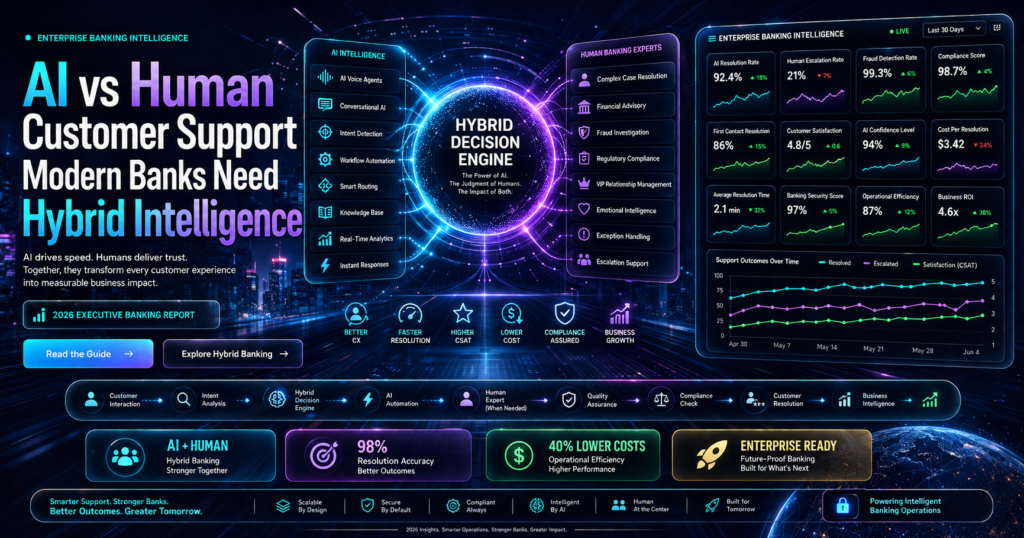
Banks investing heavily in AI chatbots, voice bots, and automation platforms are discovering a hard truth: technology alone does not transform customer experience or reduce cost-to-serve. The real differentiator is operational intelligence — how well a bank’s people, processes, and AI systems work together across every customer touchpoint. The “AI vs human customer support” debate is a false choice; the highest-performing banks and financial institutions in 2026 deploy hybrid models where AI handles volume, repetition, and data retrieval, while trained human agents handle judgment, empathy, and compliance-sensitive decisions. This is why leading BPO companies in India — including specialized providers like MasCallNet — are being retained not just for cost arbitrage, but for their ability to design, staff, and continuously optimize intelligent banking operations that AI-only deployments cannot replicate on their own.
Executive Introduction
Every bank CEO has heard the same pitch by now: deploy generative AI, deflect 60–70% of tickets, cut contact center headcount, and watch margins expand. Vendors show polished dashboards. Consultants publish glowing case studies. Boards approve budgets.
And yet, walk into the operations review of almost any bank eighteen months into an AI rollout, and you’ll hear a different story — rising escalations, frustrated customers repeating themselves to a bot before reaching a human, compliance teams uneasy about AI-generated responses to regulated queries, and a customer satisfaction score that hasn’t moved, or has quietly declined.
This isn’t a technology failure. It’s a design failure.
We’ve spent years inside contact center operations — banking, insurance, healthcare, retail — and the pattern is consistent: AI improves the parts of customer support that were already well-managed, and it exposes the parts that weren’t. A bank with poor call routing, undocumented processes, and inconsistent agent training doesn’t fix those problems by adding a chatbot. It automates the dysfunction and hides it behind a friendlier interface — until the dysfunction resurfaces as a churn event, a regulatory complaint, or a viral social media post.
This is the core argument of this resource: AI alone will not transform banks in 2026. What transforms banks is Contact Center Intelligence™ — the discipline of engineering how AI, human expertise, data, and process design work together as one operating system. Every customer interaction — whether resolved by a bot, an agent, or both — is a data point that should make the next interaction faster, smarter, and more profitable. Institutions that treat customer support as a cost center to automate will lose ground to institutions that treat it as an intelligence asset to compound.
This distinction — AI as a tool inside an intelligent operation versus AI as a standalone strategy — is what separates banks that reduce cost-to-serve by 30–40% while improving Net Promoter Score, from banks that reduce headcount by 20% and watch attrition-driven revenue loss erase the savings within two quarters.
The purpose of this resource is to give banking executives, COOs, CX leaders, and procurement teams a complete, evidence-based framework for making this decision correctly — including how to evaluate whether to build internally, partner with a specialized BPO, or run a hybrid model, and how to identify which outsourcing partners in India are actually equipped to deliver intelligent banking operations rather than headcount arbitrage dressed up as “AI-powered support.”
Key Insights for Decision-Makers
- AI without operational redesign increases cost. Deploying AI on top of broken processes typically increases handling time for escalated cases by 15–25%, because agents now troubleshoot both the customer’s problem and the AI’s mistake.
- The AI vs human customer support debate is obsolete. The institutions winning in 2026 aren’t choosing between AI and humans — they’re engineering the handoff between them.
- Banking customers tolerate AI for simple tasks, not for money. Balance inquiries, statement requests, and card blocking are AI-appropriate. Disputes, fraud, hardship, and loan restructuring are not — yet many banks route these identically.
- Compliance is the silent constraint most AI vendors ignore. Every AI-generated response involving financial advice, credit decisions, or dispute language carries regulatory exposure that pure-technology vendors are not equipped to manage.
- The best BPO companies in India now compete on intelligence design, not seat cost. Labor arbitrage is no longer the differentiator — process engineering, compliance fluency, and AI-human orchestration are.
- Every customer conversation is reusable intelligence. Institutions that capture, structure, and feed conversation data back into product, credit, and risk teams outperform those that treat each call as a closed transaction.
The Market Reality: Why Banking AI Projects Underdeliver
Direct Answer: Most banking AI deployments underdeliver because they automate existing workflows instead of redesigning them, and because they are implemented without the human operational layer needed to handle exceptions, compliance, and emotionally sensitive interactions.
Why It Matters
Boards approve AI budgets expecting transformation. When the results are incremental at best — or negative at worst, due to customer frustration with poorly escalated bot conversations — the entire digital transformation agenda loses credibility internally. CX and operations leaders end up defending technology spend instead of demonstrating business impact.
The Pattern We See Repeatedly
| Stage | What Banks Expect | What Actually Happens |
|---|---|---|
| Month 1–3 | Deflection rate climbs, cost savings visible | Deflection rate climbs, but complaint volume rises in parallel |
| Month 4–6 | CSAT stable or improving | CSAT dips as customers hit “bot loops” for complex issues |
| Month 7–9 | Headcount reduced, margin improves | Attrition-linked revenue loss appears in retention data |
| Month 10–12 | Full AI-first model declared success | Quiet re-hiring of human agents begins; escalation queues balloon |
Executive Interpretation
The failure point is almost never the AI model itself. It’s the absence of a deliberate intelligent operating layer that decides, in real time, which conversations belong to AI, which belong to humans, and which belong to both. Banks that skip this design step are effectively asking a chatbot to make an operational strategy decision it was never built to make.
Boardroom Insight
If your AI deflection rate is rising but your Net Promoter Score isn’t, you are not automating support — you are automating customer frustration and calling it efficiency. Deflection is a vanity metric unless it is measured against resolution quality and retention impact.
Summary
AI adoption in banking has outpaced operational design. The gap between the two is where cost overruns, compliance risk, and customer attrition live.
Key Takeaway
AI adoption without intelligent operational design doesn’t transform banking support — it relocates the problem downstream and makes it more expensive to fix.
Industry Trends Shaping Banking Operations in 2026
Direct Answer: Five trends are converging in 2026: agentic AI moving from chat to task execution, regulators tightening scrutiny of AI-generated financial communication, customers demanding channel continuity, banks shifting from cost-center to intelligence-center thinking about support, and BPO providers repositioning around AI-human orchestration rather than seat-based pricing.
- From chatbots to agentic AI. Banks are moving past scripted bots toward AI agents that can execute multi-step tasks — checking eligibility, initiating a dispute, scheduling a callback. This raises the stakes for governance, because an agent that acts, rather than just responds, carries more risk if it acts incorrectly.
- Regulatory scrutiny of AI in customer communication. Financial regulators across markets are increasingly focused on AI explainability and fair-treatment obligations in customer interactions, particularly around credit, collections, and complaint handling. This is pushing banks to keep humans in the loop for anything with regulatory exposure.
- Channel continuity as the new CSAT driver. Customers now expect a conversation that starts on WhatsApp, continues on a phone call, and resolves via email — without repeating themselves. This requires unified conversation intelligence, not siloed channel tools.
- Support reframed as a revenue and retention function, not just a cost line — the essence of Support-Led Revenue Growth™. Banks are realizing that a well-handled dispute call retains a customer worth multiples of the call’s cost, while a poorly handled AI interaction can trigger closure of a primary banking relationship.
- BPO providers repositioning as intelligence partners. The best BPO companies in India are shifting their commercial pitch from “we reduce your cost per contact” to “we improve your resolution quality, compliance posture, and customer lifetime value” — a fundamentally different, higher-value conversation with banking clients.
Boardroom Insight
Every one of these trends points to the same conclusion: the institutions that win are not the ones with the most advanced AI model. They are the ones with the most disciplined operating model that decides where AI belongs and where it doesn’t — this is the essence of Contact Center Intelligence™.
Key Takeaway
The competitive battleground in banking support has shifted from “who has AI” to “who has engineered the smartest AI-human operating model.”
Defining Intelligent Banking Operations
Direct Answer: Intelligent Banking Operations is the discipline of designing customer support, collections, onboarding, and service delivery as a single connected system — where AI handles structured, high-volume, low-risk interactions; trained human specialists handle judgment-intensive and compliance-sensitive interactions; and every interaction feeds a shared intelligence layer that continuously improves both.
This is distinct from three things it’s commonly confused with:
- It is not “AI-powered support.” AI-powered support describes a technology stack. Intelligent Banking Operations describes an operating philosophy that determines how that stack is used, governed, and improved.
- It is not traditional BPO. Traditional outsourcing sells labor capacity. Intelligent operations sell decision quality — knowing which 30% of interactions require a human, and making sure that human is the right one, with the right context, in under 90 seconds.
- It is not a chatbot deployment. A chatbot is a component. An intelligent operation is the system that governs when the chatbot should hand off, to whom, with what context, and how that handoff is measured.
Why It Matters
Banks that define their AI strategy around a specific technology (a chatbot, a voice bot, an agent-assist tool) tend to optimize for that technology’s success metrics — deflection, containment, automation rate. Banks that define their strategy around intelligent operations optimize for business outcomes — retention, resolution quality, compliance integrity, and cost-to-serve. The second group consistently outperforms the first.
Framework: The Three Layers of Intelligent Banking Operations
| Layer | Function | Owned By |
|---|---|---|
| Execution Layer | AI handles structured, repeatable, low-risk interactions (balance checks, card blocks, appointment scheduling, FAQs) | AI agents, voice bots, self-service |
| Judgment Layer | Humans handle disputes, fraud, hardship cases, complex product questions, emotionally charged conversations | Trained specialists, escalation teams |
| Intelligence Layer | Every interaction — AI or human — is captured, structured, and analyzed to improve routing, scripts, product design, and risk models | Contact Center Intelligence Layer™ |
Executive Interpretation
Most banks build the Execution Layer first because it’s the easiest to buy off the shelf. Few banks build the Intelligence Layer, because it requires operational discipline, not just software procurement. This is precisely where the transformation gap lives.
Key Takeaway
Intelligent Banking Operations is not a technology purchase — it’s an operating model decision that determines whether your AI investment compounds in value or decays into customer frustration.
Why This Matters to the Business
Direct Answer: The way a bank designs its AI-human support model directly affects customer retention, regulatory exposure, cross-sell conversion, and cost-to-serve — making it a board-level decision, not an IT or vendor procurement decision.
Every banking executive we’ve worked with underestimates one number: the revenue attached to a single support interaction. A customer calling about a declined transaction isn’t just seeking resolution — they’re deciding, in that moment, whether to trust the bank with their salary account, their mortgage, their next credit product. This is the operational reality behind Revenue Recovery Through CX™: the way a complaint is resolved determines whether the relationship is retained or quietly closed within the next renewal cycle.
The Business Case in One Table
| Business Function | Impact of Poor AI-Human Design | Impact of Intelligent Operations |
|---|---|---|
| Retention | Silent attrition after unresolved AI loops | Higher retention through fast, empathetic resolution |
| Compliance | AI-generated responses create audit and regulatory risk | Human oversight on regulated interactions reduces exposure |
| Cross-sell | Missed signals in routine interactions | Conversation intelligence surfaces upsell and retention opportunities |
| Cost-to-serve | Escalations increase average handling time | Right-first-time routing reduces total contact volume |
| Brand trust | Viral complaints about bot frustration | Consistent, human-backed resolution builds public trust |
Boardroom Insight
If your customer support strategy sits three levels below the CEO, your bank is treating a revenue and retention function like a back-office utility. The banks pulling ahead in 2026 have moved contact center strategy into the same conversation as digital banking, credit strategy, and product roadmap.
Key Takeaway
Support design is a revenue decision wearing an operations costume — treat it accordingly.
How Intelligent Banking Operations Work
Direct Answer: Intelligent Banking Operations works through a continuous cycle: interactions are triaged by intent and risk, routed to the right resource (AI or human), resolved with full context, and then fed back into a shared intelligence system that improves routing accuracy, agent scripts, and AI training data over time.
The Operating Cycle
- Intent and Risk Classification — Every incoming interaction (call, chat, email, WhatsApp) is classified not just by topic, but by risk level: transactional, informational, emotional, regulatory, or fraud-adjacent.
- Dynamic Routing — Low-risk, high-volume intents go to AI. Judgment-intensive or regulated intents go directly to a trained human specialist, skipping the bot entirely to avoid frustration and compliance exposure.
- Context Assembly — Whichever channel resolves the query — AI or human — has access to the full customer history, prior interactions, and account context. This is where most banks fail: agents inherit a bot conversation with zero context, forcing the customer to repeat themselves.
- Resolution and Quality Scoring — Every interaction is scored not just on speed, but on resolution accuracy, compliance adherence, and customer sentiment shift (did the customer’s tone improve or worsen during the interaction?).
- Intelligence Feedback Loop — Resolved interactions feed back into three systems: the AI’s training data (to improve future automation), the agent knowledge base (to improve human consistency), and the product/risk teams (to surface recurring friction points). This closed loop is what we call the Customer Intelligence Loop™ — every interaction becomes reusable business intelligence rather than a closed, forgotten transaction.
Table: What Runs on AI vs What Requires Human Judgment in Banking
| Interaction Type | Recommended Owner | Why |
|---|---|---|
| Balance inquiry, mini statement | AI | Structured, low-risk, high-volume |
| Card block/unblock | AI with human fallback | Time-sensitive but rule-based |
| Loan EMI reminder | AI | Structured, informational |
| Disputed transaction | Human | Judgment, documentation, regulatory sensitivity |
| Fraud report | Human, immediate escalation | High emotional stakes, legal exposure |
| Hardship/restructuring request | Human | Requires empathy and policy discretion |
| Cross-sell during service call | Hybrid — AI signals, human executes | AI detects opportunity, human builds trust |
| Complaint escalation | Human, senior specialist | Reputational and regulatory risk |
Executive Interpretation
The quality of a bank’s support operation is determined less by which AI model it licenses and more by how well it has mapped every possible interaction type to the right owner — and how disciplined it is about not letting AI “own” interactions it shouldn’t.
Key Takeaway
Intelligent operations succeed or fail at the routing decision — everything downstream, including AI performance, is a consequence of getting that decision right.
Business Impact Analysis
Direct Answer: Banks that implement intelligent, hybrid AI-human operations typically see measurable improvement across four dimensions simultaneously — cost-to-serve, resolution quality, compliance exposure, and customer retention — whereas AI-only deployments typically improve only cost-to-serve, and often only temporarily.
Framework: The Four-Dimension Impact Model
| Dimension | AI-Only Model | Intelligent Hybrid Model |
|---|---|---|
| Cost-to-serve | Drops initially, rises again as escalations increase | Drops and stays lower due to right-first-time routing |
| Resolution quality | Inconsistent on complex queries | Consistently high due to human ownership of complexity |
| Compliance exposure | Elevated — unmonitored AI responses on regulated topics | Reduced — humans own regulated interactions |
| Customer retention | Declines on high-value accounts due to frustration | Improves due to trust-building on critical moments |
What We Have Observed
Across contact center engagements, the institutions that achieve durable cost reduction are the ones that resist the temptation to declare an AI deflection target before they’ve mapped their interaction types. The ones that chase a deflection number first — “get us to 60% AI containment by Q3” — consistently end up quietly reversing course by Q4, because the number was never grounded in what customers were actually asking for.
Common Executive Mistakes
- Setting AI deflection targets before completing an intent audit of actual call/chat volume.
- Measuring AI success by containment rate instead of resolution accuracy and repeat contact rate.
- Assuming compliance sign-off on AI is a one-time approval rather than an ongoing monitoring requirement.
- Underinvesting in the human specialist tier while overinvesting in AI licensing.
What High-Performing Organizations Do Differently
They start with a rigorous interaction audit, build the routing logic before selecting AI tools, invest disproportionately in the judgment-layer human team (better training, better pay, lower attrition), and treat the intelligence feedback loop as a permanent operational function, not a one-time analytics project.
Boardroom Insight
The banks that report the best AI ROI numbers publicly are rarely the ones with the most advanced AI. They’re the ones who were disciplined enough to keep AI out of the interactions where it doesn’t belong.
Key Takeaway
Business impact comes from disciplined routing, not from AI sophistication — a mid-tier AI model inside a well-designed operation outperforms a state-of-the-art model inside a poorly designed one.
What Everyone Gets Wrong About AI in Banking
The Common Narrative
“AI will replace human agents and cut contact center costs by half.” This is the pitch heard at almost every banking technology conference, and it’s technically possible — for the 30–40% of interactions that are simple, structured, and low-risk.
The Overlooked Reality
The other 60–70% of banking interactions — disputes, fraud, hardship, complex product questions, complaint escalations — are precisely the interactions that drive customer lifetime value and regulatory exposure. These are the interactions AI is least equipped to own safely, and they are exactly where most of a bank’s support cost and risk actually live.
What Actually Happens Inside Banks
Banks deploy AI for the easy 30–40%, declare victory on cost savings, and then discover that the harder 60–70% hasn’t gotten any easier — it’s gotten worse, because the agents now handling it are junior, under-resourced, and inheriting AI conversations with no context. The complexity didn’t disappear. It moved downstream and got more expensive.
The Hidden Cost
The hidden cost isn’t in the AI budget line — it’s in silent attrition. A customer who has a poor AI experience during a fraud dispute doesn’t file a formal complaint; they simply move their primary account relationship elsewhere at the next opportunity, often without the bank ever knowing why. This is one of the most underreported forms of revenue leakage in banking today.
The MasCallNet Perspective
We do not sell AI as a replacement strategy, because our operational experience across banking, healthcare, and retail support tells a consistent story: the value of AI is proportional to the quality of the human-designed system around it. Our engagements start with mapping where AI creates value and, just as importantly, where it destroys it.
Executive Action
Before your next AI vendor conversation, commission an internal audit of your last 90 days of support interactions, tagged by intent and outcome. You cannot make a sound AI-vs-human decision without first knowing what your customers are actually contacting you about — and what happens to their loyalty after each interaction type.
The MasCallNet Revenue Leakage Model™
Definition: A diagnostic model that quantifies the revenue lost through poor support experiences — including silent attrition, missed cross-sell signals, repeat contact costs, and compliance remediation costs — that do not appear on a standard contact center cost report.
Methodology: The model scores four leakage categories on a 0–25 point scale each (100 points total):
| Leakage Category | What It Measures | Typical Banking Signal |
|---|---|---|
| Silent Attrition Leakage | Customers who reduce or close relationships after poor service, without complaining | Declining product holding per customer post-interaction |
| Repeat Contact Leakage | Cost of customers contacting multiple times for the same unresolved issue | First Contact Resolution below 65% |
| Missed Opportunity Leakage | Cross-sell/upsell signals surfaced during service calls but not acted on | Zero product offers logged during high-eligibility calls |
| Compliance Remediation Leakage | Cost of correcting or defending AI/human errors in regulated interactions | Rising regulatory complaint escalations |
Scoring Logic: Each category is scored based on data availability — full data access yields precise scoring; limited data yields a proxy score based on industry benchmark ranges. A composite score above 70 indicates severe, board-level leakage; 40–70 indicates moderate leakage requiring a structured remediation plan; below 40 indicates a well-managed operation with targeted optimization opportunities.
Interpretation: Most banks we’ve assessed score in the 55–75 range — meaning more revenue is typically being lost through poor interaction design than is being saved through AI-driven cost reduction. This is the single most persuasive data point boards need to see before approving further AI-only investment.
Executive Recommendation: Commission a Revenue Leakage assessment before your next contact center technology renewal cycle. Renewing an AI platform contract without this data means renewing a system whose true cost impact is unknown.
Key Takeaway
Most banks are measuring contact center savings on one side of the ledger while ignoring a larger, unmeasured leakage on the other.
The MasCallNet Outsourcing Readiness Score™
Definition: A scoring framework that determines whether a bank or financial institution is operationally ready to outsource support functions to a BPO partner — and whether it should outsource fully, partially, or not yet.
Methodology: Institutions are scored across five dimensions, each weighted out of 20 points:
| Dimension | What’s Assessed |
|---|---|
| Process Documentation | Are workflows, escalation paths, and compliance rules documented well enough to transfer? |
| Data & Systems Access | Can a partner securely access CRM, core banking, and knowledge systems in real time? |
| Compliance Clarity | Are regulatory requirements for outsourced interactions clearly defined? |
| Volume Predictability | Is ticket/call volume stable enough to forecast staffing and pricing accurately? |
| Change Management Capacity | Does internal leadership have bandwidth to manage a transition without disruption? |
Scoring Logic: 80–100 = fully ready for comprehensive outsourcing; 60–79 = ready for phased or hybrid outsourcing starting with lower-risk functions; below 60 = internal process work needed before outsourcing, regardless of vendor quality.
Interpretation: A common executive mistake is selecting a BPO vendor before completing this internal assessment — resulting in blaming the vendor for failures that were actually rooted in undocumented internal processes.
Executive Recommendation: Run this assessment internally, or request it as part of your vendor’s discovery process. Any BPO company in India that proposes a pricing model without first assessing your readiness score is pricing blind — a critical due-diligence gap procurement teams should flag immediately.
Vendor Evaluation: Choosing the Best BPO Companies in India for Banking Support
Direct Answer: The best BPO companies in India for banking and financial services are evaluated not on seat cost, but on compliance fluency, AI-human orchestration capability, data security certifications, domain-specific agent training, and demonstrated ability to reduce escalations — not just contact volume.
India remains the world’s largest hub for outsourced customer support and banking BPO operations, but the market has bifurcated sharply. On one end are high-volume, low-differentiation providers competing purely on per-seat pricing. On the other are specialized, technology-integrated providers — including firms like MasCallNet — that position themselves around intelligent operations, compliance depth, and measurable business outcomes rather than headcount.
The MasCallNet Vendor Evaluation Matrix™
| Evaluation Criterion | Weight | What Good Looks Like |
|---|---|---|
| Domain Expertise (Banking/BFSI) | 20% | Agents trained on regulatory language, dispute handling, KYC/AML basics |
| AI-Human Orchestration Capability | 20% | Proven routing logic, not just AI licensing |
| Data Security & Compliance Certifications | 20% | ISO 27001, SOC 2, PCI-DSS awareness, data residency compliance |
| Technology Integration | 15% | Native integration with Salesforce, Zendesk, Freshdesk, HubSpot, ServiceNow, or core banking CRMs |
| Transparent Pricing & SLAs | 15% | Clear per-interaction or outcome-based pricing, published SLA benchmarks |
| Scalability & Flexibility | 10% | Ability to scale from hundreds to thousands of interactions without re-negotiation delays |
Vendor Scorecard: How to Score Any BPO Proposal
| Score Range | Interpretation |
|---|---|
| 85–100 | Enterprise-ready intelligent operations partner |
| 65–84 | Competent execution partner; verify compliance depth before committing to regulated workflows |
| Below 65 | Labor arbitrage provider; suitable only for low-risk, non-regulated volume |
What Most Procurement Teams Miss
Procurement teams frequently run BPO vendor selection as a pure cost RFP — lowest per-hour or per-seat rate wins. This approach systematically favors labor arbitrage providers over intelligence-driven providers, and it is one of the most common root causes of failed outsourcing programs in banking. The RFP should weight compliance fluency and AI-human orchestration capability at least as heavily as price.
The MasCallNet Perspective
We built our banking and BFSI support practice around the belief that a bank’s outsourcing partner should be evaluated the way it evaluates a technology vendor — on architecture, governance, and outcomes — not the way it evaluates a temporary staffing agency. Our engagements typically begin with a readiness assessment and interaction audit before a single agent is hired, because pricing a program before understanding its risk profile leads to renegotiation, scope disputes, and quality erosion within the first two quarters.
If you are comparing customer support outsourcing providers for banking or BFSI workflows, request their compliance certification documentation and their AI-human routing logic before requesting their rate card. The rate card should be the last conversation, not the first.
Executive Action
Score your top three shortlisted BPO providers against the Vendor Evaluation Matrix above before your next contract cycle. If none scores above 65, expand your search — do not compromise on compliance depth to save on per-seat cost in a regulated industry.
AI vs Human vs Hybrid: The Real Operating Model for Banking Support
Direct Answer: In banking, AI should own structured and low-risk interactions, humans should own judgment-intensive and regulated interactions, and hybrid models — where AI assists a human in real time — should own the majority of medium-complexity interactions. Neither pure AI nor pure human staffing outperforms a well-designed hybrid model on cost, quality, or compliance combined.
Comparison Table: AI vs Human vs Hybrid
| Factor | AI-Only | Human-Only | Hybrid (Intelligent Operations) |
|---|---|---|---|
| Cost per interaction | Lowest | Highest | Moderate, trending lower over time |
| Consistency | High for scripted queries | Variable across agents | High, with human override for exceptions |
| Compliance safety | Risky for regulated content | Safe if well-trained | Safest — AI drafts, human reviews for regulated content |
| Customer trust on sensitive issues | Low | High | High |
| Scalability | Instant | Slow, hiring-dependent | Fast, with AI absorbing volume spikes |
| Emotional intelligence | Absent | Present, variable | Present, augmented by AI-surfaced context |
| 24/7 availability | Native | Requires shift staffing | Native, with human escalation on-call |
Interpretation and Recommendation
Pure AI is appropriate only for narrow, low-regulation use cases — internal IT helpdesks, simple e-commerce order tracking, basic FAQ deflection. Pure human staffing is appropriate for boutique private banking relationships where every interaction is high-touch by design. For mainstream retail banking, NBFCs, digital lenders, and insurance servicing, the hybrid model consistently outperforms both extremes — which is why the AI vs human customer support debate is, in practice, a distraction from the real question: how do you architect the handoff between them?
Boardroom Insight
Ask any vendor pitching a pure AI-first banking support model one question: “What happens when a customer in genuine financial distress reaches your bot at 2 AM?” Their answer will tell you everything about whether they understand banking, or just understand chatbots.
Key Takeaway
The winning model isn’t AI vs human — it’s AI plus human, engineered around risk and emotional stakes, not just query volume.
The MasCallNet CX Maturity Scorecard™
Definition: A four-stage maturity model that benchmarks where a bank’s customer support operation sits on the path from reactive service delivery to intelligence-driven, revenue-generating operations.
| Stage | Characteristics | Typical Outcome |
|---|---|---|
| Stage 1: Reactive | Siloed channels, no intent classification, agents work from memory | High cost, inconsistent quality, no visibility into root causes |
| Stage 2: Automated | AI deployed for deflection, limited routing logic, minimal compliance review of AI outputs | Short-term cost drop, rising escalation complexity |
| Stage 3: Orchestrated | Clear AI-human routing rules, context handoff, quality scoring in place | Stable cost-to-serve, improving CSAT |
| Stage 4: Intelligent | Full Customer Intelligence Loop™ — interaction data feeds product, risk, and retention strategy | Compounding improvement in retention, cross-sell, and cost efficiency |
Interpretation: Most banks we assess sit at Stage 2 — they’ve deployed AI but haven’t built orchestration or intelligence layers. Reaching Stage 4 typically requires 12–18 months of disciplined execution, but delivers the only form of AI ROI that compounds rather than plateaus.
Executive Recommendation: Diagnose your current stage honestly before setting next year’s AI budget. Investing further in Stage 2 AI tooling without building Stage 3 orchestration is the single most common cause of stalled ROI we observe.
Scalability Framework for Growing Banks and NBFCs
Direct Answer: Scalable banking support requires a modular operating model — a stable core team for judgment-intensive work, an elastic layer of trained human agents for volume spikes, and AI absorbing structured demand — so that growth in customer base or product lines doesn’t require proportional increases in cost or hiring lead time.
Framework: The Three-Tier Scalability Model
- Core Tier (Fixed): Senior specialists handling disputes, fraud, and compliance-sensitive escalations. This tier should never be scaled down under cost pressure — it protects the institution’s regulatory and reputational exposure.
- Elastic Tier (Variable): Trained agents, often through an outsourcing partner, who can scale from dozens to hundreds within weeks to absorb seasonal spikes (tax season, festive lending campaigns, product launches) — this is where outsource call center services deliver the most measurable value.
- Automated Tier (Instant): AI and self-service absorbing structured, repeatable demand instantly, with no marginal cost per additional interaction.
What High-Performing Organizations Do Differently
They pre-negotiate elastic capacity with their outsourcing partner before a volume spike, rather than scrambling during it. They also treat automated-tier expansion as a continuous process — reviewing quarterly which new intents can safely move from human to AI ownership, based on accumulated intelligence data, not vendor sales pressure.
Key Takeaway
Scalability isn’t about having the most agents or the most advanced AI — it’s about having the right tier absorb the right kind of growth.
Benchmark Analysis and Industry Statistics
Direct Answer: Across banking and BFSI contact center engagements, well-designed hybrid operations typically achieve First Contact Resolution above 75%, Average Handling Time reductions of 20–30% on structured queries, and cost-to-serve reductions of 25–40% — without the retention decline seen in AI-only deployments.
MasCallNet Benchmark Index (Illustrative Ranges Across Banking Support Engagements)
| Metric | Legacy Human-Only Model | AI-Only Model | Intelligent Hybrid Model |
|---|---|---|---|
| First Contact Resolution | 55–65% | 45–60% (declines on complex queries) | 75–85% |
| Average Handling Time (structured queries) | 6–8 minutes | 1–2 minutes | 1–2 minutes (AI) + faster human resolution via context |
| Cost-to-serve reduction (vs. legacy) | Baseline | 30–45% (short-term) | 25–40% (sustained) |
| Customer Satisfaction (CSAT) | Stable, moderate | Volatile — drops on escalations | Stable to improving |
| Compliance incident rate | Low, human-managed | Elevated on regulated topics | Low — human oversight retained |
Independent industry research from analyst firms and consulting houses covering financial services operations has consistently pointed to the same directional conclusion over the past several years: automation delivers durable value only when paired with structured human oversight and continuous process redesign — not as a standalone cost initiative. This resource’s benchmarks are consistent with that broader industry direction, drawn from operational engagements across banking, healthcare, and retail support functions.
Key Takeaway
The data consistently favors hybrid design over either extreme — the debate isn’t which model performs better in theory, it’s which model your organization is currently disciplined enough to execute.
Case Study: From AI-Only to Intelligent Operations
Challenge
A mid-size digital lending and retail banking institution deployed an AI chatbot and voice bot across its customer support and collections functions, aiming for 60% automated containment within two quarters. Within four months, containment reached 55%, but complaint volume through the regulator’s grievance portal rose by 22%, and customer attrition on high-value savings accounts increased noticeably in the same period.
Root Cause
An interaction audit revealed the AI system was handling dispute and hardship-related queries with generic scripted responses, without recognizing emotional escalation cues or routing to a human within an acceptable time window. Customers in financial distress were being cycled through bot menus for an average of 4–6 minutes before reaching a human — if they reached one at all before abandoning the interaction.
Solution
The institution restructured its operating model around three changes: (1) immediate human routing for any interaction tagged with dispute, hardship, or fraud intent, bypassing the bot entirely; (2) a context-handoff system ensuring human agents received full conversation history instantly; and (3) a quality scoring system tracking sentiment shift, not just resolution time, on every interaction.
Implementation
The transition was phased over 90 days: intent classification rules were rebuilt in the first 30 days using historical conversation data; routing logic was redeployed in the next 30 days with a specialized human team trained specifically on dispute and hardship conversations; and the final 30 days focused on building the feedback loop connecting resolved interactions back into both AI training data and product/risk reporting.
Results
- First Contact Resolution on dispute-related contacts improved from 41% to 78%.
- Regulatory grievance volume declined by 34% within the following quarter.
- Attrition on high-value accounts stabilized and began improving within two quarters.
- Overall cost-to-serve remained lower than the pre-AI baseline, because structured, low-risk volume continued to run efficiently through AI — the savings were preserved, not reversed, once the judgment-layer routing was corrected.
Lessons Learned
AI containment targets set without an intent-risk audit create the illusion of efficiency while actively damaging the institution’s highest-value relationships. The fix was not to abandon AI — it was to redraw the boundary of what AI should own, and invest the savings into a smaller, better-trained human team focused entirely on judgment-intensive conversations. This is the operational proof point behind Contact Center Intelligence™: the interactions AI shouldn’t touch are exactly the ones that determine whether a customer stays or leaves.
Pricing Analysis: What Outsourced Customer Support Actually Costs
Direct Answer: Outsourced customer support pricing in India for banking and BFSI workflows typically ranges from $8–$14 per agent hour for standard support, $14–$22 per agent hour for compliance-trained, domain-specialized support, and outcome-based or per-resolution pricing models for mature engagements — significantly lower than onshore equivalents, which commonly run $28–$45 per agent hour for comparable domain expertise.
Pricing Models Compared
| Pricing Model | How It Works | Best For |
|---|---|---|
| Per-Hour / Per-Seat | Fixed rate per agent hour, regardless of volume | Predictable, stable volume operations |
| Per-Interaction | Fixed rate per resolved ticket/call | Variable volume, transactional support |
| Outcome-Based | Pricing tied to resolution quality, CSAT, or retention metrics | Mature partnerships focused on business outcomes, not just volume |
| Hybrid Retainer + Variable | Fixed retainer for core tier, variable pricing for elastic tier | Institutions with a stable core and seasonal spikes |
What Most Pricing Comparisons Miss
Cost comparisons that only compare per-hour rates ignore the cost of poor quality — repeat contacts, escalations, and compliance remediation all add hidden cost per resolved case that a low headline rate can mask entirely. A $9/hour agent with a 45% First Contact Resolution rate is often more expensive per successfully resolved issue than a $16/hour specialist with an 80% resolution rate.
Simple Cost Calculator Framework
True Cost Per Resolved Interaction = (Agent Hourly Rate ÷ Interactions Resolved Per Hour) + (Repeat Contact Rate × Average Repeat Handling Cost) + (Compliance Remediation Risk Cost, where applicable)
Example:
- Provider A: $9/hour, 6 resolved interactions/hour, 35% repeat contact rate, $3.50 average repeat cost → True cost ≈ $1.50 + $1.23 = $2.73 per resolved interaction
- Provider B: $16/hour, 9 resolved interactions/hour, 12% repeat contact rate, $3.50 average repeat cost → True cost ≈ $1.78 + $0.42 = $2.20 per resolved interaction
Provider B, despite a 78% higher hourly rate, delivers a lower true cost per resolved interaction — a calculation most procurement RFPs never run.
Executive Action
Request First Contact Resolution and repeat-contact data — not just hourly rates — from every shortlisted customer support outsourcing company in India before comparing pricing. Ask them to walk through this calculation with their own historical data.
The MasCallNet Revenue Acceleration Framework™
Definition: A four-stage ROI model that quantifies the financial return of moving from a fragmented or AI-only support model to an intelligent, hybrid operating model.
Methodology:
| Stage | ROI Driver | Measurement |
|---|---|---|
| 1. Cost Efficiency | Reduced cost-to-serve through correct AI/human allocation | Cost per resolved interaction, pre vs. post |
| 2. Retention Recovery | Reduced silent attrition on high-value accounts | Product-holding retention rate, 6-month trend |
| 3. Revenue Capture | Cross-sell/upsell conversion surfaced during service interactions | Offer-to-conversion rate on service calls |
| 4. Compounding Intelligence | Continuous improvement in routing accuracy and AI training from accumulated interaction data | Quarter-over-quarter improvement in First Contact Resolution |
Scoring Logic: ROI is calculated cumulatively across all four stages, not just Stage 1. Institutions that measure ROI only through Stage 1 (cost efficiency) typically report initial gains that plateau or reverse within 9–12 months. Institutions that track all four stages report ROI that compounds year over year, because Stage 4 continuously feeds improvements back into Stages 1–3.
Interpretation: If your current ROI reporting on AI/support investment stops at “cost per contact reduced by X%,” you are only measuring one-quarter of the actual return — and likely missing the leakage documented in the Revenue Leakage Model above.
Executive Recommendation: Rebuild your quarterly business review template for support and contact center operations around all four stages of this framework, not cost-per-contact alone. This is what genuine Predictable Revenue Operations™ looks like in a banking support function — a system where customer interactions actively improve, rather than merely report, forecasting accuracy and retention performance.
Industry Use Cases Beyond Banking
The intelligent operations model described throughout this resource extends across every regulated or trust-sensitive industry:
- Insurance: Claims status inquiries suit AI; claims disputes and denial explanations require human specialists trained in policy language and empathy.
- Healthcare: Appointment confirmations and prescription refill reminders suit automation; diagnosis-adjacent or billing dispute conversations require trained human staff. Our healthcare BPO services and patient appointment scheduling services apply this exact routing logic for U.S. hospital systems.
- Retail and eCommerce: Order tracking and return initiation suit AI; damaged-goods disputes and loyalty escalations benefit from human ownership — a model equally relevant to Shopify and WooCommerce-based merchants managing high support volume.
- Telecommunications: Plan changes and billing inquiries suit automation; service outage complaints and contract disputes require human de-escalation.
- Automotive and EV: Service scheduling suits AI; warranty disputes and charging infrastructure complaints (unique to EV owners) require specialized human support.
- Logistics: Shipment tracking suits AI; delivery failure disputes and claims require human judgment.
- Aviation: Booking changes suit self-service; flight disruption compensation claims require trained human specialists managing regulatory entitlement rules.
Key Takeaway
The AI-vs-human routing logic described for banking is a universal operating principle — the risk and emotional-stakes framework transfers across every regulated, trust-dependent industry.
Technology Ecosystem
Direct Answer: Intelligent banking operations run on an integrated stack combining CRM and ticketing platforms, cloud infrastructure, conversational AI, and workforce management tools — none of which delivers transformation independently.
| Layer | Representative Platforms | Role |
|---|---|---|
| CRM & Ticketing | Salesforce, Zendesk, Freshdesk, HubSpot, ServiceNow | Case management, customer history, workflow automation |
| Contact Center Infrastructure | Genesys, Five9, Talkdesk, NICE CXone | Omnichannel routing, IVR, voice infrastructure |
| Conversational AI | OpenAI, Google Gemini, Claude, Microsoft Copilot | Natural language understanding, agent-assist, response drafting |
| Cloud Infrastructure | Amazon Web Services, Google Cloud, Microsoft Azure | Scalability, data hosting, security compliance |
| Internal Collaboration | Slack, Microsoft Teams | Real-time escalation and specialist consultation |
| Commerce Integration | Shopify, WooCommerce, Stripe, PayPal | Relevant for banking-adjacent fintech and payments support |
| Live Chat/Messaging | Intercom | Digital-first customer engagement |
Executive Interpretation
No single platform in this stack constitutes a strategy. The differentiator is integration discipline — ensuring a customer’s context flows seamlessly from the CRM to the AI system to the human agent’s screen, without gaps that force repetition. This integration work is precisely what separates a functioning intelligence layer from a collection of disconnected tools, and it is a core part of what we help institutions execute through automating business processes across their support function.
Key Takeaway
Technology selection matters far less than technology integration — the best platforms in a disconnected stack still produce a fragmented customer experience.
Security, Compliance, and Risk
Direct Answer: Banking support operations, whether in-house or outsourced, must meet data residency requirements, maintain audit trails for AI-generated and human-generated responses, and enforce strict access controls — with outsourcing partners required to demonstrate certified information security management, not just contractual assurances.
Key Compliance Considerations
- Data residency and localization requirements vary by jurisdiction and must be verified explicitly with any outsourcing partner, not assumed.
- Audit trails should capture not just what was said, but which system (AI or human) generated each response, for regulatory review purposes.
- Access control and role-based permissions should ensure outsourced agents access only the customer data necessary for their specific task.
- AI explainability — banks should be able to explain, on regulatory request, why an AI system provided a specific response or recommendation.
- Certifications to verify in any outsourcing partner: ISO 27001 (information security), SOC 2 (operational controls), and PCI-DSS awareness where payment data is involved.
Boardroom Insight
Compliance teams are frequently brought into AI and outsourcing conversations after vendor selection, not before. This sequencing is backwards and is one of the most common causes of costly mid-implementation rework.
Key Takeaway
In banking, security and compliance are not a checklist item at the end of vendor selection — they are the first filter, not the last.
The India Advantage
Direct Answer: India remains the leading destination for outsourced banking and customer support operations due to a combination of skilled English-speaking talent, mature information security infrastructure, cost efficiency relative to onshore markets, and a growing base of providers specializing in AI-integrated, compliance-fluent BFSI support.
Why Banks Continue to Choose India
- Talent depth: A large pool of graduates with finance, technology, and communication skills, supported by established training pipelines in BFSI-specific processes.
- Time zone coverage: India’s position enables genuine 24/7 support coverage for banks operating across North America, Europe, and Asia-Pacific.
- Cost efficiency without quality compromise: Leading providers now compete on process maturity and compliance depth, not just cost — a shift that benefits banks seeking long-term partners rather than transactional vendors.
- Infrastructure maturity: Established data center infrastructure, strong connectivity to AWS, Google Cloud, and Microsoft Azure regions, and increasing adoption of internationally recognized security certifications among top providers.
- Specialized BPO hubs: Cities including Noida, Gurugram, Bengaluru, and Hyderabad host a concentrated ecosystem of BFSI-experienced BPO talent and infrastructure. Our own call center operations in Noida reflect this regional advantage, combining NCR talent density with enterprise-grade infrastructure.
What Sets Leading Indian BPO Providers Apart Today
The best BPO companies in India for banking clients in 2026 are no longer competing purely on cost. They differentiate through domain-specific agent certification programs, proprietary AI-human orchestration platforms, transparent compliance documentation, and a demonstrated ability to reduce escalations and repeat contacts — not just answer volume. Institutions evaluating an AI-powered BPO company in India should weight these operational differentiators as heavily as pricing.
Key Takeaway
India’s advantage has evolved from labor cost to operational intelligence — the providers winning enterprise banking contracts today are the ones who’ve made that shift.
Comparison Tables for Executive Decision-Making
In-House vs. Outsourced Support
| Factor | In-House | Outsourced |
|---|---|---|
| Setup speed | Slow — hiring, training, infrastructure | Fast — operational within weeks |
| Cost structure | High fixed cost | Variable, scalable cost |
| Domain control | Full control | Requires strong governance and SLAs |
| Scalability | Constrained by hiring cycles | Elastic, on-demand |
| Best for | Highly specialized, low-volume, strategic relationships | Volume-driven, structured, and hybrid support functions |
Recommendation: A hybrid model — core judgment-layer functions retained in-house, elastic volume outsourced — outperforms both pure models for most mid-to-large banking institutions.
Offshore vs. Onshore Customer Support Outsourcing
| Factor | Offshore (e.g., India) | Onshore |
|---|---|---|
| Cost | 40–65% lower for comparable skill level | Higher baseline cost |
| Time zone coverage | Enables 24/7 coverage naturally | Requires shift premiums for 24/7 |
| Domain expertise availability | Growing rapidly among specialized providers | Historically stronger, gap narrowing |
| Cultural/linguistic nuance | Strong for global English-speaking markets | Native advantage for hyper-local nuance |
Recommendation: Offshore outsourcing to India is well-suited for structured, high-volume banking support; retain onshore or hybrid staffing for hyper-localized regulatory or relationship-critical functions.
Build vs. Buy
| Factor | Build (In-House AI/Ops) | Buy (Specialized Partner) |
|---|---|---|
| Time to value | 12–24 months | 60–120 days |
| Upfront investment | High | Low to moderate |
| Ongoing optimization | Requires dedicated internal team | Included in partner’s operating model |
| Risk of misalignment | Lower if internal expertise is strong | Requires careful vendor governance |
Recommendation: Buy for execution capability; build only the strategic oversight and data governance function internally.
Dedicated Team vs. Shared Team
| Factor | Dedicated Team | Shared Team |
|---|---|---|
| Cost | Higher | Lower |
| Institutional knowledge | Deep, compounding | Shallower, spread across clients |
| Best for | Core judgment-layer functions, high-value accounts | Structured, lower-risk volume |
Traditional BPO vs. Intelligent Operations Model
| Factor | Traditional BPO | Intelligent Operations (Contact Center Intelligence™) |
|---|---|---|
| Value proposition | Labor cost reduction | Decision quality and revenue protection |
| Measurement | Volume handled, cost per seat | Resolution quality, retention impact, compliance integrity |
| AI role | Bolt-on tool | Integrated component of routing and intelligence design |
| Data usage | Reporting only | Continuous feedback into product, risk, and CX strategy |
Recommendation: Evaluate any BPO partner against the right-hand column, regardless of how they market themselves — the label matters less than the operating model underneath it.
Risk Analysis
Direct Answer: The primary risks in banking support transformation are compliance exposure from ungoverned AI, customer attrition from poor escalation design, vendor lock-in without performance accountability, and data security gaps in outsourced operations — each manageable through the frameworks outlined in this resource, but each capable of significant financial and reputational damage if ignored.
| Risk | Likelihood if Unmanaged | Mitigation |
|---|---|---|
| AI-generated compliance violation | Moderate-High | Human review layer on all regulated-topic responses |
| Silent customer attrition | High | Revenue Leakage Model™ assessment and routing redesign |
| Vendor underperformance without recourse | Moderate | Outcome-based SLAs, not just volume-based contracts |
| Data breach via outsourced access | Low-Moderate | Certified partners only (ISO 27001, SOC 2), strict access controls |
| Internal change resistance | High | Structured change management, phased rollout, agent involvement in design |
Key Takeaway
Every risk in this table is manageable with disciplined design — the actual danger is treating AI and outsourcing decisions as purely technical or procurement matters instead of enterprise risk decisions.
Future Trends Through 2028
Direct Answer: Expect agentic AI capable of executing multi-step banking tasks under human supervision, deeper integration between conversation intelligence and credit/risk systems, tighter regulatory frameworks governing AI in financial communication, and BPO providers increasingly measured on outcome-based contracts rather than seat count.
- Agent Assist becomes standard, not premium — AI drafting responses for human review in real time will become baseline practice, not a differentiator, across banking support.
- Voice bots mature for structured banking tasks but remain restricted from regulated conversations without human oversight, as regulatory guidance solidifies.
- Predictive analytics shift support from reactive to preventive — flagging at-risk customers or likely disputes before they contact the bank at all.
- Workflow automation extends beyond support into onboarding and collections, unifying the Customer Intelligence Loop™ across the entire customer lifecycle, not just the service function.
- Knowledge management becomes AI-curated but human-validated, ensuring agent and AI responses stay accurate as products and regulations change.
- Outcome-based BPO contracts become the norm for mature banking relationships, replacing pure per-seat or per-hour pricing as the primary commercial model.
Key Takeaway
The institutions best positioned for 2028 are building their intelligence layer now — retrofitting it later, after AI-only deployments have already damaged customer trust, is significantly more expensive than designing it correctly from the start.
Executive Decision Tree
Step 1: Do you know your interaction mix by intent and risk level?
→ No: Commission an interaction audit before any AI or outsourcing decision.
→ Yes: Proceed to Step 2.
Step 2: Does your current support model route disputes, fraud, and hardship cases directly to trained humans?
→ No: Redesign routing logic before scaling AI further.
→ Yes: Proceed to Step 3.
Step 3: Do you have internal capacity to manage a BPO partnership, or does volume/complexity require phased outsourcing?
→ Limited capacity: Start with a phased, hybrid outsourcing model for elastic-tier volume.
→ Sufficient capacity: Evaluate full outsourcing or build for core functions.
Step 4: Are your compliance and security requirements documented and ready to share with a partner?
→ No: Complete this before vendor selection.
→ Yes: Proceed to Vendor Evaluation Matrix scoring.
Step 5: Does your shortlisted partner score above 65 on the Vendor Evaluation Matrix?
→ No: Continue vendor search.
→ Yes: Proceed to pilot phase with outcome-based SLA design.
Executive Checklist
- Complete an interaction audit tagging volume by intent and risk level
- Run the Revenue Leakage Model™ assessment before renewing AI or BPO contracts
- Confirm dispute, fraud, and hardship interactions route directly to trained humans
- Verify compliance and data security certifications of any outsourcing partner
- Score shortlisted BPO vendors against the Vendor Evaluation Matrix™
- Build outcome-based SLAs, not just volume-based contracts
- Establish a feedback loop connecting resolved interactions to product and risk teams
- Diagnose your CX Maturity Scorecard™ stage before setting next year’s AI budget
- Calculate true cost per resolved interaction, not just hourly rate, in pricing comparisons
- Assign executive-level ownership of the support function, not just operational ownership
Frequently Asked Questions
1. Is AI or human customer support better for banking?
Neither is universally better — the right choice depends on the interaction type. AI is better for structured, low-risk queries like balance checks; humans are better for disputes, fraud, and emotionally sensitive conversations. The highest-performing banks use both in a deliberately designed hybrid model.
2. Why hasn’t AI transformed banking customer support the way vendors promised?
Because most banks deployed AI on top of existing, undocumented processes instead of redesigning the operating model first. AI amplifies whatever process it’s layered onto — good or bad.
3. What percentage of banking support interactions can realistically be automated?
Based on operational experience, roughly 30–45% of banking support volume is appropriate for full AI automation. The remainder requires human judgment or hybrid handling, depending on regulatory and emotional complexity.
4. What are the best BPO companies in India for banking support?
The strongest providers combine BFSI domain expertise, verified data security certifications, AI-human orchestration capability, and transparent outcome-based pricing — rather than competing on per-seat cost alone. Evaluate any provider, including MasCallNet, against the Vendor Evaluation Matrix outlined in this resource before making a selection.
5. How much does outsourced customer support cost in India?
Standard support typically ranges $8–$14 per agent hour, while compliance-trained, domain-specialized BFSI support ranges $14–$22 per agent hour — substantially lower than onshore equivalents, though true cost should always be calculated per resolved interaction, not per hour alone.
6. Is offshore outsourcing to India safe for banking data?
Yes, when the partner holds recognized certifications such as ISO 27001 and SOC 2, and when data residency and access control requirements are contractually defined and audited — safety depends on partner selection and governance, not geography alone.
7. What is the difference between AI-powered support and intelligent banking operations?
AI-powered support refers to the technology deployed. Intelligent banking operations refers to the complete system — including routing logic, human specialist design, and the feedback loop — that determines how that technology is used and governed.
8. Should a bank build its own AI support system or outsource to a BPO partner?
Most institutions benefit from outsourcing execution and elastic capacity while retaining strategic oversight and data governance internally — a “buy the execution, build the strategy” approach that shortens time to value significantly.
9. How do you measure ROI on banking customer support AI investment?
ROI should be measured across four stages — cost efficiency, retention recovery, revenue capture through cross-sell, and compounding intelligence gains — not cost-per-contact alone, which typically overstates short-term success and understates long-term risk.
10. What happens if AI gives an incorrect or non-compliant response to a banking customer?
This creates regulatory and reputational exposure. Institutions should maintain audit trails distinguishing AI-generated from human-generated responses and enforce mandatory human review for any regulated-topic interaction.
11. Can small or mid-size banks and NBFCs afford intelligent, hybrid support operations?
Yes — outsourcing the elastic and automated tiers to a specialized BPO partner allows smaller institutions to access enterprise-grade operational design without the upfront cost of building it entirely in-house.
12. What is the biggest mistake banks make when adopting AI in customer support?
Setting an AI deflection or containment target before completing an audit of what customers are actually contacting them about — leading to AI handling interactions it was never suited for.
13. How long does it take to transition from a legacy support model to an intelligent hybrid model?
Typically 90–180 days for a phased transition, depending on process documentation maturity, compliance approval timelines, and volume complexity — organizations starting with a strong Outsourcing Readiness Score move faster.
14. Do customers actually prefer talking to a human over AI?
It depends on the interaction. Customers generally accept or even prefer AI for quick, transactional tasks, but strongly prefer human interaction for disputes, financial hardship, fraud, and anything involving significant money or emotional stakes.
15. What certifications should a banking BPO partner in India hold?
At minimum, ISO 27001 for information security management and SOC 2 for operational controls; PCI-DSS awareness is important if the partner handles any payment card data.
16. How is customer support outsourcing pricing structured — per hour, per ticket, or by outcome?
All three models exist. Mature, high-performing partnerships increasingly move toward outcome-based pricing tied to resolution quality and retention metrics, as it aligns vendor incentives directly with business results.
17. What is the role of platforms like Salesforce, Zendesk, and Freshdesk in banking support?
These platforms provide the case management and workflow infrastructure that intelligent operations run on — but the platform alone doesn’t create intelligence; the routing logic and human process design built on top of it does.
18. Is a chatbot the same as an AI agent in banking support?
No. A chatbot typically responds to scripted intents. An AI agent can execute multi-step actions such as initiating a dispute or checking loan eligibility — which carries more operational and compliance risk and requires stronger governance.
A Practical Next Step
If any part of this resource matched what you’re currently experiencing — rising AI deflection with flat or declining CSAT, escalation queues growing faster than headcount, or a BPO relationship priced on seat cost with no visibility into resolution quality — the most useful next step isn’t another vendor demo. It’s a structured diagnostic of your current interaction mix and support architecture.
Technology Ecosystem Integration Note
Institutions running on Salesforce, Zendesk, Freshdesk, HubSpot, or ServiceNow, and considering deeper integration with Genesys, Five9, Talkdesk, or NICE CXone infrastructure, should evaluate any outsourcing or automation partner’s ability to work natively within that stack — re-platforming your CRM to accommodate a support vendor is a red flag, not a requirement.
For CEOs, COOs, and CX Leaders
Every framework in this resource — the Revenue Leakage Model™, the Outsourcing Readiness Score™, the Vendor Evaluation Matrix™, and the CX Maturity Scorecard™ — exists to give leadership teams a shared, data-grounded language for a decision that is too often made on vendor sales pressure alone. Whether the outcome of that decision is building internally, partnering with an outsourcing provider, or redesigning your existing AI deployment, the discipline of asking these questions first is what separates institutions that compound value from those that chase the next technology cycle.
Considering the Numbers for Your Institution
If you’d like a working estimate of true cost-per-resolved-interaction, retention impact, or Revenue Leakage exposure specific to your current support volume and structure, our team can walk through the calculation using your own data rather than industry averages. This is typically a more useful starting point than a generic vendor proposal.
Speak With Our Team
MasCallNet works with banks, NBFCs, insurers, and regulated financial institutions to design and operate intelligent, compliant, AI-human hybrid support functions — not headcount arbitrage dressed up as transformation. If you’re evaluating customer support outsourcing partners, exploring call center AI-powered BPO solutions, or simply trying to understand why your current AI deployment isn’t delivering the results it promised, we’re glad to have that conversation — starting with a diagnostic, not a sales pitch. Explore our case studies or contact our team to begin.
Conclusion
Banks will keep investing in AI in 2026 — that trajectory isn’t in question. What separates the institutions that turn that investment into durable competitive advantage from those that turn it into a customer trust problem is not the AI model they choose. It’s whether they build the operating discipline to decide, deliberately and continuously, which conversations belong to AI, which belong to humans, and how every one of those conversations feeds a system that gets smarter over time.
This is the argument this resource has made from every angle — the market data, the case study, the frameworks, the benchmarks: AI alone won’t transform banks. Intelligent, orchestrated, human-and-AI operations will. This is what Contact Center Intelligence™ means in practice, and it is the standard against which every AI vendor pitch, every BPO proposal, and every internal transformation roadmap should be measured going forward.
For executive teams ready to move past the AI vs human customer support debate and toward a genuinely intelligent operating model — whether built internally, outsourced to a specialized partner in India, or run as a hybrid — the frameworks in this resource are designed to be the starting point for that conversation, not the end of it.