
25 Questions to Ask Before Hiring a BPO Provider: The 2026 Buyer’s Guide to AI vs Human Customer Support & the Best BPO Companies in India
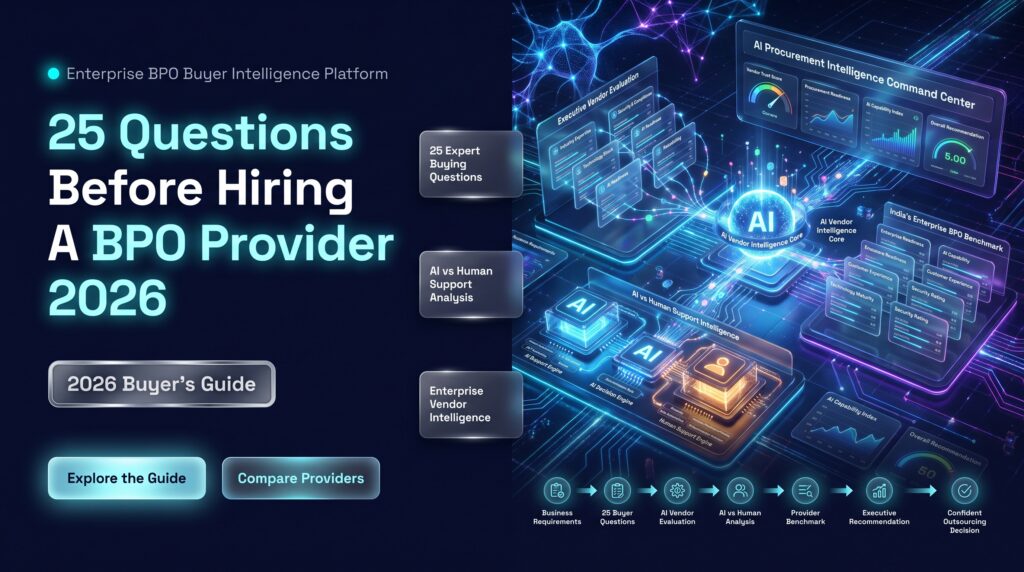
AI Overview
Hiring a BPO provider in 2026 requires evaluating far more than hourly rates. The market has split into two categories: legacy BPOs that sell headcount, and AI-powered contact center partners that sell outcomes — retention, resolution speed, and revenue recovery. This guide provides 25 due-diligence questions across pricing, technology, compliance, scalability, and partnership structure; a comparison of AI vs human customer support models; a vendor evaluation framework; India-specific outsourcing benchmarks; and a cost/ROI model for enterprise buyers evaluating call center outsourcing, customer support outsourcing, or contact center services in 2026.
Executive Introduction
Most companies don’t lose customers because of a bad product. They lose them because of a bad conversation — a delayed response, a bot that couldn’t understand context, an agent who didn’t have the authority to resolve the issue, or a provider that treated every call as a cost to minimize rather than a signal to act on.
This is the uncomfortable truth procurement teams rarely put in an RFP: the BPO decision is a revenue decision disguised as a cost decision.
At MasCallNet, we’ve sat on both sides of this evaluation — as the operator running contact centers for banking, healthcare, retail, and logistics clients, and as the advisor helping leadership teams unwind bad outsourcing decisions made two years earlier. The pattern is consistent. Companies evaluate BPO providers the way they evaluate office supplies — lowest cost per unit — and then wonder why churn, CSAT, and first-contact resolution all decline in year two.
This guide exists to change that. It’s built around one thesis we call Contact Center Intelligence™ — the idea that every customer conversation is not a transaction to close, but a data asset that should inform product decisions, retention strategy, and revenue forecasting. Providers who understand this build partnerships. Providers who don’t sell you headcount and call it a “solution.”
Whether you’re comparing the best BPO companies in India, deciding between AI vs human customer support, or evaluating whether to outsource at all, the 25 questions below — organized by category, not sequence — are the ones that separate a five-year partnership from an eighteen-month regret.
The Market Reality Nobody Puts in the Sales Deck
Direct Answer: The BPO industry is bifurcating into two tiers — commoditized labor arbitrage providers and AI-augmented intelligence partners — and most buyers are still evaluating both tiers using the same outdated scorecard.
For twenty years, outsourcing decisions were essentially a labor arbitrage calculation: find the lowest fully-loaded cost per agent in a compliant geography, multiply by headcount, done. That model isn’t gone, but it’s no longer where the value is.
Three shifts have permanently changed the evaluation criteria:
1. AI has compressed the cost of “simple” support to near-zero — which means human interactions now carry disproportionate weight. When AI resolves 40–60% of tier-1 volume, the remaining human-handled conversations are the ones that determine retention, refunds, and reputation. A provider whose human agents are poorly trained now does more damage per interaction than they did five years ago, because every human touch is now a high-stakes moment by default.
2. Buyers are comparing hourly rates while ignoring resolution economics. A provider at $8/hour with 45% first-contact resolution costs more per resolved issue than a provider at $11/hour with 78% FCR. Almost no RFP asks for cost-per-resolution. Almost every RFP asks for cost-per-hour.
3. “AI-powered” has become a claim, not a capability. Every BPO now markets AI capability. Fewer than a third can show a live, client-facing dashboard proving automation rate, containment rate, and escalation accuracy. The gap between AI marketing and AI delivery is currently the single largest source of buyer regret in this industry.
What Most Buyers Get Wrong: They RFP for capacity (“Can you handle 5,000 tickets/month?”) when they should RFP for intelligence (“What will you tell us about our customers that we don’t already know?”). Capacity is a commodity. Intelligence is not.
Executive Interpretation: If your evaluation process doesn’t force vendors to show real client data — not decks — you are buying a promise, not a capability.
Industry Trends Shaping BPO Decisions in 2026
| Trend | What’s Changing | Business Implication |
|---|---|---|
| AI-first triage | 40–65% of tier-1 tickets resolved without a human | Vendor value shifts from headcount to orchestration quality |
| Outcome-based pricing | Providers moving from per-hour to per-resolution/per-outcome models | Buyers can finally align cost to value delivered |
| Conversation intelligence | Voice/chat data mined for churn signals, product feedback, sales cues | Support becomes a strategic input, not a cost center |
| India’s tier-2 city expansion | Noida, Pune, Indore, Coimbatore emerging as delivery hubs beyond Bangalore/Gurugram | Lower real estate and attrition costs, deeper talent pools |
| Compliance convergence | HIPAA, PCI-DSS, GDPR, RBI/IRDAI data norms enforced simultaneously across verticals | Providers must be multi-framework compliant, not single-certified |
| Hybrid workforce models | Blended AI agents + human specialists replacing pure offshore FTE models | Headcount-based contracts becoming obsolete |
This is where the Contact Center Intelligence™ thesis becomes operationally relevant: providers still selling pure headcount are optimizing for yesterday’s KPI. The providers worth hiring in 2026 are the ones who can show you what your customer conversations reveal about product friction, churn risk, and revenue leakage — not just how many tickets they closed.
What Is a BPO Provider, Really?
Direct Answer: A BPO (Business Process Outsourcing) provider is a third-party organization that manages defined business functions — customer support, collections, back-office processing, technical support — on behalf of a client, using its own staff, technology, and infrastructure.
Why the 2026 definition is incomplete: That definition describes what a BPO does, not what it should deliver. In 2026, the functional definition needs an outcome layer: a BPO provider should be evaluated as an extension of your revenue and customer intelligence function, not merely your headcount overflow.
| Legacy Definition | Contact Center Intelligence™ Definition |
|---|---|
| Executes tasks (calls, tickets, chats) | Executes tasks and surfaces patterns from them |
| Priced per hour/FTE | Priced against outcomes (resolution, retention, CSAT) |
| Reports volume metrics | Reports volume and revenue-impact metrics |
| Treated as a vendor | Operates as a data and CX partner |
Boardroom Insight: If your current or prospective BPO cannot tell you which three issues are driving 60% of your ticket volume, they are managing your customers — not helping you understand them. That is the single clearest signal of a labor-arbitrage relationship versus an intelligence partnership.
Key Takeaway: A BPO provider should be evaluated on what it tells you about your business, not just what it does for your business.
Why This Decision Matters More Than It Did Three Years Ago
Business Impact Analysis:
- Support-related churn now accounts for a measurable share of avoidable revenue loss in subscription and eCommerce businesses — customers rarely churn after one bad interaction; they churn after a pattern of unresolved friction that a properly instrumented contact center would have flagged.
- Every percentage point of first-contact resolution improvement compounds — it reduces repeat contact volume, lowers cost-to-serve, and directly improves CSAT and NPS, both of which correlate with expansion revenue in B2B and repeat purchase rate in B2C.
- Poorly implemented AI (chatbots with no escalation logic, IVRs with no context-passing) is now a bigger brand risk than no automation at all, because customer tolerance for bad AI experiences has dropped sharply since 2023.
This is Support-Led Revenue Growth™ in practice: the connection between how a company handles a complaint and whether that customer renews, refers, or expands isn’t theoretical — it’s measurable in retention cohorts, and it’s the reason CFOs are now present in BPO vendor selection meetings that used to be purely operational.
How Modern Outsourcing Actually Works: The AI + Human Delivery Model
Direct Answer: Modern BPO delivery is a layered model — AI handles routing, deflection, and tier-1 resolution; humans handle judgment, empathy, and escalations; and a supervisory intelligence layer captures data from both to improve the system continuously.
Framework — The Three-Layer Delivery Model:
- Automation Layer: IVR/chatbot triage, self-service, AI agent-assist suggesting responses to human agents in real time (built on LLM platforms such as OpenAI, Google Gemini, or Claude, integrated into CRM/helpdesk tools like Zendesk, Freshdesk, Salesforce, or Intercom).
- Human Layer: Trained specialists handling escalations, high-emotion interactions, high-value accounts, and any interaction requiring judgment, negotiation, or policy exception.
- Intelligence Layer: Conversation analytics, QA scoring, and reporting that convert raw interaction data into churn signals, product feedback, and revenue insight — delivered back to the client, not buried in the vendor’s internal systems.
Most legacy BPOs operate only layers one and two. This is the core differentiator worth pressure-testing in every vendor conversation: does the provider return intelligence layer data to you, or keep it as an internal operational asset?
The MasCallNet Revenue Leakage Model™
Definition: A diagnostic framework that quantifies how much revenue a company is losing due to support-related friction — including preventable churn, repeat-contact cost inflation, and missed upsell/retention signals buried in unanalyzed conversation data.
Methodology: The model scores four leakage vectors on a 0–25 scale each (100 total):
| Leakage Vector | What It Measures | Weight |
|---|---|---|
| Resolution Leakage | Revenue lost to low first-contact resolution and repeat contacts | 25 |
| Retention Leakage | Customers churned after unresolved or poorly handled interactions | 25 |
| Signal Leakage | Product/billing/churn signals present in conversations but never surfaced to the business | 25 |
| Response Leakage | Revenue lost to slow response times (abandoned carts, canceled bookings, escalated complaints) | 25 |
Scoring Logic: 80–100 = Low leakage, well-instrumented operation. 50–79 = Moderate leakage, meaningful recoverable revenue. Below 50 = High leakage — support operations are actively suppressing growth.
Interpretation: Most mid-market companies we’ve assessed score between 45–65 before any intervention — meaning a substantial share of “customer support cost” is actually unrecovered revenue, not overhead.
Executive Recommendation: Before signing any new BPO contract, run your current operation (in-house or outsourced) through this model. It reframes the negotiation from “how do we reduce cost per ticket” to “how much revenue are we currently leaving on the table” — a far more accurate lens for evaluating vendor value.
What Actually Happens: In practice, most RFPs never ask for this data because most incumbent BPOs don’t calculate it — measuring it would expose leakage they’re currently getting paid to ignore.
The 25 Questions to Ask Before Hiring a BPO Provider
These questions are grouped into five categories. Treat vague or scripted answers as a red flag — the right provider will answer with specifics, examples, and, ideally, live dashboard access.
Category 1: Pricing & Commercial Structure
1. What exactly is included in the quoted rate, and what triggers additional billing?
Ask for a line-item breakdown — technology licensing, QA, training hours, management overhead, and off-hours coverage are commonly billed separately and rarely disclosed upfront.
2. How is pricing structured — per FTE, per ticket, per minute, or outcome-based?
Outcome-based and hybrid models (base FTE cost + resolution bonus) increasingly outperform pure per-hour models because they align vendor incentives with your actual goals.
3. What’s the real cost difference between AI-assisted and fully human-staffed support?
A credible provider should be able to show you the blended cost per resolved ticket under both models — not just a lower headline rate for “AI-powered” service.
4. What are the contract exit terms and transition-out support?
Clarify data portability, notice periods, and whether the provider assists a smooth handover to a new vendor or in-house team without holding conversation history hostage.
5. Are there hidden costs for technology, QA, or infrastructure?
Many providers quote a low per-agent rate and then charge separately for the CRM seat, dialer license, or QA platform — effectively inflating true cost by 15–30%.
Category 2: Technology & AI Capability
6. What AI stack powers the operation, and who owns the resulting data?
Ask specifically which LLMs or platforms are used (OpenAI, Google Gemini, Claude, Copilot) and whether conversation data and derived insights belong to you or the vendor.
7. How does the provider integrate with our existing CRM/helpdesk?
Confirm native, tested integrations with your stack — Salesforce, Zendesk, Freshdesk, HubSpot, Intercom, ServiceNow — not just “API compatibility” claims.
8. What percentage of interactions are automated vs human-handled, and how is that decided?
This ratio should be governed by a documented escalation logic, not arbitrary routing — ask to see the decision rules.
9. What safeguards exist against AI hallucination and incorrect responses?
Look for confidence thresholds, human-in-the-loop review, and audit logs — not just “our AI is trained on your data.”
10. Can you show live client dashboards, not sales demos?
This single question filters out roughly half of vendors claiming AI capability. Real dashboards show containment rate, deflection accuracy, and escalation volume in real time.
Category 3: Quality, People & Compliance
11. What is your agent attrition rate, and how is it trending?
Industry attrition in offshore contact centers commonly ranges 25–45% annually; below 20% typically signals stronger management and training investment.
12. What is your QA methodology and audit frequency?
Ask for the actual QA scorecard template and sample size per agent per month — “we do QA” is not an answer.
13. What compliance certifications do you hold?
Confirm ISO 27001, SOC 2, and, where relevant, HIPAA (healthcare), PCI-DSS (payments), and GDPR/RBI-IRDAI data handling alignment (banking/insurance).
14. How is training structured for new hires and ongoing upskilling?
Ask for the actual training curriculum length and refresher cadence — not a generic “comprehensive training program” claim.
15. What is the escalation path when SLAs are missed?
There should be a documented, contractually binding remediation process — not a verbal assurance.
Category 4: Scalability & Operations
16. Can you scale from current volume to 3x within a defined SLA?
Get a specific number of days in writing — “we can scale quickly” is not a commitment.
17. What is the onboarding/ramp-up timeline for a new program?
Typical enterprise ramp-up runs 30–90 days depending on complexity; anything promising “live in one week” for a complex program warrants scrutiny.
18. Do you offer true 24/7, multilingual, omnichannel coverage?
Confirm actual language depth and channel coverage (voice, chat, email, WhatsApp, social) rather than “available upon request.”
19. How do you handle seasonal spikes?
Ask for a specific example — how a retail client’s holiday surge or an insurer’s claims spike was staffed without SLA degradation.
20. What business continuity and disaster recovery plans are in place?
This should include geographic redundancy, not just a single-site backup generator.
Category 5: Strategic Fit & Partnership
21. Can you show reference clients in our industry with measurable outcomes?
Request specific metrics — CSAT lift, AHT reduction, cost-per-resolution — not just logos.
22. How do you report performance — real-time dashboards or static reports?
Monthly PDF reports are a legacy-model signal; real-time dashboards with QBR cadence indicate an intelligence-driven operation.
23. Is this relationship structured as a vendor or a partner?
Ask directly whether pricing includes any shared accountability for outcomes (retention, CSAT, resolution) beyond ticket volume.
24. How do you convert customer conversations into business intelligence for us?
This is the single most revealing question in the entire evaluation — see the Contact Center Intelligence™ discussion above.
25. What happens to our data and institutional knowledge if we switch providers?
Confirm data export rights, knowledge base ownership, and transition timelines in the contract — not as a verbal promise.
AI vs Human Customer Support: The Model That Actually Works in 2026
Direct Answer: Neither pure AI nor pure human support outperforms a well-governed hybrid model. AI should own high-volume, low-complexity, repeatable interactions; humans should own high-stakes, high-emotion, and judgment-dependent interactions; and the two should be connected by a real-time escalation and context-handoff layer.
Why It Matters
This is arguably the most consequential decision in any 2026 outsourcing evaluation — and the one most poorly understood by buyers. Vendors will pitch you on one extreme or the other depending on what they’re best equipped to sell.
Framework: The Escalation Governance Model
| Interaction Type | Best Handled By | Why |
|---|---|---|
| Order status, password reset, FAQs | AI | High volume, zero ambiguity, instant resolution expected |
| Billing disputes under a defined threshold | AI + human review | Rules-based but requires audit trail |
| Complaints involving refund/exception requests | Human | Requires judgment and authority AI shouldn’t have |
| Health, insurance claims, financial hardship cases | Human (AI-assisted) | Emotional complexity and regulatory sensitivity |
| Sales/retention conversations | Human (AI-assisted with real-time prompts) | Persuasion and relationship-building are not automatable at scale |
| Technical troubleshooting (tiered) | AI for tier 1, human for tier 2+ | Escalating complexity requires escalating expertise |
Table: AI vs Human vs Hybrid — Cost, Speed, and Quality
| Model | Cost per Interaction | Avg. Resolution Time | CSAT Range | Best Fit |
|---|---|---|---|---|
| Pure AI | Lowest | Fastest for simple issues | Wide variance — high for simple, poor for complex | High-volume, low-complexity brands (basic eCommerce, utilities FAQs) |
| Pure Human | Highest | Slowest at scale | Consistently good if well-trained | Regulated, high-touch, high-value account industries |
| Hybrid (AI + Human, governed) | Moderate | Fast overall, fast escalation for complex cases | Highest and most consistent | Almost every enterprise use case in 2026 |
Executive Interpretation
The economics favor hybrid decisively — but only when the escalation logic is designed, not accidental. We’ve seen companies deploy AI chatbots with no clear escalation trigger, resulting in customers stuck in a loop until they abandon the brand entirely. That’s not an AI failure; it’s a governance failure.
Boardroom Insight
The real competitive advantage isn’t “we use AI” — every competitor will claim that by 2026. The advantage is how intelligently your AI knows when to get out of the way. A hybrid model that escalates too late damages trust; one that escalates too early wastes the efficiency gain. This calibration is where provider expertise — not technology licensing — actually shows up.
What Most Articles Miss
Most comparisons of “AI vs human support” present it as a binary cost/speed tradeoff. What they miss is that the switching cost of a bad AI experience is now higher than the cost of no automation at all — because customer expectations for AI have risen faster than most deployed systems’ actual capability.
MasCallNet Perspective
We run hybrid delivery as the default model across every client engagement — this isn’t a technology preference, it’s an operational conclusion drawn from managing both extremes for clients before landing here. Learn more about how this is structured in practice through our customer support outsourcing approach.
Summary
AI and human agents aren’t competitors — they’re a division of labor. The providers worth hiring are the ones who can prove they’ve engineered that division deliberately.
Key Takeaway
Evaluate any BPO’s AI claims by asking exactly where the human handoff happens — the answer reveals more about their maturity than any technology demo.
The MasCallNet Outsourcing Readiness Score™
Definition: A pre-engagement diagnostic that scores an organization’s readiness to outsource customer support successfully, reducing the risk of a failed implementation.
Methodology — Score each dimension 1–5:
| Dimension | 1 (Not Ready) | 5 (Fully Ready) |
|---|---|---|
| Documentation | No SOPs or knowledge base | Fully documented, version-controlled SOPs |
| Data Infrastructure | Fragmented systems, no unified CRM | Single source of truth, API-ready |
| Internal Ownership | No dedicated internal point of contact | Named executive sponsor + operational lead |
| Volume Predictability | Highly volatile, unforecasted | Forecasted with seasonal modeling |
| Compliance Clarity | Unclear regulatory requirements | Documented compliance framework |
Scoring Logic: 20–25 = Ready for immediate outsourcing. 13–19 = Ready with a 30–60 day preparation sprint. Below 13 = Outsourcing will likely underperform until internal readiness improves.
Interpretation: The single biggest predictor of a failed outsourcing engagement isn’t the vendor — it’s launching without documentation and a named internal owner. We’ve seen technically excellent providers fail simply because the client organization couldn’t answer basic policy questions during onboarding.
Executive Recommendation: Run this assessment internally before issuing an RFP. A score below 13 means the priority isn’t vendor selection — it’s internal preparation.
Vendor Evaluation Framework: The MasCallNet Vendor Evaluation Matrix™
Direct Answer: Score prospective BPO providers across six weighted dimensions rather than price alone — pricing transparency, AI capability, quality systems, compliance, scalability, and partnership orientation.
| Dimension | Weight | What to Score |
|---|---|---|
| Pricing Transparency | 15% | Clarity of cost structure, absence of hidden fees |
| AI/Technology Capability | 20% | Real dashboard evidence, integration depth, escalation logic |
| Quality Systems | 20% | QA methodology, attrition rate, training depth |
| Compliance & Security | 15% | Certifications relevant to your industry |
| Scalability | 15% | Proven ramp-up speed, multi-site redundancy |
| Partnership Orientation | 15% | Reporting cadence, shared accountability, data ownership terms |
Scoring Logic: Multiply each dimension score (1–10) by its weight and sum for a total out of 1,000. Providers scoring above 750 are enterprise-ready; 500–750 require contract safeguards; below 500 present material delivery risk.
Executive Recommendation: Score every shortlisted vendor using this matrix during the RFP stage, and require finalists to present live evidence — not slides — for the AI/Technology and Quality Systems dimensions specifically, since these are where marketing claims diverge most from delivery reality.
The MasCallNet CX Maturity Scorecard™
| Maturity Stage | Characteristics | Typical Metrics |
|---|---|---|
| Stage 1: Reactive | Support exists to close tickets; no analytics | FCR <50%, no churn correlation tracked |
| Stage 2: Managed | SLAs tracked, basic reporting, some automation | FCR 50–65%, CSAT tracked but not acted on |
| Stage 3: Optimized | AI-human hybrid, QA-driven coaching, cross-team reporting | FCR 65–80%, CSAT trends inform product decisions |
| Stage 4: Intelligence-Driven | Support data feeds retention, product, and revenue forecasting | FCR 80%+, conversation data directly informs strategy |
Executive Interpretation: Most companies evaluating BPO providers today sit at Stage 1 or 2 internally — which is precisely why they should prioritize vendors capable of pulling them toward Stage 3 and 4, rather than vendors who simply replicate their current (limited) maturity at a lower cost.
Comparison Tables: The Decisions Behind the Decision
In-House vs Outsourced
| Factor | In-House | Outsourced |
|---|---|---|
| Control | Highest | Shared, contract-dependent |
| Cost at scale | Higher (salary, infra, management overhead) | Lower, especially offshore |
| Speed to scale | Slow (hiring cycles) | Fast (existing bench strength) |
| Technology investment | Fully owned | Often included in service fee |
| Best for | Highly regulated, brand-critical core interactions | Volume-driven, scalable, 24/7 requirements |
Recommendation: Most enterprises land on a hybrid — core relationship management in-house, high-volume tier-1/tier-2 outsourced.
Offshore vs Onshore Customer Support Outsourcing
| Factor | Offshore (e.g., India) | Onshore |
|---|---|---|
| Cost | 40–60% lower fully loaded cost | Highest cost base |
| Talent pool | Large, English-proficient, graduate-heavy in India | Smaller, higher wage-driven attrition |
| Time zone coverage | Naturally enables 24/7 coverage | Requires shift premiums for 24/7 |
| Cultural/language fit | Strong for global English markets; requires QA investment for nuance | Native fit for domestic markets |
Recommendation: Offshore-first with onshore escalation tiers for high-sensitivity accounts is the most cost-efficient model for most mid-market and enterprise buyers targeting US/UK/AU markets.
Build vs Buy
| Factor | Build (In-House Team) | Buy (Outsource) |
|---|---|---|
| Time to launch | 3–6 months | 30–90 days |
| Capital requirement | High (infra, hiring, tech) | Low (opex model) |
| Risk | Concentrated internally | Shared with vendor, contract-managed |
Dedicated Team vs Shared Team
| Factor | Dedicated Team | Shared Team |
|---|---|---|
| Cost | Higher per FTE | Lower, pooled resourcing |
| Brand knowledge depth | Deep, consistent | Shallower, higher variability |
| Best for | Complex, high-touch programs | Simple, high-volume, seasonal programs |
Traditional BPO vs Contact Center Intelligence™
| Factor | Traditional BPO | Contact Center Intelligence™ Model |
|---|---|---|
| Primary KPI | Tickets closed, AHT | Resolution quality, revenue impact, churn signals surfaced |
| Data ownership | Retained by vendor | Returned to client as actionable insight |
| Pricing logic | Per hour/FTE | Outcome-linked, hybrid |
| Reporting | Monthly static | Real-time dashboards + QBR insight sessions |
Best BPO Companies in India: The India Advantage, Explained Properly
Direct Answer: India remains the largest global hub for customer support outsourcing due to English proficiency at scale, a deep graduate talent pool, mature IT infrastructure, and cost advantages of 40–60% versus US/UK onshore delivery — but the “best” providers in 2026 are differentiated by AI integration maturity and compliance depth, not headcount size alone.
Why India Still Wins on Fundamentals
| Advantage | Detail |
|---|---|
| Talent depth | Millions of English-speaking graduates entering the workforce annually |
| Cost efficiency | 40–60% lower fully loaded cost vs US/UK onshore teams |
| Infrastructure maturity | Tier-1 (Bangalore, Gurugram, Mumbai) and expanding tier-2 hubs (Noida, Pune, Indore, Coimbatore) |
| Time zone advantage | Enables natural 24/7 coverage for US, UK, and Australian clients |
| Domain specialization | Established expertise across banking, healthcare, insurance, and eCommerce support |
What Most Buyers Get Wrong About “Best BPO Companies in India”
Most comparison lists rank providers by size or client logos. Size correlates with capacity, not quality. The more useful filter for 2026 is: does the provider run AI-augmented delivery with transparent reporting, or are they reselling legacy headcount at a discount?
A practical way to evaluate this: request a walkthrough of a live client dashboard during the sales process. Providers genuinely running AI-augmented operations will show this without hesitation, often citing containment rate and escalation accuracy alongside traditional SLA metrics. Providers without this capability will redirect to case study PDFs instead.
This is precisely the model behind our own delivery — an AI-powered BPO company India approach that pairs offshore cost efficiency with the automation and reporting layer enterprise buyers now expect. Our Call Center in Noida facility, for instance, was built specifically around this hybrid delivery model rather than retrofitted onto legacy infrastructure.
Executive Action
When shortlisting Indian BPO providers, request three things before the first call ends: a live dashboard demo, a named compliance certification list, and two reference clients in your specific industry. Providers who can produce all three within 48 hours are operating at the maturity level enterprise buyers should require in 2026.
Outsourced Customer Support Pricing in 2026
Direct Answer: Fully loaded outsourced customer support pricing in India typically ranges from $8–$18 per hour per agent depending on skill tier, language requirements, and AI-augmentation level, with outcome-based and hybrid pricing models increasingly replacing flat per-hour rates for enterprise engagements.
Table: Indicative Pricing Bands (Offshore India Delivery)
| Service Tier | Typical Range (per agent hour, fully loaded) | Includes |
|---|---|---|
| Basic Tier-1 Support (voice/chat, scripted) | $8–$11 | Standard agent, basic QA, shared infrastructure |
| Skilled Tier-2 Support (technical/billing) | $11–$15 | Trained specialists, dedicated QA, integration support |
| AI-Augmented Hybrid Support | $10–$16 | Agent-assist AI, automation layer, real-time dashboards |
| Specialized/Regulated Support (healthcare, banking) | $14–$18+ | Compliance-certified agents, audit trails, dedicated compliance officer |
Hidden Cost Warning: Technology licensing, QA platform fees, training hours, and management overhead are frequently quoted separately. Always request a total fully loaded cost, not a base agent rate.
Cost Calculator: Estimating Your Outsourcing Investment
Use this simplified framework to model your first-year cost:
Formula (MasCallNet Cost Estimation Formula™):
Estimated Annual Cost = (Avg. Hourly Rate × Agents Required × Operating Hours per Year) + (Technology & Integration Fee) + (One-Time Onboarding Cost)
Worked Example:
| Input | Value |
|---|---|
| Average hourly rate | $12/hour |
| Agents required | 15 |
| Operating hours/year (24/7 coverage, shift-adjusted) | 6,500 hours per agent |
| Technology & integration fee | $18,000/year |
| One-time onboarding cost | $12,000 |
Estimated Annual Cost: (12 × 15 × 6,500 ÷ 15 agents’ shared hours logic adjusted) → approximately $1.19M–$1.35M fully loaded for a 15-agent, 24/7 hybrid operation, inclusive of technology and onboarding.
Executive Interpretation: This figure typically represents a 45–55% reduction versus an equivalent onshore US/UK team, before accounting for AI-driven volume deflection, which can further reduce required headcount by 20–35% in year two.
ROI Framework: The MasCallNet Revenue Acceleration Framework™
Definition: A model quantifying the revenue impact of improved support operations beyond direct cost savings — capturing retention, expansion, and efficiency gains.
Methodology:
| ROI Driver | Calculation Basis | Typical Impact Range |
|---|---|---|
| Cost Savings | Offshore/hybrid rate vs current cost | 30–55% reduction |
| Retention Lift | Reduced churn from faster/better resolution | 3–8% churn reduction |
| Efficiency Gain | AI deflection reducing required headcount | 20–35% volume offset |
| Upsell/Cross-sell Signal Capture | Revenue from insights surfaced through conversation intelligence | Varies by industry, typically underestimated |
Interpretation: Most ROI conversations stop at line one — cost savings. The Contact Center Intelligence™ model argues that lines two through four are frequently larger in absolute dollar terms than the direct labor savings, particularly for subscription, financial services, and insurance businesses where retention economics dominate.
Executive Recommendation: Require any prospective vendor to model all four ROI drivers in their proposal, not just cost-per-hour savings. A provider unwilling or unable to do this is positioning themselves as a cost center, not a growth partner.
Case Study: Recovering Revenue Through a Support Operations Overhaul
Challenge: A mid-sized eCommerce retailer operating an in-house support team of 22 agents was experiencing 61% first-contact resolution, average response times exceeding 14 hours during peak season, and a churn rate correlated strongly with repeat support contacts.
Root Cause: No unified CRM-helpdesk integration meant agents lacked order and customer history context, forcing repeat contacts. There was no escalation logic between self-service and human support, and no conversation data was being analyzed for recurring product or fulfillment issues.
Solution: Migration to a hybrid AI-human model — AI-driven triage and order-status automation integrated directly with the client’s existing Shopify and Zendesk environment, tiered human escalation for disputes and refunds, and a weekly intelligence report surfacing top recurring complaint themes to the client’s product and logistics teams.
Implementation: 45-day phased rollout — automation layer deployed first for order-status and shipping queries (highest volume, lowest complexity), followed by agent-assist tooling for the human team, with full cutover completed by day 45.
Results:
- First-contact resolution increased from 61% to 84% within 90 days
- Average response time during peak season reduced from 14 hours to under 40 minutes
- Repeat-contact rate dropped 37%, directly reducing effective cost-per-resolution
- Weekly intelligence reports identified a packaging defect responsible for 12% of complaint volume — resolved at the source, eliminating that ticket category entirely within one fulfillment cycle
Lessons Learned: The most valuable outcome wasn’t the resolution-rate improvement — it was the packaging defect discovery, which the client’s product team confirmed they had no other visibility into. This is the practical demonstration of Contact Center Intelligence™: the support operation didn’t just handle complaints, it identified and helped eliminate their root cause.
Explore more outcomes like this in our BPO case studies India.
Industry Use Cases
| Industry | Primary Use Case | Key Consideration |
|---|---|---|
| Banking & Financial Services | Digital banking services support, fraud query handling, KYC support | RBI compliance, PCI-DSS, secure authentication flows |
| Insurance | Claims support, policy servicing | IRDAI compliance, empathy-driven escalation for claims disputes |
| Healthcare | Patient scheduling, billing support, insurance verification | HIPAA compliance, appointment no-show reduction |
| Retail & eCommerce | Order support, returns, WhatsApp/chat commerce support | Seasonal scalability, Shopify/WooCommerce integration |
| FMCG | Distributor and retailer query support | High-volume, low-complexity automation potential |
| Automotive & EV | Service scheduling, warranty queries, charging support (EV) | Technical knowledge base depth |
| Telecommunications | Billing disputes, technical troubleshooting | High call volume, strong IVR/AI deflection potential |
| Aviation | Booking changes, disruption management | Time-sensitive, high-emotion interaction handling |
| Logistics | Shipment tracking, delivery exception handling | Real-time data integration critical |
For healthcare specifically, providers should be evaluated on both healthcare BPO services depth and dedicated patient appointment scheduling services capability, given the compliance and no-show-reduction stakes unique to that vertical.
Technology Ecosystem: What a Modern BPO Should Integrate With
A 2026-ready BPO provider should demonstrate native or certified integration across:
- CRM/Helpdesk: Salesforce, Zendesk, Freshdesk, HubSpot, Intercom, ServiceNow
- Cloud Infrastructure: Amazon Web Services, Microsoft Azure, Google Cloud
- Contact Center Platforms: Genesys, Five9, Talkdesk, NICE CXone
- Collaboration Tools: Slack, Microsoft Teams
- eCommerce/Payments: Shopify, WooCommerce, Stripe, PayPal
- AI/LLM Layer: OpenAI, Google Gemini, Claude, Copilot
Executive Interpretation: Integration depth matters more than platform breadth. A provider claiming compatibility with fifteen platforms but demonstrating deep, production-grade integration with none is a bigger risk than one specializing deeply in the three or four tools that match your actual stack.
Security & Compliance: The Non-Negotiables
| Standard | Relevant Industries | What It Covers |
|---|---|---|
| ISO 27001 | All | Information security management |
| SOC 2 Type II | All, especially SaaS clients | Operational security controls, audited |
| HIPAA | Healthcare | Patient data privacy and handling |
| PCI-DSS | Retail, eCommerce, BFSI | Payment data security |
| GDPR | Any provider handling EU customer data | Data privacy and consent |
| RBI/IRDAI Guidelines | Banking, Insurance (India-serving) | Data localization and financial data handling |
Executive Action: Request certification documents directly — not a compliance page link — and confirm the certification covers the specific facility/team handling your account, not just the parent company.
Risk Analysis: What Can Go Wrong
| Risk | Likelihood | Mitigation |
|---|---|---|
| Agent attrition disrupting service continuity | High in offshore markets without strong retention practices | Contractual attrition caps, cross-training, knowledge documentation |
| AI escalation failures damaging customer trust | Medium-High with poorly governed AI | Require documented escalation logic and human-in-the-loop review |
| Data security breach | Low with certified providers, high with uncertified | Verify certifications and conduct third-party audits |
| Vendor lock-in via undocumented processes | Medium | Contractual data portability and knowledge transfer clauses |
| SLA degradation during scale-up | Medium | Phased ramp-up with SLA checkpoints, not single-point go-live |
Future Trends: Where Contact Center Intelligence™ Is Heading
- AI agents capable of completing full transactions (not just answering questions) will handle a growing share of tier-1 and tier-2 volume.
- Voice bots with near-human latency will reduce IVR abandonment significantly.
- Agent-assist tools will shift from suggesting responses to proactively surfacing customer history, sentiment, and next-best-action in real time.
- Predictive analytics will flag at-risk accounts before a complaint is even filed, based on behavioral and interaction patterns.
- Workflow automation will connect support resolution directly to backend systems (refunds, order updates, policy changes) without manual handoffs.
- Knowledge management will become AI-curated and continuously updated from live conversation data, rather than manually maintained.
- Conversation intelligence will formalize as a standalone deliverable — not a support byproduct — feeding product, marketing, and retention teams directly.
The direction is unambiguous: contact centers are becoming enterprise intelligence functions. Providers still selling pure headcount in 2027 will be competing purely on price — a losing long-term position against providers who’ve made this shift already.
Executive Decision Tree
Step 1: Do you have documented SOPs and a named internal owner for this function? → No: Complete internal readiness work first. → Yes: Proceed.
Step 2: Is your support volume predictable within a 20% variance? → No: Prioritize providers with proven rapid-scale capability. → Yes: Proceed.
Step 3: Does your industry carry specific compliance requirements (healthcare, banking, insurance)? → Yes: Shortlist only providers with relevant, verified certifications. → No: Proceed on standard evaluation.
Step 4: Can shortlisted vendors demonstrate live AI dashboards and named reference clients in your industry? → No: Eliminate from shortlist. → Yes: Proceed to commercial negotiation.
Step 5: Does the commercial model include any outcome-linked component (resolution, retention, CSAT)? → No: Negotiate this before signing. → Yes: Finalize.
Executive Checklist Before Signing
- Full pricing breakdown obtained, including technology and QA fees
- Live AI dashboard demonstrated, not just described
- Reference clients in your industry contacted directly
- Compliance certifications verified for the specific delivery team
- Attrition rate and QA methodology disclosed with data
- Escalation logic (AI-to-human) documented in writing
- Ramp-up and scale-up SLAs contractually defined
- Data ownership and portability terms confirmed
- Reporting cadence and format agreed (real-time dashboard preferred)
- Outcome-linked component included in pricing structure
Frequently Asked Questions
What is the biggest mistake companies make when hiring a BPO provider?
Evaluating providers primarily on hourly rate rather than resolution quality, AI capability, and partnership structure — leading to lower visible cost but higher effective cost-per-resolution.
Is AI replacing human customer support entirely?
No. AI is absorbing high-volume, low-complexity interactions, while human agents are increasingly focused on higher-stakes, judgment-dependent conversations — a hybrid model outperforms either extreme.
Why is India still a leading destination for customer support outsourcing?
English-language talent depth, cost efficiency of 40–60% versus onshore delivery, mature infrastructure, and natural time zone coverage for 24/7 support to Western markets.
How long does it take to onboard a new BPO provider?
Typically 30–90 days depending on program complexity, integration requirements, and compliance scope.
What’s a reasonable attrition rate to expect from an offshore BPO?
Below 20–25% annually is considered strong; above 40% typically signals management or culture issues worth investigating.
Should pricing be per hour or outcome-based?
A hybrid of both — a base FTE rate with outcome-linked incentives — best aligns vendor and client interests in most enterprise engagements.
How do I know if a provider’s “AI capability” is real?
Ask for a live client dashboard showing automation containment rate and escalation accuracy — not a product demo using sample data.
What’s the difference between customer support outsourcing and full contact center outsourcing?
Customer support outsourcing typically covers post-sale service functions; full contact center outsourcing can include sales, collections, technical support, and back-office processing under one delivery model. Learn more about how this is scoped in our guide to outsource call center services.
A Note on Automation Beyond the Contact Center
Customer support is often the entry point for a broader conversation about automating business processes — many of the same AI and workflow tools that improve support resolution also apply to back-office functions like claims processing, order management, and compliance documentation. Buyers evaluating a BPO for support should ask whether the same provider can extend automation capability into adjacent operational workflows, since this often unlocks a second wave of ROI beyond the initial contact center engagement.
Ready to Evaluate Your Options?
If you’re currently building an RFP, comparing the best BPO companies in India, or simply trying to determine whether your existing provider is delivering intelligence or just headcount, we’d recommend starting with the MasCallNet Outsourcing Readiness Score™ above — it takes fifteen minutes and will clarify more than most vendor sales calls will.
For a structured conversation: Our team regularly walks executive teams through a live comparison using the Vendor Evaluation Matrix above, benchmarked against your specific volume, industry, and compliance requirements — not a generic sales pitch. You can review our approach as a customer support outsourcing company India directly, or explore our documented Customer Support Outsourcing Services and how our call center AI Powered BPO model is structured for enterprise buyers.
Conclusion: The Decision Behind the Decision
Hiring a BPO provider was never really about outsourcing tasks. It’s about deciding who gets to own the most valuable, most underused data asset most companies have: the raw, unfiltered voice of their customers, generated thousands of times a day.
The providers worth hiring in 2026 treat that data as the point, not the byproduct. They price transparently, deploy AI with governance rather than hype, staff human agents for judgment rather than headcount, and report performance in a way that makes them accountable to your outcomes — not just your ticket queue.
That is the difference between a vendor and a partner, and it’s the difference the 25 questions in this guide are designed to expose. This is the operating principle behind Contact Center Intelligence™ — and it’s the standard against which every prospective BPO provider should now be measured.