
Knowledge Process Outsourcing (KPO) in 2026: AI vs Human Customer Support and the Best BPO Companies in India
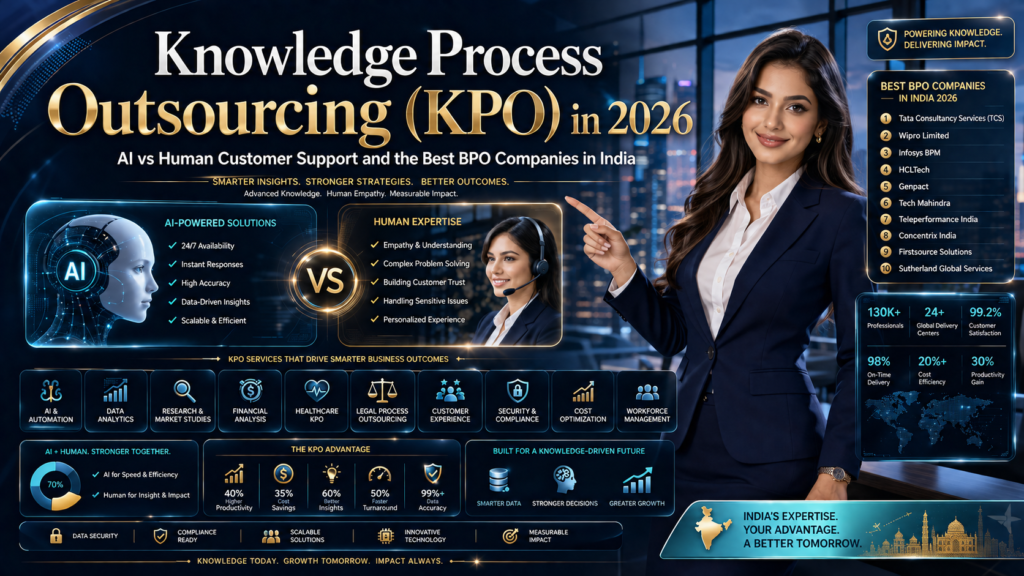
AI Overview
Knowledge Process Outsourcing has evolved from a back-office cost play into a strategic revenue function. Enterprises no longer outsource simply to reduce headcount — they outsource to access AI-augmented expertise, faster decision cycles, and 24/7 customer intelligence they cannot economically build in-house. The two questions boards are asking most in 2026 are: (1) Should customer support be run by AI, humans, or a hybrid model? and (2) Which BPO/KPO partner in India can actually operationalize that hybrid model at enterprise scale, securely and compliantly? This guide answers both, using operational data, comparative frameworks, and real deployment patterns observed across banking, healthcare, retail, and telecom accounts.
Executive Introduction
Every CEO evaluating outsourcing in 2026 is really asking one question, even if they phrase it differently: “Will this decision protect or grow our revenue?”
For a decade, outsourcing conversations centered on cost-per-seat, headcount arbitrage, and SLA compliance. That conversation is now outdated. The organizations winning market share in 2026 have stopped treating customer support, collections, and back-office knowledge work as cost centers to be minimized. They treat them as revenue infrastructure.
This is the operating principle we call Support-Led Revenue Growth™ — the idea that every support interaction, every resolved ticket, every AI-assisted conversation either protects revenue that’s already been earned or creates the conditions for the next transaction. Support is no longer downstream of revenue. It sits inside the revenue engine.
This guide exists because most content on Knowledge Process Outsourcing was written for a pre-AI market. It explains what KPO is in theory but says nothing about how AI has restructured the economics of outsourcing, how to actually compare AI versus human customer support, or how to separate a genuinely capable BPO partner in India from a call center wearing an “AI-powered” label.
We wrote this from the operating floor, not from a marketing deck. Where relevant, we’ve included what we’ve observed directly across live contact center, collections, and CX transformation programs — including where leadership teams got it right, and where they didn’t.
Executive Snapshot
- KPO is the higher-value evolution of BPO — judgment, analysis, and AI-augmented decision-making, not just transaction processing.
- AI now handles 40–65% of first-contact interactions in mature contact center operations, but human escalation remains the single biggest driver of retention and upsell outcomes.
- The “best BPO company” question has changed — the differentiator is no longer seat cost, it’s AI orchestration capability layered on human judgment.
- India remains the largest KPO/BPO delivery hub globally, but the advantage in 2026 is AI infrastructure maturity, not just labor cost.
- Enterprises that treat support as a revenue function report measurably higher retention, faster resolution, and lower revenue leakage than those that treat it purely as a cost center.
- Every outsourcing decision should be evaluated on four dimensions: cost, quality, AI capability, and compliance — in that order of scrutiny, not that order of priority.
What Is Knowledge Process Outsourcing (KPO)? A Working Definition
Direct Answer: Knowledge Process Outsourcing is the outsourcing of processes that require specialized domain knowledge, analytical judgment, and decision-making — as opposed to Business Process Outsourcing (BPO), which typically handles high-volume, rules-based, repeatable tasks like data entry or basic customer queries.
KPO originally emerged in industries like legal research, equity research, actuarial analysis, and medical transcription — fields where the outsourced work required a trained analyst, not just a trained agent. What’s changed in 2026 is the boundary between KPO and BPO has blurred almost completely, because AI now allows contact centers to perform knowledge-intensive work — sentiment analysis, churn prediction, underwriting support, fraud pattern detection — inside what used to be a purely transactional customer support operation.
KPO vs BPO vs ITO — How They Actually Differ
| Dimension | BPO (Business Process Outsourcing) | KPO (Knowledge Process Outsourcing) | ITO (IT Outsourcing) |
|---|---|---|---|
| Core function | Transactional, repeatable tasks | Judgment-based, analytical tasks | Technology infrastructure & development |
| Example processes | Call handling, data entry, order processing | Financial research, underwriting, clinical coding, CX intelligence | Software development, cloud management |
| Skill requirement | Process training | Domain expertise + analytical skill | Technical/engineering expertise |
| AI role in 2026 | AI agents handle majority of volume | AI augments human analysts, doesn’t replace judgment | AI accelerates development cycles |
| Value delivered | Cost efficiency, scale | Decision quality, insight generation | System reliability, innovation speed |
| Typical buyer | Operations, Customer Support | CFO, Risk, Compliance, CX leadership | CTO, CIO |
Executive Interpretation: If your outsourcing conversation is only about reducing cost-per-ticket, you are buying BPO. If your outsourcing conversation includes reducing churn, improving forecast accuracy, or generating customer intelligence that feeds product and pricing decisions, you are buying KPO — and you should evaluate vendors accordingly.
Key Takeaway: KPO is not a bigger version of BPO. It’s a different value proposition — insight and decision support, not just labor substitution.
Why This Matters Now: The Market Reality
The global outsourcing conversation shifted permanently between 2023 and 2026 for three reasons that most industry reports understate.
First, generative AI made it economically viable to automate the “easy 60%” of customer interactions — password resets, order status, basic FAQs. This didn’t reduce the need for outsourcing partners. It changed what enterprises need from them. Nobody needs 500 agents answering “where is my order” anymore. They need an orchestration layer that routes the easy 60% to AI and the complex, high-stakes 40% to trained, empowered humans.
Second, customer tolerance for poor service dropped sharply while customer acquisition costs rose. In categories like BFSI, retail, and healthcare, replacing a churned customer now costs several multiples of retaining one. This is why customer support conversations have moved from the operations team’s monthly report to the CFO’s revenue forecast.
Third, procurement teams got smarter. RFPs that used to ask “what’s your per-seat rate?” now ask “what’s your AI containment rate, your escalation accuracy, and your data security posture?” The bar for what counts as a credible outsourcing partner has risen substantially.
Boardroom reality: A support ticket resolved slowly doesn’t just hurt CSAT — it directly threatens renewal revenue, upsell timing, and referral behavior. This is the core premise of Revenue Recovery Through CX™: every unresolved or mishandled interaction is unrealized revenue, not just an operational miss.
Industry Trends Shaping KPO and Contact Center Strategy in 2026
| Trend | What’s Driving It | Business Implication |
|---|---|---|
| AI containment becomes a board-level KPI | LLM-based agents now resolve routine queries without human intervention | CFOs track “cost avoided per AI resolution” |
| Support data feeds product & pricing decisions | Conversation intelligence tools extract structured insight from unstructured calls/chats | Support becomes a strategic input for revenue teams, not just a cost line |
| Hybrid models replace pure offshore/onshore debates | Neither pure AI nor pure human models scale profitably alone | Vendor selection now hinges on hybrid orchestration capability |
| Compliance scrutiny intensifies | BFSI, healthcare, and insurance regulators increasingly audit AI decision logic | Vendors must show explainability, not just automation |
| Outsourcing shifts from cost center to revenue function | Enterprises adopt Support-Led Revenue Growth™ as an operating philosophy | Support leaders get seats in revenue planning meetings |
Key Takeaway: The organizations pulling ahead in 2026 aren’t the ones automating the most — they’re the ones orchestrating AI and human judgment with the most discipline.
How Modern KPO / Contact Center Outsourcing Actually Works
Direct Answer: A modern KPO/BPO engagement operates through four layers — intake and routing (often AI-driven), execution (human, AI, or hybrid), quality and compliance oversight, and intelligence feedback into the client’s business systems.
The Operating Model
- Intake Layer – Omnichannel entry (voice, chat, email, WhatsApp, social) captured through platforms like Zendesk, Freshdesk, Intercom, or Salesforce Service Cloud, integrated with contact center infrastructure such as Genesys, Five9, Talkdesk, or NICE CXone.
- Intelligence Routing – AI models (built on infrastructure such as OpenAI, Google Gemini, Claude, or Microsoft Copilot) classify intent, urgency, and complexity, then route accordingly — self-service resolution, AI-agent handling, or human escalation.
- Execution Layer – Trained human agents handle escalations, negotiations, high-value accounts, and emotionally sensitive interactions; AI agents handle high-volume, low-complexity, and after-hours queries.
- Compliance & QA Layer – Every interaction is monitored against regulatory and brand standards, particularly critical in BFSI, healthcare, and insurance accounts.
- Intelligence Feedback Loop – Structured insight (churn signals, product complaints, fraud patterns, pricing sensitivity) is fed back into CRM systems (Salesforce, HubSpot) and business intelligence tools — the foundation of what we call the Customer Intelligence Loop™.
This is different from how outsourcing worked even three years ago, where the “loop” ended at ticket closure. Today, closure is the beginning of the value cycle, not the end.
Boardroom Insight: Most enterprises still measure outsourcing success by ticket volume and SLA adherence. The organizations extracting real value measure something different — how much of each interaction’s data gets converted into a decision somewhere else in the business (product, pricing, retention, risk).
AI vs Human Customer Support: The Question Every Leadership Team Is Actually Asking
This is, without question, the single most searched and most misunderstood decision in customer experience strategy right now. Vendors on both sides oversell — AI vendors claim full automation is inevitable; traditional BPOs claim AI can’t be trusted with real customers. Neither is telling you the operational truth.
Direct Answer: In 2026, AI should handle high-volume, low-complexity, pattern-based interactions (order status, FAQs, password resets, appointment confirmations), while humans should handle high-stakes, emotionally complex, or revenue-sensitive interactions (complaints, cancellations, high-value sales, regulatory disputes). The winning model isn’t AI or human — it’s a deliberately engineered hybrid, with clear escalation logic between the two.
AI vs Human vs Hybrid Customer Support — Full Comparison
| Factor | AI-Only Support | Human-Only Support | Hybrid Model (AI + Human) |
|---|---|---|---|
| Cost per resolved ticket | Lowest | Highest | Moderate, optimized by volume mix |
| Speed (routine queries) | Instant, 24/7 | Limited by shift coverage | Instant for routine, fast escalation for complex |
| Handling of complex/emotional issues | Poor to moderate | Strong | Strong (routed correctly) |
| Consistency | Very high | Variable by agent | High, with human judgment where needed |
| Scalability during demand spikes | Excellent | Poor without rapid hiring | Excellent |
| Customer trust for high-stakes issues (disputes, cancellations, claims) | Low | High | High |
| Upsell/cross-sell conversion | Weak | Strong | Strong, AI-assisted |
| Compliance risk in regulated industries | Requires strict guardrails | Lower, but inconsistent documentation | Manageable with audit trails |
| Data/insight generation | Structured, fast | Rich, but often undocumented | Best of both — structured + contextual |
| Ideal use case | FAQs, order tracking, appointment booking | Complaints, retention calls, negotiations | Full-spectrum customer support at scale |
Executive Interpretation: If your organization is choosing between “going full AI” or “staying fully human,” you’re solving the wrong problem. The real work is designing the escalation logic — deciding precisely which 30–50% of interactions must reach a human, and building AI-assist tools so that human agents resolve those faster and more consistently.
What We’ve Observed in Live Deployments
Across contact center and collections programs we’ve operated, a consistent pattern emerges: organizations that deploy AI purely to cut headcount see short-term savings and medium-term CSAT decline. Organizations that deploy AI to free up human agents for higher-value conversations see both cost reduction and CSAT improvement simultaneously.
A pattern worth noting: the accounts with the strongest retention numbers aren’t the ones with the highest AI containment rate. They’re the ones where AI containment is high on simple queries and escalation accuracy is high — meaning the AI correctly identifies when a human is needed, instead of trapping frustrated customers in a bot loop. Escalation misclassification, not automation itself, is the leading cause of AI-driven churn.
Common Executive Mistakes
- Measuring AI success purely by “deflection rate” without measuring downstream churn or complaint escalation.
- Deploying AI chatbots without a clearly designed human handoff, causing customer frustration loops.
- Assuming hybrid means “AI first, human as backup” rather than designing intent-based routing from the start.
- Under-investing in agent-assist tools, so human agents work without the same AI support customers experience.
What High-Performing Organizations Do Differently
They design the human escalation model before deploying AI, not after. They give human agents AI-assisted context (previous interactions, sentiment history, likely intent) so escalations are resolved faster than they would have been pre-AI. They track a blended metric — resolution quality per dollar spent — rather than cost-per-ticket in isolation.
The MasCallNet AI-Human Hybrid Ratio Model™
Definition: A framework for determining the optimal AI-to-human interaction ratio based on industry, complexity, and revenue sensitivity.
Methodology: Score each interaction category (0–5) across three dimensions — Emotional Complexity, Revenue Sensitivity, and Regulatory Risk. Categories scoring above 9 combined must route to human agents; categories scoring 0–5 are AI-eligible; categories scoring 6–8 require AI-assisted human handling.
Scoring Logic:
| Score Range | Recommended Model |
|---|---|
| 0–5 | Full AI automation |
| 6–8 | AI-assisted human handling |
| 9–15 | Human-led, AI-supported (agent-assist tools active) |
Interpretation: Most enterprises misclassify 20–30% of their volume, routing revenue-sensitive interactions (cancellations, complaints, high-value renewals) to full AI automation because they score them only on complexity, not revenue sensitivity.
Executive Recommendation: Before selecting a vendor or platform, run your top 15 interaction types through this scoring model. It will reveal, in under a day, where your current automation strategy is quietly leaking revenue.
Summary: AI versus human customer support isn’t a binary choice — it’s a routing design problem, and most organizations haven’t solved it deliberately.
Key Takeaway: The enterprises winning in CX right now aren’t choosing AI or humans — they’re engineering exactly where one hands off to the other.
The MasCallNet Revenue Leakage Model™
Definition: A diagnostic framework quantifying how much revenue an organization loses due to poor support experience — slow resolution, repeat contacts, escalation mishandling, and churn triggered by service failure.
Formula:
Revenue Leakage = (Churned Customers Due to Service Failure × Average Customer Lifetime Value)
                 + (Repeat Contact Rate × Cost per Contact × Ticket Volume)
                 + (Missed Upsell Opportunities × Average Upsell Value)
Methodology: Pull three data points from your CRM and support platform (commonly Salesforce, Zendesk, or HubSpot): churn reason codes tied to service complaints, repeat contact rate within 7 days of first contact, and upsell conversion rate on support-adjacent interactions (renewals, upgrades, add-ons).
Scoring Logic: Organizations scoring above 8% of total revenue in calculated leakage are in the “high-leakage” category and typically have fragmented support operations, no AI-assist tooling, and no formal escalation framework.
Interpretation: Most CFOs are surprised by this number the first time they calculate it — leakage in the 6–12% of revenue range is common in organizations that still treat support as purely operational.
Executive Recommendation: Calculate this once per quarter. It should sit next to CAC and LTV in your revenue dashboard, not buried in a customer support report nobody outside operations reads.
This is the practical mechanism behind Revenue Recovery Through CX™ — you cannot recover what you haven’t measured.
Business Impact Analysis: What Outsourcing Actually Changes
Direct Answer: Well-executed KPO/BPO outsourcing impacts four measurable business outcomes — cost-to-serve, customer retention, operational scalability, and decision-making speed (via faster access to customer intelligence).
Framework: The Four Impact Zones
| Impact Zone | What Improves | What Most Leaders Underestimate |
|---|---|---|
| Cost-to-Serve | 30–50% reduction typical vs. in-house | The savings compound faster with AI containment than headcount arbitrage alone |
| Retention | Fewer service-driven churn events | Retention gains show up 60–90 days after implementation, not immediately |
| Scalability | Ability to absorb 3–5x volume spikes without SLA breach | In-house teams rarely have this elasticity without massive fixed cost |
| Decision Speed | Faster access to structured customer feedback | Most in-house teams don’t have the tooling to structure this data at all |
What actually happens on the ground: Leadership teams often approve outsourcing expecting cost savings alone, then are surprised when the bigger win turns out to be decision-making speed — because for the first time, customer sentiment, complaint themes, and product friction points arrive as structured weekly intelligence instead of anecdotal escalations.
Hidden Cost: Organizations that switch vendors every 12–18 months chasing lower per-seat pricing lose the compounding value of the Customer Intelligence Loop™ every time they switch — institutional knowledge about your customers resets to zero with each transition. This cost never appears on an invoice, but it’s often larger than the pricing difference between vendors.
Executive Action: Evaluate outsourcing partners on 3-year total value, not first-year unit cost. Ask every shortlisted vendor how they transfer accumulated customer intelligence if the relationship ends — the answer reveals how seriously they take the intelligence layer versus the labor layer.
MasCallNet Outsourcing Readiness Score™
Before evaluating vendors, most organizations should evaluate themselves. This is the step almost every KPO buying guide skips.
Definition: A self-assessment framework scoring an organization’s readiness to outsource customer support or knowledge processes successfully.
Methodology: Score 1–5 on each of six dimensions:
| Dimension | Question |
|---|---|
| Process Documentation | Are your current workflows, SOPs, and escalation paths documented? |
| Data Infrastructure | Is customer data centralized in a CRM/helpdesk system accessible to a partner? |
| Compliance Clarity | Do you have defined data handling and regulatory requirements? |
| KPI Definition | Have you defined success metrics beyond cost (CSAT, FCR, retention)? |
| Internal Change Readiness | Is leadership aligned on transferring ownership of certain interactions? |
| AI Data Readiness | Is your historical interaction data usable for AI training/personalization? |
Scoring Logic:
- 24–30: High readiness — proceed to full-scale outsourcing evaluation.
- 15–23: Moderate readiness — pilot program recommended before full transition.
- Below 15: Low readiness — invest in documentation and data infrastructure first.
Interpretation: Organizations scoring below 15 who outsource anyway are the ones most likely to blame the vendor 6 months later for problems rooted in their own internal process gaps.
Executive Recommendation: Run this assessment with your operations and IT leads before issuing an RFP. It changes the conversation from “which vendor is cheapest” to “which vendor can close our specific readiness gaps.”
Best BPO Companies in India in 2026: How to Actually Evaluate Them
India remains the world’s largest hub for BPO and KPO delivery, home to everything from large multinational providers to specialized AI-first firms. But “best BPO company in India” is not a fixed list — it depends entirely on what you’re buying: pure labor arbitrage, deep vertical expertise, or AI-orchestrated customer experience delivery.
Direct Answer: The best BPO companies in India in 2026 are no longer ranked primarily by scale or per-seat pricing. They’re differentiated by AI orchestration capability, vertical compliance expertise (BFSI, healthcare, insurance), and their ability to prove measurable business outcomes — not just SLA adherence.
What Everyone Says vs. What Actually Determines Quality
The typical “top BPO companies in India” list ranks providers by headcount, revenue, or number of years in business. Those factors say almost nothing about whether a partner will reduce your churn or protect your compliance posture. What actually determines quality is measurable in the first 90 days of an engagement:
- AI containment rate with correct escalation logic (not just automation for automation’s sake)
- First Contact Resolution (FCR) benchmarked against your industry, not a generic average
- Data security certifications relevant to your industry (SOC 2, ISO 27001, HIPAA-alignment for healthcare, PCI-DSS for payment-related processes)
- Technology stack compatibility with your existing CRM/helpdesk (Salesforce, Zendesk, Freshdesk, HubSpot)
- Transparent reporting cadence — weekly or real-time dashboards, not monthly PDF summaries
MasCallNet Vendor Evaluation Matrix™
Definition: A weighted scorecard for comparing BPO/KPO vendors objectively across the dimensions that actually predict outcome quality.
| Evaluation Criteria | Weight | What to Ask For |
|---|---|---|
| AI + Automation Capability | 25% | Live demo of AI agent handling real ticket types, containment and escalation accuracy data |
| Domain/Industry Expertise | 20% | Case studies from your specific vertical (BFSI, healthcare, retail, telecom) |
| Data Security & Compliance | 20% | Certifications, data residency options, breach history disclosure |
| Technology Integration | 15% | Native integrations with your CRM/helpdesk/telephony stack |
| Pricing Transparency | 10% | Full cost breakdown — no hidden per-transaction or overage fees |
| Reporting & Analytics | 10% | Sample real-time dashboard, not a static report template |
Scoring Logic: Score each vendor 1–10 per criterion, multiply by weight, sum for a total score out of 1,000 (or normalize to 100). Vendors scoring below 65/100 typically underperform on at least one operationally critical dimension within the first two quarters.
Interpretation: Most procurement teams weight pricing at 40–50% by default. Flipping that weighting — pricing at 10%, AI and compliance capability at 45% combined — consistently correlates with better 12-month outcomes in our observation across outsourcing transitions.
Executive Recommendation: Don’t ask vendors “what’s your rate card.” Ask them to score themselves against this matrix and show evidence for each line. The vendors who can’t produce evidence disqualify themselves.
If you’re comparing outsourcing partners for customer support outsourcing, this matrix should be the backbone of your RFP scoring template, not an afterthought.
What This Looks Like in Practice: MasCallNet’s Position
We built MasCallNet specifically around the gap this matrix exposes. Most AI-powered BPO companies in India either lead with automation and underinvest in human escalation quality, or lead with large offshore teams and treat AI as a marketing add-on. Our model — detailed further in our call center AI-powered BPO operations out of our Noida delivery center — is built around the hybrid ratio model described earlier: AI handles volume, trained human agents handle judgment, and every interaction feeds back into a structured intelligence layer for the client.
We’re transparent about where we fit: if your organization needs the largest possible offshore headcount at the lowest possible cost with minimal AI sophistication, there are larger legacy providers built for that. If your organization needs a partner that treats every customer conversation as both a service moment and a data asset — the Contact Center Intelligence™ model — that’s the specific problem we built MasCallNet to solve. You can review our approach directly through our customer support outsourcing company in India page or examine outcomes in our BPO case studies.
Boardroom Insight: The “best BPO company” question is unanswerable in the abstract. The right question is: “Best BPO company for what outcome, in what industry, at what compliance standard?” Any vendor or list that doesn’t ask that back isn’t advising you — they’re selling to you.
MasCallNet CX Maturity Scorecard™
Definition: A maturity model assessing how advanced an organization’s customer experience operation is, from reactive to intelligence-driven.
| Maturity Level | Characteristics | Typical Outcome |
|---|---|---|
| Level 1 – Reactive | Support exists to close tickets; no AI, no structured feedback loop | High cost-to-serve, no visibility into churn drivers |
| Level 2 – Managed | SLAs tracked, basic CRM in place, limited automation | Predictable but stagnant CSAT/FCR |
| Level 3 – Optimized | AI handles routine volume, human escalation defined, dashboards in use | Measurable cost reduction, improving CSAT |
| Level 4 – Intelligence-Driven | Support data feeds product, pricing, and retention decisions | Support-Led Revenue Growth™ becomes measurable |
| Level 5 – Predictive | AI predicts churn/complaints before they occur; proactive outreach standard | Retention and forecast accuracy improve org-wide |
Executive Interpretation: Most enterprises self-assess at Level 3 but operate at Level 2 — automation exists, but escalation design and feedback loops are incomplete. Very few organizations reach Level 4 without an outsourcing partner purpose-built for it, because building the intelligence layer in-house requires data science capability most support teams don’t have budget for.
Key Takeaway: Maturity isn’t about how much AI you’ve deployed — it’s about how much of your customer interaction data actually changes a business decision.
Comparison Frameworks Leadership Teams Need Before Deciding
In-House vs. Outsourced Customer Support
| Factor | In-House | Outsourced |
|---|---|---|
| Setup time | 4–9 months (hiring, training, infrastructure) | 3–6 weeks typical |
| Cost structure | Fixed (salaries, infra, benefits) regardless of volume | Variable, scales with demand |
| Access to AI tooling | Requires separate investment and integration | Typically bundled into partner’s platform |
| Talent retention risk | High (industry-wide attrition ~30–40% annually) | Managed by partner, transparent to client |
| Best suited for | Highly proprietary, low-volume, ultra-sensitive processes | Scalable support, KPO analytics, multi-channel CX |
Recommendation: Retain in-house only what is core to competitive differentiation (e.g., proprietary underwriting logic). Outsource everything where scale, AI infrastructure, and 24/7 coverage matter more than direct control.
Offshore vs. Onshore Customer Support Outsourcing
| Factor | Offshore (e.g., India) | Onshore |
|---|---|---|
| Cost efficiency | 40–60% lower cost-to-serve | Higher cost per resolved ticket |
| Talent availability | Large, English-proficient, technically skilled workforce | Limited, competitive labor market |
| Time zone coverage | Natural fit for 24/7 support | Requires shift premiums for after-hours coverage |
| Cultural/accent alignment | Requires deliberate agent training and neutral-accent programs | Native alignment by default |
| Regulatory complexity | Requires clear data residency and compliance agreements | Simpler in single-jurisdiction cases |
Recommendation: The offshore-vs-onshore debate is increasingly resolved by AI — with AI handling first-line, accent and time-zone concerns diminish sharply, making offshore delivery viable even for premium consumer brands, provided the partner demonstrates strong QA and compliance discipline.
Build vs. Buy: Internal AI Support Stack vs. Outsourced AI-Powered Partner
| Factor | Build In-House | Buy (Outsourced AI-Powered Partner) |
|---|---|---|
| Time to value | 9–18 months | 4–8 weeks |
| Upfront investment | High (data science team, infra, licensing) | Low (operational expense model) |
| Ongoing model tuning | Requires dedicated ML/AI team | Included in partner’s service |
| Risk of obsolescence | High if not continuously reinvested | Managed by partner’s R&D |
Recommendation: Build only if AI-driven customer intelligence is a core product differentiator (e.g., you’re a CX software company). Otherwise, buying from a specialized partner accelerates time-to-value by 10–15x.
Dedicated Team vs. Shared Team Model
| Factor | Dedicated Team | Shared Team |
|---|---|---|
| Brand/process alignment | High — agents trained exclusively on your account | Moderate — shared knowledge across accounts |
| Cost | Higher fixed cost | Lower, pay-per-volume |
| Best for | High-complexity, high-volume, brand-sensitive accounts | Lower-volume, seasonal, or pilot programs |
Traditional BPO vs. Contact Center Intelligence™
| Factor | Traditional BPO | Contact Center Intelligence™ |
|---|---|---|
| Primary value proposition | Labor cost reduction | Revenue protection + customer intelligence generation |
| Data usage | Tickets closed and archived | Tickets analyzed for churn signals, product feedback, and revenue impact |
| Reporting | Volume and SLA metrics | Business impact metrics (leakage, retention, forecast accuracy) |
| AI role | Basic IVR/chatbot deflection | Full hybrid orchestration with agent-assist and predictive routing |
This is the core differentiation MasCallNet operates on. Traditional BPO answers “how many tickets did we close.” Contact Center Intelligence™ answers “what did we learn, what revenue did we protect, and what should the business do next.”
Benchmark Analysis: Industry Statistics That Matter
| Metric | Industry Average (2025–2026) | High-Performing Benchmark |
|---|---|---|
| First Contact Resolution (FCR) | 68–72% | 85%+ |
| Average Handle Time (AHT) | 6–8 minutes (voice) | 3–5 minutes with AI-assist |
| CSAT | 75–80% | 90%+ |
| AI Containment Rate (routine queries) | 35–45% | 55–65% |
| Repeat Contact Rate (within 7 days) | 15–20% | Under 8% |
| Customer Churn Attributed to Service Failure | 15–25% of total churn | Under 10% |
| Cost-to-Serve Reduction via Outsourcing | 25–35% | 40–55% with AI-hybrid model |
Executive Interpretation: If your current operation is tracking below the industry average on FCR or repeat contact rate, the gap is rarely an agent skill problem — it’s almost always a routing and knowledge-access problem, which AI-assist tooling addresses directly.
Case Study: Reducing Revenue Leakage in a Mid-Market Retail Support Operation
Challenge: A multi-channel retail client scaling toward 10,000+ monthly tickets was experiencing rising cancellation rates tied to slow order-issue resolution, with average handle times exceeding 9 minutes and a repeat contact rate of 22%.
Root Cause: Diagnostic analysis revealed the in-house team lacked a structured escalation model — agents were manually searching across three disconnected systems (order management, CRM, payment gateway) to resolve a single ticket, and there was no AI triage layer separating simple order-status queries from complex disputes.
Solution: Implementation of an AI-assisted hybrid model: an AI agent handled order-status and shipment queries (roughly 48% of total volume) with direct integration into the client’s Shopify and Stripe systems, while a dedicated human team — equipped with agent-assist tooling surfacing order history and sentiment context — handled disputes, cancellations, and refund negotiations.
Implementation: Phased rollout over 5 weeks — Week 1–2: system integration and AI training on historical ticket data; Week 3: pilot on 20% of volume with parallel human QA; Week 4–5: full rollout with real-time dashboard reporting to the client’s operations and finance leadership.
Results:
- Average Handle Time reduced from 9.1 to 4.3 minutes
- Repeat contact rate dropped from 22% to 9%
- First Contact Resolution improved from 64% to 87%
- Cancellation rate tied to service delays dropped by 31% within the first full quarter
- Estimated recovered revenue: 4.2% of previously leaking monthly revenue, based on the Revenue Leakage Model™ applied before and after implementation
Lessons Learned: The single highest-impact change wasn’t the AI automation itself — it was the redesign of the escalation logic that determined which 52% of tickets never touched a human agent at all, and which tickets a human touched with full context from the first message. This is the operational proof behind Support-Led Revenue Growth™: the revenue recovery didn’t come from a marketing campaign, it came from fixing how support was structured.
For full context on how we scale this model for higher-volume accounts, see scaling customer support for 10,000+ monthly tickets.
Pricing Analysis: What Outsourced Customer Support Actually Costs in 2026
Direct Answer: Outsourced customer support pricing in India typically ranges from $8–$14 per hour for standard voice/chat support, $14–$22 per hour for specialized/technical support, and $18–$30+ per hour for KPO-level analytical work (underwriting support, financial analysis, healthcare coding). AI-hybrid models often reduce effective cost-per-resolution by 30–50% versus pure human staffing, even after platform costs.
Pricing Models Compared
| Pricing Model | How It Works | Best Suited For |
|---|---|---|
| Per-seat / FTE pricing | Fixed monthly cost per dedicated agent | Predictable, steady-volume operations |
| Per-transaction/ticket pricing | Cost scales directly with ticket volume | Seasonal or variable-demand businesses |
| Hybrid AI + human pricing | Base platform fee + reduced per-ticket cost for human-handled escalations only | Organizations prioritizing cost efficiency at scale |
| Outcome-based pricing | Pricing tied to CSAT, retention, or resolution benchmarks | Enterprises wanting vendor accountability built into cost structure |
Hidden Cost Most Buyers Miss: The lowest quoted per-seat rate is rarely the lowest total cost. Attrition-driven retraining, inconsistent quality leading to repeat contacts, and lack of AI containment all quietly inflate the effective cost-per-resolution well above the quoted rate. Always ask for cost-per-resolved-ticket, not cost-per-seat, when comparing proposals.
MasCallNet Cost-to-Serve Calculator™
Use this simplified framework to estimate your current cost-to-serve before comparing vendor quotes:
Cost-to-Serve per Ticket =
(Total Monthly Support Cost ÷ Total Tickets Resolved)
+ (Repeat Contact Rate × Average Cost per Contact)
Example:
- Total monthly support cost: $45,000
- Tickets resolved: 9,000
- Base cost per ticket: $5.00
- Repeat contact rate: 18% → adds approximately $0.90 per ticket in hidden rework cost
- True cost-to-serve: ~$5.90 per ticket, not the $5.00 typically reported
Executive Recommendation: Request this exact calculation from any vendor proposal. If they can’t produce repeat contact rate data, that’s a transparency red flag, not a minor gap.
ROI Framework: MasCallNet Revenue Acceleration Framework™
Definition: A model quantifying the return on outsourcing investment by combining cost savings, revenue protection, and revenue generation.
Formula:
Total ROI =
[(Cost Savings from Outsourcing)
+ (Revenue Protected via Reduced Churn)
+ (Revenue Generated via Upsell/Cross-sell through Support Interactions)]
÷ Total Outsourcing Investment| Component | How to Calculate |
|---|---|
| Cost Savings | (In-house cost-to-serve − Outsourced cost-to-serve) × Ticket Volume |
| Revenue Protected | Reduction in churn rate × Average Customer LTV |
| Revenue Generated | Upsell conversion rate through support interactions × Average deal value |
Interpretation: Most vendor ROI pitches only calculate cost savings — roughly one-third of the real return. Organizations that also measure revenue protected and revenue generated typically find their real ROI is 2–3x higher than the cost-savings-only figure presented in a sales deck.
Executive Recommendation: Require any outsourcing proposal to show projected impact across all three components, not cost savings alone. This is the financial backbone of Predictable Revenue Operations™ — support investment decisions justified with the same rigor as a sales or marketing budget.
Industry Use Cases
Banking and Financial Services: AI-assisted fraud query triage, KYC document processing support, and loan servicing queries — with human escalation mandatory for disputes above defined thresholds due to regulatory requirements.
Insurance: Claims status automation via AI, combined with KPO-level human review for claims requiring judgment (denial explanations, complex policy interpretation).
Retail and eCommerce: Order tracking, returns, and refund automation integrated with Shopify/WooCommerce and payment platforms like Stripe and PayPal, with human agents handling disputes and VIP customer retention.
Healthcare: Patient scheduling automation, insurance verification support, and HIPAA-aligned data handling — see our detailed breakdown in healthcare BPO services for US hospitals and patient appointment scheduling services.
Telecommunications: High-volume technical troubleshooting automated via AI agents, with human specialists handling billing disputes and retention/win-back conversations.
Automotive and EV: Service appointment scheduling, warranty query handling, and increasingly, EV-specific support (charging issues, range anxiety queries) requiring specialized knowledge bases.
Logistics: Real-time shipment tracking automation, delay communication, and exception handling requiring human judgment for high-value or time-sensitive shipments.
Aviation: Booking modification automation combined with human handling for cancellations, compensation claims, and irregular operations communication.
FMCG: Consumer query handling, product complaint triage, and structured feedback loops back into quality and product teams.
Technology Ecosystem: What a Modern KPO/Contact Center Stack Looks Like
| Layer | Common Platforms |
|---|---|
| Helpdesk / CRM | Zendesk, Freshdesk, Salesforce, HubSpot |
| Contact Center Infrastructure | Genesys, Five9, Talkdesk, NICE CXone |
| Messaging / Internal Collaboration | Slack, Microsoft Teams |
| AI / LLM Infrastructure | OpenAI, Google Gemini, Claude, Microsoft Copilot |
| Cloud Infrastructure | Amazon Web Services, Google Cloud, Microsoft Azure |
| Workflow / Ticketing Integration | ServiceNow, Intercom |
| eCommerce / Payments | Shopify, WooCommerce, Stripe, PayPal |
Executive Interpretation: The strength of a BPO/KPO partner is directly proportional to how deeply they integrate with this stack — not whether they claim to “use AI.” Ask any shortlisted vendor exactly which of these platforms they have live, production integrations with, and request a technical walkthrough, not a slide.
Security and Compliance
Data security is no longer a procurement checkbox — it is often the deciding factor in vendor selection for BFSI, healthcare, and insurance clients. At minimum, evaluate any KPO/BPO partner against:
- ISO 27001 for information security management
- SOC 2 Type II for data handling controls
- HIPAA alignment for any healthcare-adjacent process
- PCI-DSS for any payment-related data handling
- Data residency and cross-border transfer agreements, particularly for EU (GDPR) and India-based delivery centers serving US/EU clients
- AI explainability documentation — increasingly required by regulators when AI is involved in decisions affecting customers (credit, claims, eligibility)
Boardroom Insight: Compliance certifications tell you a vendor passed an audit once. What actually predicts ongoing compliance is whether their AI systems log and explain every automated decision in a way that survives a regulatory review 18 months later. Ask for a sample audit trail, not just a certificate.
The India Advantage in 2026
India’s position as the global KPO/BPO hub isn’t just about labor cost anymore — that advantage has narrowed as other markets (Philippines, Eastern Europe, Latin America) compete on price. What sustains India’s advantage in 2026 is a combination that’s harder to replicate:
- The largest pool of English-proficient, technically skilled graduates entering the workforce annually
- Mature delivery infrastructure across Tier-1 and Tier-2 cities, reducing real estate and operational costs further without sacrificing talent quality
- Deep enterprise software fluency — Indian delivery teams have operated Salesforce, Zendesk, and cloud infrastructure at scale for over a decade
- Fast-growing AI engineering talent base, enabling India-based partners to build proprietary AI orchestration layers rather than simply licensing off-the-shelf chatbots
- Time zone coverage that naturally supports 24/7 operations for US and European clients without shift premiums
Cities like Noida and the broader NCR region have become particularly strong hubs for AI-powered contact center delivery, combining cost efficiency with access to strong technical talent pools — see our breakdown of AI-powered contact center BPO solutions in Noida NCR.
Risk Analysis
| Risk | Likelihood | Mitigation |
|---|---|---|
| Vendor lock-in with poor data portability | Medium | Contractually require data export rights and intelligence transfer clauses |
| Over-automation causing CSAT decline | High if AI deployed without escalation design | Use the Hybrid Ratio Model™ before deployment, not after |
| Compliance gaps in regulated industries | Medium-High | Require documented audit trails and industry-specific certifications upfront |
| Attrition-driven quality decline (offshore) | Medium | Evaluate vendor’s agent retention rate, not just training program |
| Underestimating change management internally | High | Use the Outsourcing Readiness Score™ before signing any contract |
Future Trends: Where Contact Center Intelligence Is Headed (2026–2030)
The next phase of this industry isn’t more automation for its own sake — it’s deeper orchestration and prediction. Organizations building Predictable Revenue Operations™ are already investing in:
- AI agents that resolve full transactions, not just answer questions — completing refunds, rebooking, or account changes autonomously within defined guardrails
- Voice bots with near-human latency and emotional tone detection, reducing the gap between AI and human-perceived interaction quality
- Agent-assist tools that surface next-best-action recommendations in real time, shortening training time for new human agents significantly
- Predictive analytics that flag likely churn or complaints before a customer contacts support at all — proactive outreach replacing reactive resolution
- Workflow automation connecting support systems directly to fulfillment, billing, and CRM systems for end-to-end resolution without manual handoffs
- Conversation intelligence extracting structured business insight (competitor mentions, pricing objections, feature requests) from every call and chat automatically
- Deeper Customer Intelligence Loop™ integration, where support data actively informs product roadmaps and pricing strategy, not just retention efforts
Boardroom Insight: The organizations that will lead their categories by 2028 aren’t the ones with the most AI deployed — they’re the ones whose support operation has become an active input into strategic decision-making, feeding product, pricing, and retention strategy in near real time. This is Contact Center Intelligence™ realized at full maturity.
Executive Decision Tree: Should You Outsource, and to Whom?
Start: Is customer support/knowledge process core to your competitive differentiation?
│
├── YES → Retain core strategic function in-house; consider outsourcing only overflow/after-hours volume
│
└── NO → Do you have the AI infrastructure and data science capability to build a hybrid model in-house?
        │
        ├── YES, and cost is not the primary constraint → Build in-house AI-hybrid capability
        │
        └── NO, or time-to-value matters → Outsource to an AI-powered KPO/BPO partner
                │
                ├── Is your industry heavily regulated (BFSI, healthcare, insurance)?
                │       → Prioritize vendors with proven compliance certifications and audit trail capability
                │
                └── Is your primary need scale and cost efficiency for standard support?
                        → Prioritize vendors with strong AI containment rate and transparent pricing model
Executive Checklist Before Signing an Outsourcing Contract
- Calculated your current Revenue Leakage using the model above
- Completed the Outsourcing Readiness Score™ internally
- Scored at least three vendors on the Vendor Evaluation Matrix™
- Requested cost-per-resolved-ticket, not just cost-per-seat, from every vendor
- Confirmed AI escalation logic design, not just automation percentage
- Verified relevant compliance certifications for your industry
- Requested a sample real-time reporting dashboard, not a static report template
- Confirmed data ownership and portability terms in the contract
- Defined success metrics beyond cost: FCR, CSAT, repeat contact rate, churn impact
- Piloted with a defined volume percentage before full-scale migration
Mid-Content Insight
If you’ve calculated your Revenue Leakage above and the number surprised you, you’re not alone — most leadership teams underestimate it by 40–60% until they run the actual math. If you’d like a second set of eyes on that calculation specific to your business, our team can walk through it with your actual ticket and churn data. Talk to a MasCallNet strategist — no sales pitch, just the numbers.
FAQs
What is the difference between KPO and BPO?
BPO handles high-volume, rules-based, repeatable tasks (data entry, basic customer queries). KPO handles judgment-intensive, analytical work requiring domain expertise (financial analysis, underwriting support, clinical coding, and increasingly, AI-driven customer intelligence).
Is AI better than human customer support?
Neither is universally better. AI is faster and more cost-efficient for high-volume, low-complexity queries. Humans outperform AI on emotionally complex, high-stakes, or revenue-sensitive interactions like cancellations, disputes, and negotiations. The best-performing operations in 2026 use a deliberately engineered hybrid model, not one or the other exclusively.
Which is the best BPO company in India?
There is no single “best” — the right partner depends on your industry, compliance requirements, and whether you need pure labor scale or AI-orchestrated hybrid support. Evaluate vendors using a weighted scorecard covering AI capability, domain expertise, compliance certifications, technology integration, and pricing transparency rather than relying on generic rankings.
How much does outsourced customer support cost in India?
Standard voice/chat support typically ranges from $8–$14 per hour, specialized technical support $14–$22 per hour, and KPO-level analytical work $18–$30+ per hour. AI-hybrid models often reduce effective cost-per-resolution by 30–50% compared to pure human staffing.
Is offshore customer support outsourcing safe for regulated industries?
Yes, provided the vendor holds relevant certifications (ISO 27001, SOC 2, HIPAA-alignment, PCI-DSS as applicable) and can demonstrate data residency compliance and AI decision audit trails. Compliance risk comes from vendor selection quality, not from offshore delivery itself.
How long does it take to transition customer support to an outsourcing partner?
A well-scoped transition typically takes 3–6 weeks for standard support functions, and up to 8–12 weeks for complex, multi-system KPO processes requiring deeper integration and compliance validation.
Can outsourcing actually improve customer retention, not just reduce cost?
Yes — when the outsourcing partner is measured on resolution quality and escalation design (not just cost-per-ticket), retention typically improves because repeat contacts and mishandled escalations, the two biggest drivers of service-related churn, decline significantly.
Executive CTA
If your leadership team is currently evaluating whether to build, buy, or restructure your customer support operation, the highest-value next step isn’t a vendor demo — it’s an honest diagnostic of where your current revenue is leaking through support gaps. Request a Revenue Leakage Assessment with our team, using your actual ticket, churn, and CRM data.
ROI CTA
Want to see your organization’s numbers run through the Revenue Acceleration Framework™ before you commit budget? Get a custom ROI model built around your ticket volume and current cost-to-serve — delivered as a working spreadsheet, not a sales deck.
Consultation CTA
If you’re comparing outsourcing partners and want a second opinion grounded in operational reality rather than a sales pitch, our team is happy to walk through your specific requirements — industry, compliance needs, and current pain points — and tell you honestly whether an AI-hybrid model fits your business. Book a strategy consultation with MasCallNet.
Conclusion: The Real Decision Behind This Article
Every framework, table, and model in this guide points to the same underlying shift: customer support and knowledge process outsourcing have moved from the operations budget to the revenue strategy table. The organizations that will lead their industries through 2030 aren’t the ones that automated the most, or outsourced the most cheaply. They’re the ones that engineered the handoff between AI and human judgment deliberately, measured the revenue impact of every interaction, and chose partners capable of turning conversations into intelligence rather than just closing tickets.
This is what Support-Led Revenue Growth™ means in practice — not a slogan, but a measurable discipline: calculate your leakage, define your readiness, evaluate partners on evidence rather than pricing alone, and treat every customer interaction as both a service moment and a data asset. Revenue Recovery Through CX™ and Contact Center Intelligence™ aren’t abstractions here; they are the operating principles behind the models and case study detailed above, and they are the standard we hold our own delivery teams to.