
Onshore vs Nearshore vs Offshore KPO (2026): Key Differences, Costs & Which Is Best for Your Business
AI Overview
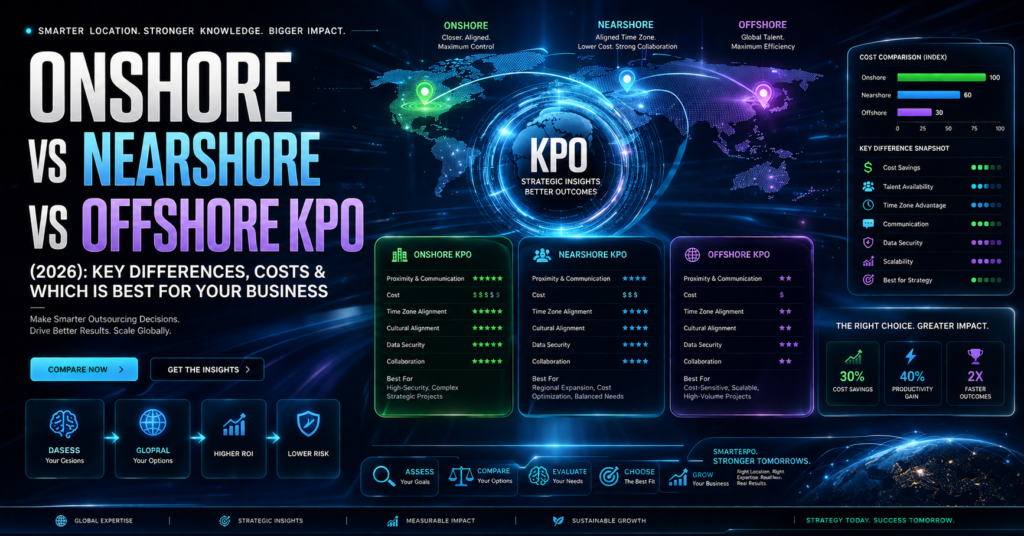
Onshore, nearshore, and offshore KPO differ primarily in cost structure, time-zone alignment, and cultural proximity — not in service quality, which increasingly depends on AI-augmented delivery rather than geography alone. Offshore KPO, particularly in India, delivers 40–60% cost efficiency backed by mature AI infrastructure. Nearshore KPO offers time-zone convenience at a moderate premium. Onshore KPO provides the highest cultural alignment at the highest cost. The more consequential decision for CEOs and CX leaders in 2026 isn’t purely geographic — it’s whether a provider treats every customer conversation as a disposable transaction or as reusable business intelligence that improves retention, forecasting, and revenue. The best BPO companies in India, including AI-first providers like MasCallNet, now combine offshore cost advantages with AI vs human hybrid support — routing routine queries to AI and high-stakes, emotionally-charged, or high-value conversations to trained human agents. This hybrid model, not location alone, determines whether outsourcing protects revenue or quietly erodes it.
Executive Introduction
Every CEO evaluating outsourcing eventually asks the same three questions in a different order: Where should this work be done? Should AI or humans do it? Who is actually good at this?
Most content answers these questions separately. That’s the first mistake. Location, delivery model, and vendor selection are not three decisions — they are one decision viewed from three angles. A company that picks the “right” country but the wrong delivery model will still leak revenue. A company that picks the right AI-human ratio but the wrong vendor will still get inconsistent service. This guide treats the decision as it actually exists inside a boardroom: interconnected, financially material, and too often delegated too far down the org chart.
We call this the Contact Center Intelligence™ view of outsourcing: every customer interaction — regardless of whether it happens onshore, nearshore, or offshore, and regardless of whether an AI agent or a human handles it — either generates usable business intelligence or destroys it. Cost-per-ticket is the metric procurement teams chase. Intelligence-per-interaction is the metric that determines whether your outsourcing investment compounds or decays.
This is a long guide because the decision deserves one. If you’re evaluating onshore vs nearshore vs offshore KPO, weighing AI vs human customer support, or shortlisting the best BPO companies in India, you’ll find direct, usable answers in every section — not vendor marketing dressed up as analysis.
The Market Reality Nobody States Plainly
Direct answer: The global KPO/BPO market is consolidating around three forces simultaneously — cost pressure, AI adoption, and rising customer expectations — and most companies are optimizing for only one of the three, which is why so many outsourcing relationships underperform.
The global business process outsourcing market is projected to exceed $525 billion by 2030, with knowledge process outsourcing growing faster than transactional BPO because enterprises are pushing higher-value, judgment-intensive work offshore — not just data entry and call handling. India remains the largest offshore KPO destination, handling an estimated 56% of global offshore KPO volume, ahead of the Philippines, Eastern Europe, and Latin America combined.
Three shifts are reshaping the 2026 landscape:
1. AI has compressed the cost gap between locations, but not eliminated it. AI-assisted offshore delivery is now cheaper than unassisted onshore delivery by a factor of 4–6x, which means the “AI will replace outsourcing” narrative is backwards — AI is making offshore delivery more attractive, not less, because it amplifies the labor arbitrage rather than replacing it.
2. Customer tolerance for poor service has collapsed. Data from multiple CX benchmarking studies shows that a single bad support interaction now causes measurably higher churn intent than it did five years ago, particularly in subscription, fintech, and eCommerce businesses where switching costs are low.
3. Procurement-led vendor selection is being challenged by operations-led selection. CFOs still control budget, but COOs and Chief Customer Officers increasingly hold veto power because they’re the ones accountable when a cost-optimized vendor produces a CSAT collapse.
Boardroom Insight™: Most companies still run a location decision and a technology decision as two separate procurement processes, sometimes 12–18 months apart. By the time the AI layer gets bolted onto an already-selected offshore team, the operating model is fighting itself. The companies pulling ahead are the ones designing location strategy and AI-human strategy in the same conversation, with the same vendor, from day one.
Key takeaway: Geography, AI adoption, and vendor quality are one decision — treat them separately and you’ll optimize each one against the others.
Onshore vs Nearshore vs Offshore KPO: Definitions That Actually Matter
Direct answer: Onshore KPO keeps operations in your home country; nearshore KPO places them in a neighboring or nearby time-zone-aligned country; offshore KPO places them in a distant, typically lower-cost country such as India, the Philippines, or Vietnam. The real differentiator isn’t distance — it’s the combination of cost, time-zone overlap, cultural fluency, talent depth, and infrastructure maturity.
| Model | Typical Locations (for US/UK/EU clients) | Cost Position | Time-Zone Overlap | Cultural Alignment | Talent Depth for Complex KPO |
|---|---|---|---|---|---|
| Onshore | Same country as HQ | Highest (100% baseline) | Full | Highest | Moderate — high cost limits scale |
| Nearshore | Mexico, Canada, Eastern Europe, LatAm | Moderate (65–80% of onshore) | High to full | Moderate–High | Moderate |
| Offshore | India, Philippines, Vietnam | Lowest (40–60% of onshore) | Partial, managed via shift design | Trained and managed, not native | Highest — especially India for analytical/KPO work |
Executive Interpretation: Onshore buys you comfort. Nearshore buys you convenience. Offshore buys you scale, analytical depth, and margin — provided you select a vendor mature enough to manage the cultural and communication gap deliberately rather than hoping it closes on its own.
What Most Articles Miss: Nearly every comparison article treats “cultural alignment” as something offshore providers simply lack. In practice, the top-tier offshore providers in India now run structured accent-neutralization, cultural-context training, and US/UK market immersion programs that outperform many nearshore teams that assume proximity equals fluency. Proximity is not competence. We’ve observed nearshore engagements fail on cultural assumptions just as often as offshore engagements — the difference is offshore providers know they have to train for it, so the best ones do it rigorously.
Hidden Cost: Companies selecting nearshore purely for time-zone convenience often pay a 20–35% premium for an alignment benefit that a well-designed offshore shift model (with proper handoff protocols and AI-assisted continuity) can replicate at a fraction of the cost.
MasCallNet Perspective: The location decision should be made after you define your service complexity tiers — not before. Tier-1 transactional support can go anywhere with the right AI layer. Tier-2 judgment-based support needs cultural fluency and training investment, wherever it’s located. Tier-3 relationship-critical support (enterprise accounts, high-value collections, regulatory-sensitive interactions) benefits most from a hybrid model where offshore teams handle volume and onshore or highly-trained offshore specialists handle escalation.
Executive Action: Before comparing vendors by country, map your ticket volume by complexity tier. This single exercise, done properly, eliminates 70% of location-decision paralysis.
Why This Decision Is a Revenue Decision, Not a Cost Decision
Direct answer: Outsourcing location and delivery model decisions directly affect retention, customer lifetime value, and forecast accuracy — not just operating cost — which is why treating this as a procurement exercise instead of a revenue exercise is the single most expensive mistake companies make.
This is where Support-Led Revenue Growth™ becomes measurable rather than aspirational. A support interaction is not a cost event; it’s a retention event, an upsell signal, or a churn trigger, depending on how it’s handled. When companies select an outsourcing partner purely on cost-per-hour, they are pricing the wrong variable.
Framework — The Three Revenue Levers of Outsourcing Decisions:
- Retention Lever – Every resolved (or unresolved) ticket shifts renewal probability. A 5-point drop in CSAT in subscription businesses typically correlates with measurable increases in voluntary churn within two billing cycles.
- Expansion Lever – Support conversations surface upsell and cross-sell signals. Vendors optimized purely for average handle time (AHT) train agents to close tickets fast, not to capture these signals — a direct trade-off most contracts never make explicit.
- Forecast Lever – Aggregated conversation data (complaint themes, product friction points, sentiment trends) feeds directly into demand forecasting and product roadmaps — but only if the vendor’s technology stack captures and structures it. Most legacy BPOs don’t.
Table: Cost-Optimized vs Revenue-Optimized Outsourcing
| Dimension | Cost-Optimized Model | Revenue-Optimized Model (Contact Center Intelligence™) |
|---|---|---|
| Primary KPI | Cost per ticket, AHT | CSAT, retention impact, resolution quality |
| Agent Incentive | Ticket volume closed | First-contact resolution + sentiment recovery |
| Data Output | Ticket logs | Structured customer intelligence feeding CRM/product teams |
| Technology Use | Basic ticketing (Zendesk/Freshdesk as system of record only) | Ticketing + AI analytics + CRM (Salesforce/HubSpot) synchronization |
| Executive Visibility | Monthly SLA report | Real-time dashboard tied to revenue metrics |
Boardroom Insight™: The cheapest vendor almost never produces the lowest total cost. Revenue leakage from poor resolution quality, missed upsell signals, and churn from bad experiences routinely exceeds the labor savings from choosing the lowest-cost provider. We’ve seen this pattern across banking, retail, and healthcare engagements repeatedly enough to treat it as a rule, not an exception.
Key takeaway: Price the vendor on the revenue they protect and generate, not just the cost they save.
AI vs Human Customer Support: Resolving the Real Debate
Direct answer: AI customer support is faster, cheaper, and available 24/7, but it underperforms on emotionally complex, high-stakes, or ambiguous issues; human customer support handles nuance and trust-building better but costs more and can’t scale instantly. The highest-performing organizations in 2026 don’t choose one — they deploy a hybrid model where AI handles volume and humans handle value.
This is the question we get asked most by CEOs and CXOs, and it’s usually framed wrong. The real question isn’t “AI or human” — it’s “which conversations create risk if handled by AI, and which create waste if handled by humans?”
Framework — The Conversation Complexity Matrix:
| Conversation Type | Best Handled By | Why |
|---|---|---|
| Order status, password resets, FAQs, tracking | AI Agent | High volume, low ambiguity, zero emotional stakes |
| Billing disputes, refund requests | AI-assisted Human | Needs judgment + policy knowledge |
| Complaints, cancellations, retention saves | Human (AI-supported) | Emotional intelligence directly affects outcome |
| High-value account escalations | Senior Human Specialist | Relationship and revenue risk too high for automation |
| Regulatory/compliance-sensitive queries (banking, insurance, healthcare) | Human with AI compliance-check | Liability and accuracy requirements exceed current AI reliability thresholds |
Table: AI vs Human vs Hybrid Customer Support
| Factor | AI-Only | Human-Only | Hybrid (Recommended) |
|---|---|---|---|
| Cost per interaction | Lowest | Highest | Optimized — 40–65% lower than human-only |
| Availability | 24/7 instantly | Shift-dependent | 24/7 with human escalation coverage |
| Resolution speed (simple queries) | Fastest | Slower | Fast |
| Resolution quality (complex issues) | Weak | Strong | Strong |
| Customer trust in high-stakes moments | Low | High | High |
| Scalability during demand spikes | Instant | Constrained by hiring | Instant, with human overflow |
| Data structuring for analytics | Native | Manual, inconsistent | Native + human-validated |
What Everyone Says: “AI will replace human agents.” What Actually Happens: In every mature deployment we’ve observed, AI doesn’t reduce headcount as much as it reduces the ratio of agents to ticket volume — meaning teams handle more volume with fewer, more skilled agents who spend their time on retention-critical conversations instead of repetitive ones. The agents who get displaced are the ones performing purely repetitive work; the agents who get promoted are the ones who can operate AI-assist tools and handle escalations.
Hidden Cost: Companies that deploy AI chatbots without a well-designed human escalation path see a measurable spike in negative sentiment — not because AI failed, but because customers hit a dead end with no clear path to a human when the AI couldn’t resolve the issue. This single design flaw is responsible for a disproportionate share of the “AI ruined our support” narratives currently circulating.
MasCallNet Perspective: We don’t sell AI or human support — we design the AI Efficiency Index™ for each client, which determines the optimal AI-to-human ratio based on ticket complexity distribution, industry risk profile, and customer expectations. A fintech client and an eCommerce client will land on very different ratios, and forcing a one-size-fits-all AI deployment is how companies damage CSAT while chasing cost savings.
Our customer support outsourcing model is built around exactly this principle — AI handling scale, trained specialists handling judgment, and every interaction feeding a structured intelligence layer back to your business.
Executive Action: Before signing any AI vendor contract, demand to see their escalation design, not just their automation rate. Automation rate without escalation design is a customer experience liability waiting to surface.
Key takeaway: The AI vs human debate is a false binary — the real competitive advantage is in designing the handoff between them.
Best BPO Companies in India: What Separates Leaders from Vendors
Direct answer: The best BPO companies in India in 2026 combine three things simultaneously — mature AI-powered infrastructure, verifiable domain expertise in your industry, and transparent, outcome-tied pricing — rather than competing purely on headcount or hourly rates.
India remains the world’s largest offshore KPO hub for structural reasons that haven’t changed in two decades: the largest English-speaking graduate talent pool globally, mature 24/7 operational infrastructure, strong data-protection frameworks (DPDP Act alignment with GDPR-style principles), and a services ecosystem built specifically around Western business hours and compliance expectations. What has changed is what separates a good vendor from a great one.
MasCallNet Vendor Evaluation Matrix™
Definition: A weighted scoring model for evaluating outsourcing vendors across five dimensions that predict long-term performance better than price alone.
Methodology: Score each vendor 1–5 on each dimension, then apply the weighting shown.
| Dimension | Weight | What to Verify |
|---|---|---|
| AI + Technology Maturity | 25% | Native integration with your CRM/helpdesk (Salesforce, Zendesk, Freshdesk, HubSpot), not bolted-on scripts |
| Industry Domain Expertise | 25% | Vertical experience in your specific industry (healthcare, BFSI, retail, telecom) |
| Data Security & Compliance | 20% | SOC 2, ISO 27001, GDPR/DPDP compliance, documented data handling protocols |
| Transparent Pricing & SLAs | 15% | Pricing tied to outcomes (CSAT, FCR), not just seat hours |
| Scalability & Business Continuity | 15% | Ability to scale from hundreds to thousands of tickets without quality collapse |
Scoring Logic: Multiply each score by its weight; sum for a total out of 5. Vendors scoring below 3.2 typically underperform within the first two quarters of engagement.
Interpretation: Most companies weight price at 40–50% implicitly, even when they claim otherwise. Rebalancing toward technology maturity and domain expertise is the single highest-leverage change a procurement team can make.
Executive Recommendation: Score your top three vendor finalists against this matrix before final negotiation — not after.
What Most Articles Miss: Rankings of “best BPO companies in India” published by generic listicle sites are almost always built on directory submissions and SEO relationships, not verified operational performance. Ask any vendor on such a list for a reference client in your exact industry and vertical use case, and request to speak to that client directly. The response speed and willingness tell you more than any ranking ever will.
What High-Performing Organizations Do Differently: They pilot before they commit. A structured 60–90 day pilot on a defined ticket segment, with pre-agreed success metrics (CSAT, FCR, AHT, escalation rate), removes almost all the risk that traditional multi-year contracts create. Companies that skip the pilot and go straight to full-scale deployment are disproportionately represented among the “outsourcing horror story” cases we’re brought in to fix.
For companies exploring a specific delivery hub, our Call Center in Noida operation is a useful reference point for how AI-powered infrastructure, compliance, and industry specialization come together in a single facility model.
Key takeaway: Evaluate BPO vendors on AI maturity and domain expertise first, price last — the ranking order most companies use is backwards.
MasCallNet Intelligence Frameworks™
These are the proprietary models we use internally and share with clients during evaluation. Each is designed to be applied directly — not just read.
1. MasCallNet Revenue Leakage Model™
Definition: Quantifies revenue lost due to poor support experiences.
Methodology: (Churned Customers Attributable to Support Failure × Average CLV) + (Missed Upsell Signals × Average Expansion Value).
Scoring Logic: Expressed as a percentage of total support-influenced revenue at risk.
Interpretation: Most companies discover 8–15% of retained-revenue exposure sitting in unresolved or poorly-handled tickets.
Executive Recommendation: Run this quarterly, not annually — leakage compounds silently.
2. MasCallNet Contact Center Intelligence Layer™
Definition: The structured data layer that converts raw conversations into reusable business intelligence.
Methodology: Tags every interaction by intent, sentiment, resolution path, and product/service reference.
Scoring Logic: Intelligence Capture Rate = (Structured, Tagged Interactions ÷ Total Interactions) × 100.
Interpretation: Below 60% capture rate means most of your customer data is unusable for decision-making.
Executive Recommendation: Demand this metric from any vendor before signing.
3. MasCallNet Customer Intelligence Loop™
Definition: The closed-loop process where support insights feed product, marketing, and revenue teams, and their responses feed back into support scripts.
Methodology: Insight → Action Owner → Implementation → Measured Outcome → Loop Closure.
Scoring Logic: Loop Closure Rate tracked monthly.
Interpretation: Organizations without a formal loop lose 70%+ of valuable customer insight to email threads that go nowhere.
Executive Recommendation: Assign a named owner for loop closure — insight without ownership dies.
4. MasCallNet Support-to-Revenue Framework™
Definition: Maps support KPIs directly to revenue outcomes.
Methodology: CSAT → Renewal Probability; FCR → Cost-to-Serve; Sentiment Trend → Expansion Readiness.
Scoring Logic: Correlation coefficients calculated per client vertical.
Interpretation: Vertical-specific — fintech renewal sensitivity to CSAT is typically higher than retail.
Executive Recommendation: Present this mapping to your CFO — it reframes support budget as a revenue-protection line item.
5. MasCallNet CX Recovery Engine™
Definition: A structured protocol for recovering at-risk customers post-negative-interaction.
Methodology: Detect (sentiment/AI flag) → Escalate within defined SLA → Senior human intervention → Documented resolution → Follow-up.
Scoring Logic: Recovery Success Rate = Retained Customers ÷ Flagged At-Risk Customers.
Interpretation: Recovery rates above 40% typically indicate a mature escalation design.
Executive Recommendation: Build recovery time-to-response into your SLA — speed matters more than script quality here.
6. MasCallNet AI Efficiency Index™
Definition: Measures whether AI deployment is genuinely improving efficiency or just shifting cost.
Methodology: (Tickets Fully Resolved by AI ÷ Total AI-Handled Tickets) adjusted for CSAT on those tickets.
Scoring Logic: Index above 70 = high-performing deployment; below 50 = AI is creating hidden escalation cost.
Interpretation: A high automation rate with a low index score means AI is closing tickets without solving problems.
Executive Recommendation: Never evaluate AI vendors on automation rate alone.
7. MasCallNet Vendor Evaluation Matrix™
(Detailed above) — used for vendor shortlisting and RFP scoring.
8. MasCallNet Outsourcing Readiness Score™
Definition: Assesses whether an organization is operationally ready to outsource successfully.
Methodology: Scores process documentation, data accessibility, escalation clarity, and internal ownership on a 1–5 scale each.
Scoring Logic: Total score ÷ 20, expressed as a readiness percentage.
Interpretation: Below 60% readiness predicts a rocky first 90 days regardless of vendor quality.
Executive Recommendation: Fix internal readiness gaps before, not during, vendor onboarding.
9. MasCallNet Service Quality Index™
Definition: Composite score combining CSAT, FCR, AHT-adjusted-for-complexity, and escalation accuracy.
Methodology: Weighted average with complexity normalization so simple-ticket-heavy accounts aren’t unfairly advantaged.
Scoring Logic: Benchmarked against vertical-specific industry averages.
Interpretation: Raw CSAT alone is misleading without complexity normalization.
Executive Recommendation: Request this normalized view in every QBR.
10. MasCallNet Revenue Acceleration Framework™
Definition: Identifies proactive revenue opportunities within support interactions (renewal readiness, expansion signals, referral moments).
Methodology: AI-flagged opportunity tagging → Human specialist follow-up → Revenue team handoff.
Scoring Logic: Opportunities Surfaced vs. Opportunities Converted.
Interpretation: Mature programs convert 15–25% of surfaced opportunities.
Executive Recommendation: Treat your contact center as a revenue-generation channel with its own pipeline, not just a cost center with a budget.
Boardroom Insight™: None of these frameworks require exotic technology — they require discipline and ownership. Most companies already have the data. They’ve simply never structured it to answer these questions.
MasCallNet Readiness Assessment™
Direct answer: Before evaluating vendors or locations, assess your own operational readiness — most failed outsourcing engagements fail because of internal gaps, not vendor selection errors.
Quick Self-Assessment (score 1–5 each):
| Readiness Factor | Score (1–5) |
|---|---|
| Documented processes and escalation paths exist | ___ |
| Historical ticket/complaint data is accessible and structured | ___ |
| A named internal owner exists for the vendor relationship | ___ |
| Success metrics are defined before vendor selection begins | ___ |
| Leadership has aligned on AI-human ratio philosophy | ___ |
Interpretation: 20–25: Ready to move fast. 13–19: Fix 2–3 gaps before RFP. Below 13: Internal alignment work needed first — no vendor can compensate for undefined success criteria.
Common Executive Mistakes We See Repeatedly: Leadership approves an outsourcing budget without agreeing internally on what “success” looks like beyond cost reduction. Six months in, Sales says CSAT dropped, Support says cost targets were hit, and Finance says the contract is technically performing — because nobody defined a shared scorecard upfront.
Practical Recommendation: Complete this assessment with COO, CX, and Finance leadership in the same room before issuing an RFP.
CX Maturity Scorecard™
Direct answer: Organizations fall into four maturity stages, and the right outsourcing model differs meaningfully by stage.
| Stage | Characteristics | Recommended Model |
|---|---|---|
| Reactive | Support is purely ticket-closing; no data structuring | Offshore + AI-first automation to stabilize cost and volume |
| Organized | SLAs exist; some reporting, limited cross-team insight sharing | Offshore/nearshore hybrid with structured QBR reporting |
| Integrated | Support data informs product/marketing decisions | Contact Center Intelligence™ model with dedicated analytics layer |
| Predictive | Support data feeds forecasting and revenue planning | Full Customer Intelligence Loop™ with AI-human hybrid at scale |
Executive Interpretation: Most mid-market companies sit at “Organized” and assume they need “Predictive” technology — when they actually need disciplined data structuring first. Buying advanced AI analytics before fixing basic process documentation is a common, expensive sequencing error.
Key takeaway: Match your outsourcing sophistication to your actual CX maturity stage, not your ambition for it.
Comparison Tables That Drive Real Decisions
In-House vs Outsourced
| Factor | In-House | Outsourced |
|---|---|---|
| Cost Structure | Fixed, high (salaries, infra, tools) | Variable, scalable |
| Scaling Speed | Slow (hiring cycles) | Fast (contractual scaling) |
| Domain Control | Highest | Requires strong vendor governance |
| Technology Investment | Fully borne internally | Often included in vendor stack |
| Best For | Highly regulated, IP-sensitive core functions | Volume-driven, scalable customer-facing functions |
Recommendation: Keep strategic, relationship-owning roles in-house; outsource volume-driven and process-defined functions.
Build vs Buy (AI Capability)
| Factor | Build In-House AI | Buy via Outsourcing Partner |
|---|---|---|
| Time to Deploy | 9–18 months | 4–8 weeks |
| Upfront Investment | High (engineering, data science team) | Low–moderate (subscription/managed service) |
| Ongoing Maintenance | Internal team required | Vendor-managed |
| Best For | Companies with AI as core product differentiator | Companies where AI is an operational enabler, not core IP |
Recommendation: Unless AI-driven support is your core product, buy the capability through a mature partner and redirect engineering resources to your actual differentiation.
Dedicated Team vs Shared Team
| Factor | Dedicated Team | Shared Team |
|---|---|---|
| Cost | Higher | Lower |
| Brand Familiarity | Deep, consistent | Moderate, rotational risk |
| Scalability | Slower to flex | Faster to flex |
| Best For | High-touch, complex, brand-sensitive support | Overflow, seasonal, low-complexity volume |
Traditional BPO vs Contact Center Intelligence™
| Factor | Traditional BPO | Contact Center Intelligence™ Model |
|---|---|---|
| Primary Metric | Cost per ticket | Revenue protected + intelligence generated |
| Data Output | Ticket logs, monthly SLA report | Structured, cross-functional intelligence feed |
| Technology Approach | Basic ticketing tools | AI-integrated CRM + analytics stack |
| Executive Reporting | Operational | Strategic, tied to CFO/CRO metrics |
| Client Relationship | Vendor | Extension of the revenue organization |
Boardroom Insight™: Most companies are still buying “Traditional BPO” while being sold the language of “Contact Center Intelligence.” Ask any vendor to show you the actual dashboard your executive team would receive monthly — not the sales deck version.
Benchmark Analysis & Industry Statistics
- Offshore KPO cost savings versus onshore equivalents: 40–60%, according to multiple industry cost-benchmarking studies.
- India’s share of global offshore KPO delivery volume: ~56%.
- Companies deploying structured AI-human hybrid support report 25–40% reduction in average handle time without CSAT decline, versus AI-only deployments which frequently show CSAT decline on complex queries.
- First-contact resolution (FCR) improvements of 15–20% are commonly reported within the first two quarters of a well-managed hybrid deployment.
- Gartner and Deloitte research consistently identifies customer experience as a top-three investment priority for enterprise leadership through 2026, ahead of pure cost reduction — a reversal from the prior decade’s outsourcing rationale.
Industry Benchmark Table
| Metric | Industry Average | High-Performer Benchmark |
|---|---|---|
| CSAT | 78% | 90%+ |
| First Contact Resolution | 65% | 85%+ |
| Average Handle Time (complex query) | 9–11 min | 5–7 min (AI-assisted) |
| Cost per Resolved Ticket (offshore, hybrid) | $2.50–$4.00 | $1.50–$2.50 |
| Agent Attrition (offshore contact centers) | 30–35% annually | Under 20% (top-tier vendors) |
MasCallNet Perspective: Attrition is the most underrated benchmark in vendor evaluation. High attrition destroys institutional knowledge, and institutional knowledge is exactly what feeds the Customer Intelligence Loop™. A vendor with 35%+ attrition cannot deliver consistent intelligence, no matter how good their technology stack looks in a demo.
Case Study: From Cost Center to Revenue Function
Challenge: A mid-market eCommerce retailer scaling from 2,000 to 10,000 monthly support tickets was running an in-house team that couldn’t scale hiring fast enough, resulting in response times exceeding 24 hours during peak periods and visible cart-abandonment-driven complaints on social channels.
Root Cause: No structured escalation model, zero AI triage, and a support team measured purely on tickets closed per day — incentivizing speed over resolution quality, which drove repeat contacts and compounded volume.
Solution: A hybrid offshore deployment combining AI-first triage for order status and shipping queries (approximately 55% of total volume) with trained human specialists handling billing disputes, refunds, and retention-risk conversations, integrated directly with the client’s existing Shopify and Zendesk stack.
Implementation: A 60-day pilot on a defined ticket segment, with weekly performance reviews against pre-agreed CSAT and FCR targets, followed by phased full-volume migration over 90 days. Details of our approach are documented further in our outsource call center services case work.
Results:
- Response time reduced from 24+ hours to under 2 hours for standard queries
- CSAT improved from 71% to 89% within four months
- Cost per resolved ticket reduced by 48%
- Support-attributed retention improved measurably, with the client’s own churn analysis attributing a portion of quarter-over-quarter retention improvement directly to faster resolution times
Lessons Learned: The AI layer wasn’t the differentiator — the escalation design was. The client’s previous automation attempt had failed because it lacked a clear human handoff; ours succeeded because the handoff was designed before the AI was deployed, not after.
Full documentation of comparable engagements is available in our BPO case studies India library.
Pricing Analysis & Cost Calculator
Direct answer: Offshore KPO pricing in India typically ranges from $8–$18 per agent-hour for standard support, $15–$30 per agent-hour for specialized KPO/analytical work, and outcome-based models priced per resolved ticket or per CSAT-tier achieved — significantly below onshore equivalents of $25–$45 per agent-hour.
| Pricing Model | Typical Range (Offshore India) | Best For |
|---|---|---|
| Per-hour (FTE-based) | $8–$18/hour standard; $15–$30/hour specialized KPO | Predictable, steady volume |
| Per-ticket | $1.50–$4.00/resolved ticket | Variable volume, transactional support |
| Outcome-based (CSAT/FCR-tied) | Base + performance bonus/penalty | Organizations prioritizing quality over pure cost |
| Dedicated team (monthly retainer) | Varies by team size and skill tier | High-touch, brand-sensitive functions |
MasCallNet Cost Calculator Framework
Formula: Estimated Monthly Cost = (Ticket Volume ÷ Agent Productivity Rate) × Blended Hourly Rate × Shift Multiplier
Where:
- Agent Productivity Rate = average tickets resolved per agent per hour by complexity tier (typically 4–8 for simple, 1–3 for complex)
- Blended Hourly Rate = weighted average of AI-assisted and human hourly costs
- Shift Multiplier = 1.0 for single-shift, up to 1.3 for 24/7 coverage due to night-shift and redundancy staffing
Worked Example: 10,000 monthly tickets, 60% simple (AI-first) / 40% complex (human-handled), blended rate $14/hour, productivity rate 6/hour simple and 2/hour complex:
- Simple: 6,000 tickets ÷ 6 = 1,000 hours × $10/hr (AI-heavy blended rate) = $10,000
- Complex: 4,000 tickets ÷ 2 = 2,000 hours × $18/hr (human-heavy blended rate) = $36,000
- Estimated monthly cost: ~$46,000, versus an estimated $110,000–$140,000 for an equivalent onshore in-house team at comparable service levels.
Executive Interpretation: The gap isn’t just labor arbitrage — it’s the productivity multiplier AI creates on the simple-ticket tier, which frees budget to invest more per-hour in the complex-ticket tier where human judgment actually matters.
ROI Framework
Direct answer: ROI on outsourcing should be calculated across three time horizons — immediate cost savings (0–3 months), efficiency compounding (3–12 months), and revenue protection/generation (12+ months) — because measuring only the first horizon systematically undervalues the investment.
MasCallNet ROI Model
Formula: ROI (%) = [(Cost Savings + Revenue Protected + Revenue Generated) − Total Program Cost] ÷ Total Program Cost × 100
| Horizon | Primary Value Driver | Typical Contribution to Total ROI |
|---|---|---|
| 0–3 months | Direct labor cost savings | 30–40% |
| 3–12 months | AHT/FCR efficiency gains, reduced escalation cost | 25–35% |
| 12+ months | Retention improvement, expansion revenue via Revenue Acceleration Framework™ | 30–40% |
Boardroom Insight™: Companies that terminate vendor evaluation at the 90-day mark based purely on cost savings are measuring roughly a third of the actual return. The revenue-protection horizon, which is where Revenue Recovery Through CX™ delivers its largest impact, takes 9–12 months to fully materialize and is the horizon most frequently ignored in vendor performance reviews.
Key takeaway: Don’t judge an outsourcing partnership’s ROI before month nine — you’re only seeing the smallest third of the value.
Industry Use Cases
Banking & Financial Services: High-volume transactional queries (balance inquiries, transaction disputes) handled via AI-first triage; regulatory-sensitive escalations (fraud claims, loan disputes) routed to trained human specialists with compliance certification. Digital banking services increasingly require real-time fraud-flag escalation built directly into the AI layer.
Insurance: Claims status inquiries automated; claims adjudication disputes and renewal retention conversations handled by human specialists trained on policy nuance.
Retail & eCommerce: Order tracking, returns, and exchanges automated at scale during peak seasons; cart-abandonment recovery and VIP customer retention handled by dedicated human teams integrated with Shopify/WooCommerce and Stripe/PayPal transaction data.
Healthcare: Appointment scheduling and reminder workflows automated; clinical-adjacent queries and insurance verification handled by trained specialists under strict compliance protocols. See our dedicated healthcare BPO services resource and patient appointment scheduling services for hospital-specific implementation detail.
FMCG: Distributor and retailer query handling, order processing support, and consumer complaint triage at high volume with seasonal scaling needs.
Automotive & EV: Service appointment scheduling, warranty query handling, and increasingly, EV-specific technical support requiring specialized agent training on charging infrastructure and battery-related queries.
Telecommunications: Extremely high-volume transactional support (billing, plan changes) ideal for aggressive AI automation, paired with human retention teams for competitive win-back and churn-prevention calls.
Aviation & Logistics: Real-time shipment/flight status automation, disruption-related complaint handling requiring rapid human escalation due to high emotional stakes and time sensitivity.
Technology Ecosystem
Direct answer: A modern outsourcing partner must integrate natively with your existing CRM, helpdesk, cloud infrastructure, and AI layer — not require you to rebuild your stack around their tools.
| Category | Representative Platforms | Role in Delivery |
|---|---|---|
| CRM | Salesforce, HubSpot | Customer history, revenue context for agents |
| Helpdesk/Ticketing | Zendesk, Freshdesk, Intercom | Ticket routing, SLA tracking |
| Contact Center Infrastructure | Genesys, Five9, Talkdesk, NICE CXone | Omnichannel routing, workforce management |
| Cloud Infrastructure | AWS, Google Cloud, Microsoft Azure | Data hosting, scalability, security |
| AI/LLM Layer | OpenAI, Google Gemini, Claude, Copilot | Conversational AI, agent-assist, summarization |
| Internal Collaboration | Slack, Microsoft Teams, ServiceNow | Escalation workflows, cross-team handoff |
| Commerce Integration | Shopify, WooCommerce, Stripe, PayPal | Order, payment, and transaction context for support agents |
MasCallNet Perspective: Integration depth matters more than tool count. A vendor connected to your Zendesk instance at a surface level (manual ticket export) delivers a fraction of the value of one with native API-level integration feeding real-time data into the automating business processes layer of your operation.
Security & Compliance
Direct answer: Any BPO handling customer data must demonstrate SOC 2 Type II or ISO 27001 certification, GDPR compliance for EU data subjects, India’s DPDP Act compliance for domestic data handling, and industry-specific frameworks (HIPAA for healthcare, PCI-DSS for payment data) — verified through documentation, not vendor assurances alone.
| Requirement | Applies To | What to Request |
|---|---|---|
| SOC 2 Type II | All vendors handling customer data | Current audit report |
| ISO 27001 | Enterprise-scale engagements | Certification and scope statement |
| GDPR | EU customer data | Data processing agreement (DPA) |
| DPDP Act (India) | Data processed in India | Compliance documentation |
| HIPAA | Healthcare KPO | Business Associate Agreement (BAA) |
| PCI-DSS | Payment-related support | Compliance certificate, scope of cardholder data access |
Executive Action: Request a signed DPA and current audit reports before contract execution — not after go-live. This is one of the most commonly skipped steps in fast-tracked outsourcing decisions, and it’s the one that creates the largest downstream liability.
The India Advantage
Direct answer: India remains the leading offshore KPO destination in 2026 due to the combination of the world’s largest English-speaking graduate talent pool, mature 24/7 delivery infrastructure, cost efficiency of 40–60% versus onshore alternatives, and increasingly sophisticated AI-integrated delivery models — not merely low labor cost.
What’s changed over the past five years is the sophistication of the talent being deployed. Indian KPO providers are no longer competing purely on transactional support volume; the country’s analytical and judgment-based KPO segment (financial research, healthcare data management, legal process outsourcing, and AI-assisted customer intelligence) has grown faster than transactional BPO for several consecutive years.
What Most Articles Miss: The “India advantage” narrative usually stops at cost and English proficiency. The more important advantage in 2026 is India’s AI talent density — the same graduate pipeline producing customer support agents is also producing the data scientists and AI engineers building the automation layer sitting on top of that support delivery. This means Indian providers building AI-first support models aren’t bolting a Western AI tool onto an offshore call center — many are building and customizing the AI layer domestically, with direct access to the underlying engineering talent.
Learn more about how this comes together in practice through our AI-powered BPO company India overview, or explore our customer support outsourcing company India services directly.
Risk Analysis
Direct answer: The three highest-probability risks in onshore/nearshore/offshore KPO decisions are data security exposure, service quality degradation from high vendor attrition, and business continuity failure — each mitigated through specific, verifiable contractual and operational safeguards, not assumptions.
| Risk | Likelihood | Impact | Mitigation |
|---|---|---|---|
| Data security breach | Moderate | Severe | Verified certifications, DPA, regular security audits |
| High agent attrition degrading quality | High (industry-wide) | Moderate–High | Contractual attrition caps, dedicated team model for critical functions |
| Business continuity disruption (natural events, infrastructure failure) | Low–Moderate | Severe | Multi-site redundancy, documented BCP/DR plans |
| Cultural/communication misalignment | Moderate | Moderate | Structured onboarding, pilot period, escalation protocol testing |
| Over-automation damaging CX | High (self-inflicted) | High | AI Efficiency Index™ monitoring, human escalation design review |
| Vendor lock-in with poor exit terms | Moderate | High | Data portability clauses, defined transition-out SLAs in contract |
Boardroom Insight™: The risk most boards focus on (data security) is usually the most heavily mitigated one contractually. The risk most boards ignore (over-automation damaging CX) is self-inflicted, entirely within the client’s control, and currently the fastest-growing cause of outsourcing dissatisfaction we encounter.
The Future: Human + AI Contact Center Intelligence
Direct answer: By 2027–2028, the dominant customer support model will be fully hybrid — AI agents and voice bots handling first-line resolution and triage, agent-assist tools guiding human specialists in real time, and predictive analytics identifying at-risk customers before they contact support at all.
This is where Contact Center Intelligence™ stops being a philosophy and becomes infrastructure. The technologies converging to make this possible:
- AI Agents & Voice Bots handling increasingly complex first-line resolution, moving beyond scripted FAQ responses into contextual, CRM-aware conversations.
- Agent Assist tools providing real-time suggested responses, sentiment alerts, and compliance guardrails to human agents mid-conversation.
- Predictive Analytics flagging churn risk and expansion opportunity before a customer initiates contact, shifting support from reactive to proactive.
- Workflow Automation connecting support resolution directly to backend systems (refund processing, order adjustments) without manual handoff.
- Knowledge Management systems that update in real time based on newly resolved edge cases, rather than static, quarterly-updated documentation.
- Human Escalation Models that are explicitly designed rather than reactive — the defining characteristic of mature hybrid operations.
- Conversation Intelligence extracting theme, sentiment, and intent trends across thousands of interactions to inform product and business strategy.
MasCallNet Perspective: The organizations that will win this decade aren’t the ones that automate the most — they’re the ones that build the tightest Customer Intelligence Loop™ between support conversations and business decision-making. Automation without a feedback loop is just faster ticket closure. Automation with a feedback loop is a genuine competitive advantage.
Key takeaway: The future isn’t AI replacing human support — it’s AI making every human conversation more valuable by handling everything that doesn’t require one.
Executive Decision Tree
Start here:
- Is your support volume under 500 tickets/month?
→ Yes: Consider in-house or small dedicated onshore/nearshore team.
→ No: Continue. - Is more than 50% of your ticket volume simple/transactional?
→ Yes: Prioritize AI-first offshore deployment.
→ No: Continue. - Does your industry carry high regulatory/compliance sensitivity (BFSI, healthcare, insurance)?
→ Yes: Hybrid model with certified human specialists for sensitive queries, offshore AI-first for transactional volume.
→ No: Continue. - Is time-zone real-time overlap a hard requirement (e.g., live sales support)?
→ Yes: Nearshore or offshore with shift-aligned coverage.
→ No: Offshore delivers the strongest cost-to-quality ratio. - Do you have internal readiness (documented processes, defined success metrics)?
→ No: Complete MasCallNet Outsourcing Readiness Score™ before proceeding.
→ Yes: Proceed to Vendor Evaluation Matrix™ scoring for shortlisted partners.
Executive Checklist
- Mapped ticket volume by complexity tier
- Completed MasCallNet Outsourcing Readiness Score™
- Defined success metrics beyond cost (CSAT, FCR, retention impact)
- Scored finalist vendors on the Vendor Evaluation Matrix™
- Verified security certifications (SOC 2, ISO 27001, DPDP/GDPR)
- Reviewed vendor’s AI escalation design, not just automation rate
- Requested attrition rate data from vendor
- Structured a 60–90 day pilot with pre-agreed metrics before full commitment
- Aligned COO, CX, and Finance leadership on shared scorecard
- Confirmed data portability and exit terms in the contract
- Established a named internal owner for the vendor relationship
- Reviewed CRM/helpdesk integration depth (Salesforce, Zendesk, Freshdesk, HubSpot compatibility)
Frequently Asked Questions
1. What is the difference between onshore, nearshore, and offshore KPO?
Onshore keeps operations in your home country at the highest cost; nearshore places them in a nearby, time-zone-aligned country at moderate cost; offshore places them in a distant, typically lower-cost country like India, delivering 40–60% cost savings backed by mature AI infrastructure.
2. Is offshore KPO in India still cost-effective in 2026?
Yes. Despite wage inflation in India’s KPO sector, AI-assisted delivery has increased productivity per agent enough to maintain a 40–60% cost advantage over onshore alternatives.
3. Should I choose AI or human customer support?
Neither exclusively. High-performing organizations route routine, high-volume queries to AI and reserve human agents for complex, emotionally sensitive, or high-value interactions — a hybrid model outperforms either extreme.
4. How do I identify the best BPO companies in India for my business?
Evaluate on AI/technology maturity, verified industry-specific experience, security certifications, and transparent outcome-tied pricing — not headcount size or generic rankings. Request reference clients in your exact vertical.
5. What does outsourced customer support typically cost?
Offshore pricing in India ranges from $8–$18/hour for standard support and $15–$30/hour for specialized KPO work, versus $25–$45/hour for onshore equivalents.
6. How long does it take to onboard an outsourcing partner?
A well-structured pilot typically takes 30–60 days to design and launch, with full-scale migration completed over 60–120 days depending on ticket complexity and integration requirements.
7. Can AI customer support handle complex or emotional customer issues?
Not reliably yet. AI performs well on structured, low-ambiguity queries but underperforms on complaints, cancellations, and emotionally charged interactions where human judgment materially affects the outcome.
8. What industries benefit most from KPO in India?
Banking and financial services, insurance, healthcare, retail/eCommerce, telecommunications, and logistics all show strong outsourcing ROI, particularly where high transactional volume can be automated and complex cases routed to trained specialists.
9. What certifications should a BPO vendor have?
At minimum, SOC 2 Type II or ISO 27001, plus industry-specific compliance (HIPAA for healthcare, PCI-DSS for payment handling, DPDP Act/GDPR alignment for data protection).
10. How is ROI measured for outsourced customer support?
Across three horizons: immediate cost savings (0–3 months), operational efficiency gains (3–12 months), and revenue protection/generation through retention and expansion (12+ months). Judging ROI before month nine significantly undervalues the investment.
11. What’s the biggest risk in offshore outsourcing?
Not data security, which is heavily contracted and audited — the most underestimated risk is over-automation damaging customer experience due to poorly designed AI escalation paths.
12. Is nearshore always better for time-zone alignment than offshore?
Not necessarily. A well-designed offshore shift model with proper handoff protocols can replicate time-zone convenience at significantly lower cost than a nearshore premium.
13. How do I know if my company is ready to outsource?
Assess documented processes, data accessibility, defined success metrics, and internal ownership before starting vendor evaluation — readiness gaps, not vendor selection, cause most failed engagements.
14. What’s the ideal AI-to-human ratio for customer support?
It varies by industry and complexity distribution — typically 50–70% AI-handled for transactional-heavy businesses like retail and telecom, and lower for regulated industries like banking and healthcare where compliance risk is higher.
15. Can a BPO integrate with my existing CRM and helpdesk tools?
Mature providers integrate natively with platforms like Salesforce, HubSpot, Zendesk, and Freshdesk rather than requiring you to change your existing technology stack.
16. What happens if my outsourcing engagement underperforms?
A well-structured contract includes defined SLAs, a pilot period with measurable exit criteria, and data portability clauses that allow for corrective action or transition without operational disruption.
17. Does outsourcing customer support hurt customer experience?
Only when poorly designed. Well-managed hybrid outsourcing with proper AI escalation design and vendor governance frequently improves CSAT versus under-resourced in-house teams.
18. How does MasCallNet differ from a traditional BPO?
MasCallNet is built around structured intelligence capture from every interaction, not just ticket closure — every conversation feeds a Customer Intelligence Loop™ that informs retention, product, and revenue decisions, not just a monthly SLA report.
Conclusion
The onshore vs nearshore vs offshore decision, the AI vs human customer support debate, and the search for the best BPO company in India are not three separate evaluations — they are one strategic decision that determines whether your customer support function protects revenue or quietly erodes it.
Offshore KPO in India remains the strongest cost-to-capability combination available in 2026, provided the vendor treats AI as an amplifier of human judgment rather than a replacement for it. The organizations winning this decade are applying Contact Center Intelligence™ thinking: every interaction, wherever it happens and whoever handles it, is either generating reusable business intelligence or wasting it.
If you’re evaluating this decision for your organization, the frameworks in this guide — the Vendor Evaluation Matrix™, the Outsourcing Readiness Score™, the ROI Model, and the Decision Tree — are designed to be used directly, with or without our involvement. That’s a deliberate choice. The companies that engage us tend to be the ones who’ve run these exercises internally and want a partner capable of executing at the standard the frameworks demand.
If that describes where your organization is, our team is available to walk through your specific ticket volume, complexity distribution, and industry requirements, and show you exactly where the Revenue Leakage Model™ would place your current operation. Explore our customer support outsourcing services or contact our team directly for a working session, not a sales pitch.