
AI Call Center Solutions in India (2026): Reduce Customer Support Costs with Automation & BPO
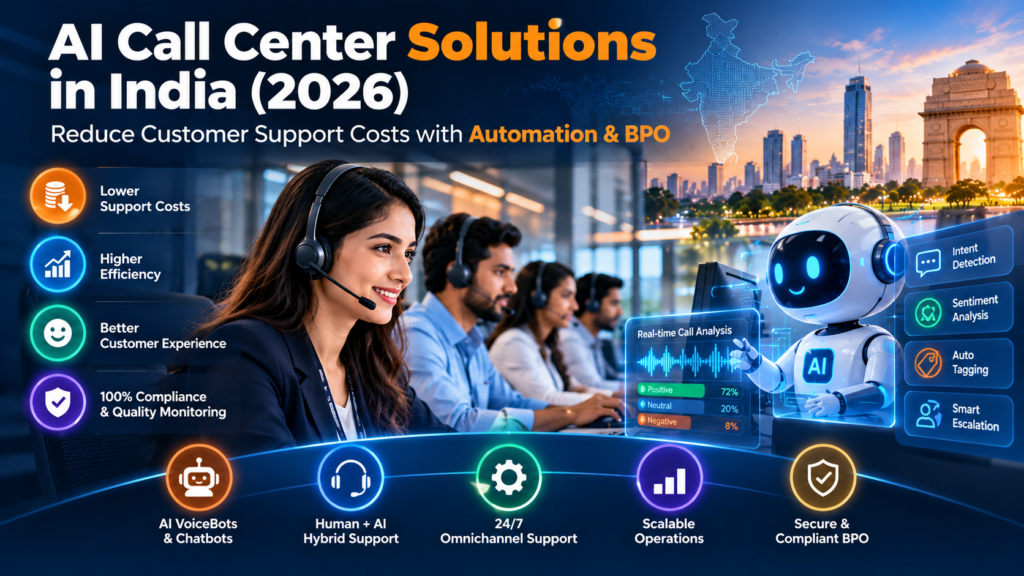
AI Overview: AI call center solutions in India combine conversational AI, voice bots, intelligent routing, agent-assist, automated quality assurance, analytics, and human BPO delivery to reduce the cost of resolving customer issues while maintaining service quality. For most enterprises, the practical model is not “AI instead of people”; it is a hybrid operating model in which AI handles predictable, high-volume work and trained human teams handle exceptions, complex cases, escalations, sales, collections, and compliance-sensitive interactions.
For businesses evaluating customer support in 2026, the key question is no longer simply how much an agent costs. The more useful question is: How much does it cost to resolve a customer issue end-to-end, and how much of that work can be automated, assisted, or outsourced without increasing repeat contacts or risk?
This guide explains how AI-powered call center solutions in India work, where they reduce operating costs, how AI and BPO fit together, what enterprises should automate first, how to calculate ROI, and what to evaluate before selecting an AI-enabled contact center partner.
In this guide
- What Are AI Call Center Solutions?
- How AI Reduces Customer Support Costs
- The AI + Human BPO Operating Model
- AI Voice Bots
- CallMaster™ and Conversation Intelligence
- Industry Use Cases
- AI Call Center ROI
- How to Choose an AI Call Center Partner in India
- 90-Day Implementation Plan
- Frequently Asked Questions
What Are AI Call Center Solutions?
AI call center solutions are technologies and operating processes that use artificial intelligence to understand customer interactions, automate routine tasks, assist human agents, identify risk, and generate operational insights.
A modern AI-enabled contact center can combine:
- AI voice bots and conversational AI
- Interactive voice response (IVR) and intelligent call routing
- Natural language processing and intent classification
- Agent-assist and real-time knowledge recommendations
- Automatic call summarization and dispositioning
- AI-powered quality assurance and conversation analytics
- Sentiment, intent, escalation and churn-risk detection
- Predictive analytics and workforce insights
- CRM, ticketing and workflow integrations
- Human BPO teams for complex, high-value and exception-driven interactions
The important distinction is that AI is not simply another chatbot added to an existing call center. The strongest operating model connects automation to the people, processes, systems and governance that already determine customer outcomes.
Why Indian Businesses Are Moving Toward AI + BPO Contact Centers in 2026
Traditional call center economics are largely linear: more interactions require more agent hours, supervisors, QA effort, training and infrastructure. AI changes that equation by allowing selected activities to scale without a proportional increase in manual effort.
However, pure automation is not appropriate for every customer interaction. Complex complaints, financial disputes, sensitive escalations, retention conversations, technical exceptions and compliance-sensitive processes still require human judgment.
That is why a hybrid AI-human model is increasingly relevant: automate predictable work, assist agents where human judgment remains necessary, and use BPO delivery to provide scalable operational capacity.
How AI Reduces Customer Support Costs
Cost reduction should be measured at the resolution level rather than by looking only at headcount or Average Handle Time (AHT). A system that reduces AHT but causes customers to call again has not necessarily reduced the true cost of support.
| AI lever | What it changes | Business impact |
|---|---|---|
| Self-service & deflection | Routine interactions handled without an agent | Lower assisted-contact volume |
| AI voice bots | Automated voice conversations for defined intents | 24/7 capacity and lower manual workload |
| Agent assist | Knowledge, prompts and next actions during calls | Lower handling effort and faster resolution |
| Auto-summary & disposition | Automates after-call documentation | Less paid administrative time |
| AI quality assurance | Analyzes conversations at scale | Greater QA coverage with targeted human review |
| Intent & root-cause analytics | Identifies recurring demand drivers | Fewer repeat issues and better process design |
| Predictive routing | Routes customers based on intent, urgency or value | Better use of specialist capacity |
Cost Per Contact vs Cost Per Resolution
One of the most important changes in evaluating AI call center solutions is moving from cost per contact to cost per resolution.
Cost per contact = Total support cost ÷ total customer interactions
Cost per resolution = Total support cost ÷ customer issues resolved end-to-end
Suppose an AI bot reduces the number of calls reaching agents but customers frequently call again because the bot could not resolve the issue. The contact-center dashboard may show improved containment, while the business is actually creating additional demand.
For an enterprise buyer, the better question is therefore not “What percentage of calls can AI answer?” but “What percentage of eligible customer issues can AI resolve correctly without increasing repeat contacts, complaints or escalations?”
The AI + Human BPO Operating Model
A practical AI-powered call center normally operates across three lanes:
| Lane | Best suited for | Typical examples |
|---|---|---|
| Automate | Stable, predictable, low-risk tasks | Order status, appointment confirmation, simple FAQs, payment reminders |
| Assist | Human-led interactions where AI can reduce effort | Knowledge search, summaries, next-best action, script adherence |
| Human-first | Complex, sensitive or high-risk cases | Disputes, fraud escalation, retention, complex complaints, regulated decisions |
This model avoids a common implementation mistake: automating a process because it is technically possible rather than because it is operationally suitable.

AI Voice Bots: Where They Deliver the Most Value
AI voice bots are particularly useful when an organization has high volumes of repetitive, structured conversations. They can operate outside traditional business hours and can handle large campaign spikes without requiring an equivalent increase in agent capacity.
Common AI voice bot use cases
- Appointment booking and reminders
- Order and delivery updates
- Payment reminders and collections workflows
- Lead qualification
- Customer surveys and feedback
- Renewal reminders
- Outbound follow-ups
- Basic troubleshooting and information capture
- Call-back scheduling
The strongest implementations also include an immediate escalation path. When an intent is outside the bot’s approved scope, the interaction should move to a human agent with the relevant context rather than forcing the customer through the same questions again.

AI Agent Assist: Reduce Cost Without Removing Human Expertise
Agent-assist is often a lower-risk starting point than fully autonomous customer-facing AI. The customer still speaks to a trained agent, while AI works in the background to make the agent faster and more consistent.
Depending on the workflow, agent-assist can:
- Surface relevant knowledge-base information
- Recommend approved responses
- Identify missing information
- Generate call summaries
- Suggest next-best actions
- Flag compliance or script deviations
- Detect sentiment changes and escalation risk
This is particularly useful in BFSI, insurance, healthcare, telecom and other environments where an incorrect answer can create a much larger downstream cost than a longer call.
AI-Powered Quality Assurance: Move Beyond Sampling
Traditional contact center QA relies heavily on manual sampling. AI can analyze a much larger proportion of conversations and identify interactions that require human attention.
Useful AI QA dimensions include:
- Script adherence
- Mandatory disclosure compliance
- Customer sentiment
- Agent behavior and communication quality
- Intent classification
- Escalation indicators
- Complaint or dispute signals
- Call outcome and disposition accuracy
The objective is not to remove human QA entirely. It is to use automation to identify patterns and high-risk conversations so human QA and coaching resources are concentrated where they add the most value.
What CallMaster™ Adds to an AI-Enabled Contact Center
CallMaster™ is Mas Callnet’s conversation intelligence platform designed to connect customer conversations with quality, compliance and operational intelligence.
Its capabilities include conversation analysis, real-time auditing, sentiment and intent analysis, escalation-risk identification, automated tagging and performance insights. The platform is designed to work alongside human contact center operations rather than treating AI and BPO as separate systems.
For enterprises, this creates a feedback loop: conversations generate structured intelligence; intelligence improves agent performance and workflows; improved workflows reduce avoidable effort; and the resulting data helps management identify recurring customer and process problems.
AI Call Center Solutions for BFSI, FinTech and Collections
Financial services are among the areas where AI-enabled contact centers can create significant operational value, but they also require stronger governance.
Typical use cases include:
- Customer service for accounts, cards and loans
- EMI and repayment reminders
- Collections calling and PTP analysis
- Fraud and dispute escalation
- Customer onboarding and verification support
- Loan application support
- Digital banking assistance
- Compliance monitoring and conversation audits
In collections, for example, AI can classify customer intent, identify promise-to-pay signals, detect dispute language and prioritize conversations for human intervention. In customer service, AI can handle routine informational interactions while routing complex complaints to trained specialists.
Mas Callnet’s BFSI contact center solutions combine customer support, collections, automation and conversation intelligence for financial-services operations.
AI Call Center Solutions for E-commerce and Retail
E-commerce support has a different operational profile: high interaction volume, seasonal peaks and a large number of repetitive queries.
AI can assist with:
- Order status and delivery updates
- Returns and refund workflows
- Payment-related questions
- Product information
- Abandoned-cart follow-up
- Customer feedback
- Order confirmation
- Escalation management
The BPO layer becomes particularly valuable during festive periods, product launches and other demand spikes because the organization can add operational capacity without permanently carrying the full peak-season headcount.
AI Call Center Solutions for Healthcare
Healthcare support requires a different balance between automation and human interaction. Appointment scheduling, reminders, basic administrative information and follow-up workflows can often be structured for automation, while clinical, sensitive or ambiguous conversations should be routed according to defined escalation rules.
The principle is simple: automate administration, not judgment that requires qualified human involvement.
AI Call Center Solutions for Telecom, Insurance, Logistics and Automotive
AI-enabled contact center workflows can also support industries where customer volume and repetitive service events are high.
| Industry | Potential AI-enabled workflows |
|---|---|
| Telecom | Plan queries, service requests, renewals, retention and technical triage |
| Insurance | Policy support, renewal reminders, claim-status assistance and customer communication |
| Logistics | Delivery status, appointment coordination, exception handling and customer notifications |
| Automotive & EV | Service appointments, lead follow-up, test-drive scheduling and ownership support |
| Consumer electronics | Troubleshooting, warranty support, service requests and product information |
How Much Can an AI Call Center Save?
There is no responsible single percentage that applies to every business. Savings depend on interaction mix, automation eligibility, AHT, wage rates, repeat contacts, technology costs, integration complexity, service levels and governance requirements.
A credible business case should model specific mechanisms rather than promising a generic “AI savings percentage.”
Example ROI model
Assume a company has 60,000 monthly customer interactions. Instead of assuming that AI will save a fixed percentage, model:
- Eligible interactions for automation
- Successful resolution rate for those interactions
- Agent minutes avoided
- After-call work minutes eliminated
- QA productivity improvement
- Change in repeat-contact rate
- Implementation and integration costs
- AI platform and telecom costs
- Human BPO cost for the remaining workload
Net annual benefit = avoided operating cost + productivity value + avoided rework − implementation cost − recurring technology cost − governance cost.
This model is more useful for CFOs and procurement teams than a headline claim because every assumption can be tested against actual operational data.
AI Call Center vs Traditional BPO
| Dimension | Traditional BPO | AI-enabled BPO |
|---|---|---|
| Scaling | Primarily headcount-driven | Combination of automation and flexible staffing |
| QA | Manual sampling | AI-assisted conversation analysis plus human review |
| After-call work | Agent-driven | Can be partially automated |
| Routing | Rule-based or queue-based | Can incorporate intent and customer context |
| Insights | MIS and periodic reports | Conversation-level analytics and trend detection |
| 24/7 capability | Requires staffing coverage | Can combine AI availability with human coverage |
| Human role | Primary interaction layer | Complexity, empathy, judgment and escalation layer |
AI Call Center vs In-House Customer Support
Building an in-house operation gives an organization direct control but also creates responsibility for hiring, training, workforce management, QA, technology, telecom, information security, infrastructure and peak-capacity planning.
An AI-enabled BPO can provide these capabilities as a managed operating model. The right comparison therefore should include the fully loaded cost of the internal operation, not only agent salaries.
| Cost component | In-house | AI + BPO model |
|---|---|---|
| Recruitment | Internal responsibility | Provider responsibility |
| Training | Internal | Shared/provider-led depending on SOW |
| QA & supervision | Build internally | Included in managed operation or priced separately |
| Technology | Buy/integrate/manage | Can be provided or integrated by partner |
| Peak capacity | Permanent capacity or temporary hiring | Can use flexible delivery capacity |
| AI optimization | Internal capability required | Can be provided by AI-enabled BPO |
How to Choose an AI Call Center Partner in India
Do not select a provider based only on per-agent pricing. Evaluate the complete operating model.
1. Ask what is actually automated
“AI-powered” can mean anything from a basic chatbot to real-time conversation intelligence and automated workflows. Ask which specific tasks are automated and how performance is measured.
2. Ask how human escalation works
A good solution should define exactly when an AI interaction moves to a human, what information is transferred, and how the customer avoids repeating the conversation.
3. Evaluate QA coverage
Ask whether conversations are sampled or analyzed comprehensively, which compliance rules are checked, and how exceptions reach supervisors.
4. Examine integrations
Review integration with your CRM, ticketing system, telephony, knowledge base and operational systems. Automation that cannot update the underlying workflow often becomes another disconnected tool.
5. Validate information security
Ask about access control, recording, encryption, data retention, incident management, employee access, audit trails and applicable contractual and regulatory requirements.
6. Demand measurable KPIs
Define KPIs before implementation: FCR, AHT, repeat-contact rate, escalation rate, CSAT, QA score, abandonment, service level, conversion or recovery rate, and cost per resolution.
What to Automate First: A Practical Decision Framework
Score each process against four dimensions:
- Volume: How frequently does the interaction occur?
- Predictability: Is the workflow stable and rule-based?
- Risk: What happens if the AI makes a mistake?
- Measurability: Can successful resolution be objectively verified?
High-volume, predictable, low-risk and measurable tasks are usually the strongest candidates for early automation.
90-Day AI Call Center Implementation Plan
| Period | Focus | Key activities |
|---|---|---|
| Days 1–15 | Baseline | Map volumes, intents, AHT, repeat contacts, costs and risks |
| Days 15–30 | Design | Select automation candidates, escalation rules, integrations and KPIs |
| Days 30–60 | Pilot | Deploy selected AI workflows with controlled human escalation |
| Days 60–75 | Optimize | Review accuracy, repeat contacts, sentiment, QA and exceptions |
| Days 75–90 | Scale | Expand successful workflows and formalize governance |
Security, Compliance and Governance
AI does not remove accountability. Organizations still need clear controls for customer data, access, recordings, retention, model behavior, human escalation and incident response.
For regulated industries, governance should be designed before automation goes live. This includes approved knowledge sources, role-based access, audit trails, escalation thresholds, human review requirements and a process for updating AI knowledge when policies change.
Mas Callnet states that its operations are supported by ISO 27001:2022-aligned information security practices, with security and compliance controls incorporated into its contact center operating model. Specific client requirements should always be validated during solution design and contracting.
Why the Future of Customer Support Is Hybrid
The most useful way to think about AI in customer service is not as a replacement for the contact center. It is as a new operating layer.
AI can absorb repetitive work, assist agents, analyze conversations and surface patterns. Human teams provide empathy, judgment, negotiation, exception handling and accountability. BPO provides scalable operational execution.
Combined correctly, these capabilities create a contact center that can scale without relying exclusively on linear headcount growth.
Why Businesses Work With Mas Callnet for AI-Powered Contact Center Operations
Mas Callnet combines contact center operations, BPO/KPO capabilities and AI-enabled conversation intelligence. Its contact center services cover inbound customer service, outbound engagement, technical support, omnichannel operations, AI-assisted QA and industry-specific workflows.
The operating approach is designed around a combination of people, process and technology rather than treating automation as an isolated software purchase.
For organizations evaluating a managed model, this can include:
- Inbound and outbound customer support
- AI voice bot workflows
- Cloud telephony and contact center technology
- Human agent delivery
- Conversation intelligence through CallMaster™
- AI-assisted quality monitoring
- Collections and recovery operations
- Sales, upsell and retention support
- Back-office and KPO processes
- Industry-specific customer operations
Frequently Asked Questions About AI Call Center Solutions in India
What is an AI call center?
An AI call center combines artificial intelligence with contact center technology and human operations to automate routine customer interactions, assist agents, analyze conversations and improve service workflows.
Can AI replace human call center agents?
AI can automate selected tasks, but it does not eliminate the need for human agents in complex, sensitive, high-value or exception-driven interactions. A hybrid model is often more practical because automation and human expertise serve different parts of the customer journey.
How does AI reduce call center costs?
AI can reduce costs by deflecting eligible contacts, automating voice interactions, reducing after-call work, assisting agents, automating parts of QA and identifying root causes that create repeat contacts.
What is the difference between an AI call center and a traditional BPO?
A traditional BPO is primarily a human-operated delivery model. An AI-enabled BPO combines human delivery with automation, conversation intelligence, workflow integration and AI-assisted quality and analytics.
Is AI call center outsourcing suitable for BFSI companies?
It can be, provided the solution includes appropriate security, governance, human escalation, auditability and compliance controls. BFSI organizations can use AI for customer service, collections, onboarding support, reminders, classification and conversation monitoring while retaining human control over sensitive cases.
How do I calculate AI call center ROI?
Start with your current total support cost, interaction volume, AHT, after-call work, repeat-contact rate and cost per resolution. Then model specific savings from automation, agent productivity and QA efficiency while including technology, integration, governance and BPO costs.
What should I ask an AI call center vendor before signing?
Ask what is automated, what remains human, how escalations work, how customer context is transferred, what integrations are available, how conversations are audited, how data is protected, what KPIs are contractually measured and how the solution scales during demand peaks.
Can an AI call center support multiple languages in India?
Yes. Multilingual voice and digital support can be designed into the operating model, subject to the language capabilities of the selected AI technology and the availability of trained human agents for escalation and complex interactions.
Related Mas Callnet Resources
Continue the research with these related Mas Callnet guides:
- AI-Powered Call Center Cost Reduction in India (2026): Cut Costs, Scale Support & Improve ROI
- How to Reduce Customer Support Costs in 2026: AI & Outsourcing Strategy
- Average Customer Support Resolution Time in 2026: Benchmarks, Root Causes and How to Reduce TTR
- FinTech Customer Support Outsourcing in 2026: AI-Powered 24/7 CX, Compliance & BPO Guide
- eCommerce Customer Support Outsourcing for Peak Season (2026)
Evidence & Further Reading
The operating principles in this guide are consistent with current contact-center AI documentation and industry guidance. Google Cloud documents virtual agents that can handle voice or chat interactions and escalate sessions to human agents when needed. IBM describes contact-center AI as a combination of automation and AI assistance for human representatives. Salesforce’s 2026 India analysis describes the shift toward AI-enabled, scalable contact-center operations.
- Google Cloud: Virtual agents and human escalation
- IBM: What is contact center AI?
- Salesforce India: Contact Centre Automation in India
Explore the relevant Mas Callnet solution areas: Contact Center Services · 360° Customer Support · Customer Experience Management · Business Process Automation · BFSI Solutions · Insurance Solutions · Retail & eCommerce · CallMaster™
Final Takeaway
AI call center solutions in India are most valuable when they reduce the cost of resolving customer issues—not simply the number of people answering phones.
The strongest operating model combines three capabilities: AI for repetitive and predictable work, human experts for complex interactions, and BPO infrastructure for scalable execution.
If your organization is evaluating customer support cost reduction, automation, outsourcing or a hybrid contact center model, start with your actual interaction data. Identify the highest-volume intents, measure repeat contacts and cost per resolution, then determine which workflows should be automated, assisted or kept human.
Mas Callnet can help assess the current operation and design an AI + human customer support model around your volumes, processes, technology stack and business objectives.
Talk to Mas Callnet about your AI-powered contact center strategy →