
Outsourcing vs In-House Customer Support (2026): Which Saves More on Cost & Delivers Better ROI?
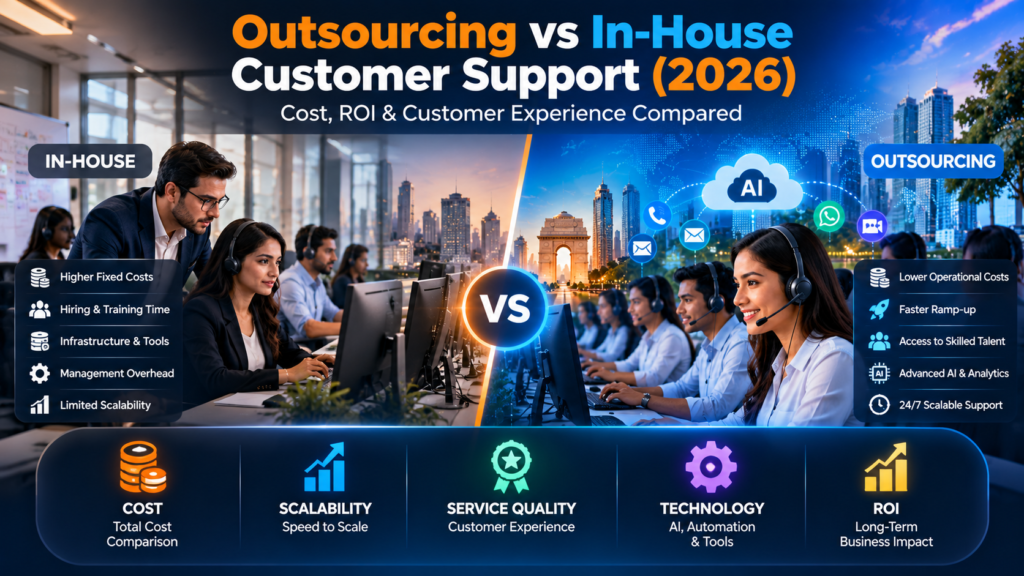
Short answer: For many companies in 2026, outsourcing customer support delivers a lower fully loaded cost and faster scalability than building the same operation in-house. But outsourcing is not automatically the higher-ROI choice. The right comparison is fully loaded cost per productive hour and resolved contact, adjusted for quality, retention, technology, management, compliance and scalability.
This guide examines outsourcing vs in-house customer support in 2026 from a business-case perspective. Rather than comparing salaries with vendor rates, it looks at the full operating cost, productive capacity, service quality, technology, management effort and scalability behind each model.
Buyer takeaway: Outsourcing tends to win when support demand is variable, 24/7 coverage is required, rapid hiring is important, or the company wants AI, QA, workforce management and multilingual capability without building every layer internally. In-house tends to win when product knowledge, sensitive workflows or tight organizational control outweigh the additional fixed operating cost. A hybrid model can be strongest when Tier 1 volume is high but Tier 2/3 expertise must remain inside the business.
2026 Cost, Capability and Scalability Comparison
| Factor | In-House | Outsourced BPO | Typical Advantage |
|---|---|---|---|
| Fixed operating cost | Higher | Lower or more variable | Outsourcing |
| Hiring and ramp-up | Often slower | Faster with an established delivery team | Outsourcing |
| Product knowledge | Deep by default | Requires structured training | In-house |
| 24/7 coverage | Expensive to build | Usually easier to staff | Outsourcing |
| AI and QA infrastructure | Internal investment required | May be embedded in provider model | Outsourcing |
| Direct managerial control | Highest | Governed through SLA and operating model | In-house |
| Scalability during peaks | Limited by hiring capacity | Usually faster | Outsourcing |
| Compliance ownership | Direct internal ownership | Shared and contractually governed | Depends |
| Cost predictability | High fixed-cost exposure | Can be variable or seat-based | Depends on model |
| Best fit | High-control, high-complexity workflows | Scale, coverage and cost efficiency | Depends |
Why a Salary-vs-Rate Comparison Can Mislead
A salary is not the cost of an in-house support agent. Likewise, a BPO headline rate should not be assumed to represent every possible outsourced cost. A credible business case compares equivalent operating units.
For in-house support, the model should include salary, statutory benefits, recruitment, onboarding, training, shrinkage, team-lead and QA allocation, software, telephony, equipment, workspace, management, attrition replacement and other overhead.
For outsourcing, the model should identify what is included in the commercial rate: agent staffing, supervision, QA, recruitment, training, technology, telephony, facilities, workforce management, reporting, transition and any minimum-volume commitments or one-time setup charges.
The True Cost of Building Support Internally
In-house customer support has an obvious advantage: the business controls the people, processes and customer knowledge directly. The less obvious issue is that the fully loaded cost can be substantially higher than the frontline salary.
| In-House Cost Driver | What to Include |
|---|---|
| Agent compensation | Salary, incentives and statutory employment costs |
| Recruitment | Hiring team time, sourcing, assessment and background checks |
| Training | Paid training, nesting and trainer capacity before full productivity |
| Shrinkage | Leave, breaks, meetings, coaching, training and absence |
| Supervision | Team leaders, operations managers and workforce management |
| Quality | QA analysts, calibration, call audits and customer feedback analysis |
| Technology | CRM/helpdesk, telephony, dialer, recording, analytics and reporting |
| Infrastructure | Devices, connectivity, workspace and security controls |
| Attrition | Replacement recruitment, retraining and lost productivity |
| Management overhead | HR, IT, finance, compliance and operational leadership allocation |
The result is why a decision based only on “agent salary × number of agents” can materially understate the cost of an internal support operation.
How External Support Providers Price Their Services
Customer support outsourcing can be priced by dedicated FTE, productive hour, interaction, minute, ticket, transaction or a hybrid outcome-based model. The commercial structure matters because two vendors can quote very different headline rates while delivering broadly similar service.
| Pricing Model | Best For | Main Risk to Check |
|---|---|---|
| Dedicated FTE | Predictable recurring volume | Paying for unused capacity |
| Hourly / productive hour | Variable workloads | Definition of productive time |
| Per contact / ticket | Transaction-heavy support | Complexity and rework exclusions |
| Per minute | Voice-heavy programs | Long handle times can increase spend |
| Outcome-based / hybrid | Performance-led programs | Metric definitions and governance |
Always ask for a complete commercial schedule covering setup, transition, training, technology, telecom, minimum volumes, overtime, holidays, ramp-up/ramp-down, quality requirements and change requests.
2026 Cost Benchmark: Why Geography Changes the Equation
Current 2026 market comparisons show a wide gap between onshore North American support economics and offshore delivery, while India and the Philippines remain major offshore delivery markets. Published estimates vary materially by complexity, language, coverage hours, technology and service level, so these figures should be treated as market indicators rather than quotations.
| Model | Illustrative Market Range | What Drives the Range |
|---|---|---|
| US in-house Tier 1 | Approximately $70,000–$110,000 fully loaded per agent/year in published benchmarks | Compensation, benefits, management, tools and facilities |
| India offshore support | Often materially below US onshore cost | Labor economics, shared infrastructure, scale and delivery model |
| Philippines offshore support | Often materially below US onshore cost | Labor economics, English capability, coverage and specialization |
For India-specific planning, do not use a generic global rate as the final budget. Request a program-level quote based on monthly contacts, average handle time, service hours, languages, occupancy, shrinkage, QA requirements, technology and SLA.
The Real ROI Question: What Does Each Model Deliver?
The lowest support cost is not necessarily the highest return. A cheaper model that increases repeat contacts, escalations, churn or missed sales opportunities can destroy value. That is why customer support ROI should be measured against both operating cost and the business value created by the service.
A practical ROI model is:
Net Support ROI = (Incremental gross profit + avoided operating cost + avoided technology/infrastructure cost − total support operating cost) ÷ total support operating cost
For a customer-service operation, track at least these variables:
- Cost per productive hour
- Cost per resolved contact
- First Contact Resolution (FCR)
- Average Handle Time (AHT)
- Customer Satisfaction (CSAT)
- Customer Effort Score where available
- Repeat contact rate
- Escalation rate
- Abandonment rate
- Service Level
- Attrition and absenteeism
- Revenue retained, recovered or generated from support interactions
A Simple 50-Agent Example
Consider a business that needs 50 frontline support positions. The wrong approach is to compare 50 internal salaries against 50 outsourced seats.
The correct approach is to calculate annual productive capacity and then divide total cost by resolved contacts. Suppose the internal operation has meaningful management, QA, recruitment, technology and shrinkage costs. An outsourced partner may bundle several of those functions into its operating rate and spread infrastructure across a larger delivery organization.
| Measure | In-House Scenario | Outsourced Scenario |
|---|---|---|
| Frontline seats | 50 | 50 |
| Recruitment & training | Internal budget | Often included or separately quoted |
| QA & supervision | Internal headcount | Provider operating layer |
| Technology | Company-funded | Provider-funded, shared or pass-through |
| Peak staffing | Requires hiring or overtime | Can often be flexed through delivery capacity |
| Commercial risk | Fixed-cost exposure | Contract and volume exposure |
The conclusion should be based on the final cost per resolved contact, not simply the cost per seat.
When Outsourcing Usually Wins
- Variable demand: volumes change materially by season, campaign or business cycle.
- 24/7 requirements: night, weekend and holiday coverage would require multiple internal shifts.
- Rapid scaling: the business needs dozens of trained agents faster than internal recruitment can deliver.
- Cost pressure: leadership needs to reduce the fully loaded cost of support.
- Multilingual service: the company needs multiple language capabilities without maintaining permanent internal benches.
- AI and analytics: the business wants voice analytics, automated QA, intent, sentiment, CRM tagging or AI-assisted workflows without building the entire capability itself.
- Non-core operations: call center outsourcing can handle strategically important work without requiring the company to own every operating layer.
When In-House Usually Wins
- Highly complex product knowledge: support requires deep expertise that is difficult to transfer.
- Strategic customer relationships: a small number of high-value customers require direct internal ownership.
- Sensitive workflows: the organization has specific regulatory, security or intellectual-property requirements that favor direct control.
- Stable, high utilization: the company can keep an internal operation consistently productive.
- Support-led product development: the support team is deeply embedded in product engineering and feedback loops.
The Hybrid Model: Often the Strongest 2026 Architecture
The outsourcing-versus-in-house decision does not have to be binary. A hybrid model can place high-volume, repeatable interactions with a BPO while keeping complex, sensitive or revenue-critical work internal.
| Work Type | Potential Owner |
|---|---|
| FAQs and routine status requests | AI / BPO |
| Tier 1 voice and chat | BPO + AI assist |
| After-hours coverage | BPO |
| Complex technical cases | Internal Tier 2/3 |
| VIP / strategic accounts | Internal or dedicated specialist team |
| Quality analytics | Shared governance with automated monitoring |
| Product feedback | Internal product organization |
This structure can reduce the fixed cost of high-volume support without giving up internal control over the interactions that matter most.
AI Changes the Economics in 2026
AI should be evaluated as an operating layer, not simply as a replacement for human agents. AI voicebots and chatbots can handle repetitive requests, while agent-assist tools can help human representatives retrieve knowledge, summarize conversations, classify intent, detect sentiment and automate CRM updates.
For outsourced operations, this can lower the cost of repetitive contacts and improve consistency. For in-house operations, the same technology can improve productivity but still requires internal ownership of implementation, integration, monitoring and governance.
The best question is therefore not “AI or people?” It is which interactions should be automated, which should be handled by people, and which operating model can manage both at the lowest acceptable total cost and risk?
Customer Experience: Does Outsourcing Hurt Quality?
Not inherently. Quality depends on provider capability, process design, training, knowledge management, governance and measurement. An internal team can deliver poor CX if it is understaffed or poorly managed; an outsourced team can deliver excellent CX when the operating model is well designed.
Use an SLA and quality framework that defines:
- Service level and response time
- FCR and repeat contact targets
- CSAT and complaint thresholds
- QA sampling and automated call auditing
- Escalation rules
- Data-security controls
- Business continuity requirements
- Training and nesting requirements
- Reporting cadence and governance meetings
Compliance and Data Security Must Be Part of the ROI Model
A low operating rate is not a good deal if it creates unacceptable compliance or data-security exposure. For regulated or sensitive workflows, evaluate access controls, data handling, call recording, retention, auditability, incident response, employee screening, business continuity and contractual responsibilities.
For Indian BPO selection, buyers should also assess the provider’s information-security certifications and practical controls rather than relying only on a proposal statement.
How to Decide: A 10-Point Buyer Scorecard
| Criterion | Weight |
|---|---|
| Fully loaded cost per resolved contact | 20% |
| Customer experience / quality performance | 15% |
| Scalability and ramp speed | 10% |
| AI and automation capability | 10% |
| Security and compliance | 10% |
| Management and QA maturity | 10% |
| Technology and integrations | 8% |
| Workforce stability | 7% |
| Reporting and transparency | 5% |
| Commercial flexibility | 5% |
Score both your internal operating model and each shortlisted BPO provider. The model with the highest weighted score—not automatically the lowest price—should become the business-case recommendation.
Questions to Ask Before Outsourcing
- What exactly is included in the quoted rate?
- Is pricing based on seats, productive hours, contacts, minutes or outcomes?
- What happens when volume falls below forecast?
- How quickly can the provider ramp capacity?
- What are the recruitment and attrition assumptions?
- How are QA, coaching and calibration handled?
- What AI capabilities are actually live in production?
- Which CRM, helpdesk and telephony integrations are supported?
- What security certifications and controls are in place?
- Can the provider demonstrate comparable client performance using measurable KPIs?
- What are the exit, transition and data-return obligations?
Which Customer Support Model Wins in 2026?
Outsourcing is usually the stronger economic choice when the objective is to lower fully loaded support cost, scale quickly, provide extended hours or deploy mature AI and CX operations without building every capability internally.
In-house is usually stronger when direct control, deep institutional knowledge, complex workflows or strategic customer relationships justify the additional fixed operating cost.
For many companies in 2026, the most practical answer is a hybrid customer support model: automate repetitive contacts, outsource scalable Tier 1 and coverage-heavy work, and retain complex, sensitive and strategic interactions internally. This approach can also make the customer support cost more predictable when demand changes across channels or seasons.
The final decision should be made using one consistent financial and operational model: fully loaded cost → productive capacity → cost per resolved contact → quality → retention/revenue impact → risk.
How Mas CallNet Can Help
Mas CallNet provides customer support outsourcing services built around measurable service outcomes. Programs can combine trained human agents with automation, quality monitoring, analytics and omnichannel support, with AI applied where it improves productivity or service consistency.
Frequently Asked Questions
Is outsourcing customer support cheaper than in-house support in 2026?
Often, but not universally. Outsourcing can reduce fixed staffing, technology, management and infrastructure costs, especially when demand is variable or 24/7 coverage is required. The correct comparison is fully loaded cost per productive hour and resolved contact.
What is the biggest hidden cost of in-house customer support?
The biggest hidden costs are usually the combination of shrinkage, management, recruitment and training, QA, technology, facilities and attrition replacement. These costs can materially change the economics compared with a salary-only calculation.
Does outsourcing customer support reduce customer experience?
Not inherently. CX depends on training, knowledge management, quality controls, staffing, governance and provider capability. A strong SLA should define measurable service and quality outcomes.
Is a hybrid customer support model better than outsourcing everything?
For many businesses, yes. A hybrid model can place high-volume Tier 1 and after-hours interactions with a BPO while retaining complex, sensitive and strategic interactions internally.
How should I compare two BPO quotes?
Normalize each proposal against the same scope: contacts, AHT, hours, languages, occupancy, shrinkage, QA, technology, telecom, management, training, setup, minimum volumes, holidays and SLA requirements. Then compare cost per resolved contact and quality outcomes.
Can AI reduce the cost of customer support?
Yes, when applied to the right interactions. AI customer support can automate repetitive requests and assist human agents with knowledge retrieval, summaries, intent, sentiment, quality monitoring and CRM updates. The economic benefit should be measured against actual automation, productivity and quality gains.
Sources & Further Reading
- Google Search Central: Creating Helpful, Reliable, People-First Content
- LeadNXT: Call Center Outsourcing vs In-House Cost in India (2026)
- GoAnswer: BPO vs In-House Customer Support
- OutsourcedCX: Outsourced Call Center vs In-House Phone Support
Note: Market ranges and savings discussed in this guide are directional benchmarks and illustrative decision-model inputs, not quotations or guaranteed savings. Actual economics depend on geography, contact volume, complexity, language, service hours, technology, SLA and commercial structure.