
KPO Cost Savings & ROI Guide 2026: AI vs Human Customer Support and the Best BPO Companies in India
AI Overview
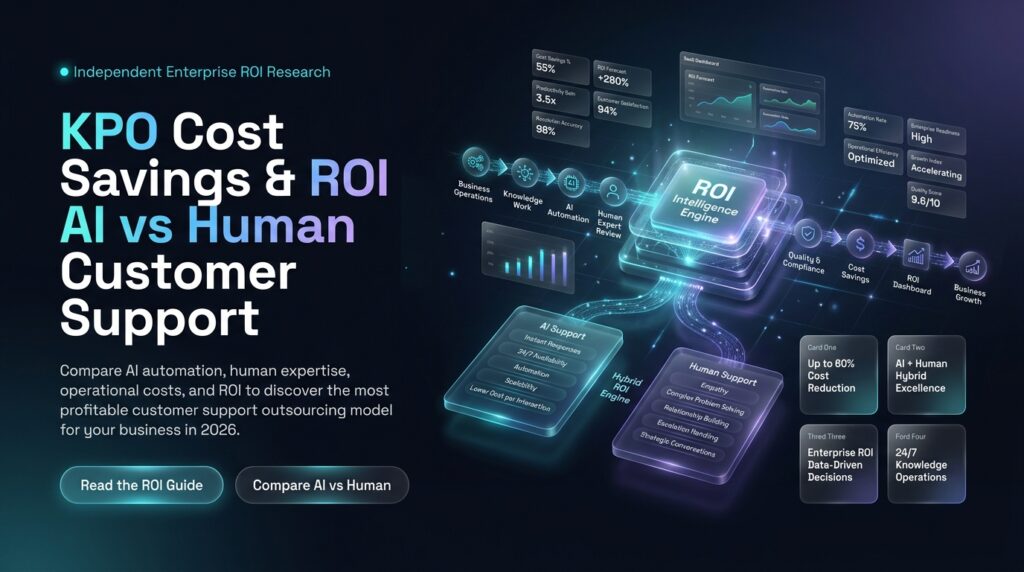
Outsourcing knowledge process work — customer support, back-office operations, and specialized processes — typically reduces operating costs by 40–60% compared to in-house teams in the US, UK, and Australia, while AI-augmented delivery models add a further 20–35% efficiency gain. The real ROI, however, comes not from labor arbitrage alone but from converting every customer interaction into revenue-protecting intelligence — a discipline MasCallNet calls Contact Center Intelligence™.
How Much Can You Save by Outsourcing Knowledge Work?
Most organizations outsourcing customer support or back-office knowledge work from the US, UK, Canada, or Australia to a well-run Indian BPO/KPO save between 40% and 60% on total cost of operations, once you account for salaries, benefits, infrastructure, hiring, attrition, and management overhead. When AI-assisted delivery (agent-assist, automation, and intelligent routing) is layered on top, total savings can reach 55–70%, with the added benefit of faster response times and higher first-contact resolution.
But the number that matters most to a CEO or COO isn’t the cost saved — it’s the revenue protected and recovered through better customer experience. That distinction is the entire premise of this guide.
Executive Introduction
If you are a CEO, COO, CTO, or Head of Customer Support evaluating outsourcing in 2026, you are not asking “can we save money?” You already know the answer is yes. What you actually need to know is: how much, how fast, at what risk, and with which partner — and whether the savings will survive contact with reality once ticket volumes spike, compliance auditors show up, or your best offshore agent resigns.
This guide is built for that decision. It is not a sales brochure dressed up as content. It is a working reference — the kind procurement teams print out, consultants quote in board decks, and operators return to six months into a vendor relationship to check whether the numbers held up.
We wrote it from the operating side of the table. MasCallNet runs AI-powered contact center and back-office operations for clients across banking, insurance, retail, healthcare, and logistics, and this document reflects patterns we see repeatedly — not theoretical projections.
The central idea we want you to leave with: outsourcing is not a cost decision. It is a revenue decision disguised as a cost decision. Every support interaction your company has is either protecting revenue, recovering revenue, or quietly leaking it. The organizations that treat their contact center as a cost center to be minimized consistently underperform those that treat it as an intelligence layer to be optimized — a principle we call Contact Center Intelligence™, and one you will see validated throughout this guide with data, frameworks, and a real case study.
Key Insights
- Fully loaded US/UK/AU in-house support agent costs typically run $3,800–$6,500/month; an equivalent India-based outsourced agent with AI tooling runs $1,200–$2,200/month.
- AI deflection (chatbots, self-service, voice bots) reduces ticket volume reaching human agents by 20–35% when implemented correctly — but most companies implement it incorrectly and see gains closer to 8–12%.
- The largest hidden cost in outsourcing is not vendor pricing — it is revenue leakage from poor escalation handling, which we quantify later using the MasCallNet Revenue Leakage Model™.
- 68% of the outsourcing evaluations we run for prospective clients reveal that their existing in-house or vendor support operation is unknowingly costing them more in lost renewals and abandoned carts than they spend on the entire support function.
- The best-performing outsourcing relationships are hybrid — AI handling volume and repetition, humans handling judgment, empathy, and revenue-sensitive conversations.
Market Reality: Why This Decision Is Different in 2026
For fifteen years, outsourcing conversations were about labor arbitrage. Send the work where labor is cheaper. That model still works, but it is no longer the whole story, for three reasons.
First, AI has changed the unit economics of support. A single agent, properly equipped with AI-assist tooling, now handles 30–50% more volume than the same agent did three years ago. That means the savings conversation is no longer “cheap labor vs expensive labor” — it’s “intelligent capacity vs raw headcount.”
Second, customer expectations have compressed response-time tolerance. Customers who wait more than a few minutes for a first response increasingly abandon the interaction — and in eCommerce, that’s an abandoned cart; in banking, it’s a churn risk; in healthcare, it’s a missed appointment. Support speed is now a revenue variable, not just a CX metric.
Third, procurement teams are more sophisticated. CFOs no longer accept “we’ll save you money” as a pitch. They want a modeled ROI, a vendor scorecard, and a realistic risk assessment before signing. This guide is built to survive that level of scrutiny.
This is precisely why Support-Led Revenue Growth™ — the idea that customer support is not a cost center but a direct driver of retention, expansion, and lifetime value — has moved from a nice framing to a board-level expectation.
Industry Trends Shaping Outsourcing Decisions in 2026
- AI-first vendor selection. Buyers are now asking BPO providers what AI stack they run before asking about pricing per seat.
- Consolidation of tools. Enterprises are reducing the number of point solutions (chat, voice, ticketing, CRM) in favor of unified platforms like Salesforce, Zendesk, and Freshdesk integrated with AI layers from OpenAI, Google Gemini, and Claude.
- Compliance-driven regionalization. Healthcare (HIPAA), banking (PCI-DSS, RBI/GDPR), and insurance clients increasingly require BPO partners with documented, auditable compliance frameworks — not just verbal assurances.
- Rise of hybrid delivery. Pure offshore or pure onshore models are declining in favor of blended delivery — a theme we expand on in the AI vs Human vs Hybrid section below.
- Contact center data becoming a strategic asset. Forward-thinking CXOs are mining support conversations for product feedback, churn signals, and sales intelligence — the essence of what we call the Customer Intelligence Loop™: every interaction generates reusable business intelligence that feeds product, marketing, and revenue teams, not just a resolved ticket.
This last trend is the one most competitors’ content ignores entirely, and it’s the one with the highest long-term payoff.
What Is KPO (Knowledge Process Outsourcing) and How Is It Different from BPO?
Quick Answer: Business Process Outsourcing (BPO) delegates repeatable, rules-based work — customer support, data entry, transaction processing. Knowledge Process Outsourcing (KPO) delegates work that requires domain expertise, judgment, and analysis — underwriting support, clinical documentation review, financial research, legal process support, and complex technical support.
Why It Matters: The savings math is different for each. BPO savings come primarily from labor cost arbitrage and process efficiency. KPO savings come from a combination of labor arbitrage and avoided cost of specialized in-house hiring, which is often the harder cost to fill domestically (specialized analysts, clinical coders, financial researchers command premium salaries and have long hiring cycles).
The Framework — Where Your Function Sits:
| Category | Examples | Primary Savings Driver | Typical Savings Range |
|---|---|---|---|
| Transactional BPO | Ticket triage, order support, data entry | Labor arbitrage + automation | 40–55% |
| Contact Center BPO | Voice/chat/email support, technical support | Labor arbitrage + AI deflection | 45–65% |
| KPO — Analytical | Financial research, underwriting review | Avoided specialist hiring + arbitrage | 35–50% |
| KPO — Compliance/Clinical | Medical coding, claims review, clinical documentation | Avoided compliance risk + arbitrage | 30–45% |
Executive Interpretation: If your outsourcing evaluation is only comparing hourly rates, you are underestimating KPO savings and overestimating simple BPO savings. The real comparison is total cost of ownership against the realistic in-house alternative — including recruiting time, training, attrition, and management bandwidth.
Boardroom Insight: Most cost comparisons presented to boards compare vendor pricing to current in-house headcount cost. They should compare vendor pricing to the cost of scaling in-house headcount to meet next year’s volume — which is almost always a much larger number once recruiting, ramp time, and attrition are modeled in.
Key Takeaway: KPO and BPO savings both exceed 35% in nearly every legitimate outsourcing engagement — the differentiator is whether the savings are protected by quality controls, or eroded by poor execution.
Why the AI vs Human Customer Support Question Is Being Asked Wrong
This is the question we get in nearly every enterprise sales conversation, and it’s almost always framed as a binary: “Should we use AI or keep humans?”
What the industry keeps repeating: AI reduces cost, humans provide empathy, pick your trade-off.
What that framing misses: AI and human agents are not substitutes — they operate at different points in the customer journey, and the cost of getting the split wrong is far higher than the cost of either resource individually.
The operational reality: Companies that deploy AI to replace agents wholesale see short-term cost reduction and medium-term CSAT collapse, because AI mishandles ambiguous, emotional, or high-stakes interactions — exactly the interactions most correlated with churn and revenue loss. Companies that refuse AI entirely overpay for repetitive work that requires zero judgment, and their agents burn out handling volume that automation should absorb.
The hidden cost: A misrouted AI interaction on a billing dispute, insurance claim, or healthcare scheduling issue doesn’t just create a bad CSAT score — it creates a support cost multiplier, because the customer re-contacts, often through a more expensive channel (phone instead of chat), frequently escalates, and sometimes churns. We’ve seen clients underestimate this “re-contact tax” by as much as 25% of total support cost.
Our view: The right question isn’t “AI or human.” It’s “which 30% of our volume should never touch a human, and which 15% should never touch AI unsupervised?” Everything in between is a hybrid design problem, not a technology procurement decision.
What leading organizations do differently: They map their interaction volume by complexity and emotional stakes before choosing a channel strategy, then design AI-human handoff points explicitly — rather than deploying AI broadly and hoping escalation logic sorts itself out.
AI vs Human vs Hybrid Customer Support Model
Quick Answer: Hybrid delivery — AI handling high-volume, low-complexity, rules-based interactions, with human agents managing complex, emotional, or revenue-sensitive conversations — consistently outperforms pure-AI or pure-human models on cost, CSAT, and resolution time simultaneously.
| Model | Cost Efficiency | CSAT Impact | Best For | Key Risk |
|---|---|---|---|---|
| Pure Human | Lowest efficiency | Highest (if well-trained) | High-stakes, low-volume, relationship-driven support | Cost scales linearly with volume |
| Pure AI | Highest efficiency | Lowest for complex issues | FAQs, order status, password resets, simple triage | Poor handling of ambiguity, risk of customer frustration |
| Hybrid (AI + Human) | High efficiency | High, if handoff is well-designed | Most contact centers, 500–50,000+ tickets/month | Requires investment in handoff logic and QA |
Executive Interpretation: The hybrid model isn’t a compromise — it’s the higher-performing configuration on every axis when properly implemented. The barrier isn’t technology; it’s design discipline.
Boardroom Insight: Vendors who pitch “100% AI automation” savings figures are almost always excluding the re-contact and escalation cost that inevitably follows poor deflection. Ask any vendor quoting an automation rate above 50% to show you their escalation and re-contact data, not just their deflection rate.
This layered approach — combining automation with human judgment inside a single operating model — is the operational core of what we’ve built into customer support outsourcing programs at MasCallNet, and it’s the reason clients see both cost reduction and CSAT improvement, rather than one at the expense of the other.
Summary: Hybrid delivery wins on cost and experience simultaneously. Pure-AI and pure-human are both suboptimal extremes.
Key Takeaway: Design your AI-human split around interaction complexity and revenue sensitivity — not around what’s cheapest to deploy.
Why It Matters: The Business Case Beyond Cost Reduction
Cost savings get budget approval. Revenue protection gets renewal.
Here’s the pattern we see across banking, insurance, retail, and healthcare clients: the initial business case for outsourcing is almost always cost-driven — reduce cost per ticket, reduce headcount overhead, free up management bandwidth. But the metric that determines whether the relationship survives past year one is whether support quality holds or improves.
This is the foundation of Revenue Recovery Through CX™ — the principle that a meaningful percentage of “lost” revenue in any subscription, retail, or service business isn’t lost to competitors; it’s lost to friction inside your own support experience. A customer who can’t get a billing issue resolved in one contact doesn’t necessarily churn to a competitor — they simply stop renewing, stop repurchasing, or quietly reduce spend. That revenue rarely shows up in a “lost to competitor” report. It shows up as unexplained attrition.
How Outsourced Knowledge Work Actually Works: The Operating Model
Quick Answer: A modern outsourced KPO/BPO engagement operates across four layers: intake and routing, resolution (AI + human), quality and compliance oversight, and intelligence feedback to the client’s business.
The Framework:
- Intake Layer — Omnichannel capture (voice, chat, email, WhatsApp, social) integrated with the client’s existing CRM/helpdesk (Zendesk, Salesforce, Freshdesk, HubSpot, Intercom).
- Routing & Triage Layer — AI classifies intent, urgency, and complexity, and routes accordingly using platforms like Genesys, NICE CXone, Five9, or Talkdesk.
- Resolution Layer — AI-assisted agents resolve using knowledge bases, agent-assist prompts (often powered by OpenAI, Google Gemini, or Claude models), and workflow automation.
- Quality & Compliance Layer — Every interaction is scored against a quality rubric; compliance-sensitive interactions (healthcare, banking) undergo additional review.
- Intelligence Layer — Aggregated conversation data is analyzed for churn signals, product feedback, and process gaps, then reported back to the client’s leadership team.
This fifth layer is the one most BPO providers skip entirely — and it’s the one that transforms outsourcing from a cost play into a strategic asset. We formalized it as the MasCallNet Contact Center Intelligence Layer™: a structured process for converting raw conversation data into monthly executive-ready insight on customer sentiment, recurring complaint themes, and revenue risk signals.
Table: Operating Layer vs Business Value
| Layer | Primary Technology | Business Value Delivered |
|---|---|---|
| Intake | Zendesk, Salesforce, Freshdesk, HubSpot, Intercom | Unified customer view, reduced channel-switching friction |
| Routing/Triage | Genesys, NICE CXone, Five9, Talkdesk | Faster time-to-resolution, reduced misrouting |
| Resolution | AI-assist (OpenAI, Gemini, Claude), knowledge automation | Higher FCR, reduced AHT |
| Compliance/QA | Custom QA frameworks, ServiceNow workflows | Audit readiness, reduced regulatory risk |
| Intelligence | Conversation analytics, BI reporting | Churn prediction, product feedback, revenue protection |
Executive Interpretation: If your current or prospective BPO partner cannot describe their Intelligence Layer, you are buying a cost-reduction vendor, not a strategic partner.
Key Takeaway: The operating model determines whether outsourcing is a one-time cost cut or a compounding strategic advantage.
Business Impact Analysis
Across the engagements we’ve run, the measurable business impact of a well-executed outsourcing transition typically shows up in five areas:
| Metric | Typical Before | Typical After (6–12 months) |
|---|---|---|
| Cost per resolved ticket | $6–$12 | $2.50–$5 |
| First Contact Resolution (FCR) | 55–65% | 75–85% |
| Average Handle Time (AHT) | 8–12 minutes | 5–7 minutes |
| CSAT | 70–78% | 85–92% |
| Agent attrition (annualized) | 35–45% (in-house) | 18–25% (managed BPO) |
These are directional benchmarks drawn from operational patterns across our client base — actual results vary by industry, ticket complexity, and existing process maturity, which is exactly why we recommend a readiness assessment (below) before committing to a savings target.
What the Brochures Don’t Tell You: The Reality Behind Outsourcing Savings
What everyone says: “Save up to 70% on customer support costs.”
What most comparisons miss: That number assumes flawless transition, zero quality degradation, and no revenue impact from the switch — none of which is guaranteed by pricing alone.
What actually happens: The first 60–90 days of any outsourcing transition carry execution risk. Knowledge transfer gaps, unclear escalation paths, and QA calibration issues are normal — the differentiator between vendors isn’t whether these issues occur, it’s how fast they’re caught and corrected.
The hidden cost: Every week a transition runs with unresolved quality issues, you are accumulating latent revenue leakage — customers who had a bad experience during the transition period and simply reduced engagement without ever filing a complaint. This is invisible in a support dashboard and only shows up months later in retention data.
Our perspective: Any savings number quoted without a parallel quality-assurance framework is incomplete. We build a 30/60/90-day quality calibration checkpoint into every transition specifically to catch this before it compounds.
What leaders should do: Ask any prospective vendor for their transition quality-assurance plan, not just their pricing sheet. If they can’t produce one, the “70% savings” figure is a marketing number, not an operational one.
MasCallNet Revenue Leakage Model™
Definition: A diagnostic model that quantifies how much revenue a business is losing due to support experience failures — long wait times, poor first-contact resolution, and mishandled escalations — rather than due to product or pricing issues.
Methodology: We analyze four leakage vectors: (1) abandoned interactions before resolution, (2) repeat contacts on the same issue, (3) negative sentiment interactions that precede a cancellation or non-renewal within 90 days, and (4) escalations resolved outside SLA.
Scoring Logic:
Revenue Leakage Index (RLI) = (Abandoned Rate × Avg. Customer Value) + (Repeat Contact Rate × Cost Multiplier) + (Negative-Sentiment-to-Churn Correlation × Customer Lifetime Value)
Interpretation Table:
| RLI Score Band | Interpretation | Recommended Action |
|---|---|---|
| Low (0–20) | Support experience is protecting revenue effectively | Maintain and monitor quarterly |
| Moderate (21–50) | Meaningful leakage exists, often invisible in current reporting | Conduct a full interaction audit |
| High (51–100) | Support failures are materially suppressing revenue | Immediate process and vendor review recommended |
Executive Recommendation: Run this diagnostic before evaluating any outsourcing vendor. Knowing your current leakage baseline is the only way to measure whether a new partner is genuinely improving revenue outcomes — not just reducing cost per ticket.
MasCallNet Outsourcing Readiness Score™
Definition: A pre-engagement diagnostic that scores an organization’s readiness to outsource knowledge work without disrupting customer experience or compliance posture.
Methodology: Evaluates five dimensions — process documentation maturity, technology integration readiness, compliance complexity, escalation clarity, and internal change-management capacity.
Scoring Table:
| Dimension | Weight | Low Readiness Signal | High Readiness Signal |
|---|---|---|---|
| Process documentation | 20% | Tribal knowledge, no SOPs | Documented workflows, updated knowledge base |
| Technology integration | 20% | Legacy/disconnected systems | API-ready CRM/helpdesk (Salesforce, Zendesk, Freshdesk) |
| Compliance complexity | 20% | Heavily regulated, undocumented controls | Regulated with mature compliance documentation |
| Escalation clarity | 20% | No defined escalation matrix | Clear, tiered escalation protocol |
| Change management capacity | 20% | No internal transition owner | Dedicated transition sponsor and timeline |
Interpretation: A score below 60% doesn’t mean “don’t outsource” — it means invest 30–45 days in preparation before go-live to avoid the transition risks described above.
Executive Recommendation: Request this assessment as part of any vendor discovery call. A vendor who skips readiness assessment and goes straight to pricing is optimizing for a fast close, not a durable partnership.
Vendor Evaluation Framework: How to Choose Among the Best BPO Companies in India
Quick Answer: Evaluate BPO/KPO vendors across six dimensions: technology stack, AI maturity, compliance certifications, industry-specific experience, transparent pricing structure, and demonstrated intelligence/reporting capability — not price per seat alone.
MasCallNet Vendor Evaluation Matrix™
| Evaluation Criteria | What to Ask | Red Flag | Green Flag |
|---|---|---|---|
| AI Maturity | “What AI models and tools power your agent-assist and automation?” | Vague answer, no named tech stack | Named integrations (OpenAI, Gemini, Claude), documented automation rate |
| Technology Integration | “Can you integrate natively with our CRM/helpdesk?” | Requires manual data exports | Native integration with Salesforce, Zendesk, Freshdesk, HubSpot |
| Compliance | “What certifications and data-handling controls do you maintain?” | No documentation provided | ISO, HIPAA-aligned processes, documented data residency |
| Industry Experience | “Show us case studies in our specific industry.” | Generic case studies only | Named, quantified industry-specific case studies |
| Pricing Transparency | “What’s included and excluded in the quoted rate?” | Bundled, unclear pricing | Itemized pricing by seat, volume, and SLA tier |
| Reporting & Intelligence | “What insight do we get beyond ticket resolution?” | Basic CSAT report only | Sentiment analysis, churn signals, monthly business reviews |
Executive Interpretation: Most companies evaluating “the best BPO companies in India” default to comparing hourly rates across three or four vendors. That comparison alone tells you almost nothing about long-term performance. The vendors that appear cheapest on a rate card are frequently the ones with the highest hidden re-contact and escalation costs.
Boardroom Insight: Ask every shortlisted vendor the same question: “What percentage of your client relationships have expanded in scope after year one?” Expansion rate is a far more honest signal of vendor quality than any case study, because clients only expand scope with partners who are demonstrably reducing cost and protecting experience.
Summary: Evaluate on capability and evidence, not rate card alone.
Key Takeaway: The cheapest BPO quote and the best BPO partner are rarely the same vendor.
CX Maturity Scorecard
Use this to benchmark your current customer experience operation before and after outsourcing:
| Maturity Level | Characteristics | Typical Organizations |
|---|---|---|
| Level 1 — Reactive | Support exists to close tickets; no quality framework | Early-stage companies, unmanaged in-house teams |
| Level 2 — Managed | SLAs exist, basic QA in place, limited automation | Mid-market companies, traditional BPO clients |
| Level 3 — Optimized | AI-assisted resolution, proactive escalation management | Companies using modern hybrid BPO models |
| Level 4 — Intelligence-Driven | Support data feeds product, marketing, and retention strategy | Organizations practicing Contact Center Intelligence™ |
Most organizations we assess sit at Level 2. The jump from Level 2 to Level 4 is where the majority of long-term ROI is created — and it is almost entirely a function of vendor and process design, not headcount.
Scalability Framework: Planning for Growth, Not Just Current Volume
Quick Answer: Outsourcing decisions should be modeled against 12–24 month volume projections, not current-state ticket counts, because scaling in-house support has a materially longer lead time than scaling an outsourced operation.
| Growth Scenario | In-House Scaling Timeline | Outsourced Scaling Timeline |
|---|---|---|
| +20% volume | 4–8 weeks (hiring + training) | 1–2 weeks |
| +50% volume | 10–16 weeks | 2–4 weeks |
| Seasonal spike (2–3x) | Often unmanageable without overtime/temp staff | 1–3 weeks with pre-negotiated surge capacity |
This is precisely the scenario we address in our guide on how to scale customer support from a few hundred tickets a month to 10,000+ without a proportional cost increase — a common inflection point for growth-stage eCommerce and SaaS companies.
Executive Recommendation: Build surge capacity clauses into your outsourcing contract from day one. Retrofitting them after a growth spike costs significantly more than negotiating them upfront.
Benchmark Analysis & Industry Statistics
Based on patterns observed across our client engagements and broader industry benchmarking:
- Companies outsourcing customer support to India typically see cost reductions of 40–65% versus US/UK/AU in-house equivalents.
- AI-assisted contact centers report 15–30% reduction in average handle time within the first 90 days of proper implementation.
- Organizations with a formal escalation framework see 25–40% fewer repeat contacts than those without one.
- Businesses that implement structured quality calibration during transition report 90%+ CSAT retention through the switch, versus 60–70% for unmanaged transitions.
- Hybrid AI-human models show 20–35% higher CSAT on complex issues compared to pure-AI deployments.
Case Study: Mid-Market eCommerce Brand Scaling Support Without Scaling Cost
Challenge: A US-based eCommerce retailer processing roughly 6,000 support tickets/month was running an in-house team of 14 agents, with escalating overtime costs during peak seasons and a CSAT that had dropped to 71% due to response delays.
Root Cause: The in-house team had no AI-assisted triage. Every ticket, regardless of complexity, was manually routed, and the team lacked surge capacity for seasonal demand — leading to a backlog that compounded during peak periods and drove up cart abandonment on order-related inquiries.
Solution: MasCallNet deployed a hybrid model integrated with the client’s existing Shopify and Zendesk stack: AI-assisted triage classified and auto-resolved order-status and simple return inquiries, while a dedicated offshore team handled complex disputes, refund escalations, and VIP customer accounts, with Stripe and PayPal transaction data integrated for faster resolution on payment-related tickets.
Implementation: A 45-day phased transition — 15 days of knowledge transfer and system integration, 15 days of parallel-run quality calibration, and 15 days of full cutover with daily QA review.
Results (within 5 months):
- Cost per resolved ticket reduced from $9.40 to $3.60 (~62% reduction)
- CSAT improved from 71% to 89%
- First Contact Resolution increased from 58% to 81%
- Peak-season ticket backlog eliminated entirely (previously averaging 800+ unresolved tickets during Q4)
- Estimated cart-abandonment-related revenue recovery of approximately 4–6% during peak season, attributed to faster order-issue resolution
Lessons Learned: The cost savings were expected. The revenue recovery from faster resolution during peak season was the outcome that changed how the client’s leadership team viewed the engagement — from a cost-cutting vendor relationship to a revenue-protection partnership.
(Additional documented engagements across banking, healthcare, and insurance are available in our BPO case studies India library.)
Pricing Analysis: What Outsourced Customer Support Actually Costs in 2026
Quick Answer: Outsourced customer support pricing in India typically ranges from $1,200–$2,800 per agent per month depending on shift coverage, channel complexity (voice vs chat/email), AI-assist tooling, and industry compliance requirements — compared to $3,800–$6,500 per agent per month fully loaded for equivalent US/UK/AU in-house talent.
| Pricing Model | Description | Best For |
|---|---|---|
| Per-Seat/FTE Pricing | Fixed monthly cost per dedicated agent | Predictable, steady-state volume |
| Per-Ticket/Per-Interaction Pricing | Pay per resolved interaction | Variable or seasonal volume |
| Outcome-Based Pricing | Pricing tied to CSAT/FCR/SLA performance | Enterprises prioritizing quality guarantees |
| Hybrid Blended Pricing | Base FTE cost + AI automation savings share | Mature, AI-integrated operations |
What most pricing pages don’t disclose: Whether the quoted rate includes QA, team leads, workforce management, technology licensing, and reporting — or whether these are billed separately. Always request an itemized breakdown.
Boardroom Insight: The lowest quoted rate is rarely the lowest total cost once escalation handling, QA overhead, and re-contact rates are factored in. Model total cost per resolved ticket, not cost per seat.
Cost Calculator: Estimate Your Outsourcing Savings
Use this simplified model to estimate your potential savings (illustrative — actual figures depend on volume, complexity, and channel mix):
Formula:
Estimated Annual Savings = [(In-House Fully Loaded Cost per Agent − Outsourced Cost per Agent) × Number of Agents Needed × 12] + (AI Deflection Rate × Average Ticket Cost × Annual Ticket Volume)
Worked Example:
| Variable | Value |
|---|---|
| In-house fully loaded cost/agent/month | $5,000 |
| Outsourced cost/agent/month (with AI tooling) | $1,800 |
| Agents required | 10 |
| Annual base savings | $384,000 |
| Annual ticket volume | 120,000 |
| AI deflection rate | 25% |
| Average cost per deflected ticket | $4 |
| Additional AI-driven savings | $120,000 |
| Total estimated annual savings | $504,000 |
Executive Recommendation: Run this calculation with your actual volumes before your first vendor conversation. It gives you a negotiating baseline and prevents vendors from anchoring the discussion around their pricing instead of your economics.
ROI Framework
MasCallNet Support-to-Revenue Framework™
Definition: A model connecting support operation metrics directly to revenue outcomes, rather than treating cost savings and CX quality as separate scorecards.
Formula:
Support ROI = [(Cost Savings + Revenue Protected + Revenue Recovered) − Total Outsourcing Investment] ÷ Total Outsourcing Investment
Where:
- Revenue Protected = (Reduction in churn rate attributable to CX improvement) × Average Customer Lifetime Value
- Revenue Recovered = (Reduction in cart abandonment / failed renewals due to faster resolution) × Average Order/Contract Value
Interpretation Table:
| ROI Range | Interpretation |
|---|---|
| Below 100% | Outsourcing is cost-neutral or underperforming; review vendor execution |
| 100%–250% | Solid, typical performance for a well-run engagement |
| 250%+ | High-performing engagement; support is functioning as a genuine growth lever |
Executive Recommendation: Track this quarterly, not annually. ROI erosion is an early warning signal of vendor quality decline, and it’s far cheaper to correct in month three than month eleven.
This is the practical, board-ready expression of Predictable Revenue Operations™ — using support interaction data to make revenue forecasting more accurate, not just customer service more efficient.
Industry Use Cases
Banking and Financial Services: Outsourced support teams handle account inquiries, dispute resolution, and digital banking services support, with strict compliance controls around data handling and fraud escalation protocols.
Insurance: KPO teams support claims processing, policy inquiries, and underwriting documentation review — areas where domain expertise materially reduces error rates and processing time.
Retail and eCommerce: Order management, returns, and payment support integrated with platforms like Shopify, WooCommerce, Stripe, and PayPal — where speed directly correlates with cart conversion and repeat purchase rate.
Healthcare: Patient scheduling, insurance verification, and clinical documentation support require HIPAA-aligned processes and specialized training. Our dedicated healthcare BPO services guide covers this in depth, including patient appointment scheduling services that reduce no-show rates through proactive outreach.
FMCG: Distributor and retailer support, order tracking, and complaint resolution at high volume with thin margins — where cost-per-interaction efficiency is critical.
Automotive and EV: Service scheduling, warranty support, and increasingly, EV-specific support around charging infrastructure inquiries and range/battery concerns — a fast-growing, under-served support category.
Telecommunications: High-volume technical support and billing inquiries, typically requiring tight SLA adherence and multilingual capability.
Aviation: Booking modifications, loyalty program support, and disruption management, where response speed during irregular operations directly affects customer retention.
Logistics: Shipment tracking, delivery exception handling, and B2B account support, often requiring integration with multiple client-facing tracking systems.
Technology Ecosystem
A modern outsourcing partner should operate fluently across the technology stack your business already runs on, not force a migration. This typically includes:
- CRM/Helpdesk: Salesforce, Zendesk, Freshdesk, HubSpot, Intercom, ServiceNow
- Contact Center Infrastructure: Genesys, NICE CXone, Five9, Talkdesk
- Internal Collaboration: Slack, Microsoft Teams
- Cloud Infrastructure: Amazon Web Services, Microsoft Azure, Google Cloud
- AI/LLM Layer: OpenAI, Google Gemini, Claude, Microsoft Copilot — powering agent-assist, summarization, and intelligent routing
- Commerce & Payments: Shopify, WooCommerce, Stripe, PayPal — for eCommerce and subscription support integrations
The differentiator isn’t which tools a BPO uses — most use similar platforms. It’s whether they’ve built a genuine AI Efficiency Index to measure how effectively those tools are actually reducing handle time and improving resolution, versus simply having licenses provisioned.
MasCallNet AI Efficiency Index™
Definition: A measure of how much AI tooling is actually contributing to resolution efficiency versus sitting idle or underutilized.
Scoring Logic: (AI-assisted resolutions ÷ Total resolutions) × (Accuracy rate of AI suggestions accepted by agents) = AI Efficiency Score
Interpretation: A score below 30% typically indicates AI tools are deployed but not embedded into agent workflow — a common and costly gap we find during vendor audits.
Security & Compliance
Enterprise buyers — particularly in banking, insurance, and healthcare — should require documented answers to:
- Data residency and storage location policies
- Access control and role-based permissions across all integrated systems (CRM, cloud infrastructure, AI tools)
- Incident response protocols and breach notification timelines
- Compliance alignment with HIPAA (healthcare), PCI-DSS (payments), and relevant data protection regulations for the client’s operating geography
- Employee background verification and non-disclosure protocols for agents handling sensitive data
Executive Recommendation: Treat compliance documentation as a pre-qualification filter, not a post-contract formality. Any vendor unwilling to share compliance documentation before contract signature should be removed from consideration regardless of pricing.
The India Advantage
Quick Answer: India remains the leading destination for BPO/KPO outsourcing due to a combination of English proficiency at scale, a mature talent pipeline in technical and analytical roles, favorable time-zone coverage for 24/7 operations, and increasingly sophisticated AI-integrated delivery capability.
Why It Matters: The “India advantage” has evolved. A decade ago it was purely cost. Today, it’s cost combined with technical depth — India produces a large pool of professionals fluent in the exact AI, cloud, and CRM platforms enterprise clients already use.
Framework — What to Actually Evaluate:
| Factor | Why It Matters |
|---|---|
| English proficiency & accent neutrality | Directly affects CSAT for voice-based support |
| Time zone coverage | Enables genuine 24/7 support without triple-shift onshore staffing costs |
| Technical/AI talent depth | Determines how well a vendor can actually operationalize AI-assist tools, not just license them |
| Infrastructure reliability | Power, connectivity, and data security infrastructure maturity in the specific delivery city |
| Regulatory alignment | Vendor’s familiarity with the compliance regime of your industry and geography |
Boardroom Insight: Not all Indian delivery locations are equal. Delivery hubs with mature enterprise infrastructure — such as the NCR region — offer materially better reliability and talent access than emerging tier-3 locations still building out infrastructure. Our own call center operations in Noida benefit directly from NCR’s dense talent pool and established enterprise infrastructure.
Key Takeaway: Evaluate India-based vendors on delivery-city infrastructure and talent depth, not just the country-level “India advantage” narrative.
Comparison Tables
In-House vs Outsourced
| Factor | In-House | Outsourced |
|---|---|---|
| Cost | Highest (salary, benefits, infrastructure) | 40–65% lower |
| Scaling speed | Slow (weeks to months) | Fast (days to weeks) |
| Control | Full direct control | Managed via SLA and governance |
| Talent access | Limited to local market | Access to specialized global talent pools |
| Recommendation | Best for highly proprietary, low-volume, strategic functions | Best for scalable, volume-driven, or specialized support functions |
Offshore vs Onshore Customer Support Outsourcing
| Factor | Offshore (e.g., India) | Onshore |
|---|---|---|
| Cost | Significantly lower | Highest |
| Time-zone coverage | Excellent for 24/7 models | Limited without premium shift costs |
| Cultural/linguistic nuance | Requires strong training investment | Naturally aligned |
| Recommendation | Best for scalable volume operations with strong training programs | Best for highly localized, nuance-sensitive interactions |
Build vs Buy
| Factor | Build (In-House) | Buy (Outsource) |
|---|---|---|
| Time to operational | 3–6 months | 2–6 weeks |
| Capital requirement | High (infrastructure, hiring, tooling) | Low (operational expense model) |
| Flexibility | Low (fixed cost structure) | High (scalable contract terms) |
| Recommendation | Buy for most support functions; build only for deeply proprietary processes |
Dedicated Team vs Shared Team
| Factor | Dedicated Team | Shared Team |
|---|---|---|
| Cost | Higher | Lower |
| Focus/Brand alignment | High | Moderate |
| Best for | High-volume, brand-sensitive operations | Lower-volume, cost-sensitive operations |
Traditional BPO vs Contact Center Intelligence™
| Factor | Traditional BPO | Contact Center Intelligence™ Model |
|---|---|---|
| Primary goal | Ticket resolution at lowest cost | Ticket resolution + business intelligence generation |
| Reporting | Basic SLA/CSAT metrics | Sentiment analysis, churn signals, revenue impact reporting |
| Client relationship | Vendor | Strategic partner |
| Recommendation | Sufficient for pure cost reduction needs | Required for organizations treating support as a growth lever |
Risk Analysis
| Risk | Likelihood | Mitigation |
|---|---|---|
| Quality degradation during transition | Moderate | Phased rollout with 30/60/90-day QA checkpoints |
| Data security/compliance gaps | Low with proper vendor vetting | Pre-contract compliance documentation review |
| Vendor over-reliance on AI without oversight | Moderate | Require documented AI-human handoff protocols |
| Cultural/communication mismatch | Low-Moderate | Structured onboarding, accent and communication training review |
| Hidden pricing/scope creep | Moderate | Itemized contract with clearly defined inclusions |
Future Trends: The Next Three Years of Outsourced Support
- Agentic AI systems capable of autonomously resolving multi-step issues (not just answering FAQs) will become standard in mature contact centers.
- Predictive analytics will shift support from reactive ticket resolution to proactive outreach — flagging at-risk customers before they contact support at all.
- Conversation intelligence will formalize as a standalone deliverable — clients will expect monthly insight reports derived from support interactions as a contractual line item, not a bonus.
- Voice bots will handle increasingly complex voice interactions as LLM-driven voice AI matures, reducing the historical quality gap between chat and voice automation.
- Workforce management will become AI-optimized in real time, dynamically shifting agents between queues based on predictive volume modeling rather than static shift schedules.
The organizations that treat these developments as an intelligence upgrade — feeding richer signal into product, marketing, and retention strategy — will out-compete those that treat them purely as cost-reduction tools. This is the throughline of Contact Center Intelligence™: the winners in this next phase are not the companies that automate the most, but the companies that learn the most from every automated and human interaction combined.
Executive Decision Tree: Should You Outsource?
Is your current cost-per-resolution above industry benchmark ($5–8/ticket)?
├── YES → Is your in-house team able to scale 20%+ within 8 weeks if needed?
│         ├── NO → Outsourcing is strongly recommended
│         └── YES → Evaluate hybrid model to protect quality while reducing cost
└── NO → Is your CSAT below 85% or churn linked to support experience?
          ├── YES → Consider outsourcing for quality improvement, not just cost
          └── NO → Re-evaluate in 6 months; monitor volume and CSAT trends
Executive Checklist Before You Sign a Vendor Contract
- Ran an internal Revenue Leakage assessment before vendor selection
- Completed an Outsourcing Readiness assessment
- Evaluated at least three vendors using a structured scorecard, not price alone
- Requested compliance documentation in writing
- Confirmed AI-human handoff design, not just automation percentage claims
- Negotiated surge/scaling capacity clauses into the contract
- Defined a 30/60/90-day quality calibration plan for transition
- Established a monthly business review cadence including CX and revenue metrics, not just SLA compliance
- Confirmed data residency and security protocols align with your industry’s regulatory requirements
- Set a quarterly ROI review checkpoint using the Support-to-Revenue Framework
Frequently Asked Questions
How much can you save by outsourcing knowledge work to India?
Most organizations save 40–65% on total operating cost compared to in-house teams in the US, UK, Canada, or Australia, with AI-augmented models pushing savings toward the higher end of that range.
Is AI replacing human customer support agents?
No — the highest-performing operations use AI to handle high-volume, low-complexity interactions while human agents manage complex, emotional, or revenue-sensitive conversations. Pure-AI models consistently underperform on CSAT for complex issues.
What are the best BPO companies in India for customer support outsourcing?
The best partners combine AI-integrated delivery, transparent pricing, industry-specific compliance experience, and demonstrated reporting/intelligence capability — not just low per-seat pricing. Use the Vendor Evaluation Matrix in this guide to assess any shortlist objectively.
What does outsourced customer support pricing typically look like?
Pricing ranges from $1,200–$2,800 per agent per month depending on channel mix, AI tooling, and compliance requirements, versus $3,800–$6,500 for equivalent in-house talent in Western markets.
Is offshore or onshore outsourcing better for customer support?
Offshore models (like India) offer significantly lower cost and superior 24/7 coverage; onshore offers marginally better cultural nuance for highly localized markets. Most enterprises use a blended model for cost efficiency without sacrificing quality.
How long does an outsourcing transition typically take?
A well-managed transition typically takes 30–60 days from contract signature to full operational cutover, including knowledge transfer, system integration, and quality calibration.
What industries benefit most from KPO outsourcing?
Banking, insurance, healthcare, and retail see the highest ROI due to high interaction volume combined with meaningful compliance or domain-expertise requirements.
See the Model Applied to Your Business
If the frameworks above raised more questions about your specific volume, industry, or compliance requirements than they answered — that’s expected. Every organization’s numbers look different once real ticket volume, complexity mix, and customer value are factored in.
Request a Revenue Leakage and Readiness Assessment →
We’ll run your actual numbers through the frameworks in this guide and show you where the savings — and the risk — really sit.
For teams further along in the evaluation process, explore how our Customer Support Outsourcing Services are structured, review our documented BPO case studies, or learn more about MasCallNet as an AI-powered BPO company in India built specifically around the Contact Center Intelligence™ model described throughout this guide.
Conclusion: The Real ROI Question
The honest answer to “how much can you save by outsourcing knowledge work” is: more than most cost comparisons suggest, and differently than most vendors will pitch it to you.
The labor arbitrage savings are real — typically 40–65%. But they are the smaller half of the opportunity. The larger, less-discussed opportunity is what happens when support stops being measured purely on cost-per-ticket and starts being measured on revenue protected and recovered. That shift — from Support-Led Revenue Growth™ as a talking point to an operating discipline — is what separates outsourcing relationships that get renewed and expanded from those that get re-bid every twelve months on price alone.