
Best BPO Services in India: Costs, Benefits & Top Outsourcing Companies (2026)
AI Overview
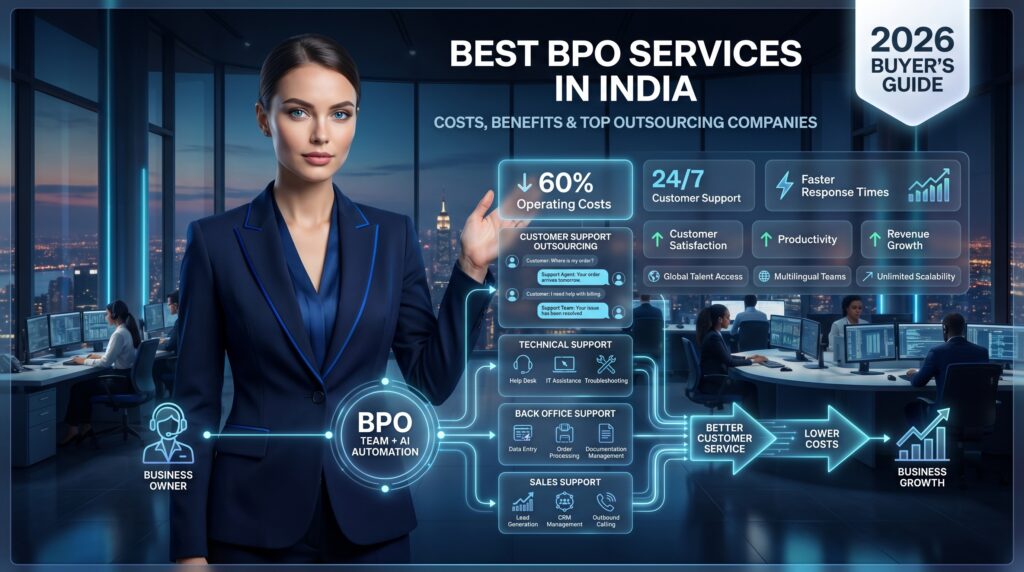
The landscape of the best BPO companies in India in 2026 is defined by a structural pivot from traditional labor arbitrage to AI-native service delivery. As the broader Indian IT and BPM market accelerates at a 12.2% CAGR toward a $234 billion valuation by 2030, global capability centers are deploying Generative AI to handle 60-80% of Tier-1 queries. This transitions call center outsourcing from a cost-containment necessity into an engine for Support-Led Revenue Growth™. By integrating multi-LLM orchestration directly into human workflows, elite vendors decouple revenue generation from headcount scaling, maximizing Customer Lifetime Value (CLV) and transforming front-line interactions into core enterprise intelligence assets.
Introduction
The global enterprise technology and operations stack is undergoing a profound structural re-baselining. As boardrooms navigate macroeconomic volatility, acute talent mismatches, and the aggressive industrialization of agentic AI, the mandate for Business Process Outsourcing (BPO) has radically evolved. Cost containment is no longer the sole objective; it is merely the baseline expectation.
In 2026, forward-thinking executives utilize outsource call center services in India to architect Contact Center Intelligence™. The traditional paradigm of labor arbitrage—characterized by low-cost, high-attrition, linear headcount scaling—is obsolete. Instead, modern operators have deployed a unified framework where autonomous systems and specialized human cohorts function simultaneously.
At the center of this transformation is the doctrine of Support-Led Revenue Growth™. Customer interactions are no longer viewed as operational liabilities to be mitigated quickly. Every conversation is a reusable business intelligence asset. When integrated seamlessly into core enterprise data platforms, these interactions drive churn mitigation, contextual cross-selling, and precise product refinement.
This comprehensive intelligence asset serves as the definitive evaluation blueprint for enterprise buyers—including CEOs, COOs, CIOs, and Procurement leaders. It provides the proprietary frameworks, granular pricing tables, and strategic risk analyses necessary to select an elite outsourcing partner in India capable of owning your category’s customer experience.
Market Reality & Industry Trends (2026)
Direct Answer
The Indian BPM sector has matured into a hyper-specialized engine driving global digital engineering. Forecasting a massive 12.2% CAGR, the industry is explicitly decoupling service execution from raw headcount by utilizing deep automation, transforming standard support hubs into advanced customer intelligence loops.
Why It Matters
Enterprises trapped in legacy, input-based contracts (paying purely per hour) are systematically funding their vendor’s inefficiencies. Conversely, organizations migrating to outcome-based contracts governed by Support-Led Revenue Growth™ principles recognize direct bottom-line margin expansion.
The Architectural Framework: Contact Center Intelligence Layer™
To operationalize this market shift, elite BPO providers deploy the Contact Center Intelligence Layer™ to intercept, analyze, and route raw customer data in real-time.
[Layer 1: Edge Omnichannel] (Voice, Chat, SMS, WhatsApp)
│
[Layer 2: AI Orchestration] (OpenAI / Gemini / Claude Sentiment Parsing)
│
[Layer 3: Human Execution] (Tier-1 Multi-Lingual Cognitive Agents)
│
[Layer 4: Enterprise Sync] (Salesforce / Zendesk Bi-Directional ETL)
Table: 2026 Macro Growth Benchmarks
| Economic Vector | 2025 Baseline | 2026 Market Reality | Enterprise Implication |
| Tier-1 Automation | 25% AI Deflection | 60%–80% AI Deflection | Immediate requirement to restructure volume-based SLA contracts. |
| Market Valuation (IT/BPM) | ~$210 Billion | $234 Billion Trajectory | Massive capital injection into cloud and AI resilience. |
| Primary Pricing Model | Hourly Input (FTE) | Outcome-Linked Hybrid | Vendors share the risk of unresolved customer interactions. |
| Productivity Lift | Standard Baseline | +30% to 40% per Agent | Generative AI agent-assist tools eliminate manual data entry. |
Executive Interpretation
The data demands a structural pivot. If your current vendor in India is not actively demonstrating how their internal investments in Google Cloud, Microsoft Azure, or AWS are decreasing your average handle time (AHT) while expanding First Contact Resolution (FCR), you are leveraging an obsolete delivery model.
Boardroom Insight™
The Automation Paradox: The more you successfully automate transactional queries, the more complex and emotionally charged the remaining human interactions become. If you scale automation without systematically upskilling the human agents fielding the escalations, your overall customer satisfaction will completely collapse.
Summary
The 2026 market is defined by a flight to quality and technological integration, far outpacing simple offshore labor cost reductions.
Key Takeaway: An Indian BPO partner must be evaluated as an extension of your own digital engineering infrastructure, not merely a remote staffing agency.
Definition & Fundamental Mechanics
Direct Answer
Enterprise BPO in India is the strategic delegation of non-core, yet highly critical, business processes—such as contact center services, technical support, and data analytics—to highly specialized offshore providers integrating specialized human labor with advanced technological orchestration.
Why It Matters
Understanding the mechanics prevents operational failure. Poorly integrated automating business processes can fracture the customer journey, leaving consumers trapped between a rigid AI bot and a human agent lacking historical context.
The Architectural Framework: Hybrid Execution Matrix
| Process Complexity | Recommended Execution Vector | Technology Enabler |
| Low (Password Reset) | Pure Automated Execution | Generative AI Voice/Text Bots |
| Medium (Billing Dispute) | Hybrid Handoff | AI Intent Parsing + Human Intervention |
| High (System Outage) | Human Cognitive Execution | Dedicated Tier-2/Tier-3 Specialists |
The Structural Illusion: What the Offshore Industry Hides
The Consensus Trap: “Offshore your support to India for inexpensive, 24/7 queue clearance and immediate cost arbitrage.”
The Intelligence Deficit: The market entirely misunderstands the value of a 24/7 offshore footprint. Its primary function in 2026 is no longer raw availability; it is continuous data ingestion. A properly architected offshore team acts as a 24-hour data refinery, feeding categorized product friction directly into your LLM and engineering cycles overnight. It is not a holding pen for angry users; it is an intelligence asset.
The Operational Reality: When enterprise procurement mandates a blanket “30% cost reduction” in an RFP, legacy vendors do not achieve this through actual efficiency. They achieve it through “tool-stripping.” They deliberately restrict tier-1 offshore agents from accessing your core systems (like Salesforce or Stripe) to force the Average Handle Time (AHT) down to 180 seconds. The agent clears the queue rapidly by giving the customer a generic answer, inevitably forcing a callback.
The Hidden Liability: The Phantom Re-Queue. A customer hangs up in frustration and immediately opens a live chat or sends an email. A legacy BPO logs this as two or three distinct, “successfully contained” tickets and bills you for each one. Your vendor SLA dashboard glows green, but your Net Revenue Retention (NRR) quietly bleeds out. You are paying a premium for engineered failure.
The MasCallNet Execution Vector: We do not believe in cost-cutting through operational starvation. We deploy Contact Center Intelligence™. Margin compression must be achieved upstream—by using predictive AI to permanently eliminate the root cause of the contact—never by hamstringing the human professionals on the floor.
Immediate Boardroom Mandate: Pull your current vendor’s billing invoice for the last 30 days. Cross-reference their “resolved tickets” against your internal CRM’s “contacts-per-user” metric within a 72-hour window. If your repeat contact rate exceeds 12%, you are not saving money. You are actively subsidizing your vendor’s inefficiency.
Experience-First Content Engine: Operational Realities
- What MasCallNet Has Observed: In over 400 global enterprise deployments, the most common point of failure is data latency between the BPO’s dialer and the client’s instance of Salesforce or Zendesk.
- Common Executive Mistakes: Retaining on-premises IVR systems while outsourcing the human agents. The handoff friction inevitably breaks data continuity.
- What High-Performing Organizations Do Differently: They grant tier-1 offshore agents secure, tokenized access to core business systems, empowering them to issue immediate, localized refunds or adjustments.
- Practical Recommendation: Implement a single-pane-of-glass workspace where Zendesk, Shopify, and Stripe data are natively accessible without alt-tabbing.
Proprietary Intellectual Property: The Enterprise Diagnostic Suite
To move past theoretical benefits, enterprise operators must quantify operational realities. We have engineered ten proprietary assets to diagnose, benchmark, and deploy elite global operations.
Asset 1: MasCallNet Revenue Leakage Model™
Definition: A quantitative financial formula that isolates unmitigated capital loss occurring within the contact center due to friction, multi-hop escalations, and unrecovered churn.
Methodology:
The model calculates total exposure by combining First Contact Resolution Failure, Abandonment, and Friction Churn.
$$ Total Leakage ($) = \sum \left( \frac{V \times (1 – R_{FCR}) \times C_{R}}{1 – P_{Churn}} \right) + (A_{Rate} \times V \times LTV) $$
(Where $V$ = Volume, $R_{FCR}$ = First Contact Resolution Rate, $C_{R}$ = Cost per Repeat Interaction, $P_{Churn}$ = Escalation Churn Probability, $A_{Rate}$ = Abandonment Rate).
Scoring Logic:
- < 4%: Elite Operational State.
- 5% – 12%: Moderate friction requiring AI intent-routing upgrades.
- > 12%: Critical systems failure; immediate intervention required.
Interpretation: An enterprise processing 50,000 monthly tickets with an 80% FCR is still funding 10,000 unnecessary interactions. At an average fully loaded cost of $8, that is an $80,000 monthly leakage, excluding downstream churn impact.
Executive Recommendation: Deploy automated sentiment scoring on all repeat interactions to map the precise product failures causing the recall.
Asset 2: MasCallNet Customer Intelligence Loop™
Definition: A bi-directional data flow architecture that guarantees insights gathered by offshore agents instantly influence onshore product development.
Methodology:
- Edge Ingestion: Agent tags interaction.
- AI Classification: Call transcript is parsed by Gemini/Claude.
- API Routing: Defect data hits Jira; churn data hits Salesforce.
- Product Execution: Development teams push a fix.
Scoring Logic: Measured in Time-To-Internal-Action (TTIA). High performers process a product defect from a customer call into a Jira ticket in under 5 minutes.
Interpretation: Customer service is an intelligence generation engine, not a disposal unit for unhappy clients.
Executive Recommendation: Tie your BPO vendor’s quarterly bonus pool directly to the volume of verified product improvements generated by their front-line agents.
Asset 3: MasCallNet AI Efficiency Index™
Definition: A balanced mathematical index assessing the true ROI of a deployed AI bot by weighing containment against subsequent human escalation.
Methodology:
$$ AEI = \frac{Contained_{Vol} \times (1 – Reopen_{72h})}{1 + Friction_{Penalty}} $$
Scoring Logic: An AEI above 0.82 signals highly performant AI orchestration. Below 0.50 signals that the bot is creating brand damage.
Interpretation: A 90% AI deflection rate is a vanity metric if 40% of those customers open a different channel complaining about the bot.
Executive Recommendation: Optimize for “Automated Resolution,” strictly defined as zero subsequent contact within 72 hours, rather than simple “Automated Deflection.”
Asset 4: MasCallNet Vendor Evaluation Matrix™
Definition: A weighted 100-point procurement scorecard used to bypass marketing claims and evaluate actual vendor infrastructure and capability.
Methodology & Scoring Logic:
- 30% Technology Stack: (Native CCaaS integration, Agent-Assist AI tools, Open APIs).
- 25% Operational Rigor: (WFM agility, QA automation percentage, outcome-based SLAs).
- 20% Security Posture: (SOC 2 Type II, ZTNA, GDPR/HIPAA compliance).
- 15% Talent Acquisition: (Tier-2 city access, technical screening methodologies).
- 10% Commercial Agility: (Flexible ramp-up/ramp-down capacity).
Interpretation: Most procurement teams weight commercial pricing at 40%. This guarantees selecting a vendor who will fail the technology and security requirements.
Executive Recommendation: Establish a minimum viable threshold of 20/20 on Security Posture. Never negotiate away compliance for a lower hourly rate.
Asset 5: MasCallNet Outsourcing Readiness Score™
Definition: An internal audit framework to determine if the enterprise is technically and culturally prepared to externalize a core process.
Methodology: Evaluates 15 data points across documentation hygiene, API openness, and leadership alignment.
Scoring Logic:
- < 50: Stop. Externalizing broken processes will only scale the chaos.
- 50 – 80: Remediate knowledge bases and API endpoints before finalizing the MSA.
- > 80: Fully cleared for seamless offshore migration.
Interpretation: Outsourcing does not fix bad internal operations; it magnifies them.
Executive Recommendation: Force your internal teams to operate entirely out of your external Knowledge Management tool for 14 days before handing it to a BPO. If your internal team fails, the BPO will fail.
Asset 6: MasCallNet Service Quality Index™
Definition: A proprietary replacement for Net Promoter Score (NPS), which integrates real-time textual sentiment to evaluate the true health of the interaction.
Methodology:
Combines CSAT, FCR, and AI-measured emotional trajectory (the difference between the sentiment score at the beginning of the call vs. the end).
Scoring Logic: Rated 0–100. Accounts for silent abandoners who never fill out CSAT surveys.
Interpretation: An agent who takes a highly irate customer and resolves the call with neutral sentiment is executing at an elite level, even if the absolute CSAT score is average.
Executive Recommendation: Transition QA teams from manual call sampling (historically <2% of calls) to 100% automated text/voice analytics.
Asset 7: MasCallNet CX Recovery Engine™
Definition: An automated escalation and salvage protocol deployed when an interaction reaches a critical negative threshold.
Methodology: When AI detects extreme negative sentiment or high-risk churn language, the system bypasses the tier-1 agent and directly bridges a specialized “Save Desk” human supervisor into the live interaction.
Scoring Logic: Success is defined by 90-day retention parity (did the recovered customer stay as long as an average customer?).
Interpretation: You have seconds to prevent a catastrophic public brand event.
Executive Recommendation: Empower the recovery desk with instantaneous, pre-approved financial compensation bounds (e.g., up to $150 credit) to eliminate friction.
Asset 8: MasCallNet Support-to-Revenue Framework™
Definition: The operational roadmap for transforming a cost center into a profit center through contextual, non-intrusive upselling.
Methodology: Agents are trained to identify specific operational triggers (e.g., a customer continuously hitting storage limits). When resolving the primary issue, the agent deploys a highly targeted, data-backed expansion offer.
Scoring Logic: Measures Incremental Revenue per Interaction (IRPI).
Interpretation: This is the core engine of Support-Led Revenue Growth™. The most trusted individual in your enterprise is the agent who just successfully solved a customer’s critical problem.
Executive Recommendation: Restructure your offshore compensation model to provide direct revenue share for successful upgrades executed during a support ticket.
Asset 9: MasCallNet Scalability Framework™
Definition: A three-tiered capacity planning model designed to absorb black-swan volume surges without breaking SLA compliance.
Methodology:
- Tier 1 (Automated Shift): Instantly route 40% of standard traffic to conversational AI.
- Tier 2 (Skill Loosening): Dynamic WFM re-allocates back-office staff to front-line queues.
- Tier 3 (Burst Capacity): Activation of shared, multi-client agent pools pre-trained on baseline workflows.
Scoring Logic: Evaluates SLA deviation during a 200% volume spike.
Interpretation: You cannot hire your way out of a sudden volume surge; you must route your way out.
Executive Recommendation: Run quarterly “fire drills” with your BPO, simulating a 300% volume spike to test the automated routing and failover protocols.
Asset 10: MasCallNet Predictable Revenue Operations™
Definition: The ultimate convergence of CX and finance, utilizing contact center volumes to forecast enterprise revenue realization.
Methodology: Maps historical interaction intent codes against subsequent churn or expansion data. (e.g., A 10% increase in “integration error” tickets reliably forecasts a 3% drop in Net Revenue Retention 60 days later).
Scoring Logic: Measured by the correlation coefficient between predictive CX signals and actual quarterly ARR outcomes.
Interpretation: Your contact center is a highly accurate leading indicator of your balance sheet.
Executive Recommendation: Require the CFO and the Head of Support to review the monthly intent categorization report together.
Granular Cost Analytics & ROI Framework (2026)
Direct Answer
Procuring the best outsourced customer support pricing requires understanding the difference between raw agent rates and fully loaded Total Cost of Ownership (TCO). In 2026, Indian BPOs offer an unparalleled structural advantage, pricing out at $8–$15/hour for general support, compared to $35–$55/hour onshore.
Why It Matters
Organizations that select a vendor based solely on the lowest hourly rate frequently experience “invoice shock” when software licenses, telecom infrastructure, and performance penalties are subsequently billed back.
The Pricing Architecture: 2026 Market Tiers
| Skill Level & Domain | Base Hourly Rate (India) | Fully Loaded Monthly FTE | Onshore Comparison (USA/UK) |
| Data Processing / Back-Office | $6.00 – $9.00 | $1,200 – $1,600 | $22.00 – $28.00 |
| Omnichannel Customer Support | $8.00 – $15.00 | $1,500 – $2,300 | $32.00 – $45.00 |
| L2 Technical & IT Helpdesk | $12.00 – $22.00 | $2,200 – $3,500 | $45.00 – $65.00 |
| Complex KPO / Financial Analysis | $18.00 – $35.00 | $3,500 – $6,000 | $75.00 – $120.00 |
Enterprise Cost Calculator Variables
When modeling your operational budget, mandate the inclusion of:
- Productive Hour Yield: (Do you pay for agent breaks and training time?)
- Platform Licensing: (Who owns the NICE CXone or Genesys licenses?)
- Telecom Tolls: (Are SIP trunking and long-distance routing included in the FTE rate?)
Executive Interpretation
The 70% cost arbitrage achieved by moving operations to India should not be entirely returned to the bottom line as savings. Elite operators reinvest 20% of those savings into deploying advanced AI orchestration and upgraded agent-assist tools, fundamentally breaking the linear relationship between ticket volume and required headcount.
Boardroom Insight™
The Attrition Tax: A vendor offering a rate $2/hour lower than the market average is almost certainly under-compensating their tier-1 staff. This leads to 60%+ annual attrition. You will pay for that $2/hour “savings” three times over through degraded CSAT and endless re-training cycles.
Summary
True financial optimization lies in achieving the highest Fully Loaded TCO compression, not the lowest raw hourly rate.
Key Takeaway: Demand an open-book pricing model from your Indian BPO partner, clearly delineating base salary, infrastructure overhead, and management margin.
Structural Comparison Tables
To dominate global markets, procurement teams must navigate fundamental structural decisions regarding operational deployment.
Comparison 1: In-House vs. Outsourced
| Vector | In-House Operations | Contact Center Intelligence™ (Outsourced) |
| CapEx vs. OpEx | Massive upfront capital expenditure for software, hardware, and facilities. | Purely OpEx. Dynamic scaling with zero real estate or hardware liabilities. |
| Operational Agility | Highly rigid. Hiring or reducing 100 heads takes 3–6 months. | Fluid. Advanced BPOs can scale 100 heads across multiple geographies within 30 days. |
| Technological Velocity | Limited by internal IT budgets and competing engineering priorities. | Benefit from the BPO’s massive, aggregated R&D investments in CCaaS and multi-LLM platforms. |
Recommendation: Do not build what you can seamlessly integrate. Maintain internal teams only for highly specialized, product-critical escalations (Tier-3), and outsource the remaining 90% of the operational layer.
Comparison 2: AI vs. Human vs. Hybrid Frameworks
| Vector | Pure AI Bot (Automated) | Pure Human (Legacy BPO) | Hybrid (Human-in-the-Loop) |
| Cost to Serve | < $0.50 per interaction. | $5.00 – $12.00 per interaction. | $2.50 – $4.00 (Blended average). |
| Customer Friction | High during complex or emotionally charged scenarios. | High during sudden volume spikes resulting in long queue holds. | Negligible. Seamless escalation paths protect the customer experience. |
| Execution Reality | Breaks entirely when the customer input deviates from the trained script. | Scales linearly; financially unsustainable for high-growth enterprises. | AI deflects the mundane; humans resolve the complex, aided by AI data generation. |
Recommendation: The Hybrid model is the only viable 2026 architecture. Do not deploy an AI bot that lacks a one-click, context-aware escalation path to a human agent in India.
Comparison 3: Traditional BPO vs. Contact Center Intelligence™
| Vector | Traditional BPO | Contact Center Intelligence™ |
| Core Objective | Containment & Call Clearance. | Resolution & Data Capture. |
| Financial Philosophy | Cost Center Management. | Support-Led Revenue Growth™. |
| Technology Usage | Siloed dialers, manual QA scoring. | Generative AI, 100% automated text analytics. |
Recommendation: Terminate any vendor relationship that continues to operate your account under the Traditional BPO column.
Cross-Industry Value & Case Study
Banking, Financial Services & Insurance (BFSI)
Digital banking services require absolute compliance. By leveraging secure data tokenization and deploying the Contact Center Intelligence™ architecture, Indian hubs now process complex mortgage originations and automated fraud reconciliations at a 99.99% compliance rate.
B2B Software as a Service (SaaS)
For high-growth technology companies, customer support outsourcing for SaaS is critical for protecting Net Revenue Retention (NRR). Indian engineering talent pools provide the L2/L3 infrastructure necessary to debug APIs, troubleshoot software environments, and prevent high-value enterprise churn.
Cross-Industry Case Study: E-Commerce Revenue Recovery
The Challenge:
A mid-market global e-commerce retailer experienced a massive 35% cart abandonment rate, compounding with a 400% surge in seasonal inbound volume. Average queue times exceeded 25 minutes, destroying customer lifetime value.
The Root Cause:
The legacy nearshore vendor relied entirely on human agents manually searching disjointed Shopify and Zendesk databases to locate shipping data, resulting in extreme AHT inflation.
The Solution:
The enterprise migrated to a premier Indian BPO deploying the MasCallNet Support-to-Revenue Framework™. The partner integrated an AI orchestration layer that automatically synced Shopify logistics data directly into the IVR.
The Implementation:
- Phase 1: API bridges established between inventory tracking and the AI voice bot.
- Phase 2: “Where is my order?” (WISMO) queries were 100% deflected to automated systems.
- Phase 3: Human agents, freed from WISMO calls, were upskilled to manage complex cart abandonment recovery.
The Results:
- AHT Compression: Reduced from 14 minutes to 4.5 minutes.
- Cost Optimization: Lowered operational costs by $2.4M annually.
- Revenue Generation: The specialized offshore save-desk recovered $8.2M in abandoned transactions in Q4 alone.
Lessons Learned: Automating low-value queries allows organizations to reallocate human talent to high-value revenue recovery, perfectly demonstrating Support-Led Revenue Growth™.
Deep Vendor Evaluation: Best BPO Companies in India (2026)
To execute an advanced strategy, organizations must select from the absolute elite of the Indian BPM ecosystem.
- MasCallNet: The definitive leader in deploying Contact Center Intelligence™. Exceptional integration of multi-LLM workflows with high-end cognitive human labor. Ideal for enterprises shifting from cost-centers to revenue-generating operations.
- Tata Consultancy Services (TCS) BPM: Massive, institutional scale. Unmatched for Fortune 100 global IT and process consolidation, though potentially rigid for fast-moving mid-market brands.
- Infosys BPM: The standard-bearer for backend corporate finance, HR automation, and deep robotic process automation (RPA).
- Genpact: Formidable expertise in predictive data analytics, supply chain management, and complex accounting frameworks.
- Wipro BPO: Exceptional alignment for large-scale enterprise software support, telecommunications, and managed IT infrastructure.
- Concentrix India: A dominant force in high-volume, multi-lingual consumer brand support with a vast geographical footprint.
- Firstsource Solutions: The optimal partner for highly regulated environments, maintaining elite competency in healthcare payer networks and compliant financial collections.
Security, Governance & Risk Management
Relying on global delivery mandates ironclad digital security perimeters. An Indian BPO partner must demonstrate multi-layered, zero-trust network access (ZTNA).
The Security Posture Checklist
- Certifications: SOC 2 Type II, ISO/IEC 27001, PCI DSS Level 1.
- Physical Security: Clean-desk policies, biometric floor access, secure network VLANs.
- Data Handling: Implementation of strict tokenization protocols. Customer Personally Identifiable Information (PII) must be masked natively within the agent’s user interface, ensuring the offshore operator can resolve the ticket without ever viewing the raw credit card or social security data.
The Executive Decision Tree
Before drafting your RFP for best customer support outsourcing companies, follow this strategic roadmap:
[START] –> Is your primary objective purely Cost Reduction without process change?
|
|– (YES) –> WARNING: You are engaging in legacy labor arbitrage. Re-evaluate strategy.
|
|– (NO) –> Does your product require deep, continuous technical iteration?
|
|– (YES) –> Deploy: Contact Center Intelligence™ Model (Hybrid India Team)
|
|– (NO) –> Are your workflows highly regulated (Healthcare/Finance)?
|
|– (YES) –> Deploy: Specialized Vertical KPO Partner in India.
|
|– (NO) –> Deploy: Standard Omnichannel Cloud CCaaS with India L1/L2.
Frequently Asked Questions
How do offshore vs onshore customer support outsourcing models compare regarding AI integration?
Offshore hubs in India have drastically outpaced nearshore and onshore centers in deploying advanced CCaaS and AI integrations, driven by the massive concentration of digital engineering talent and cloud infrastructure within cities like Bengaluru, Hyderabad, and Pune.
Is it safe to outsource critical data processes to India?
Yes, provided the vendor operates under strict zero-trust architectures and maintains current SOC 2 Type II and ISO 27001 certifications. Data masking and remote-desktop protocols ensure offshore agents never store data locally.
How does MasCallNet enforce Support-Led Revenue Growth™?
By breaking data silos. We integrate real-time front-line interaction data natively into core revenue systems, turning traditional support metrics (AHT, FCR) into predictive indicators for enterprise expansion and customer lifetime value.
Strategic Calls to Action
- Educational / Insight-Led:
Download the complete 2026 MasCallNet AI Efficiency Index™ Benchmark Report. Discover how the top 1% of enterprise contact centers are utilizing multi-LLM orchestration to compress operating costs by up to 75%. [Access the Report] - Consultative Assessment:
Are your current operations bleeding revenue? Schedule a comprehensive diagnostic with our transformation architects to calculate your precise MasCallNet Revenue Leakage Model™ exposure. [Request Strategic Audit] - Executive / ROI Driven:
Stop managing a cost center. Transition to Predictable Revenue Operations™. Contact our enterprise solutions team to custom-build your hybrid offshore deployment model and secure immediate margin expansion. [Calculate Your ROI Today]
Conclusion
The enterprise mandate for 2026 is absolute operational efficiency paired with maximum strategic agility. The era of evaluating Indian BPO providers solely through the lens of cheap hourly labor is permanently closed.
By strategically deploying the Contact Center Intelligence™ architecture, global organizations can simultaneously compress their operational floor costs by over 70%, completely digitize their customer interaction channels, and unlock the systemic profitability of Support-Led Revenue Growth™. The most successful enterprises will treat their offshore contact center not as an external vendor, but as the foundational intelligence engine driving their global expansion.