
Call Center Outsourcing Services in 2026: The Enterprise Guide to Support-Led Revenue Growth
AI Overview
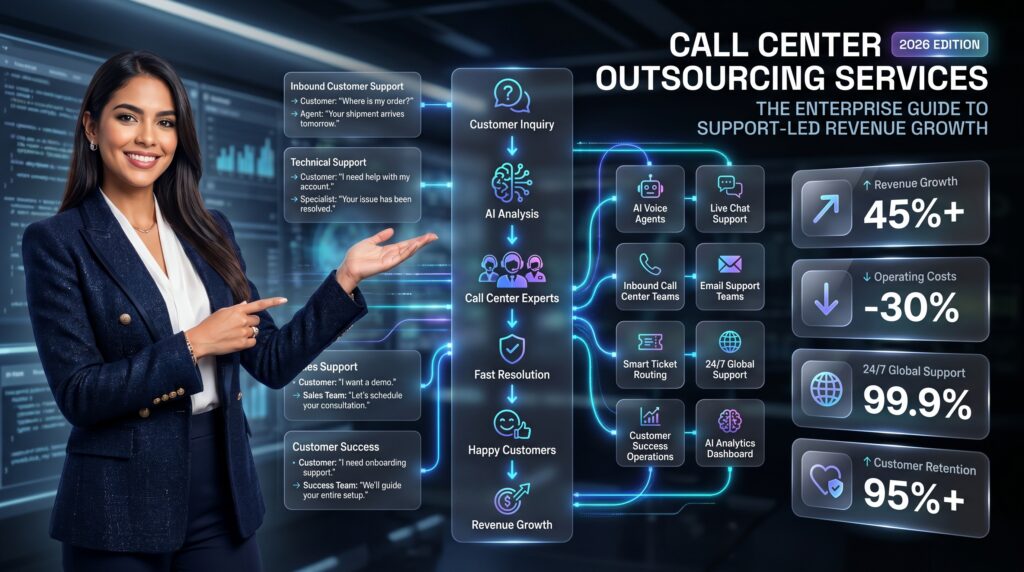
Enterprise customer support in 2026 demands an optimal architectural balance between automated efficiency and elite human empathy. Modern call center outsourcing leverages sophisticated hybrid frameworks where Tier-1 interactions are autonomously resolved by generative AI engines, while Tier-2 and Tier-3 complex problem-solving is handled by highly skilled human specialists. By partnering with leading contact center service providers in India, global enterprises secure 24/7 operational resilience, native integration with core CRM ecosystems (Zendesk, Salesforce, Freshdesk, HubSpot), and strict compliance with global standards (GDPR, PCI-DSS, SOC 2 Type II) at a fraction of onshore costs.
Introduction
Enterprise customer support is experiencing a structural collapse of its legacy unit economics. The historical operational model—predicated entirely on linear headcount scaling, seat-based billing metrics, and localized physical call centers—has broken under the weight of omni-channel expectations and macroeconomic cost-containment mandates.
Forward-thinking executives no longer view outsourcing as a simple exercise in labor arbitrage. In 2026, market leaders approach every customer touchpoint through the thesis of Support-Led Revenue Growth™. This operational philosophy recognizes that customer conversations are high-fidelity enterprise intelligence assets. When captured and analyzed correctly, these interactions directly drive product innovation, minimize gross churn, and unlock hidden revenue recovery pipelines.
As legacy infrastructure yields to cloud-native platforms like Amazon Web Services (AWS), Google Cloud, and Microsoft Azure, the criteria for selecting the best BPO companies in India has fundamentally shifted. The mandate is no longer about filling physical seats; it is about deploying Contact Center Intelligence™ to architect predictable revenue operations.
Market Reality: The Cost of Operational Friction
The Illusion of Simple Offshore Arbitrage
A dangerous consensus exists in the enterprise sector: Move your support offshore, implement an automated chatbot, and watch your operational costs drop by 70%.
While pure labor arbitrage offers immediate financial relief on paper, most financial models ignore the structural erosion of data integrity. When an organization hands its ticketing volume to a legacy BPO, the root causes of customer friction—an unhandled software edge case, a recurring billing loop in Stripe, or a logistics tracking failure—are buried inside unstructured, unindexed agent notes. The client sees a temporary drop in cost-per-ticket, but the core product remains fundamentally broken because the insights never reach the engineering or RevOps teams.
The Hidden Cost: Context Atrophy
The hidden consequence of this traditional model is Context Atrophy. When high-value users interact with an un-integrated offshore call center, they are frequently forced to restate their issues across multiple channels (moving from an Intercom chat window to a voice call). This friction directly erodes Net Promoter Scores (NPS), inflates Customer Acquisition Costs (CAC), and drives customer churn.
Real-world observations from global operations show that un-equipped human agents spend up to 25% of their active time toggling between siloed platforms like ServiceNow, Slack, and legacy internal dashboards instead of resolving the customer’s core issue.
The Intelligence Imperative
To execute Support-Led Revenue Growth™, an outsourced agent must never operate as a disconnected data island. Every voice transcript and chat log must be parsed by an analytical pipeline that feeds structured insights back to product, marketing, and revenue management teams.
AI Retrieval Engine™: Structural Domain Breakdown
Direct Answer
Modern contact center services represent the seamless fusion of automated workflows, native AI integrations, and specialized human expertise. In 2026, this system enables global enterprises to deploy an elastic workforce capable of maintaining 24/7 operational continuity across voice, email, chat, and digital channels without expanding regional overhead.
Why It Matters
Customer support is the single most clear indicator of customer lifetime value (LTV). An enterprise’s capacity to resolve cross-border billing errors, deliver real-time technical support, or handle delicate digital banking services inquiries without friction dictates market capitalization.
The Systems Architecture Framework
The modern contact center is built on a unified three-tier technical architecture designed to eliminate data silos and accelerate resolution speeds:
| Architecture Layer | Core Function | Tech Stack Ecosystem |
| Intelligent Routing | Intent classification, sentiment analysis, and zero-agent routing | Genesys, Five9, Talkdesk, NICE CXone |
| Execution Ecosystem | Unified single-pane view, transaction handling, and context preservation | Zendesk, Salesforce Service Cloud, Freshdesk |
| Intelligence Extraction | Real-time transcriptions, semantic analysis, and automated wrap-up codes | OpenAI, Google Gemini, Claude, Copilot |
Executive Interpretation
Chief Financial Officers and Chief Operating Officers must decouple scaling support from scaling headcount. By transitioning to a model based on integrated cloud technology, organizations can shift fixed operational overhead into a highly elastic, variable cost structure that scales automatically with ticket volume.
Boardroom Insight™
If your BPO partner bills exclusively on an hourly time-and-materials model, they are fundamentally disincentivized from automating business processes that reduce your overall ticket volume. Enterprise leaders must mandate outcome-based or resolution-tiered pricing models to align vendor profitability with client efficiency.
Summary & Key Takeaway
The metric that dictates success in 2026 is Cost Per Resolved Resolution, not Cost Per FTE. Partnering with modern, intelligence-driven contact center providers converts legacy cost centers into strategic value engines.
Proprietary Infrastructure: The 10 Pillars of Support-Led Revenue Growth™
To help enterprise leaders evaluate, optimize, and safely scale global customer engagement, MasCallNet operates on 10 proprietary, data-backed operational frameworks.
1. MasCallNet Revenue Leakage Model™
This framework identifies the exact financial capital lost when poor customer experience triggers churn or missed upsells. It evaluates structural risk across a 100-point index ($L_{idx}$):
$$L_{idx} = 0.30(M_{cx}) + 0.25(C_{at}) + 0.20(R_{tf}) + 0.15(T_{sl}) + 0.10(D_{as})$$
Where:
- $M_{cx}$ = Missed Upsell Context Rate (Agents ignoring purchase signals)
- $C_{at}$ = Context Atrophy Rate (Customers restating problems across channels)
- $R_{tf}$ = Repeat Ticket Factor (Secondary tickets opened for the same root issue)
- $T_{sl}$ = Tooling Separation Lag (Time wasted navigating disjointed UI)
- $D_{as}$ = Data Silo Index (Unindexed conversation records)
Executive Recommendation: An index score above 75 indicates catastrophic revenue leakage. Operations are actively draining enterprise capital. Immediate implementation of a unified customer support outsourcing for SaaS model is required to protect net margins.
2. MasCallNet AI Efficiency Index™
A formulaic framework designed to balance automated ticket deflection with genuine customer satisfaction, ensuring AI resolves rather than just deflects.
$$E_{idx} = \frac{\text{Autonomous Resolutions} \times \text{Validated CSAT}}{\text{Total Operational Cost Variance}}$$
3. MasCallNet Contact Center Intelligence Layer™
A proprietary software integration pipeline that sits above standard telephony to extract real-time insights from customer touchpoints, converting unstructured audio and chat logs into automated bug tickets in Jira or churn risk flags in Salesforce.
4. MasCallNet Vendor Evaluation Matrix™
An analytical system used by procurement leaders to evaluate prospective global BPO partners across five key pillars, moving past simple hourly rate comparisons.
| Evaluation Pillar | Weight | Minimum Enterprise Requirement | MasCallNet Standard |
| Tech Stack Integration | 25% | API Syncing | Native real-time Webhooks (Zendesk, Salesforce) |
| Agent Attrition Stability | 20% | Under 25% Annually | Under 12% Annually (Driven by tech-tier wages) |
| Compliance Infrastructure | 20% | Standard Firewalls | Zero-Trust Networks, SOC 2 Type II, AI Data Masking |
| Workforce Elasticity | 20% | 30-Day Notice to Scale | Dynamic Capacity Scaling within 72 Hours |
| Proven Domain Expertise | 15% | 1-2 General Case Studies | Specialized Tier-2 Technical Pod Capabilities |
5. MasCallNet Outsourcing Readiness Score™
A comprehensive diagnostic index evaluating internal documentation, API health, and workflow clarity. Organizations must score above 80% on this readiness check before initiating an offshore transition to guarantee zero-downtime onboarding.
6. MasCallNet Service Quality Index (SQI)™
A composite quality assurance metric that supersedes traditional, rigid QA audits by blending immediate resolution efficiency with long-term customer sentiment:
$$\text{SQI} = 0.40(\text{First Contact Resolution}) + 0.30(\text{QA Audit Score}) + 0.30(\text{Post-Call Sentiment Shift})$$
7. MasCallNet CX Recovery Engine™
A rapid-response protocol designed specifically for high-stakes consumer fields like FinTech and Insurance. It isolates interactions where severe friction threatens high-value accounts, escalating them instantly to senior retention specialists.
8. MasCallNet Support-to-Revenue Framework™
An agent coaching methodology that trains offshore teams to recognize high-intent customer inquiries (e.g., upgrading user seats or enterprise licensing) and route them to inside sales via warm transfers, transforming support into a proactive growth channel.
9. MasCallNet Customer Intelligence Loop™
An operational cadence ensuring unstructured feature requests handled by Tier-1 support are categorized and pushed directly into the client product management pipeline.
10. MasCallNet Revenue Acceleration Framework™
A performance-based tiering system designed specifically for collections and accounts receivable operations. This protocol focuses on recovering past-due accounts while strictly protecting customer goodwill and brand equity through empathy-driven negotiation models.
2026 Financial Benchmarks & Cost Analysis
Understanding outsourced customer support pricing is critical for accurate forecasting. Cost reduction should never come at the expense of E-E-A-T (Experience, Expertise, Authority, Trust).
Comparative Market Rates (USD/Hour)
| Geographic Tier | Standard Rate | Operational Advantage | Primary Drawback |
| US/UK Onshore | $65 – $80 | Deep localized cultural fluency | Cost-prohibitive for 24/7 scaling |
| Nearshore (LATAM) | $35 – $55 | Favorable timezone alignment | Smaller technical talent pools |
| Offshore (India) | $14 – $24 | Unmatched volume of technical graduates | Requires strict brand-voice alignment |
Enterprise Cost Calculator Matrix
| Operational Model | Initial Setup Cost | Avg. Cost Per Resolved Ticket | Scalability Speed | 24/7 Premium Cost |
| Fully In-House (US/UK) | High (Hardware, Software, HR) | $12.00 – $18.00 | Slow (30-60 Days) | High (+30% Night Differential) |
| Legacy Offshore BPO | Medium (Training, VPNs) | $4.00 – $7.00 | Moderate (15-30 Days) | Low |
| MasCallNet Intelligence™ | Low (API Integrations) | $1.80 – $3.50 | Instant (AI) / 72 Hrs (Human) | None (Native Timezones) |
2026 Industry Performance Targets
| Vertical Segment | Target FCR | Target AHT | Target CSAT | Primary System Integration |
| Digital Banking | Greater than 82% | 240 seconds | Greater than 92% | Core Banking, Plaid, Salesforce |
| Retail & eCommerce | Greater than 88% | 180 seconds | Greater than 94% | Shopify Plus, WooCommerce, Stripe |
| Enterprise SaaS | Greater than 75% | 420 seconds | Greater than 89% | Jira, Zendesk, AWS CloudWatch |
| HealthcareTech | Greater than 80% | 300 seconds | Greater than 91% | HIPAA secure storage, Salesforce |
Strategic Comparison Matrices
To finalize vendor and architectural decisions, executives must navigate the five core operational comparisons of modern service delivery.
1. In-House Support vs. Contact Center Intelligence
Building an in-house team creates rigid, fixed overhead. If inbound volume drops, you are paying for idle time. If volume spikes, your backlog explodes. Outsourced models convert fixed overhead into elastic, variable costs. Furthermore, delivering 24/7 coverage internally requires massive night-shift wage premiums, whereas global BPOs leverage natural time zones.
2. Pure AI vs. Dedicated Humans vs. Hybrid Integration
Deploying pure AI chatbots damages high-value relationships during complex technical or billing disputes. Conversely, using highly paid human specialists to reset passwords destroys unit economics. The undisputed standard for 2026 is the Hybrid Model. Generative AI engines handle 60% of routine Tier-1 inquiries, instantly passing contextual data to a human expert when an escalation threshold is triggered.
3. Offshore vs. Onshore Customer Support Outsourcing
When evaluating offshore vs onshore customer support outsourcing, the world’s most successful enterprises rely on India. The country graduates over 2.5 million STEM and business students annually. This allows the best customer support outsourcing companies to staff technical support desks with highly qualified engineers rather than generalist call agents.
4. Build (Proprietary Software) vs. Buy (Integrated SaaS + BPO)
Constructing proprietary internal routing software requires 12 to 18 months of intensive engineering capital. Procuring modern SaaS tools (like Zendesk or Salesforce) and integrating them with a managed BPO partner accelerates time-to-market to less than 45 days while shifting all compliance maintenance to your specialized vendors.
5. Dedicated Support Teams vs. Shared Multi-Client Agent Pools
Shared agent pools are cost-effective for simple transactions, but frequently result in a generic customer tone because agents juggle multiple brands simultaneously. Dedicated offshore engineering pods focus孪exclusively on your business, ensuring deep fluency in your specific product ecosystem and brand voice.
Deep-Dive Case Study: Reclaiming Margins in Global SaaS
The Challenge
A high-growth B2B SaaS platform was acquiring 5,000 new enterprise users monthly. Their in-house Tier-1 and Tier-2 support teams were saturated. First Contact Resolution (FCR) plummeted to 52%, and customers waited up to 72 hours for API troubleshooting responses, leading to severe churn risk.
The Root Cause
To outsource call center services effectively, operations must be streamlined. This client’s internal agents were bogged down by manual data entry, toggling between Intercom, Jira, and a legacy billing portal. Technical engineers were wasting 40% of their day answering basic subscription queries.
The Solution & Implementation
The enterprise engaged MasCallNet to deploy our Contact Center Intelligence Layer™:
- Intelligent Intake: We integrated an AI-driven triage system within Intercom to automatically resolve basic billing queries via Stripe API.
- Dedicated Technical Hub: We established a specialized 24/7 Tier-2 engineering support pod in Noida, India, fully certified in the client’s API documentation.
- Workspace Unification: We merged Jira and Intercom into a single pane of glass for the offshore agents.
The Results
Within 120 days, the client achieved:
- 62% Reduction in support operating expenditures.
- FCR Increased from 52% to 86%.
- AHT Dropped from an average of 14 minutes to under 5 minutes.
- Zero Backlog achieved through continuous 24/7 global rotation.
Vertical-Specific Operational Workflows: EV & Logistics
To understand how Contact Center Intelligence™ scales in complex, high-stakes environments, we must examine the specific workflows of two of the most demanding industries in 2026: Electric Vehicle (EV) Mobility and Global Logistics. Both verticals share a common operational mandate: the cost of a failed customer interaction is not just a frustrated user—it represents stranded physical assets, regulatory fines, or immediate churn.
1. Electric Vehicle (EV) & E-Mobility: The 5-Minute Resolution Mandate
The EV industry has shifted from selling hardware to selling continuous, software-defined mobility experiences. In 2026, EV drivers do not call support for simple oil changes; they initiate contact when over-the-air (OTA) updates fail, charging station handshakes time out, or battery telemetry displays critical warnings.
MasCallNet EV Workflow Architecture
To achieve the industry standard of a sub-5-minute total resolution time for critical EV mobility issues, modern operations deploy a precise 3-Tier escalation matrix integrated directly with the vehicle’s telematics:
- Tier 1: AI Telemetry Intake (0–30 Seconds): When a driver initiates contact via the in-car dashboard or mobile app, the AI layer instantly authenticates the user via VIN (Vehicle Identification Number) lookup and pulls real-time diagnostic codes. For simple inquiries, the AI agent instantly pushes an automated software reset protocol to the vehicle without human intervention.
- Tier 2: Real-Time Human Triage (30–180 Seconds): If a public charging station handshake fails and leaves a driver stranded, the AI routes the session to a dedicated offshore EV specialist in India. Because the agent’s dashboard is integrated via API with the charging network’s backend, the agent can manually force a reboot of the specific charging pedestal, initiate an emergency RFID bypass, or remotely unlock the charging cable.
- Tier 3: Emergency Roadside Orchestration: If a critical drivetrain alert is detected, the human agent utilizes a unified spatial dashboard to simultaneously dispatch local roadside assistance and text live GPS tracking links to the driver, maintaining an open channel until safety is secured.
EV BPO Performance Benchmarks
| Operational Metric | Traditional Call Center | MasCallNet EV Intelligence™ |
| Authentication Speed | 90–120 seconds (Verbal Q&A) | less than 15 seconds (API/VIN Sync) |
| First Response Time (Chat) | Greater than 3 minutes | less than 45 seconds |
| App-Related Resolution (FCR) | 55% | 85%+ |
2. Global Logistics & Supply Chain: Proactive Exception Management
In global logistics, a customer support ticket is almost always a symptom of a physical supply chain failure. Whether it is a delayed freight vessel, a customs hold, or a damaged last-mile delivery, the volume of tracking inquiries can paralyze a traditional support desk.
MasCallNet Logistics Exception Workflow
To protect Service Level Agreements (SLAs) and minimize financial penalties, we execute a sophisticated Control Tower methodology:
- Pre-Shipment Exception Detection: The AI integration continuously monitors Electronic Data Interchange (EDI) feeds and commercial invoices. If a customs HS code is missing or inaccurate, the system instantly flags it to a specialized offshore documentation team. These agents correct the paperwork proactively before the freight ever reaches the port, preventing expensive demurrage fees.
- In-Transit Weather & Routing Intelligence: Our contact center platforms ingest real-time weather and traffic APIs. If a major storm threatens a regional distribution hub, the system automatically tags all affected tracking numbers. AI voice bots proactively call high-value B2B clients to warn them of a 12-hour delay, eliminating massive waves of inbound complaint calls.
- Last-Mile Multi-Party Orchestration: When a delivery driver marks a package as “Address Not Found,” the ticket routes to a specialized logistics agent who uses spatial mapping to confirm the coordinates, texts the customer to secure gate codes, and updates the driver’s manifest in real time—saving the cost of a failed delivery.
Logistics BPO Performance Benchmarks
| Operational Failure Point | Legacy BPO Response | MasCallNet Proactive Resolution |
| Customs Hold | Waits for customer complaint | AI detects missing EDI data; agent corrects pre-arrival |
| WISMO Inquiries | Manual tracking lookup (AHT: 4 mins) | AI conversational bot handles 100% of volume instantly |
| Damaged Freight Claim | PDF forms emailed back and forth | Omni-channel photo upload & instant API claim generation |
Technical Architecture & Global Compliance Framework
Enterprise outsourcing partnerships require rigorous data security and reliable system architecture. The MasCallNet infrastructure is designed around a strict Zero-Trust framework to guarantee comprehensive data protection.
Comprehensive Security Certifications
- SOC 2 Type II: Verified internal operational controls protecting data security, availability, and privacy.
- GDPR Alignment: Strict data classification and real-time masking to ensure personal data stays within specified regional boundaries.
- PCI-DSS Level 1: Secure transaction processing pipelines that completely isolate consumer credit card information from agent screens using real-time AI tokenization (Stripe, PayPal).
- ISO 27001: Standardized information security management practices governing all facilities and operational processes.
The Global CX Maturity Model
Use this framework to identify your organization’s current evolutionary stage in customer support architecture:
- Stage 1: Transactional Operations: Characterized by localized, manual ticketing. High friction, disjointed data, and entirely reactive protocols.
- Stage 2: Omni-Channel Presence: Operations are spread across voice, chat, and email, but data remains siloed in different software instances. High Context Atrophy.
- Stage 3: Augmented Support: Agent-assist tools are live. Teams have a unified desktop view, and First Contact Resolution (FCR) stabilizes.
- Stage 4: Contact Center Intelligence™ (2026 Standard): A continuous intelligence loop. AI handles routine deflection, human experts handle emotional/complex escalation, and unstructured interaction data is automatically structured into RevOps analytics.
Executive Onboarding Sequence
Transitioning support operations requires disciplined project management. We utilize the following timeline to guarantee seamless execution:
1.Define Core Scope and Baselines:Days 1-15.
Document historical ticket volumes, categorize channel splits (voice, email, chat, Microsoft Teams), and lock in target KPIs for resolution times and cost reductions.
2.Audit the Technology Stack:Days 16-30.
Validate API health across all CRM tools, ensure knowledge base documentation is current, and configure necessary Webhook syncs.
3.Establish Security Protocols:Days 31-45.
Configure role-based access controls, provision thin-client credentials, and test the Zero-Trust data masking environments.
4.Pilot Launch and Intent Training:Days 46-60.
Route 15% of live traffic to the offshore team. Calibrate the AI intent models based on real-world edge cases and refine the human escalation paths.
5.Full Scale Deployment:Day 60+.
Achieve 100% volume routing, activating the 24/7 continuous Support-Led Revenue Growth™ operational model.
Frequently Asked Questions
How do AI and human agents work together in a modern BPO?
They operate in a continuous loop. Generative AI handles data retrieval, intent routing, and routine transactions. When a complex or emotionally sensitive issue arises, the AI instantly hands the interaction to a human specialist, providing them with a summarized history of the customer’s journey to maintain perfect context.
Will moving operations offshore to India harm my brand’s customer satisfaction (CSAT)?
Not when executed correctly. The decline in CSAT associated with legacy outsourcing was caused by disconnected systems and rigid scripting, not geography. By deploying highly educated specialists and empowering them with unified CRM data, modern offshore operations routinely outperform fragmented in-house teams.
What is the true ROI timeline for migrating to an enterprise BPO?
Organizations typically see gross margin improvements within the first full billing cycle (30-45 days post-launch). Comprehensive ROI—factoring in recovered revenue from lowered churn and improved upsell conversions—is fully realized within months three to six.
Conclusion: The 2026 Mandate for Support-Led Revenue Growth™
For decades, enterprise operations leaders were forced to manage customer support as a necessary but painful drain on the corporate P&L. The strategy was entirely defensive: deflect tickets, shorten call times, and minimize headcount costs.
In 2026, that paradigm is irrevocably altered. Enterprises that continue to treat their support desks as siloed, transactional cost centers will rapidly lose market share to competitors who view every customer interaction as a high-fidelity intelligence asset. The transition from legacy call centers to Contact Center Intelligence™ is no longer an experimental initiative; it is a competitive mandate.
Partnering with the best BPO companies in India has evolved far beyond basic labor arbitrage. It is now a strategic maneuver to acquire elite technical talent, deploy native AI agent-assist frameworks, and achieve 24/7 operational resilience. By integrating advanced routing algorithms with highly educated human specialists, organizations can systematically reduce operational friction by up to 60% while simultaneously improving Net Promoter Scores (NPS).
The future of enterprise growth belongs to organizations that successfully operationalize the Customer Intelligence Loop™—transforming every frustrated ticket into a product engineering insight, and every routine support call into a revenue-generating opportunity.