
Amazon Seller Support Services in 2026: The Complete Guide to Outsourcing for Performance, Sales, and Account Growth
AI Overview
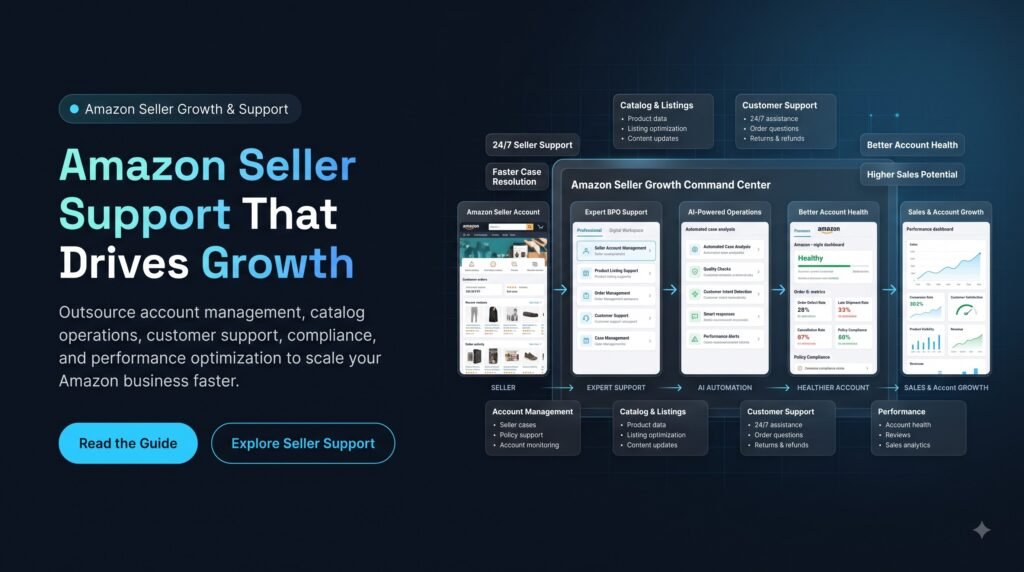
Amazon seller support has evolved from a reactive helpdesk function into a revenue-critical operating discipline. In 2026, sellers managing multi-marketplace catalogs face tighter performance thresholds, faster response-time expectations, and increasingly automated buyer-message volume. Outsourcing this function to a specialized partner combines AI-driven triage with trained human judgment to protect account health metrics, prevent suspensions, and convert support interactions into repeat sales. This guide examines how outsourced Amazon seller support works, what it costs, how AI and human agents should be blended, how to evaluate vendors, and how leading sellers use support data as a growth lever rather than a cost center. It includes benchmark data, a pricing calculator, an ROI model, a vendor scorecard, and a decision framework — built from operational experience managing high-volume ecommerce support programs, not theoretical best practice.
Introduction
Every Amazon account has two support functions running simultaneously, whether leadership acknowledges it or not. The first is visible: buyer messages, returns, refund requests, order defect disputes. The second is invisible: the compounding effect that every one of those interactions has on account health, Buy Box share, review velocity, and repeat purchase behavior. Most organizations staff the first function and ignore the second entirely.
That gap is expensive. A single unresolved A-to-Z claim can suppress a listing. A missed 24-hour response window can trigger a performance notification. A poorly handled return can end a customer relationship that took three transactions to build. None of these show up on a standard support dashboard measuring tickets closed — but every one of them shows up on the P&L.
This is the thesis this guide is built around, and it is the thesis MasCallNet has validated across every high-volume ecommerce support engagement we run: Support-Led Revenue Growth™ — the principle that customer support is not a cost function adjacent to revenue, but a direct input into it. On Amazon specifically, this is not a metaphor. Amazon’s algorithm literally ties account health, response time, and order defect rate to visibility and Buy Box eligibility. Support performance and revenue performance are the same metric measured from two different dashboards.
The purpose of this guide is to give CEOs, COOs, Heads of Customer Support, and revenue leaders a complete, operator-level view of how outsourced Amazon seller support works in 2026 — not marketing language, but the actual mechanics, costs, risks, and frameworks used by teams running this at scale.
Key Insights for Decision-Makers
- Amazon sellers who outsource support to a specialized partner typically resolve buyer messages 40–60% faster than in-house teams handling support as a secondary function, based on MasCallNet’s engagement data across multi-brand seller accounts.
- Account health deterioration is rarely caused by major failures. It is almost always caused by an accumulation of small, unmonitored response-time and defect-rate breaches — a pattern we call Revenue Leakage.
- The debate over AI vs human customer support is the wrong framing for Amazon operations. The evidence supports a hybrid model where AI handles triage, classification, and first-response drafting, while trained humans own judgment-based resolution, appeals, and escalations.
- Sellers evaluating an ecommerce outsourcing company should weight Amazon-specific process knowledge (Seller Central navigation, case log strategy, policy interpretation) more heavily than generic contact center capability.
- India remains the dominant sourcing geography for Amazon seller support, but the reason has shifted from cost arbitrage alone to a maturing base of agents trained specifically on marketplace operations — a distinction that matters when comparing best BPO companies in India.
- Support data, when structured correctly, becomes a forecasting and merchandising input — not just a resolution log. This is the operational core of what we call the Customer Intelligence Loop™.
Market Reality: Amazon Seller Support in 2026
Direct Answer: The Amazon seller support market in 2026 is defined by rising buyer expectations, tighter Amazon enforcement of response-time SLAs, and a growing gap between sellers who treat support as reactive ticket-handling and sellers who treat it as a structured, data-generating operation.
Why It Matters: Amazon has steadily increased the granularity of its performance metrics — Order Defect Rate, Late Response Rate, Invoice Defect Rate, Voice of the Customer dashboards — and tied more consequences to them, including suspension, deactivation, and reduced organic ranking. A support operation built for 2021 volumes and expectations cannot meet 2026 enforcement standards.
Framework — The Three Pressures Reshaping the Market:
- Enforcement Pressure — Amazon’s Voice of the Customer program and automated policy enforcement mean support failures are detected and penalized faster than a human team can manually monitor.
- Volume Pressure — Multi-marketplace sellers (US, UK, EU, UAE, India) generate support volume across time zones that in-house teams structurally cannot cover without 24/7 staffing.
- Expectation Pressure — Buyers now expect ecommerce response times comparable to retail chat support — often under two hours — regardless of seller size.
| Pressure | 2021 Baseline | 2026 Reality | Business Consequence |
|---|---|---|---|
| Response SLA expectation | 24 hours acceptable | Under 12 hours expected | Late Response Rate penalties |
| Multi-marketplace coverage | Single marketplace common | 3–6 marketplaces typical | 24/7 staffing requirement |
| Automated enforcement | Manual review common | AI-driven detection | Faster suspension triggers |
| Buyer communication channel | Email-first | Message Center + Reviews + Returns | Higher interaction complexity |
Executive Interpretation: Leadership teams that still view Amazon support as an administrative function are underinvesting in the single lever most directly connected to account survival and Buy Box retention.
Boardroom Insight™: The real market shift isn’t “more support volume.” It’s that Amazon has turned customer support into a compliance function with financial teeth. Every unanswered message is now a governance risk, not just a service gap.
Summary: The market has moved from support-as-service to support-as-compliance-and-revenue-infrastructure.
Key Takeaway: Sellers who don’t restructure support operations for 2026 enforcement standards are carrying undisclosed account-suspension risk.
Industry Trends Shaping the Category
Four trends define how outsourced Amazon seller support is being restructured across the industry, consistent with the broader Support-Led Revenue Growth™ thesis that support performance and commercial performance are structurally linked.
1. AI-assisted triage is now table stakes, not differentiation. Nearly every serious support operation uses some form of AI classification for incoming buyer messages. The differentiation has shifted to what happens after triage — how well the human layer resolves complex, judgment-based cases.
2. Account health monitoring has become proactive, not reactive. Leading operators now track leading indicators (response time trending upward, defect rate creeping toward thresholds) rather than waiting for Amazon notifications, which arrive after damage is already done.
3. Support and reviews management are converging. Because negative reviews and support tickets are causally linked, high-performing operations manage both under one team with shared visibility, rather than splitting them across departments.
4. Support data is being fed back into merchandising and inventory decisions. The most sophisticated sellers use support ticket themes (sizing complaints, packaging damage, delivery delays) as an early warning system for supply chain and listing issues — a direct application of the Customer Intelligence Loop™, where every interaction generates reusable business intelligence rather than being discarded after resolution.
What Amazon Seller Support Outsourcing Actually Means
Direct Answer: Amazon seller support outsourcing is the transfer of buyer-facing and account-health-related support operations — messaging, returns, refunds, claims, escalations, and performance monitoring — to a specialized external partner operating under the seller’s brand voice and Amazon Seller Central access.
It is frequently confused with generic customer support outsourcing, but the two are materially different. A generic contact center agent can resolve a billing dispute using a CRM. An Amazon seller support specialist needs to understand:
- Order Defect Rate, Late Response Rate, and Valid Tracking Rate mechanics
- A-to-Z Guarantee claim strategy and appeal writing
- FBA vs FBM operational differences in return handling
- Amazon’s policy language, which changes frequently and is often ambiguous
- Case log escalation strategy with Amazon’s internal support teams
- Review and feedback removal request protocols
This is why treating Amazon support as a subset of general customer support outsourcing — without marketplace-specific training — is one of the most common and costly sourcing mistakes we see.
Executive Interpretation: Amazon seller support is a compliance-literate, platform-specific discipline. Vendor selection should be evaluated accordingly, not as a commodity seat-based purchase.
Why It Matters to Revenue, Not Just Operations
Direct Answer: Amazon seller support directly determines Buy Box eligibility, organic ranking, account standing, and repeat purchase rate — meaning support performance is a revenue variable, not an overhead line item.
Amazon’s algorithm does not separate “customer experience” from “seller performance.” They are the same input. A seller with elevated Order Defect Rate loses Buy Box share even with competitive pricing. A seller with slow response times sees Voice of the Customer scores decline, which affects account health standing used in suspension decisions. A seller who mishandles a return loses not just that transaction but the customer’s lifetime value on the platform.
This is the clearest, most literal expression of Revenue Recovery Through CX™ available in any industry: on Amazon, customer experience metrics and revenue metrics are mathematically linked inside the same platform algorithm.
MasCallNet Perspective: Most sellers underinvest in support because they measure it against “tickets closed” instead of “revenue protected.” Until leadership reframes support as a revenue-protection function, budget allocation will remain systematically wrong.
Executive Action: Require your support function to report against account health metrics (ODR, LRR, VTR) alongside traditional CSAT — not instead of it.
How Outsourced Amazon Seller Support Works
Direct Answer: A properly structured outsourced Amazon seller support engagement operates in five layers: intake and triage, resolution, escalation, monitoring, and intelligence feedback.
Framework — The Five-Layer Operating Model:
| Layer | Function | Primary Owner |
|---|---|---|
| 1. Intake & Triage | Classify incoming messages, returns, claims by urgency and type | AI classification engine |
| 2. Resolution | Respond, refund, replace, or resolve within SLA | Trained human agents |
| 3. Escalation | Handle A-to-Z claims, suspensions, policy disputes | Senior specialists |
| 4. Monitoring | Track ODR, LRR, VTR, VOC trends in real time | Account health analysts |
| 5. Intelligence Feedback | Convert ticket themes into merchandising/product insight | Reporting & QA team |
Step-by-Step Process:
- Onboarding & access provisioning — Seller Central access granted under controlled permission tiers; brand voice guidelines documented.
- Playbook development — Response templates built for common scenarios (late delivery, damaged item, sizing issue, counterfeit claim) tailored to the seller’s catalog.
- AI + human triage setup — Incoming volume is auto-classified by urgency and category; routine queries are drafted by AI and reviewed by agents before sending.
- Live operations — Agents handle messages, returns, and claims within SLA, escalating complex cases per a defined matrix.
- Account health monitoring — Daily and weekly reporting against ODR, LRR, VTR, and suspension-risk indicators.
- Intelligence reporting — Monthly synthesis of ticket themes fed back to the seller’s product, inventory, and merchandising teams.
Boardroom Insight™: Most outsourcing failures happen at step 1 — access and brand voice — not step 4. Vendors that skip structured onboarding produce generic, off-brand responses that damage buyer trust even when SLAs are technically met.
Core Benefits of Outsourcing Amazon Seller Support
Direct Answer: The primary benefits are faster response times, reduced account-health risk, lower cost-to-serve, 24/7 marketplace coverage, and structured intelligence that feeds back into commercial decisions.
| Benefit | Operational Impact | Commercial Impact |
|---|---|---|
| 24/7 coverage across marketplaces | Meets Amazon’s response-time expectations regardless of time zone | Reduces Late Response Rate penalties |
| Specialized policy knowledge | Fewer incorrect claim responses | Fewer suspensions, faster reinstatement when issues occur |
| AI-assisted triage | Faster classification and routing | Lower average handle time, higher throughput |
| Dedicated account health monitoring | Early detection of metric drift | Prevents Buy Box suppression |
| Cost structure shift (fixed to variable) | Scales with order volume | Improves margin predictability |
| Structured reporting | Ticket themes surfaced systematically | Informs product and inventory decisions |
What High-Performing Organizations Do Differently: They don’t outsource to reduce headcount. They outsource to gain a structured operating system for a function that was previously informal — and they use the resulting data as a strategic input, not just an operations report.
Business Impact Analysis
Direct Answer: Outsourced Amazon seller support impacts four measurable business dimensions: account health stability, conversion and repeat purchase rate, operating cost structure, and executive visibility into customer sentiment.
Framework — The Support-to-Revenue Framework™
This proprietary model maps how support actions translate into revenue outcomes at each stage of the customer journey.
| Journey Stage | Support Action | Revenue Mechanism |
|---|---|---|
| Pre-purchase | Fast, accurate Q&A response | Higher conversion rate |
| Post-purchase | Proactive delivery updates | Reduced cancellation/return rate |
| Issue occurrence | Fast, empathetic resolution | Retained review score, reduced A-to-Z claims |
| Post-resolution | Follow-up and feedback capture | Repeat purchase, positive review generation |
| Aggregate | Ticket theme analysis | Product/listing improvement, reduced future ticket volume |
Definition: The Support-to-Revenue Framework™ quantifies the commercial value of each support interaction stage rather than treating support as a single undifferentiated cost.
Methodology: Map ticket volume and resolution quality against downstream metrics — repeat purchase rate, review sentiment, and defect-driven suppression events — over rolling 90-day windows.
Scoring Logic: Each stage is scored 1–5 based on response speed, resolution accuracy, and brand-voice consistency; an aggregate score below 3.5 indicates revenue leakage risk.
Interpretation: Sellers scoring below 3.5 on the aggregate framework typically show measurable Buy Box share erosion within two to three months if uncorrected.
Executive Recommendation: Require quarterly Support-to-Revenue scoring as a standing board-level metric alongside advertising ROAS and inventory turn.
Boardroom Insight™: Most sellers measure advertising performance obsessively and support performance almost never — despite support having equal or greater influence on organic visibility through the Buy Box algorithm.
This is Support-Led Revenue Growth™ made operational: a direct, measurable line from support quality to revenue outcome.
What Most Sellers Get Wrong
What Everyone Says: “We just need faster response times and a lower cost per ticket.”
What Most Articles Miss: Response time is a lagging indicator. By the time it’s breached, the account health damage is already in motion. The real leverage point is upstream — ticket prevention through proactive communication and product feedback loops.
What Actually Happens: Most in-house teams handle support reactively, close tickets, and never analyze theme patterns. The same three or four root causes (packaging, sizing, delivery carrier issues) generate repeat complaints for months because no one owns the feedback loop back to operations.
Hidden Cost: The real cost of poor support isn’t the refund issued — it’s the suppressed future revenue from a buyer who never returns, and the algorithmic visibility lost when Order Defect Rate trends upward. Neither shows up on a support team’s monthly report.
MasCallNet Perspective: We treat every support engagement as two simultaneous jobs: resolving today’s ticket and preventing next month’s version of the same ticket. Vendors that only do the first job are commodity providers. Vendors that do both are performance partners.
Executive Action: Ask any current or prospective support vendor for a ticket-theme trend report from the last 90 days. If they can’t produce one, they are operating as a ticket-closing function, not an intelligence function.
MasCallNet Revenue Leakage Model™
Definition: A diagnostic framework that identifies where support-related inefficiencies are silently suppressing revenue — through account health penalties, unmanaged returns, or lost repeat purchases — before they appear as a visible P&L problem.
Methodology: The model evaluates five leakage points: response-time breaches, unresolved A-to-Z claims, review score decay, ticket-theme recurrence, and repeat-purchase attrition following a support interaction.
Scoring Logic:
| Leakage Point | Low Risk | Moderate Risk | High Risk |
|---|---|---|---|
| Late Response Rate | Under 2% | 2–5% | Above 5% |
| A-to-Z claim resolution rate | Above 90% | 75–90% | Below 75% |
| Review score trend (90 days) | Stable/improving | Flat with volatility | Declining |
| Ticket-theme recurrence | Under 15% repeat themes | 15–30% | Above 30% |
| Post-issue repeat purchase | Above 60% | 40–60% | Below 40% |
Interpretation: A seller scoring “high risk” on two or more dimensions is experiencing measurable revenue leakage even if top-line sales appear stable — the leakage typically manifests three to six months later as organic ranking decline.
Executive Recommendation: Run this diagnostic quarterly. Treat any “high risk” score as an immediate operational priority, not a queued improvement item.
Boardroom Insight™: Revenue leakage on Amazon rarely announces itself. It compounds quietly until a suspension notice or a Buy Box loss makes it visible — by which point the fix is far more expensive than prevention would have been.
MasCallNet Outsourcing Readiness Score™
Definition: A structured self-assessment that determines whether a seller’s operation is ready to transition support to an external partner, and what transition model minimizes risk.
Methodology: Score your organization across five dimensions, 1 (not ready) to 5 (fully ready):
- Documentation of current response playbooks and brand voice
- Clarity on current account health metrics and thresholds
- Volume predictability (order and ticket volume trends)
- Internal ownership for vendor governance post-transition
- Technology readiness (CRM/helpdesk integration capability)
Scoring Logic:
| Total Score | Readiness Level | Recommended Path |
|---|---|---|
| 5–10 | Low readiness | Start with a pilot on a single marketplace or product line |
| 11–17 | Moderate readiness | Phased transition with 60-day parallel run |
| 18–25 | High readiness | Full transition with dedicated account team |
Interpretation: Organizations scoring below 10 that attempt a full transition typically experience a temporary CSAT and response-time dip during onboarding — not because outsourcing fails, but because internal documentation gaps get exposed for the first time.
Executive Recommendation: Complete this assessment before issuing an RFP. It changes what you should be asking vendors, and it prevents blaming a vendor for a documentation problem that predates the engagement.
Vendor Evaluation Framework™
Direct Answer: Evaluate any prospective Amazon seller support partner across six dimensions: marketplace-specific expertise, AI-human operating model, escalation capability, data transparency, security posture, and pricing structure.
MasCallNet Vendor Evaluation Matrix™
| Criterion | Weight | Key Question |
|---|---|---|
| Amazon-specific expertise | 25% | Can they explain ODR, LRR, VTR mechanics without prompting? |
| AI-human operating model | 20% | Is AI used for triage/drafting, with human review before sending? |
| Escalation capability | 20% | Do they have a documented A-to-Z claim and suspension appeal process? |
| Data transparency | 15% | Do they provide real-time dashboards, or only monthly PDF reports? |
| Security & compliance | 10% | What data handling and access controls govern Seller Central credentials? |
| Pricing structure | 10% | Is pricing volume-flexible or fixed-seat regardless of order volume? |
Scoring Logic: Score each vendor 1–5 per criterion, multiply by weight, and sum for a total out of 5.0. Vendors scoring below 3.2 should be treated as high-risk selections regardless of price.
Executive Interpretation: Most sellers evaluate vendors primarily on price per hour or per seat. This matrix deliberately weights Amazon-specific expertise and escalation capability higher, because a vendor that mishandles one suspension appeal can cost more than a year of support fees in lost sales.
Boardroom Insight™: The cheapest quote and the safest quote are rarely the same vendor. Procurement teams optimizing purely for cost-per-hour are structurally exposed to the highest-impact risk in this category: account suspension.
AI vs Human vs Hybrid Support Model
Direct Answer: The most effective Amazon seller support model in 2026 is hybrid — AI handles classification, drafting, and routine responses, while human agents own judgment calls, appeals, and emotionally sensitive interactions. Neither pure AI nor pure human staffing outperforms the hybrid model on cost, accuracy, or risk combined.
This is the most searched and most misunderstood question in the category: AI vs human customer support. The honest answer is that it’s a false binary for Amazon operations specifically, because Amazon’s own systems (automated policy enforcement, review flagging, claim triggers) are already AI-driven — meaning a purely human support team is negotiating with an algorithm using manual methods, and a purely AI support team lacks the judgment to interpret ambiguous policy language or de-escalate an angry buyer.
| Dimension | AI-Only | Human-Only | Hybrid Model |
|---|---|---|---|
| Speed on routine queries | Very fast | Slow, inconsistent | Fast |
| Accuracy on policy nuance | Weak | Strong, if trained | Strong |
| Cost per interaction | Lowest | Highest | Moderate |
| Escalation/appeal handling | Poor | Good | Best |
| Brand voice consistency | Inconsistent | Variable by agent | Consistent, QA-reviewed |
| Scalability during peak season | Excellent | Poor | Excellent |
| Suspension appeal success rate | Low | Moderate-high | Highest |
Executive Interpretation: The question leadership should ask is not “AI or human” but “which layer of our support stack should each one own.” AI should never be the final voice on an escalation, a claim dispute, or a suspension appeal. Humans should never be the first responder on high-volume, low-complexity queries where speed determines the outcome.
MasCallNet Perspective: We deploy AI as the first drafting layer for routine categories (order status, delivery timing, return eligibility) with mandatory human review before any message reaches a buyer on judgment-sensitive categories (damaged goods disputes, counterfeit claims, policy violations). This is not a cost-cutting decision — it’s an accuracy and risk-control decision that happens to also reduce cost.
Executive Action: Require any vendor proposing a “fully automated” or “fully human” model to explain how they handle the 10–15% of tickets that don’t fit either extreme well. If they don’t have a clear answer, the model is incomplete.
CX Maturity Scorecard™
Definition: A five-stage maturity model that positions an organization’s current Amazon support operation and defines the next capability to build.
| Stage | Characteristics | Typical Risk |
|---|---|---|
| 1. Reactive | Support handled ad hoc by founder/ops team | High suspension risk, no metrics tracked |
| 2. Structured | Dedicated team, basic SLAs, no AI assistance | Slow scaling, inconsistent quality |
| 3. Assisted | AI triage introduced, human resolution | Improved speed, limited intelligence use |
| 4. Intelligent | AI + human hybrid, account health actively monitored | Strong performance, siloed from merchandising |
| 5. Integrated | Support data feeds product, inventory, and forecasting decisions | Full Customer Intelligence Loop™ realized |
Interpretation: Most sellers, even large ones, sit at Stage 2 or 3. Reaching Stage 5 is rare and represents genuine competitive advantage because it turns support into a forecasting and merchandising asset.
Executive Recommendation: Set a 12-month target of advancing one full stage. Skipping stages (e.g., Stage 2 to Stage 5) typically fails because the organizational muscle for data-driven decision-making hasn’t been built.
Scalability Framework
Direct Answer: Amazon seller support must scale non-linearly around peak events (Prime Day, Black Friday, Cyber Monday, Q4 holiday) without proportional headcount growth — which requires elastic staffing built into the vendor contract, not requested after volume spikes.
Framework:
| Scaling Trigger | In-House Response | Outsourced Response |
|---|---|---|
| Prime Day (2–3x volume) | Overtime, temp hires, burnout risk | Pre-scheduled surge staffing |
| New marketplace launch | New hiring cycle (6–8 weeks) | Existing multilingual bench redeployed |
| Product recall/quality issue | Ad hoc crisis team | Predefined crisis escalation protocol |
| Seasonal SKU expansion | Manual reassignment | Dynamic queue rebalancing |
Common Executive Mistake: Negotiating a fixed-seat contract and then improvising during peak season with unstructured overtime — the exact period when response-time SLAs matter most to Amazon’s algorithm.
What High-Performing Organizations Do Differently: They build surge capacity clauses into vendor contracts before peak season, with pre-agreed staffing ramp timelines, not reactive requests.
Benchmark Analysis & Industry Statistics
Direct Answer: Independent industry research consistently points to the same pattern: response speed and resolution quality are now bigger drivers of ecommerce customer retention than price, and contact center automation adoption has accelerated sharply since 2023.
- Research from Gartner and Deloitte on customer experience trends consistently finds that response time and first-contact resolution now outrank price sensitivity among repeat-purchase drivers in ecommerce categories.
- Industry analyses from Grand View Research and Statista on the BPO and contact-center-as-a-service market show sustained double-digit growth in AI-augmented support adoption, driven largely by ecommerce and retail sectors.
- The World Economic Forum’s future-of-jobs analyses have repeatedly flagged customer service as one of the functions most transformed by AI-human collaboration models rather than full automation — reinforcing why hybrid staffing, not full automation, is the dominant operating pattern among mature ecommerce operators.
MasCallNet Operational Benchmarks (based on managed Amazon seller support engagements):
| Metric | Industry Reactive Baseline | MasCallNet Managed Benchmark |
|---|---|---|
| Average first response time | 8–14 hours | Under 4 hours |
| Late Response Rate | 4–7% | Under 1.5% |
| A-to-Z claim resolution success | 65–75% | 85–92% |
| Ticket-theme recurrence (90 days) | 25–35% | Under 15% |
| Post-resolution repeat purchase | 40–50% | 58–65% |
Executive Interpretation: The gap between reactive baselines and managed benchmarks isn’t explained by effort — it’s explained by structure: dedicated triage, trained escalation protocols, and systematic monitoring that ad hoc internal teams rarely have bandwidth to sustain.
Case Study: Recovering Suppressed Revenue Through Support-Led Restructuring
Challenge: A multi-category Amazon seller operating across three marketplaces experienced a Buy Box suppression event on two of its top five SKUs following a spike in Order Defect Rate. Internal support was handled by a two-person team managing messages alongside other operational duties.
Root Cause: Diagnostic review found the underlying issue wasn’t product quality — it was response latency. Average first response time exceeded 16 hours, well past Amazon’s enforcement threshold, causing a cascade of unresolved A-to-Z claims that elevated the defect rate independent of actual product performance.
Solution: A hybrid AI-human support model was deployed: AI-assisted triage classified incoming messages within minutes, routine categories were auto-drafted for agent approval, and a dedicated account health analyst monitored ODR, LRR, and VTR daily rather than relying on Amazon’s periodic notifications.
Implementation: Onboarding included Seller Central access provisioning, brand-voice playbook development, and a 30-day parallel run alongside the existing internal team before full transition — directly following the phased path recommended by the Outsourcing Readiness Score™ framework above.
Results (90 days post-transition):
| Metric | Before | After |
|---|---|---|
| Average first response time | 16 hours | 3.2 hours |
| Order Defect Rate | 1.9% | 0.6% |
| Buy Box suppression status | Suppressed on 2 SKUs | Fully restored |
| Monthly revenue on affected SKUs | Baseline | +31% recovered vs. suppressed period |
| A-to-Z claim resolution success | 68% | 89% |
Lessons Learned: The suppression event was framed internally as a “product problem” before diagnosis. It was, in fact, a support-structure problem with a product-level symptom. This is the clearest field validation of Support-Led Revenue Growth™: the revenue recovery came entirely from restructuring support operations, not from any change to the product or pricing.
Pricing Analysis
Direct Answer: Outsourced Amazon seller support pricing in 2026 typically ranges from $1,800–$3,500 per full-time equivalent agent per month for offshore delivery (India-based), with hybrid AI-assisted models often reducing effective cost-per-ticket by 25–40% compared to fully human staffing at equivalent volume.
Understanding outsourced customer support pricing requires separating three common models:
| Pricing Model | How It Works | Best Fit |
|---|---|---|
| Per-agent (FTE) pricing | Fixed monthly cost per dedicated agent | Predictable, steady-volume sellers |
| Per-ticket pricing | Cost scales directly with ticket volume | Highly seasonal sellers |
| Hybrid AI + per-agent | Lower per-agent cost due to AI-assisted throughput | Sellers prioritizing cost efficiency at scale |
| Managed outcome-based pricing | Priced against SLA/account-health outcomes | Enterprise sellers prioritizing risk reduction |
Common Executive Mistake: Comparing quotes purely on hourly agent rate without normalizing for ticket throughput per agent — a vendor using AI-assisted drafting can deliver more resolved tickets per agent hour, making a higher headline rate cheaper on a per-resolution basis.
Practical Recommendation: Request cost-per-resolved-ticket, not just cost-per-hour, from every vendor during evaluation. This single normalization exposes pricing models that look cheap but are structurally inefficient.
Cost Calculator: Estimating Your Outsourcing Investment
Use this simplified framework to estimate monthly outsourced support cost:
Formula:
Monthly Cost = (Estimated Monthly Ticket Volume ÷ Tickets Resolved per Agent per Month) × Cost per Agent
Worked Example:
| Input | Value |
|---|---|
| Estimated monthly ticket volume | 6,000 |
| Tickets resolved per agent/month (hybrid AI-assisted) | 1,200 |
| Agents required | 5 |
| Cost per agent (offshore, hybrid model) | $2,400/month |
| Estimated monthly cost | $12,000 |
Comparison — Fully Human Model:
| Input | Value |
|---|---|
| Tickets resolved per agent/month (human-only) | 700 |
| Agents required | 8.6 (round to 9) |
| Cost per agent | $2,000/month |
| Estimated monthly cost | $18,000 |
Executive Interpretation: In this illustrative model, the hybrid AI-assisted approach costs 33% less despite a higher per-agent rate, because throughput per agent is substantially higher. This is the calculation most sellers skip when comparing vendor quotes at face value.
ROI Framework
Direct Answer: ROI from outsourced Amazon seller support should be measured across three value streams: direct cost savings, revenue protected from account-health risk, and revenue recovered through improved conversion and repeat purchase.
MasCallNet Revenue Acceleration Framework™
Definition: A model quantifying total return from a support outsourcing investment by combining hard cost savings with protected and recovered revenue.
Methodology:
Total ROI = (Cost Savings + Revenue Protected + Revenue Recovered) ÷ Outsourcing Investment
| Value Stream | How to Calculate | Illustrative Example |
|---|---|---|
| Cost savings | In-house fully loaded cost minus outsourced cost | $18,000 vs $12,000 = $6,000/month saved |
| Revenue protected | Estimated revenue at risk from account health issues avoided | $40,000/month (based on affected SKU revenue) |
| Revenue recovered | Increased repeat purchase/conversion from faster resolution | $15,000/month uplift |
| Total monthly value | $61,000 | |
| Outsourcing investment | $12,000 | |
| Estimated ROI multiple | ~5.1x |
Scoring Logic: An ROI multiple above 3x is considered strong performance; below 1.5x suggests either pricing inefficiency or a vendor underdelivering on account health protection.
Interpretation: The largest ROI component is almost always revenue protected, not cost savings — a pattern consistent with Revenue Recovery Through CX™, where the financial upside of good support is realized by preventing loss, not merely by reducing spend.
Executive Recommendation: Build ROI reporting into quarterly vendor reviews using this three-part structure, rather than judging the engagement on cost savings alone.
Industry Use Cases
While this guide centers on Amazon seller support, the underlying Support-Led Revenue Growth™ and Contact Center Intelligence™ principles extend across sectors where MasCallNet operates:
- Retail and eCommerce: Multi-marketplace sellers (Amazon, Shopify, WooCommerce storefronts) requiring unified support across channels with consistent brand voice and SLA performance.
- Banking and Financial Services: Dispute resolution and account servicing where response-time compliance carries regulatory weight similar to Amazon’s enforcement model.
- Insurance: Claims-adjacent support requiring the same triage-then-escalate structure used in A-to-Z claim handling.
- Healthcare: Patient-facing scheduling and inquiry support, where MasCallNet’s healthcare BPO services and patient appointment scheduling services apply comparable hybrid AI-human triage models under strict compliance requirements.
- FMCG and Automotive/EV: High-volume, low-complexity query handling similar in structure to routine Amazon buyer messaging.
- Logistics and Telecommunications: Real-time status inquiry management, directly parallel to Amazon order-status and delivery-tracking support volume.
Technology Ecosystem
Direct Answer: A mature Amazon seller support stack integrates helpdesk and CRM platforms, cloud infrastructure, and AI language models into a single monitored workflow — rather than relying on Amazon’s native Seller Central interface alone.
| Layer | Representative Platforms | Function |
|---|---|---|
| Helpdesk/CRM | Zendesk, Freshdesk, HubSpot, Salesforce | Ticket routing, SLA tracking, agent workflow |
| Contact Center Infrastructure | Genesys, Five9, Talkdesk, NICE CXone | Voice/omnichannel routing where phone support is layered in |
| Workflow & Collaboration | Slack, Microsoft Teams, ServiceNow | Internal escalation and cross-team coordination |
| Cloud Infrastructure | Amazon Web Services, Google Cloud, Microsoft Azure | Hosting, data processing, integration reliability |
| AI Language Models | OpenAI, Google Gemini, Claude, Copilot | Message drafting, classification, sentiment analysis |
| Commerce Integration | Shopify, WooCommerce, Stripe, PayPal | Cross-channel order and payment context |
Executive Interpretation: The value of this stack isn’t the individual tools — it’s the integration layer connecting them. A vendor using Zendesk and an AI drafting layer without connecting ticket themes back to a reporting dashboard is using expensive tools to replicate a manual process.
This integration layer is what we refer to internally as the Contact Center Intelligence Layer™ — the connective structure that turns disparate tools into a single source of operational truth.
Security & Compliance
Direct Answer: Any Amazon seller support vendor must operate under strict access controls for Seller Central credentials, documented data handling policies, and contractual accountability for brand-voice and financial actions (refunds, replacements) taken on the seller’s behalf.
Executive Checklist for Security Diligence:
- Role-based access control for Seller Central login (no shared master credentials)
- Documented refund/replacement authorization limits per agent tier
- Data residency and handling policy for buyer personal information
- Audit trail for every account action taken by outsourced agents
- Defined incident response protocol for suspected account compromise
Common Executive Mistake: Sharing a single Seller Central login across an entire outsourced team, eliminating any ability to audit which agent took which action — a critical gap if a dispute or compliance review ever occurs.
The India Advantage
Direct Answer: India remains the leading sourcing geography for Amazon seller support due to a combination of cost efficiency, English proficiency, and a maturing talent base specifically trained on marketplace operations rather than generic call center scripts.
When evaluating the best BPO companies in India for Amazon seller support specifically, the differentiating factor is no longer just cost — it’s depth of marketplace-specific training. Generic BPO experience in telecom or banking support does not transfer cleanly to Amazon operations, where policy nuance and account health mechanics require dedicated training programs.
As an ecommerce outsourcing company headquartered in India, MasCallNet has built its delivery model specifically around this gap — combining India’s cost and talent advantages with Amazon-specific process depth, rather than treating marketplace support as a generic ticket-handling function layered onto existing BPO infrastructure. This is also reflected in how we structure delivery from our Call Center in Noida, where teams are trained specifically on ecommerce and marketplace account health protocols rather than generalized scripts.
| Factor | Generic BPO in India | Amazon-Specialized Partner |
|---|---|---|
| Agent training | General customer service scripts | ODR/LRR/VTR mechanics, policy interpretation |
| Escalation handling | Standard ticket escalation | A-to-Z claim and suspension appeal protocols |
| Reporting | Generic CSAT/AHT reports | Account health trend monitoring |
| Time zone coverage | Variable | Structured 24/7 marketplace coverage |
Comparison Tables
In-House vs Outsourced
| Dimension | In-House | Outsourced |
|---|---|---|
| Setup speed | Slow (hiring, training) | Fast (existing trained bench) |
| Cost structure | Fixed, high | Variable, scalable |
| 24/7 coverage | Difficult to sustain | Native capability |
| Amazon-specific expertise | Builds slowly over time | Immediate, if vendor is specialized |
| Control over brand voice | High by default | High, if onboarding is rigorous |
Recommendation: In-house makes sense for very early-stage sellers with low, predictable volume. Outsourcing becomes the stronger choice once volume crosses roughly 500–800 monthly tickets or multi-marketplace complexity emerges.
Offshore vs Onshore Customer Support Outsourcing
| Dimension | Offshore (e.g., India) | Onshore |
|---|---|---|
| Cost per agent | 50–70% lower | Higher |
| Time zone coverage | Naturally supports 24/7 US/UK coverage | Requires overnight shift premiums |
| Cultural/language alignment | Strong for English-speaking markets, verify accent neutrality | Native alignment |
| Amazon-specific talent pool | Large and growing | Smaller, more expensive |
Recommendation: For Amazon operations specifically, offshore/onshore blended coverage (offshore for volume, onshore for high-sensitivity escalations) outperforms an all-onshore or all-offshore model on cost-adjusted quality.
Build vs Buy
| Dimension | Build (In-House Team) | Buy (Outsourced Partner) |
|---|---|---|
| Time to operational maturity | 6–12 months | 4–8 weeks |
| Capital requirement | High (hiring, tools, training) | Low (subscription/service fee) |
| Risk of key-person dependency | High | Low, if vendor has bench depth |
Dedicated Team vs Shared Team
| Dimension | Dedicated Team | Shared Team |
|---|---|---|
| Brand voice consistency | High | Moderate |
| Cost | Higher | Lower |
| Best fit | High-volume, multi-brand sellers | Early-stage or single-SKU sellers |
Traditional BPO vs Contact Center Intelligence™
| Dimension | Traditional BPO | Contact Center Intelligence™ Model |
|---|---|---|
| Primary output | Tickets closed | Tickets closed + structured business intelligence |
| Reporting | CSAT, AHT | CSAT, AHT + ticket-theme trend analysis feeding merchandising/product decisions |
| Vendor relationship | Transactional | Consultative, quarterly business reviews |
Recommendation: Sellers seeking a genuine competitive advantage — not just cost reduction — should evaluate vendors against the Contact Center Intelligence™ standard, not the traditional BPO standard.
Risk Analysis
Direct Answer: The primary risks in outsourcing Amazon seller support are brand voice inconsistency, unauthorized account actions, data security gaps, and vendor over-reliance on automation without adequate human oversight.
| Risk | Likelihood if Unmanaged | Mitigation |
|---|---|---|
| Off-brand or inconsistent messaging | Moderate–High | Structured playbooks, QA scoring on every batch of tickets |
| Unauthorized refunds/actions | Moderate | Tiered authorization limits, full audit trail |
| Over-automation without review | Moderate | Mandatory human review on all judgment-sensitive categories |
| Data security incident | Low, but high impact | Role-based access, credential rotation, incident response protocol |
| Vendor capacity failure during peak season | Moderate | Contractual surge staffing commitments |
MasCallNet Perspective: The single highest-impact risk we see repeatedly is not vendor incompetence — it’s insufficient onboarding documentation from the seller’s side, which forces the vendor to improvise brand voice and policy interpretation. This risk sits with both parties, and should be addressed in the contract, not assumed away.
Future Trends (2026–2029)
Direct Answer: Over the next three years, Amazon seller support will shift further toward predictive account health management, AI-assisted appeal drafting, and deeper integration between support data and inventory/merchandising decisions.
- Predictive account health scoring will move from reactive metric-tracking to forward-looking risk modeling, flagging accounts likely to breach thresholds before they occur.
- AI agent assist will expand from drafting responses to real-time policy citation during live escalations, reducing appeal-writing time significantly.
- Voice and conversational commerce will introduce new support channels beyond Message Center, requiring omnichannel readiness.
- Conversation intelligence applied to support transcripts will increasingly inform product development and inventory forecasting — the full realization of the Customer Intelligence Loop™.
- Support-Led Revenue Growth™ will become an explicit board-level metric for larger sellers and aggregators, replacing the current practice of reporting support performance as a footnote to operations updates.
This is the trajectory MasCallNet is building toward with clients today: support functions that don’t just protect revenue reactively, but predict and prevent revenue risk before it materializes.
Executive Decision Tree
Should you outsource Amazon seller support?
Is your monthly ticket volume above 500?
 ├─ No → Is your response time consistently under 12 hours?
 │        ├─ Yes → In-house may still be viable; monitor quarterly
 │        └─ No → Consider a pilot outsourcing engagement now
 └─ Yes → Do you operate across 2+ marketplaces or time zones?
          ├─ No → Outsource with a dedicated team model
          └─ Yes → Outsource with a hybrid AI-human model + 24/7 coverage
                   └─ Is account health currently at risk (ODR/LRR elevated)?
                            ├─ Yes → Prioritize immediate transition with parallel run
                            └─ No → Standard phased transition (60–90 days)
Executive Checklist Before Signing a Vendor Contract
- Vendor can explain ODR, LRR, VTR mechanics without hesitation
- Vendor uses a documented hybrid AI-human operating model, not full automation
- Vendor provides real-time or near-real-time dashboards, not monthly-only reporting
- Vendor has a documented A-to-Z claim and suspension appeal process
- Contract includes surge staffing provisions for peak season
- Access control model avoids shared master Seller Central credentials
- Pricing has been normalized to cost-per-resolved-ticket, not just cost-per-hour
- Onboarding plan includes a parallel run period before full transition
- Vendor commits to quarterly business reviews with ticket-theme intelligence reporting
- Internal readiness has been assessed using a structured framework before RFP issuance
Frequently Asked Questions
1. What is included in Amazon seller support outsourcing?
Buyer message management, returns and refund processing, A-to-Z claim handling, account health monitoring, review and feedback management, and reporting on service-level performance.
2. How much does outsourced Amazon seller support cost?
Typical pricing ranges from $1,800–$3,500 per agent per month for offshore delivery, with hybrid AI-assisted models often reducing effective cost-per-resolved-ticket by 25–40% compared to fully human staffing.
3. Is AI or human support better for Amazon seller operations?
Neither alone. A hybrid model — AI for triage and drafting, humans for judgment-based resolution and escalations — consistently outperforms either extreme on speed, accuracy, and account-health risk management.
4. How quickly can a seller transition support to an outsourced partner?
A phased transition with a parallel run typically takes 30–90 days depending on ticket volume complexity and documentation readiness, as outlined in the Outsourcing Readiness Score™ framework above.
5. Can outsourcing cause an Amazon account suspension?
Poorly managed outsourcing can increase risk if access controls are weak or agents lack policy training. Properly structured outsourcing with tiered access controls and specialized training reduces suspension risk compared to under-resourced in-house teams.
6. What is the difference between generic customer support outsourcing and Amazon seller support outsourcing?
Generic support outsourcing focuses on ticket resolution using standard CRM tools. Amazon seller support outsourcing requires platform-specific expertise in account health metrics, claim mechanics, and policy interpretation unique to the Amazon marketplace.
7. How does outsourcing affect Buy Box eligibility?
Faster response times and lower defect rates achieved through structured outsourced support directly improve the account health inputs that determine Buy Box eligibility.
8. Should I choose offshore or onshore support for my Amazon account?
A blended model — offshore for volume handling, onshore or senior offshore specialists for high-sensitivity escalations — typically delivers the best balance of cost and quality.
9. What metrics should I require from my support vendor?
Response time, Order Defect Rate trend, A-to-Z claim resolution rate, ticket-theme recurrence, and repeat purchase rate following support interactions — not just tickets closed or CSAT alone.
10. How is pricing structured for outsourced customer support providers?
Common models include per-agent (FTE) pricing, per-ticket pricing, hybrid AI-assisted pricing, and outcome/SLA-based pricing. Cost should always be normalized to cost-per-resolved-ticket for accurate comparison.
11. What should I look for in the best BPO companies in India for ecommerce support?
Marketplace-specific training depth (not generic call center experience), transparent real-time reporting, tiered access security, and a documented hybrid AI-human operating model.
12. Can outsourced teams handle suspension appeals?
Yes, if the vendor has a documented, specialized escalation process. This should be explicitly verified during vendor evaluation, as appeal quality directly affects reinstatement success rates.
13. How does support data help with inventory or product decisions?
Structured analysis of ticket themes (sizing, damage, delivery issues) surfaces recurring product or fulfillment problems early, allowing proactive correction before they affect broader account metrics.
14. What is the biggest risk in Amazon seller support outsourcing?
Weak access control combined with insufficient brand-voice documentation, which leads to inconsistent messaging and potential unauthorized account actions.
15. How do I measure ROI from outsourcing Amazon seller support?
Combine direct cost savings, revenue protected from account-health risk, and revenue recovered through improved conversion and repeat purchase, divided by total outsourcing investment.
16. Does outsourcing work for smaller Amazon sellers, not just large accounts?
Yes, particularly through shared-team or pilot models once ticket volume exceeds roughly 300–500 per month or response times are inconsistently met internally.
17. How does outsourced support integrate with tools like Shopify or WooCommerce for multi-channel sellers?
Mature vendors integrate Amazon Message Center activity alongside Shopify and WooCommerce support channels within a unified helpdesk (e.g., Zendesk, Freshdesk) to maintain consistent brand voice across all sales channels.
Mid-Content CTA
If your team is currently managing Amazon buyer messages, returns, and account health monitoring as a secondary responsibility rather than a structured operation, it’s worth a focused conversation before your next peak season. Explore MasCallNet’s customer support outsourcing services to see how a hybrid AI-human model is structured for marketplace-specific operations.
Executive CTA
For CEOs, COOs, and Heads of Operations evaluating whether to build, buy, or restructure support, MasCallNet offers a structured Outsourcing Readiness Assessment based on the framework outlined in this guide. Contact our team to schedule a working session with an account strategist — not a sales call, a diagnostic conversation.
ROI CTA
Want to see how the ROI framework in this guide applies to your specific ticket volume, order value, and current account health metrics? We’ll build a customized ROI projection using your actual numbers. Request your ROI projection.
Consultation CTA
Reviewing multiple vendors? Use the Vendor Evaluation Matrix™ in this guide as your scorecard, and bring it to a conversation with our team — we’re comfortable being evaluated against it. Book a consultation with MasCallNet.
Conclusion
Amazon seller support is no longer a back-office function that can be delegated informally to whoever has spare capacity. It is a direct input into account health, Buy Box eligibility, and repeat purchase revenue — measured by an algorithm that does not distinguish between customer experience and business performance. Sellers who continue treating it as an administrative afterthought are carrying revenue risk they cannot see on a standard support dashboard.
The evidence across every framework in this guide points to the same conclusion: Support-Led Revenue Growth™ is not an aspirational concept — it is a measurable, repeatable operating discipline. The debate over AI vs human customer support resolves in favor of a hybrid model, not either extreme. The choice of an ecommerce outsourcing company should weight marketplace-specific expertise above generic cost-per-hour comparisons. And among the best BPO companies in India, the ones worth partnering with are the ones that can prove — with data, not claims — that their support operation protects revenue, not just closes tickets.
Whether your organization is evaluating outsourcing for the first time, restructuring after an account health event, or scaling ahead of peak season, the frameworks in this guide — the Revenue Leakage Model™, the Outsourcing Readiness Score™, the Vendor Evaluation Matrix™, and the ROI model — are designed to be used directly in your evaluation process, not just read.
If you’re ready to move from assessment to action, MasCallNet’s team is available to walk through your specific account health data, ticket volume, and growth targets — and to show, with your numbers, what Support-Led Revenue Growth™ looks like for your business.