
Reduce Customer Support Costs with AI Outsourcing: The Complete Customer Support Outsourcing Strategy for 2026
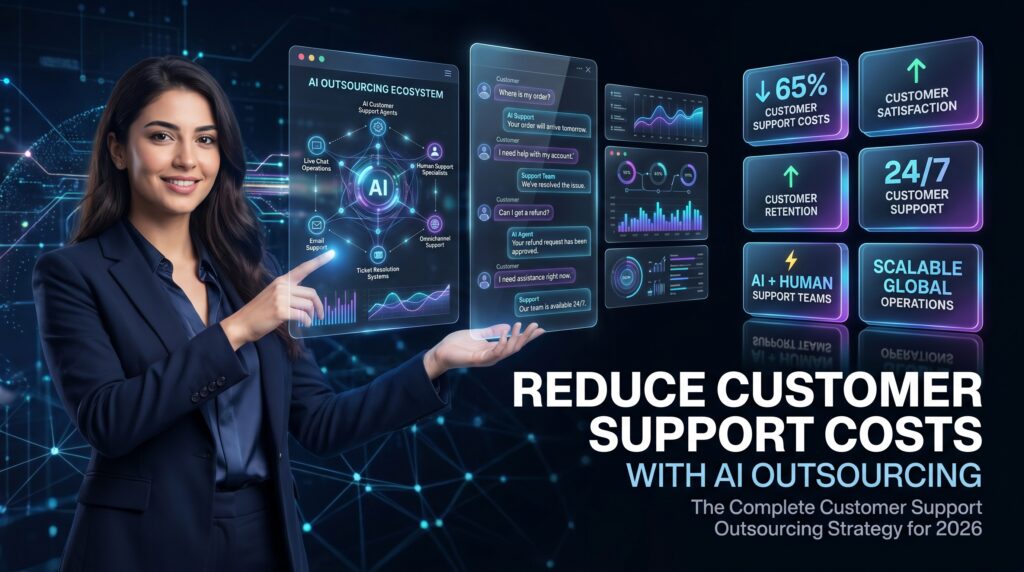
AI Overview
Customer support outsourcing has evolved from a cost-saving tactic into a strategic growth engine. Modern organizations combine call center outsourcing, AI-powered automation, and specialized contact center services to deliver faster support, improve customer satisfaction, and reduce operational expenses.
As AI transforms customer service, businesses are increasingly automating business processes while maintaining human expertise for complex interactions. The most successful organizations use hybrid support models that combine AI, trained support professionals, and advanced customer service platforms to improve efficiency and customer retention.
Whether you’re a SaaS company, eCommerce brand, fintech provider, or enterprise organization, outsourcing customer support enables faster scaling, lower costs, and improved customer experience without the burden of expanding internal support operations.
Introduction
Customer support has become one of the most expensive operational functions in modern business.
Customer expectations continue to rise. Response times are expected to be instant. Support is expected to be available 24/7. Customers demand personalized experiences across email, chat, voice, social media, and self-service channels.
At the same time, labor costs, hiring challenges, and support complexity continue increasing.
This is why customer support outsourcing has become a strategic priority for growth-focused organizations.
Businesses are no longer outsourcing solely to reduce costs. They are leveraging call center outsourcing, AI automation, and global delivery models to improve customer experience while accelerating growth.
According to recent Gartner research, more than half of customer service journeys now begin on third-party platforms, including AI-powered discovery experiences. Organizations that deliver fast, accurate support experiences gain a significant competitive advantage.
For many companies, particularly those seeking to outsource customer support to India, outsourcing has become a scalable pathway to operational efficiency and customer retention.
The challenge is determining how to implement outsourcing successfully.
This guide provides the framework.
Key Insights
- Customer support outsourcing can reduce operational costs by 30–60%.
- AI-powered support environments can improve response times by 2–3x.
- Hybrid AI and human support models outperform fully manual operations.
- Global outsourcing enables true 24/7 customer coverage.
- Modern contact center services now include AI automation, analytics, and workflow optimization.
- SaaS, eCommerce, fintech, and healthcare organizations are leading outsourcing adoption.
- Businesses that combine outsourcing with automation achieve the strongest long-term ROI.
Market Reality: Why Businesses Are Shifting to AI-Powered Outsourcing
The customer service industry is experiencing a structural transformation.
Traditional support models relied heavily on internal teams managing tickets manually. Today, support organizations are expected to deliver:
- Omnichannel service
- 24/7 availability
- Personalized interactions
- Self-service capabilities
- Faster resolution times
Meeting these expectations internally often requires substantial investment.
Modern contact center services providers now integrate:
- Artificial intelligence
- Workforce management
- Knowledge management
- Analytics platforms
- Quality assurance programs
- Automating business processes
This shift has transformed outsourcing providers into strategic customer experience partners rather than simple labor vendors.
Organizations that delay modernization often face:
- Higher support costs
- Slower response times
- Lower customer satisfaction
- Increased churn rates
- Scaling limitations
As customer experience becomes a competitive differentiator, outsourcing increasingly serves as a growth strategy rather than a cost-cutting initiative.
What Is Customer Support Outsourcing?
Customer support outsourcing refers to partnering with a specialized external provider to manage customer service operations.
Services commonly include:
- Email support
- Live chat support
- Voice support
- Technical support
- Help desk operations
- Social media support
- Back-office processing
Businesses often outsource call center services to gain access to trained support professionals, advanced technology platforms, and scalable infrastructure.
Many modern offshore call center outsourcing services providers also integrate AI-powered customer service tools to improve efficiency and service quality.
How AI-Powered Customer Support Outsourcing Works
Modern outsourcing follows a hybrid operational model.
Step 1: AI Handles Routine Interactions
AI systems resolve:
- Frequently asked questions
- Password resets
- Order tracking
- Account updates
- Basic troubleshooting
These interactions typically account for a significant percentage of support volume.
Step 2: Human Agents Handle Complexity
Escalated inquiries are routed to trained professionals who manage:
- Technical issues
- Billing disputes
- Customer retention
- Product guidance
- Complex service requests
Step 3: Continuous Optimization
Support interactions generate valuable data used to improve:
- Knowledge bases
- Workflow design
- Customer journeys
- Automation rules
The result is a support organization that becomes more efficient over time.
Benefits of Customer Support Outsourcing
1. Significant Cost Reduction
One of the primary drivers of outsourcing is cost efficiency.
Organizations commonly reduce support costs by 30–60% through:
- Lower labor expenses
- Reduced infrastructure requirements
- Optimized staffing models
- Automation efficiencies
What this means for your business
Instead of investing heavily in support overhead, organizations can allocate resources toward product innovation, marketing, and growth initiatives.
2. Faster Response Times
Customers increasingly expect immediate support.
Outsourcing providers often maintain dedicated teams operating around the clock.
Benefits include:
- Faster first-response times
- Reduced queue lengths
- Improved resolution speeds
What this means for your business
Faster service improves customer trust and reduces churn risk.
3. Improved Customer Satisfaction
Professional outsourcing providers implement:
- Quality monitoring
- Agent coaching
- Performance measurement
- Customer experience optimization
These initiatives contribute directly to stronger customer satisfaction scores.
What this means for your business
Satisfied customers are more likely to remain loyal, purchase additional services, and recommend your brand.
4. Scalability
Support demand fluctuates significantly.
Common growth events include:
- Product launches
- Seasonal demand spikes
- Marketing campaigns
- International expansion
Outsourcing partners can rapidly increase support capacity without requiring lengthy hiring cycles.
What this means for your business
Growth becomes easier to manage without sacrificing customer experience.
Customer Support Outsourcing Pricing Guide
Understanding outsourced customer support pricing is critical for evaluating ROI.
Monthly Cost Per Agent
| Support Model | Typical Monthly Cost |
| Offshore Agent | $800–$2,000 |
| Nearshore Agent | $1,500–$3,500 |
| Onshore Agent | $3,500–$7,000+ |
Call Center Outsourcing Pricing Models
Dedicated Team
A fixed monthly fee for assigned support agents.
Best for:
- SaaS companies
- Enterprise support
- Technical support operations
Shared Team
Businesses pay only for utilized capacity.
Best for:
- Startups
- Small businesses
- Seasonal operations
Per-Ticket Pricing
Costs are based on ticket volume.
Best for predictable support workloads.
Outcome-Based Pricing
Compensation tied to service-level performance.
Increasingly adopted among enterprise providers.
Customer Support Outsourcing for SaaS
SaaS businesses face unique customer support challenges.
These include:
- Product onboarding
- Technical troubleshooting
- Subscription retention
- User education
Customer support outsourcing for SaaS enables organizations to scale support without dramatically increasing internal headcount.
Support providers commonly integrate with:
- Zendesk
- Salesforce
- Freshdesk
- HubSpot
This creates a seamless support ecosystem that improves customer retention and operational efficiency.
eCommerce Customer Support
eCommerce brands rely heavily on responsive customer service.
Common support requirements include:
- Order tracking
- Returns processing
- Product questions
- Shipping inquiries
Specialized contact center services providers help online retailers improve customer satisfaction while managing seasonal volume spikes efficiently.
Fintech and Digital Banking Services
Fintech companies operate in highly regulated environments.
Support requirements often include:
- Account assistance
- Transaction support
- Fraud prevention communication
- Customer onboarding
Providers specializing in digital banking services combine compliance expertise, secure infrastructure, and customer service capabilities.
The result is a more secure and efficient customer experience.
Healthcare Outsourcing Services
Healthcare organizations face increasing administrative complexity.
Common outsourced functions include:
- Appointment scheduling
- Patient communication
- Claims support
- Administrative assistance
Healthcare outsourcing services help providers improve operational efficiency while maintaining patient engagement.
Why Businesses Outsource Customer Support to India
India remains one of the world’s leading outsourcing destinations.
Organizations that outsource customer support to India benefit from:
- Cost efficiencies
- Large talent pools
- Strong English communication skills
- Established BPO ecosystems
- 24/7 support capabilities
Many offshore call center outsourcing services providers in India also offer advanced AI integration and enterprise-grade security standards.
These advantages make India a preferred destination for global customer support operations.
In-House vs Call Center Outsourcing
| Factor | In-House Team | Call Center Outsourcing |
| Hiring Costs | High | Lower |
| Infrastructure Costs | High | Lower |
| Scalability | Limited | Flexible |
| Global Coverage | Expensive | Standard |
| Technology Access | Variable | Advanced |
| Workforce Availability | Limited | Extensive |
For many organizations, outsourcing delivers stronger operational flexibility and cost efficiency.
AI vs Human vs Hybrid Support
| Model | Strengths | Limitations |
| AI Only | Speed, cost efficiency | Limited empathy |
| Human Only | Personalized service | Higher costs |
| Hybrid Model | Balance of efficiency and expertise | Requires integration |
Industry trends strongly favor hybrid support environments.
Organizations achieve better customer outcomes when AI and human expertise work together.
Implementation Framework
Phase 1: Audit Existing Operations
Evaluate:
- Ticket volume
- Resolution times
- Customer satisfaction
- Support costs
Phase 2: Vendor Selection
When evaluating the best customer support outsourcing companies, assess:
- Industry expertise
- Security standards
- Technology capabilities
- Performance metrics
- Client references
Phase 3: Technology Alignment
Integrate support operations with platforms such as:
- Zendesk
- Salesforce
- Freshdesk
- HubSpot
- Amazon Web Services
- Google Cloud
Technology integration directly impacts operational performance.
Phase 4: Pilot Program
Start with a controlled deployment.
Measure:
- Service levels
- Customer satisfaction
- Resolution quality
- Operational efficiency
Phase 5: Scale Strategically
Expand support coverage gradually while maintaining quality standards.
Risks and Mitigation Strategies
Data Security
Risk:
Customer information exposure.
Mitigation:
Encryption, access controls, compliance audits, and security certifications.
Vendor Dependency
Risk:
Overreliance on a single provider.
Mitigation:
Clear SLAs and contingency planning.
Compliance Challenges
Risk:
Regulatory requirements may create operational complexity.
Mitigation:
Choose providers with demonstrated compliance expertise.
Future Trends Shaping Customer Support Outsourcing
AI-Driven Customer Experience
AI will continue transforming support through:
- Intelligent routing
- Predictive support
- Personalization
- Advanced analytics
Automation-First Operations
Organizations increasingly prioritize automating business processes before expanding support headcount.
This improves operational efficiency and reduces long-term costs.
AI-Powered Knowledge Management
Knowledge systems will become more dynamic, contextual, and predictive.
Support agents will resolve issues faster using AI-assisted guidance.
Decision Framework: Should You Outsource?
Outsource If:
- Support costs are increasing
- Customer demand is growing
- Global coverage is required
- Internal teams are overloaded
- Expansion is planned
Avoid Outsourcing If:
- Support volume is extremely low
- Processes are undocumented
- Compliance requirements remain undefined
Frequently Asked Questions
What is customer support outsourcing?
Customer support outsourcing is the practice of hiring a specialized third-party provider to manage customer service operations such as chat, email, phone, and technical support.
How much does call center outsourcing pricing cost?
Call center outsourcing pricing typically ranges from approximately $800 to $7,000+ per agent per month depending on location, service complexity, and staffing model.
Is customer support outsourcing safe?
Yes. Reputable providers implement encryption, access controls, compliance frameworks, and security monitoring to protect customer data.
Why outsource customer support to India?
India offers cost advantages, skilled talent, strong English proficiency, mature outsourcing infrastructure, and 24/7 support capabilities.
What are the best customer support outsourcing companies?
The best customer support outsourcing companies combine skilled personnel, AI capabilities, strong security standards, proven performance metrics, and industry expertise.
What is the difference between offshore vs onshore customer support outsourcing?
Offshore vs onshore customer support outsourcing primarily differs in geography, labor costs, operating hours, and talent availability. Offshore models generally provide greater cost savings while onshore models may offer closer market alignment.
Conclusion
Customer support outsourcing has evolved into a strategic business capability that improves customer experience while reducing operational costs.
Organizations that combine call center outsourcing, AI-powered automation, and specialized support expertise gain measurable advantages in efficiency, scalability, and customer satisfaction.
The future of customer service belongs to organizations that balance technology, human expertise, and operational excellence.
Businesses that embrace this model today will be better positioned to compete, retain customers, and scale profitably tomorrow.
Ready to Reduce Customer Support Costs?
If your organization is evaluating customer support outsourcing, now is the ideal time to assess how AI-powered support operations can improve efficiency, reduce costs, and strengthen customer experience.
Explore how Mascallnet helps organizations scale support operations through expert teams, AI-driven workflows, and measurable business outcomes. mascallnet