
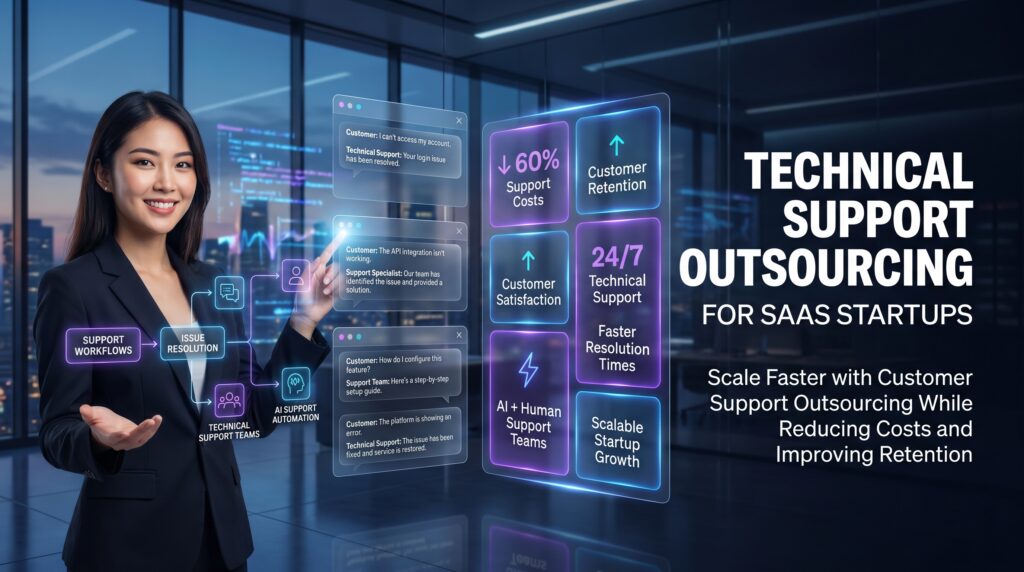
Technical Support Outsourcing for SaaS Startups: Scale Faster with Customer Support Outsourcing While Reducing Costs and Improving Retention
AI Overview
Technical support outsourcing has become a strategic advantage for SaaS startups seeking to improve customer experience while controlling operational costs. Through customer support outsourcing, businesses gain access to specialized contact center services, technical expertise, AI-powered automation, and scalable support infrastructure.
Modern call center outsourcing providers combine skilled agents, advanced technologies, and automating business processes to handle technical troubleshooting, onboarding, customer success, and multichannel support. Whether supporting SaaS applications, digital banking services, healthcare platforms, or eCommerce businesses, outsourcing partners help organizations improve service quality while reducing operational complexity.
For growth-stage SaaS companies, outsourcing support operations delivers faster response times, improved retention, lower costs, and the flexibility required to scale globally.
Introduction
The SaaS industry is built on recurring revenue.
Unlike traditional software companies that depend on one-time purchases, SaaS businesses rely on customer retention, product adoption, and long-term satisfaction. A single negative support experience can increase churn, reduce expansion revenue, and impact brand reputation.
At the same time, customer expectations continue to rise.
Users expect immediate assistance, personalized interactions, self-service options, and support across multiple channels. Delivering this level of service requires significant investment in people, processes, and technology.
This challenge has made customer support outsourcing one of the fastest-growing operational strategies among SaaS startups.
Instead of building large internal support teams, organizations are increasingly leveraging call center outsourcing and specialized contact center services to deliver enterprise-grade customer experiences. Many businesses also choose to outsource customer support to India, gaining access to skilled technical professionals, round-the-clock support, and significant cost advantages.
The result is a support operation that scales alongside growth without creating operational bottlenecks.
Key Insights
- Customer support outsourcing can reduce support costs by 30–60%.
- Outsourced teams often achieve 2–3x faster response times.
- SaaS startups can scale globally without increasing internal headcount.
- AI-powered support improves productivity and ticket resolution rates.
- Offshore call center outsourcing services provide 24/7 customer coverage.
- Hybrid AI-human support models outperform purely manual support operations.
- Strategic outsourcing improves customer retention and lifetime value.
The Market Reality: Why SaaS Companies Are Outsourcing Customer Support
Customer experience has become a competitive differentiator.
Research consistently shows that customers are more likely to remain loyal to businesses that deliver fast, reliable, and personalized support experiences.
Modern customers expect:
- Instant responses
- Omnichannel communication
- Technical expertise
- Self-service capabilities
- Proactive issue resolution
Meeting these expectations internally requires substantial investment.
As a result, SaaS companies increasingly partner with providers offering advanced contact center services that combine skilled support professionals with AI-powered technology.
Organizations are also investing heavily in automating business processes such as:
- Ticket classification
- Workflow routing
- Customer authentication
- Knowledge retrieval
- Quality assurance
- Performance reporting
Automation enables support teams to focus on complex customer interactions while AI handles repetitive tasks.
What Is Technical Support Outsourcing?
Technical support outsourcing refers to the practice of partnering with an external provider to manage customer-facing technical support functions.
Services commonly include:
- Help desk support
- Technical troubleshooting
- Software onboarding
- Product guidance
- Email support
- Chat support
- Phone support
- Escalation management
- Knowledge base maintenance
When businesses outsource call center services, they gain access to trained professionals, proven workflows, support technology, and operational expertise.
Today’s offshore call center outsourcing services providers often function as strategic extensions of internal teams rather than traditional outsourced vendors.
How Technical Support Outsourcing Works
Step 1: Customer Contact
Customers reach support through:
- Phone
- Chat
- Mobile applications
- Social media
- Self-service portals
Step 2: AI-Powered Routing
Modern support platforms automatically categorize and prioritize requests based on urgency and complexity.
Step 3: Technical Resolution
Support specialists investigate issues, provide solutions, and escalate advanced cases when required.
Step 4: Performance Measurement
Support operations track:
- First Response Time
- Average Resolution Time
- Customer Satisfaction Score (CSAT)
- First Contact Resolution
- Net Promoter Score (NPS)
Step 5: Continuous Optimization
Support insights help organizations improve products, reduce recurring issues, and enhance customer experience.
Benefits of Customer Support Outsourcing
1. Significant Cost Reduction
Hiring and maintaining internal support teams involves expenses related to:
- Recruitment
- Salaries
- Benefits
- Training
- Infrastructure
- Software licensing
- Management
Customer support outsourcing reduces many of these expenses.
Cost Comparison
| Expense Category | In-House Team | Outsourced Team |
| Recruitment | High | Included |
| Training | High | Included |
| Infrastructure | High | Included |
| Technology | High | Often Included |
| Management | High | Reduced |
| Scalability | Limited | Flexible |
What This Means for Your Business
Lower support costs allow SaaS companies to invest more resources into product development, customer acquisition, and market expansion.
2. Faster Response Times
Response speed directly impacts customer satisfaction.
Dedicated support providers operate around the clock, ensuring customers receive assistance whenever needed.
Typical improvements include:
- Faster first responses
- Reduced ticket backlogs
- Improved SLA performance
- Higher resolution rates
What This Means for Your Business
Customers receive answers faster, reducing frustration and increasing loyalty.
3. Improved Customer Satisfaction
High-performing contact center services focus on measurable outcomes.
Industry Benchmarks
| KPI | Industry Average | Best-in-Class |
| CSAT | 75–85% | 90%+ |
| First Contact Resolution | 65–80% | 90%+ |
| Average Response Time | 4–12 Hours | Under 1 Hour |
| NPS | 20–30 | 50+ |
What This Means for Your Business
Satisfied customers are more likely to renew subscriptions and expand their spending.
4. Access to Specialized Expertise
Technical support requires specialized knowledge.
Experienced outsourcing providers often maintain teams trained in:
- SaaS applications
- APIs
- Cloud infrastructure
- Security protocols
- Integrations
- Customer success methodologies
This expertise reduces training requirements and accelerates support maturity.
5. Scalability
Growth often creates unpredictable support demand.
New feature launches, marketing campaigns, and customer acquisition surges can dramatically increase ticket volumes.
Customer support outsourcing enables rapid scaling without lengthy hiring cycles.
Customer Support Outsourcing Pricing
Pricing varies depending on service complexity, location, operating hours, and required expertise.
Call Center Outsourcing Pricing
Offshore Support
- $8–$18 per hour
- $1,200–$3,500 per agent/month
Nearshore Support
- $15–$30 per hour
- $2,500–$5,000 per agent/month
Onshore Support
- $30–$75+ per hour
- $5,000–$10,000+ per agent/month
Outsourced Customer Support Pricing Factors
Pricing depends on:
- Technical complexity
- Languages supported
- Service channels
- Support coverage hours
- Compliance requirements
- AI integration requirements
- Monthly ticket volume
Understanding outsourced customer support pricing requires evaluating both direct labor costs and productivity gains.
Use Cases Across Industries
SaaS
Common functions include:
- Technical troubleshooting
- Product onboarding
- Subscription support
- Customer success assistance
These organizations frequently leverage advanced contact center services to manage growth.
eCommerce
Support teams manage:
- Order tracking
- Returns processing
- Live chat
- Customer retention
Fintech
Financial organizations often require specialists familiar with digital banking services, payment systems, and regulatory compliance.
Healthcare
Healthcare outsourcing services support:
- Patient engagement
- Appointment scheduling
- Telehealth assistance
- Platform troubleshooting
Why SaaS Companies Choose to Outsource Customer Support to India
India remains one of the world’s leading outsourcing destinations.
Key advantages include:
Access to Technical Talent
India produces millions of technology professionals and graduates annually, creating a large pool of skilled support specialists.
Cost Efficiency
Organizations can achieve significant savings compared to onshore operations.
24/7 Operations
Time zone advantages support continuous customer service coverage.
Mature Outsourcing Ecosystem
India has decades of experience delivering global support operations.
Strong Technology Infrastructure
Modern outsourcing providers leverage enterprise-grade cloud environments and support platforms.
For many SaaS companies, the decision to outsource customer support to India delivers both operational and financial advantages.
Technology Stack for Modern Support Operations
Leading support providers commonly integrate platforms such as:
- Zendesk
- Salesforce
- Freshdesk
- HubSpot
Infrastructure frequently operates on:
- Amazon Web Services
- Google Cloud
These technologies support automation, analytics, workflow management, and customer engagement.
Case Study Example
SaaS Startup Scaling from 5,000 to 50,000 Users
Challenge
A rapidly growing SaaS startup experienced:
- Increasing ticket volumes
- Rising support costs
- Delayed response times
- Customer churn
Solution
The company partnered with a technical support outsourcing provider offering:
- 24/7 support
- AI-assisted ticket routing
- Dedicated technical agents
- Omnichannel support
Results
- 45% reduction in support costs
- 60% faster response times
- 25% improvement in CSAT
- Increased customer retention
Implementation Framework
Phase 1: Support Audit
Evaluate:
- Ticket volume
- Escalation rates
- Response times
- Customer satisfaction
Phase 2: Vendor Selection
Assess:
- Industry expertise
- Security certifications
- Technology stack
- Scalability
Phase 3: Technology Integration
Integrate:
- CRM systems
- Help desk platforms
- Analytics tools
- Communication channels
Phase 4: Pilot Program
Launch with a limited support scope and measurable KPIs.
Phase 5: Scale Operations
Expand support functions based on performance outcomes.
In-House vs Call Center Outsourcing
| Factor | In-House | Call Center Outsourcing |
| Cost | High | Lower |
| Hiring Speed | Slow | Fast |
| Scalability | Limited | High |
| 24/7 Support | Expensive | Standard |
| Expertise | Variable | Specialized |
| Global Coverage | Difficult | Easy |
AI vs Human vs Hybrid Support
| Model | Advantages | Limitations |
| AI Only | Fast, scalable | Limited empathy |
| Human Only | Personalized | Expensive |
| Hybrid | Best balance | Requires integration |
The future belongs to hybrid support operations that combine AI automation with human expertise.
Risks and Mitigation
Data Security
Mitigation:
- Encryption
- Access controls
- Security audits
Vendor Dependency
Mitigation:
- Clear SLAs
- Regular reviews
- Documentation standards
Compliance Risks
Mitigation:
- Industry certifications
- Regulatory monitoring
- Governance frameworks
Future Trends
Support operations are evolving rapidly.
Key trends include:
-
- AI-powered customer interactions
- Predictive support
- Intelligent routing
- Self-service ecosystems
- Voice AI
- Customer success integration
Organizations adopting these capabilities will gain competitive advantages in customer experience.
Decision Clarity
When to Outsource
Consider outsourcing when:
- Support demand is increasing rapidly
- Hiring is becoming difficult
- Customers require 24/7 support
- Operational costs are rising
When Not to Outsource
Avoid outsourcing if:
- Support volumes remain very low
- Product knowledge changes daily
- Internal support operations scale efficiently
Key Decision Triggers
- Increasing churn
- Declining customer satisfaction
- Missed service-level agreements
- International expansion
Frequently Asked Questions
What is customer support outsourcing?
Customer support outsourcing is the practice of using a third-party provider to manage customer service functions including phone, email, chat, and technical support.
How much does call center outsourcing pricing cost?
Call center outsourcing pricing typically ranges from $1,200 to $10,000+ per agent per month depending on location, expertise, and service requirements.
Is customer support outsourcing safe?
Yes. Reputable providers implement strict security controls, compliance programs, and data protection measures.
Why outsource customer support to India?
India offers skilled talent, cost efficiency, 24/7 coverage, and extensive outsourcing experience.
What are the best customer support outsourcing companies?
The best customer support outsourcing companies combine industry expertise, AI capabilities, security compliance, scalability, and proven performance.
What is offshore vs onshore customer support outsourcing?
Offshore vs onshore customer support outsourcing refers to whether support teams operate outside or within a company’s home country. Offshore models generally offer greater cost savings, while onshore models may provide closer cultural alignment.
Strategic Growth Opportunity
Support is no longer simply an operational function.
It is a revenue driver, retention engine, and competitive differentiator.
Companies that invest in scalable support infrastructure improve customer loyalty, increase lifetime value, and strengthen market position.
Discover how AI-powered customer experience solutions can help your business scale: mascallnet.ai
Conclusion
Technical support outsourcing has evolved from a cost-saving tactic into a strategic business decision.
Through customer support outsourcing, SaaS startups can reduce costs, improve customer satisfaction, accelerate response times, and scale globally without building large internal support organizations.
Modern call center outsourcing providers combine technology, talent, and automation to deliver exceptional customer experiences while enabling sustainable growth.
Organizations that treat customer support as a strategic advantage rather than an operational expense will be best positioned to compete in the increasingly competitive SaaS marketplace.