
Scale Customer Support Without Hiring More Agents: AI & Outsourcing Guide for 2026
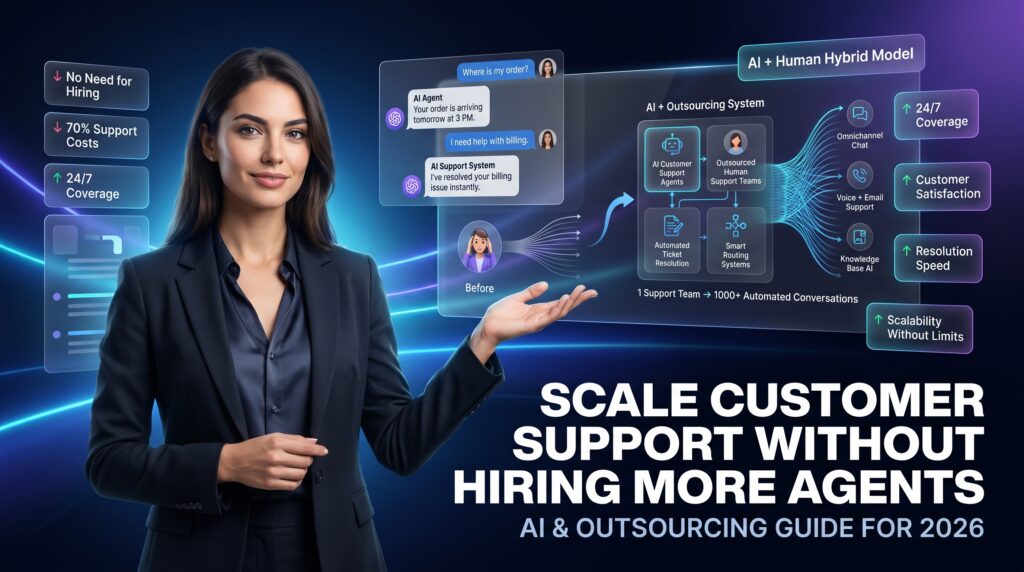
AI Overview
Organizations entering 2026 face a critical challenge: support volume is growing faster than internal support teams.
The highest-performing SaaS companies are solving this problem through:
- Customer support outsourcing
- AI customer support automation
- Hybrid human + AI support models
- Global contact center services
- Strategic offshore support operations
Rather than hiring more agents, leading organizations are redesigning support operations around efficiency, scalability, and customer experience outcomes.
Introduction
Support demand is increasing.
Headcount budgets are not.
For many SaaS companies, every new customer generates additional tickets, chats, onboarding questions, billing inquiries, and technical support requests.
Historically, growth meant hiring more agents.
In 2026, that model is becoming financially unsustainable.
Organizations are increasingly adopting customer support outsourcing for SaaS combined with AI-driven workflows to increase support capacity without significantly increasing payroll costs.
The result is a more scalable operating model capable of supporting growth while protecting margins.
Key Insights
| Insight | Impact |
| AI resolves repetitive inquiries | Lower support costs |
| Outsourcing provides elastic capacity | Faster scaling |
| Hybrid models outperform AI-only approaches | Better CX outcomes |
| Offshore operations improve economics | Higher margins |
| Process automation reduces ticket volume | Greater efficiency |
Key Takeaway
The goal is not replacing agents.
The goal is increasing support capacity per dollar invested.
Market Reality: Why Traditional Support Models Are Breaking
What Most Content Says
Support volume increases as companies grow.
What Most Content Misses
The real issue is support cost growth often outpaces revenue growth.
What Enterprise Buyers Need to Know
Support teams frequently become one of the fastest-growing operational expenses.
Key drivers include:
- Increased ticket complexity
- Multi-channel support requirements
- Global coverage expectations
- Compliance obligations
- Product expansion
What Decision Makers Should Do Next
Audit support costs against customer growth.
Measure:
- Cost per ticket
- Cost per customer
- Agent utilization
- First-contact resolution
What Is Customer Support Outsourcing?
Definition
Customer support outsourcing is the practice of partnering with a third-party provider to deliver customer service, technical support, live chat, email support, social support, or phone support.
Related services include:
- Call center outsourcing
- Contact center services
- Technical support outsourcing
- Help desk outsourcing
- AI customer support outsourcing
Framework
Support can be outsourced across:
| Function | Typical Outsourcing Use |
| Email Support | High volume |
| Live Chat | 24/7 coverage |
| Voice Support | Call center outsourcing |
| Technical Support | SaaS expertise |
| Billing Support | Subscription businesses |
| Customer Success | Expansion support |
Summary
Outsourcing converts fixed staffing costs into scalable operating costs.
Key Takeaway
Customer support outsourcing enables growth without proportional headcount increases.
The MasCallNet Customer Support Cost Leakage Model™
What Most Content Says
Outsourcing reduces labor costs.
What Most Content Misses
Many organizations lose money through operational inefficiencies before labor becomes the issue.
Hidden Cost Leakage Areas
| Leakage Source | Typical Impact |
| Agent idle time | 10–25% |
| Training costs | High |
| Turnover | Significant |
| After-hours coverage | Expensive |
| Management overhead | Hidden |
| QA operations | Ongoing |
Key Takeaway
Most support organizations have cost leakage before they have staffing problems.
Benefits of Customer Support Outsourcing
1. Cost Efficiency
Benefits:
- Lower staffing costs
- Reduced recruiting costs
- Lower infrastructure costs
What This Means for Your Business
Revenue:
More budget available for growth initiatives.
Retention:
Improved support coverage.
Margin:
Reduced operating expenses.
Efficiency:
Higher support output.
Scalability:
Easier expansion.
Growth:
Support no longer limits customer acquisition.
2. 24/7 Global Coverage
Benefits:
- Faster response times
- Global customer service
- Improved SLAs
What This Means for Your Business
Revenue:
More global opportunities.
Retention:
Higher customer satisfaction.
Margin:
Lower overnight staffing costs.
Efficiency:
Continuous operations.
Scalability:
Support follows demand.
Growth:
International expansion becomes easier.
3. Access to Specialized Talent
Benefits:
- SaaS-trained agents
- Technical support experts
- Customer success specialists
What This Means for Your Business
Revenue:
Higher upsell potential.
Retention:
Lower churn.
Margin:
Reduced training investment.
Efficiency:
Faster resolutions.
Scalability:
Specialized teams available immediately.
Growth:
Accelerated onboarding.
AI vs Human vs Hybrid ROI Model
Framework
| Model | Cost | CSAT | Scalability |
| Human Only | High | High | Medium |
| AI Only | Low | Medium | High |
| Hybrid | Medium | High | High |
What Most Content Says
AI reduces support costs.
What Most Content Misses
Customer experience often declines when AI operates without human escalation.
Enterprise Recommendation
Use AI for:
- FAQs
- Order tracking
- Password resets
- Ticket routing
Use humans for:
- Escalations
- Retention
- Technical troubleshooting
Key Takeaway
Hybrid support consistently delivers the highest ROI.
Mid-Content CTA
Organizations evaluating customer support outsourcing services should begin with a support operations assessment before selecting vendors or technologies.
Assess:
- Ticket volume
- Cost per interaction
- Automation opportunities
- Staffing requirements
- SLA performance
Proof & Benchmarks
Common Performance Benchmarks
| KPI | Benchmark |
| First Response Time | < 1 hour |
| CSAT | 85–95% |
| FCR | 70–85% |
| Ticket Resolution | < 24 hours |
| Agent Utilization | 75–85% |
SLA Example
- Email response: 1 hour
- Chat response: 30 seconds
- Phone answer rate: 80/20
- Critical escalation: 15 minutes
Key Takeaway
Benchmarks should be tied to business outcomes, not activity metrics.
Case Study
Challenge
A SaaS company experienced 60% ticket growth while maintaining flat support budgets.
Solution
Implemented:
- AI ticket triage
- Customer support outsourcing
- Knowledge base optimization
Implementation
Phase 1:
Workflow audit
Phase 2:
Vendor onboarding
Phase 3:
AI deployment
Phase 4:
Performance optimization
Results
- 42% lower support cost per ticket
- 68% faster response times
- 31% higher CSAT
- 24/7 support coverage achieved
Lessons Learned
Technology alone was insufficient.
Process redesign and outsourced expertise drove the majority of gains.
Outsourced Customer Support Pricing
Monthly Pricing
| Model | Typical Range |
| Shared Team | $1,000–$5,000/month |
| Dedicated Team | $2,000–$15,000+/month |
| Enterprise Support | Custom |
Per-Agent Pricing
| Location | Cost |
| Offshore | Lower |
| Nearshore | Medium |
| Onshore | Higher |
Additional Costs
- Setup fees
- Technology licensing
- Training
- QA management
- Reporting
Hidden Costs Analysis
Watch for:
- Seat minimums
- Overtime charges
- Volume surcharges
- Technology markups
Key Takeaway
Outsourced customer support pricing should be evaluated based on total operational value, not hourly rates.
Cost Savings Calculator Framework
Formula
Current Cost
=
Labor
+
Technology
+
Management
+
Recruiting
+
Training
Future Cost
=
Outsourcing
+
AI
+
Vendor Management
Savings
=
Current Cost
−
Future Cost
Key Takeaway
The largest savings often come from operational efficiency rather than labor arbitrage alone.
Industry Use Cases
SaaS
Challenge
Rapid ticket growth.
Solution
Customer support outsourcing for SaaS plus AI automation.
Outcome
Scalable support operations.
eCommerce
Challenge
Seasonal spikes.
Solution
Contact center services and outsourced support teams.
Outcome
Elastic support capacity.
Fintech
Challenge
Compliance requirements.
Solution
Digital banking services support teams with specialized training.
Outcome
Improved customer trust and regulatory alignment.
Healthcare
Challenge
Patient communication complexity.
Solution
Healthcare outsourcing services with compliance-focused workflows.
Outcome
Faster service delivery and better patient experiences.
India Advantage
Why Companies Outsource Customer Support to India
Talent Availability
Large English-speaking workforce.
Cost Efficiency
Lower operating costs.
Scalability
Rapid team expansion.
Global Coverage
24/7 operations.
Offshore Call Center Outsourcing Services
Advantages include:
- Lower costs
- Larger talent pools
- Around-the-clock coverage
Key Takeaway
For many organizations, the decision to outsource customer support to India provides the strongest balance between quality and economics.
Offshore vs Onshore Customer Support Outsourcing
| Factor | Offshore | Onshore |
| Cost | Lower | Higher |
| Talent Pool | Large | Limited |
| Coverage | Excellent | Limited |
| Proximity | Lower | Higher |
| Scalability | High | Medium |
Interpretation
The best choice depends on business priorities, customer expectations, and support complexity.
In-House vs Call Center Outsourcing
| Factor | In-House | Outsourced |
| Hiring | Internal | Vendor |
| Training | Internal | Shared |
| Scalability | Slower | Faster |
| Cost | Higher | Lower |
| Coverage | Limited | Flexible |
Key Takeaway
Call center outsourcing often accelerates growth while reducing operational burden.
Build vs Buy
| Factor | Build | Buy |
| Speed | Slow | Fast |
| Investment | High | Lower |
| Expertise | Internal | External |
| Risk | Higher | Shared |
Interpretation
Most growth-stage SaaS businesses benefit from buying before building.
Vendor Evaluation Matrix
MasCallNet Vendor Scorecard™
| Criteria | Weight |
| Industry Expertise | 20% |
| Technology Stack | 15% |
| SLA Performance | 15% |
| Security | 15% |
| Scalability | 15% |
| Reporting | 10% |
| Pricing Transparency | 10% |
Best Customer Support Outsourcing Companies Evaluation Criteria
Evaluate vendors based on:
- SaaS experience
- Platform expertise
- Security certifications
- AI capabilities
- Global coverage
Implementation Framework
Phase 1
Assessment
Phase 2
Vendor Selection
Phase 3
Knowledge Transfer
Phase 4
Pilot Program
Phase 5
Optimization
Key Takeaway
Successful outsourcing is an operational transformation project, not merely a staffing initiative.
MasCallNet Outsourcing Readiness Score™
Score your organization:
| Area | Score |
| Process Documentation | 0–5 |
| Ticket Volume | 0–5 |
| Automation Readiness | 0–5 |
| SLA Maturity | 0–5 |
| Reporting Quality | 0–5 |
21–25 = Ready
15–20 = Nearly Ready
Below 15 = Preparation Needed
MasCallNet CX Maturity Framework™
Level 1: Reactive
Level 2: Managed
Level 3: Optimized
Level 4: Automated
Level 5: Predictive
Key Takeaway
Organizations at Levels 4–5 typically achieve the highest support efficiency.
Risk Analysis
Security
Mitigation:
- SOC 2
- ISO certifications
- Access controls
Compliance
Mitigation:
- Regular audits
- Regulatory training
Vendor Dependency
Mitigation:
- Multi-vendor strategy
Data Privacy
Mitigation:
- Encryption
- Data governance
Service Disruption
Mitigation:
- Disaster recovery plans
Future Trends
Automating Business Processes
Support operations increasingly depend on automating business processes through AI workflows.
Emerging Trends
- AI copilots
- Predictive support
- Voice automation
- Real-time QA
- Hyper-personalization
Technology Stack Relevance
Platforms such as Zendesk, Salesforce, Freshdesk, HubSpot, Amazon Web Services, and Google Cloud increasingly form the foundation of modern support ecosystems.
Executive Decision Tree
Do you have rising ticket volume?
→ No → Keep current model
→ Yes
Can AI automate 30%+ of inquiries?
→ Yes → Implement AI
→ No → Evaluate outsourcing
Need 24/7 support?
→ Yes → Consider offshore model
Need strict localization?
→ Yes → Consider onshore model
Decision Clarity
When to Outsource
- Growing support volume
- Rising support costs
- Need for 24/7 coverage
- Expansion into new markets
When Not to Outsource
- Highly specialized support
- Undefined processes
- No internal ownership
Executive CTA
Leaders evaluating support transformation should benchmark current operations against future growth targets before making staffing decisions.
ROI CTA
Calculate:
Current support cost per customer
versus
Projected outsourced and AI-enabled support cost per customer
The resulting gap often reveals significant efficiency opportunities.
Consultation CTA
Conduct an outsourcing readiness assessment and operational efficiency review before selecting a provider or technology platform.
For organizations exploring strategic support transformation, additional resources can be found at: mascallnet
Recommended internal resources:
- Customer support outsourcing services
- AI customer support outsourcing
- Offshore support operations
- Contact center transformation
FAQs
What is customer support outsourcing?
Customer support outsourcing is the practice of hiring a specialized external provider to manage customer service interactions across channels such as email, chat, phone, and social media.
How much does call center outsourcing pricing cost?
Call center outsourcing pricing varies based on geography, support complexity, coverage hours, and staffing model. Costs can range from shared-team plans to dedicated enterprise support operations.
Is customer support outsourcing safe?
Yes. Reputable providers implement security controls, compliance frameworks, encryption, and access management processes to protect customer data.
Why outsource customer support to India?
India offers a large skilled workforce, cost efficiency, scalability, multilingual support capabilities, and strong experience supporting global businesses.
What is offshore vs onshore customer support outsourcing?
Offshore outsourcing uses providers in other countries, while onshore outsourcing uses providers in the same country as the business. Offshore models generally offer lower costs and greater scalability.
Which are the best customer support outsourcing companies?
The best provider depends on industry expertise, SLA performance, technology capabilities, security standards, and operational alignment with business goals.
Conclusion
The companies that scale customer support most effectively in 2026 are not necessarily hiring more agents.
They are redesigning support operations through AI, automation, outsourcing, and operational excellence.
The winning model is increasingly hybrid:
AI for efficiency.
Humans for complexity.
Outsourcing for scalability.
Organizations that embrace this approach can improve customer experience while protecting margins and accelerating growth.