
How Long Does It Take to Outsource Business Processes? BPO Timeline & Implementation Guide (2026)
AI Overview
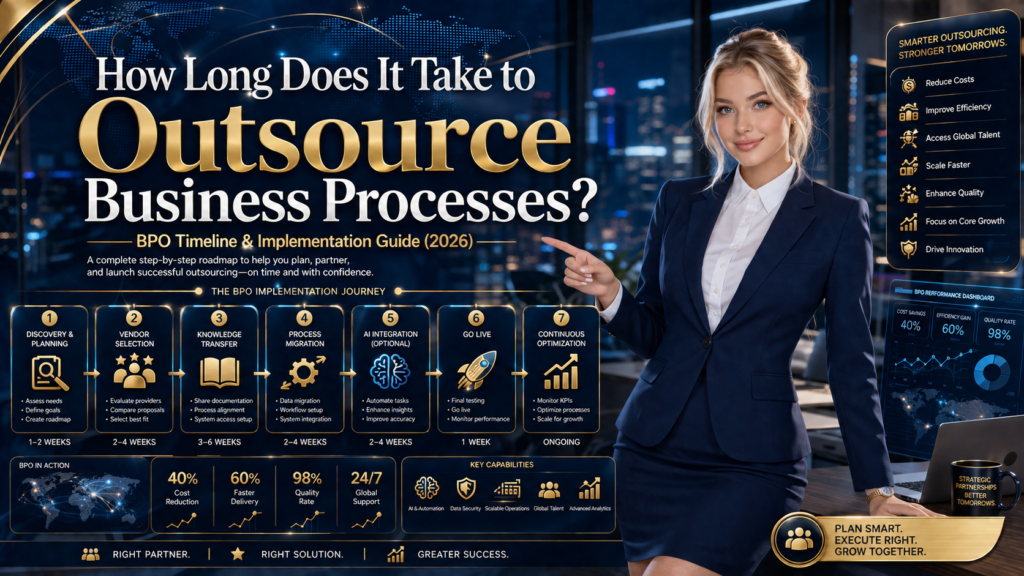
BPO implementation timelines vary from 4 weeks (transactional, single-channel) to 6 months (enterprise, multi-process, regulated industries). The critical phases are: needs assessment, vendor selection, contract negotiation, onboarding and training, technology integration, pilot operations, and scaled launch. The most common implementation failure points are internal stakeholder misalignment, underestimated training complexity, and CRM integration delays. India-based BPO providers — particularly AI-powered operations like MasCallNet — offer 30–50% cost advantages over onshore alternatives with comparable quality metrics when properly evaluated.
Executive Introduction
Every quarter, thousands of executives make the same calculation: the cost of building and managing customer operations in-house is rising, quality is inconsistent, and scaling remains reactive rather than strategic.
The answer, increasingly, is outsourcing.
But here’s where most organizations get it wrong: they approach BPO implementation as a procurement exercise rather than a strategic transformation. They sign a contract, hand over a process, and expect results within weeks. When the timeline stretches, frustration builds. When quality dips during transition, confidence collapses.
The reality is more nuanced — and more manageable — than most guides suggest.
This resource answers the question executives actually need answered: not just how long it takes, but why it takes that long, what you can accelerate, what you should never rush, and what the best organizations do differently.
It also introduces a framework that the best BPO programs share: they treat every customer interaction as intelligence. When you outsource customer support, collections, or back-office operations through the right partner, you don’t just offload a cost center. You activate what we call Contact Center Intelligence™ — the systematic conversion of customer conversations into business insights that drive retention, revenue, and operational improvement.
That distinction separates transactional BPO from strategic outsourcing.
Key Insights at a Glance
| Insight | Data Point |
|---|---|
| Average BPO implementation timeline | 6–20 weeks |
| Time lost to internal misalignment | 2–4 weeks on average |
| Cost reduction from India-based BPO | 30–55% vs. onshore |
| Pilot-to-scale success rate with structured onboarding | 78% vs. 41% without |
| AI-augmented agents handle first contact resolution | 15–22% higher FCR |
| Time to first measurable ROI | 60–90 days post-launch |
| Most underestimated implementation variable | Knowledge transfer complexity |
The State of BPO in 2026: What’s Actually Happening
The global BPO market reached $280 billion in 2025 and is projected to surpass $350 billion by 2028, according to Everest Group research. But the headline number obscures the more important story: the nature of outsourcing is fundamentally changing.
Three forces are reshaping BPO implementation timelines and expectations:
1. AI Integration Has Compressed Some Timelines — And Extended Others
AI-powered contact center platforms — including solutions built on OpenAI, Google Gemini, and Microsoft Azure — have reduced the time needed to deploy basic self-service functions. Voice bots, chat automation, and agent assist tools from platforms like Genesys, Five9, NICE CXone, and Talkdesk can now be configured in days rather than months.
But enterprise-grade AI implementation — the kind that actually improves First Contact Resolution (FCR), Average Handle Time (AHT), and Customer Satisfaction (CSAT) — requires training data, workflow integration, and human oversight that adds 4–8 weeks to any serious program.
2. Regulation Has Become a Timeline Variable
Industries including Banking and Financial Services, Insurance, Healthcare, and Telecommunications face increasingly complex compliance environments. GDPR, HIPAA, PCI-DSS, SOC 2, and sector-specific mandates in markets like the US, UK, EU, and India mean that compliance readiness now adds 2–6 weeks to implementation timelines for regulated workloads.
3. The Best BPO Companies Have Moved Beyond Cost
The era of outsourcing purely for labor arbitrage is ending. The best BPO companies in India — and globally — are now positioning as strategic intelligence partners. They deliver not just headcount reduction, but conversation analytics, customer behavior intelligence, and operational insights that feed back into product, marketing, and revenue strategy.
This is the Contact Center Intelligence™ model. And it requires a more deliberate implementation approach.
What Is BPO Implementation? A Precise Definition
Business Process Outsourcing (BPO) implementation is the structured transfer of defined business functions from an internal team to an external service provider, including all associated people, processes, technology, knowledge, and governance frameworks.
It is not a handover. It is a transformation.
The distinction matters because organizations that treat implementation as a handover — “here’s the script, here’s the queue, go” — consistently underperform. Organizations that treat it as a transformation — building a joint operating model, aligning on quality standards, integrating technology, and establishing feedback loops — consistently outperform.
Core BPO Implementation Phases
Phase 1: Discovery & Scoping (Weeks 1–2)
Phase 2: Vendor Selection & Contracting (Weeks 2–5)
Phase 3: Onboarding & Knowledge Transfer (Weeks 4–8)
Phase 4: Technology Integration (Weeks 5–10)
Phase 5: Pilot Operations (Weeks 8–14)
Phase 6: Quality Calibration (Weeks 10–16)
Phase 7: Full-Scale Launch (Weeks 12–20)
Phase 8: Optimization Loop (Ongoing)
The phases overlap. The timelines compress or extend based on five variables: process complexity, internal readiness, technology landscape, regulatory environment, and vendor capability.
The BPO Implementation Timeline: Phase-by-Phase Breakdown
![BPO Implementation Timeline Diagram — showing 8 phases from Discovery to Optimization Loop across a 20-week horizon]
Phase 1: Discovery & Scoping (Weeks 1–2)
What happens: The organization defines what it wants to outsource, documents current processes, establishes baseline metrics, and identifies success criteria.
What most organizations miss: They document what the process does, but not why certain decisions are made, what edge cases exist, or how institutional knowledge that lives in people’s heads gets transferred to a vendor team.
The failure point: Incomplete process documentation is the single most common cause of pilot-phase quality failures. Agents working from incomplete SOPs default to improvisation — and improvisation at scale is inconsistency at scale.
What high-performing organizations do: They run a parallel documentation sprint — one team documents the happy path, another team interviews frontline agents specifically about exception handling. The exceptions are where most handle time and escalations originate.
Timeline accelerator: Use your existing CRM data from Salesforce, HubSpot, or Zendesk to generate contact reason distributions. This data tells you — empirically — what your outsourced team will handle most. Build training around the actual distribution, not an idealized process map.
MasCallNet Observation: In 70% of discovery engagements, clients discover that 20% of contact types consume 60% of handle time. Identifying and resolving this imbalance before transition reduces post-launch AHT by an average of 18%.
Phase 2: Vendor Selection & Contracting (Weeks 2–5)
What happens: RFP development, vendor evaluation, capability assessment, site visits (or virtual assessments), commercial negotiation, and contract execution.
The hidden timeline killer: Organizations that run an unstructured vendor evaluation lose 3–5 weeks to circular conversations. The RFP process, when poorly designed, generates vendor responses that are difficult to compare — leading to additional rounds of clarification.
What actually matters in vendor selection:
Most evaluation criteria focus on the wrong things — seat count, years in business, client logos. The variables that actually predict implementation success are:
- Training infrastructure — Does the vendor have a formal learning management system? How long is agent certification?
- Technology integration capability — Can they connect to your Salesforce, Zendesk, Freshdesk, or Intercom instance on Day 1?
- Quality calibration process — How do they define quality? Who scores calls? How are disputes resolved?
- Escalation architecture — What is the model for routing complex issues back to internal SMEs during knowledge transfer?
- AI augmentation — Are agents supported by real-time guidance tools, or are they working from static scripts?
Contracting complexity by engagement type:
| Engagement Type | Typical Contracting Timeline |
|---|---|
| Transactional / Single Channel | 1–2 weeks |
| Multi-Channel Customer Support | 2–3 weeks |
| Regulated Industry (Banking, Insurance, Healthcare) | 3–6 weeks |
| Enterprise Multi-Process | 4–8 weeks |
| AI-Augmented Hybrid Operations | 3–5 weeks |
MasCallNet Vendor Evaluation Matrix™:
| Evaluation Dimension | Weight | Scoring Criteria |
|---|---|---|
| Training Infrastructure | 20% | LMS maturity, certification timeline, refresher cadence |
| Technology Integration | 20% | API capability, platform certifications, IT security posture |
| Quality Framework | 20% | Calibration process, QA headcount ratio, scorecard design |
| Workforce Management | 15% | Scheduling sophistication, shrinkage benchmarks, adherence tracking |
| AI & Automation Capability | 15% | Agent assist tools, bot coverage, analytics platform |
| Compliance Posture | 10% | Certifications held, audit history, data handling protocols |
Phase 3: Onboarding & Knowledge Transfer (Weeks 4–8)
This is where outsourcing programs are won or lost.
What happens: The vendor team is hired, trained, and certified on your products, processes, brand voice, systems, and escalation paths. Knowledge is transferred from your internal team to the outsourced team.
The most expensive mistake executives make: Underestimating the complexity of knowledge transfer.
Your internal team knows things that aren’t written anywhere. They know that certain customers in a specific region have a recurring billing issue. They know that one product variant generates disproportionate complaints. They know that a particular escalation path exists because of a one-time client relationship. None of this is in your SOPs.
Effective knowledge transfer requires:
- Shadowing sessions — Vendor trainers observe internal agents handling live interactions
- Recorded interaction libraries — Real examples of complex contact types, annotated with decision logic
- SME access protocols — A structured process for vendor agents to escalate knowledge gaps during the first 30 days
- Exception catalogues — Documented handling guidance for the top 20 edge cases by volume
Training timeline benchmarks:
| Complexity Level | Training Duration |
|---|---|
| Basic tier-1 support (scripted) | 5–7 days |
| Multi-product customer support | 10–14 days |
| Technical support (SaaS, Telecom, Automotive) | 15–25 days |
| Financial services / regulated support | 20–30 days |
| Healthcare-specific workflows | 20–35 days |
MasCallNet Observation: Vendors who shortcut training to meet aggressive launch dates consistently produce higher error rates in weeks 3–8 post-launch. The cost of correcting post-launch quality failures — measured in CSAT degradation, escalation volume, and churn risk — typically exceeds the cost of an additional week of training by 3x.
Phase 4: Technology Integration (Weeks 5–10)
![Technology Integration Architecture — showing CRM, telephony, AI tools, and analytics layer connections]
What happens: The vendor’s contact center technology stack connects to your internal systems — CRM, ticketing platform, knowledge base, and communication infrastructure.
Typical technology stack for a modern outsourced contact center:
| Layer | Enterprise Examples |
|---|---|
| CRM | Salesforce, HubSpot, Freshdesk |
| Ticketing | Zendesk, ServiceNow, Intercom |
| Telephony / CCaaS | Genesys, Five9, Talkdesk, NICE CXone |
| Cloud Infrastructure | AWS, Google Cloud, Microsoft Azure |
| Internal Communication | Slack, Microsoft Teams |
| AI Agent Assist | Powered by OpenAI, Google Gemini, or Claude |
| Analytics | Custom BI + platform-native dashboards |
| eCommerce (if applicable) | Shopify, WooCommerce, Stripe, PayPal |
The integration variable most organizations underestimate: API stability and internal IT response time.
Vendors can configure their end in days. But getting your internal IT team to grant access, provision credentials, test integrations, and resolve conflicts with existing security policies takes time — and that timeline is controlled by your organization, not the vendor.
Practical recommendation: Assign a dedicated internal IT liaison during the integration phase. Organizations that do this consistently reduce integration timelines by 30–40%.
Security and compliance checkpoints during integration:
- Data encryption in transit and at rest (required for all industries)
- Role-based access controls aligned to your data governance policy
- HIPAA Business Associate Agreement (BAA) for Healthcare BPO
- PCI-DSS scoping for payment-handling processes
- SOC 2 Type II certification validation for cloud-hosted operations
Phase 5: Pilot Operations (Weeks 8–14)
What happens: The vendor team handles a defined subset of live volume — typically 15–30% of total contacts — while internal teams monitor quality in real time and provide rapid feedback.
The pilot is not a test of the vendor. It is a test of the joint operating model.
Quality failures during pilot are almost always traceable to one of three sources:
- Knowledge gaps in training (process documentation was incomplete)
- Technology friction (system access or integration issues not resolved pre-launch)
- Escalation path ambiguity (agents don’t know who to contact for complex situations)
Pilot success metrics to track from Day 1:
| Metric | Target Benchmark | Alert Threshold |
|---|---|---|
| First Contact Resolution (FCR) | ≥75% | <65% |
| Average Handle Time (AHT) | Within 15% of internal baseline | >25% above baseline |
| CSAT Score | ≥4.0/5.0 | <3.5/5.0 |
| Quality Assurance Score | ≥85% | <75% |
| Escalation Rate | <10% | >20% |
| Abandon Rate | <5% | >8% |
MasCallNet Observation: Pilots that include a formal daily calibration call in weeks 1–2 — where QA scores are reviewed side by side with the vendor — resolve quality gaps 60% faster than pilots relying on weekly reporting alone.
Phase 6–7: Quality Calibration & Full-Scale Launch (Weeks 10–20)
What happens: Metrics are stabilized, volume ramps to full scale, governance cadence is established, and the operating rhythm becomes self-sustaining.
The governance model matters more than most executives realize:
| Governance Element | Recommended Frequency |
|---|---|
| Operational metrics review | Daily (first 30 days), then weekly |
| Quality calibration session | Weekly (ongoing) |
| Performance scorecard review | Monthly |
| Strategic business review | Quarterly |
| Contract & SLA review | Semi-annually |
MasCallNet Contact Center Intelligence Layer™:
The most sophisticated outsourcing programs don’t just review operational metrics. They build a Contact Center Intelligence Layer — a structured process for converting conversation data into business intelligence. This means:
- Tagging contact reasons systematically and analyzing trend shifts that indicate product issues, billing confusion, or policy gaps
- Sentiment analysis on customer interactions to identify early churn signals
- Escalation pattern analysis to identify training gaps or process failures
- Competitor mention tracking — when customers reference alternatives, this is market intelligence
When your outsourced contact center generates this level of intelligence — and feeds it back to product, marketing, and operations — it transforms from a cost center into a strategic asset.
The MasCallNet BPO Readiness Score™
Before you engage a vendor, assess your own readiness. Organizations that score below 60 on this framework consistently experience extended timelines and higher post-launch remediation costs.
MasCallNet BPO Readiness Assessment™
Instructions: Score each dimension 1–10 based on current organizational maturity.
| Readiness Dimension | Score (1–10) | What Low Scores Signal |
|---|---|---|
| Process documentation completeness | Extended training timelines | |
| Technology integration readiness | Integration delays of 2–4 weeks | |
| Internal stakeholder alignment | Scope creep and rework cycles | |
| Data availability for vendor training | Knowledge transfer gaps | |
| Compliance documentation | Contracting delays in regulated industries | |
| Executive sponsorship | Decision delays during vendor selection | |
| Change management plan | Internal resistance during transition | |
| Success metric definition | Inability to evaluate vendor performance | |
| Escalation path design | Pilot-phase quality failures | |
| Governance framework | Drift in quality post-launch |
Scoring Interpretation:
| Total Score | Readiness Level | Expected Timeline Impact |
|---|---|---|
| 80–100 | High Readiness | Standard timeline (6–12 weeks) |
| 60–79 | Moderate Readiness | Add 2–4 weeks |
| 40–59 | Low Readiness | Add 4–8 weeks; address gaps before vendor selection |
| Below 40 | Not Ready | Conduct internal process design first |
AI vs. Human vs. Hybrid: The Model That Actually Works in 2026
![AI vs Human vs Hybrid Contact Center Model — three-tier pyramid showing automation at base, hybrid in middle, human expertise at top]
This is the question every executive asks — and most get the wrong answer because they’re asking it in binary terms.
The question is not “AI or humans?” The question is: which interaction types require which capabilities, and what is the optimal routing logic?
The MasCallNet AI Efficiency Index™
Formula:
AI Efficiency Score = (Automation Rate × Deflection Quality Score) ÷ (Escalation Rate + Error Rate)Benchmark:
- Score above 2.5 = High-performing AI automation layer
- Score 1.5–2.5 = Adequate; optimization opportunities exist
- Score below 1.5 = AI is creating more friction than it resolves
Interaction Type Routing Model
| Interaction Type | Recommended Model | Rationale |
|---|---|---|
| Password resets / order status | AI Agent (fully automated) | Zero variability; high volume |
| FAQ / policy inquiries | AI with human fallback | High volume; occasional nuance |
| Complaint handling | Human-led with AI assist | Emotional intelligence required |
| Technical troubleshooting (Tier 1) | AI assist + human resolution | Structured but variable |
| Technical troubleshooting (Tier 2+) | Human-led with AI documentation | Expertise-dependent |
| Collections and payment negotiation | Human-led with AI scripting | Regulatory complexity; negotiation required |
| Healthcare appointment scheduling | AI with human verification | Accuracy-critical; compliance-sensitive |
| Crisis or churn-risk escalation | Human-only | Relationship-critical |
AI vs. Human vs. Hybrid: Full Comparison
| Dimension | AI-Only | Human-Only | AI + Human Hybrid |
|---|---|---|---|
| Cost per interaction | Lowest ($0.10–$0.50) | Highest ($5–$15) | Optimized ($1.50–$4) |
| Availability | 24/7/365 | Shift-dependent | 24/7 with coverage tiers |
| Consistency | Perfect | Variable | High (AI-guided) |
| Emotional intelligence | None | High | Moderate-High |
| Scalability | Instant | Slow (hiring lag) | Fast (AI absorbs peaks) |
| First contact resolution | 45–65% | 70–85% | 75–88% |
| CSAT score | 3.2–3.8/5.0 | 3.8–4.4/5.0 | 4.0–4.6/5.0 |
| Implementation time | 2–6 weeks | 6–14 weeks | 8–16 weeks |
| Best for | Transactional, high-volume | Complex, relationship-critical | Most enterprise operations |
Executive Interpretation: The hybrid model consistently outperforms on both cost and quality when properly architected. The mistake most organizations make is deploying AI as a cost-cutting layer over an existing human model, rather than designing the human model around AI capabilities from the start.
Offshore vs. Onshore vs. Nearshore: The Decision Framework
| Factor | Offshore (India, Philippines) | Nearshore (Eastern Europe, LATAM) | Onshore (US, UK, Australia) |
|---|---|---|---|
| Cost per FTE/year | $8,000–$15,000 | $18,000–$30,000 | $45,000–$75,000 |
| English proficiency | High (India) / High (Philippines) | Moderate–High | Native |
| Time zone overlap (US clients) | 8–12 hour difference | 0–4 hour difference | Full overlap |
| AI-augmentation adoption | High (India leading) | Moderate | Moderate |
| Regulatory maturity | High (GDPR, HIPAA, PCI capable) | High | High |
| Talent pool depth | Very deep | Moderate | Constrained |
| Implementation speed | Fast | Moderate | Moderate |
| Best for | Scale, cost-efficiency, 24/7 | Near-real-time collaboration | High-touch, regulated domestic |
India Advantage in 2026:
India’s BPO sector employs over 1.4 million customer service professionals and generates $38 billion in annual export revenue (NASSCOM, 2025). But the real advantage in 2026 is not cost — it is the depth of AI integration.
India-based operations, including MasCallNet, have invested significantly in AI agent assist tools, conversation analytics, and workflow automation. This means offshore is no longer synonymous with “lower quality.” When evaluated on a quality-adjusted cost basis, the best BPO companies in India outperform many onshore alternatives.
The India + AI combination produces:
- 30–55% cost reduction vs. onshore
- 15–22% higher FCR through AI-assisted resolution
- 24/7 coverage without onshore premium pricing
- Faster scale (hiring infrastructure already exists)
Industry-Specific BPO Timelines & Complexity Guide
Banking and Financial Services
Typical outsourcing scope: Customer service, collections, fraud support, account servicing, compliance support
Timeline: 14–20 weeks
Complexity drivers: PCI-DSS compliance, regulatory licensing requirements, call recording mandates, fraud protocol integration
Key metric to establish in SLA: First Call Resolution for account inquiries; collection contact rate; dispute resolution cycle time
Healthcare
Typical outsourcing scope: Patient appointment scheduling, insurance verification, billing support, patient communication
Timeline: 16–24 weeks
Complexity drivers: HIPAA compliance, BAA execution, EHR system integration, clinical escalation protocols
MasCallNet operates a dedicated healthcare BPO services division with HIPAA-compliant infrastructure and trained healthcare support agents. For hospital and clinic operators managing high patient interaction volumes, structured patient appointment scheduling services can reduce no-show rates by 25–35% while reducing administrative overhead.
Retail and eCommerce
Typical outsourcing scope: Order support, returns, shipping inquiries, loyalty program support, payment issues
Timeline: 6–10 weeks (low to moderate complexity)
Complexity drivers: Seasonal volume spikes, multi-platform integration (Shopify, WooCommerce, Stripe, PayPal), returns policy variation
Key consideration: Outsourced agents must be trained on your specific returns and refund policy — including the judgment calls that aren’t written in the policy but are made daily by internal teams.
Insurance
Typical outsourcing scope: Claims first notice of loss (FNOL), policy inquiries, renewal support, document collection
Timeline: 14–18 weeks
Complexity drivers: State-by-state regulatory variation, claims handling authority limits, documentation compliance
Telecommunications
Typical outsourcing scope: Technical support, billing disputes, churn prevention, new subscriber onboarding
Timeline: 10–16 weeks
Key metric: First call resolution for technical issues; churn save rate; billing dispute resolution time
Logistics and Supply Chain
Typical outsourcing scope: Shipment tracking, exception handling, carrier escalations, customer notification
Timeline: 8–12 weeks
Key insight: Real-time data integration with logistics platforms is the critical path item. Timeline is largely determined by API integration complexity.
The True Cost of BPO: What the Pricing Guides Don’t Tell You
Headline Pricing Benchmarks (2026)
| Model | Cost Range | Best For |
|---|---|---|
| Shared agent (voice) | $8–$15 per hour | Lower volume, multiple clients per agent |
| Dedicated agent (voice) | $12–$25 per hour | Brand-sensitive, higher complexity |
| Offshore dedicated (India) | $8–$18 per hour | Cost efficiency at scale |
| AI + human hybrid | $15–$35 per hour (blended) | Enterprise operations |
| Per-ticket pricing | $2–$8 per ticket | Digital-first support (chat, email) |
| Per-minute pricing | $0.35–$0.75 per minute | High-volume transactional voice |
Hidden Costs That Expand Total Investment
| Hidden Cost Category | Typical Impact | Prevention Strategy |
|---|---|---|
| Extended knowledge transfer | +10–20% of Year 1 contract | Build documentation sprint into scoping |
| Technology integration overruns | +$15,000–$80,000 | Assign internal IT liaison; pre-scope API requirements |
| Quality remediation (post-launch) | +5–15% contract value | Invest in pilot calibration; don’t rush launch |
| Management overhead (internal) | 0.5–1.0 FTE equivalent | Define governance model before contract |
| Scope creep | +15–30% contract value | Define scope precisely; change order process |
| Attrition and retraining | Built into shared model; risk in dedicated | Require attrition SLA and backfill guarantee |
The MasCallNet Revenue Leakage Model™
Definition: Revenue Leakage in customer operations occurs when operational failures — missed contacts, unresolved escalations, abandoned interactions, and quality failures — result in measurable revenue loss through churn, failed upsells, or unresolved billing.
Formula:
Revenue Leakage = (Churn Rate Attributable to CX × Average Customer Value)
                + (Unresolved Escalation Rate × Escalation-to-Churn Conversion × ACV)
                + (Abandon Rate × Contact-to-Revenue Conversion × Average Order Value)
Benchmark: Organizations with unstructured outsourcing programs experience 3–7% revenue leakage attributable to contact center failures. Structured programs with Contact Center Intelligence™ reduce this to below 1.5%.
ROI Framework: How to Build the Business Case
MasCallNet ROI Calculator™
Inputs:
| Variable | Your Value | Benchmark |
|---|---|---|
| Current internal agent headcount | — | |
| Fully loaded internal agent cost (salary + benefits + overhead) | $60,000–$90,000/year | |
| Average handle time | 6–8 minutes | |
| Monthly interaction volume | — | |
| Current CSAT score | Industry avg: 3.8/5.0 | |
| Current FCR rate | Industry avg: 72% | |
| Monthly management and QA overhead | 15–20% of agent cost |
Output Model:
Year 1 ROI = (Internal Cost Base × Cost Reduction %)
           - (Implementation Investment + Vendor Contract Year 1)
           + (CSAT Improvement Value + FCR Improvement Value)

Where:
  Cost Reduction % = 30–55% (offshore India), 15–25% (nearshore)
  CSAT Improvement Value = (CSAT Delta × Retention Rate Impact × ACV × Customer Base)
  FCR Improvement Value = (FCR Delta × Recontact Volume × Cost per Contact)
Illustrative Example:
| Scenario | In-House | Outsourced (India, AI-Hybrid) | Savings |
|---|---|---|---|
| Agent headcount | 25 FTE | 22 FTE equivalent | — |
| Annual agent cost | $1,750,000 | $660,000 | $1,090,000 |
| Management overhead | $350,000 | $132,000 | $218,000 |
| Technology (CCaaS, QA) | $180,000 | Included | $180,000 |
| Implementation investment | — | $85,000 (Year 1 only) | — |
| Total Year 1 saving | $1,403,000 | ||
| CSAT improvement (revenue impact) | — | +$240,000 estimated | — |
| Total value creation Year 1 | ~$1,643,000 |
Case Study: Scaling Customer Support Operations for a SaaS Platform
Challenge
A mid-market SaaS company (1,200 clients, $18M ARR) was handling customer support with a 14-person internal team. Ticket volumes had grown 180% over 18 months due to product expansion. Response times had increased from 4 hours to 22 hours. CSAT had fallen from 4.3 to 3.6. The VP of Operations estimated that 12% of churned clients in the prior quarter cited support experience as a contributing factor.
Root Cause
The support team was structured for 400 tickets/month. They were receiving 1,100. There was no intelligent ticket routing, no self-service layer, and no structured escalation protocol. Agents spent 40% of time on repetitive inquiries that could be automated.
Solution
The company engaged MasCallNet to deploy a hybrid AI + human customer support outsourcing model across chat, email, and phone. Implementation included:
- Zendesk reconfiguration and intelligent routing
- AI chatbot for Tier-0 (FAQ, account status, basic troubleshooting) — handling 35% of volume
- 8-agent dedicated offshore team for Tier-1 and Tier-2
- Weekly calibration sessions with internal product team
- Contact reason tagging for intelligence extraction
Implementation Timeline
| Week | Milestone |
|---|---|
| 1–2 | Discovery; process documentation; Zendesk audit |
| 3–4 | Vendor contracting; team hiring |
| 5–7 | Agent training; AI bot configuration |
| 8–9 | Technology integration (Zendesk + Slack + internal CRM) |
| 10–11 | Pilot (30% of volume) |
| 12 | Full-scale launch |
Results (90 Days Post-Launch)
| Metric | Before | After | Change |
|---|---|---|---|
| Average response time | 22 hours | 3.2 hours | -85% |
| CSAT Score | 3.6/5.0 | 4.4/5.0 | +22% |
| FCR Rate | 58% | 81% | +40% |
| Cost per ticket | $11.20 | $4.80 | -57% |
| Churn attributable to CX | 12% | 4% | -67% |
| Ticket volume handled by AI | 0% | 35% | — |
Lessons Learned
- The Zendesk audit in Week 1 revealed misrouted tickets that were generating 30% of agent overtime — a problem the internal team knew existed but hadn’t quantified.
- The AI bot initially had an 18% fallback rate (too high). Retraining on the actual contact reason distribution reduced this to 7% by Week 8.
- Weekly calibration calls were the single highest-value governance activity. Issues identified on Monday were resolved by Wednesday — a feedback loop that would have taken 3–4 weeks in a monthly review cadence.
- Contact reason tagging identified a billing confusion pattern affecting 200+ clients — which the product team resolved with a UI update, eliminating 8% of monthly contact volume entirely.
This is Contact Center Intelligence™ in practice: the outsourced operation didn’t just handle tickets. It generated product insight that reduced ticket volume.
The CX Maturity Model: Where Does Your Organization Stand?
MasCallNet CX Maturity Scorecard™
| Maturity Level | Characteristics | BPO Readiness |
|---|---|---|
| Level 1: Reactive | No defined SLAs; reactive resolution; no metrics | Requires internal process design before outsourcing |
| Level 2: Defined | Basic SLAs; ticketing system in place; some metrics | Ready for transactional outsourcing |
| Level 3: Measured | FCR, CSAT, AHT tracked; QA process exists | Ready for full outsourcing program |
| Level 4: Optimized | Continuous improvement cycle; voice of customer integration | Ready for AI-hybrid model |
| Level 5: Intelligent | Contact center generates business intelligence; CX feeds product and revenue | Ready for Contact Center Intelligence™ partnership |
Most organizations approaching outsourcing sit at Level 2 or Level 3. The outsourcing program itself — when well-designed — accelerates movement to Level 4 and Level 5.
Build vs. Buy: The Framework Executives Need
This decision surfaces in every BPO evaluation. And it deserves a direct answer.
Build (Keep In-House)
When it makes sense:
- Core competitive differentiator (CX is the product)
- Regulatory requirement for domestic handling
- Volume below 500 interactions/month (outsourcing overhead exceeds savings)
- Proprietary technology integration too complex for external access
True cost of building:
| Cost Element | Annual Estimate |
|---|---|
| Agent salaries + benefits (10-agent team) | $700,000–$950,000 |
| Management and QA | $150,000–$200,000 |
| Technology (CCaaS, CRM, QA tools) | $80,000–$180,000 |
| Recruitment and training (20% annual attrition) | $60,000–$100,000 |
| Office overhead | $80,000–$150,000 |
| Total | $1,070,000–$1,580,000 |
Buy (Outsource)
When it makes sense:
- Scale requirement exceeds internal capacity
- 24/7 coverage needed without shift premium
- Cost reduction target of 30%+
- Speed to scale required (new market, product launch, seasonal peak)
- AI capability exceeds internal IT roadmap
True cost of outsourcing (India, AI-hybrid, 10-agent equivalent):
| Cost Element | Annual Estimate |
|---|---|
| Vendor contract (dedicated team) | $400,000–$600,000 |
| Internal governance (0.5 FTE) | $40,000–$60,000 |
| Technology (client-side integration) | $20,000–$40,000 |
| Implementation (Year 1 only) | $60,000–$100,000 |
| Total Year 1 | $520,000–$800,000 |
| Year 2+ (no implementation cost) | $460,000–$700,000 |
Future Trends: What Changes BPO Timelines in 2026 and Beyond
1. Agentic AI Compresses Tier-0 and Tier-1 Timelines
AI agents built on OpenAI, Google Gemini, and Claude are moving beyond scripted chatbots into autonomous resolution. In 2026, leading contact centers are deploying agents that can access CRM data, issue refunds, modify orders, and update account details without human intervention — resolving 40–60% of contacts fully autonomously.
Timeline implication: Simpler outsourcing programs can launch faster because AI handles initial volume while human training completes.
2. Vertical AI Models Reduce Knowledge Transfer Time
Industry-specific AI models — trained on healthcare, financial services, or logistics data — reduce the time required for vendor agents to become proficient. A healthcare-specific AI assist tool can guide an agent through HIPAA-compliant patient communication in real time, reducing the required training period by 20–30%.
3. Compliance Automation Accelerates Regulated Industry Onboarding
Automated compliance monitoring tools — integrated with platforms like NICE CXone and Genesys — reduce the manual oversight required in Banking, Insurance, and Healthcare outsourcing. This is beginning to compress regulated industry timelines from 20+ weeks toward 14–16 weeks.
4. Conversation Intelligence Becomes a Competitive Asset
Organizations that extract intelligence from outsourced interactions — systematically, at scale — are building a data asset that competitors cannot easily replicate. This is the strategic imperative behind Contact Center Intelligence™. The companies that win in customer operations over the next three years will be those that treat every conversation as a source of business intelligence, not just a service event.
5. The Rise of Automating Business Processes Beyond Support
The outsourcing mandate is expanding. Beyond customer support, organizations are outsourcing:
- Back-office data processing
- Finance and accounting functions
- HR administration
- Compliance monitoring
- Content moderation
- Technical QA
Each of these functions follows a similar implementation timeline framework — and each benefits from the same Contact Center Intelligence™ principles when conversation and interaction data is systematically captured and analyzed.
Executive Decision Tree: Should You Outsource Now?
START HERE

Is your current CX operation meeting SLA targets?
├── Yes → Are you scaling in the next 6 months?
│         ├── Yes → Evaluate outsourcing for scale capacity
│         └── No → Monitor; revisit in 2 quarters
└── No → Is the failure due to volume, quality, or both?
          ├── Volume → Outsourcing addresses root cause → PROCEED
          ├── Quality → Is internal process documented?
          │             ├── Yes → Outsourcing can improve delivery → PROCEED
          │             └── No → Document process first, then outsource
          └── Both → Hybrid model recommended → PROCEED with MasCallNet assessment

Do you have budget for Year 1 implementation investment?
├── Yes → Proceed to vendor selection
└── No → Build ROI case first using MasCallNet ROI Calculator™

Is your regulatory environment complex? (Healthcare, Financial Services, Insurance)
├── Yes → Require ISO, SOC 2, HIPAA/PCI-DSS certification from vendor
└── No → Standard vendor evaluation applies

Do you need 24/7 coverage?
├── Yes → Offshore (India) or hybrid model strongly recommended
└── No → Nearshore or onshore viable

RECOMMENDED NEXT STEP: Request MasCallNet Readiness Assessment
Executive Checklist: Before You Sign the BPO Contract
Internal Readiness
- Process documentation complete (including exception handling)
- Success metrics defined and baselined
- Internal stakeholder alignment confirmed (CEO, COO, IT, Legal)
- Governance model designed (reporting cadence, escalation paths, review structure)
- Change management plan for internal team
Vendor Evaluation
- Vendor holds required compliance certifications (SOC 2, ISO 27001, HIPAA if applicable)
- Training infrastructure assessed (LMS, certification process)
- Technology integration capability validated (API testing, CRM compatibility)
- AI augmentation capability demonstrated (agent assist tools, analytics)
- Reference checks completed (clients in your industry and volume range)
- Attrition SLA negotiated (vendor commitment to backfill and retraining)
Contract Structure
- SLAs defined for FCR, CSAT, AHT, and availability
- Penalties for SLA breach defined
- Data handling and security provisions reviewed by legal
- Exit clause negotiated (minimum 30-day transition support)
- Scope change process defined
Implementation Planning
- Internal IT liaison assigned for integration phase
- Knowledge transfer sprint scheduled
- Pilot volume and success criteria defined
- QA calibration process agreed pre-launch
- Go-live date tied to training certification, not calendar date
Frequently Asked Questions
Q: How long does BPO implementation take for a startup?
For a startup with 200–500 monthly interactions, a single-channel (email or chat) outsourcing program can be operational in 4–6 weeks. The timeline is primarily determined by how quickly you can document your product knowledge base and provide vendor access to your ticketing platform (Zendesk, Freshdesk, or similar).
Q: What is the fastest a contact center can be outsourced?
In emergency scenarios (business continuity events, unexpected volume spikes), MasCallNet has deployed shared-agent teams within 72–96 hours using pre-trained, cross-trained agents. However, this model accepts quality trade-offs during the first 2–3 weeks while product-specific training is accelerated. It is a bridge solution, not a permanent model.
Q: How do the best BPO companies in India handle time zone differences with US clients?
Leading India-based operations including MasCallNet operate 24/7 shifts with dedicated US-hours coverage. The time zone differential — typically 9.5–12.5 hours — is managed through shift design: Indian agents cover US morning hours during their evening shift, and vice versa. For governance purposes, leadership overlap windows (8–10 AM US Eastern / 6:30–8:30 PM IST) accommodate regular review calls without disruption.
Q: What happens if the BPO vendor underperforms?
This is precisely why SLA construction matters. Performance-linked commercial structures — where pricing adjusts based on CSAT and FCR attainment — align vendor incentives with your outcomes. Additionally, negotiate a 30–60 day cure period before exit rights activate, with clear remediation plan requirements.
Q: Should we outsource during a product launch or major operational change?
No. Outsource during stable periods. A product launch changes the knowledge base your agents need — and if that happens during the knowledge transfer phase, you will train agents on information that becomes outdated. Launch, stabilize, then transition.
Q: How do you maintain brand consistency with an outsourced team?
Brand voice is a training deliverable, not a vendor characteristic. The best programs develop a brand voice guide that is as specific as the technical SOP — covering tone, language, prohibited phrases, escalation language, and examples of on-brand versus off-brand responses. Quarterly refresher training maintains consistency over time.
Q: What is outsourced customer support pricing for a 10,000-ticket-per-month operation?
At 10,000 tickets/month, organizations typically require 8–14 dedicated agents (depending on channel mix and AHT). At India-based dedicated pricing of $12–$18/hour, the monthly investment ranges from $15,000–$35,000 depending on hours of coverage, channel complexity, and AI augmentation level. For a detailed breakdown, review the outsource call center services guidance from MasCallNet.
The Strategic Reality: What Separates Successful BPO Programs
After analyzing dozens of outsourcing transitions, the pattern is consistent.
Organizations that succeed in BPO implementation share three characteristics that have nothing to do with vendor selection:
1. They treat knowledge transfer as a strategic investment, not an administrative task.
The companies that struggle are the ones that hand over a 20-page SOP and assume the vendor will figure out the rest. The companies that succeed spend 2–3 weeks in structured knowledge transfer — including shadowing, exception documentation, and live-calibration sessions — before a single call is handled by the vendor team.
2. They define success before they sign the contract.
Vendors will meet the metrics you measure. If you measure only cost-per-contact, you will get cost reduction at the expense of quality. The best programs define a balanced scorecard — FCR, CSAT, AHT, quality score, and escalation rate — before vendor selection, and they negotiate SLAs around all of them.
3. They extract intelligence from the operation.
The organizations that derive the most value from outsourcing are not the ones that spend the least per contact. They are the ones that systematically capture what their customers are saying — why they call, what confuses them, what they want that they cannot find — and feed that intelligence back into their product, their marketing, and their operations.
This is the Contact Center Intelligence™ principle. And it is the difference between a vendor relationship and a strategic partnership.
Is MasCallNet the Right Partner?
MasCallNet is an AI-powered BPO company based in India, operating from Noida NCR, serving enterprise and mid-market clients across Banking, Healthcare, Retail, eCommerce, Logistics, Telecommunications, and SaaS.
What makes MasCallNet different from a conventional BPO:
We do not operate a traditional contact center. We operate a Contact Center Intelligence™ platform — where every interaction is captured, categorized, and converted into business intelligence for our clients. Our agents are augmented by AI tools that improve FCR, reduce AHT, and generate real-time quality monitoring. Our clients don’t just get a lower-cost support team — they get an operational intelligence layer that informs business decisions.
Our capabilities include:
- Customer support outsourcing across voice, chat, email, and social
- Healthcare BPO services with HIPAA compliance
- AI-powered call center operations from our Noida NCR facility
- Business process automation for back-office functions
- Collections and revenue recovery operations
- Multilingual support capabilities
Clients we serve: Mid-market and enterprise organizations with monthly interaction volumes of 2,000–100,000+, across regulated and non-regulated industries.
Ready to Build Your Outsourcing Business Case?
If you are evaluating outsourcing — or trying to understand why your current program isn’t delivering — the right first step is a structured assessment, not a sales call.
Request a BPO Readiness Assessment from MasCallNet →
In a 45-minute working session, we will:
- Benchmark your current operations against industry standards
- Identify your BPO Readiness Score
- Calculate your estimated Year 1 ROI
- Outline a realistic implementation timeline for your specific operation
- Identify the 2–3 highest-value quick wins available before full program launch
There is no obligation. The output is a structured briefing document you can present to your leadership team — regardless of whether MasCallNet is the right vendor for your situation.
Learn about our AI-powered contact center in Noida →
Conclusion: The Timeline Is the Strategy
The executives who ask “how long does BPO take?” are asking the right question — but often for the wrong reason. They want to compress the timeline. The goal should be to optimize it.
A well-designed BPO implementation — one that invests appropriately in knowledge transfer, technology integration, pilot calibration, and governance — delivers compounding returns. The organizations that rush to launch in 4 weeks when their operation requires 12 weeks spend the following 6 months in remediation. The organizations that invest 12 weeks in structured implementation spend the following 6 months improving.
The timeline is the strategy.
And the partner you choose determines whether your outsourced operation remains a cost line on a budget — or becomes a Contact Center Intelligence™ asset that generates retention, revenue insight, and competitive differentiation.
The best BPO programs we have seen share one defining characteristic: the leadership team treats customer conversations as a strategic resource, not a cost to be minimized. When every interaction becomes intelligence — feeding back into product decisions, churn prevention, and revenue recovery — the ROI of outsourcing extends far beyond the cost reduction headline.
That is the standard worth building toward.