
eCommerce Product Catalog Management Services (2026): Scale Multi-Channel Retail With Accurate Product Data
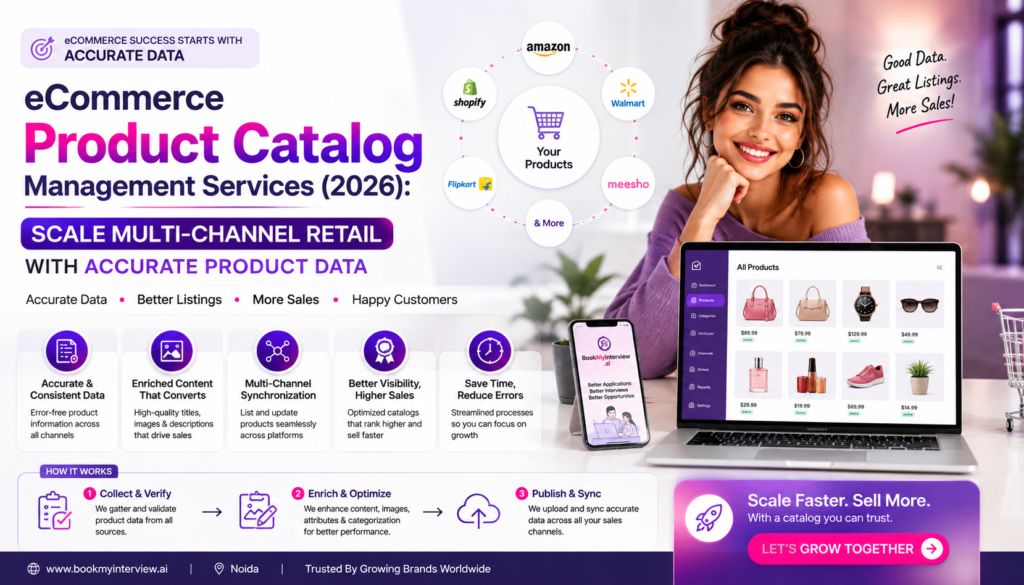
AI Overview
Product catalog management has quietly become a revenue function, not a back-office task. As retailers list across Amazon, Shopify, WooCommerce, and regional marketplaces simultaneously, inconsistent titles, missing attributes, and outdated pricing create returns, chargebacks, and a surge in “where is my order” and “this isn’t what I ordered” support tickets. Enterprise catalog management services combine AI-driven data enrichment (image tagging, attribute extraction, duplicate detection) with human quality validation to keep catalogs accurate at scale. The debate isn’t AI versus human — it’s which tasks belong to each. Leading Indian BPO providers now bundle catalog management with customer support, using shared data and conversation intelligence to catch data errors before they become customer complaints. For CEOs, COOs, and CX leaders evaluating outsourcing partners, the right vendor treats catalog accuracy as a direct driver of conversion, retention, and support cost — not an isolated data-entry function.
Introduction
Every retail executive has had this conversation. A product ranks well, gets clicks, and still underperforms on conversion. The team checks pricing. They check the ad spend. They check the funnel. Eventually, someone finds the real problem sitting quietly in the catalog — a missing size attribute, a description copied from a supplier PDF three years ago, an image that matches the SKU on the website but not on the marketplace listing.
None of this looks urgent on a dashboard. All of it is expensive.
We’ve spent years inside contact center operations watching the second half of this story play out — the support ticket that opens with “this isn’t what the picture showed,” the return that costs more to process than the product’s margin, the agent who has no idea a SKU was renamed last week because nobody told the support desk. Catalog management and customer support outsourcing are not two separate problems. They are one operational system, and most retailers manage them as if they aren’t connected.
This guide is built for the people who own that outcome — CEOs and founders accountable for margin, COOs accountable for operating cost, CIOs and CTOs accountable for data integrity across systems, and heads of customer support who inherit every catalog mistake as a ticket. If you’re evaluating whether to build catalog management in-house, fold it into a broader outsourcing program, or bring in a specialist partner to handle both, this is the resource we wish existed before we built our own answer to it.
One idea runs through everything that follows: customer experience and revenue are not separate outcomes. A catalog error and a support failure are usually the same leak, showing up in two different reports. Fix the data, and support volume drops. Strengthen support intelligence, and data errors surface faster. Treat them as one system, and you recover revenue that was never really lost — it was just misfiled as returns, refunds, and churn.
The Market Reality
Direct answer: Product catalogs didn’t scale at the same pace retailers expanded into new sales channels, and the resulting data fragmentation now shows up as lost conversion, inflated returns, and support cost that nobody traces back to its actual source.
Ten years ago, most retailers managed one catalog for one channel. Today the same SKU might live on a Shopify storefront, a WooCommerce build for a regional market, three marketplaces, and a WhatsApp commerce catalog — each with different field requirements, image specifications, and attribute schemas. Nobody designed this complexity on purpose. It accumulated, one channel launch at a time.
What most leadership teams miss is where the cost actually lands. It rarely appears on a report labeled “catalog quality.” It shows up as:
- Elevated return rates attributed vaguely to “product-market fit”
- Rising ticket volume that support leaders are told to “handle with more agents”
- Marketplace suppression blamed on pricing, when the real cause is incomplete attribute data
- Customer lifetime value erosion that appears in a retention report, disconnected from its actual root cause
We’ve reviewed contact center data across retail engagements where 18–27% of inbound tickets traced back to a catalog data error, not a fulfillment or service failure. That isn’t a support problem. That’s a data problem wearing a support costume.
Industry Trends Shaping 2026
Direct answer: Three forces are converging this year — AI-driven catalog enrichment at scale, marketplace algorithms that penalize incomplete data more aggressively, and a shift toward unified contact center services that combine catalog operations with customer conversations under one delivery team.
| Trend | What’s Changing | Executive Implication |
|---|---|---|
| AI-assisted enrichment | Models from providers like OpenAI, Google Gemini, and Claude now draft attribute-complete descriptions from raw supplier data | Speed to list improves, but unverified AI output introduces new accuracy risk without human review |
| Marketplace algorithm sensitivity | Amazon and regional marketplaces increasingly suppress listings with incomplete attributes | Catalog completeness is now a visibility lever, not just a UX one |
| Unified delivery models | Providers offering contact center services are merging catalog teams with support teams so the group fixing a listing also handles the resulting ticket | Fragmented vendor relationships — one for data, one for support — recreate the exact blind spot causing revenue leakage |
| PIM and retail media convergence | Product Information Management systems now feed ads, storefronts, and support simultaneously | Catalog accuracy directly affects ad spend efficiency, not only organic conversion |
| Compliance tightening | Consumer protection rules increasingly require accurate product claims, particularly in FMCG, healthcare-adjacent, and automotive categories | Inaccurate catalogs are becoming a legal exposure, not just a CX one |
The pattern worth naming directly: unified catalog-and-support delivery is outgrowing the old model of siloed vendors, because when the team fixing your data and the team talking to your customers are the same team, revenue that was leaking through both channels gets recovered simultaneously.
What Is Product Catalog Management?
Direct answer: Product catalog management is the discipline of creating, standardizing, enriching, validating, and continuously syncing every piece of product data — descriptions, images, attributes, pricing, inventory status, and variants — across every sales and support channel, so what a customer sees and what a support agent sees always match reality.
It includes:
- Product onboarding — structuring new SKUs to channel-specific schemas
- Data enrichment — writing or generating complete, accurate descriptions and attributes
- Image and asset management — sizing, tagging, and compliance-checking visuals per channel
- Catalog QA — auditing listings against a single source of truth
- Multi-channel sync — pushing updates to Shopify, WooCommerce, marketplaces, and internal support tools at the same time
- Deduplication and taxonomy management — preventing duplicate or miscategorized listings
- Pricing and inventory accuracy — ensuring what’s listed matches what’s actually sellable
Executive interpretation: If your team can answer “how many SKUs do we have, right now, across every channel” with one confident number, you likely don’t need this guide. Most enterprise retailers cannot answer that question. That gap is the business case.
Why Catalog Accuracy Is a Revenue Function
Direct answer: Catalog accuracy sits upstream of conversion, returns, support cost, and marketplace visibility — a single data error compounds into four separate P&L impacts before anyone traces it back to its source.
Most organizations budget catalog management as a data-entry cost center, measured on throughput — SKUs processed per day. That measurement model guarantees the wrong behavior: speed over accuracy, because nobody is measuring the downstream cost.
Here’s the chain leadership teams consistently underestimate:
- A supplier sends incomplete attribute data for a new SKU.
- It gets listed quickly to hit a launch date, gaps filled with best-guess assumptions.
- Customers order based on the inaccurate listing.
- Returns spike, tagged generically as “not as described.”
- Support tickets spike, handled by agents with no visibility into the original data gap.
- The marketplace algorithm quietly reduces visibility due to elevated return rates.
- Marketing increases ad spend to compensate for lost organic visibility.
Every step is measured by a different team, in a different report, with no shared attribution back to step one.
Boardroom Insight: If your returns, support cost, and ad efficiency reports live in three different dashboards owned by three different leaders, you cannot see this leak — by design, not by accident. The fix isn’t more reporting. It’s connecting ownership of catalog data and support data.
How Catalog Management Works
Direct answer: Enterprise catalog management runs as a five-stage pipeline — ingestion, enrichment, validation, multi-channel publishing, and continuous monitoring — with AI handling volume and humans handling judgment at each stage.
| Stage | What Happens | AI’s Role | Human’s Role |
|---|---|---|---|
| 1. Ingestion | Raw data collected from suppliers, ERPs, spreadsheets | Auto-parsing, format standardization | Exception handling, supplier follow-up |
| 2. Enrichment | Descriptions, attributes, categorization applied | Draft generation, attribute extraction from images | Brand voice review, accuracy verification |
| 3. Validation | Data checked against channel rules and source of truth | Rule-based compliance checks, duplicate detection | Edge-case judgment |
| 4. Publishing | Listings pushed live across channels and support tools | Automated sync and formatting | Approval gates for high-risk categories |
| 5. Monitoring | Ongoing accuracy checks tied to returns and ticket data | Anomaly detection | Root-cause investigation, escalation |
Stage five is the one almost every provider skips. Catalog management is usually sold as a project — get the catalog live — rather than an ongoing discipline. This is exactly where automating business processes across ingestion and validation frees up human capacity for the judgment calls that actually require it, rather than burning it on repetitive formatting work.
Core Benefits of Getting This Right
Direct answer: Getting catalog data right reduces returns, cuts support ticket volume, improves marketplace visibility, and frees merchandising teams from repetitive data work — typically within 60–90 days.
- Lower return rates — accurate sizing, materials, and imagery reduce “not as described” returns
- Lower cost per support ticket — fewer catalog-driven tickets means agents spend time on higher-value issues
- Faster time-to-market — new SKUs launch across all channels in days, not weeks
- Better marketplace ranking — complete attribute data satisfies algorithmic visibility requirements
- Predictable cost structure — a variable outsourced model replaces headcount that under- or over-utilizes during seasonal surges
Many of these gains compound further when catalog accuracy is paired with a broader customer support outsourcing engagement, because the same team resolving tickets can flag the data errors causing them — closing a loop most retailers leave permanently open.
The MasCallNet Revenue Leakage Model™
Definition: A diagnostic framework that quantifies how much revenue a retailer loses annually to catalog data errors, by connecting return rate, support cost, and marketplace visibility loss into a single figure.
Formula:
Revenue Leakage = Catalog-Attributable Return Value
                 + Catalog-Attributable Support Cost
+ Estimated Visibility Loss Value- Catalog-Attributable Return Value = Total returns × % tagged “not as described” × average order value
- Catalog-Attributable Support Cost = Catalog-related tickets × fully-loaded cost per ticket
- Estimated Visibility Loss Value = Traffic decline on affected SKUs × conversion rate × average order value
Scoring Logic: Retailers above 3% of gross merchandise value (GMV) in combined leakage are high-priority intervention candidates. Most enterprise retailers we’ve assessed fall between 2.5% and 6% — a figure almost never visible in standard financial reporting.
Interpretation: A retailer with $50M in annual GMV at 4% leakage is losing $2M a year to a problem categorized internally as “operations” rather than “revenue.”
Executive Recommendation: Run this calculation before evaluating any outsourcing partner. It turns an abstract “should we fix our catalog” conversation into a number your CFO will act on.
What Most Retailers Get Wrong
What everyone says: “We need better product descriptions and cleaner images.”
What most articles miss: Catalog accuracy isn’t a content quality problem — it’s a data governance problem. The description is the symptom; the absence of a single source of truth across ERP, PIM, storefront, marketplace, and support systems is the disease.
What actually happens: Teams hire copywriters or AI tools to “fix descriptions” while the underlying attribute data in five different systems still disagrees with itself. Six months later, the same errors resurface because nothing structural changed.
Hidden cost: Every rewrite without governance is a sunk cost that will need repeating. We’ve seen retailers pay for full catalog rewrites two and three times because no one addressed why the data drifted out of sync in the first place.
Our perspective: Fix the pipeline before you fix the copy. A governance layer connecting your systems, with clear ownership of what “correct” means for each field, has to exist before enrichment work holds its value.
Executive Action: Before signing a catalog management contract, ask one question: “How do you prevent this from breaking again in six months?” If the answer is only about content quality, keep looking.
AI vs Human Customer Support: Who Should Own What
Direct answer: AI should own detection, drafting, and pattern recognition at scale; humans should own judgment, brand voice, exception handling, and trust-repair moments. The strongest operations assign work by this split instead of treating AI and human labor as competitors.
Framing AI vs human customer support as a competition misses how enterprise operations actually run in 2026. The real question is a division-of-labor question — and it applies just as much to catalog data as it does to customer conversations, because both are ultimately about accuracy at scale.
| Task | Best Owner | Why |
|---|---|---|
| Extracting attributes from thousands of supplier images | AI | Speed and consistency at a volume no human team can match |
| Drafting first-pass product descriptions | AI | Removes blank-page time, applies consistent tone |
| Verifying claims for regulated categories (FMCG, healthcare, automotive) | Human | Legal and brand risk requires accountable judgment |
| Detecting anomalies, like a sudden return spike on one SKU | AI | Pattern detection across large datasets in real time |
| Resolving a frustrated customer’s escalated complaint | Human | Trust repair requires empathy AI cannot yet reliably replicate |
| Routine order-status and FAQ tickets | AI-assisted | High volume, low ambiguity, immediate resolution expected |
| Root-causing why a return spike happened | Human, AI-assisted | Requires cross-referencing catalog and support data — judgment informed by AI-surfaced patterns |
What high-performing organizations do differently: They don’t ask “AI or human.” They map ticket and data-error volume by ambiguity level, assign AI to the high-volume, low-ambiguity end, humans to the high-stakes end, and build agent-assist tooling so humans handle the hard cases faster because AI already surfaced the context.
Common executive mistake: Buying an AI chatbot expecting it to replace the support team, then watching escalation rates climb because the bot has no visibility into the catalog data errors causing the confusion in the first place.
Boardroom Insight: The organizations winning this debate stopped debating it two years ago. They built hybrid operating models and moved on to optimizing the split. If your leadership team is still asking “AI or human,” you’re behind, not ahead.
Executive Action: Audit your last 90 days of support tickets. Tag what percentage originated from a catalog data error versus a genuine service issue. That single exercise tells you more about where to deploy AI versus human effort than any vendor pitch will.
The MasCallNet Outsourcing Readiness Score™
Definition: A self-assessment framework scoring an organization’s readiness to outsource catalog and support operations, across five dimensions.
Score each 1 (low) to 5 (high):
- Data centralization — one system of record, or scattered spreadsheets?
- SKU velocity — how often do SKUs launch or change?
- Channel complexity — how many platforms require formatted data?
- Support-data linkage — can support see catalog changes in real time?
- Executive sponsorship — is there one accountable owner for catalog accuracy?
Scoring Logic:
- 5–12: Not ready — fix internal data governance first
- 13–19: Ready for a phased pilot with a partner offering governance support
- 20–25: Ready for full-scale outsourced execution
Executive Recommendation: Organizations scoring below 13 who outsource anyway typically see disappointing early results — not because the vendor underperformed, but because the underlying data chaos got outsourced along with the task.
Choosing the Best BPO Companies in India
Direct answer: The best BPO companies in India for this work are evaluated on domain depth in retail and eCommerce, integration capability with your existing tech stack, transparency in how they split AI and human effort, and evidence of connecting catalog data to support outcomes — not on cost per hour or headcount availability alone.
India remains the leading global destination for this category of outsourcing, and for good reason: a mature talent pool with strong English proficiency, two decades of operational discipline, and increasingly sophisticated AI tooling layered on top of experienced teams. But “best” isn’t a fixed list — it depends on fit against your operational profile.
Vendor Evaluation Matrix
| Criterion | What to Ask | Red Flag Answer |
|---|---|---|
| Domain expertise | “Show me retail catalog work in my category” | Generic data-entry portfolio, no retail specialization |
| Technology integration | “Can you work natively inside Shopify, WooCommerce, and our PIM?” | Requires manual export/import |
| AI transparency | “Which tasks does AI handle, and how is output QA’d?” | Vague answer, or claims “we do everything with AI” |
| Support-catalog linkage | “How does support flag catalog errors back to the data team?” | Treated as separate departments or vendors |
| Scalability proof | “Show SKU volume you’ve scaled from X to 10X” | No evidence of handling growth |
| Pricing transparency | “What’s included, and what triggers extra cost?” | Pricing that shifts materially post-contract |
A related question worth asking separately: among the best customer support outsourcing companies, how many actually treat product data as part of the support mandate, rather than someone else’s problem? Very few do. Most quote you a seat rate for agents and stop there, leaving catalog accuracy — the thing generating a large share of their own ticket volume — completely outside the scope of the engagement.
What most listicles miss: Nearly every “best BPO in India” ranking sorts providers by size or client logos. Size correlates with capacity, not fit. A provider that has scaled 200-agent voice programs for banks may have zero retail catalog expertise. Match a provider’s proven domain to your actual problem, not to their brand recognition.
We built our own delivery model around this exact gap — the same operational leadership overseeing catalog accuracy also owns customer support outcomes. You can review how we approach this as an AI-powered BPO company in India, or look through our BPO case studies from India to see delivery evidence rather than claims.
Catalog & CX Maturity Scorecard™
Direct answer: Most retailers sit at Stage 2 of a four-stage model — they’ve automated parts of catalog entry, but haven’t connected catalog data to support intelligence, which is where the largest recovery opportunity lives.
| Stage | Characteristics | Typical Leakage |
|---|---|---|
| 1 — Manual | Spreadsheets, manual entry, no QA process | 6%+ of GMV |
| 2 — Partially Automated | Some AI enrichment, siloed from support | 3–5% of GMV |
| 3 — Connected | Catalog and support data linked, shared reporting | 1.5–3% of GMV |
| 4 — Intelligence Loop | Support conversations actively correct the catalog in near real time | Under 1.5% of GMV |
Executive interpretation: Moving from Stage 2 to Stage 3 delivers the largest single reduction in leakage of any transition on this scale, because it’s the point where catalog and support stop being reported — and managed — separately.
Scaling Without Breaking: The Call Center Outsourcing Question
Direct answer: Scalable operations are built on modular workflows — ingestion templates, QA checklists, and publishing rules that don’t need rebuilding every time SKU count multiplies — rather than on linear headcount addition, and the same principle applies directly to call center outsourcing decisions.
Executive teams often assume scaling means proportionally scaling headcount, whether that’s catalog analysts or support agents. It doesn’t have to. A properly designed pipeline scales enrichment and validation through AI at near-zero marginal cost, while human QA capacity scales in defined tiers — every additional 5,000–10,000 SKUs, not every additional SKU. Retailers that also need to outsource call center services to handle seasonal ticket surges benefit from the same modular thinking: build the workflow once, add trained capacity behind it, rather than starting from zero with every peak season.
Practical recommendation: Before a major SKU expansion or a new market launch, stress-test your current process at 3x current volume on paper. If it breaks conceptually, it will break operationally.
Industry Benchmarks
| Metric | Industry Benchmark | High-Performing Organizations |
|---|---|---|
| Catalog-attributable return rate | 15–25% of total returns | Under 8% |
| Catalog-attributable support tickets | 18–27% of total ticket volume | Under 10% |
| Time to list a new SKU across channels | 5–10 business days | Under 2 business days |
| Catalog data accuracy rate | 80–88% | 97%+ |
| Cost per catalog-driven support ticket | Comparable to standard tickets, higher escalation rate | 20–30% lower through root-cause resolution |
These figures are directional, compiled from operational data across retail engagements. Measure your own baseline before setting improvement targets.
Case Study: From Catalog Chaos to Revenue Recovery
Challenge: A mid-market fashion retailer selling across a Shopify storefront, two marketplaces, and a growing WooCommerce presence was running a 22% return rate, well above category norms, alongside rising support cost per order.
Root Cause: Investigation traced 61% of returns to sizing and material mismatches between marketplace listings and actual product specifications — caused by manual, inconsistent data entry across three separate teams with no shared source of truth.
Solution: A unified governance layer was established with one source-of-truth attribute set, AI-assisted enrichment for drafting, and human QA gates specifically on sizing and material claims — the two attributes driving the highest return rates. Support tickets were tagged to flag catalog-driven complaints back to the data team within 24 hours.
Implementation: Rolled out over 90 days — governance and source-of-truth setup (weeks 1–3), re-enrichment of highest-return SKUs first (weeks 4–8), full catalog coverage and feedback-loop activation (weeks 9–12).
Results:
- Return rate declined from 22% to 11% within four months
- Catalog-attributable support tickets fell by 34%
- Marketplace visibility improved on previously suppressed listings
- Estimated annual revenue recovery: roughly 3.8% of GMV
Lessons Learned: The fastest win wasn’t rewriting the entire catalog — it was fixing the highest-return SKUs first, proving value within weeks rather than waiting for full completion.
Pricing: What Outsourced Customer Support and Catalog Work Actually Costs
Direct answer: Outsourced catalog management in India typically runs $0.50–$3.00 per SKU for enrichment and QA, or as a monthly retainer scaled to SKU volume. Outsourced customer support pricing typically follows a per-agent, per-hour, or per-resolution model, generally 40–65% lower than equivalent onshore execution — but the number on the quote is rarely the full story.
| Pricing Model | Best Fit | Typical Range |
|---|---|---|
| Per-SKU catalog pricing | One-time builds, new market launches | $0.50–$3.00 per SKU |
| Monthly catalog retainer | Ongoing management, frequent updates | Scaled to SKU count and update cadence |
| Per-agent support pricing | Dedicated support teams | Varies by shift, skill level, and language coverage |
| Per-resolution support pricing | Transactional, high-volume ticket types | Priced per closed ticket, often blended with a base retainer |
| Blended catalog + support | Retailers wanting unified accountability | Custom, typically discounted versus separate vendors |
Cost Calculator Formula:
Estimated Monthly Cost =
(Active SKU Count × Per-SKU Enrichment Rate)
+ (Monthly Update Volume × Per-Update QA Rate)
+ (Support Ticket Volume Attributable to Catalog × Per-Ticket Handling Cost)
Executive interpretation: Most retailers underestimate the third term. Budgeting only for enrichment while ignoring the ongoing support cost of unmanaged catalog drift understates true program cost by 20–35%. When you’re comparing quotes, ask every vendor to show pricing against this full formula, not just their headline rate.
ROI Framework
Formula:
ROI (%) = [(Revenue Recovered − Program Cost) / Program Cost] × 100

Revenue Recovered =
Reduction in Return-Related Loss
+ Reduction in Support Cost
+ Incremental Conversion Gain from Improved Listings
Interpretation: In the case study above, a program cost representing roughly 0.6% of GMV recovered an estimated 3.8% of GMV in reduced leakage — an ROI exceeding 500% in year one, consistent with what we typically see once catalog and support data are connected rather than managed separately.
Executive Recommendation: Require any vendor proposal to include a projected ROI using this structure before signing. If a vendor can’t articulate expected return in these terms, they’re pricing a task, not managing an outcome.
Industry Use Cases
| Industry | Catalog Complexity Driver | Where the Framework Applies |
|---|---|---|
| Retail & eCommerce | Multi-channel SKU proliferation, seasonal churn | Return reduction, marketplace visibility |
| FMCG | Regulatory claims accuracy, high SKU turnover | Compliance risk reduction, listing speed |
| Automotive & EV | Technical specification accuracy | Warranty and return reduction |
| Banking & Insurance | Product and plan catalog accuracy | Reduced misselling complaints, similar governance discipline used across digital banking services support programs |
| Healthcare | Compliance-sensitive claims | Legal risk mitigation, comparable to our healthcare BPO services approach |
| Logistics-adjacent retail | Inventory accuracy tied to fulfillment promises | Reduced “item unavailable” escalations |
The banking comparison is worth pausing on. Institutions running digital banking services face an almost identical version of this problem — product and rate information published across web, app, and branch channels drifts out of sync the same way retail catalogs do, and the support team absorbs the confusion. The discipline of one governed source of truth, validated before it reaches the customer, transfers directly. It’s the same logic we apply to patient appointment scheduling services in healthcare — accuracy upstream prevents friction downstream, regardless of industry.
Technology Ecosystem
Enterprise catalog and support operations run across an interconnected stack:
| Category | Representative Platforms |
|---|---|
| Commerce platforms | Shopify, WooCommerce |
| Payments | Stripe, PayPal |
| CRM & helpdesk | Zendesk, Salesforce, Freshdesk, HubSpot, Intercom, ServiceNow |
| Contact center infrastructure | Genesys, Five9, Talkdesk, NICE CXone |
| Collaboration | Slack, Microsoft Teams |
| Cloud infrastructure | Amazon Web Services, Google Cloud, Microsoft Azure |
| AI/LLM layer | OpenAI, Google Gemini, Claude, Microsoft Copilot |
Providers offering true contact center services should be fluent across most of this stack, not locked into a single platform. The vendor question isn’t “do you use AI” — nearly every serious provider does now. It’s which platforms they integrate with natively versus which require manual data handoffs, because every manual handoff is a place where catalog and support data quietly drift back out of sync.
Security & Compliance
Catalog and customer data handling should meet the same rigor as any enterprise data function — role-based access controls, encrypted data transfer, documented retention policies, and compliance alignment with relevant regional frameworks. Any outsourcing partner should be able to produce documentation on data handling and incident response before a contract is signed, not after.
The India Advantage
India’s position as the leading destination for call center outsourcing and catalog management work isn’t accidental. It reflects a genuine combination of factors that compound: a large, English-proficient, technically trained workforce; two decades of operational maturity that predates the current AI wave; time-zone coverage that enables genuine 24/7 operations for US and European retailers, as demonstrated in delivery models like our call center operations in Noida; and increasingly, AI-tooling sophistication layered on top of experienced human teams rather than replacing them. Cost advantage remains real — typically 40–65% versus onshore equivalents — but cost alone no longer explains why India retains this position against emerging lower-cost geographies. Operational maturity and domain depth do.
Offshore vs Onshore, and Other Decisions You’ll Face
Direct answer: The offshore vs onshore customer support outsourcing decision usually comes down to cost sensitivity, required coverage hours, and how culturally localized your customer conversations need to be — and for most multi-channel retailers, offshore delivery wins on economics without sacrificing quality, provided the partner has genuine domain depth.
Offshore vs Onshore
| Factor | Offshore (e.g., India) | Onshore |
|---|---|---|
| Cost | 40–65% lower | Baseline |
| Talent pool depth | Large, specialized BPO market | Smaller, often generalist |
| Time zone coverage | Enables true 24/7 with proper shift design | Limited without premium overnight staffing |
| Recommendation | Strong default for cost-sensitive, scale-driven operations | Consider for highly localized, low-volume, culturally nuanced categories |
In-House vs Outsourced
| Factor | In-House | Outsourced |
|---|---|---|
| Cost structure | Fixed, scales with headcount | Variable, scales with volume |
| Speed to scale | Slow (hiring cycles) | Fast (existing bench capacity) |
| Recommendation | Best for proprietary, low-volume catalogs | Best for multi-channel, high-volume, or fast-scaling operations |
AI vs Human vs Hybrid
| Factor | AI-Only | Human-Only | Hybrid |
|---|---|---|---|
| Speed | Very high | Low | High |
| Accuracy on ambiguous cases | Low-moderate | High | High |
| Recommendation | Not viable alone for regulated or brand-sensitive categories | Not scalable at enterprise SKU volume | The default model for enterprise operations |
Traditional BPO vs Connected Delivery
| Factor | Traditional BPO | Connected Catalog + Support Model |
|---|---|---|
| Data treatment | Tickets closed and archived | Conversations mined for catalog and product insight |
| Vendor structure | Often separate vendors for catalog and support | Unified delivery team across both |
| Recommendation | Sufficient for pure cost-reduction mandates | Necessary for organizations prioritizing revenue recovery |
Risk Analysis
- Vendor lock-in — mitigated by contractual data portability and clean export rights
- Over-reliance on unverified AI output — mitigated by mandatory human QA gates on regulated or high-return categories
- Fragmented vendor accountability — mitigated by choosing one partner across catalog and support rather than separate specialists
- Data security exposure — mitigated by verified compliance certifications before onboarding
- Underestimating change management — internal teams need clear process handoffs, or you’ll recreate the same fragmentation you set out to fix
Future Trends
AI agents will increasingly handle first-pass catalog enrichment and routine customer queries simultaneously, drawing from the same underlying product knowledge base. Voice bots and agent-assist tools will surface catalog inconsistencies to human agents in real time, during a live interaction, rather than after a return is filed. Predictive analytics will flag likely catalog-driven return risk before a listing even goes live. Workflow automation will connect PIM, storefront, marketplace, and helpdesk systems into a single governed pipeline. Conversation intelligence will formalize what today happens informally in the best-run programs — feeding customer language and complaint patterns directly back into catalog corrections. Every interaction becomes reusable intelligence that improves the catalog, which reduces future interactions. Organizations that build this loop will operate at structurally lower cost and higher conversion than those still treating catalog and support as separate disciplines.
Executive Decision Tree
Is your catalog-attributable return/support rate above 15%?
├── No → Monitor quarterly using the Revenue Leakage Model™
└── Yes → Is your data centralized across one source of truth?
    ├── No → Prioritize governance/PIM consolidation before outsourcing
    └── Yes → Do you have internal bandwidth to scale QA at current SKU velocity?
        ├── Yes → Consider selective outsourcing for peak/seasonal volume
        └── No → Pursue a full outsourced catalog + support partnership
            with one unified delivery team
Executive Checklist
- Calculated your Revenue Leakage Model™ estimate
- Scored your organization on the Outsourcing Readiness Score™
- Confirmed the vendor’s AI-vs-human task allocation is explicit and documented
- Verified native integration with your commerce platform and helpdesk
- Requested SLA terms with defined remediation for missed accuracy targets
- Reviewed data security and compliance documentation
- Required an ROI projection using a documented formula
- Confirmed whether catalog and support will be managed by one team or split across vendors
- Piloted on highest-return SKUs before full catalog rollout
- Established a feedback loop between support tickets and catalog QA before go-live
Frequently Asked Questions
1. What is eCommerce product catalog management?
The ongoing process of creating, enriching, validating, and syncing product data across every channel a retailer sells on, so listings stay accurate and consistent everywhere.
2. Is AI or human customer support better for handling catalog-related tickets?
Neither alone. AI handles high-volume, low-ambiguity queries efficiently; humans handle exceptions, escalations, and judgment calls. The strongest operations use both, allocated by task complexity.
3. How do I find the best BPO companies in India for this work?
Evaluate on retail domain expertise, native platform integration, transparency in how they split AI and human effort, and evidence of connecting catalog and support data — not on size or headline rate alone.
4. What’s the difference between offshore and onshore customer support outsourcing?
Offshore delivery, particularly from India, typically costs 40–65% less and offers deep domain talent pools; onshore may suit highly localized, low-volume categories where cultural nuance is critical.
5. How much does outsourced customer support pricing typically run?
Pricing usually follows per-agent, per-hour, or per-resolution models. Exact rates depend on shift coverage, language requirements, and complexity, but offshore delivery is generally 40–65% below onshore equivalents.
6. What is call center outsourcing, and is it the same as customer support outsourcing?
Call center outsourcing typically refers to voice-based support delivered by a third party. Customer support outsourcing is broader, covering voice, chat, email, and social channels — call center outsourcing sits inside it.
7. How long does it take to implement outsourced catalog management?
A phased rollout — governance setup, priority-SKU enrichment, then full coverage — typically takes 60–90 days for enterprise catalogs.
8. What’s the difference between catalog management and customer support outsourcing?
Catalog management focuses on product data accuracy; customer support outsourcing focuses on customer interactions. They’re deeply connected, since catalog errors are a leading cause of support tickets — which is why unified delivery outperforms separate vendors.
9. Can AI fully automate catalog management?
No. AI automates drafting, extraction, and detection at scale, but regulated categories, brand voice, and ambiguous edge cases still require human validation.
10. How do I measure ROI on catalog management outsourcing?
Compare program cost against recovered revenue from reduced returns, reduced support cost, and improved conversion, using a documented formula rather than a general estimate.
11. What causes most eCommerce returns related to product data?
Sizing mismatches, incorrect material or specification claims, and image inconsistencies between what’s listed and what’s shipped are the leading causes.
12. Does catalog accuracy affect marketplace ranking?
Yes. Marketplaces increasingly suppress listings with incomplete attribute data, making catalog completeness a visibility factor, not just a UX one.
13. What’s the minimum SKU volume that justifies outsourcing?
There’s no fixed threshold, but organizations managing 2,000+ SKUs across three or more channels typically see clear ROI from outsourced or hybrid catalog management.
14. Which industries benefit most from unified catalog and support outsourcing?
Retail, eCommerce, FMCG, automotive, and any regulated category where product claim accuracy carries compliance risk alongside CX risk. Digital banking services face a close parallel with product and rate data.
15. How does MasCallNet differ from traditional BPO providers?
We treat catalog management and customer support as one connected operating system rather than separate service lines, feeding support conversation data back into catalog QA to close a loop most providers leave open.
16. What should I look for among the best customer support outsourcing companies specifically for eCommerce?
Platform-native integration with your commerce stack, transparent AI-versus-human task allocation, and proof they’ve scaled ticket volume during peak seasons without SLA slippage.
17. Is my data secure with an outsourced catalog and support partner?
It should be, provided the vendor can document access controls, encryption standards, and compliance certifications in writing before onboarding.
Conclusion
Product catalog management stopped being a back-office task the moment retailers went multi-channel. Every inaccurate attribute, every mismatched image, every outdated price is now a direct line to a return, a support ticket, or a suppressed listing — and most organizations still measure these outcomes in three disconnected reports, unable to see the single leak causing all three.
The fix isn’t a bigger content team or a better chatbot. It’s treating catalog data and customer support conversations as one intelligence system. Organizations that make this shift consistently recover 2–5% of GMV previously lost to returns, support cost, and lost visibility — revenue that was never actually gone, just misallocated.
Whether you’re weighing call center outsourcing, comparing offshore vs onshore customer support outsourcing, or trying to shortlist the best BPO companies in India for a catalog-heavy operation, the underlying question is the same: does this partner understand that your product data and your customer conversations are two views of the same problem? Most don’t. The ones that do will save you far more than their invoice.
Talk to Us
If your team has already noticed the symptoms — returns that don’t quite make sense, support tickets that trace back to a listing, a catalog that three departments describe differently — you don’t need another audit. You need a partner who has already built the operating model to fix it.
Speak with our team about a revenue leakage assessment for your catalog and support operations, review our case studies, or explore our approach to customer support outsourcing and automating business processes as connected disciplines, not separate services.