
Outcome-Based BPO (2026): From Headcount to Measurable Business Results
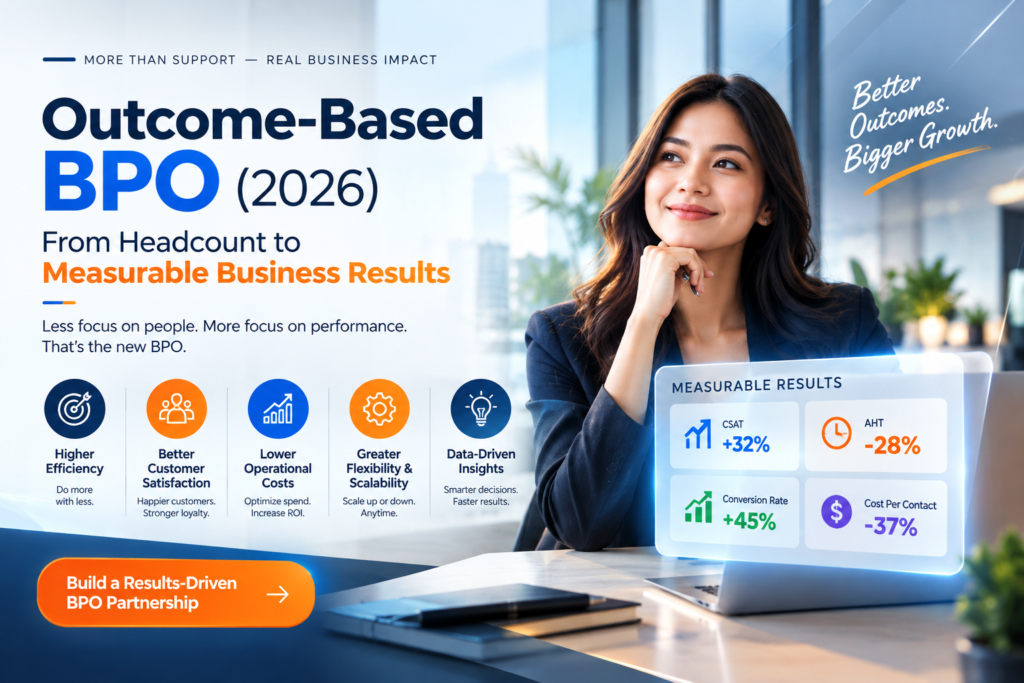
Executive summary: Outcome-based BPO is a commercial model in which part of a BPO provider’s compensation is linked to a defined business result rather than only to headcount, hours or transaction volume. In 2026, the model is becoming more relevant as AI automation changes the relationship between labour input, operating cost and measurable customer outcomes.
If you are evaluating BPO services in India, customer service outsourcing in India, an AI contact center or an AI-powered BPO, the central question should not be “How many agents will I receive?” It should be: What outcome am I buying, how will it be measured, and which part of the outcome can the provider genuinely influence?
Outcome-Based BPO: What Buyers Need to Know
| Buyer question | Practical answer |
|---|---|
| What is outcome-based BPO? | A BPO commercial structure where part of the provider’s fee is tied to a defined business result. |
| Is it the same as transaction pricing? | No. Transaction pricing pays for work processed; outcome pricing connects payment to the result achieved. |
| Is it always cheaper? | No. Performance risk has a commercial value. Compare total cost of ownership with verified business value. |
| Where can it work? | Customer service, collections, selected sales processes and defined back-office workflows where outcomes can be measured. |
| What is the safest transition? | A controlled pilot or hybrid model with a base fee, operational SLAs, quality floors and a clearly defined performance component. |
This article is designed for CX leaders, operations heads, CFOs, procurement teams and founders comparing BPO companies in India, customer support outsourcing models and AI-enabled contact center operations.

What Is Outcome-Based BPO?
Outcome-based BPO is business process outsourcing in which provider compensation is linked, wholly or partly, to a defined result. Instead of treating labour capacity as the primary unit of value, the commercial model recognises what the operation achieves.
Consider four common BPO pricing models:
| Model | What you primarily buy | Typical measurement | Primary commercial logic |
|---|---|---|---|
| FTE / seat-based | Dedicated capacity | Agents, shifts, hours | Capacity |
| Transaction-based | Processed workload | Calls, tickets, cases | Throughput |
| Outcome-based | Defined business result | Resolution, recovery, conversion, retention | Value delivered |
| Hybrid | Base capacity plus performance | FTE/volume plus outcome KPIs | Shared risk and accountability |
For example, paying for 25 customer service agents is a capacity model. Paying per ticket processed is a transaction model. Paying a base operating fee plus a verified incentive for improved first-contact resolution, maintained quality and lower repeat contact is an outcome-linked hybrid model.
Why BPO Pricing Is Moving Toward Outcomes
The shift is not simply a pricing trend. It is connected to three changes in how business processes are operated.
1. AI weakens headcount as a proxy for value
An AI contact center can automate defined conversations, assist human agents, classify intent, route interactions, summarise calls, monitor quality and identify escalation risk. As automation changes the amount of human effort required, a contract based only on seats can become disconnected from productivity.
Current BPO research also reflects this direction. HFS Research reported survey expectations among more than 500 executives that effort/input commercial models would decline over a three-year period while outcome-based or shared-revenue models would increase. Those figures describe survey expectations, not current market share. HFS Research.
2. Customer journeys are increasingly measurable
Modern operations can measure response time, average handling time (AHT), first-contact resolution, repeat contact, CSAT, NPS, intent, sentiment, escalation, conversion and retention. This makes it possible to connect operational delivery to a broader business result.
3. Buyers want ROI, not only activity reports
A monthly report showing 100,000 calls handled does not answer whether customers were successfully served. A more useful question is how many customer issues were resolved, how much rework was prevented, whether complaints declined and whether the total cost per successful outcome improved.
Outcome-Based BPO Does Not Mean “Pay Only If You Win”
This distinction is critical when negotiating an outsourcing contract.
A BPO provider can control staffing, training, scripts, workflow, routing, quality assurance and agent behaviour. It usually cannot fully control a client’s pricing, product availability, credit policy, marketing, website, inventory or customer demand.
Therefore, outcomes are often co-produced.
- Provider-controlled: staffing, training, QA, workflow, routing, agent behaviour and operational execution.
- Client-controlled: product, pricing, policy, inventory, credit decisions, marketing and upstream technology.
- Shared: knowledge management, automation, process redesign, analytics and customer-journey improvement.
- External: seasonality, market conditions, regulatory events and extraordinary disruptions.
A credible outcome-based BPO contract must document these variables before attaching money to a KPI.
FTE vs Transaction vs Outcome-Based BPO
There is no universal “best” pricing model. The appropriate model depends on process characteristics, data quality, volume stability and the amount of influence the provider has over the result.
| Factor | FTE | Transaction | Outcome | Hybrid |
|---|---|---|---|---|
| Cost predictability | High | Medium | Variable | High to medium |
| Measurement complexity | Low | Medium | High | High |
| Provider performance risk | Lower | Medium | Higher | Medium |
| Automation alignment | Moderate | Good | Strong | Strong |
| Attribution requirement | Low | Medium | Very high | High |
When FTE pricing makes sense
FTE pricing remains appropriate when you need dedicated capacity, stable staffing, specialised knowledge or predictable coverage. It can be sensible for complex technical support, dedicated enterprise queues and processes where demand is reasonably stable.
When transaction pricing makes sense
Transaction pricing works when the unit of work is clear and relatively homogeneous: a document processed, a ticket handled or a defined transaction verified.
When outcome pricing makes sense
Outcome pricing becomes attractive when success is measurable and the provider materially influences the causal chain. Examples include verified resolution, qualified appointments, specific collections outcomes and defined accuracy targets.
Why a hybrid BPO model is often practical
A hybrid model protects operational continuity while introducing accountability for results. A buyer might pay a base fee for agreed capacity and a variable component for verified improvement in FCR, quality, recovery, conversion or another business KPI.
The Mas Callnet Outcome Contract Readiness Test
This is a Mas Callnet analytical framework created for this article; it is not an external certification or industry standard.
Before moving a process to outcome-based BPO, test the proposed KPI against five conditions:
| Test | Question | If the answer is no |
|---|---|---|
| Definable | Can both parties define success precisely? | Disputes over interpretation. |
| Measurable | Is reliable data available? | Fees depend on estimates. |
| Attributable | Can provider contribution be separated from other variables? | Unfair risk transfer. |
| Auditable | Can finance and operations reproduce the calculation? | Settlement disputes. |
| Steerable | Can the teams act on the KPI frequently enough? | The metric becomes retrospective reporting. |
Do not choose a commercial KPI simply because it is easy to report. Choose it because improvement in that KPI represents meaningful business value and the provider can materially influence it.
Which Outcomes Can Be Measured in BPO?
| Process | Potential outcome | Key safeguard |
|---|---|---|
| Customer service | Successful resolution / FCR | Define resolution and reopen period. |
| Collections | Verified recovery / PTP conversion | Control for portfolio quality and policy. |
| Sales support | Qualified appointment / conversion | Define lead quality and attribution. |
| Back office | Right-first-time processing | Include downstream rework. |
| Insurance operations | Accurate processing within TAT | Balance speed with quality. |
| Customer experience | CSAT / complaint reduction | Govern survey methodology. |
| Technical support | Resolution / repeat-contact reduction | Separate product defects from agent performance. |
| Ecommerce support | Resolution / conversion assist / retention | Control inventory and fulfilment variables. |
Customer Service Outsourcing in India: Measure the Outcome, Not Just the Agent
When companies evaluate customer service outsourcing in India, the first commercial comparison is often the monthly FTE rate. That is useful, but it does not reveal the total cost of delivering a successful customer outcome.
A serious customer support outsourcing programme should track:
- Service level and response time
- Average handling time
- First-contact resolution
- Repeat-contact rate
- CSAT
- Quality score
- Complaint and escalation rate
- Agent productivity
- Knowledge-base effectiveness
- Automation and self-service containment
For example, reducing AHT from six minutes to four minutes is not automatically a success. If FCR falls and customers call again, the organisation may simply have moved work from one interaction to two. Reduce AHT should therefore be balanced against FCR, quality and customer experience.
Mas Callnet provides contact center services covering voice, chat, email, social channels, automation and technical support. Explore Mas Callnet contact center services.

AI Contact Center: How AI Changes BPO Economics
An AI contact center is an operating model in which AI is integrated into customer interaction workflows rather than added as an isolated chatbot.
Depending on the use case, the technology layer can include:
- AI voice bot for defined inbound and outbound journeys
- Conversational AI for customer service
- Intelligent call routing
- Real-time agent assist AI
- AI call analytics
- AI call summarization
- Customer intent detection
- AI sentiment analysis for CX
- AI escalation detection
- AI quality monitoring
- AI compliance monitoring tools
- AI-powered omnichannel support
- AI ticketing automation
The commercial implication is straightforward: if technology changes the amount of human work required, the buyer should be able to discuss productivity and outcomes rather than treating the original number of seats as immutable.
For enterprises, the technology stack may also include an AI customer experience platform, a customer service automation platform, enterprise contact center software, CRM integrations and conversation intelligence. The important question is not how many AI features are listed; it is which workflow they improve and how that improvement will be measured.
AI Quality Monitoring and 100% Call Audits
Traditional contact center quality assurance often relies on sampling. An AI quality monitoring layer can analyse a much larger interaction population and flag conversations for review based on defined criteria.
Potential checks include:
- Script and disclosure adherence
- Compliance deviations
- Negative sentiment
- Escalation risk
- Missed sales opportunities
- Unresolved intent
- Repeated customer issues
- Agent behaviour patterns
This is where AI call scoring software and conversation intelligence become commercially relevant. The objective is not merely to produce another dashboard. It is to identify the interactions, behaviours and root causes that influence the business outcome.
Mas Callnet’s CallMaster™ page describes capabilities including 100% call audits, auto-tagging, risk prediction, fraud detection, NPS/CSAT tracking, sales intelligence and collections intelligence. Explore CallMaster™.
BFSI Contact Center Outsourcing and Outcome-Based Models
BFSI contact center outsourcing has an additional constraint: performance cannot be separated from compliance and customer trust.
A bank, NBFC, fintech or insurer may care about cost per interaction, but it also needs measurable controls around customer service, collections, complaints, fraud signals, escalation and process adherence.
Potential metrics include:
- Successful customer resolution
- Payment reminder effectiveness
- Promise-to-pay conversion
- Recovery performance
- Complaint reduction
- Compliance adherence
- Fraud and escalation alerts
- Quality score
Mas Callnet’s BFSI offering describes customer service, collections, PTP tracking, intent classification, root-cause detection, real-time QA and call-audit capabilities. See the BFSI contact center solution.

AI Collections: Where Outcome Measurement Becomes Especially Important
Collections is a natural candidate for carefully designed outcome-linked commercial models because results can be measured, but attribution must be handled rigorously.
An AI collections platform can support workflows such as customer intent classification, PTP analysis, dispute tagging, escalation-risk identification, collection call monitoring and agent behaviour monitoring.
Relevant concepts include:
- AI in loan collections
- PTP prediction
- PTP conversion
- Digital collections
- Human + AI collections
- Collection compliance
- Root-cause detection
However, a provider should not automatically be paid solely on gross collections without considering portfolio age, customer segment, repayment capacity, contactability, client policy and other variables. A more defensible model can combine operational fees, verified recovery metrics, quality floors and explicit exclusions.
For more detail, see Mas Callnet’s debt collection outsourcing guide.

Ecommerce Customer Support Outsourcing
Ecommerce operations combine high interaction volumes with variables that may sit outside the contact center: delivery performance, inventory, promotions, returns policy and payment systems.
An ecommerce customer support outsourcing programme can therefore measure successful resolution, repeat contacts, return-related resolution, response time, CSAT and selected conversion-assist outcomes. The contract should isolate what the contact center controls from what the fulfilment operation controls.
See the ecommerce customer support outsourcing guide for a broader operating-model discussion.
Multilingual and 24/7 Customer Support
For global businesses, multilingual customer support and 24/7 coverage can be important parts of the operating model. But the commercial KPI should remain tied to customer outcomes, not simply the number of shifts staffed.
For US and UK companies outsourcing customer experience to India, relevant considerations include time-zone coverage, language requirements, data governance, escalation coverage, knowledge transfer and continuity. See Mas Callnet’s US and UK CX outsourcing guide.

How to Measure ROI in Outcome-Based BPO
The correct ROI calculation should include more than the provider invoice.
A practical framework is:
Total cost of successful outcome = provider cost + technology cost + internal governance cost + rework cost + repeat-contact cost + failure cost.
Then compare the result with the business value created or protected by the operation.
| Metric | Why it matters |
|---|---|
| Cost per resolved case | Connects operating cost to successful resolution. |
| FCR | Shows whether issues are solved without avoidable repeat contact. |
| AHT | Shows effort per interaction, but should not be optimised alone. |
| CSAT | Connects service delivery to customer perception. |
| Quality | Protects against gaming speed or closure metrics. |
| Repeat contact | Exposes hidden rework. |
| Escalation rate | Shows where the operating model is failing or where customers need intervention. |
| Automation rate | Shows how much eligible work is handled through technology. |
What Does Outcome-Based BPO Cost?
There is no universal outcome-based BPO price. Commercial terms depend on process complexity, geography, volume, service hours, technology, compliance requirements, risk allocation and the definition of the outcome.
Do not compare a performance-linked proposal with an FTE proposal by looking only at the headline monthly fee. Compare:
- Base operating fee
- Variable outcome fee
- Technology and integration costs
- Minimum volume commitments
- Quality and SLA requirements
- Management and governance costs
- Data and compliance requirements
- Rework and repeat-contact exposure
- Change-control terms
The commercial question is not “Which rate is lowest?” It is “Which structure produces the lowest sustainable cost per successful business outcome at the required quality level?”
Security, Compliance and Data Governance
Outcome-based pricing does not reduce security obligations. If customer conversations, payment information, identity information or regulated data are processed, the contract should address access control, data minimisation, retention, audit rights, incident management, subcontracting, business continuity, secure integrations and exit procedures.
AI introduces an additional governance layer because conversation data may be used for analytics, classification, quality monitoring or automation. The technology should therefore be assessed together with its data flows and access controls.
Mas Callnet states on its website that it operates an ISO 27001-certified information-security framework. Buyers should still evaluate the applicable certification scope and contractual controls for their own engagement.
What to Put in an Outcome-Based BPO RFP
- Define every billable outcome.
- Define the baseline period and baseline data source.
- Specify the calculation formula.
- Identify provider-controlled variables.
- Identify client-controlled variables.
- Define exclusions and extraordinary events.
- Set minimum quality thresholds.
- Set operational SLAs.
- Define audit rights.
- Define data ownership and retention.
- Define settlement frequency.
- Define volume-change treatment.
- Define technology and integration costs.
- Define automation-savings treatment.
- Define change-control procedures.
- Define dispute resolution.
- Define governance cadence.
- Define exit and transition requirements.
Five Failure Modes to Avoid
1. Paying for a KPI that can be gamed
Paying for ticket closure can encourage closure without resolution. Paying only for speed can encourage shorter interactions. Use balanced KPIs.
2. Starting without a reliable baseline
If the baseline is weak, every improvement claim becomes a negotiation. Establish historical data before changing the commercial formula.
3. Ignoring attribution
If pricing, product quality, inventory or portfolio quality changes the KPI, the contract must define how those variables are handled.
4. Transferring uncontrollable risk
Providers price material risk. A contract that appears inexpensive because it transfers every downside to the provider may simply embed a risk premium elsewhere.
5. Confusing reporting with governance
A dashboard is not governance. Governance requires calibration, decision rights, escalation paths, auditability and change control.
How to Choose a BPO Company for an Outcome Model
When evaluating a BPO company in India, assess more than headcount and price.
- Industry and process experience
- AI and automation capability
- Quality assurance maturity
- Conversation intelligence
- Compliance controls
- CRM and telephony integration
- Analytics and reporting
- Scalability
- Business continuity
- Data security
- Governance capability
- Commercial flexibility
- Evidence of measurable outcomes
A provider should be able to explain how people, process and technology work together. A labour-only proposition may miss the productivity opportunity created by AI; a technology-only proposition may underestimate the operational complexity of real customer conversations.
For a broader vendor-evaluation framework, see 25 Questions to Ask Before Hiring a BPO Provider.
Outcome-Based BPO for US and UK Companies Outsourcing to India
For companies outsourcing customer experience to India, an outcome-oriented commercial model can combine the advantages of Indian delivery operations, extended-hours coverage, AI automation and centralised quality management.
The contract should still account for language requirements, time zones, customer expectations, security, regulatory requirements, knowledge transfer, escalation coverage and business continuity.
Customer Support Cost Reduction Without Sacrificing CX
Customer support cost reduction should not mean simply paying less per agent. A better objective is to reduce the total cost of achieving a successful customer outcome.
- Reduce avoidable contacts
- Increase self-service
- Improve FCR
- Reduce repeat contact
- Automate routine interactions
- Improve agent productivity
- Reduce rework
- Improve knowledge management
- Automate quality assurance
- Detect escalation risk earlier
This is where AI customer service ROI should be measured. The relevant question is not merely the price of an AI tool; it is the change in total operating cost and customer outcomes after deployment.
Related reading: AI-powered call center cost reduction in India and how to reduce customer support costs with AI and outsourcing.
Outcome-Based BPO and Customer Experience Intelligence
The next stage of BPO value is not just handling conversations. It is turning conversations into operational intelligence.
An AI customer interaction intelligence platform can identify patterns across large interaction volumes: why customers contact support, where they become frustrated, which issues create repeat contact, which agents resolve issues effectively, where escalation risk increases and where sales opportunities are missed.
This is the foundation of a conversational intelligence platform and a more measurable customer experience operation.
Practical Example: Moving a 50-Agent Support Operation Toward Outcomes
Consider a hypothetical company with 50 customer service agents. Under an FTE model, the client pays for capacity and measures service level, productivity and quality.
The company then introduces agent assist, automated call summarisation and AI quality monitoring. Instead of immediately reducing the provider fee, both parties establish a baseline for FCR, repeat contact, QA, CSAT, escalation rate and cost per resolved case.
The next contract phase could contain:
- A base fee for agreed operational capacity
- A performance incentive for verified FCR improvement
- A quality floor that must be maintained
- Service credits for material SLA failures
- A defined mechanism for sharing verified automation benefits
The commercial relationship has moved from “50 agents” to “50 agents plus measurable customer outcomes.”
When Outcome-Based BPO Is Not the Right Model
Do not force outcome pricing onto a process simply because it sounds modern.
An FTE or transaction model may remain more appropriate when:
- The process is highly variable and the outcome is difficult to attribute.
- The client controls most of the factors affecting the result.
- There is insufficient historical data.
- The workload requires dedicated specialist capacity.
- The outcome definition would create excessive commercial disputes.
- Quality cannot be measured reliably.
In those cases, improve the operating model first. Introduce outcome-linked compensation when the measurement system is mature enough to support it.
10 Questions to Ask Before Signing an Outcome-Based BPO Contract
- What business outcome are we actually buying?
- How is success defined?
- What is the verified baseline?
- Which variables are controlled by the provider?
- Which variables are controlled by the client?
- Which KPI protects customer experience?
- Can both parties reproduce the calculation?
- What happens when technology or process changes?
- How are automation savings shared?
- What happens if the commercial model stops working?
How Mas Callnet Approaches Outcome-Focused CX and BPO
Mas Callnet positions its offering around customer experience, contact center services, BPO, automation, analytics and industry-specific operations. Its current website reports more than two decades of operating experience, 250+ global clients, 4+ delivery centers and 2,500+ team members. These are company-reported figures and should be evaluated in the context of the specific engagement.
Its contact center offering combines voice, chat, email and social channels with automation and technical support. Its CallMaster™ platform describes conversation intelligence capabilities across quality, customer experience, sales and collections.
For a business considering a move from FTE pricing toward transaction or outcome-linked commercial terms, the appropriate starting point is an operating-model assessment: establish the baseline, identify controllable levers, define the outcome, design the governance model and then determine the commercial structure.
Related Mas Callnet Resources
- 25 Questions to Ask Before Hiring a BPO Provider
- BPO vs In-House Customer Support in 2026
- In-House Customer Support vs Outsourcing
- How to Choose the Right BPO Company
- Types of BPO Services in 2026
- Agentic AI in Customer Service
- FinTech Customer Support Outsourcing
- eCommerce Customer Support Outsourcing
- AI Voice Agent Services for Banks
- Customer Support Resolution Time
- How to Handle High Customer Support Volume Without Hiring More Agents
Frequently Asked Questions
What is outcome-based BPO?
Outcome-based BPO links some or all provider compensation to a measurable business result rather than primarily to headcount, hours or transaction volume.
Is outcome-based BPO cheaper?
Not automatically. Performance risk has a commercial cost. Compare the complete commercial model against total cost of ownership and verified business value.
What is the difference between outcome-based and transaction-based BPO?
Transaction pricing pays for units processed. Outcome pricing connects payment to a defined result. Processing 10,000 tickets is an output; successfully resolving those issues without avoidable repeat contact is closer to an outcome.
Can outcome-based BPO work for customer support?
Yes, when resolution, quality, repeat contact and customer experience can be measured reliably and the provider materially influences the result.
Can outcome-based BPO work for collections?
Yes, but the commercial model should account for portfolio quality, contactability, customer circumstances, client policy and other variables outside the provider’s control.
Can an AI contact center use outcome-based pricing?
Yes. AI can improve automation, measurement and quality coverage, but the contract still needs attribution rules, quality safeguards and governance.
What is a hybrid BPO model?
A hybrid model combines a base operating fee with variable performance-linked compensation. It is often a practical transition from conventional FTE pricing to stronger outcome alignment.
What is the biggest risk in outcome-based BPO?
Weak attribution. If a provider is financially accountable for an outcome it cannot materially influence, the commercial model can become difficult to sustain.
How should a company start?
Start with one measurable process. Establish the baseline, identify provider-controlled variables, define quality safeguards and run a controlled pilot before making a large proportion of the commercial fee outcome-dependent.
Sources and Further Reading
- HFS Research — BPO services and outcome-oriented commercial models
- Deloitte — 2025 Global Business Services Survey
- Google Search Central — guidance for generative AI features in Search
- Google Search Central — Search spam policies
Start with the outcome you want to buy, then work backwards to the people, process, technology, measurement and commercial structure required to deliver it. Talk to Mas Callnet.