
AI-Powered Call Center Cost Reduction in India (2026): Cut Costs, Scale Support & Improve ROI
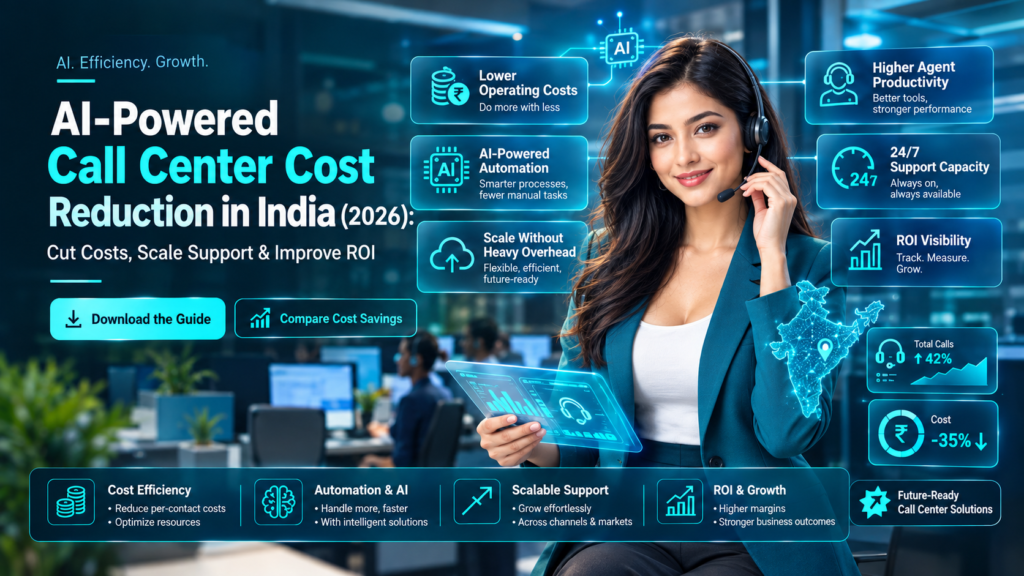
Reducing call center cost in 2026 isn’t mainly about paying fewer people to answer more calls. It’s about lowering your cost per resolved customer issue without creating a second bill later in the form of repeat contacts, escalations, refunds, chargebacks, or churn.
AI can help—but only when you apply it to the right parts of the operation, with controls strong enough to prevent “AI-driven rework.” This guide is written for leaders who are being asked to cut support costs in India while maintaining service levels: COOs, Heads of CX/Support, CFOs, CIO/CTOs, and procurement teams evaluating AI-enabled operating models.
What you’ll leave with:
- a practical cost model (cost per resolution, not just cost per contact)
- where AI typically reduces cost and where it doesn’t
- a decision tree for automate vs assist vs keep human
- hidden cost items most business cases miss
- vendor evaluation criteria for AI + outsourcing in India
What “call center cost” really means (and why cost per resolution wins)
Direct answer: The most useful metric for cost reduction is usually cost per resolution (what it costs to fully solve the customer’s problem), not cost per contact (what it costs to handle one interaction). AI can reduce cost per contact while increasing cost per resolution if it creates repeat calls, misroutes, or poor-quality deflection.
A simple operational definition
- Cost per contact = Total support cost ÷ total interactions
- Cost per resolution = Total support cost ÷ issues resolved end-to-end (with minimal repeat contacts)
If your AI lowers AHT but increases repeat contacts, your unit economics can quietly get worse even while dashboards look “efficient.”
Where the money actually goes (typical cost buckets)
Below is a practical cost map most finance teams recognize. The key is: AI affects some buckets directly, others indirectly, and some not at all.
| Cost bucket | Examples | What AI can realistically change |
|---|---|---|
| Frontline labour | agent salaries, incentives | reduce required headcount via deflection/assist; reduce overtime |
| Shrinkage | leave, training time, breaks, meetings | reduce training time; better WFM forecasting |
| Supervision & QA | team leads, QA analysts | automate portions of QA; increase QA coverage |
| Telecom & tooling | telephony, CRM, ticketing, CCaaS | consolidate tooling; shift to digital-first; optimize routing |
| After-call work | dispositioning, summarisation, tagging | automate documentation and summarization |
| Rework (“failure demand”) | repeat contacts, escalations, callbacks | reduce by improving knowledge, first-contact guidance, root cause insights |
| Risk/compliance cost | monitoring, audits, incident response | better compliance monitoring; but also adds AI governance work |
If you want a clean cost-reduction program, start by agreeing on the unit metric your exec team will judge: cost per resolved issue + customer impact.
The uncomfortable truth: AI doesn’t fix broken support
Direct answer: AI reduces cost when the underlying process is stable enough to automate or assist. If the problem is unstable—policy ambiguity, frequent product bugs, unclear eligibility rules, weak knowledge—AI often amplifies inconsistency and pushes cost into escalations.
Common failure patterns buyers discover too late:
- AI deflection that “contains” but doesn’t resolve → repeat calls within 24–72 hours
- GenAI answers that sound confident but are non-compliant → refunds, complaints, regulatory exposure
- Agent-assist trained on outdated SOPs → faster wrong answers
- Automation without exception handling → “edge cases” flood supervisors
If you remember one thing: AI doesn’t eliminate work. It moves work. Your job is to move it to the cheapest place it can be done without creating downstream cost.
Six AI levers that reduce cost in real operations
This section is intentionally mechanical: it focuses on how cost comes out, not just what vendors promise.
Lever 1: Deflection (but only when the issue is truly self-servable)
Direct answer: Deflection reduces cost when it prevents an interaction that would otherwise reach an agent and the customer still reaches a correct outcome.
Where it works best:
- order status, delivery ETA, basic account updates
- password reset, address changes (with strong authentication)
- “how-to” questions with stable, approved content
Where it backfires:
- disputes, exceptions, high-value retention, complex eligibility decisions
- anything requiring negotiation or empathy
- policies that change weekly without governance
Lever 2: Agent-assist (the fastest route to lower handle time without hollowing out quality)
Direct answer: Agent-assist cuts cost by reducing the time agents spend searching, composing, and documenting—especially for newer agents—while making answers more consistent.
Mechanisms that matter:
- surfacing the right knowledge article during the interaction
- guided workflows (“if X, do Y, capture Z”)
- approved response suggestions aligned to policy and tone
- real-time prompts to collect missing fields (reducing reopen rates)
This is often a safer early step than full customer-facing automation because humans remain responsible for the final response.
Lever 3: After-call work (ACW) automation
Direct answer: ACW automation reduces paid minutes that don’t create customer value: summaries, tags, dispositions, and internal notes.
What to insist on operationally:
- structured fields are still completed (not just free-text summaries)
- summaries are auditable and consistent
- exceptions flow to human review (not silently shipped)
Lever 4: QA automation + targeted coaching (reduce QA cost, increase coverage)
Direct answer: AI-assisted QA reduces cost by scaling evaluation beyond small samples and by focusing human QA time on the riskiest interactions.
High-leverage uses:
- automatic detection of script deviations or missing disclosures
- “near-miss” identification (high sentiment drop, repeat contacts)
- cluster analysis to find new failure modes early
Lever 5: Better forecasting and scheduling (WFM optimization)
Direct answer: WFM optimization reduces cost by cutting overstaffing, understaffing (and the overtime that follows), and shrinking backlog-driven churn.
AI can help with:
- channel mix forecasting (voice vs chat vs email)
- intraday re-forecasting during campaigns/incidents
- schedule adherence insights tied to real demand
Lever 6: Root-cause analytics (remove demand, not just handle it cheaper)
Direct answer: The cheapest contact is the one that never happens. Analytics reduces cost by identifying product, policy, billing, or logistics drivers that create repeat demand.
If your operation is large enough, this becomes one of the highest-ROI “AI” investments because it reduces volume permanently rather than optimizing it temporarily.
For organisations that want automation beyond the contact center (e.g., back-office tasks triggered by support), connect these initiatives to a broader program of automating business processes rather than treating support as a standalone island.
The Cost-to-Resolution Decision Tree
Direct answer: Use three lanes—Automate, Assist, Human—based on risk, variability, and cost of a wrong answer. This avoids the common mistake of automating what’s easy to demo instead of what’s safe to run at scale.
The three-lane decision tree
Use this as an operating rule for your 2026 roadmap.
Lane A — Automate (customer-facing) when all are true:
- the policy is stable and documented
- identity/auth controls are strong enough for the task
- the cost of an incorrect answer is low-to-moderate
- success can be measured objectively (e.g., “address changed”)
Lane B — Assist (agent-facing) when any are true:
- the issue is moderately complex but pattern-based
- the policy is stable, but exceptions exist
- compliance matters, and you want humans to approve the final message
- you need fast time-to-value without taking customer-facing risk
Lane C — Human-first when any are true:
- high regulatory/compliance risk
- financial disputes, fraud, chargebacks
- high-emotion retention and escalations
- ambiguous policy, frequent product incidents
“Hidden cost” warning: AI that increases repeat contacts
If you implement deflection without a tight feedback loop, you may improve containment while harming resolution.
Add two metrics to your exec dashboard (even if you automate nothing else):
- Repeat-contact rate (within 7 days) by issue type
- Escalation rate from bot/IVR to agent by issue type
If these rise, your cost-per-resolution will rise even if cost-per-contact falls.
India delivery models in 2026: in-house vs outsourced vs hybrid
Direct answer: The best model depends on whether your main constraint is cost, speed, control/compliance, or talent availability. Most mature teams land on a hybrid: strategic ownership in-house, scalable execution via a partner, with shared governance.
Model comparison (practical, not theoretical)
| Model | When it fits | Typical trade-offs |
|---|---|---|
| In-house + AI tools | strong internal ops maturity; tight compliance needs; stable volumes | slower scaling; higher fixed cost base; harder 24/7 coverage |
| Outsourced (AI-enabled) | volatile volumes; need to scale fast; want variable cost; need multilingual coverage | requires governance; transition effort; vendor lock-in risk if poorly designed |
| Hybrid | want control over policy/knowledge while outsourcing execution | requires clear RACI, shared QA, and clean escalation design |
If you’re evaluating outsourcing as the delivery layer, start with a clear understanding of what the provider’s call center outsourcing actually includes (channels, staffing model, QA/WFM, escalation handling, reporting, transition management)—because “outsourcing” can mean anything from staff augmentation to fully managed operations.
For global teams deciding between geographies and operating models, it’s also worth grounding the discussion in a clear comparison of offshore vs onshore customer support outsourcing so the decision doesn’t devolve into hourly-rate debates.
Pricing models and the cost drivers procurement should challenge
Direct answer: Contact center pricing is less about the headline “per agent” rate and more about what’s included, how utilization is measured, how peaks are handled, and what AI adds in platform + integration + governance costs.
Common pricing models you’ll see
- Per-agent / per-FTE (dedicated team): predictable; good for steady volume
- Per-interaction / per-ticket: aligns cost to demand; needs clean definitions
- Shared pool: cheaper at low volumes; less control over staffing continuity
- Hybrid: dedicated core + flex pool for peaks
- Outcome-based elements: useful only when outcomes are unambiguous and controllable
Cost drivers that change the real price (even if the rate looks “competitive”)
Procurement teams typically get better outcomes when they explicitly price these drivers rather than fighting over base rate:
- Channel mix (voice usually costs more than chat/email; async channels can batch)
- Complexity and regulatory risk (KYC, disputes, medical information, etc.)
- Hours of coverage (night shift, 24/7, multilingual)
- Seasonality (peaks create either overstaffing or SLA risk)
- Knowledge volatility (weekly product/policy changes increase training and QA load)
- Security controls (device controls, access restriction, logging, audits)
- Tooling responsibility (who pays for CCaaS/CRM licenses and call recording)
- AI scope (deflection vs assist vs QA automation) and who owns the AI run cost
- Transition plan quality (a cheap transition becomes an expensive stabilization)
If your company operates in multiple geographies and you need a benchmark of how vendors structure costs in mature outsourcing markets, MasCallNet maintains a separate guide on outsourced customer support pricing (USA/UK/Australia). Even if you buy in India, this helps procurement ask sharper questions about inclusions and hidden line items.
Illustrative ROI framework
Direct answer: A credible ROI case for AI cost reduction must include (1) unit economics, (2) implementation + run costs, (3) risk controls, and (4) “rework” impact (repeat contacts and escalations). Without rework, most business cases are optimistic on paper and disappointing in operations.
Step 1: Baseline your current unit economics
Define:
- Monthly interactions (by channel)
- AHT and ACW (by channel and issue type)
- FCR (or repeat-contact rate)
- Fully loaded monthly cost (labour + supervision + QA + tools + telecom + overhead allocation)
Then calculate:
- Cost per contact = total monthly cost ÷ total interactions
- Cost per resolution = total monthly cost ÷ resolved issues (net of repeats)
Step 2: Model benefits by mechanism
Do not model “AI saves 30%.” Model specific levers:
- deflection rate for eligible intents
- AHT reduction from agent-assist on selected intents
- ACW reduction from summarization
- QA productivity change from automation
- repeat-contact reduction (or increase) due to deflection quality
Step 3: Include real costs (often omitted)
- integration (CRM, ticketing, telephony/CCaaS)
- knowledge base cleanup and governance
- training and change management
- AI governance: approval workflows, monitoring, incident response
- ongoing model tuning and content updates
Illustrative Example — Not MasCallNet Performance Data
Assumptions (example only):
- 60,000 interactions/month
- Baseline cost per contact = ₹X (use your actual number)
- AI program impacts:
- 10% of contacts deflected for low-risk intents
- 6% AHT reduction on 40% of remaining contacts via agent-assist
- 20% ACW reduction on 50% of remaining contacts
- Repeat-contact rate does not increase (critical assumption)
Illustrative annual benefit logic:
- Contact reduction benefit = baseline cost per contact × deflected contacts
- Productivity benefit = baseline agent minutes saved × cost per minute
- Net benefit = total benefit − (implementation + run + governance costs)
Board-level reality check: If repeat contacts rise even slightly, the ROI can flip. That’s why cost-per-resolution is the metric to defend in the business case.
Implementation: a realistic 90-day plan
Direct answer: The fastest safe path is usually to start with agent-assist + ACW automation on a limited set of intents, prove quality and governance, then expand to deflection for low-risk intents.
Days 0–15: Baseline + risk boundaries
- confirm top 20 contact drivers and pick 3–5 for phase 1
- define “never automate” categories (regulatory, disputes, high-risk)
- define acceptance criteria: accuracy, compliance, escalation rate, repeat-contact rate
- decide: build internally vs partner-delivered
Days 15–45: Knowledge + workflow hardening
- clean and version-control SOPs and KB articles
- define escalation rules and exception handling
- design QA sampling + AI-assisted monitoring for new flows
- implement feedback loop (agents flag wrong suggestions; content is fixed fast)
Days 45–75: Pilot + controlled rollout
- pilot on one queue or segment
- monitor: repeat contacts, escalations, sentiment, complaints
- tighten prompts/guardrails and improve knowledge gaps
- retrain and coach agents on new workflows
Days 75–90: Scale the levers that worked
- expand intents or channels
- start low-risk deflection if governance is stable
- formalize monthly ops: knowledge governance, model review, incident drills
If your ticket volume is growing quickly and you need immediate staffing elasticity, it can be useful to review an outsourcing scaling approach alongside your AI plan. This guide on how to outsource call center services (at higher ticket volumes) is a good reference for what breaks first when you scale too fast.
Security, compliance, and AI governance
Direct answer: Outsourcing and AI do not remove your accountability for customer outcomes, data handling, and regulatory obligations. You can delegate execution, but you still need governance: access control, auditability, incident response, and clear accountability for AI behavior.
India data protection: what to plan for
India’s Digital Personal Data Protection Act, 2023 (DPDP Act) establishes obligations around lawful processing, notice/consent (where applicable), safeguards, and breach response. The detailed operational rules have been evolving, so treat this as a governance program, not a one-time compliance checkbox.
Practical implications for contact centers:
- data minimization (agents shouldn’t see more than they need)
- strict role-based access to CRM/ticketing
- logging and monitoring of access and exports
- retention controls for call recordings and transcripts
- vendor contracts that define processor obligations, breach notification, and subcontractor controls
AI-specific risks you must actively control
- Hallucinations: GenAI can generate plausible but incorrect answers. For regulated scripts, you often need retrieval-based answers from approved knowledge plus strong guardrails.
- Prompt injection / data leakage: customer inputs can try to manipulate the model; controls are required to prevent disclosure of internal data.
- Policy drift: when SOPs change, AI suggestions must update immediately—or you accelerate wrong work.
A useful north star is to align your AI governance with recognized frameworks (for example, the NIST AI Risk Management Framework and AI management system standards such as ISO/IEC 42001)—not because they are mandatory in every case, but because they help structure risk ownership and controls.
How to evaluate vendors: an RFP-ready checklist
Direct answer: Evaluate an AI-enabled contact center partner on (1) operational maturity, (2) governance, (3) transition capability, and (4) economics that match your demand pattern—not on demos.
The 12 questions that prevent expensive surprises
- What’s included in the operating model? (WFM, QA, training, reporting cadence, escalation handling)
- How do you define and measure “resolution”? (and repeat-contact tracking)
- What is your approach to knowledge management? (versioning, approvals, change turnaround time)
- How does AI stay grounded in approved content? (guardrails, retrieval, human approval)
- What’s the plan for exception handling? (edge cases, disputes, high-risk requests)
- What security controls are standard vs optional? (device, access, logging, recording, redaction)
- What are subcontractor policies? (and how you audit them)
- What does transition look like week-by-week? (SMEs, shadowing, reverse shadowing, stabilization)
- How is QA done at scale? (sampling, automation, calibration)
- What is the commercial model for peaks? (elasticity, surge pricing, notice periods)
- What happens if the relationship fails? (exit plan, data return/destruction, knowledge transfer)
- Who owns the AI run cost and tuning work? (licensing, platform fees, change requests)
If your stakeholders are comparing multiple India-based providers, MasCallNet’s perspective on why global firms are increasingly evaluating India for AI-enabled operations may also be useful: best customer support outsourcing companies.
When outsourcing makes sense—and when it doesn’t
Direct answer: Outsourcing can be the right move when your biggest problem is scalability, cost variability, and operational bandwidth. It’s the wrong move when support is a strategic differentiator you can’t operationally specify, or when your governance maturity is too low to manage a partner.
Outsourcing tends to make sense when
- volumes are volatile and forecasting is difficult
- you need 24/7 coverage without building multiple shifts internally
- you need faster hiring and training cycles
- you want variable cost instead of a fixed cost base
- you need mature QA/WFM operations without building them from scratch
Staying in-house often makes more sense when
- support is tightly tied to product strategy and changes daily
- your risk/compliance posture requires unusually tight internal control
- your volumes are low and stable (outsourcing overhead may not pay back)
- you cannot provide stable SOPs/knowledge (partners can’t “guess” policies)
A practical middle ground: outsource execution, retain policy ownership
Many teams keep these in-house:
- policy ownership and approvals
- knowledge governance (final sign-off)
- high-risk escalations and complaints
…and partner on:
- day-to-day interactions
- tier-1/2 execution with AI-assisted workflows
- QA operations with shared calibration
If you’re exploring that model, start by reviewing what an AI-enabled provider means by customer support outsourcing—because the “AI” part only matters if it’s connected to governance, training, QA, and measurable resolution outcomes.
FAQs
1) What is the fastest safe way to reduce call center costs with AI?
For many teams, it’s agent-assist + after-call work automation on a limited set of intents. You can save paid minutes without taking customer-facing automation risk on day one.
2) Will AI reduce headcount in a call center?
Sometimes—but not automatically. AI often first reduces overtime, backlog, and ramp time. Sustainable headcount reduction typically requires stable deflection and lower repeat contacts, not just faster handling.
3) What’s the difference between cost per contact and cost per resolution?
Cost per contact measures the cost of handling one interaction. Cost per resolution measures the cost of solving the underlying issue end-to-end (including repeats). Cost per resolution is harder to game—and more aligned to true profitability.
4) Where does AI deflection usually fail?
Deflection fails when intents are high-variance, policy is unclear, authentication is weak, or the cost of a wrong answer is high (disputes, refunds, regulated disclosures). It can also fail when knowledge isn’t version-controlled.
5) What hidden costs should we include in an AI contact center business case?
Integration, knowledge cleanup, governance/approvals, training, ongoing tuning, monitoring for drift, incident response drills, and the operational work to track repeat contacts and escalations.
6) Is GenAI safe for regulated customer support (BFSI, insurance, healthcare)?
It can be, but only with strong controls: grounded answers from approved knowledge, audit logs, clear escalation rules, compliance monitoring, and human approval for higher-risk responses. Treat it as a controlled system, not a chatbot.
7) Should we build AI internally or use a partner?
Build if you have strong internal ops + data + governance capabilities and stable demand. Consider a partner if speed-to-value, scaling, and operational maturity are constraints—or if you want variable cost and managed operations.
8) What metrics best prove AI ROI in support operations?
Cost per resolution, repeat-contact rate, escalation rate, AHT/ACW by intent, QA/compliance pass rate, SLA attainment, and customer impact metrics (CSAT, complaint rate). Track by intent; averages hide failures.
9) How do we prevent AI from giving wrong answers at scale?
Ground answers in approved knowledge (not open-ended generation), enforce guardrails, require human approval for sensitive intents, monitor drift, and run calibration between QA, ops, and policy owners weekly during rollout.
10) When does outsourcing in India create the most value?
When you need scalability, multi-shift coverage, and cost variability—and you can provide stable SOPs/knowledge plus governance. The highest value comes from combining India delivery with process discipline and AI-assisted operations.
11) What should we ask about security when outsourcing AI-enabled support?
Ask about access control, device controls, logging, call/transcript retention, redaction of PII, incident response, audit rights, subcontractor governance, and how AI prompts/outputs are stored and monitored.
12) How long does it take to implement AI in a contact center?
A controlled pilot can be done in weeks, but a stable scale rollout typically takes multiple cycles because knowledge, QA, exception handling, and governance must mature alongside the technology.
Next step: get a cost-per-resolution baseline (before buying anything)
If your goal is cost reduction without hidden rework, a good next step is a short diagnostic that maps:
- your top contact drivers and repeat-contact rate
- what is safe to automate vs assist vs keep human
- the expected cost-per-resolution impact (including governance costs)
MasCallNet provides contact center services for organizations evaluating AI-enabled, scalable customer operations in India. If you want a structured conversation about operating model options (in-house vs outsourced vs hybrid) and what an implementation would involve, that’s the most direct place to start.