
Call Center Outsourcing vs In-House Support (2026): Cost, ROI, Scalability and Customer Experience
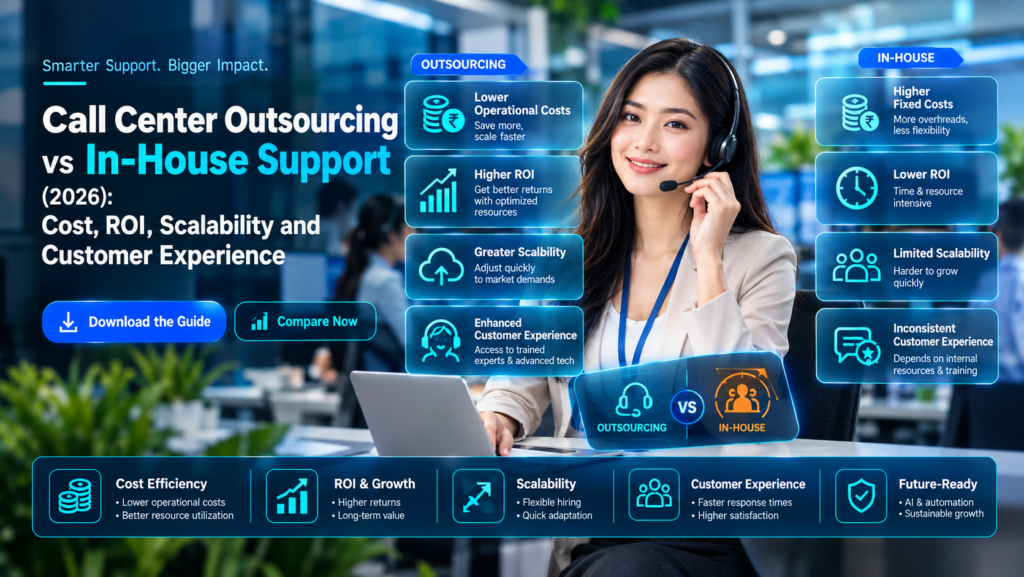
Why This Decision Is Harder Than It Looks in 2026
Most organisations approach the outsourcing-versus-in-house question as though it has a universal answer. It does not. And the companies that treat it as though it does — selecting one model primarily on cost grounds or competitive convention — tend to be the same companies revisiting the decision eighteen months later at significant cost.
What makes the question genuinely difficult is that both models have improved substantially. Running an in-house contact center in 2026 is not the same operational challenge it was in 2019. AI-assisted agents, workforce management platforms, and cloud-based telephony have reduced some of the traditional disadvantages of internal delivery. At the same time, the outsourcing market has changed too. The best providers are no longer simply cheaper labour — they bring specialised technology, quality frameworks and operational management that most buyers cannot economically replicate internally.
That means the comparison requires more analytical discipline than most leaders apply to it. The difference between the right decision and the wrong one can be measured in millions of dollars of operational spend over a contract period, and in customer retention rates that compound quietly in the background long after the initial choice was made.
This article is a working framework for that decision. It covers total cost of ownership on both sides, how to think about scalability, what customer experience data actually shows, how AI has altered the economics, and what risks each model carries that its advocates rarely volunteer.
One thing this article will not do is tell you outsourcing is always better. For some organisations, in a specific set of circumstances, building and operating internal support capability is the correct choice. Understanding which camp you are in — before you sign anything — is the purpose of what follows.
Defining the Models Clearly Before Comparing Them
Comparisons that conflate different variants of each model produce unreliable conclusions. Before evaluating cost, quality or risk, the specific model being compared needs to be clear.
In-house customer support means the organisation directly employs all agents, supervisors, trainers and quality analysts. It owns or leases the physical or virtual infrastructure, licenses the technology platforms, manages workforce scheduling, and bears the full cost of attrition, recruitment and training. Operational decisions are made internally. Management accountability is internal.
There are variants within in-house delivery. Some organisations run a single centralised team. Others operate regionally distributed teams to cover time zones. Some build sophisticated internal operations with dedicated QA functions, workforce optimisation tools and internal training academies. Others run a smaller, less structured operation where agents carry multiple responsibilities. These differences matter significantly when calculating cost and assessing capability.
Call center outsourcing means contracting a specialist third-party provider to manage customer interactions on the organisation’s behalf. The provider employs agents, manages operations, and typically provides the technology, infrastructure and management layer. The buyer defines service standards, products, processes and escalation policies, and measures the provider’s performance against agreed SLAs.
Outsourcing also has meaningful variants. A dedicated model means the buyer has exclusive use of a named team — agents work only on their account. A shared model means agents handle interactions for multiple clients, typically priced per interaction or per minute. Offshore outsourcing places the team in a lower-cost geography, most commonly India, the Philippines or Eastern Europe. Nearshore means a geographically closer country with lower cost than the domestic market. Onshore outsourcing uses a domestic provider but shifts the employment and management burden to a specialist operator.
The economics, the quality characteristics and the risks differ substantially across these variants. A comparison of offshore shared outsourcing against a highly structured domestic in-house operation is a very different analysis from comparing a nearshore dedicated model against a lean internal team at a growth-stage company.
This distinction matters throughout what follows. Where a point applies to all variants, that is stated. Where it applies specifically to one variant, that is specified.
The True Total Cost of In-House Customer Support
This is the section most cost analyses of this topic get wrong — not because the numbers are difficult, but because decision-makers consistently undercount what the in-house model actually costs.
The visible costs are straightforward: agent salaries, supervisor salaries, recruitment fees. Most leaders can produce those numbers quickly. The costs that consistently escape budget models are the ones listed below.
Labour costs: what is typically missed
Salaries are the starting point, not the total. Employer-side costs — payroll taxes, retirement contributions, health insurance, life insurance, paid leave accruals, statutory benefits — typically add between 25% and 40% to base salary costs in the United States, United Kingdom and Australia, depending on jurisdiction and benefit structure. A contact center agent earning USD 38,000 per year in the United States can cost the employer between USD 47,500 and USD 53,200 before a single operational cost is added.
Attrition compounds this further. Industry data from organisations tracking contact center operations consistently places annual agent attrition in the range of 30% to 45% for in-house operations in developed markets, with higher figures in high-volume or transactional environments. Every departing agent generates: recruitment cost (typically 50%–80% of one year’s salary when recruiter fees and time are included), onboarding cost, training cost, and a productivity deficit during the ramp period. At 40% attrition across a team of 50 agents, that is 20 replacement cycles per year. The cumulative cost is rarely modelled at the point of decision.
Supervision and management carry a ratio cost. Most well-run contact centers operate a supervisor-to-agent ratio of between 1:10 and 1:15. For a team of 50 agents, that represents four to five supervisors, plus a team leader layer, a QA analyst, and at minimum a partial allocation of an operations manager. These roles carry their own employer cost multipliers.
Technology: licensed, maintained and periodically replaced
An in-house contact center in 2026 requires, at minimum: a telephony or cloud contact center platform, a CRM or ticketing system, a workforce management tool, a quality monitoring system, and — increasingly — some form of AI-assisted agent support or self-service capability. Platform licensing costs vary considerably by vendor and scale, but a mid-sized in-house operation should budget between USD 80 and USD 200 per agent per month for a reasonable technology stack, before integration, customisation or professional services costs.
Enterprise platforms from vendors such as Genesys, NICE CXone, Five9 or Talkdesk carry significant implementation costs that are often treated as one-time capital events but recur during platform upgrades or migration. Zendesk, Salesforce Service Cloud and Freshdesk are common on the CRM and ticketing side, each with their own licensing and configuration cost structures.
Technology costs also include IT support for infrastructure, security tooling, and — for regulated industries — compliance-specific configurations that require specialist implementation.
Physical infrastructure or remote infrastructure
For organisations operating a physical site, premises cost, utilities, equipment, and fit-out are real expenditure lines. For remote operations, the cost profile shifts to device provisioning, secure access infrastructure, and the management overhead of a distributed workforce — which is not trivial for regulated industries with data handling requirements.
Training: initial and ongoing
Product knowledge, process knowledge, compliance requirements, and soft skills training represent significant cumulative investment. In complex product environments — financial services, healthcare, technology products — initial training periods of four to eight weeks are common before an agent is considered productive. That represents fully loaded salary cost with zero interaction revenue during the period. Ongoing training for product changes, regulatory updates and quality improvement is an indefinite recurring cost.
Quality assurance
A functioning QA programme requires dedicated analyst resource, call scoring methodology, feedback delivery, calibration sessions, and root-cause analysis. In a lean in-house operation, QA is frequently underfunded, which produces service quality problems that generate secondary costs: repeat contacts, escalations, complaints, and churn.
Capacity planning and overstaffing
Contact volume is rarely perfectly predictable. In-house operations must staff for peak demand or accept that they will miss service levels during high-volume periods. Staffing for peak means carrying idle capacity during troughs — a cost that does not appear on the salary line but is present in utilisation ratios and effective cost per interaction.
An Illustrative Total Cost of Ownership (TCO) Model
The following is an illustrative example only. Actual costs will vary significantly by geography, industry, team size, benefit structure, attrition rate, technology selection and operational model. This is not MasCallNet performance data. It is an analytical framework to help buyers build their own calculation.
| Cost Category | Illustrative Annual Cost (50-agent in-house team, USD) |
|---|---|
| Agent base salaries (50 × USD 38,000) | USD 1,900,000 |
| Employer-side benefits and taxes (30%) | USD 570,000 |
| Supervisors and team leads (5 × USD 55,000) | USD 275,000 |
| Supervisor benefits and taxes (30%) | USD 82,500 |
| QA analyst + operations manager allocation | USD 120,000 |
| Recruitment (40% attrition × 50 agents × USD 19,000) | USD 380,000 |
| Training (new hires + ongoing) | USD 90,000 |
| Technology platforms (USD 150/agent/month) | USD 90,000 |
| IT infrastructure and support allocation | USD 40,000 |
| Premises / remote infrastructure | USD 75,000 |
| Management overhead and HR allocation | USD 60,000 |
| Estimated Total Annual TCO | USD 3,682,500 |
| Effective cost per agent per year | USD 73,650 |
| Effective cost per agent per month | USD 6,137 |
Many organisations entering this comparison budget approximately USD 38,000 to USD 45,000 per agent per year. The actual loaded cost, once attrition, technology, infrastructure, management and training are accounted for, is typically 60%–90% higher than the base salary figure.
This gap is where outsourcing’s economic case is built. Not on cheap labour — on reducing the scope of what the buyer has to manage, own, staff and fund directly.
What Call Center Outsourcing Actually Costs
Outsourcing pricing is as easy to misread as in-house TCO — in the opposite direction. Headline rates appear attractively low. What they include and exclude determines whether the comparison is meaningful.
Common outsourcing pricing models
Dedicated agent model: The buyer contracts for a named team working exclusively on their account. Pricing is typically expressed per agent per month or per agent per year. This model provides predictability and capacity certainty. It suits operations with consistent volume and where brand familiarity across the team is important.
Shared agent model: Agents handle interactions for multiple clients, and the buyer pays per interaction, per minute or per ticket. This model suits lower or highly variable volumes where a dedicated team would be inefficient. Quality consistency can be harder to maintain, and the provider’s prioritisation decisions during peak periods are a genuine risk.
Per-interaction and per-ticket pricing: Common in digital support channels. Unit economics are clear, but cost can escalate rapidly if interaction volumes grow or if FCR is poor (generating repeat contacts).
Outcome-based pricing: Emerging model where pricing is tied to resolution rates, CSAT scores or other performance outcomes. Requires robust measurement infrastructure and clear definitions. Not yet standard across the industry.
What the headline rate typically includes
When a provider quotes a per-agent monthly rate, it generally includes: agent salary and benefits, supervision, floor management, basic training (onboarding), technology access, site infrastructure (for offshore/onshore delivery), and a baseline QA function. This is the bundle that replaces the largest cost categories in the in-house model.
What the headline rate typically excludes
Implementation and transition fees are commonly separate. Building knowledge bases, configuring technology integrations with the buyer’s CRM or ticketing system, setting up telephony routing, and training agents on the buyer’s product take time and skilled resource. Providers price this separately, and it can represent a significant upfront investment — particularly for complex product environments.
Management fees charged above the agent rate are common for dedicated programmes. These cover account management, reporting, analytics delivery and strategic review sessions.
Premium channel capabilities — video support, complex technical support, multilingual coverage, compliance-intensive environments — carry higher rates than standard voice or chat support.
Technology platform fees may or may not be included depending on whether the buyer brings their own platform or uses the provider’s. Buyers using platforms like Zendesk or Salesforce and expecting the provider to operate within those systems may incur integration, licensing allocation or customisation costs.
Minimum commitment thresholds are standard in dedicated models. A provider offering a dedicated team of ten agents will typically require a twelve-month minimum commitment. A buyer whose volumes fall below the minimum may still pay the full contracted rate.
Indicative offshore outsourcing rate ranges (2026)
These are market-directional ranges based on publicly available industry information. Actual rates depend heavily on provider scale, service complexity, technology requirements, minimum commitment and contract structure. Always validate with provider-specific proposals.
| Delivery Model | Indicative Monthly Rate Per Agent |
|---|---|
| Offshore — India (dedicated, voice) | USD 1,200 – USD 2,200 |
| Offshore — India (dedicated, digital/omnichannel) | USD 1,400 – USD 2,500 |
| Offshore — Philippines (dedicated, voice) | USD 1,400 – USD 2,400 |
| Nearshore — Eastern Europe (dedicated) | USD 2,000 – USD 3,500 |
| Onshore — United States (dedicated) | USD 3,500 – USD 6,500 |
| Shared model (per interaction, varies by channel) | USD 0.50 – USD 3.50 per interaction |
For detailed outsourced customer support pricing including geography-specific benchmarks, the outsourced customer support pricing guide covers United States, United Kingdom and Australia market rates with additional context.
Honest limitations of outsourcing cost comparisons
A provider quoting USD 1,500 per agent per month for offshore delivery is not delivering the same service profile as an in-house operation at USD 6,000 per agent per month. What varies: agent tenure and product depth, QA rigour, escalation latency, management continuity, and the buyer’s ability to influence day-to-day operational decisions. Whether those differences matter — and how much they matter — depends on the nature of the support being delivered. For straightforward transactional queries, they may matter very little. For complex financial or technical support, they can matter a great deal.
ROI Framework: How to Compare the Two Models Honestly
A simple cost comparison between outsourcing and in-house delivery misses the commercial picture. The ROI question requires tracking two simultaneous streams: cost reduction and revenue impact.
The cost stream
Calculate TCO for the in-house model using the methodology in Section 3. Build a realistic estimate for the outsourcing model using Section 4’s cost categories, including implementation fees, transition costs and ongoing management costs. The transition period — during which both models may be partially running — is a real cost that is frequently omitted.
The cost saving from outsourcing, where it exists, is not the headline rate differential. It is the difference between full in-house TCO and total outsourcing cost including all fees, integration work and transition investment, amortised across the contract period.
For a typical offshore dedicated model replacing an in-house US-based operation, industry practitioners generally cite cost savings in the range of 40%–60% of total operational expenditure over a three-year period, depending on operational complexity and technology requirements. These figures are directional, not guaranteed, and the range is wide enough to require case-specific modelling.
The revenue impact stream
Customer support directly influences customer retention, repeat purchase and referral behaviour. Research published by Bain & Company (a frequently cited reference in customer experience literature) suggests that a 5% increase in customer retention can increase profits by 25%–95%, depending on the industry. The mechanisms are compounding: a retained customer buys again, refers others, and does not generate the cost of re-acquisition.
An outsourcing relationship that reduces CSAT from 82% to 74% is not saving money. It is generating an invisible revenue leak that will not appear clearly on the P&L until the churn effect accumulates. Conversely, an outsourcing provider that improves FCR by 8 percentage points reduces repeat contacts, lowers cost per resolution, and reduces the friction that causes customers to leave.
A practical ROI calculation structure
Illustrative only. Not MasCallNet performance data. Assumptions must be replaced with organisation-specific figures.
Step 1: Calculate baseline in-house cost per interaction
Total in-house TCO ÷ Total annual interactions handled = In-house cost per interaction
Step 2: Calculate outsourcing cost per interaction
(Total annual outsourcing fees including implementation amortisation) ÷ Total annual interactions handled = Outsourcing cost per interaction
Step 3: Calculate gross cost saving
(In-house cost per interaction − Outsourcing cost per interaction) × Annual interaction volume = Annual gross cost saving
Step 4: Adjust for quality delta
If outsourcing improves CSAT by X points, estimate the retention impact.
If outsourcing reduces CSAT by X points, estimate the incremental churn cost.
Step 5: Calculate net ROI
Net annual saving = Gross cost saving ± Quality/retention adjustment − Transition and governance costs
Step 6: Payback period
Total transition investment ÷ Net monthly saving = Months to payback
This framework will not produce a precise answer — no framework can before actual implementation data is available. But it forces buyers to model the right variables rather than comparing headline rates to salary costs.
Scalability: Where the Difference Becomes Stark
Scalability is one of the genuinely unambiguous advantages of outsourcing in most operating scenarios. The reasons are structural, not rhetorical.
An in-house contact center scales through a series of sequential actions that each carry time and cost: identifying headcount need, recruiting candidates (typically four to eight weeks in competitive labour markets), training new agents (two to eight weeks depending on complexity), acquiring additional workspace or remote infrastructure, and adjusting technology licensing. Each of those steps has a minimum cost regardless of how many agents are being added. Adding five agents to a 30-person team is nearly as operationally expensive per head as the original build.
Reducing headcount is harder still. Employment law in most jurisdictions creates real constraints on rapid downscaling. A business that staffs for a seasonal peak and then needs to reduce by 30% faces redundancy costs, notice periods, and the risk that the agents it wants to keep are the ones most likely to find alternative employment during a period of uncertainty.
An outsourcing provider with a multi-client operation manages this problem at portfolio scale. Agents can be moved between accounts during demand troughs and added from a trained reserve pool during peaks. For the buyer, this translates to contractual flexibility — the ability to increase or decrease committed capacity with agreed notice periods (typically 30–90 days, depending on the model) rather than the multi-month operational cycle of internal recruitment and onboarding.
For growth-stage organisations — SaaS companies scaling to enterprise, eCommerce businesses managing seasonal demand, FinTech startups adding product lines — this scalability difference can be decisive. A company adding 1,000 customers per month cannot staff an internal contact center with the speed its growth requires. Outsourcing with an established provider collapses the time from volume increase to operational capacity.
The scaling advantage is not unlimited. Moving from 20 to 200 dedicated agents on a single outsourcing contract is a significant operational transition for any provider. Buyers at that scale should evaluate whether the provider has genuinely delivered programmes of comparable size, not just whether they claim the capacity. For practical guidance on scaling high-volume operations, the scale customer support for high monthly ticket volumes resource addresses the operational mechanics in detail.
Customer Experience: Which Model Performs Better?
This is where most outsourcing comparisons become dishonest — on both sides. Outsourcing advocates minimise the real CX risks. In-house advocates romanticise the quality of internal delivery without examining what their operations actually produce.
The honest answer is that neither model has a structural CX advantage. Quality is a function of operational management, not organisational form.
What in-house delivery does well
Internal agents who work exclusively on one product in one organisation, managed by leaders who understand the business deeply, typically develop product knowledge that external agents take months to match. For technically complex support — enterprise software, bespoke financial products, custom manufacturing solutions — that depth of knowledge genuinely reduces escalation rates and improves resolution quality.
Internal teams are also faster to absorb product changes. When an engineering team ships a new feature at 9pm, an in-house support leader can push an updated briefing and have agents trained by the following morning. For organisations where the product evolves rapidly and support knowledge is a source of competitive differentiation, that agility has real value.
Where in-house delivery underperforms
Many internal contact centers are, in practice, under-managed. QA programmes are underfunded. Coaching is inconsistent. Workforce scheduling is imprecise. Attrition is high precisely because the management quality and career development that retain good agents are not present. Senior leaders are often too distant from daily operations to recognise performance problems until they appear in customer complaints or churn data.
The comparison should not be between a well-managed in-house operation and a mediocre outsourcing partner. It should be between whatever the organisation is realistically capable of building and sustaining internally, versus what a focused specialist can deliver.
What outsourcing does well for CX
Mature outsourcing providers operate dedicated QA functions with structured sampling methodologies, calibrated scoring frameworks, and coaching programmes that most in-house operations do not match. Workforce management at scale is a core competency — not an overhead function. Agent attrition management, which is one of the most significant drivers of CX quality degradation, is an ongoing operational investment rather than a reactive HR activity.
Omnichannel delivery — covering voice, chat, email, social, and messaging platforms within a single interaction model — is technically and operationally complex. Specialist providers have invested in the platforms and operating models to manage this. Most in-house operations handle omnichannel imperfectly, prioritising one channel and underfunding others.
The real CX risks in outsourcing
Agent product knowledge ramp: Agents at an outsourcing provider do not know your product on day one. The quality of knowledge transfer during transition is the single largest determinant of early CX performance. A poorly managed transition produces a visible quality dip that customers notice and competitors can exploit. This is not a reason to avoid outsourcing — it is a reason to invest in the transition.
Management distance: When the people managing your customer interactions are employed by another company, in another building (or country), the feedback loop is slower. Problems that an internally located leader would detect in a daily floor walk take longer to surface through formal reporting. The governance model — how frequently performance is reviewed, how escalations are handled, how process changes are communicated — needs to be deliberately designed, not assumed.
Prioritisation in a shared model: In a shared agent environment, the provider’s commercial interest is to maximise utilisation across all clients. During peak periods, your customers may wait longer because agents are handling interactions for another client. This is a real operational reality that shared model pricing does not make explicit.
For SaaS companies evaluating customer support specifically, customer support outsourcing for SaaS covers the product-knowledge and CX management considerations in a technology company context.
Technology: The Factor That Changed Both Equations
Technology has fundamentally altered the economics and capability profile of both delivery models — and understanding how is necessary to make the comparison accurately in 2026.
AI in the contact center: what it actually does
AI-assisted agent support (agent copilot tools) work by surfacing relevant knowledge base content, suggested responses and process guidance during a live interaction. The practical effect is that agents with less product knowledge and shorter tenure can handle a wider range of queries accurately. This matters significantly for the outsourcing equation: it accelerates new agent ramp time and reduces the knowledge depth disadvantage that external teams carry.
AI-powered self-service — conversational IVR, chatbots, automated resolution flows — deflects interactions that would otherwise require a live agent. For straightforward, high-volume query types (order status, account balance, password reset, appointment booking), automation rates of 30%–60% are achievable in well-implemented deployments. The interactions that reach human agents are, on average, more complex — which changes the skill and training requirements for those agents.
The implications for cost comparison are significant. An outsourcing provider operating a well-implemented AI stack can deliver the same effective support capacity with fewer live agents, reducing the cost per interaction for routine queries while maintaining or improving resolution quality. An in-house operation that has not invested in similar tooling is carrying a structural cost disadvantage that salary comparisons do not capture.
Technology access as an outsourcing advantage
Building and maintaining a modern contact center technology stack internally requires significant expertise and ongoing investment. Platforms like Genesys, NICE CXone and Amazon Connect are not simple to implement or to optimise. AI integrations, quality monitoring analytics, and real-time dashboards require technical capability that most non-specialist organisations do not maintain.
Specialist outsourcing providers make this investment once and amortise it across their client portfolio. For individual buyers — particularly at the mid-market level — accessing equivalent technology capability through an outsourcing relationship is materially cheaper than building it independently.
Technology as an in-house advantage in specific contexts
For organisations that have already made substantial technology investments — proprietary CRM systems, custom knowledge bases, deeply integrated service platforms — there can be an argument for internal delivery where those integrations are too complex or too commercially sensitive to expose to a third party. In practice, this argument is often overstated. Mature outsourcing providers have experience integrating with most major enterprise platforms, and secure API-level integration is standard rather than exceptional.
The genuine technology advantage for in-house delivery is control. When you own the platform, you can change it, configure it and optimise it without a contract change request or a provider’s development prioritisation decision. For organisations that iterate rapidly on support processes, that control has operational value.
For a deeper understanding of how AI is changing the outsourcing model specifically, customer support outsourcing in 2026 examines the AI integration dimension in detail.
Risk: What Neither Model’s Advocates Tell You
Most content on this topic addresses risk superficially — a brief mention of data security for outsourcing, perhaps a note about attrition for in-house. This section is longer than most would make it, because risk is where decisions go wrong, and understanding failure modes before committing is the point.
Outsourcing risks that are real and frequently underestimated
Provider financial instability: Outsourcing providers, particularly at the mid-market level, are not immune to financial difficulty. A provider that enters financial distress mid-contract creates an acute operational crisis. Critical customer interactions, active accounts, and agent knowledge may be inaccessible or lost. Buyers evaluating providers should examine financial health — not just capability and pricing — as part of due diligence.
Key-person dependency: The quality of an outsourcing relationship often correlates heavily with specific individuals at the provider — the account manager, the operations lead, the QA manager. When those people leave, the continuity of operational quality can degrade. Buyers should understand who manages their account and what succession arrangements exist.
Contract drift: Over a multi-year contract, the operational reality gradually diverges from the contract terms. SLAs that were challenging become routine; providers optimise toward metrics that are measured and under-invest in dimensions that are not. Active governance — not passive reporting — is required to maintain performance standards over time.
Exit complexity: When an outsourcing relationship ends — whether by choice, contract expiry or provider failure — transitioning operations is time-consuming, costly and operationally risky. Agent knowledge, process documentation, recorded interactions, and operational data need to be transferred. The longer the relationship, the more embedded the provider becomes, and the harder the exit. This is rarely discussed in detail at the point of signing.
Data security and regulatory risk: Outsourcing does not transfer regulatory responsibility. If customer data is processed or stored insecurely by a provider, the buyer remains accountable to regulators. This is explicit under frameworks including GDPR (EU/UK), DPDPA (India), CCPA (California), and most financial services regulatory regimes. Due diligence on a provider’s security controls, certifications and subcontracting arrangements is mandatory in regulated industries — not optional.
In-house risks that are real and frequently minimised
The attrition spiral: High attrition is not just a cost problem — it is a quality problem. When 35%–45% of a contact center team is replaced each year, the average team tenure falls, product knowledge shallows, and the management layer spends an increasing proportion of its time on recruitment and onboarding rather than performance development. Left unaddressed, this creates a gradual quality decline that is invisible in aggregate metrics but visible to customers.
Technology stagnation: Internal technology decisions go through procurement cycles, budget approvals and IT prioritisation queues. In practice, many in-house contact centers operate on technology that is two or three generations behind what specialist providers deploy. The competitive disadvantage this creates in customer experience quality grows each year that the technology gap widens.
Hidden management cost: Running a contact center competes for management attention with the organisation’s core activities. For businesses where customer support is not the core product — a software company, a retailer, a financial institution — the operational management of a contact center requires leaders who understand workforce management, QA methodology, telephony operations, and customer experience design. These are specialised skills. Expecting a generalist operations leader to manage them alongside other responsibilities is how performance problems develop invisibly.
Regulatory non-compliance through neglect: Regulated industries — financial services, healthcare, insurance — face detailed requirements around call recording, disclosure, consent, data handling and complaints management. Internal operations that are not regularly audited against these requirements accumulate compliance risk that is not visible until a regulatory review, a complaint escalation, or an audit reveals the exposure.
The MasCallNet Support Delivery Decision Matrix
This framework was developed by MasCallNet as an analytical tool for organisations evaluating customer support delivery models. It is designed to be applied with organisation-specific inputs, not interpreted as a universal prescription. It does not replace detailed financial modelling or operational assessment.
The following matrix evaluates six business dimensions across both delivery models. For each dimension, the matrix indicates which model typically performs better, under what conditions, and what assumptions apply.
Dimension 1: Volume and Predictability
| Volume Profile | In-House | Outsourcing |
|---|---|---|
| Low volume, stable | ✓ Manageable internally | May not meet minimum commitments |
| High volume, stable | Viable but expensive to manage | ✓ Efficient at scale |
| Low volume, highly variable | At-risk of over/understaffing | ✓ Shared model absorbs volatility |
| High volume, highly variable | Requires expensive over-staffing | ✓ Contractual flex provisions |
| Rapid growth trajectory | Struggles with recruitment speed | ✓ Can scale with contracted notice |
Dimension 2: Service Complexity
| Complexity Level | In-House | Outsourcing |
|---|---|---|
| Simple, transactional (Tier 1) | Viable | ✓ Strong efficiency advantage |
| Moderate complexity (mixed Tier 1/2) | Viable | ✓ Competitive if provider is experienced |
| High complexity, specialised knowledge | ✓ Better knowledge retention | Viable with strong transition and governance |
| Technical product support (B2B/SaaS) | ✓ Often preferable for deep technical issues | ✓ Specialist technical providers available |
| Regulatory/compliance-sensitive | Viable with right controls | Viable with right controls and due diligence |
Dimension 3: Budget and Cost Structure
| Financial Situation | In-House | Outsourcing |
|---|---|---|
| Fixed budget ceiling | Risk of budget overrun during attrition peaks | ✓ Predictable cost under dedicated model |
| CAPEX preference (technology ownership) | ✓ Control over assets | Typically OPEX-based |
| OPEX preference (variable cost model) | Fixed cost structure difficult to vary | ✓ Natural fit |
| Cost reduction priority | High TCO when fully loaded | ✓ Typically 40%–60% lower at offshore delivery |
Dimension 4: Time to Operational Readiness
| Scenario | In-House | Outsourcing |
|---|---|---|
| Launch from zero | 3–6+ months (recruit, train, build infra) | 6–14 weeks (with experienced provider) |
| Add 20% capacity | 4–8 weeks | 2–6 weeks (dedicated); faster in shared model |
| Reduce 20% capacity | Complex; redundancy cost and risk | Contractual notice period |
| Enter new geography / time zone | Major investment | ✓ Immediate access via provider’s existing footprint |
Dimension 5: Technology and AI Capability
| Capability Required | In-House | Outsourcing |
|---|---|---|
| Basic telephony and ticketing | Achievable internally | Included in most provider packages |
| Omnichannel (voice, chat, email, social) | Complex and expensive to manage | ✓ Mature providers deliver as standard |
| AI-assisted agent tools | Requires investment and expertise | ✓ Advanced providers include or can integrate |
| Real-time analytics and reporting | Requires investment | ✓ Standard in enterprise providers |
| Custom integrations with proprietary systems | ✓ Direct control | Achievable via API; requires provider capability |
Dimension 6: Strategic Control
| Control Priority | In-House | Outsourcing |
|---|---|---|
| Day-to-day operational decisions | ✓ Direct control | Indirect; managed through governance |
| Rapid process change implementation | ✓ Fast | Depends on change management process |
| Brand voice and tone consistency | ✓ Easier to maintain internally | Achievable with investment in training and QA |
| Data sovereignty and processing location | ✓ Full control | Depends on provider structure and contract |
| Competitive sensitivity of interactions | ✓ No third-party exposure | Risk managed through NDA and access controls |
How to use this matrix:
Score each dimension based on your organisation’s actual situation. Count how many dimensions favour outsourcing versus in-house delivery. The model with more dimension-level advantages in your specific context is the model worth modelling in detail. No single dimension is automatically decisive — the pattern across all six indicates the direction of fit.
When Outsourcing Makes Business Sense — and When It Does Not
Outsourcing is likely to make strong business sense when:
- Interaction volumes require a team of ten or more agents and are growing
- 24/7 or extended-hours coverage is needed but difficult to staff internally
- Multiple channels require management simultaneously (voice, chat, email, social)
- The support function is consuming management attention disproportionate to its strategic value
- The organisation is entering a new market, geography or product line and needs rapid operational capacity
- Attrition management is creating sustained cost and quality pressure internally
- Technology investment required to remain competitive is difficult to fund or justify internally
- The internal operation has been consistently missing SLA targets despite management effort
- The cost structure of the in-house model is not sustainable at the current growth trajectory
- Speed to scale is a competitive priority
Outsourcing is unlikely to be the right choice when:
- Interaction volumes are low (fewer than five to eight agents) and stable, with no near-term growth expected
- The nature of support is highly proprietary and knowledge transfer to an external team carries genuine commercial or regulatory risk
- The business requires real-time operational control that a provider relationship cannot accommodate
- Regulatory requirements in the specific jurisdiction create constraints that eliminate viable outsourcing options
- The organisation has already made substantial technology and management investments that are working effectively
- The support function is genuinely a source of competitive differentiation that would be diluted by external delivery
That second list is shorter than the first for a practical reason: most organisations that believe they belong in it actually benefit from at least exploring what an outsourcing model would look like. The assumption that internal delivery is working well is more common than the evidence supports.
For organisations evaluating call center outsourcing for the first time, understanding the full scope of available service models is the starting point rather than the conclusion.
How to Evaluate a Call Center Outsourcing Partner
Most vendor evaluation frameworks focus on capabilities and pricing. The questions that actually determine whether an outsourcing relationship will perform well are operational, commercial and governance-related.
Capability and experience questions
Does the provider have demonstrable experience in your industry? Industry experience reduces ramp time significantly and reduces compliance risk in regulated sectors. Request specific examples of comparable programmes — not testimonials, but operational descriptions of complexity, volume, channels, and what was learned.
What technology platforms does the provider operate, and how do they integrate with your existing systems? A provider that is expert in platforms you do not use is less valuable than a provider with strong integration capability across the platforms you already operate.
What is the provider’s approach to agent training and knowledge management? Request the training methodology documentation. Ask how product knowledge is updated when your product changes. Ask how quickly a process change can be communicated and implemented across the agent team.
Operational questions
What is the provider’s agent attrition rate, specifically for dedicated programmes? Industry-wide attrition in the BPO sector varies, but well-managed providers with strong agent experience can operate at meaningfully lower attrition than the market average. High attrition in a dedicated programme means constant knowledge dilution.
What is the supervisor-to-agent ratio, and how are supervisors deployed? Supervision density is one of the clearest indicators of QA investment.
How is quality assurance structured? Request the QA framework, the scoring methodology, and the process for agent coaching following low-score interactions. Ask how often calibration sessions happen between the provider’s QA team and your team.
What is the escalation model? Understand exactly how complex or sensitive interactions are identified, escalated, and resolved. Understand what the provider can handle independently and what requires buyer involvement.
Commercial and governance questions
What are the exact contract terms for scaling up and scaling down? What notice periods apply? What minimum commitments are required? Are there penalties for volume shortfalls?
How are SLAs defined, and what happens when they are missed? Understand the remedy structure — credits, improvement plans, exit rights.
What is the governance model? How frequently are performance reviews held? Who attends from both sides? How are issues formally raised and tracked?
What are the exit provisions? How long would a transition take? What data, documentation and process knowledge would be transferred? Who bears the transition cost?
The questions providers hope you will not ask
What has gone wrong on programmes similar to ours, and how was it resolved? A provider that has only success stories to share either lacks experience or lacks transparency.
What would make our programme more difficult to manage than a typical client? This reveals how clearly the provider has assessed your requirements and whether they understand your complexity.
What happens to our account if your business is acquired, restructured or experiences financial difficulty? Exit and continuity provisions for provider-side events are frequently absent from standard contracts.
For companies comparing offshore delivery models specifically, the offshore vs onshore customer support outsourcing analysis covers the geographic dimension of provider selection in more depth.
Security, Compliance and Vendor Governance
Outsourcing a customer-facing function does not transfer regulatory accountability. This is a fundamental principle across virtually every relevant regulatory framework, and it is worth stating clearly because the misunderstanding causes real compliance failures.
Under GDPR and the UK GDPR, a regulated entity that shares personal data with an outsourcing provider remains a data controller. The provider is a data processor. The buyer bears responsibility for ensuring that the processor provides sufficient guarantees of compliance, evidenced through a Data Processing Agreement that meets the applicable requirements. A provider’s failure to protect data does not insulate the buyer from regulatory action.
The Digital Personal Data Protection Act (DPDPA) in India creates comparable obligations. Financial services regulators in major markets — the FCA in the UK, SEBI and RBI in India, ASIC in Australia, SEC/FINRA in the United States — have specific expectations around outsourcing governance, including requirements for due diligence, ongoing monitoring and the right to audit providers.
Security due diligence: what to examine
- Access controls: Who has access to customer data within the provider’s organisation? Is access role-restricted and logged?
- Data handling geography: Where is data stored and processed? Does this create cross-border transfer obligations?
- Security certifications: ISO 27001 certification provides a framework baseline; ask for current certification documentation and scope definition.
- Subcontracting: Does the provider use subcontractors for any functions? If so, are they subject to the same contractual data protection obligations?
- Incident response: What is the provider’s incident detection and notification process? How quickly are buyers notified of suspected breaches?
- Business continuity: What provisions exist for service continuity during systems failures, natural disasters or pandemic-level disruptions?
Governance requirements
An outsourcing contract for a regulated activity should include, at minimum: defined SLAs with remedy provisions, audit rights that allow the buyer or their representative to assess provider operations, data protection obligations aligned with applicable law, change management processes, escalation and complaints management procedures, and exit provisions that ensure continuity of service and data return.
The governance model post-contract is as important as the contract itself. Scheduled performance reviews, documented issue logs, structured escalation paths and regular calibration sessions between buyer and provider teams are the mechanisms through which outsourcing relationships perform sustainably over multi-year periods. Governance that is allowed to atrophy produces performance that gradually diverges from contractual standards.
India as an Outsourcing Destination in 2026
India has been the dominant offshore outsourcing destination for contact center services for over two decades. Understanding why — with precision, not convention — is useful for buyers making location decisions.
Labour market and talent depth
India produces approximately 1.5 million engineering graduates per year, alongside a large graduate population in commerce, business and humanities. English language proficiency, while variable by region, is a genuine structural advantage in customer-facing roles compared to most alternative offshore locations. The National Association of Software and Service Companies (NASSCOM) reports that India’s IT-BPM sector employs several million professionals, representing a talent pool with no close equivalent in a single country.
Cities including Bengaluru, Hyderabad, Pune, Chennai, Mumbai and the National Capital Region (Delhi-NCR) have established contact center operations with trained talent pipelines and operational infrastructure. Provider competition within these markets has driven management quality upward and created a labour market with significant expertise density.
Cost structure
Offshore delivery from India provides a substantial cost differential relative to domestic US, UK or Australian operations — typically in the range of 50%–70% lower total cost of delivery for comparable service scope. This differential is not simply a wage gap. It reflects lower total cost of facilities, infrastructure, and management in the Indian market relative to developed markets.
The differential has narrowed modestly over the past decade as Indian wages in the BPO sector have grown. It remains material and is not expected to close significantly within the current decade, particularly for the combination of English-language capability, operational maturity and scale available in India’s established delivery centres.
Process maturity and technology adoption
India’s BPO sector has invested substantially in operational frameworks, quality management methodologies and technology adoption. The sector’s exposure to global enterprise clients over multiple decades has produced a management culture that understands SLA governance, regulatory compliance requirements, and CX methodology at a level that newer offshore markets have not replicated.
AI adoption within India’s BPO sector is accelerating. Providers are investing in agent copilot tools, conversational AI, and analytics capabilities in response to both competitive pressure and client demand. The technology capability differential between the leading Indian BPO providers and their smaller global competitors has widened as this investment has concentrated in established players.
Limitations worth naming
India is not without outsourcing risk. Time zone overlap with US Pacific and US Mountain time zones is limited, which matters for organisations requiring real-time collaboration between buyer and provider teams during business hours. Cultural and accent considerations vary by region and by the agent populations providers recruit and train — buyers should listen to actual agent interactions, not simply accept provider assertions about language quality. And not all Indian BPO providers are equivalent. The quality differential between the top-tier providers and mid-market operators is significant and not always visible from a headline rates comparison.
For US companies specifically, why US companies are scaling AI customer support outsourcing to India provides a detailed strategic perspective on the India delivery model.
What a Transition Plan Should Actually Contain
The quality of the transition from in-house delivery to an outsourcing model — or from one provider to another — is one of the most significant predictors of long-term programme performance. It is also one of the most consistently underprepared elements of outsourcing decisions.
A credible transition plan should contain the following:
Knowledge transfer programme
This is not a document handover. It is a structured process through which operational knowledge — product details, process flows, system access, escalation paths, exception handling, edge cases — is transferred from the buyer’s operation to the provider’s team. The quality of this programme determines how quickly agents reach acceptable proficiency and how severe the quality dip during ramp is.
Effective knowledge transfer includes: documented process guides in the provider’s required format, live training sessions delivered by or with buyer subject-matter experts, shadowing periods where incoming agents observe live interactions before handling independently, and sign-off criteria that must be met before agents go live without supervision.
Parallel running period
Where volume and risk level permit, a period of parallel operation — where both the existing operation and the incoming provider handle interactions simultaneously — reduces transition risk. The buyer observes provider performance in live conditions before full cutover. This is not always commercially viable or operationally practical, but the option should be explicitly considered and the decision documented.
Technology integration and testing
All system integrations — telephony routing, CRM access, ticketing system access, quality monitoring tools, reporting dashboards — should be built, tested and validated before live interactions are handled by the provider. Integration failures discovered after go-live create customer-facing quality problems that are disproportionately difficult to resolve under operational pressure.
Performance monitoring framework for the ramp period
The first 90 days of a new outsourcing programme are operationally different from steady state. Performance expectations during ramp should reflect this — targets that would be appropriate in month 12 are not appropriate in week 2. A credible transition plan includes a ramp-period SLA framework that acknowledges the learning curve while establishing minimum performance floors and clear triggers for remedial action.
Exit provisions (even for a new relationship)
Every transition plan should include provisions for what happens if the relationship does not work. At what point would the buyer trigger an exit clause? How would the transition back be managed? Who retains what data, and in what format? Planning for exit at the start of a relationship is not pessimism — it is the commercial discipline that prevents exit becoming a crisis.
Executive Decision Checklist
The following checklist is designed for senior leaders finalising their delivery model evaluation. It is not a scoring tool — it is a structured set of questions that should have clear answers before a commitment is made.
Business case
- Have you calculated full in-house TCO (Section 3 methodology), not just salary costs?
- Have you modelled total outsourcing cost including implementation, transition and management fees?
- Have you modelled the quality impact on customer retention in both directions?
- Have you calculated payback period for transition investment?
- Have you identified the break-even interaction volume for each model?
Strategic fit
- Is customer support a genuine source of competitive differentiation that cannot be transferred to an external partner?
- Is the volume and growth trajectory compatible with the outsourcing model being considered?
- Does the organisation have the management capacity to govern an outsourcing relationship effectively?
- Are regulatory or data requirements compatible with the outsourcing model and the provider’s location?
Provider evaluation
- Have you evaluated at least three providers with demonstrable experience in your industry and at your volume?
- Have you spoken to references — not selected by the provider, but identified independently?
- Have you reviewed actual interaction recordings from comparable programmes?
- Have you assessed provider financial stability, not just capabilities and pricing?
- Have you reviewed the proposed contract for SLA remedies, audit rights, data provisions and exit terms?
Transition readiness
- Is there a detailed knowledge transfer plan with sign-off criteria?
- Are system integrations scoped, planned and resourced?
- Is there a ramp-period performance framework?
- Is there an exit plan?
- Does internal leadership have the bandwidth to manage transition actively?
Frequently Asked Questions
What is the primary financial advantage of call center outsourcing over in-house support?
The primary financial advantage is not simply lower wages — it is the elimination of the management, technology, infrastructure and attrition costs that inflate the true cost of internal delivery. When a full TCO comparison is performed (including employer taxes, recruitment, training, technology licensing, premises and management overhead), in-house costs for a developed-market operation typically run 60%–90% above base salary. Offshore outsourcing typically delivers at 30%–60% of that fully loaded cost, depending on model and geography.
Is call center outsourcing suitable for small businesses?
It depends on volume and growth trajectory. Most dedicated outsourcing models require a minimum commitment of at least five to ten agents, making them impractical for very small operations. Shared models and per-interaction pricing can serve smaller volumes, but quality consistency in shared models requires careful provider selection. For businesses growing toward significant interaction volumes, outsourcing often makes sense earlier than most founders expect.
How does outsourcing affect first contact resolution (FCR) rates?
The effect varies. Providers with well-structured knowledge management and strong QA programmes frequently match or exceed in-house FCR rates after the initial ramp period. During ramp, FCR typically dips before recovering. In-house operations with high attrition often have lower FCR than they report, because repeat contacts from the same customer are not always identified as repeats in imprecise measurement frameworks. Compare FCR on a consistent definition across both models.
What are the typical contract lengths for call center outsourcing?
Standard initial terms range from twelve months (shared or per-interaction models) to twenty-four or thirty-six months (dedicated models). Longer terms typically produce better pricing and greater provider investment in programme-specific training. Buyers should ensure that longer terms include meaningful performance remedies and structured exit rights rather than simply extending financial commitment.
How quickly can an outsourcing provider be operational?
For a new programme with a well-prepared buyer and an experienced provider, operational readiness typically takes six to fourteen weeks. This includes contracting, knowledge transfer, technology integration, training and go-live validation. Rushed transitions of four weeks or less carry significant quality risk. Buyers who need capacity within thirty days should be realistic about the quality profile they will receive.
Does outsourcing mean losing control of the customer experience?
It means changing the form of control, not losing it. Direct operational control is replaced by governance control — SLA management, performance review, QA access, and contractual remedies. Whether this governance model is sufficient depends on how well it is designed and how actively it is managed. Buyers who treat outsourcing as a set-and-forget arrangement lose effective control. Buyers who invest in active governance typically maintain high CX standards.
What happens to customer data when support is outsourced?
Customer data remains the buyer’s legal and regulatory responsibility. The provider processes it as a data processor under the buyer’s data controller instructions. A compliant outsourcing arrangement requires a Data Processing Agreement aligned with applicable regulation (GDPR, DPDPA, CCPA, or other applicable framework), explicit data handling and retention instructions, security controls commensurate with the sensitivity of the data, and audit rights that allow the buyer to verify compliance.
How do I manage service quality in an outsourced model?
Quality management in an outsourced model requires: a defined QA scoring framework agreed with the provider, a structured interaction sampling and scoring programme, regular calibration sessions between the provider’s QA team and the buyer’s quality standards, agent coaching and improvement processes with visible tracking, and performance review meetings with documented escalation paths. Quality management should be a contractual obligation with defined minimum standards, not a discretionary activity.
What are the most common reasons outsourcing relationships fail?
The most common failure modes are: insufficient knowledge transfer during transition (causing quality problems that damage the buyer’s confidence early), inadequate governance post-launch (allowing performance to drift without detection), misaligned expectations between buyer and provider (particularly around the complexity of the interaction type), provider-side attrition in key management roles, and contractual structures that do not provide effective remedies when performance standards are not met.
How does AI change the outsourcing cost calculation?
AI affects both sides of the equation. In-house operations that adopt AI-assisted agent tools, self-service automation and intelligent routing can reduce their per-interaction cost without increasing headcount. Outsourcing providers that have invested in similar capability pass this efficiency to buyers through higher automation rates and lower cost per resolved interaction. Buyers should evaluate prospective providers not only on current pricing but on their demonstrated AI capability and the integration options available for the buyer’s existing platforms.
Should a company outsource its entire contact center or just a portion?
A hybrid model — outsourcing specific channels, volume tiers or time-zone coverage while retaining strategic functions in-house — is a legitimate operational approach. Common hybrid models include: outsourcing overflow and after-hours volume while handling core business-hours contacts internally; outsourcing digital channels (chat, email) while retaining voice; or outsourcing Tier 1 contacts while handling complex Tier 2 and Tier 3 escalations internally. The governance complexity of a hybrid model is higher than a single-model approach and requires clear demarcation of responsibilities.
How should I evaluate an outsourcing provider’s cultural fit with my brand?
Beyond reviewing sample interactions, assess: how the provider trains agents on brand voice and tone; whether there is a dedicated training resource for your programme; how frequently brand guidelines are reinforced; how the provider handles interactions that fall outside scripted flows; and what happens when an agent’s response is inconsistent with your values. Ask for examples of how the provider has managed brand-sensitive situations for comparable clients. Cultural fit is transmitted through training, reinforced through QA, and sustained through governance — not through a provider’s marketing claims.
What KPIs should an outsourcing contract include?
Core KPIs for most contact center outsourcing contracts include: Service Level (percentage of contacts answered within a defined time threshold), Average Handle Time (AHT), First Contact Resolution (FCR), Customer Satisfaction Score (CSAT), Quality Score (from structured QA), Abandon Rate, Schedule Adherence, and Occupancy Rate. Regulated industries should add compliance-specific metrics. Performance against KPIs should be reviewed at defined intervals with documented consequences for sustained underperformance.
Can outsourcing work for complex technical support?
Yes, but it requires more investment in transition and knowledge management than transactional support. Specialist technical support providers — with agent profiles that include technical qualifications and experience with comparable product complexity — exist and can deliver high-quality technical support at offshore cost structures. The key is accurate complexity assessment at the point of provider selection and a transition plan that allows sufficient time for deep product knowledge development before agents handle live escalations.
Conclusion: The Decision Framework in Summary
The outsourcing-versus-in-house question does not have a universal answer, and any article or advisor that suggests it does is optimising for simplicity rather than accuracy.
What the evidence consistently supports is this: when organisations compare actual total cost of ownership rather than headline figures, the economic case for outsourcing — particularly offshore outsourcing for English-language support — is stronger than most in-house advocates acknowledge. When AI capability, scalability, technology access and 24/7 coverage requirements are added to the equation, the advantage of specialist delivery widens further in most operational contexts.
What the evidence also supports is that outsourcing creates real risks that require real management. The organisations that have poor outsourcing experiences are usually not the ones that chose the wrong model — they are the ones that chose the right model but underinvested in transition quality, governance, and provider relationship management.
The decision framework is not complicated, but it requires honesty about the current state of the internal operation (which most leaders underassess), a rigorous financial model that captures the full cost of both delivery paths (which most budget exercises do not), a provider evaluation process that goes beyond pricing and capability claims to operational depth and financial stability, and a governance model that is designed before the contract is signed rather than improvised after go-live.
For organisations at the point of serious evaluation, the next step is not selecting a provider. It is understanding your own operation clearly enough to specify what any provider would need to demonstrate in order to perform better than what you currently have — or to confirm that what you currently have, properly resourced, is the right answer.
MasCallNet provides contact center services and customer support outsourcing across multiple industries and delivery models. If you are at the evaluation stage and want to understand what a capable provider relationship could look like for your specific operation, we are ready for that conversation.
Is your current customer support model costing more than you think — or delivering less than it should?
If you are seriously evaluating your delivery options, the most useful next step is a structured conversation about your operation’s specific characteristics: volume, complexity, channels, growth trajectory, and what you need from a provider that you are not currently getting.
Contact the MasCallNet team to discuss your requirements — no generic pitch, no pressure. Just a clear conversation about whether and how an outsourcing model could work for your organisation.