
BPO vs In-House Customer Support (2026): Cost Comparison, ROI & Which Model Actually Drives Growth
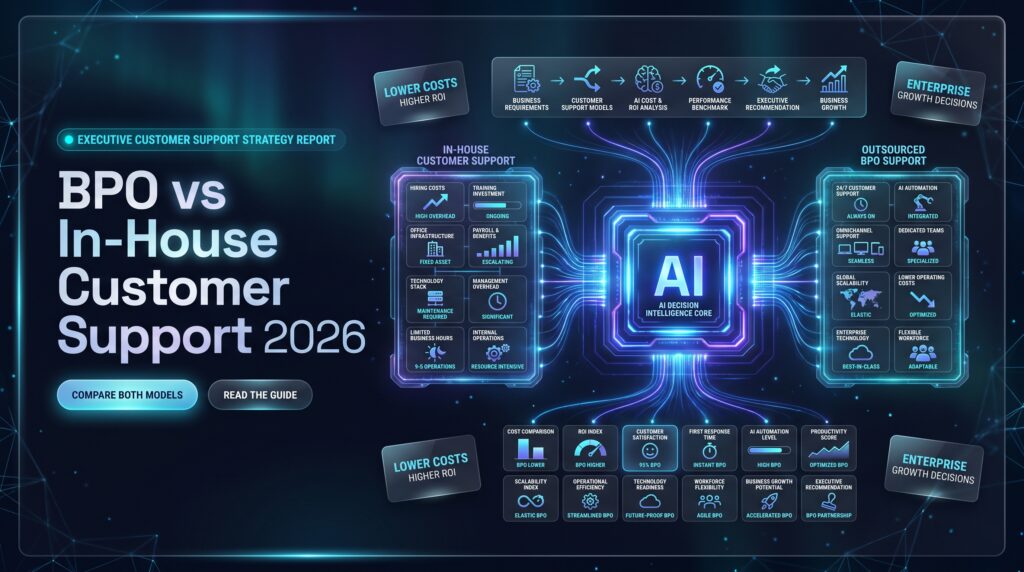
AI Overview Summary
Choosing between BPO and in-house customer support in 2026 is a revenue decision, not just a cost decision. Organizations that treat support as a driver of retention, upsell, and forecast accuracy — a philosophy we call Support-Led Revenue Growth™ — consistently outperform those that treat it as a back-office expense. AI-powered outsourcing partners, particularly the best BPO companies in India, now combine automation (via platforms like OpenAI, Google Gemini, and Claude) with trained human agents to deliver both lower cost per ticket and higher customer retention than either model alone.
Introduction
Every growing company eventually asks the same question in a leadership meeting:
“Should we keep building our support team internally, or is it time to bring in a partner?”
It sounds like an operational question. It isn’t.
It’s a revenue question.
Support interactions are where retention is won or lost, where upsell opportunities are created or missed, and where your brand’s promise is either kept or broken — thousands of times a day. This is the foundation of what we call Support-Led Revenue Growth™: the principle that customer support is not a cost line to minimize, but a revenue lever to manage deliberately.
This article is written for the people who actually make this decision — CEOs, COOs, CIOs, Heads of Customer Support, Revenue Leaders, and Procurement teams evaluating vendors. We’ll walk through real cost structures, a practical AI vs human customer support framework, offshore vs onshore economics, and the criteria that separate the best BPO companies in India from the rest.
No fluff. No generic “outsourcing saves money” advice. Just the numbers, the frameworks, and the operational realities we’ve seen play out across banking, healthcare, retail, telecom, and logistics support programs.
Key Insights at a Glance
- In-house support typically costs 40–70% more per resolved ticket once attrition, hiring, and infrastructure are fully accounted for.
- AI vs human customer support is a false binary — hybrid models consistently outperform either approach in isolation.
- Revenue leakage from slow, inconsistent support often exceeds the entire support budget itself.
- India remains the most mature market for AI-integrated BPO delivery, combining cost efficiency with technical depth.
- The companies winning in 2026 aren’t choosing “BPO or in-house” — they’re building a support architecture aligned to revenue outcomes.
The Market Reality in 2026
Customer expectations have shifted permanently. Buyers expect resolution in minutes, not days. A single bad support experience influences renewal decisions as much as product quality does — this is especially true in Banking and Financial Services, Insurance, Healthcare, and Telecommunications, where trust is the product.
At the same time, internal support teams are under pressure from two directions: rising wage costs in mature markets, and rising customer expectations for speed and personalization. Something has to give — and for most companies, that “something” is the operating model itself.
Why it matters: Support cost structures built five years ago were not designed for AI-augmented service delivery, omnichannel expectations, or 24/7 global coverage. Companies still running 2019-era support models are absorbing costs and losing customers they don’t have visibility into.
Boardroom insight: The companies gaining market share aren’t the ones with the cheapest support — they’re the ones whose support function is directly tied to retention and revenue metrics, and who’ve built the operational flexibility to scale it up or down without a six-month hiring cycle.
Industry Trends Shaping the Decision
Several forces are converging to make this decision more urgent than it was even two years ago:
- AI has moved from pilot to production. Platforms like Zendesk, Salesforce Service Cloud, and Freshdesk now ship native AI capabilities powered by models from OpenAI, Google Gemini, and Claude. Ticket triage, response drafting, and sentiment detection are no longer experimental — they’re table stakes.
- Compliance requirements have tightened. Healthcare (HIPAA), banking (PCI-DSS, RBI guidelines), and insurance regulators now expect documented data handling practices regardless of whether support is delivered in-house or outsourced.
- Customer support has become a retention metric leadership tracks. Boards are asking about churn attribution, not just CSAT scores. This is Support-Led Revenue Growth™ playing out in real boardrooms — support metrics are being reported alongside pipeline and revenue metrics, not separately from them.
- The offshore BPO market has matured technically. Best BPO companies in India are no longer positioned purely on labor cost — they’re differentiating on AI integration, industry specialization, and analytics maturity.
- Hybrid workforce models are now the default, not the exception, for companies scaling past their first 5,000 monthly tickets.
In-House vs. Outsourced Customer Support: The Real Definition
In-house customer support means the company owns hiring, training, technology, quality assurance, and infrastructure end-to-end. Every agent is a direct or contracted employee, and every tool — Zendesk, Salesforce, Genesys, Five9, NICE CXone — is licensed and managed internally.
Customer support outsourcing (BPO) means a specialized third party operates some or all of this function on your behalf, typically under an SLA-based contract, using their own workforce, infrastructure, and (in mature providers) their own AI tooling layered on top of your existing CRM or helpdesk stack.
| Dimension | In-House | Outsourced (BPO) |
| Cost structure | Fixed, high | Variable, lower |
| Hiring speed | 30–60 days | 1–3 weeks (existing bench) |
| 24/7 coverage | Expensive to build | Standard offering |
| AI integration | Requires internal investment | Often built-in |
| Compliance ownership | Fully internal | Shared, contractually defined |
| Scalability during spikes | Slow | Fast |
| Brand/product depth | High (native) | Requires ramp-up |
Executive interpretation: In-house isn’t wrong — it’s expensive and slow to scale. Outsourcing isn’t automatically cheaper — it’s operationally faster, but only pays off with the right governance and the right partner.
Why This Decision Actually Matters (Beyond Cost)
Most articles frame this as a cost-cutting exercise. That’s the least interesting part of the decision.
The more important question: does your current support model help or hurt your retention numbers?
Consider what actually happens inside a growing company:
What’s commonly assumed: “We’ll outsource once we can’t afford to hire more agents.”
What that misses: By the time cost becomes the trigger, churn has often already started rising quietly — because response times slipped months before the budget conversation happened.
What actually happens operationally: Support quality degrades gradually. Average handle time creeps up. First-contact resolution drops. None of this shows up on a P&L line item — it shows up three months later as a dip in renewal rates that gets attributed to “the market” or “the product,” not to support capacity.
The hidden cost: Revenue leakage from support degradation is rarely tracked as a support cost. It’s absorbed into churn, into customer success overtime, into discounting to retain accounts. It’s real money, and it’s invisible until someone builds a model to find it — which is exactly what we cover in the next section.
Our take: Don’t wait for a hiring freeze to force the outsourcing conversation. Build the cost and revenue model now, before the quality dip happens.
What leaders should do: Review FCR (first contact resolution) and AHT (average handle time) trends over the last two quarters — not just headcount and cost. If FCR is declining while ticket volume grows, you already have your answer.
The MasCallNet Revenue Leakage Model™
Definition: A diagnostic framework that quantifies the revenue lost to underperforming customer support operations — separate from and often larger than the visible cost of running the support function.
Methodology: Score six leakage sources on a 1–5 scale based on the last two quarters of data:
| Leakage Source | What to Measure | Score (1–5) |
| Response delay | Time to first response vs. SLA | |
| Resolution inconsistency | FCR variance across channels | |
| Escalation backlog | % tickets requiring 2+ escalations | |
| Billing/account errors | Tickets tied to preventable errors | |
| Automation gap | % of repetitive queries still manual | |
| Knowledge gaps | Agent reliance on ad-hoc answers vs. documented process |
Scoring logic: Total score above 20 out of 30 indicates high revenue leakage risk — meaning support inefficiency is likely already suppressing renewal or expansion revenue, even if it hasn’t shown up as an explicit line item yet.
Interpretation: Companies scoring above 20 typically discover, once they model it out, that revenue leakage exceeds their entire annual support budget by a factor of 2–4x.
Executive recommendation: Run this assessment before comparing vendor pricing. Fixing leakage often changes the entire business case for outsourcing — sometimes making it more urgent, sometimes revealing that a smaller, better-managed team solves the actual problem.
AI vs Human Customer Support: What the Data Actually Shows
This is the single most searched, and most misunderstood, question in this space.
Direct answer: AI and human agents are not competing for the same job. AI is fastest and cheapest at high-volume, low-complexity interactions. Humans remain essential for emotionally sensitive, high-stakes, or ambiguous cases. The businesses winning in 2026 aren’t choosing one — they’re routing intelligently between both.
Where AI Wins
- Order status, account balance, appointment confirmations
- FAQ-style queries and policy lookups
- Ticket categorization and routing
- Drafting first-response suggestions for agents
- After-hours coverage for simple requests
Platforms like Zendesk AI, Salesforce Einstein, and Freshdesk’s Freddy AI — often built on top of OpenAI, Google Gemini, or Claude models — now handle a meaningful share of Tier-1 volume automatically.
Where Humans Win
- Billing disputes and financial hardship conversations (Banking, Insurance)
- Clinical or medication-related questions (Healthcare)
- Complex technical troubleshooting (Telecom, Automotive/EV)
- Any interaction where the customer is frustrated or at risk of churning
The Hybrid Model
| Model | Cost Efficiency | Empathy | Scalability | Best Fit |
| AI-only | Highest | Low | Instant | High-volume, low-complexity |
| Human-only | Lowest | Highest | Slow | High-stakes, regulated interactions |
| Hybrid (AI + Human) | High | High | Fast | Most enterprise use cases |
Boardroom insight: The mistake most companies make isn’t choosing AI or human — it’s deploying AI without redesigning the escalation path. AI without a well-trained human safety net creates a worse experience than no AI at all, because customers hit a wall exactly when they’re already frustrated.
What we’ve observed: In every AI rollout we’ve supported, the deployments that succeeded had one thing in common — they mapped which 20% of ticket types absolutely required a human before they wrote a single line of automation logic. The ones that struggled tried to automate everything at once and had to walk it back within 90 days.
Common executive mistake: Treating AI deployment as an IT project instead of a customer experience redesign. The technology is rarely the failure point — the workflow design is.
What high performers do differently: They set a clear AI/human split target (for example, 60% AI-deflected Tier-1, 40% human-handled) and measure against it monthly, adjusting the routing logic as AI accuracy improves.
Practical recommendation: Start with agent-assist (AI supporting human agents) before jumping to fully autonomous AI resolution. It’s lower-risk, and it builds the training data you’ll need for higher automation later.
Key takeaway: The right question isn’t “AI or human” — it’s “what’s the right split for this ticket type, this industry, and this customer segment.”
Cost Comparison: In-House vs. Outsourced Customer Support (2026)
Here’s where most articles get vague. Let’s get specific.
In-House Cost Structure (US/UK Benchmark)
| Cost Component | Annual Cost per Agent |
| Base salary | $45,000 – $70,000 |
| Benefits & payroll tax | $8,000 – $15,000 |
| Recruitment | $3,000 – $6,000 |
| Training & onboarding | $2,000 – $4,000 |
| Supervision/QA allocation | $8,000 – $12,000 |
| Tools & infrastructure | $4,000 – $8,000 |
| Estimated total | $70,000 – $110,000 |
| Effective cost per ticket | $6 – $12 |
Offshore BPO Cost Structure (India Benchmark)
| Cost Component | Annual Cost per Agent |
| Fully loaded agent cost | $12,000 – $22,000 |
| Recruitment, training, QA | Typically included |
| Infrastructure | Typically included |
| Effective cost per ticket | $2 – $5 |
Typical realized savings: 30–55%, depending on complexity, language requirements, and AI integration level.
What most cost comparisons miss: The in-house number above almost never includes attrition replacement cost. If your in-house attrition runs 25–40% annually (common in support roles), you’re re-paying a portion of that recruitment and training cost every single year — something a stable offshore team absorbs internally.
Hidden cost: Ramp-up productivity loss. A newly hired in-house agent typically takes 60–90 days to reach full productivity. That gap is rarely modeled into cost comparisons but shows up directly in resolution quality during the ramp period.
The MasCallNet Total Cost of Support Calculator™
Definition: A simple formula to calculate the true annual cost of a support function, in-house or outsourced.
Formula:
text
True Annual Cost = (FTE Count × Fully Loaded Cost per FTE)
+ Technology Stack Cost
+ QA & Supervision Overhead
+ (Attrition Rate × Replacement Cost per Hire)
Worked example — 20-agent in-house team:
- Base cost: 20 × $80,000 = $1,600,000
- Tech stack: $120,000
- QA/Supervision: $160,000
- Attrition (30% × $4,500 replacement cost × 6 hires): $27,000
- True annual cost: ≈ $1,907,000
Interpretation: Most internal budgets only capture the first line item. The true cost is often 15–20% higher than what’s presented to the board.
Executive recommendation: Run this calculation before any outsourcing RFP. It’s the only way to compare quotes on equal footing.
Offshore vs. Onshore Customer Support Outsourcing
| Factor | Offshore (India) | Onshore |
| Cost | 30–60% lower | High |
| Talent pool depth | Large, English-proficient | Competitive, limited |
| 24/7 coverage | Standard | Expensive to staff |
| AI/tech adoption | Advanced, fast-moving | Moderate |
| Time zone coverage | Excellent for follow-the-sun models | Limited |
| Cultural/language nuance | Requires deliberate training | Native by default |
Interpretation: Offshore outsourcing isn’t a downgrade — it’s a different operating model that requires more deliberate onboarding and QA design, in exchange for significantly better cost and scalability economics. Onshore still makes sense for extremely nuanced, high-touch enterprise accounts where language and cultural fluency are the differentiator itself.
Recommendation: For most mid-market and enterprise support volumes above 5,000 tickets/month, a well-governed offshore or hybrid model outperforms onshore-only on cost, speed, and coverage — provided the partner has demonstrated industry-specific experience.
Build vs. Buy: The Strategic Lens
| Dimension | Build (In-House) | Buy (BPO Partner) |
| Time to operational | 2–4 months | 2–4 weeks |
| Capital intensity | High | Low |
| AI capability | Requires internal build | Often pre-built |
| Risk ownership | Fully internal | Shared via SLA |
| Flexibility to scale down | Difficult (layoffs, contracts) | Built into contract terms |
Boardroom insight: “Build” gives you ownership of a capability you may not need to own. Support delivery is rarely the differentiator customers choose you for — your product and your outcomes are. Owning the delivery infrastructure matters less than owning the customer relationship and the data from it.
Dedicated Team vs. Shared Team Model
| Factor | Dedicated Team | Shared Team |
| Cost | Higher | Lower |
| Brand/product depth | Deep | Moderate |
| Flexibility | Lower | Higher |
| Best for | Complex, high-value accounts | Standardized, high-volume support |
Recommendation: Use dedicated teams for your top-tier accounts or highly technical products; use shared/pooled teams for high-volume, repeatable Tier-1 support where cost efficiency matters most.
The MasCallNet Outsourcing Readiness Score™
Definition: A pre-decision scoring tool to determine whether an organization is operationally ready to outsource, and how much governance it will need.
Scoring criteria (1–5 each):
| Criteria | Score |
| Documented processes/SOPs exist | |
| CRM/helpdesk data is clean and structured | |
| Clear escalation matrix defined | |
| Compliance requirements documented | |
| Internal owner assigned for vendor governance |
Interpretation:
- 20–25: High readiness — proceed with confidence
- 12–19: Moderate — invest in documentation before transition
- Below 12: Low — fix internal process gaps first, or risk exporting chaos to a vendor
Executive recommendation: Never outsource an undocumented process. It doesn’t get fixed by a vendor — it gets scaled.
Vendor Evaluation: What Separates the Best BPO Companies in India
Not all outsourcing partners are equal, and pricing alone is a poor proxy for quality.
The MasCallNet Vendor Evaluation Matrix™
| Criteria | Weight | What to Look For |
| AI integration capability | 20% | Native support for AI-assisted ticketing, not just manual dialing |
| Industry specialization | 15% | Proven experience in your regulatory environment (banking, healthcare, etc.) |
| Compliance certifications | 15% | ISO 27001, SOC 2, PCI-DSS, HIPAA-readiness |
| Platform integration | 15% | Native support for Zendesk, Salesforce, Freshdesk, HubSpot |
| Analytics & reporting maturity | 15% | Real-time dashboards, not monthly PDF reports |
| Pricing transparency | 10% | Clear per-ticket or per-FTE breakdown, no hidden ramp fees |
| Scalability track record | 10% | Case studies showing rapid scale-up/down |
Scoring logic: Score each vendor 1–5 per criterion, multiply by weight. A score above 4.0/5.0 indicates a strategic-fit partner; below 3.0 signals a commodity vendor better suited for narrow, low-risk use cases only.
Executive recommendation: Request a live dashboard demo, not a sales deck, before signing. If a vendor can’t show real-time reporting in the sales process, they won’t have it in production either.
CX Maturity Scorecard™
Use this to benchmark where your organization currently sits:
| Level | Description | Typical Profile |
| 1 – Reactive | Support handles tickets as they come, no proactive metrics | Early-stage companies |
| 2 – Managed | KPIs tracked (CSAT, AHT) but not tied to revenue | Most mid-market companies |
| 3 – AI-Assisted | Automation deployed for Tier-1, agent-assist in place | Growth-stage companies |
| 4 – Intelligence-Driven | Support data feeds product and retention decisions | Mature enterprises |
| 5 – Revenue-Integrated | Support metrics reported alongside revenue metrics to the board | Category leaders |
Executive interpretation: Most companies we work with start at Level 2. The jump to Level 3 (AI-assisted) is where cost savings become visible. The jump to Level 4–5 is where Support-Led Revenue Growth™ actually shows up in retention and expansion numbers.
Scalability Framework
Direct answer: Scalability is the single most underrated variable in the build vs. buy decision.
| Scenario | In-House Response Time | BPO Response Time |
| Seasonal spike (Retail, Insurance renewal season) | 45–60 days to hire and train | 1–3 weeks with existing bench |
| New market launch (multilingual need) | Months to recruit language-specific talent | Often immediate via existing footprint |
| Sudden volume drop | Layoffs, severance costs | Contract flexibility |
What actually happens: Companies that rely purely on in-house teams for seasonal industries — retail during holiday peaks, insurance during renewal cycles, EV/automotive during launch windows — routinely either over-hire (wasting cost in the off-season) or under-hire (damaging CX during the peak). A hybrid model with an outsourcing partner absorbs the variable portion of that demand curve.
Industry Benchmarks (2026)
| Metric | Industry Average | High-Performing Organizations |
| First Contact Resolution (FCR) | 65–72% | 80%+ |
| Average Handle Time (AHT) | 8–10 minutes | 5–6 minutes (AI-assisted) |
| CSAT | 75–82% | 88%+ |
| Cost per ticket (in-house, US) | $6–$12 | N/A (structurally higher) |
| Cost per ticket (offshore BPO) | $2–$5 | $1.5–$3 (AI-optimized) |
| Attrition (support roles, in-house) | 25–40% | 12–18% (BPO with strong culture) |
(Benchmarks reflect commonly observed industry ranges across banking, retail, healthcare, and telecom support operations; actual results vary by business model and market.)
Case Study: AI-Powered Outsourcing in Digital Banking
Challenge
A digital banking platform processing 18,000+ support tickets a month was facing rising churn, SLA breaches during peak hours, and a support cost structure that was growing faster than its customer base.
Root Cause
The internal team had scaled headcount reactively — every volume spike triggered a hiring sprint, but training lag meant new agents were resolving fewer tickets correctly, driving up escalations and repeat contacts.
Solution
A transition to a hybrid AI-plus-offshore model: AI-based ticket classification and first-response drafting integrated directly into their existing Zendesk environment, with a trained offshore team handling escalations and complex account issues, operating on a 24/7 rotation.
Implementation
The rollout was staged over 10 weeks — starting with AI deflection on Tier-1 queries (balance checks, transaction status), followed by agent-assist tools for the human team, and a final phase integrating sentiment-based escalation routing.
Results (12 months)
- 42% reduction in overall support operating cost
- 24% improvement in first-contact resolution
- 3.8 percentage point reduction in support-attributed churn
- Estimated $4.2M in annual revenue protected through improved retention
Lessons Learned
The cost savings were real, but they weren’t the most important number. The churn reduction — directly tied to faster, more consistent resolution — represented a revenue impact roughly three times larger than the cost savings alone. This is Support-Led Revenue Growth™ in practice: the financial case for the right support model is rarely just about the expense line.
ROI Framework
A simple model for building your own business case:
text
Total ROI = Cost Savings + Revenue Recovery (from reduced churn) + Upsell Lift
÷ Total Investment in New Model
Illustrative example:
- Annual cost savings from outsourcing: $600,000
- Revenue recovered from 2% churn reduction (on a $50M revenue base): $1,000,000
- Additional upsell revenue from faster resolution and better CX: $300,000
- Total investment (transition, tooling, governance): $250,000
ROI = ($600K + $1M + $300K) / $250K ≈ 7.6x
Executive interpretation: Most companies build the business case around cost savings alone and dramatically understate the actual return. Revenue recovery is almost always the larger number — and it’s the one most executive teams forget to model until after the transition is complete.
Industry Use Cases
Banking and Financial Services — Transaction disputes, KYC support, fraud alert handling, and digital banking services onboarding, where speed and accuracy directly affect customer trust and regulatory exposure.
Healthcare — Patient appointment scheduling services, insurance verification, and HIPAA-compliant patient communication. See our detailed breakdown of healthcare BPO services for hospital and clinic-specific considerations, and patient appointment scheduling services for scheduling-specific workflows.
Retail and eCommerce — Order tracking, returns processing, and Shopify/WooCommerce-integrated support, with Stripe and PayPal transaction issue resolution during high-volume seasonal periods.
Insurance — Claims status inquiries, renewal support, and policy servicing, where FCR directly affects renewal likelihood.
Telecommunications — Technical troubleshooting and device support at high ticket volumes, where AI-based triage significantly reduces average handle time.
Automotive and EV — Post-purchase support, charging infrastructure queries (EV-specific), and service scheduling — a growing segment where support quality directly affects brand loyalty in a still-maturing category.
Logistics — Shipment tracking, delivery exception handling, and B2B account support requiring tight SLA adherence.
Technology Ecosystem
A modern support operation — whether in-house or outsourced — should integrate cleanly with the tools you already run:
CRM & Helpdesk: Zendesk, Salesforce, Freshdesk, HubSpot, Intercom, ServiceNow
Contact Center Infrastructure: Genesys, Five9, Talkdesk, NICE CXone
Cloud Infrastructure: Amazon Web Services, Microsoft Azure, Google Cloud
Internal Collaboration: Slack, Microsoft Teams
Commerce Integrations: Shopify, WooCommerce, Stripe, PayPal
AI Layer: OpenAI, Google Gemini, Claude, Copilot
A strong outsourcing partner should be able to plug into your existing stack rather than requiring you to migrate onto theirs — that alone is a useful filter when shortlisting vendors.
Security & Compliance
For regulated industries — Banking, Insurance, Healthcare, Aviation — compliance isn’t optional, and it doesn’t disappear when you outsource; it just needs to be contractually and operationally defined.
Look for:
- ISO 27001 certification
- SOC 2 Type II reporting
- PCI-DSS compliance (for payment-adjacent support)
- HIPAA-ready infrastructure and training (for healthcare)
- Role-based access controls and audit logging
- Data residency clarity, especially for cross-border banking and healthcare data
Executive action: Request the vendor’s most recent compliance audit report before contracting — not just a certification logo on their website.
The India Advantage
India’s position in the global outsourcing market has evolved well past labor-cost arbitrage. What separates the current generation of the best BPO companies in India is technical depth: AI integration into existing ticketing workflows, industry-specific process design, and analytics maturity that rivals in-house enterprise operations.
For businesses evaluating call center outsourcing or looking to outsource call center services at meaningful scale — beyond 10,000 monthly tickets — India offers a combination that’s difficult to replicate elsewhere: a large English-proficient talent pool, mature 24/7 delivery infrastructure, and increasingly, AI-first operating models built directly into day-one delivery.
If you’re scaling past that volume threshold, this breakdown on scaling customer support for 10,000+ monthly tickets walks through the specific operational adjustments that matter at that scale.
Explore our approach as an AI-powered BPO company in India, or review our BPO case studies from India for outcome-based detail.
Risk Analysis
Risks of staying fully in-house: Rising fixed costs as you scale, slower response to demand spikes, difficulty attracting AI/automation talent internally, and attrition-driven quality inconsistency.
Risks of outsourcing without governance: Data security misalignment, vendor lock-in without clear exit clauses, and quality drift if SLAs aren’t actively monitored (not just contractually defined).
Mitigation: Structure contracts with clear SLA penalties, quarterly business reviews, and a named internal owner accountable for vendor performance — treat the relationship as a managed partnership, not a handoff.
Future Trends (2026–2030)
- AI agents will handle a growing share of Tier-1 volume, but human escalation paths will become more sophisticated, not less important.
- Predictive analytics will shift support from reactive resolution to proactive churn prevention — flagging at-risk accounts before they contact support at all.
- Conversation intelligence will feed directly into product and pricing decisions, closing the loop between support data and business strategy.
- Support metrics will increasingly appear in board reporting alongside pipeline and revenue metrics — reinforcing Support-Led Revenue Growth™ as a standard executive lens, not a niche CX concept.
- Workforce models will continue shifting toward hybrid AI-plus-human delivery as the default, not the exception, across every industry covered in this article.
Executive Decision Tree
Start here:
- Is your monthly ticket volume above 8,000–10,000? → Outsourcing likely improves both cost and scalability.
- Is your current FCR declining while volume grows? → Investigate revenue leakage before comparing vendor pricing.
- Do you need 24/7 or multilingual coverage? → Offshore or hybrid model is almost always faster to deploy than in-house.
- Is your product highly technical or IP-sensitive with low ticket volume? → In-house or a dedicated BPO team may be the better fit.
- Is your internal process undocumented? → Fix that first, regardless of which model you choose.
Executive Checklist
Before making this decision, confirm:
- You’ve calculated the true cost of your current model (including attrition and ramp-up loss)
- You’ve run a revenue leakage assessment, not just a cost comparison
- You’ve scored your organization’s outsourcing readiness
- You’ve evaluated at least three vendors against a weighted scorecard, not just price
- You’ve defined your AI/human ticket-routing split by category
- You’ve confirmed compliance requirements are contractually addressed
- You’ve assigned an internal owner for ongoing vendor governance
Frequently Asked Questions
What is typical outsourced customer support pricing in India?
Fully loaded costs typically range from $8,000–$22,000 per agent annually, depending on skill level, language requirements, AI integration, and compliance needs. Cost per ticket generally falls between $2–$5.
Is AI replacing human customer support agents?
No. AI is absorbing high-volume, low-complexity interactions, which frees human agents to focus on complex, high-stakes conversations where empathy and judgment matter most. The two are complementary, not competing.
Is offshore customer support outsourcing secure?
Yes, when the partner holds relevant certifications (ISO 27001, SOC 2) and operates on secure cloud infrastructure (AWS, Azure, Google Cloud) with role-based access controls. Security should be verified through audit reports, not assumed.
How do I know if my business is ready to outsource?
Use a readiness assessment covering process documentation, data cleanliness, escalation clarity, and internal governance capacity — outsourcing an undocumented process typically scales the problem rather than solving it.
Which industries benefit most from customer support outsourcing?
Banking, insurance, healthcare, retail/eCommerce, telecom, automotive/EV, and logistics all see measurable benefit — particularly businesses with seasonal volume spikes or 24/7 coverage requirements.
What makes the best BPO companies in India different from commodity vendors?
AI integration depth, industry-specific process experience, real-time analytics, and transparent pricing — not just lower per-agent cost.
A Note Before You Decide
If you’ve read this far, you’re likely past the point of wondering whether to explore outsourcing, and closer to figuring out how to do it without disrupting the customer experience you’ve already built.
That’s exactly the conversation worth having before signing anything.
If you want a second set of eyes on your current cost structure or a readiness assessment specific to your ticket volume and industry, we’re happy to walk through it — no obligation, just a practical look at what the numbers actually show for your business.
Conclusion
The BPO vs. in-house debate, framed purely as a cost question, misses the point. The businesses pulling ahead in 2026 aren’t the ones who found the cheapest agents — they’re the ones who built a support architecture where every interaction is treated as an opportunity to protect and grow revenue, not just close a ticket.
Whether that means a fully in-house team, a hybrid AI-plus-offshore model, or a partnership with one of the best BPO companies in India depends on your ticket volume, your compliance environment, and how directly support touches your retention numbers. What shouldn’t depend on guesswork is the decision-making process itself — run the true cost calculation, assess your revenue leakage, score your readiness, and evaluate partners against more than a price sheet.
Support-Led Revenue Growth™ isn’t a slogan. It’s what happens when a company stops treating customer support as an expense to minimize and starts managing it as a lever to grow deliberately.