
AI-Powered Customer Support Outsourcing: Reduce Costs, Scale Faster & Improve CX in 2026
AI Overview
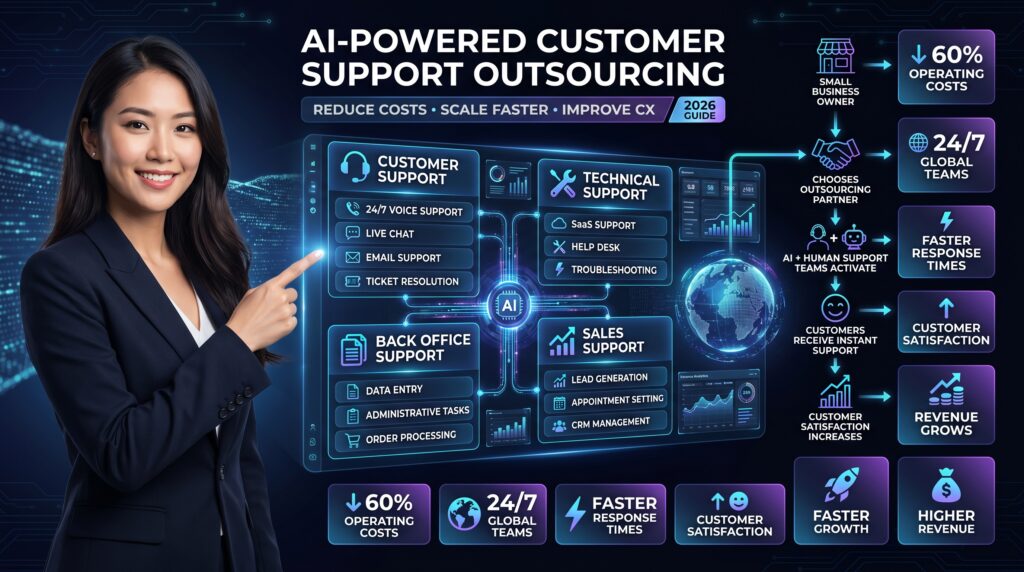
Customer support outsourcing has fundamentally shifted in 2026. Driven by the integration of Large Language Models (LLMs) and advanced agentic workflows, the focus is no longer solely on labor arbitrage. Modern organizations combine AI-powered automation, global talent pools, and specialized contact center services to deliver faster support, improve customer satisfaction (CSAT), and reduce operational expenses. The market is projected to reach $434.99 billion by the end of 2026, with the most successful models deploying a hybrid approach: AI handles routine interactions instantly, while complex, empathetic problem-solving escalates to human experts.
Introduction
For two decades, executives viewed outsourcing through a single lens: cost reduction. The traditional playbook was simple—you moved seats to a lower-cost geography, tolerated a slight dip in quality, and accepted the trade-off to protect your margins.
That model is entirely obsolete.
In 2026, customer support outsourcing is no longer about renting offshore headcount. It is about deploying Contact Center Intelligence™. We are witnessing a strategic shift where support is transitioning from an unavoidable operational expense to a primary source of enterprise intelligence and revenue protection.
The integration of generative AI, natural language voice bots, and predictive analytics has raised the baseline of customer expectations. Today, the best customer support outsourcing companies do not just provide human agents. They architect fully managed hybrid ecosystems where AI handles 60-80% of Tier-1 volume instantaneously, allowing highly trained human operators to focus exclusively on complex resolutions, empathy, and revenue recovery.
If your current support strategy relies solely on adding more human agents as your ticket volume grows, your unit economics will inevitably break. This guide provides the definitive roadmap for enterprise leaders to evaluate, structure, and execute an AI-augmented offshore strategy that scales flawlessly.
Market Reality: The Human + AI Paradigm
There is a pervasive myth in modern boardrooms that AI will entirely replace outsourced call centers. The assumption is that conversational AI will reach a point of absolute autonomy, eliminating the need for human agents altogether.
The operational reality, however, is radically different.
While AI is incredibly effective at deflecting routine inquiries—password resets, order tracking, and basic troubleshooting—it acts as a powerful filter. The inquiries that do bypass the AI and reach a human agent today are significantly more complex, emotionally charged, and critical to brand retention than they were five years ago. Companies that aggressively fire their BPO partners to rely solely on automated chatbots are experiencing massive VIP customer churn due to what we call “escalation dead-ends.” When an LLM hallucinates or traps a user in an endless loop, the customer silently abandons the brand.
The objective for 2026 is not zero human touch; it is zero wasted human touch. AI handles the transactional, while humans handle the relational.
Identifying the Silent Cost: The MasCallNet Revenue Leakage Model™
To understand why the old model is breaking, we must look at where revenue is quietly disappearing. Our proprietary MasCallNet Revenue Leakage Model™ categorizes these financial losses into three operational failures common in legacy support centers:
- Abandonment Churn: Revenue permanently lost when high-intent customers abandon purchases or cancel services due to slow First Response Times (FRT > 2 minutes).
- Escalation Friction: The drop in Customer Lifetime Value (LTV) when users are forced to repeat their complex issues across multiple agents, channels, or AI bots.
- Missed Expansion: Unrecognized upsell and cross-sell opportunities that are bypassed during routine support interactions because agents are penalized for long handle times.
Transitioning to a highly optimized, AI-powered hybrid model directly plugs these leaks.
How It Works: Architecting Contact Center Intelligence™
Modern call center outsourcing relies on a continuous, self-optimizing workflow. We call this the MasCallNet Customer Intelligence Loop™—a framework where AI resolves standard tickets, humans handle edge cases, and the outcomes of both automatically update the enterprise knowledge base.
Here is how this operational flow functions in practice:
- Predictive Intent Recognition: Before the customer even finishes typing, the AI analyzes their account history, current web session, and past telemetry to predict the reason for contact.
- Agentic Triage & Resolution: Generative AI agents handle the inquiry via natural language. If the intent is transactional, the AI executes the backend API call and resolves it instantly.
- Contextual Escalation: If the issue requires negotiation, deep empathy, or complex troubleshooting, the AI seamlessly routes the interaction to a qualified offshore human agent, summarizing the entire context to eliminate friction.
- Generative Agent Assist: While the human agent interacts, an AI copilot listens, surfacing relevant knowledge base articles and suggesting next-best actions.
The MasCallNet Contact Center Intelligence Layer™
Executing this loop requires breaking down data silos. BPO is no longer a standalone function; it must act as the central nervous system of your tech stack. Our MasCallNet Contact Center Intelligence Layer™ integrates the necessary technologies into one unified dashboard:
- CRM & Ticketing Core: Salesforce, Zendesk, Freshdesk, HubSpot, ServiceNow.
- Cloud Infrastructure: Amazon Web Services (AWS), Google Cloud, Microsoft Azure.
- CCaaS Providers: Intercom, Genesys, Five9, Talkdesk, NICE CXone.
- AI Models & Processing: OpenAI, Google Gemini, Claude, Microsoft Copilot.
- Commerce & Payments: Shopify, WooCommerce, Stripe, PayPal.
- Internal Collaboration: Automated escalations via Slack and Microsoft Teams.
By effectively automating business processes across this comprehensive ecosystem, offshore agents can resolve complex issues instantly without ever switching tabs.
Business Impact: Redefining Outsourcing ROI
Why are leading US, UK, and Australian enterprises accelerating their shift to AI-augmented offshore models? The answer lies in combining operational elasticity with dramatic cost reduction.
In-house support teams carry a massive hidden burden: the cost of hiring, training, managing, and providing benefits to a fluctuating onshore workforce is a drain on agility. When a product launch or Black Friday event spikes volume by 400%, rigid in-house teams break. An AI-powered BPO provides instant, elastic scale.
The MasCallNet AI Efficiency Index™ & Industry Benchmarks
How do you know if your outsourcing deployment is actually performing? We benchmark our partners using the MasCallNet AI Efficiency Index™, measuring the ratio of AI cost-savings against human escalation quality.
| Metric | Traditional BPO (2022) | AI-Hybrid Intelligence (2026 Target) | MasCallNet Benchmark |
| Tier-1 Deflection Rate | 15% (Rule-based bots) | 65% – 80% (Generative Agents) | > 75% |
| First Response Time (FRT) | 4.5 Hours | < 2 Minutes | Instant |
| First Contact Resolution | 68% | 88% | 92% |
| Average Handle Time (AHT) | 12 Minutes | 4.5 Minutes | 3.8 Minutes |
| Agent Attrition Rate | 45% Annually | 15% Annually | < 12% |
If your current metrics align with the “Traditional BPO” column, your operational expenses are bloated by at least 40%.
The Support-to-Revenue ROI Formula
To formalize the business case for your executive board, we utilize the MasCallNet Revenue Acceleration Framework™. This shifts the conversation from cost-cutting to value creation. Use this proprietary equation to model your transition:
$$ ROI = \frac{(C_{in} – C_{out}) + (V_{ret} \times LTV) + R_{exp}}{C_{trans} + C_{out}} \times 100 $$
Where:
- $C_{in}$ = Current in-house operational cost (Headcount x Fully Loaded Onshore Salary)
- $C_{out}$ = Projected outsourced/hybrid operational cost (AI licensing + Offshore blended rates)
- $V_{ret}$ = Volume of customers retained due to improved CSAT (prevented churn)
- $LTV$ = Customer Lifetime Value
- $R_{exp}$ = Expansion revenue generated via support-led upsells
- $C_{trans}$ = One-time transition and integration cost
(Executive Action: If you need precise figures tailored to your volume, reach out to MasCallNet to run your data through our live financial models.)
Turning Support into a Profit Center
Support teams interact with your customers at their most critical moments. We leverage two specific operational models to monetize these interactions safely and effectively.
1. The MasCallNet CX Recovery Engine™
Stop treating complaints as liabilities; treat them as your highest-converting retention opportunities. Our CX Recovery Engine™ uses NLP to detect high churn risk in real-time. The ticket instantly bypasses standard queues and routes to a specialized offshore retention expert who utilizes pre-approved commercial leverage (discounts, extended trials) dynamically generated by their AI Copilot.
2. The MasCallNet Support-to-Revenue Framework™
This framework trains agents to pivot naturally from resolution to expansion. For instance, when a retail customer initiates a return, the AI instantly analyzes their purchase history, allowing the human agent to seamlessly offer a highly personalized exchange or cross-sell, protecting the initial revenue and driving cart expansion.
Evaluating the 2026 Global Landscape
Navigating the geographical and structural choices of outsourcing requires looking past hourly rates to assess total value realization.
In-House vs. AI-Powered Outsourced
| Dimension | In-House Support | AI-Powered Outsourced (Contact Center Intelligence™) |
| Fixed Costs | High (Facilities, HR, Benefits) | Low (Variable, usage-based OPEX) |
| Scalability | Slow (Months to hire/train) | Instant (AI scaling + elastic staffing) |
| Tech Access | Capital intensive (Build it yourself) | Immediate (Leverage BPO’s existing stack) |
Offshore vs. Nearshore vs. Onshore
When evaluating offshore vs onshore customer support outsourcing, your location strategy directly dictates your operating margins.
- Onshore (US/UK/AU): Highest cost ($25-$40/hr). Best suited for highly regulated, tier-3 local legal escalations.
- Nearshore (LATAM/Eastern Europe): Moderate cost ($15-$22/hr). Effective for synchronous voice support requiring bilingual capabilities.
- Offshore (India): Highest ROI ($8-$16/hr).
In 2026, the primary keyword for enterprise growth is access to technical talent. The best BPO companies in India dominate the AI-management landscape precisely because of the country’s massive engineering and IT-fluent talent pool. You are no longer offshoring just for cheap labor; you are offshoring to access teams capable of managing complex LLM integrations and advanced technical troubleshooting.
Industry Use Cases: Precision Engineering by Vertical
The application of AI-powered outsourcing must be highly specialized. A one-size-fits-all approach inevitably degrades the customer experience.
SaaS & Technology
Customer support outsourcing for SaaS requires deep product knowledge.
- Use Case: AI API-integrated chatbots instantly provision accounts and reset instances. Human offshore developers handle Tier 3 bug reproduction and Jira escalations.
Banking and Financial Services
Requires absolute data security and zero tolerance for AI hallucinations.
- Use Case: digital banking services utilize secure AI models for fraud alert verification, while specialized human agents handle complex loan processing exceptions and high-stakes dispute resolutions.
Retail, eCommerce, & FMCG
Defined by intense seasonality and massive volume spikes.
- Use Case: AI autonomously handles 90% of WISMO (Where is my order?) queries and returns processing. Human agents focus on VIP clienteling and complex logistics coordination.
(Additional optimized verticals include: Healthcare, Telecommunications, Automotive, EV, Aviation, and Insurance).
Case Study: Scaling Support for 10,000+ Monthly Tickets
The Challenge: A rapidly growing FinTech platform was drowning in 15,000 monthly tickets. Their onshore in-house team of 25 agents was overwhelmed, resulting in a disastrous 48-hour First Response Time (FRT) and a CSAT of 71%.
The Root Cause: Highly paid, onshore agents were spending 60% of their day manually answering routine password resets and transaction status inquiries rather than investigating critical fraud escalations.
The Solution:
- Implemented the MasCallNet Contact Center Intelligence Layer™.
- Deployed a custom Generative AI agent securely trained on the company’s internal knowledge base to instantly resolve Tier-1 intents.
- Migrated all complex workflow escalations to a dedicated offshore team of financial specialists in India.
Implementation: To guarantee zero data leakage or financial hallucinations, the AI was sandboxed for 14 days prior to full deployment. The entire transition was completed in 45 days.
The Results:
- AI Deflection Rate: 45% of total volume was resolved without human touch.
- First Response Time: Reduced from 48 hours to 1.5 minutes.
- CSAT: Increased to 92%.
- Cost Reduction: Operational expenditure dropped by 42%.
Pricing Analysis: What Does It Actually Cost?
Understanding outsourced customer support pricing requires shifting away from the traditional “per seat” model toward an outcome-based framework.
- Dedicated Hourly Model (Offshore India): $10 – $16 per hour, fully loaded. Best for high complexity and dedicated brand representation.
- Shared/Per-Minute Model: $0.75 – $1.20 per minute. Best for low volume, after-hours coverage.
- AI + Human Outcome-Based Model (The 2026 Standard): Base retainer for human experts plus micropayments ($0.50 – $1.50) per successful, fully automated AI resolution.
Be highly skeptical of vendors offering flat rates below $8/hour. They achieve these margins through destructive agent attrition rates, non-existent AI investment, and dangerous compromises on data security. The financial fallout of a data breach or a churned VIP customer far outweighs the illusion of short-term wage savings.
Executive Decision & Evaluation Frameworks
Before you sign a Master Services Agreement or outsource call center services, utilize these three MasCallNet frameworks to audit your internal readiness and evaluate potential partners.
1. The MasCallNet Outsourcing Readiness Score™
Assess your internal maturity. Can you extract clean CSV data of your last 10,000 tickets? Are your standard operating procedures digitally documented? Do you use a modern cloud CRM? If your internal data is chaotic, outsourcing will simply offshore your chaos. You must be digitally prepared to integrate AI.
2. The MasCallNet Vendor Evaluation Matrix™
Do not rely on marketing brochures. Score your potential partners aggressively on:
- AI Integration Maturity: Are they using custom, secure enterprise LLMs, or a public ChatGPT wrapper?
- Data Security: Do they actively maintain SOC 2 Type II, ISO 27001, HIPAA, and PCI DSS compliance?
- Commercial Flexibility: Will they offer pay-per-resolution pricing?
3. The MasCallNet Service Quality Index™
Moving forward, ensure your SLAs are modern. Measure vendors on Context Retention Rate (CRR) (the percentage of times a customer did not have to repeat themselves to a human after speaking to the AI) and Machine-Human Handoff Latency (target: < 3 seconds).
FAQs
What is the difference between traditional BPO and Contact Center Intelligence™?
Traditional BPO provides human labor to execute repetitive, manual processes. Contact Center Intelligence™ leverages AI, data analytics, and global technical talent to permanently solve issues, automate workflows, and extract predictive business insights from every customer conversation.
Will AI replace human customer support agents entirely?
No. AI is an incredibly efficient transactional filter, effortlessly resolving 60-80% of routine queries. Human agents are subsequently elevated to handle high-value, emotionally sensitive, and complex technical interactions where human empathy and judgment are irreplaceable.
Is it safe to share customer data with offshore BPOs?
Yes, provided the partner is rigorously vetted. Elite providers operate within secure remote infrastructure management (RIM) environments, utilizing biometric access controls, PII-redacted LLMs, and strict compliance frameworks (SOC 2, GDPR, HIPAA) that frequently exceed the security postures of typical in-house teams.
Conclusion
The mandate for enterprise leaders in 2026 is clear: you must optimize operational efficiency without sacrificing the premium customer experience your brand relies on. By transitioning to an AI-powered, offshore hybrid model, organizations are successfully cutting operational costs by up to 60%, unlocking instant 24/7 global scale, and fundamentally converting their support functions into proactive revenue drivers.
Stop merely scaling your headcount to meet demand. It is time to scale your intelligence.
Ready to evaluate the operational and financial impact for your organization?
If you are looking to audit your current support economics, transition away from a legacy BPO, or implement a flawless AI-augmented offshore strategy, we can help. Reach out to the team at MasCallNet today to request a custom Readiness Assessment and ROI analysis tailored to your specific ticket volume and tech stack. Let’s uncover exactly how much capital and growth you can unlock.