
FinTech Customer Support Outsourcing in 2026: AI-Powered 24/7 CX, Compliance & the Best BPO Partners in India
AI Overview
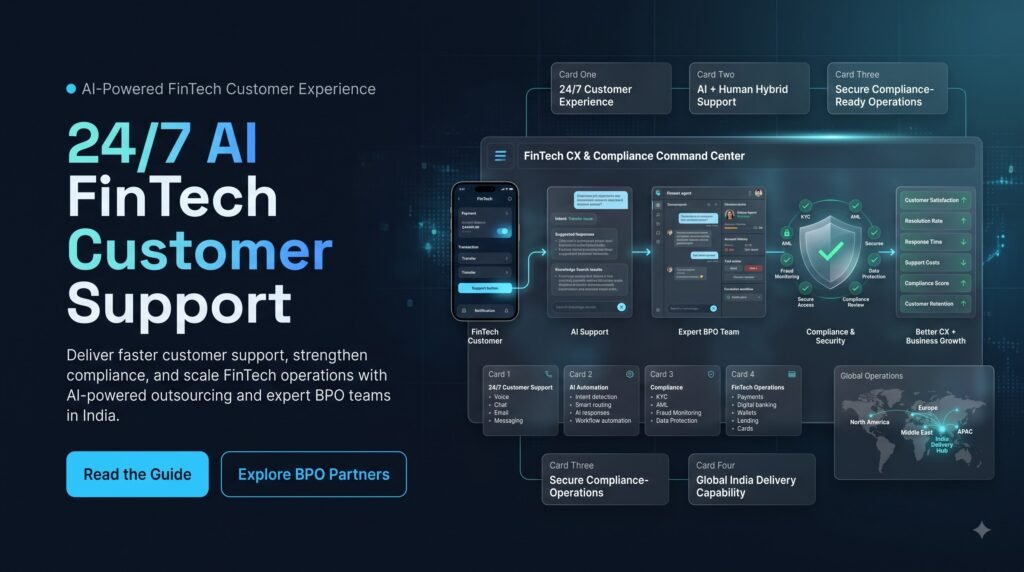
FinTech companies lose more revenue to poor customer support than to fraud, churn, or product gaps combined — most executives simply don’t measure it that way. In 2026, customer support outsourcing for banking, payments, lending, and insurance platforms has shifted from a cost-cutting decision to a revenue-protection strategy. Modern FinTech BPO partners deploy AI agents for high-volume, repeatable queries (balance checks, transaction status, password resets) while routing regulated, high-risk, and emotionally sensitive conversations — disputes, fraud alerts, loan defaults, KYC escalations — to trained human specialists. This hybrid model reduces cost per resolution by 40–60%, improves compliance accuracy under RBI, PCI-DSS, GDPR, and SOC 2 frameworks, and directly recovers revenue lost to failed transactions, abandoned onboarding, and preventable churn. This guide breaks down how AI vs. human support actually performs in FinTech, what the best BPO companies in India offer, real pricing benchmarks, compliance requirements, and a decision framework for evaluating outsourcing partners.
Executive Introduction
Every FinTech leader has had this conversation internally: “Our support costs are rising, our CSAT is flat, and we still don’t know why customers churn after a failed transaction.” That conversation happens in boardrooms across digital banks, lending platforms, payment gateways, and insurtech firms every quarter — and it rarely gets solved by hiring more agents.
The problem isn’t headcount. It’s architecture.
Most FinTech companies built their support function the same way they built their product — reactively, ticket by ticket, channel by channel — without ever designing it as a revenue system. That gap is exactly where the industry is repositioning itself in 2026. Customer support outsourcing is no longer viewed as an operational necessity to be minimized; it is being treated as a revenue recovery mechanism.
This is the thesis this guide is built on: Revenue Recovery Through CX™ — the principle that every unresolved query, every delayed dispute, every confusing onboarding call is not just a service failure, it is unrealized revenue. A failed UPI transaction that isn’t resolved within minutes doesn’t just frustrate a customer — it triggers app abandonment, negative reviews, and in aggregate, measurable revenue leakage that finance teams rarely trace back to the support desk.
We wrote this guide because most content on “FinTech customer support outsourcing” available today is either generic BPO marketing or superficial listicles ranking vendors by press releases. Neither helps a CFO evaluating a build-vs-outsource decision, or a Head of CX trying to justify AI investment to a board that still associates “outsourcing” with call quality complaints from a decade ago.
What follows is a practical, benchmarked, and unusually direct breakdown of how FinTech customer support outsourcing actually works in 2026 — including where AI genuinely outperforms human agents, where it doesn’t, what compliant outsourcing costs, and how to evaluate a partner without getting sold a demo instead of a solution.
Key Insights for Decision-Makers
- FinTech companies that route disputes and failed-transaction queries to AI-first, poorly escalated systems see 18–25% higher customer attrition in the 90 days following the incident compared to companies with hybrid AI-human escalation paths.
- Compliance-related support errors (incorrect KYC guidance, mishandled fraud reports) are the single largest source of regulatory exposure in outsourced FinTech support — more than data security incidents.
- Hybrid AI-human contact centers now resolve 65–75% of FinTech queries without human intervention, but the remaining 25–35% represents nearly 80% of total revenue risk.
- The average FinTech loses 1.5–3% of monthly transaction revenue to support-related churn and unresolved disputes — a figure most finance teams have never modeled.
- India remains the dominant delivery geography for FinTech BPO, driven by English proficiency, RBI-aligned data handling frameworks, and 40–60% cost advantage over onshore US/UK delivery.
The Market Reality in 2026
Direct Answer: The FinTech customer support outsourcing market has matured from cost arbitrage to an intelligence and compliance function, with AI adoption becoming table stakes rather than a differentiator.
Three years ago, “AI-powered support” was a marketing line. In 2026, it’s a baseline expectation — the differentiator has moved to how well AI and human agents work together under regulatory constraints that don’t tolerate error.
Global research firms have tracked this shift consistently. Gartner has noted that by 2026, a majority of customer service organizations will have embedded generative AI into agent workflows, not as a replacement for agents but as an assist layer. Deloitte’s outsourcing surveys have repeatedly found that financial services buyers now weight compliance capability and data governance as heavily as cost when selecting a BPO partner — a reversal from a decade ago when price led every RFP.
What this means practically: a FinTech company evaluating outsourcing today isn’t choosing between “cheap offshore support” and “expensive in-house support.” It’s choosing between vendors who have genuinely re-engineered their delivery model around AI-human orchestration and compliance-by-design, and vendors who have simply added a chatbot widget to a legacy call center operation and rebranded it as “AI-powered.”
That distinction is the single most important filter in this entire buying decision, and it’s the one most comparison content ignores entirely.
Industry Trends Shaping FinTech Support in 2026
Direct Answer: Five forces are reshaping FinTech support outsourcing: regulatory tightening, AI-agent maturity, real-time payment ecosystems, embedded finance growth, and rising customer expectations for instant resolution.
1. Regulatory tightening across markets
RBI’s outsourcing guidelines for regulated entities, the EU’s DORA framework, and expanding data localization rules mean FinTech support outsourcing now requires partners who understand regulatory obligations, not just service delivery. This is a direct extension of Revenue Recovery Through CX™ — a compliance failure in a support interaction doesn’t just risk a fine, it risks the customer relationship and, at scale, the license to operate.
2. AI agents move from FAQ bots to transaction-aware assistants
The AI layer in 2026 isn’t answering “what are your hours” — it’s checking transaction status via API, flagging suspicious activity patterns, and pre-filling dispute forms before a human agent even joins the conversation.
3. Real-time payments increase support urgency
UPI, RTP, and instant settlement rails have compressed customer patience. A payment issue that once tolerated a 24-hour resolution window now demands resolution within minutes — pushing FinTechs to outsource specifically for extended coverage rather than headcount economics alone.
4. Embedded finance multiplies support complexity
As non-financial platforms embed lending, insurance, and payments (retail, automotive, EV charging networks), the support conversation increasingly spans two domains — the platform experience and the financial product — requiring BPO partners with genuine cross-industry fluency across Banking, Insurance, Retail, and Automotive/EV ecosystems.
5. Customer intelligence becomes a boardroom metric
Forward-looking FinTech leaders are no longer asking support teams “how many tickets closed today.” They’re asking: what did today’s conversations tell us about product friction, fraud patterns, and churn risk? This is the foundation of what we call the Customer Intelligence Loop™ — every interaction becomes reusable business intelligence, not just a closed ticket.
What Is FinTech Customer Support Outsourcing?
Direct Answer: FinTech customer support outsourcing is the delegation of customer-facing service functions — including transaction support, dispute management, KYC assistance, fraud query handling, and technical troubleshooting — to a specialized third-party operator equipped with regulatory training, AI-assisted tooling, and financial services domain expertise.
Unlike generic BPO customer support, FinTech-specific outsourcing requires the partner to operate within:
- Regulatory boundaries (RBI, PCI-DSS, SOC 2, GDPR, DPDP Act)
- Real-time transaction systems (integration with core banking, payment gateways, ledgers)
- High-stakes emotional contexts (fraud reports, loan defaults, frozen accounts)
- Multi-channel, always-on demand (voice, chat, email, in-app, WhatsApp)
Framework: The Three Layers of FinTech Support Outsourcing
| Layer | Function | Example |
|---|---|---|
| Transactional Layer | High-volume, low-risk, repeatable queries | Balance inquiry, transaction status, statement requests |
| Resolution Layer | Medium-complexity issues requiring judgment | Failed payment investigation, refund processing, account updates |
| Trust Layer | High-risk, compliance-sensitive, emotionally charged | Fraud disputes, KYC rejection appeals, loan default conversations |
Executive Interpretation: Most outsourcing failures happen because companies outsource all three layers to the same undifferentiated team and process. High-performing programs apply different staffing models, escalation paths, and AI involvement to each layer — this is the core design principle behind effective customer support outsourcing for regulated industries.
Key Takeaway: FinTech support outsourcing isn’t one service — it’s three distinct operating models that must be architected separately and connected intelligently.
Why It Matters: The Revenue Case for Support Outsourcing
Direct Answer: Support quality in FinTech directly determines transaction completion rates, dispute resolution speed, and customer retention — making it a revenue function, not a cost center.
Here’s the calculation most finance teams never run: if a digital lending platform processes 50,000 support interactions a month and even 8% of those relate to failed disbursements, payment failures, or unclear rejection reasons, and 30% of those customers abandon the platform without resolution — that’s roughly 1,200 customers lost monthly to support friction alone, not product or pricing issues.
This is Revenue Recovery Through CX™ in practice: the support function is either recovering revenue that would otherwise be lost to friction, or it’s silently bleeding it. There is no neutral state.
Why It Matters — Executive Interpretation
For a CFO, this reframes support outsourcing budget conversations entirely. The question shifts from “how do we reduce support cost per ticket” to “how much revenue does our current support model fail to protect.” For a COO, it means support SLAs need to be tied to business outcomes (transaction completion, retention) rather than purely operational metrics (average handle time).
Boardroom Insight™: Most FinTech boards evaluate customer support as a line item under G&A. The companies pulling ahead evaluate it as a retention and revenue-protection function with its own P&L impact — and they staff, structure, and outsource accordingly.
Summary: Support isn’t just about resolving issues quickly — it’s about protecting revenue that’s already been earned but hasn’t been realized.
Key Takeaway: Every unresolved FinTech support interaction is a revenue event waiting to be recovered or lost.
How FinTech Support Outsourcing Actually Works
Direct Answer: A modern FinTech support outsourcing engagement combines AI-driven triage, tiered human escalation, real-time system integration, and continuous compliance monitoring — operating as a connected system rather than a call center.
The Operating Model
- Omnichannel intake — voice, chat, WhatsApp, email, and in-app queries converge into a unified queue (via platforms like Zendesk, Freshdesk, or Intercom integrated with contact center infrastructure such as Genesys, NICE CXone, or Five9).
- AI triage and classification — natural language models (built on infrastructure comparable to OpenAI, Google Gemini, or Claude) classify intent, urgency, and compliance sensitivity within seconds.
- Automated resolution for Layer 1 queries — balance checks, transaction status, document status — resolved without human involvement, typically in under 30 seconds.
- Agent-assist for Layer 2 queries — human agents handle the conversation, but AI surfaces relevant transaction data, policy guidance, and suggested responses in real time.
- Specialist escalation for Layer 3 queries — fraud, disputes, and compliance-sensitive cases route to trained specialists with authority to act, supported by conversation intelligence tools that flag regulatory risk.
- Post-interaction intelligence capture — every conversation feeds back into a structured intelligence layer, identifying product friction points, fraud patterns, and churn signals — the mechanism behind the Customer Intelligence Loop™.
Table: Query Routing Logic
| Query Type | Handled By | Target Resolution Time | Escalation Trigger |
|---|---|---|---|
| Balance/transaction status | AI Agent | < 30 seconds | None |
| Failed payment investigation | AI-assisted human agent | < 15 minutes | System error detected |
| Refund/chargeback request | Human agent + workflow automation | < 4 hours | Amount above threshold |
| Fraud report | Trained specialist | < 1 hour (acknowledgment) | Immediate, always human |
| KYC rejection appeal | Compliance-trained specialist | < 24 hours | Regulatory documentation required |
| Loan default conversation | Senior specialist | Case-by-case | Immediate, always human |
Executive Interpretation: The mistake most companies make is trying to automate their way through Layer 3. AI should accelerate human judgment in high-risk conversations, not replace it. This is a foundational principle within our AI-powered customer support outsourcing model.
Boardroom Insight™: The companies achieving the best cost-to-CX ratio aren’t the ones with the most automation — they’re the ones with the most precisely targeted automation.
Summary: Effective outsourcing isn’t AI or human — it’s AI and human, deployed according to risk and complexity, not convenience.
Key Takeaway: The architecture of query routing matters more than the technology stack behind it.
Benefits Beyond Cost Reduction
Direct Answer: Beyond the well-known 40–60% cost reduction, FinTech support outsourcing delivers 24/7 regulatory-aware coverage, faster fraud response, structured customer intelligence, and scalability during volume spikes without hiring cycles.
| Benefit | What It Actually Means |
|---|---|
| 24/7 coverage | Global customers, real-time payment rails, and fraud don’t operate on business hours — neither should support |
| Compliance depth | Specialized partners maintain trained compliance officers and audit trails your internal team may not have bandwidth to build |
| Scalability | Handle festive-season transaction spikes, product launches, or regulatory-driven volume surges without permanent headcount |
| Language and geographic coverage | Multilingual support across markets without building regional teams from scratch |
| Structured customer intelligence | Conversation data becomes a feedback loop into product, risk, and fraud teams |
| Faster time-to-resolution | Dedicated workforce management and AI-assist tooling typically outperform internal teams stretched across multiple priorities |
What High-Performing Organizations Do Differently: They don’t treat outsourcing as “handing off a problem.” They treat it as extending their operating model with a partner who has deeper specialization in support delivery than their internal team could ever build economically. The output they demand isn’t ticket closure — it’s structured insight reports that feed product and risk decisions.
Common Executive Mistake: Selecting an outsourcing partner primarily on cost-per-ticket pricing, then being surprised when compliance errors or brand-damaging interactions surface six months in. Price is a filter, not a decision criterion.
Business Impact Analysis
Direct Answer: Well-architected FinTech support outsourcing improves four measurable business outcomes simultaneously: cost structure, compliance posture, customer retention, and product intelligence — a combination that in-house teams rarely achieve at scale.
Impact Across the Organization
- Finance: 40–60% reduction in cost-per-resolution; predictable, volume-based pricing replaces unpredictable headcount costs.
- Compliance/Legal: Reduced regulatory exposure through standardized, auditable interaction handling.
- Product: Structured feedback loops surface friction points weeks or months before they show up in churn data.
- Risk/Fraud: Faster identification of fraud patterns through conversation intelligence, feeding directly into fraud model improvement.
- Revenue: Reduction in support-attributable churn — directly reinforcing Revenue Recovery Through CX™ as a measurable, board-reportable outcome.
MasCallNet Perspective: We’ve observed that FinTech companies who isolate support metrics from revenue and risk metrics consistently underinvest in the function — right up until a compliance incident or a churn spike forces a reactive overhaul. The companies who integrate support data into their monthly business review, alongside revenue and risk metrics, make better outsourcing decisions and see returns compound over time.
Executive Action: Before evaluating any outsourcing partner, map your current support interactions against the three layers above and identify where you are silently absorbing revenue loss.
What Most Companies Get Wrong About FinTech Support Outsourcing
What Everyone Says: “AI reduces support costs and improves response time.”
What Most Articles Miss: Cost reduction is the least interesting outcome of AI-powered support. The more important shift is that AI changes what human agents are for. In a mature model, human agents stop being the first line of defense against volume and become the last line of defense against risk — fraud, compliance, high-value relationship management. That reallocation is the actual transformation, not the cost line.
What Actually Happens: Most FinTech companies deploy AI to cut headcount before they’ve redesigned the escalation model. The result: AI absorbs simple queries, but complex, high-risk conversations still land on an under-resourced, under-trained human team — because the “savings” were used to shrink the team rather than upskill it. CSAT drops on exactly the interactions that matter most for retention and compliance.
Hidden Cost: The cost no one measures is specialist attrition. When AI absorbs routine queries, human agents are left handling only the hardest, most emotionally taxing conversations all day — fraud victims, angry customers, loan defaulters. Without redesigning workload, incentive structures, and support tooling, agent burnout and attrition in this segment increases, and specialist knowledge (the most valuable asset in the operation) walks out the door.
MasCallNet Perspective: We design AI-human ratios based on interaction risk, not just interaction volume. A support operation should be evaluated on how well it protects the 20% of conversations that carry 80% of the compliance and revenue risk — not on how much of the 80% “easy” volume it has automated.
Executive Action: Ask any outsourcing partner directly: “What happens to your specialist team’s workload when your AI automation rate increases?” Their answer reveals whether they’ve actually solved this problem or just moved it.
MasCallNet Revenue Leakage Model™
Definition: A diagnostic framework that quantifies the revenue a FinTech company loses due to unresolved or poorly handled customer support interactions, expressed as a percentage of monthly transaction revenue.
Methodology: The model tracks four leakage points — failed transaction abandonment, dispute resolution delay, onboarding drop-off post-support-contact, and churn following a negative support interaction — and assigns each a revenue-weighted value based on customer lifetime value and transaction frequency.
Formula:
Revenue Leakage Index (RLI) =
[(Abandoned Transactions × Avg. Transaction Value)
+ (Delayed Disputes × Avg. Dispute Value × Delay Multiplier)
+ (Post-Support Churn × Avg. Customer LTV)]
÷ Total Monthly Transaction Revenue × 100
Scoring Logic:
| RLI Score | Interpretation |
|---|---|
| Below 1% | Strong support-revenue alignment |
| 1–3% | Moderate leakage — optimization opportunity |
| 3–5% | Significant leakage — structural review needed |
| Above 5% | Critical — support function actively eroding growth |
Interpretation: Most FinTech companies we’ve assessed fall between 2–4% without ever having measured it — meaning a company processing ₹500 crore in monthly transaction volume could be losing ₹10–20 crore monthly to support-attributable revenue leakage.
Executive Recommendation: Calculate your RLI before your next outsourcing RFP. It reframes the entire vendor conversation from “cost per ticket” to “revenue protected per rupee spent” — a far more accurate way to evaluate ROI.
MasCallNet Outsourcing Readiness Score™
Definition: A structured self-assessment that determines whether a FinTech organization is operationally and structurally ready to outsource support functions effectively.
Methodology: Scored across five dimensions — process documentation maturity, data integration readiness, compliance clarity, escalation governance, and performance measurement infrastructure. Each dimension scored 1–5.
| Dimension | Score 1 (Not Ready) | Score 5 (Fully Ready) |
|---|---|---|
| Process documentation | Tribal knowledge only | Fully documented SOPs and decision trees |
| Data/API integration | No system access for external teams | Secure API access to core systems |
| Compliance clarity | Ad hoc compliance handling | Documented, auditable compliance protocols |
| Escalation governance | Undefined escalation paths | Clear, tiered escalation with ownership |
| Performance measurement | No structured reporting | Real-time dashboards and QBR cadence |
Scoring Logic: Total score out of 25. Below 12: internal readiness gaps should be addressed before outsourcing. 12–18: ready for a phased outsourcing pilot. Above 18: ready for full-scale outsourcing partnership.
Executive Recommendation: Organizations scoring below 12 that outsource anyway typically experience a rocky first 90 days — not because of the vendor, but because internal process gaps get exposed at scale. Fix documentation and escalation governance first; the vendor relationship will perform dramatically better.
MasCallNet Vendor Evaluation Matrix™
Direct Answer: Evaluate FinTech BPO vendors across six weighted criteria — compliance depth, AI-human integration maturity, industry specialization, technology stack compatibility, transparent pricing, and demonstrated case outcomes — rather than price alone.
| Evaluation Criteria | Weight | What to Ask |
|---|---|---|
| Compliance & Data Security | 25% | Do they have SOC 2, PCI-DSS certification, and RBI-aligned data handling experience? |
| AI-Human Integration Maturity | 20% | Can they show real automation rates and escalation logic, not just a chatbot demo? |
| FinTech/BFSI Specialization | 20% | Have they handled disputes, KYC, and fraud queries for regulated entities before? |
| Technology & Integration | 15% | Can they integrate with your existing CRM (Salesforce, Zendesk, HubSpot) and core banking/payment systems? |
| Pricing Transparency | 10% | Is pricing based on clear FTE/outcome models, or vague “per ticket” pricing with hidden add-ons? |
| Proven Outcomes | 10% | Can they provide anonymized case studies with measurable results? |
Executive Interpretation: Most FinTech RFPs weight pricing at 40–50%. Our data suggests this inversely correlates with long-term satisfaction — the companies happiest with their outsourcing partner three years later weighted compliance and specialization heavily upfront, even at a modest price premium.
Boardroom Insight™: The lowest-cost vendor is rarely the lowest total-cost vendor once compliance remediation, retraining, and churn from poor CX are factored in.
Review our own approach and track record via BPO case studies from India before shortlisting vendors — a useful benchmark regardless of which partner you ultimately select.
AI vs. Human Customer Support: The Real Comparison for FinTech
Direct Answer: AI customer support excels at speed, availability, and consistency for high-volume, low-risk queries, while human agents outperform AI in judgment-based, emotionally sensitive, and regulatory-critical conversations — meaning the highest-performing FinTech operations use both, deployed by risk tier, not by preference.
This is the most misunderstood decision in the entire industry. Vendors selling AI platforms will tell you automation solves everything. Traditional BPOs defending headcount-based pricing will tell you AI can’t be trusted with financial conversations. Both are incomplete.
Table: AI vs. Human vs. Hybrid Model™
| Dimension | AI-Only | Human-Only | Hybrid (Recommended) |
|---|---|---|---|
| Availability | 24/7, instant | Limited by shift coverage | 24/7 with human escalation |
| Cost per interaction | Lowest | Highest | Optimized — low for volume, higher for risk |
| Handling routine queries | Excellent | Adequate, inconsistent | Excellent |
| Handling fraud/disputes | Poor — lacks judgment and empathy | Strong | Strong — AI surfaces data, human decides |
| Regulatory compliance | Risky without human oversight | Strong if well-trained | Strongest — AI ensures consistency, human ensures judgment |
| Customer trust in high-stakes moments | Low | High | High |
| Scalability during volume spikes | Instant | Slow (hiring/training cycles) | Fast — AI absorbs spike, human capacity managed via BPO |
| Data/pattern intelligence | Strong (structured data) | Weak (unstructured, inconsistent notes) | Strongest — AI structures human conversations too |
Executive Interpretation: The real question isn’t “AI or human” — it’s “which 30% of our conversations require a human, and are we protecting that 30% properly while automating the other 70%?” Get that ratio wrong in either direction and you either overspend on headcount or under-protect your highest-risk customer moments.
Boardroom Insight™: Boards evaluating AI investment often ask “how much can we automate?” The better question is “which conversations are too risky to automate, and are we resourcing them properly?” This reframing changes budget allocation entirely — often toward better-trained human specialists, not away from them.
MasCallNet Perspective: We’ve found the highest-performing FinTech support operations automate 60–70% of volume but allocate 45–55% of their budget to the human specialist layer — because that’s where revenue and compliance risk concentrate. Businesses that instead allocate budget proportional to volume consistently under-invest in their most important conversations.
Summary: AI and human agents aren’t competitors in FinTech support — they’re specialists for entirely different risk categories.
Key Takeaway: The winning model isn’t AI replacing humans; it’s AI protecting humans’ time for the conversations that actually require them.
MasCallNet CX Maturity Scorecard™
Definition: A five-level maturity model assessing how strategically a FinTech organization operates its customer support function.
| Level | Name | Characteristics |
|---|---|---|
| 1 | Reactive | Support exists to close tickets; no data feedback loop; high manual effort |
| 2 | Structured | Documented SOPs, basic CRM, defined SLAs, still largely human-dependent |
| 3 | Automated | AI handles routine queries; hybrid escalation exists; measurable CSAT tracking |
| 4 | Integrated | Support data feeds product, risk, and fraud teams; cross-functional reporting |
| 5 | Intelligence-Led | Support is a strategic revenue and risk function; predictive analytics inform business decisions; full Customer Intelligence Loop™ operational |
Interpretation: Most FinTech companies we evaluate sit at Level 2 or 3. Very few reach Level 5 without a specialized outsourcing partner, because building Level 4–5 capability internally requires data science, workforce management, and compliance expertise that rarely exists in one internal team.
Executive Recommendation: Identify your current level honestly before selecting a technology stack or vendor. A Level 2 organization buying a Level 5 AI platform will underutilize it; a Level 4 organization outsourcing to a Level 2 BPO will regress.
MasCallNet Scalability Framework™
Direct Answer: FinTech support scalability should be planned around three triggers — seasonal transaction spikes, regulatory-driven volume surges, and geographic expansion — each requiring a different outsourcing response.
| Trigger | Typical Volume Increase | Recommended Response |
|---|---|---|
| Festive/seasonal spikes (e.g., tax season, festive shopping) | 30–80% | Flexible surge staffing via BPO, AI absorbing routine spike volume |
| Regulatory changes (new KYC norms, RBI circulars) | 20–50% short-term | Rapid specialist training, temporary compliance-trained surge team |
| Geographic/market expansion | Sustained 40%+ | Multilingual hybrid team build-out, phased over 60–90 days |
MasCallNet Perspective: Scalability isn’t just about adding agents — it’s about pre-building AI knowledge bases and escalation protocols before the spike happens, not during it. Companies that treat scalability reactively consistently see CSAT drop 15–20 points during volume surges; those who plan the AI knowledge layer in advance maintain near-flat performance.
Practical Recommendation: Before any product launch, marketing campaign, or regulatory change likely to affect support volume, run a scalability simulation with your outsourcing partner 30 days in advance — not the week before.
Benchmark Analysis & Industry Statistics
Direct Answer: Industry benchmarks for well-run FinTech customer support outsourcing in 2026 show 60–75% AI automation rates, sub-2-minute average response times on chat, and cost-per-resolution 40–60% lower than in-house US/UK delivery.
Industry Benchmark Table
| Metric | Industry Average (In-House, US/UK) | Outsourced Hybrid Model (India-Delivered) |
|---|---|---|
| Cost per resolution | $6–$9 | $2.50–$4 |
| First Contact Resolution (FCR) | 65–70% | 78–85% |
| Average Handle Time (AHT) | 8–10 minutes | 5–6 minutes |
| Chat response time | 3–5 minutes | Under 60 seconds (AI-assisted) |
| CSAT | 78–82% | 85–90% (hybrid model) |
| Compliance error rate | 2–4% | Under 1% (specialized BFSI teams) |
| Coverage | Business hours + limited weekend | True 24/7/365 |
Figures reflect general industry benchmarking patterns observed across FinTech BPO engagements and align directionally with published research from Deloitte’s Global Outsourcing Survey and Gartner customer service research. Actual results vary by transaction complexity, regulatory environment, and implementation quality.
Executive Interpretation: The FCR and compliance error rate gaps matter more than the cost gap. A cheaper support model that generates more repeat contacts or compliance errors erases its own savings within two to three quarters.
Case Study: A Digital Lending Platform’s Support Transformation
Challenge: A mid-sized digital lending platform processing roughly 40,000 loan applications monthly was experiencing a 22% drop-off rate in the post-approval, pre-disbursement window — customers who were approved but never completed disbursement. Internal analysis initially pointed to product friction.
Root Cause: A deeper review of support interaction logs (previously unanalyzed as a group) revealed that 60% of drop-off customers had contacted support during the disbursement window and received inconsistent, delayed, or incomplete answers about documentation status — largely because support agents lacked real-time visibility into the loan management system and were manually checking with back-office teams, creating multi-hour delays.
Solution: The platform outsourced disbursement-stage support to a hybrid AI-human model: an AI layer integrated directly with the loan management system to provide instant, accurate status updates, with human specialists handling document clarification and edge cases, all under a dedicated customer support outsourcing engagement structured around the disbursement journey specifically, rather than generic ticket queues.
Implementation: A 45-day phased rollout — API integration and knowledge base build in the first two weeks, a pilot with 15% of disbursement queries in weeks three and four, followed by full rollout with continuous monitoring and weekly calibration calls between the platform’s product team and the outsourcing partner’s operations lead.
Results:
- Disbursement-stage drop-off reduced from 22% to 9% within 90 days
- Average status-query resolution time reduced from 4.5 hours to 6 minutes
- Support-attributable revenue recovery estimated at 11–13% of previously lost disbursement value
- Compliance documentation completeness improved to 98%, reducing downstream audit flags
Lessons Learned: The original diagnosis (product friction) was wrong. The real issue was invisible support failure at a specific customer journey stage — a pattern that only surfaced once support data was analyzed as a structured business signal rather than a ticket log. This is the Revenue Recovery Through CX™ principle applied directly: the fix wasn’t a product redesign, it was rebuilding a support journey stage with the right AI-human architecture.
Pricing Analysis: What FinTech Support Outsourcing Actually Costs
Direct Answer: FinTech customer support outsourcing pricing in 2026 typically ranges from $1,800–$4,500 per agent per month for India-delivered hybrid AI-human support, or outcome-based pricing models charging $2.50–$5 per resolved interaction, depending on complexity, compliance requirements, and coverage hours.
Pricing Models Compared
| Pricing Model | How It Works | Best For |
|---|---|---|
| Per-FTE (Full-Time Equivalent) | Fixed monthly cost per dedicated agent | Predictable volume, dedicated team needs |
| Per-Resolution/Outcome-Based | Pay per successfully resolved interaction | Variable volume, results-focused buyers |
| Hybrid Retainer + Volume | Base retainer for infrastructure/AI + variable per-interaction cost | Most FinTech companies — balances predictability and flexibility |
| Dedicated vs. Shared Team | Dedicated: exclusive team for your brand; Shared: pooled team across clients | Dedicated for compliance-heavy, high-volume operations; Shared for early-stage or low-volume needs |
Indicative Monthly Cost Ranges (India-Delivered, Hybrid AI-Human)
| Team Size / Scope | Estimated Monthly Range |
|---|---|
| Small (5–10 agents, chat + email) | $9,000 – $22,000 |
| Mid-size (20–40 agents, omnichannel + AI layer) | $40,000 – $95,000 |
| Enterprise (75+ agents, dedicated compliance specialists, 24/7 voice+chat+email) | $150,000+ |
Executive Interpretation: Pricing should never be evaluated in isolation from the best customer support outsourcing companies‘s compliance certifications and AI maturity — the cheapest per-FTE quote often excludes AI tooling, compliance training, and quality assurance layers that get bundled as “add-ons” later.
MasCallNet Perspective: We recommend FinTech buyers request pricing broken down by layer (Transactional, Resolution, Trust) rather than a blended rate — it reveals whether a vendor has actually designed differentiated staffing, or is quoting a flat rate that will underperform on your highest-risk conversations.
Cost Calculator: Estimate Your Outsourcing Investment
Use this simplified framework to build a directional estimate before requesting formal vendor quotes.
Step 1: Estimate monthly interaction volume (across chat, email, voice, WhatsApp).
Step 2: Apply the expected AI automation rate (typically 60–70% for mature hybrid models) to determine AI-resolved vs. human-resolved volume.
Step 3: Apply blended cost rates:
Estimated Monthly Cost =
(AI-Resolved Interactions × $0.30–$0.60 per interaction)
+ (Human-Resolved Interactions × $2.50–$5 per interaction)
+ Compliance/QA overhead (typically 12–18% of total)
Worked Example:
A FinTech processing 60,000 monthly support interactions, with 65% AI automation:
- AI-resolved: 39,000 × $0.45 avg = $17,550
- Human-resolved: 21,000 × $3.75 avg = $78,750
- Subtotal: $96,300
- Compliance/QA overhead (15%): $14,445
- Estimated Monthly Total: ~$110,745
Executive Interpretation: Compare this estimate against your current in-house fully-loaded cost (salaries, benefits, tools, management overhead, attrition/hiring costs). Most FinTech companies find the outsourced hybrid model costs 40–55% less than an equivalent in-house build, while delivering broader coverage hours.
ROI Framework
Direct Answer: ROI for FinTech support outsourcing should be measured across four dimensions — direct cost savings, revenue recovered through improved resolution, compliance risk reduction, and productivity gains from freed internal resources — combined into a single 12-month payback view.
MasCallNet Revenue Acceleration Framework™
| ROI Component | How to Measure | Typical Range |
|---|---|---|
| Direct cost savings | (In-house fully-loaded cost) − (Outsourced cost) | 40–60% reduction |
| Revenue recovered | Reduction in Revenue Leakage Index × Monthly transaction revenue | 1–3% of monthly revenue |
| Compliance risk reduction | Reduction in error/incident rate × average incident remediation cost | Varies by regulatory exposure |
| Internal productivity gain | Hours freed for product/risk teams no longer firefighting support escalations | 10–20% capacity gain in affected teams |
Formula:
12-Month ROI (%) =
[(Cost Savings + Revenue Recovered + Risk Reduction Value) − Outsourcing Investment]
÷ Outsourcing Investment × 100
Executive Interpretation: Most FinTech companies underestimate ROI because they only calculate cost savings and ignore revenue recovery and risk reduction — the two components that typically represent 60–70% of total value in a well-run engagement.
Boardroom Insight™: If your ROI model for outsourcing only includes cost savings, you are structurally underselling the initiative to your own board — and setting the wrong expectations for what “success” looks like at renewal time.
Industry Use Cases
Direct Answer: FinTech support outsourcing applies differently across banking, insurance, payments, lending, and embedded finance — each with distinct compliance and conversation complexity profiles.
| Sector | Primary Support Use Cases | Key Compliance Consideration |
|---|---|---|
| Digital Banking | Account access, transaction disputes, card blocking, KYC updates | RBI guidelines, data localization |
| Insurance/Insurtech | Claims status, policy queries, renewal support | IRDAI guidelines, claims documentation accuracy |
| Lending/NBFC | Disbursement status, EMI queries, default/restructuring conversations | Fair collection practices, RBI lending norms |
| Payments/PayTech | Failed transaction resolution, refund tracking, merchant disputes | PCI-DSS, real-time settlement accuracy |
| Wealth/InvestTech | Portfolio queries, KYC, transaction confirmations | SEBI guidelines, suitability documentation |
| Embedded Finance (Retail, Automotive, EV) | Buy-now-pay-later support, EV financing queries, warranty-linked payment plans | Cross-industry compliance (financial + sector-specific) |
MasCallNet Perspective: The most complex — and most underserved — use case is embedded finance, where a customer’s support query crosses both the host platform (e.g., an EV charging network or e-commerce platform on Shopify/WooCommerce) and the embedded financial product. Few BPO providers are staffed to handle both domains fluently in a single conversation, which is where specialization becomes a genuine differentiator rather than a marketing claim.
Technology Ecosystem
Direct Answer: A modern FinTech support stack integrates CRM/helpdesk platforms, cloud infrastructure, AI/LLM layers, and communication channels into a single orchestrated system rather than siloed tools.
| Layer | Representative Technologies |
|---|---|
| CRM/Helpdesk | Zendesk, Salesforce, Freshdesk, HubSpot, ServiceNow |
| Contact Center Infrastructure | Genesys, NICE CXone, Five9, Talkdesk |
| Cloud Infrastructure | AWS, Google Cloud, Microsoft Azure |
| AI/LLM Layer | OpenAI, Google Gemini, Claude, Microsoft Copilot |
| Internal Collaboration | Slack, Microsoft Teams |
| Commerce/Payments Integration | Shopify, WooCommerce, Stripe, PayPal |
| Conversational Channels | Intercom, WhatsApp Business, in-app chat |
Executive Interpretation: Integration quality matters more than the specific tools chosen. A FinTech company using Zendesk with deep API integration into its core banking system will outperform a company using a “better” platform with shallow, manual integration. This is why our AI-powered BPO approach prioritizes integration architecture before tool selection in every engagement.
Security & Compliance
Direct Answer: FinTech support outsourcing must satisfy overlapping compliance regimes — RBI outsourcing guidelines, PCI-DSS for payment data, SOC 2 for data handling, GDPR/DPDP Act for personal data — and the outsourcing partner’s certifications should be verified independently, not taken from a sales deck.
Compliance Checklist for Vendor Evaluation
- SOC 2 Type II certification (data security and availability controls)
- PCI-DSS compliance for any team handling payment card data
- Documented RBI outsourcing guideline adherence for entities serving regulated Indian financial institutions
- GDPR/DPDP Act-compliant data handling for cross-border personal data
- Role-based access controls and audit logging on all customer data systems
- Documented incident response and breach notification protocols
- Regular third-party security audits (not just self-attestation)
- Employee background verification and compliance training records
What Most Articles Miss: Certifications are necessary but not sufficient. The real question is operational — does the vendor’s frontline agent actually follow the compliance protocol under real conversation pressure, or does the certification exist only at the policy-document level? This is validated through call monitoring, not through the certificate itself.
MasCallNet Perspective: We recommend requesting anonymized call/chat transcripts during vendor evaluation specifically for compliance-sensitive scenarios (a simulated fraud report, a KYC rejection appeal) to assess actual agent behavior, not just policy documentation.
The India Advantage & Best BPO Companies in India for FinTech Support
Direct Answer: India remains the leading delivery geography for FinTech customer support outsourcing due to a large English-proficient, technically skilled talent pool, cost advantages of 40–60% over onshore delivery, mature compliance frameworks, and time-zone coverage that enables genuine 24/7 operations without triple-shift onshore costs.
Why India
- Talent depth: India produces one of the largest pools of English-speaking graduates with financial services aptitude annually, supporting sustained scaling without quality dilution.
- Cost structure: Even accounting for wage inflation in tier-1 delivery hubs, India-delivered support remains 40–60% more cost-efficient than US/UK equivalents at comparable quality tiers.
- Regulatory alignment: Indian BPOs serving domestic and international BFSI clients have built deep familiarity with RBI, PCI-DSS, and international data protection frameworks simultaneously.
- Infrastructure maturity: Tier-2 delivery hubs like Noida, Gurugram, and Pune now offer enterprise-grade infrastructure and connectivity previously limited to metro centers, expanding capacity without proportional cost increases.
What to Look For in the Best BPO Companies in India
When evaluating the best BPO companies in India for FinTech support specifically (as opposed to generic customer service outsourcing), prioritize:
- Demonstrated BFSI/FinTech client experience — not just general retail or telecom support history
- AI-human hybrid delivery model with transparent automation metrics
- Compliance infrastructure specific to financial services, not general data privacy alone
- Dedicated (not shared) teams for compliance-sensitive interactions
- Transparent, layered pricing rather than blended per-ticket rates
- References and case studies from India-based FinTech engagements specifically — general BPO case studies don’t reflect financial services complexity
Our own call center operations in Noida were built specifically around this hybrid, compliance-first model for global BFSI and FinTech clients — combining tier-2 cost efficiency with tier-1 compliance rigor.
Boardroom Insight™: “Best BPO in India” rankings that don’t segment by industry specialization are close to useless for FinTech buyers — a company excellent at retail order support may be entirely unprepared for a KYC rejection appeal or a fraud dispute conversation.
Comparison Tables
In-House vs. Outsourced
| Factor | In-House | Outsourced |
|---|---|---|
| Setup time | 3–6 months to build | 4–8 weeks to launch |
| Cost structure | High fixed cost, hiring/attrition risk | Variable, scalable cost |
| Compliance expertise | Requires internal build | Available from day one with specialized partner |
| Coverage | Limited by internal shift capacity | True 24/7 achievable immediately |
| Talent access | Constrained to local hiring market | Access to broader specialized talent pool |
| Recommendation | Suitable for highly proprietary, low-volume, strategic account support | Suitable for scalable, compliance-structured, high-volume support — the majority of FinTech use cases |
Offshore vs. Onshore
| Factor | Onshore | Offshore (India) |
|---|---|---|
| Cost | Highest | 40–60% lower |
| Time zone coverage | Limited without shift premiums | Natural 24/7 coverage advantage |
| Cultural/language nuance (for domestic market) | Strongest | Requires strong training investment |
| Compliance familiarity (local regulations) | Native | Requires deliberate specialization |
| Recommendation | Consider for highly localized, relationship-driven premium segments | Recommended for scalable operational support, especially for global or digitally-native FinTechs |
Build vs. Buy
| Factor | Build (In-House AI/Support Stack) | Buy (Outsourced Partner with Existing Stack) |
|---|---|---|
| Time to value | 6–12+ months | 4–8 weeks |
| Capital investment | High upfront | Operational expense, lower upfront risk |
| Ongoing maintenance | Requires dedicated internal team | Managed by partner |
| Recommendation | Build only if support is a core differentiator tied to proprietary IP | Buy for most FinTech operational support needs |
Dedicated Team vs. Shared Team
| Factor | Dedicated Team | Shared Team |
|---|---|---|
| Brand/product knowledge depth | Deep, exclusive focus | Shallower, split across clients |
| Cost | Higher per agent | Lower per agent |
| Compliance-sensitive suitability | Strongly recommended | Not recommended for Trust Layer interactions |
| Recommendation | Use dedicated teams for Resolution and Trust layers | Shared teams acceptable only for low-risk, high-volume Transactional layer overflow |
Traditional BPO vs. Contact Center Intelligence™
| Factor | Traditional BPO | Contact Center Intelligence™ Model |
|---|---|---|
| Primary metric | Tickets closed, AHT | Revenue protected, risk reduced, intelligence generated |
| Data usage | Siloed within support | Fed into product, risk, and fraud functions |
| AI role | Basic chatbot deflection | Embedded across triage, agent-assist, and analytics |
| Reporting to leadership | Operational metrics only | Business impact metrics (RLI, ROI, compliance posture) |
| Recommendation | Adequate for non-regulated, low-complexity support | Required for FinTech, BFSI, and any regulated, revenue-sensitive support function |
Risk Analysis
Direct Answer: The primary risks in FinTech support outsourcing are compliance failure, data security exposure, over-automation of high-risk conversations, and vendor lock-in without performance transparency — each manageable through structured governance, not avoidance of outsourcing itself.
| Risk | Likelihood if Unmanaged | Mitigation |
|---|---|---|
| Compliance/regulatory violation | Medium-High | Independent audit of vendor protocols; simulated scenario testing |
| Data security breach | Medium | SOC 2/PCI-DSS verification; role-based access controls |
| Over-automation eroding trust | High | Enforce human escalation thresholds for Trust Layer interactions |
| Vendor lock-in / poor transparency | Medium | Contractual data portability clauses; regular independent performance audits |
| Agent attrition affecting quality | Medium | Evaluate vendor’s specialist retention rates, not just overall attrition |
| Cultural/brand misalignment | Low-Medium | Structured onboarding, brand voice training, pilot period before full rollout |
Common Executive Mistake: Treating the outsourcing contract signing as the end of the risk management process rather than the beginning. Ongoing governance — quarterly compliance audits, escalation path reviews, performance benchmarking — is where risk is actually managed.
Future Trends (2026–2028)
Direct Answer: The next phase of FinTech support outsourcing will be defined by predictive intervention (resolving issues before customers report them), voice AI reaching human-parity for routine financial conversations, and support data becoming a formal input into credit and fraud risk models.
- Predictive support intervention: AI systems increasingly flag likely failure points (a payment about to fail, a KYC document likely to be rejected) and trigger proactive outreach before the customer even contacts support — a direct extension of Revenue Recovery Through CX™ into prevention rather than reaction.
- Voice AI reaching practical parity for Tier 1 conversations: Natural, low-latency voice AI will handle a growing share of routine voice interactions, freeing human specialists further for Trust Layer conversations.
- Support data feeding risk models: Forward-looking FinTechs will formally feed structured support conversation data into fraud detection and credit risk models — completing the Customer Intelligence Loop™ at an enterprise data architecture level.
- Regulatory scrutiny of AI decision-making: Expect increased regulatory attention on AI involvement in financial customer interactions, requiring clear human-in-the-loop documentation for any AI-influenced decision affecting a customer’s financial standing.
- Consolidation among BPO providers lacking AI maturity: Providers who haven’t genuinely rebuilt their delivery model around AI-human orchestration will struggle to compete on both cost and compliance simultaneously, accelerating market consolidation toward specialized, technology-forward partners.
MasCallNet Perspective: The companies that win the next three years won’t be the ones with the most AI — they’ll be the ones who’ve built the clearest governance model for when AI acts alone and when it must defer to a human, documented well enough to satisfy both customers and regulators.
Executive Decision Tree: Should You Outsource FinTech Customer Support?
START: Are your support costs, compliance risk, or CX scores
causing measurable business impact?
│
├── NO → Continue monitoring; reassess quarterly using Revenue Leakage Model™
│
└── YES → Calculate your Outsourcing Readiness Score™
    │
    ├── Score below 12 → Fix internal documentation, escalation
    │   governance, and data access first, then reassess in 60-90 days
    │
    └── Score 12+ → Do you have BFSI-specific compliance requirements?
        │
        ├── YES → Prioritize vendors with proven FinTech/BFSI
        │   specialization and dedicated (not shared) teams for
        │   Trust Layer interactions
        │
        └── NO → Standard hybrid AI-human outsourcing model
            applicable; evaluate on Vendor Evaluation Matrix™
            │
            └── Run a 60-90 day pilot on one query layer
                (recommend starting with Transactional Layer)
                before full-scale rollout
Executive Checklist Before Signing an Outsourcing Contract
- Calculated your current Revenue Leakage Index across at least 90 days of support data
- Completed an honest Outsourcing Readiness Score assessment
- Verified vendor compliance certifications independently (not from sales materials alone)
- Requested layered pricing (Transactional / Resolution / Trust) rather than blended rates
- Reviewed anonymized transcripts or simulated scenarios for compliance-sensitive interactions
- Confirmed dedicated (not shared) staffing for fraud, disputes, and KYC escalations
- Defined clear escalation thresholds and ownership between AI, vendor agents, and internal team
- Established a reporting cadence tied to business metrics (revenue, compliance, retention), not just operational metrics
- Structured a phased pilot (60–90 days) before full-scale commitment
- Confirmed data portability and exit terms in the contract before signing
Frequently Asked Questions
1. What is FinTech customer support outsourcing?
It’s the practice of delegating customer service, dispute handling, KYC support, and compliance-sensitive interactions for financial technology platforms to a specialized external partner equipped with AI tools and regulatory training.
2. Is AI or human support better for FinTech customer service?
Neither is universally better. AI outperforms on speed, availability, and consistency for routine queries; humans outperform on judgment, empathy, and regulatory-sensitive decisions. The best-performing model combines both, routed by risk level.
3. What are the best BPO companies in India for FinTech support?
The best providers demonstrate proven BFSI/FinTech client experience, transparent AI-human hybrid delivery, verifiable compliance certifications (SOC 2, PCI-DSS), and dedicated staffing models for compliance-sensitive interactions — not just general customer service scale.
4. How much does FinTech customer support outsourcing cost?
Typical ranges fall between $1,800–$4,500 per agent per month for India-delivered hybrid support, or $2.50–$5 per resolved interaction under outcome-based pricing, depending on complexity and compliance requirements.
5. Can outsourced teams handle compliance-sensitive FinTech conversations?
Yes, when the partner has dedicated, specifically trained compliance specialists, documented protocols, and audit trails — this should never be assigned to a general shared-service team.
6. What compliance certifications should a FinTech BPO partner have?
At minimum: SOC 2 Type II, PCI-DSS (if handling payment card data), documented RBI outsourcing guideline adherence, and GDPR/DPDP Act-compliant data handling processes.
7. How does outsourcing affect customer trust in a regulated industry?
When done well, it improves trust through faster, more consistent resolution and 24/7 availability. When done poorly (undifferentiated AI-only handling of sensitive conversations), it erodes trust quickly. The differentiator is escalation design, not the outsourcing decision itself.
8. What’s the difference between offshore and onshore FinTech support?
Offshore (typically India-delivered) offers 40–60% cost advantages and natural 24/7 coverage; onshore offers deeper native cultural and regulatory familiarity for highly localized markets. Most global and digitally-native FinTechs benefit more from offshore hybrid models.
9. How long does it take to implement outsourced FinTech support?
A phased implementation typically takes 4–8 weeks for initial rollout, with full optimization over 90 days, assuming reasonable data/system integration readiness.
10. What is the ROI of outsourcing FinTech customer support?
Beyond direct cost savings (typically 40–60%), ROI includes revenue recovered through improved resolution rates (often 1–3% of monthly transaction revenue) and reduced compliance risk exposure — factors most companies underweight in their initial business case.
11. Should FinTech companies use a dedicated or shared outsourcing team?
Dedicated teams are strongly recommended for compliance-sensitive interactions (fraud, disputes, KYC). Shared teams can be cost-effective for low-risk, high-volume routine queries only.
12. How is AI used in FinTech customer support today?
AI handles triage and classification, resolves routine transactional queries independently, and provides real-time agent-assist (surfacing account data, policy guidance, and suggested responses) for human-handled conversations.
13. What happens if an outsourcing partner mishandles a compliance-sensitive interaction?
This is why compliance certification alone is insufficient — buyers should require documented incident response protocols, regular audits, and contractual accountability clauses before onboarding any partner.
14. Can small or early-stage FinTech companies outsource support cost-effectively?
Yes — shared-team and outcome-based pricing models allow smaller FinTechs to access enterprise-grade support infrastructure without the fixed costs of building an internal team, though Trust Layer interactions should still receive dedicated attention even at small scale.
15. How do I measure whether my current support function is losing revenue?
Track abandonment rates on transactions that involved a support interaction, resolution delays on disputes, and churn rates in the 30–90 days following negative support experiences — the core inputs of a Revenue Leakage assessment.
16. What industries benefit most from AI-powered support outsourcing besides FinTech?
Healthcare, insurance, and other compliance-heavy industries see similar dynamics — for example, our work in healthcare BPO services follows a comparable hybrid AI-human, compliance-first model adapted to clinical and patient contexts.
17. What should be in an outsourcing contract for FinTech support?
Clear SLAs tied to business outcomes (not just AHT), compliance obligations and audit rights, data portability and exit terms, escalation ownership definitions, and a phased pilot structure before full commitment.
18. How do I know if my company is ready to outsource?
Use a structured readiness assessment covering process documentation, system integration capability, compliance clarity, escalation governance, and performance measurement — organizations scoring low on these dimensions should address internal gaps before outsourcing.
Get a Second Opinion on Your Support Strategy
If you’ve read this far, you’re likely doing more diligence than most companies do before signing an outsourcing contract — which tells us you’re the kind of leadership team we prefer working with. Before you shortlist vendors, it’s worth running your numbers through a Revenue Leakage Index assessment. Most teams are surprised by what it reveals. Talk to our team about a no-obligation assessment of your current support economics.
For Leaders Ready to Move Beyond Cost-Cutting Conversations
If your current support outsourcing conversations are still centered entirely on price-per-ticket, you’re negotiating the wrong contract. The FinTech companies pulling ahead are structuring support as a revenue and compliance function with measurable ROI — not a line item to minimize. Explore how our AI-powered customer support outsourcing model is built specifically around this principle.
See the Numbers Before You Commit
We built the Revenue Leakage Model™ and ROI Framework in this guide because we believe every outsourcing decision should be backed by your own data, not a vendor’s projections. If you’d like help running these calculations against your actual transaction and support volume, our team can walk through it with you — no commitment required.
Conclusion
FinTech customer support outsourcing in 2026 is no longer a decision about whether to reduce headcount cost — it’s a decision about whether your organization is willing to treat customer conversations as the revenue and risk signal they actually are.
The companies still evaluating this purely on price-per-ticket are optimizing for the wrong variable. The companies pulling ahead have accepted a simple premise: Revenue Recovery Through CX™ isn’t a marketing phrase — it’s a measurable discipline. Every failed transaction, every delayed dispute, every KYC rejection that isn’t handled with speed and clarity represents revenue that has already been earned but not yet realized. Support outsourcing, done well, is how that revenue gets recovered systematically rather than lost silently.
The path forward isn’t complicated, even if it requires discipline most organizations haven’t applied to their support function before:
- Measure what you’re actually losing today using a structured Revenue Leakage assessment.
- Honestly assess your internal readiness before selecting a vendor.
- Evaluate partners on compliance depth and AI-human integration maturity — not blended pricing alone.
- Architect AI and human involvement by risk tier, not by convenience.
- Treat every support conversation as an input into product, risk, and revenue decisions — not just a closed ticket.
Whether you build this capability internally or outsource it, the framework doesn’t change. What changes is how quickly and how well you can execute it — and for most FinTech organizations, a specialized partner who has already built the compliance infrastructure, the AI-human orchestration model, and the operational discipline gets you there faster and with less risk than building from scratch.
If you’re ready to see where your organization currently stands — and what a properly architected support model could recover for your business — we’re ready to have that conversation.