
What Makes a Great BPO Provider? 15 Qualities Every Business Should Look For (2026)
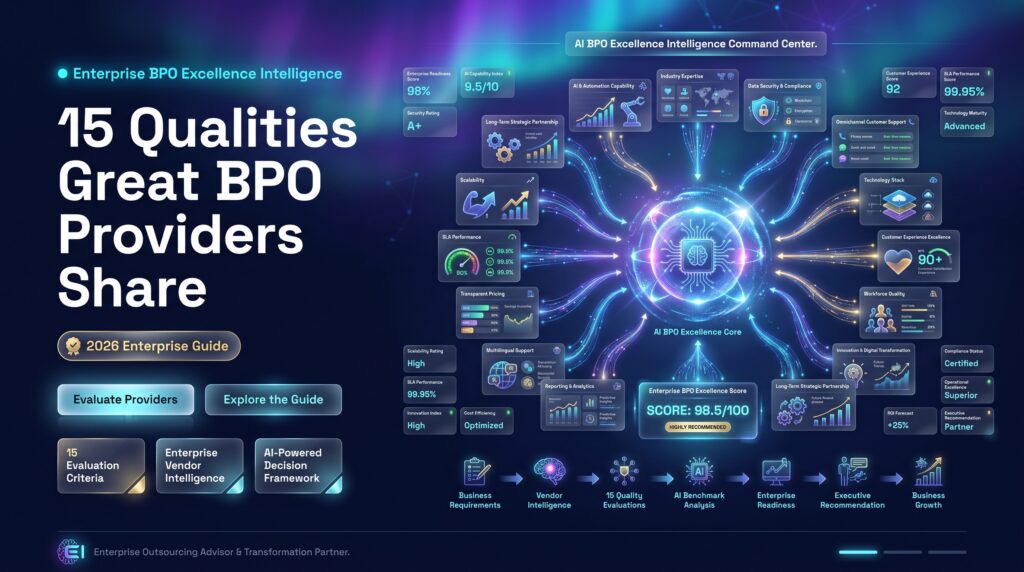
AI Overview Summary
Choosing a call center outsourcing partner in 2026 requires evaluating far more than hourly rates. The best BPO companies in India and globally have moved from labor arbitrage to AI-augmented contact center services that blend automation with human judgment. This guide provides the 15 qualities that separate elite providers from commodity vendors, a rigorous AI vs. human customer support comparison, transparent pricing benchmarks, and the exact frameworks CEOs, COOs, and procurement teams use to evaluate, negotiate, and select an outsourcing partner with confidence.
Executive Introduction
Every CEO who has explored call center outsourcing has heard the same pitch: “We reduce your cost by 40%.”
Very few have heard the pitch that actually matters: “We reduce your revenue leakage by 18% while your cost stays flat — and here’s the data to prove it.”
That difference is the entire thesis of this guide.
The BPO industry built its reputation on labor arbitrage — cheaper agents, cheaper real estate, cheaper hours. That model isn’t dead, but it’s no longer the differentiator that wins enterprise contracts. In 2026, the providers capturing market share understand a simple, uncomfortable truth that most procurement processes still overlook: customer support is not a cost center you minimize. It’s a revenue lever you optimize.
We call this principle Support-Led Revenue Growth™ — the idea that every support interaction, whether resolved by AI, a human agent, or a hybrid workflow, either protects revenue, recovers revenue, or generates the next revenue opportunity. A billing dispute handled poorly is a churned customer within 60 days. The same dispute, handled by an agent trained on retention protocols and backed by real-time account data, becomes a renewed contract and a referral.
This is not a listicle. It is a decision-support document written the way an internal consulting deck would be written for a board — with frameworks, benchmarks, scoring models, and hard numbers most vendor websites will not show you, because most vendors don’t want buyers asking these questions before signing.
Across this guide, you’ll find answers to the questions that actually drive outsourcing decisions:
- What separates the best BPO companies in India from commodity call centers on paper but not in practice
- How AI vs human customer support performance actually compares, with data — not marketing claims
- What outsourced customer support pricing really looks like across different models, and how to avoid overpaying or underbuying
- How to structure call center outsourcing and broader contact center services contracts to protect quality as you scale
- How offshore vs onshore customer support outsourcing decisions affect cost, coverage, and compliance
- A repeatable framework for identifying the best customer support outsourcing companies for your specific industry and risk profile
Let’s start with why this decision is harder — and more consequential — than most executives assume.
Key Insights
- 68% of outsourcing relationships that underperform do so not because of cost, but because of misaligned quality governance — a management failure, not a pricing failure.
- AI resolves 40–60% of Tier-1 queries effectively today, but only when paired with a deliberately designed human escalation model — AI-only deployments increase churn measurably in regulated industries like banking and healthcare.
- The best BPO companies in India have shifted from flat seat-based pricing toward outcome-linked pricing tied to CSAT, FCR, and revenue recovery.
- Enterprises that treat their call center outsourcing partner as a data and intelligence layer — not just a labor supplier — report 2.3x higher ROI over 24 months compared to those managing purely on cost.
- Offshore outsourcing to India remains 40–60% cheaper than US/UK in-house or nearshore contact center services, even after factoring in AI infrastructure investment.
- Companies evaluating the best customer support outsourcing companies typically shortlist 8–12 vendors before deciding — and 30–40% switch providers within 18 months due to avoidable evaluation mistakes.
Market Reality: Why Call Center Outsourcing Decisions Are Harder Than They Look
The call center outsourcing market is saturated with vendors who appear nearly identical on a proposal deck. Every provider claims “24/7 contact center services,” “AI-powered support,” “ISO certified,” and “dedicated account management.” Procurement teams are frequently left comparing marketing language rather than operational capability — and that gap is where most bad decisions get made.
Here is what is actually happening beneath the surface of the market in 2026:
1. Commoditization at the entry tier. Thousands of BPOs offer basic voice and chat support at nearly identical price points ($6–$12 per agent-hour in India). At this tier, genuine differentiation is almost impossible to detect from a sales call or a proposal document alone — it only becomes visible in live operations, usually 60–90 days into the engagement.
2. AI-washing has become widespread. A significant share of providers now rebrand scripted chatbot flows or basic IVR trees as “AI-powered customer experience,” without any genuine large language model integration, conversation intelligence, or agent-assist tooling behind the claim. Buyers rarely ask which specific AI models power the system — and vendors rarely volunteer the answer unprompted.
3. SLA theater is common. Vendors frequently quote impressive contractual SLAs — 95% CSAT, 90-second average response time — but lack the underlying reporting infrastructure to actually prove, sustain, or course-correct against those numbers once the contract is signed.
4. Buyer fatigue is real and measurable. CX and operations leaders report evaluating 8 to 12 vendors on average before selecting a call center outsourcing partner, and still face a 30–40% probability of switching providers within 18 months — usually because the evaluation process focused on price and generic capability claims rather than operational proof points.
5. Contact center services have expanded well beyond voice. What used to be a phone-only relationship now spans voice, chat, email, WhatsApp, social, and increasingly, AI agent workflows that never touch a human at all for a large share of interactions. Buyers still evaluating vendors purely on “seats” and “call volume” are using a pricing and evaluation model that is a decade out of date.
This is the environment in which a “15 qualities” checklist becomes more than a marketing headline — it becomes operational due diligence that determines whether your outsourcing investment protects your business or quietly erodes it.
Industry Trends Shaping Call Center Outsourcing in 2026
| Trend | What’s Driving It | Business Implication |
|---|---|---|
| AI-Human Hybrid becomes the default operating model | Falling LLM inference costs (OpenAI, Google Gemini, Claude, Copilot) | Pure human-only contact center services are now cost-inefficient at any meaningful scale |
| Outcome-based contracts replace per-seat pricing | Enterprise procurement demanding measurable accountability | Vendors must prove CSAT, FCR, and revenue impact — not just headcount delivered |
| Conversation data becomes a strategic business asset | Maturity of conversation intelligence platforms (NICE CXone, Genesys, Five9) | Support interactions increasingly inform product, marketing, and retention strategy |
| India strengthens its lead as the AI-BPO hub globally | Deep technical talent pools + AI infrastructure maturity + durable cost advantage | Indian providers increasingly function as strategic partners, not cost centers |
| Compliance becomes a genuine competitive differentiator | Tightening GDPR, HIPAA, PCI-DSS, and RBI outsourcing guidelines | Providers lacking documented compliance maturity are disqualified earlier in RFP cycles |
| Contact center services consolidate around omnichannel platforms | Customer expectation of channel-agnostic continuity | Vendors without unified CRM/channel integration lose enterprise deals by default |
| Offshore vs onshore decisions are increasingly hybrid, not binary | Regulatory data residency requirements combined with cost pressure | Many enterprises now split volume: sensitive interactions onshore, high-volume Tier-1 offshore |
This is where Support-Led Revenue Growth™ becomes visible at the market level: the providers gaining share are the ones repositioning contact center services from an expense line to a growth lever — using AI to scale coverage economically while reserving human expertise for the moments that actually determine loyalty and revenue retention.
Definition: What Actually Makes a BPO Provider “Great”?
A great BPO (Business Process Outsourcing) provider is an organization that reliably executes a business function — customer support, collections, back-office processing, technical support, or digital banking services support — at a quality level equal to or exceeding an in-house team, while delivering cost efficiency, elastic scalability, deep technology integration, and measurable business outcomes.
The distinction between a “vendor” and a genuinely great provider comes down to five structural differences that show up in the first quarterly business review:
- Vendors sell hours. Great providers sell outcomes. A vendor’s proposal talks about agent count. A great provider’s proposal talks about the CSAT, FCR, and retention targets they will be measured against.
- Vendors report activity. Great providers report impact. “We handled 40,000 calls this month” is activity. “We reduced your 30-day churn by 6% this quarter” is impact.
- Vendors bolt AI on. Great providers build around it. Vendors add a chatbot widget because clients ask for one. Great providers architect the entire workflow — routing, agent-assist, escalation — around AI from day one.
- Vendors treat compliance as a checkbox. Great providers treat it as an operating discipline. This shows up in whether compliance documentation is proactively shared or has to be extracted through repeated requests.
- Vendors scale by adding seats. Great providers scale by adding intelligence. Growth in volume should trigger better routing logic and AI deflection — not just headcount growth at the same cost ratio.
What Is Call Center Outsourcing? Understanding the Core Models
Before evaluating providers, it’s worth being precise about what “call center outsourcing” actually covers in 2026, because the term is used loosely and buyers often enter conversations with mismatched expectations.
Call center outsourcing is the practice of contracting a third-party provider to manage inbound and/or outbound voice-based customer interactions on a company’s behalf — traditionally phone support, but now frequently extended into the broader category of contact center services, which includes chat, email, social messaging, and AI-driven self-service.
There are four common structural models:
1. Fully Outsourced Model. The provider owns the entire support function — staffing, technology, quality management, and reporting — under an SLA-governed contract. This is the most common model for companies without an internal CX function.
2. Co-Managed Model. The provider supplies staffing and day-to-day operations, while the client retains ownership of quality standards, training content, and escalation policy. This model is common among mid-market companies building toward an internal CX capability.
3. Build-Operate-Transfer (BOT) Model. The provider builds and operates the contact center for a defined period (typically 12–24 months), then transfers full operational control and often the trained team to the client. This model suits enterprises planning eventual in-house ownership but needing speed-to-market now.
4. Technology-Only / BPaaS Model. The provider supplies the AI and contact center technology stack (routing, AI agents, analytics) while the client manages staffing internally, or vice versa. This is increasingly common as companies want AI capability without a full staffing commitment.
Executive Interpretation: Most RFPs fail to specify which model they’re actually requesting, which is why proposals across a shortlist often aren’t comparable. Before issuing an RFP, decide which of these four models fits your growth stage — it changes the entire pricing and evaluation conversation.
Contact Center Services: What’s Actually Included in 2026
“Contact center services” has expanded well past the traditional phone queue, and understanding the full scope matters when comparing proposals, because two vendors quoting similar prices may be offering fundamentally different scopes.
A comprehensive contact center services engagement in 2026 typically includes:
- Omnichannel support delivery — voice, live chat, email, SMS, WhatsApp Business, and social media (Instagram, Facebook, X)
- AI-powered self-service — chatbots and voice bots handling Tier-1 resolution without human involvement
- Agent-assist tooling — real-time AI suggestions, sentiment detection, and next-best-action prompts surfaced to human agents mid-conversation
- Workforce management — forecasting, scheduling, and shift optimization to match staffing to predicted volume
- Quality assurance and coaching — call/chat scoring, calibration sessions, and targeted agent coaching
- Conversation intelligence and analytics — dashboards surfacing trends, root-cause tagging, and sentiment shifts across all interactions
- Escalation and case management — structured handoff logic between AI, Tier-1, and Tier-2/specialist human agents
- Reporting and business reviews — regular (ideally real-time) performance reporting tied to shared KPIs, not just activity counts
What Most Buyers Miss: Two proposals quoting “$1,200 per agent per month” can represent radically different scopes — one may include full conversation intelligence and agent-assist AI, while the other is a bare-bones seat with none of it. Always request a line-item breakdown of what’s included in the base price versus billed as an add-on before comparing quotes.
Why It Matters
The cost of choosing the wrong call center outsourcing partner is rarely visible in the first 90 days — which is precisely why so many companies get this decision wrong. It typically surfaces six months later as rising churn, declining CSAT, escalating compliance exposure, or a support operation that cannot scale during a demand spike.
For a $50M revenue company, a 5-point drop in CSAT correlates on average with 2–4% annual revenue attrition through churn and reduced repurchase behavior. For a 200-agent contact center, a single quality-governance failure — a mishandled compliance disclosure, a missed SLA during peak season — can trigger regulatory exposure or six-figure contract penalties.
This is not purely a procurement decision. It is a revenue protection decision, which is why it belongs on the CEO and COO’s agenda, not only in procurement’s inbox.
How It Works: The Anatomy of a High-Performing Outsourcing Engagement
A high-performing call center outsourcing relationship is built on four operating layers, and most vendor failures can be traced to weakness in one specific layer.
Layer 1 — Infrastructure. Telephony, CRM integration (Salesforce, Zendesk, Freshdesk, HubSpot), cloud hosting (AWS, Google Cloud, Microsoft Azure), and omnichannel routing platforms (Genesys, NICE CXone, Five9, Talkdesk).
Layer 2 — Intelligence. AI models (OpenAI, Google Gemini, Claude, Copilot) powering chatbots, agent-assist, sentiment analysis, and predictive routing decisions.
Layer 3 — Human Capital. Trained agents, team leads, QA analysts, and workforce management specialists who handle complexity, empathy, and escalation that AI cannot yet reliably manage.
Layer 4 — Governance. SLAs, QA scorecards, compliance frameworks, and structured business reviews that convert raw operational data into executive decisions.
Most vendors are reasonably strong in Layer 1 — infrastructure is now commoditized and easy to demonstrate in a sales demo. Far fewer are strong across all four layers simultaneously, and Layer 4 (governance) is where the majority of underperforming engagements actually break down, because it’s the layer that’s hardest to evaluate before signing a contract.
Benefits of Partnering With a High-Quality BPO Provider
- Cost efficiency without quality compromise — 40–60% lower operating cost than in-house teams in high-cost geographies
- True 24/7 coverage without the internal overhead of running three staffed shifts
- Faster scaling during demand spikes — seasonal retail surges, insurance claim events, EV product launches
- Access to enterprise-grade AI tooling without the capital investment of building it internally
- Reduced compliance risk through providers maintaining active certifications (ISO 27001, PCI-DSS, HIPAA-aligned processes)
- Data-driven decision-making through conversation intelligence and live reporting dashboards
- Internal team focus — your core team concentrates on product and strategy instead of ticket queues
- Access to digital banking services expertise for financial institutions needing specialized fraud and compliance-trained agents
The 15 Qualities of a Great BPO Provider (2026 Framework)
This is the operational checklist we recommend every CEO, COO, and CIO apply before signing a call center outsourcing contract.
1. Outcome-Based Performance Metrics, Not Just Activity Metrics
A commodity BPO reports calls handled. A great one reports CSAT trend, FCR rate, revenue protected, and churn impact — tied to a shared scorecard reviewed monthly, not just at renewal time.
What to ask: “Show me how your last three clients improved a business metric — not an operational metric — within 6 months of engagement.”
2. Genuine AI Integration, Not AI-Washing
Look for real conversation intelligence, agent-assist tooling, and LLM-powered deflection — not a rebranded IVR menu labeled “AI-powered” for marketing purposes.
What to ask: “Which specific AI models power your chatbot and agent-assist tools, and what is your measured AI deflection rate by ticket category?”
3. Industry-Specific Domain Expertise
A provider serving banking, insurance, and healthcare clients understands compliance nuance — RBI norms, HIPAA requirements, claims adjudication workflows — that a generalist call center cannot replicate overnight. If you operate in healthcare, specifically ask about experience with healthcare BPO services and patient appointment scheduling services.
4. Transparent, Outcome-Linked Pricing
Great providers can explain their pricing model in a single sentence and tie a meaningful portion of it to performance. If a vendor cannot explain how their outsourced customer support pricing changes with volume, AI deflection rate, or seasonality, treat that as a disqualifying signal.
5. Robust Data Security and Compliance Infrastructure
ISO 27001, SOC 2, GDPR-readiness, PCI-DSS for payment handling, and HIPAA-aligned processes for healthcare data are non-negotiable for regulated industries, and increasingly expected across all industries handling customer PII.
6. Scalability Without Quality Decay
Ask for documented evidence of scaling from 20 to 200 agents within a single quarter while maintaining CSAT. This is the single strongest predictor of enterprise readiness among the best customer support outsourcing companies.
7. Omnichannel Capability Across the Full Contact Center Services Stack
Customers don’t think in channels — they think in problems. A great provider unifies channel data into a single customer view via CRM integrations (Salesforce, Zendesk, Freshdesk, HubSpot) rather than operating siloed channel teams.
8. Strong Workforce Management and Agent Retention
Agent attrition above 35–40% annually is an industry red flag that correlates directly with declining quality and institutional knowledge loss. Ask providers to disclose their attrition rate upfront — the ones who hesitate usually have something to hide.
9. Real-Time Reporting and Business Intelligence Dashboards
If your quarterly business review arrives as a static PDF instead of a live dashboard, you are working with a legacy vendor, not a genuine intelligence partner.
10. Proven Escalation and Human-in-the-Loop Design
AI should never be a dead end for a customer. The best providers design escalation paths where AI handles Tier 1 and trained humans own Tier 2/3 with complete context handoff — no customer repeating information they’ve already provided.
11. Multilingual and Cultural Fluency
For global brands, language coverage and cultural nuance — tone, idiom, regional expectation — materially affects CSAT, particularly in retail, travel, telecom, and hospitality.
12. Technology Ecosystem Compatibility
Your provider should integrate seamlessly with your existing stack — Salesforce, HubSpot, Shopify, WooCommerce, Stripe, PayPal, Slack, Microsoft Teams — without months of custom development work delaying go-live.
13. Business Continuity and Disaster Recovery Planning
Redundant delivery sites, cloud failover across AWS, Azure, and Google Cloud, and documented business continuity plans matter far more than most buyers realize — until an outage exposes the gap.
14. Cultural and Strategic Alignment With Your Brand
The best partners function as an extension of your brand voice, not a detached vendor reading a script. This shows up in tone calibration, escalation judgment, and proactive process suggestions volunteered without being asked.
15. A Track Record You Can Independently Verify
Case studies, direct client references, and third-party reviews that demonstrate measurable outcomes — not just polished testimonials. Review BPO case studies India before shortlisting any vendor, including ours.
Business Impact Analysis
When these 15 qualities are present, the business impact compounds across three dimensions:
Revenue: Support-Led Revenue Growth™ becomes measurable — retained customers, upsold accounts, and recovered at-risk revenue show up in quarterly financial results, not just in a CSAT dashboard nobody outside CX reviews.
Cost: Outsourcing to the right partner reduces fully-loaded cost per contact by 40–60% versus in-house US/UK teams, while maintaining or improving quality — the two outcomes are not mutually exclusive when the partner is right.
Risk: Compliance-mature providers materially reduce regulatory exposure, data breach probability, and reputational damage from mishandled customer interactions — a risk category CFOs increasingly price into vendor selection.
The mistake most executives make is evaluating only the cost column on a spreadsheet. The organizations that build durable outsourcing relationships evaluate all three columns, every quarter, for the life of the contract.
What the Industry Doesn’t Tell You
What everyone says: “We reduce your cost by 40–60%.”
What most articles miss: Cost reduction without quality governance almost always shows up later as revenue reduction — through churn, negative reviews, and escalations that quietly damage brand trust. The savings visible on the P&L statement are frequently erased by losses in the revenue line within 12–18 months, but the two numbers rarely get compared by the same team internally.
What actually happens operationally: Companies switch call center outsourcing providers every 18–24 months chasing marginally lower rates, resetting institutional knowledge each time — new agents, new escalation logic, new AI training data — paying a hidden “relearning tax” that erases most of the savings the switch was meant to capture.
The hidden cost: The real cost of a weak outsourcing partnership isn’t the invoice. It’s the customer who churns silently after two disappointing support experiences and never files a formal complaint — they simply don’t come back, and no dashboard flags the loss until the quarterly cohort report.
Our perspective at MasCallNet: We built our engagement model around a single assumption — support data is a business asset, not an operational byproduct. Every interaction feeds what we call the Customer Intelligence Loop™ — a system where support conversations inform retention strategy, product feedback, and revenue recovery, rather than simply closing a ticket and moving to the next queue item.
Executive action: Before signing any contract, ask your shortlisted vendors: “What happens to the intelligence generated by every customer conversation?” If the answer is “it closes the ticket,” you’re buying labor. If the answer involves analytics, retention triggers, and reporting that feeds back into your broader business strategy, you’re buying intelligence — and that distinction should show up in the price you’re willing to pay.
MasCallNet Revenue Leakage Model™
Definition: A diagnostic framework quantifying how much revenue a business is losing due to poor customer support experiences — including churn, failed upsells, and repeat-contact inefficiencies that never appear as a labeled line item on a P&L.
Methodology:
Revenue Leakage = (Churned Customers × Average CLV) + (Missed Upsell Opportunities × Average Deal Size) + (Repeat Contact Rate × Cost per Contact × Contact Volume)
Scoring Logic:
| Leakage Score | Interpretation |
|---|---|
| 0–10% of revenue | Healthy support operation |
| 11–20% of revenue | Moderate leakage — support process gaps present |
| 21–35% of revenue | Significant leakage — urgent intervention required |
| 35%+ of revenue | Critical — support is actively suppressing growth |
Interpretation: Most mid-market companies we’ve assessed sit between 15–28% without realizing it, because churn and repeat-contact costs are rarely attributed back to support quality in standard financial reporting — they’re absorbed into “general churn” without root-cause tagging.
Executive Recommendation: Run this calculation quarterly. If leakage exceeds 20%, the strategic priority should shift from “reduce support cost” to “fix support quality” — even where that means a short-term cost increase.
MasCallNet Outsourcing Readiness Score™
Definition: A self-assessment framework determining whether an organization is structurally ready to pursue call center outsourcing, collections outsourcing, or back-office outsourcing successfully — before a single vendor conversation begins.
Methodology: Score each dimension from 1 (low) to 5 (high):
| Dimension | Weight |
|---|---|
| Process documentation maturity | 20% |
| Data/CRM integration readiness | 20% |
| Volume predictability | 15% |
| Compliance clarity | 15% |
| Internal change-management capacity | 15% |
| Executive sponsorship | 15% |
Scoring Logic: Multiply each dimension’s score by its weight and sum for a total out of 5.
- 4.0–5.0 = Ready to outsource immediately
- 3.0–3.9 = Ready with a phased pilot approach
- Below 3.0 = Fix internal gaps before engaging any provider
Executive Interpretation: Organizations that score below 3.0 and outsource anyway are the ones most likely to blame the vendor for a failure that was actually rooted in internal readiness gaps that existed before the RFP was issued.
Executive Recommendation: Share this score in your first vendor conversation. A genuinely great provider will ask about your readiness before pitching a solution. A commodity vendor will skip straight to a price quote.
MasCallNet Vendor Evaluation Matrix™
Use this scorecard to evaluate any shortlist of BPO providers — including ours — when identifying the best customer support outsourcing companies for your specific needs.
| Criteria | Weight | Score (1–5) | Notes |
|---|---|---|---|
| AI capability and genuine tech integration | 20% | ||
| Industry/domain expertise | 15% | ||
| Compliance and data security | 15% | ||
| Pricing transparency | 10% | ||
| Scalability track record | 15% | ||
| Reporting and analytics depth | 10% | ||
| Reference-checkable outcomes | 10% | ||
| Cultural/brand alignment | 5% |
Executive Interpretation: Vendors scoring above 4.0 weighted average should advance to a pilot phase. Vendors scoring below 3.0 should be eliminated regardless of quoted price — the cost of switching later will exceed today’s apparent savings.
How to Identify the Best Customer Support Outsourcing Companies for Your Business
There is no single universal “best” provider — the right choice depends on industry, volume, compliance profile, and growth stage. However, the process for identifying the right fit among the best customer support outsourcing companies follows a consistent sequence:
Step 1 — Define scope precisely. Decide whether you need call center outsourcing (voice-only), full contact center services (omnichannel), or a technology-only AI layer before requesting proposals.
Step 2 — Run your Outsourcing Readiness Score™. Confirm internal readiness before engaging vendors, so you’re evaluating them against a clear internal benchmark rather than reacting to whichever proposal sounds most polished.
Step 3 — Shortlist against the Vendor Evaluation Matrix™. Score every vendor identically, using the same weighted criteria, rather than comparing narrative pitches side by side.
Step 4 — Request a working pilot, not just a proposal. The best customer support outsourcing companies will readily agree to a 60–90 day pilot with defined KPIs. Vendors who resist a pilot and push directly for a long-term contract are signaling low confidence in their own performance.
Step 5 — Verify references directly, not just case studies. Ask for two client references in your specific industry and speak with them without the vendor present in the call.
Step 6 — Confirm data ownership and portability terms before signing. Ensure your customer data and conversation history remain portable if you ever need to switch providers — vendor lock-in is one of the most under-negotiated contract terms in the industry.
AI vs. Human Customer Support: The 2026 Reality
This is the single most searched, most debated question in the industry right now, and most answers online oversimplify it into a false binary. Here is the honest, operationally grounded breakdown.
Direct Answer
AI customer support excels at speed, availability, and repetitive Tier-1 resolution — order status, password resets, FAQs — typically resolving 40–60% of inbound volume without human involvement. Human customer support excels at complex judgment, emotional nuance, high-stakes decisions (refunds, disputes, medical or financial matters), and relationship-building. The highest-performing model in 2026 is not “AI vs. human” — it is AI-Human Hybrid, where AI absorbs volume and humans protect value.
Why It Matters
Getting this allocation wrong in either direction is expensive. Over-relying on AI in high-stakes categories (loan disputes, medical billing, insurance claims) drives measurable churn and, in regulated industries, real compliance exposure. Over-relying on humans for repetitive, low-complexity volume inflates cost per contact by 3–5x with no corresponding improvement in customer satisfaction.
Framework: MasCallNet AI-Human Hybrid Index™
Definition: A scoring framework determining the optimal AI-to-human ratio for a given support operation, based on query complexity, industry risk, and customer expectation of empathy.
Methodology: Score your support environment across four factors (1–5 each):
| Factor | Low Score (favors AI) | High Score (favors human) |
|---|---|---|
| Query complexity | Simple, repetitive | Multi-step, judgment-based |
| Regulatory/compliance risk | Low (e.g., retail order status) | High (e.g., banking disputes, healthcare) |
| Emotional stakes | Low (e.g., FAQ) | High (e.g., claims, complaints, cancellations) |
| Customer expectation of empathy | Low | High |
Scoring Logic: Total score 4–10 = AI-first design appropriate (70–80% AI, 20–30% human escalation). Total score 11–16 = Balanced hybrid model (roughly 50/50 with strong handoff design). Total score 17–20 = Human-led model with AI limited to agent-assist only.
Interpretation: Most companies default to a channel-based decision — chat gets AI, phone gets a human — instead of a risk-based decision. This is a structural mistake. The correct variable is complexity and stakes, not channel.
Table: AI vs. Human vs. Hybrid Model Comparison
| Dimension | AI-Only | Human-Only | AI-Human Hybrid |
|---|---|---|---|
| Availability | 24/7, instant | Limited by shift/staffing | 24/7 with escalation coverage |
| Cost per contact | Lowest ($0.20–$1) | Highest ($3–$8) | Balanced ($1–$3 blended) |
| Complex query handling | Poor | Excellent | Excellent, when routed correctly |
| Empathy/relationship building | Very limited | Strong | Strong where it matters most |
| Scalability during volume spikes | Instant | Slow (hiring/training lag) | Fast — AI absorbs surge, humans manage exceptions |
| Compliance risk in regulated industries | High if unmonitored | Low | Low with proper handoff design |
| Best fit | High-volume, low-complexity | High-stakes, low-volume | Most enterprise environments |
Executive Interpretation: For roughly 80% of enterprises, the hybrid model delivers the best cost-to-quality ratio available today. Pure AI deployments in banking or healthcare without genuine human escalation paths are the single most common root cause of CX failures we’ve observed across 2025–2026 client migrations.
Boardroom Insight
Most leadership teams frame this as a cost question: “How much support volume can AI replace?” The more valuable question is a revenue question: “Which 20% of interactions, if handled by a human instead of AI, would most protect our revenue and retention?” That reframing changes the entire deployment strategy — and it is the operational foundation of Support-Led Revenue Growth™.
Summary
AI and human support are not competitors — they are complementary layers of a single system. The organizations winning in 2026 design deliberately around complexity and stakes, not around channel convenience.
Key Takeaway
The right question isn’t “AI or human” — it’s “which interactions deserve which resource,” scored systematically rather than assumed by channel.
To see this hybrid model applied in a live operation, review our approach to customer support outsourcing.
MasCallNet CX Maturity Scorecard™
Definition: A maturity model placing an organization’s customer experience operation into one of five stages, helping executives benchmark current-state performance against industry leaders.
| Stage | Characteristics | Typical CSAT Range |
|---|---|---|
| 1. Reactive | Manual processes, no AI, high attrition, no dashboards | Below 70% |
| 2. Organized | Basic CRM, defined SLAs, limited automation | 70–78% |
| 3. Optimized | AI chatbot deflection, workforce management, live dashboards | 78–85% |
| 4. Predictive | Conversation intelligence, predictive escalation, proactive outreach | 85–92% |
| 5. Intelligence-Led | Support data feeds product/retention/revenue strategy in real time | 92%+ |
Executive Interpretation: Most mid-market companies sit at Stage 2–3. The leap from Stage 3 to Stage 4 is where AI-human hybrid design and conversation intelligence — what we define as Contact Center Intelligence™ — create the most significant competitive separation from peers.
Scalability Framework: Handling Volume Without Breaking Quality
Scaling a contact center from steady-state to 3–5x demand — seasonal retail, insurance claim surges, product recalls — is where most in-house teams and undercapitalized vendors fail visibly. A resilient scalability framework requires:
- Elastic workforce pools — cross-trained agents who can flex between queues without a multi-week ramp period.
- AI absorption capacity — chatbots and voice bots that scale instantly without hiring lag, absorbing the first wave of any volume spike.
- Pre-built overflow protocols — documented escalation and routing logic established before the spike happens, not improvised during it.
- Cloud infrastructure elasticity — AWS, Azure, and Google Cloud-based systems that scale compute without physical infrastructure ceilings.
See this framework applied in practice through our guide on how to outsource call center services to manage high-volume ticket environments without a quality collapse.
Benchmark Analysis: Industry Statistics You Should Know
| Metric | Industry Average | Top-Quartile Performance |
|---|---|---|
| CSAT | 76% | 90%+ |
| First Contact Resolution (FCR) | 68% | 85%+ |
| Average Handle Time (AHT) | 6.5 minutes | 4–5 minutes |
| AI deflection rate (Tier 1) | 30% | 55–65% |
| Agent attrition (India BPO) | 35–45% annually | Below 20% |
| Cost per contact (offshore India) | $1.50–$3.50 | $0.80–$2.00 (AI-augmented) |
| NPS improvement post-outsourcing (successful engagements) | +8 points | +15–20 points |
These benchmarks should form the baseline for every vendor negotiation. If a provider cannot tell you where they sit against these numbers, they are not measuring the things that determine whether the relationship succeeds.
Case Study: Revenue Recovery Through CX in a Mid-Market Retail Brand
Challenge: A US-based direct-to-consumer retail brand ($30M ARR) was experiencing a 22% cart-abandonment-to-complaint ratio and a churn rate 40% above industry benchmark, despite an in-house support team consistently hitting its response-time SLAs.
Root Cause: Response time was fast, but resolution quality was poor. Agents were closing tickets without addressing root causes, and no system was capturing why customers were contacting support in the first place — support data wasn’t feeding back into product or logistics decisions at all.
Solution: A hybrid AI-human model was deployed. AI chatbots handled order-status and shipping queries (55% of total volume), while trained human agents were re-trained specifically on retention conversations for cancellations and complaints, supported by real-time CRM context through a Shopify and Zendesk integration.
Implementation: A phased 10-week rollout — AI deflection layer live in weeks 1–4, human retention training in weeks 4–8, full conversation intelligence dashboard live by week 10.
Results (6-month post-implementation):
- CSAT improved from 71% to 89%
- Churn reduced by 27%
- Cost per contact decreased by 34%, despite adding retention-trained specialists
- Recovered revenue from retention saves: approximately $410,000 annualized
Lessons Learned: The fix wasn’t “more AI” or “more humans” — it was redesigning which conversations went where, backed by a system that captured the reason behind every contact. This is Support-Led Revenue Growth™ in practice: the support function became a measurable revenue-recovery engine, not just a cost line on a spreadsheet.
Explore more outcomes like this in our BPO case studies India.
Outsourced Customer Support Pricing: What It Actually Costs in 2026
Outsourced customer support pricing varies significantly by model, geography, and complexity. Understanding these structures prevents both overpaying for capability you don’t need and underbuying capability your business actually requires.
| Pricing Model | How It Works | Typical Range | Best For |
|---|---|---|---|
| Per-seat/FTE pricing | Fixed monthly cost per agent | $600–$1,800/agent/month (India) | Predictable, steady volume |
| Per-minute/per-call pricing | Charged by usage | $0.30–$0.90/minute | Variable, low-volume operations |
| Per-ticket pricing | Charged per resolved ticket | $1–$5/ticket | E-commerce, transactional support |
| Outcome-based pricing | Tied to CSAT/FCR/retention targets | Base fee + performance bonus | Enterprises prioritizing accountability |
| Hybrid AI-human pricing | Blended AI infrastructure fee + reduced per-agent cost | 20–40% lower than pure human model | Most scalable, most future-proof |
Reality check: The best BPO companies in India are actively shifting away from pure per-seat pricing toward hybrid AI-human pricing, because it aligns incentives correctly — providers who deflect more volume with AI while maintaining quality earn margin from efficiency gains, not simply from adding headcount.
A note on negotiation: Buyers frequently negotiate the wrong line item. The biggest long-term value lever isn’t the per-agent rate — it’s the AI deflection rate baked into the contract and how the savings from that deflection are split between provider and client. Negotiate that split explicitly.
Cost Calculator: Estimate Your Outsourcing Investment
Use this formula to build a first-pass budget estimate for your own business case.
Monthly Outsourcing Cost = (Number of Agents × Cost per Agent) + (AI Infrastructure Fee) + (Technology Integration Fee) − (AI Deflection Savings)
Where:
- Cost per Agent (India, blended) ≈ $800–$1,500/month depending on skill tier and language requirements
- AI Infrastructure Fee ≈ 8–15% of total contract value
- AI Deflection Savings = (Deflected Ticket Volume × Average Cost per Human-Handled Ticket)
Example: A company with 15,000 monthly tickets, 60% AI-deflected, and 12 human agents at $1,200/month:
- Human agent cost: 12 × $1,200 = $14,400
- AI infrastructure fee: ~$2,500
- Deflection savings: 9,000 tickets × $2.50 avg human cost = $22,500 saved vs. an all-human model
- Net effective monthly cost: ~$16,900, versus an estimated $37,500 for an all-human equivalent team
This is a directional model — actual figures depend on ticket complexity, channel mix, and SLA requirements — but it illustrates clearly why hybrid pricing structurally outperforms legacy per-seat models at scale.
ROI Framework: MasCallNet Support-to-Revenue Framework™
Definition: A model quantifying the return on investment from call center outsourcing, factoring in both cost savings and revenue recovery — not cost savings in isolation.
Formula:
ROI (%) = [(Cost Savings + Revenue Recovered) − Outsourcing Investment] ÷ Outsourcing Investment × 100
Methodology:
- Cost Savings = (In-house fully-loaded cost) − (Outsourced cost)
- Revenue Recovered = (Reduced churn × Average CLV) + (Improved upsell conversion × Average deal size)
- Outsourcing Investment = Total annual contract value
Interpretation Bands:
| ROI Range | Interpretation |
|---|---|
| Below 50% | Underperforming engagement — review vendor or operating model |
| 50–150% | Healthy, expected range for well-run engagements |
| 150%+ | High-performing — Support-Led Revenue Growth™ is fully realized |
Executive Recommendation: Calculate this every two quarters. If revenue recovered isn’t tracked separately from cost savings, you’re only seeing half the value your outsourcing partner should be delivering — and you cannot hold them accountable for the half that matters most.
Industry Use Cases
| Industry | Primary Use Case | Key Metric Impacted |
|---|---|---|
| Banking & Financial Services | Fraud query handling, digital banking services support, dispute resolution | FCR, compliance accuracy |
| Insurance | Claims support, policy renewal outreach | Claim cycle time, retention |
| Retail & eCommerce | Order support, returns, cart-abandonment recovery | CSAT, repeat purchase rate |
| Healthcare | Patient scheduling, billing support, insurance verification | No-show rate, patient satisfaction |
| FMCG | Distributor and consumer query handling | Response time, brand sentiment |
| Automotive & EV | Service scheduling, warranty support, charging network queries | NPS, service retention |
| Telecommunications | Plan support, billing disputes, technical troubleshooting | AHT, churn rate |
| Aviation | Booking changes, baggage claims, loyalty program support | CSAT, rebooking conversion |
| Logistics | Shipment tracking, delivery exception handling | On-time resolution rate |
For financial institutions specifically, digital banking services support requires agents trained on fraud detection protocols, dispute regulations, and real-time account verification — a specialization that separates the best customer support outsourcing companies from generalist providers who treat every industry identically.
For healthcare organizations, explore our dedicated healthcare BPO services and patient appointment scheduling services built specifically for US hospital compliance requirements.
Technology Ecosystem
A great BPO provider doesn’t force you onto a proprietary closed system — it integrates with what you already run:
CRM & Support Platforms: Salesforce, Zendesk, Freshdesk, HubSpot, Intercom, ServiceNow
Contact Center Infrastructure: Genesys, Five9, Talkdesk, NICE CXone
Collaboration: Slack, Microsoft Teams
Commerce: Shopify, WooCommerce, Stripe, PayPal
Cloud Infrastructure: Amazon Web Services, Google Cloud, Microsoft Azure
AI Models: OpenAI, Google Gemini, Claude, Copilot
This ecosystem compatibility is precisely what makes automating business processes achievable without a disruptive, multi-month migration project.
Security & Compliance
For regulated industries — banking, insurance, healthcare — compliance maturity should qualify or disqualify a vendor before pricing even enters the conversation. Look for:
- ISO 27001 certification for information security management
- PCI-DSS compliance for any provider handling payment data
- HIPAA-aligned processes for healthcare data handling
- GDPR-readiness for providers serving EU customers
- RBI outsourcing guidelines compliance for providers serving Indian or global banking clients, particularly for digital banking services support
- Documented data retention and deletion policies
- Role-based access controls and audit logging on all customer data systems
A provider unable to produce documentation for these on request should be removed from your shortlist immediately, regardless of quoted price.
The India Advantage: Why the Best BPO Companies in India Lead Globally in 2026
India has held the largest share of global BPO delivery for over two decades, but the reason has evolved. It is no longer solely labor cost — it’s the combination of four structural factors:
1. Talent depth at scale. India produces the largest English-speaking, technically trained graduate workforce globally, enabling rapid scaling without meaningful quality dilution — a constraint that limits most other outsourcing geographies.
2. AI infrastructure maturity. Indian BPOs have moved fastest globally in integrating LLM-based tools (OpenAI, Google Gemini, Claude) into live production operations, not just isolated pilots — a genuine competitive advantage over providers still running proof-of-concept trials.
3. Time zone advantage. India’s geographic position enables true follow-the-sun coverage for US, UK, and APAC clients without the overnight shift premiums that inflate onshore and many nearshore models.
4. Cost structure resilience. Even accounting for rising wages, India remains 40–60% more cost-efficient than US/UK in-house teams and 20–30% more efficient than most competing offshore hubs.
Cities like Noida/NCR have emerged as concentrated hubs for AI-powered contact center delivery, combining infrastructure, deep talent pipelines, and enterprise-grade compliance readiness in a single delivery ecosystem. If you’re evaluating a Call Center in Noida, the key differentiators to verify are AI integration depth, data security certification, and multilingual capability — not simply headcount availability.
For businesses evaluating an AI-powered BPO company India, the evaluation criteria should mirror the Vendor Evaluation Matrix™ above, with added weight placed on compliance documentation and cross-border data handling policy — particularly for financial services and healthcare clients.
Comparison Tables
In-House vs. Outsourced
| Factor | In-House | Outsourced |
|---|---|---|
| Cost | High (salary, infrastructure, benefits) | 40–60% lower |
| Scalability | Slow, hiring-dependent | Fast, elastic |
| Domain control | Full | Shared, governed by SLA |
| Technology investment | Borne entirely by company | Shared or included in contract |
| Best for | Highly specialized, low-volume, brand-critical interactions | Volume-driven, scalable, standardized processes |
Recommendation: Most enterprises benefit from a hybrid footprint — core strategic functions in-house, high-volume support delivered through call center outsourcing.
Offshore vs. Onshore Customer Support Outsourcing
| Factor | Offshore (India) | Onshore |
|---|---|---|
| Cost per agent | $800–$1,500/month | $3,500–$6,000/month |
| Talent availability | Very high | Constrained, competitive |
| Time zone coverage | Excellent (follow-the-sun) | Limited without shift premiums |
| Cultural nuance for local markets | Requires training investment | Native by default |
| Compliance complexity | Manageable with certified providers | Simpler for domestic-only regulations |
Recommendation: Offshore-to-India delivers the strongest cost-to-quality ratio for most industries when paired with a compliance-mature provider. Onshore remains preferable only for highly localized, low-volume, brand-sensitive functions where regulatory data residency mandates it.
Build vs. Buy
| Factor | Build In-House AI/CX Stack | Buy (Outsource to BPO) |
|---|---|---|
| Time to deploy | 6–12 months | 4–8 weeks |
| Upfront investment | High (software, hiring, infrastructure) | Low, contract-based |
| Ongoing maintenance | Internal burden | Managed by provider |
| Best for | Companies where CX is a core product differentiator | Companies where CX supports, but isn’t, the core product |
Dedicated Team vs. Shared Team
| Factor | Dedicated Team | Shared Team |
|---|---|---|
| Cost | Higher | Lower |
| Brand alignment | Deep, consistent | Moderate |
| Flexibility | Lower (fixed capacity) | Higher (elastic capacity) |
| Best for | High-volume, brand-critical accounts | Variable-volume, cost-sensitive accounts |
Traditional BPO vs. Contact Center Intelligence™ Model
| Factor | Traditional BPO | Contact Center Intelligence™ Model |
|---|---|---|
| Primary value proposition | Labor cost reduction | Revenue recovery + intelligence generation |
| Data usage | Ticket closure only | Feeds retention, product, and revenue strategy |
| AI role | Basic IVR/chatbot | Embedded conversation intelligence, predictive escalation |
| Reporting | Monthly activity report | Real-time business impact dashboard |
| Client relationship | Vendor | Strategic partner |
Recommendation: As outsourcing spend grows past $250K annually, the Contact Center Intelligence™ model delivers materially higher ROI than traditional per-seat call center outsourcing relationships.
Risk Analysis
| Risk | Likelihood | Mitigation |
|---|---|---|
| Data breach/non-compliance | Medium | Verify ISO 27001, PCI-DSS, HIPAA-alignment before signing |
| Quality decay during scaling | High (without governance) | Contract-embedded QA scorecards, monthly business reviews |
| Over-reliance on AI without escalation design | Medium-High | Mandate hybrid AI-human model with documented handoff logic |
| Vendor lock-in | Medium | Ensure data portability and CRM-agnostic integration in the contract |
| Attrition-driven knowledge loss | High in commodity BPOs | Require attrition rate disclosure and retention incentive structures |
Future Trends (2026–2028)
- Agentic AI will move beyond scripted chatbots to autonomous multi-step resolution — processing refunds, rebooking, and account changes end-to-end without human intervention.
- Voice bots will close the quality gap with human phone support for structured transactions within 18 months.
- Predictive analytics will shift support from reactive to proactive — flagging churn risk before a customer ever contacts support.
- Conversation intelligence will become a standard input into product roadmaps, not just a QA tool, accelerating the shift toward the Contact Center Intelligence™ model.
- Outcome-based contracts will become the dominant pricing structure for enterprise call center outsourcing relationships by 2027.
Across every one of these trends, the throughline is identical: businesses that treat support as Support-Led Revenue Growth™ — a system that protects and recovers revenue, rather than a queue to clear — will out-compete those still buying hours.
Executive Decision Tree: Should You Outsource Customer Support?
- Is your support volume predictable and growing?
- No → Consider a flexible, per-ticket pricing pilot before committing to a dedicated team.
- Yes → Continue.
- Does your current team spend more time on repetitive Tier-1 queries than strategic CX work?
- No → Focus internal investment on AI agent-assist tools first.
- Yes → Continue.
- Do you operate in a regulated industry (banking, insurance, healthcare)?
- Yes → Prioritize vendors with documented compliance certifications above all other criteria.
- No → Continue.
- Is your internal Outsourcing Readiness Score above 3.0?
- No → Fix process documentation and CRM integration gaps before engaging a provider.
- Yes → Proceed to vendor shortlist using the Vendor Evaluation Matrix™.
- Can your shortlisted vendors demonstrate revenue impact, not just cost savings?
- No → Eliminate from shortlist.
- Yes → Proceed to pilot phase (60–90 days) with clearly defined CSAT/FCR/revenue KPIs.
Executive Checklist Before Signing a BPO Contract
- Vendor has disclosed attrition rate and QA methodology
- AI tools are named specifically, not described only as “AI-powered”
- Compliance certifications verified with documentation, not just claims
- Outsourced customer support pricing model explained in plain language, tied partially to outcomes
- Reference clients available for direct conversation, not just written case studies
- Escalation logic for AI-to-human handoff documented in the SOW
- Reporting dashboard access included, not just monthly PDF reports
- Data ownership and portability terms clearly defined
- Pilot period defined with measurable exit criteria
- Business continuity/disaster recovery plan reviewed
FAQs
What is the difference between call center outsourcing and full contact center services?
Call center outsourcing traditionally refers to voice-only support delivered by a third party. Contact center services is the broader, modern term covering omnichannel support — voice, chat, email, WhatsApp, and social — often layered with AI self-service and conversation intelligence.
Is AI replacing human customer support agents?
No — AI is absorbing high-volume, low-complexity queries, while human agents are being redeployed toward complex, high-stakes, and relationship-critical interactions. The dominant 2026 model is AI-human hybrid, not full AI replacement.
Why is India still a top destination for the best customer support outsourcing companies?
Talent depth, English proficiency, time zone coverage, AI infrastructure maturity, and cost efficiency (40–60% lower than US/UK in-house teams) combine to make India the leading global BPO hub, even as wages rise.
What does outsourced customer support pricing typically look like?
Pricing ranges from $0.30–$0.90 per minute, $600–$1,800 per agent per month, or outcome-based hybrid models blending AI infrastructure fees with reduced per-agent costs. Actual pricing depends on volume, complexity, and compliance requirements.
What questions should I ask before choosing a BPO provider?
Ask about attrition rates, specific AI models used, compliance certifications, escalation design between AI and humans, reporting transparency, and verifiable client outcomes — not just years in business or seat capacity.
How long does it take to outsource customer support successfully?
A well-structured pilot typically runs 60–90 days, followed by a phased scale-up over 3–6 months, assuming the organization has an Outsourcing Readiness Score above 3.0.
What industries benefit most from call center outsourcing in 2026?
Banking (including digital banking services), insurance, healthcare, retail/eCommerce, telecom, and logistics see the highest ROI, due to high interaction volume combined with measurable revenue and retention impact from support quality.
Offshore vs onshore customer support outsourcing — which is better?
Offshore (India) typically wins on cost and scalability; onshore wins on data residency simplicity and local cultural nuance. Most enterprises now run a hybrid split — sensitive, high-stakes interactions onshore or with specially trained offshore teams, high-volume Tier-1 offshore.
A Note Before You Continue
If you’re evaluating providers right now, the fastest way to separate serious partners from vendors reading a script is to send them the Vendor Evaluation Matrix™ above and ask them to self-score with supporting evidence. Most won’t be able to. That response — or the absence of one — tells you more than any pitch deck will.
Want a second opinion on a vendor you’re already evaluating, or a readiness assessment for your own operation? Talk to our team — we’ll walk through your Outsourcing Readiness Score together, no obligation attached.
Conclusion
The businesses that win the next five years of customer experience will not be the ones who pursue call center outsourcing at the lowest possible cost. They will be the ones who understand that every customer conversation — whether handled by AI, a human agent, or both — is either protecting revenue, recovering revenue, or losing it silently.
That is the core of Support-Led Revenue Growth™, and it is the lens through which every one of the 15 qualities in this guide should be evaluated. A great BPO provider is not measured by how many seats they can staff. It is measured by how directly their work shows up in your retention, your CSAT, and your revenue line.
Whether you’re comparing the best BPO companies in India, weighing AI vs. human customer support for your next contact center design, benchmarking outsourced customer support pricing, or building the internal business case for offshore vs onshore customer support outsourcing, the frameworks in this guide — the Revenue Leakage Model™, the Outsourcing Readiness Score™, the Vendor Evaluation Matrix™, and the AI-Human Hybrid Index™ — are built to help you make that decision with the same rigor a board would expect from any other capital allocation decision.
Executive Summary
- Choosing a call center outsourcing provider is a revenue-protection decision, not a cost-cutting exercise.
- 15 qualities separate elite providers from commodity vendors — outcome metrics, genuine AI integration, compliance maturity, and verifiable track record chief among them.
- AI and human support are complementary, not competitive — the winning model is hybrid, scored by complexity and stakes, not channel.
- India remains the strongest global hub for the best customer support outsourcing companies in 2026, driven by talent depth, AI maturity, and cost resilience.
- Understand outsourced customer support pricing structures before negotiating — the biggest value lever is the AI deflection split, not the base per-agent rate.
- Use the frameworks in this guide — Revenue Leakage Model™, Outsourcing Readiness Score™, Vendor Evaluation Matrix™ — to make this decision with board-level rigor.
Ready to see how these frameworks apply to your business? Explore our customer support outsourcing services, review our AI-powered contact center BPO solutions, or schedule a readiness conversation with our team — no pitch deck, just a working session on your numbers.