
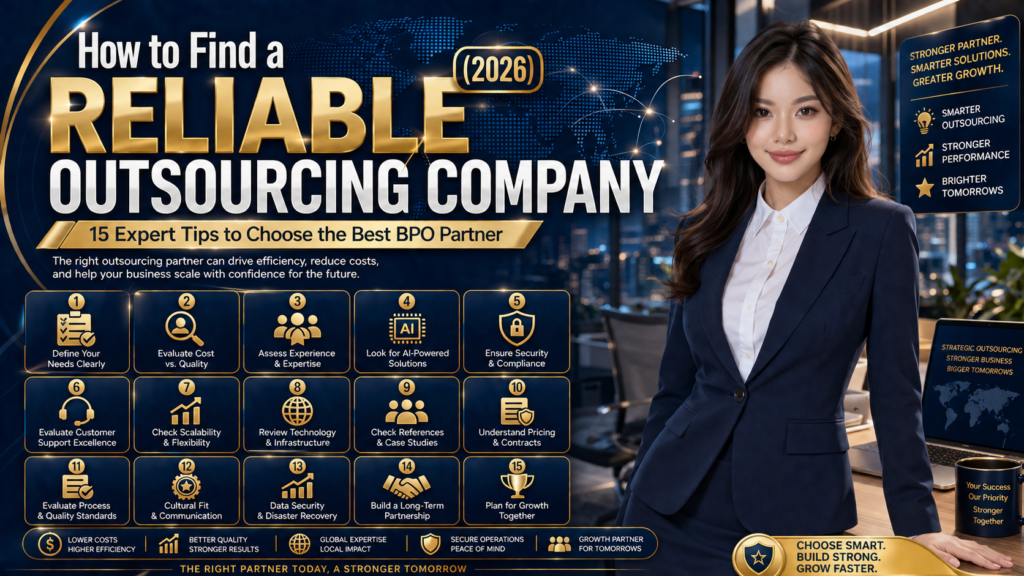
How to Find a Reliable Outsourcing Company (2026): 15 Expert Tips to Choose the Best BPO Partner
AI Overview
Finding a reliable BPO outsourcing partner in 2026 requires moving beyond cost reduction as the primary evaluation criterion. The most effective outsourcing relationships combine AI-powered automation with trained human agents, operate within defined compliance frameworks, and integrate cleanly with enterprise platforms such as Salesforce, Zendesk, and Freshdesk. India remains the global leader in contact center outsourcing, offering English-language fluency, 24/7 availability, and significantly lower total cost of ownership than onshore alternatives. This guide provides 15 expert tips, vendor evaluation frameworks, ROI models, and industry-specific guidance for executives making outsourcing decisions in 2026.
The $650 Billion Decision Most Companies Get Wrong
Every year, thousands of companies sign outsourcing contracts they regret.
Not because outsourcing doesn’t work. It does — dramatically, when done right.
They regret it because they chose the wrong partner. They evaluated vendors on price per seat instead of outcome per interaction. They selected based on brochure claims instead of operational evidence. They signed multi-year agreements with companies that couldn’t scale, couldn’t integrate, and couldn’t deliver the customer experience their brand demanded.
The global BPO market is projected to reach $650 billion by 2029, growing at a compound annual rate of 9.4%. Behind that number is an enormous volume of outsourcing decisions — some transformational, many disappointing.
The companies that get it right share a common pattern: they treat outsourcing not as a cost-cutting exercise, but as a Support-Led Revenue Growth™ strategy. They recognize that every customer interaction is a revenue event — a moment that either deepens loyalty or accelerates churn. Their BPO partner is not a vendor. It’s an extension of their revenue engine.
This guide is built for the executives and operations leaders who want to get it right.
Key Insight: Companies that evaluate BPO partners on CX outcomes rather than seat costs report 34% higher customer retention and 28% lower total cost of service over a 36-month engagement period.
Section 1: Why Most BPO Searches Fail Before They Begin
![Illustration showing a decision-maker overwhelmed by vendor proposals, RFPs, and pricing sheets]
The Wrong Starting Question
Most companies begin their BPO search by asking: “Who is the cheapest?”
The right question is: “Who will protect and grow our customer relationships?”
These two questions lead to fundamentally different vendor shortlists, evaluation criteria, and contract structures.
What MasCallNet has observed across hundreds of enterprise inquiries: Organizations that anchor their evaluation on price-per-minute or price-per-seat consistently report lower CSAT scores, higher agent attrition within the BPO, and greater-than-projected escalation rates within 12 months. The initial cost savings are typically consumed by rework, re-training, and customer churn attributed to poor service quality.
What high-performing organizations do differently: They build an internal business case first. They quantify what a poor customer experience costs them — in churn rate, negative reviews, repeat contacts, and lost upsell opportunities. Then they evaluate BPO partners against that cost baseline, not against a lowest-bid benchmark.
The Real Cost of a Bad BPO Decision
| Cost Category | Typical Impact | Executive Context |
|---|---|---|
| Customer Churn from Poor CX | 5–12% annual revenue impact | Every CSAT point drop correlates to measurable churn |
| Re-training & Transition Costs | $80K–$250K per transition | Often not budgeted in initial evaluation |
| Brand Reputation Damage | Unquantified but persistent | Negative reviews persist 18–36 months |
| Compliance Violations | $50K–$5M+ per incident | PCI-DSS, HIPAA, GDPR exposure |
| Productivity Loss During Transition | 30–60 days of sub-optimal performance | Revenue impact during migration |
Executive Interpretation: A $12/hour cost advantage disappears quickly when a BPO partner generates 2% incremental customer churn. For a company with $50M in recurring revenue, that is $1M in annual revenue at risk — from a decision made to save $200K in support costs.
Key Takeaway: The cost of a wrong BPO decision is not the contract value. It is the cumulative revenue impact of deteriorating customer relationships.
Section 2: The 2026 BPO Landscape — What Has Changed
![Timeline graphic showing BPO evolution from 2010 voice-only centers to 2026 AI-human hybrid operations]
The outsourcing industry has undergone more structural change in the last 24 months than in the previous decade.
Three forces are reshaping the market simultaneously:
1. AI Integration Is No Longer Optional
As of 2026, AI-assisted customer support is the operational standard, not a differentiator. The question is no longer whether a BPO uses AI — it is how intelligently they deploy it. The best contact centers use AI for intent detection, real-time agent guidance, sentiment analysis, and post-interaction summarization. Platforms like OpenAI, Google Gemini, and Claude are embedded into frontline operations at scale.
2. The Hybrid Model Has Won
The debate between AI vs human customer support has been resolved in practice. Pure AI deflection models achieve 65–70% automation rates but generate measurable customer frustration for complex or emotionally charged interactions. Pure human models are cost-prohibitive at scale. The high-performance model is hybrid: AI handles routine volume, humans handle judgment-intensive interactions, and AI assists humans in real-time during complex cases.
3. India Maintains Its Structural Advantage
Despite automation fears, India’s BPO sector is growing. India accounts for approximately 55% of global offshore outsourcing services and is home to some of the most sophisticated contact center operations in the world. The combination of English-language proficiency, technical talent density, 24/7 operational capacity, and 60–70% cost advantage over US and UK onshore operations remains unmatched.
MasCallNet Perspective: The best BPO companies in India are no longer competing on cost. They are competing on Contact Center Intelligence™ — the ability to convert every customer interaction into actionable business data that improves product, marketing, operations, and retention strategy.
Section 3: 15 Expert Tips to Find a Reliable Outsourcing Company
Tip 1: Define Your Outsourcing Scope Before Contacting Any Vendor
The most common mistake in BPO evaluation is beginning vendor conversations before internal clarity exists.
Before issuing an RFP or scheduling a single discovery call, your leadership team must align on:
- Volume: Monthly ticket/call/chat volume by channel
- Complexity: Percentage of Tier 1 (scripted) vs Tier 2–3 (judgment-intensive) interactions
- Languages: Required language support and regional coverage
- Channels: Voice, email, chat, social, WhatsApp, self-service
- Technology: CRM integrations required (Salesforce, HubSpot, Freshdesk, Zendesk)
- Compliance: Regulatory requirements (PCI-DSS, HIPAA, GDPR, SOC 2)
- Hours: Coverage requirements — business hours, 24/5, 24/7
- KPIs: Primary performance metrics and minimum acceptable thresholds
MasCallNet Outsourcing Scope Template:
| Dimension | Your Requirement | Priority (Critical/Important/Nice-to-Have) |
|---|---|---|
| Monthly Contact Volume | ||
| Channel Mix (Voice/Chat/Email) | ||
| Language Requirements | ||
| CRM Integration | ||
| Industry Compliance | ||
| Coverage Hours | ||
| Agent Specialization | ||
| Ramp Timeline |
Key Takeaway: Vendors cannot solve a problem you haven’t defined. Internal clarity precedes vendor evaluation.
Tip 2: Separate AI Capability Claims from AI Operational Reality
![Side-by-side comparison visual: vendor demo environment vs actual live production environment]
Every BPO vendor in 2026 claims AI capability. Few have mature AI operations.
The distinction matters enormously.
Questions that expose the gap:
- What percentage of your current contact volume is handled by AI without human intervention?
- Which AI platforms do you use — proprietary or third-party (OpenAI, Google Gemini, Claude, Copilot)?
- What is your AI containment rate by interaction type?
- How do you handle AI failure modes and escalation logic?
- Can you show us a live production environment, not a sandbox demo?
MasCallNet AI Capability Assessment Framework:
| Capability Level | Description | Operational Signal |
|---|---|---|
| Level 1 – Awareness | Vendor mentions AI in marketing | No production deployment |
| Level 2 – Experimental | Pilot programs in limited use cases | < 15% automation rate |
| Level 3 – Functional | AI deployed in production at scale | 40–60% automation rate |
| Level 4 – Integrated | AI + human hybrid fully operational | 65–75% automation rate with quality controls |
| Level 5 – Intelligent | AI drives business insights, not just deflection | Conversation intelligence feeds business decisions |
What most articles miss: AI containment rate is a vanity metric without quality context. A 70% containment rate that generates 40% CSAT scores is operationally worse than a 40% containment rate that generates 85% CSAT scores. Evaluate automation effectiveness, not automation volume.
Key Takeaway: Ask for production data, not demo environments. AI maturity is measured in operational outcomes, not platform logos.
Tip 3: Evaluate the Vendor’s Industry-Specific Experience
Customer support in banking is categorically different from customer support in healthcare, eCommerce, or telecommunications. Regulatory environments, interaction complexity, customer emotional states, and compliance requirements vary dramatically by vertical.
Industry-specific expertise affects:
- Script architecture: Healthcare interactions require empathy protocols and PHI handling. Financial services require disclosure language and regulatory compliance. eCommerce requires order management system knowledge.
- Agent certification: Healthcare BPO agents should be HIPAA-trained. Financial services agents should understand relevant regulatory frameworks. Insurance agents need product knowledge depth.
- Technology integration: A healthcare BPO must integrate with EHR systems. A retail BPO must connect with Shopify, WooCommerce, and Stripe. A financial services BPO must interface with core banking platforms.
Industry Expertise Checklist:
| Industry | What to Verify |
|---|---|
| Banking & Financial Services | FDCPA/GDPR compliance, fraud handling protocols, escalation to licensed advisors |
| Healthcare | HIPAA certification, PHI handling, EHR integration, empathy training |
| Retail & eCommerce | Order management integration, return/refund authority, Shopify/WooCommerce experience |
| Insurance | Claims knowledge, policy language, licensed adjuster escalation |
| Telecommunications | Churn save protocols, technical troubleshooting depth, billing dispute handling |
| Logistics & Aviation | Real-time tracking integration, delay management, SLA-driven resolution |
For healthcare-specific outsourcing requirements, explore MasCallNet’s Healthcare BPO Services and Patient Appointment Scheduling Services.
Key Takeaway: Generic BPO experience does not transfer across industries. Demand vertical-specific case studies with measurable outcomes.
Tip 4: Demand Transparency on Pricing Structure — Not Just Headline Rates
BPO pricing is one of the most deliberately opaque areas in enterprise services procurement.
The four pricing models in 2026:
1. Per-Minute (Voice)
Common for outbound and inbound voice. Appears low but can escalate with volume unpredictability.
2. Per-Seat / FTE-Based
Predictable for stable volume. Inefficient for seasonal or variable demand.
3. Per-Interaction / Per-Ticket
Increasingly common for multi-channel operations. Incentivizes resolution speed but can compromise quality.
4. Outcome-Based
Premium model where vendor compensation is tied to CSAT, FCR, or retention metrics. Aligns incentives most effectively.
Hidden Cost Categories Most Organizations Discover Post-Signature:
| Hidden Cost | Typical Range | When It Appears |
|---|---|---|
| Technology setup fees | $5,000–$50,000 | Contract signature |
| Training development costs | $10,000–$100,000 | Onboarding phase |
| Quality assurance fees | Billed separately | Monthly operations |
| Reporting and analytics | Add-on pricing | First invoice |
| After-hours premium | 15–35% surcharge | First billing cycle |
| Language premium | 20–50% surcharge | Specialized language go-live |
| Compliance audit fees | $5,000–$25,000 annually | Annual review |
MasCallNet Pricing Transparency Standard: All-inclusive pricing with no hidden fees. Technology integration, quality assurance, reporting, and compliance management are included in base engagement costs.
Key Takeaway: Request a fully-loaded cost model, not a per-minute rate. The total cost of outsourcing is always higher than the headline number.
Tip 5: Assess Technology Integration Depth
![Architecture diagram showing BPO technology stack connecting CRM, AI, telephony, and analytics layers]
A BPO that cannot integrate cleanly with your existing technology stack will create operational friction, data silos, and reporting gaps that cost more to resolve than they save.
Critical integration points for 2026:
- CRM: Salesforce, HubSpot, Freshdesk, Zendesk, Intercom
- Contact Center Platform: Genesys, Five9, Talkdesk, NICE CXone
- Cloud Infrastructure: Amazon Web Services, Google Cloud, Microsoft Azure
- Ticketing & ITSM: ServiceNow
- Communication: Slack, Microsoft Teams
- Commerce: Shopify, WooCommerce, Stripe, PayPal
- AI Layer: OpenAI, Google Gemini, Claude, Copilot
Integration Maturity Assessment:
| Integration Level | What It Means | Business Impact |
|---|---|---|
| No Integration | Agents work in disconnected systems | Data silos, duplicate entry, reporting gaps |
| Basic API | Data synced periodically | Lag in customer context, update delays |
| Real-Time Sync | Live bidirectional data flow | Agents see current customer state |
| Embedded Workflow | BPO workflows live inside your CRM | Zero context switching, maximum efficiency |
| AI-Augmented | AI reads CRM data to guide agents | Predictive resolution, personalized support |
Key Takeaway: Integration depth determines operational quality. A vendor with strong processes but weak integration capability will underperform consistently.
Tip 6: Validate Quality Assurance Infrastructure
QA is where outsourcing relationships succeed or fail at scale.
What mature QA looks like:
- Minimum 5–10% of interactions reviewed per agent per week
- Calibration sessions between client and vendor QA teams monthly
- Automated QA using conversation intelligence platforms (Genesys, NICE CXone, or proprietary)
- Real-time sentiment monitoring with escalation triggers
- Transparent QA scorecards shared with client leadership weekly
QA Red Flags:
- QA data not shared with client
- QA performed entirely by vendor without client calibration
- No automated QA capability
- QA metrics disconnected from business outcomes (CSAT, FCR, churn)
What MasCallNet has observed: Organizations that participate actively in QA calibration sessions with their BPO partner within the first 90 days experience 40% fewer quality incidents in months 4–12. QA is a partnership activity, not a vendor responsibility alone.
Key Takeaway: QA infrastructure is the difference between a BPO that delivers consistent quality and one that delivers inconsistent promises.
Tip 7: Require Measurable SLAs with Financial Consequences
A Service Level Agreement without financial consequences is a statement of intent, not a performance commitment.
SLAs that matter in 2026:
| Metric | Definition | Benchmark | Consequence Trigger |
|---|---|---|---|
| First Response Time | Time to first agent response | < 60 seconds (voice), < 2 hours (email) | Credit for each breach |
| First Contact Resolution (FCR) | Issues resolved in one interaction | > 75% | Monthly service credit |
| Customer Satisfaction (CSAT) | Post-interaction satisfaction score | > 85% | Contract review trigger |
| Handle Time | Average interaction duration | Context-specific | |
| Abandonment Rate | Calls/chats abandoned before agent | < 5% | Daily monitoring |
| Quality Score | QA scorecard performance | > 90% | Performance improvement plan |
| Uptime | Platform availability | 99.9% | SLA credit |
Executive Insight: The most valuable SLAs are outcome-linked, not activity-linked. An SLA that rewards calls answered in 30 seconds regardless of resolution quality is misaligned with business objectives.
Key Takeaway: Design SLAs around business outcomes. Enforce them with financial consequences. Review them quarterly.
Tip 8: Investigate Agent Attrition Rates
This is the most underrated vendor evaluation criterion in BPO procurement.
High agent attrition is the single most reliable predictor of BPO service quality degradation.
Industry average attrition in contact centers runs 30–45% annually. High-performance BPO operations maintain attrition below 15–20% through compensation, culture, career development, and AI-assisted work design that reduces agent burnout.
Why it matters to you:
- High attrition means continuous new agent training
- New agents perform at 40–60% of tenured agent quality for the first 90 days
- Your customers interact with undertrained agents more frequently than you realize
- Institutional knowledge of your products, policies, and customers is constantly lost
Questions to ask:
- What is your current annual agent attrition rate?
- What is your average agent tenure on client accounts?
- What is your agent compensation structure relative to market?
- How do you use AI to reduce agent cognitive load and burnout?
Key Takeaway: Agent attrition is your service quality risk meter. Low attrition indicates operational health. High attrition predicts quality degradation.
Tip 9: Evaluate Security, Compliance, and Data Governance
![Security framework diagram showing PCI-DSS, HIPAA, GDPR, SOC 2 compliance layers]
In 2026, data security is a board-level requirement, not an IT checklist.
Mandatory compliance standards by industry:
| Industry | Required Compliance | What to Verify |
|---|---|---|
| Financial Services | PCI-DSS, SOX, GDPR | Card data handling, audit logs |
| Healthcare | HIPAA, HITECH | PHI protocols, BAA agreement |
| eCommerce | PCI-DSS, GDPR | Payment data handling, consent management |
| Insurance | State/national regulatory frameworks | Licensed agent requirements |
| Telecommunications | TCPA, GDPR | Contact consent, call recording disclosure |
| All Industries | ISO 27001, SOC 2 Type II | Security management systems |
Data Governance Questions:
- Where is customer data stored geographically?
- Who has access to customer data within your organization?
- What is your data breach notification protocol?
- What are your data retention and deletion policies?
- Do you conduct third-party security audits? When was the last one?
Key Takeaway: A BPO that cannot provide SOC 2 Type II documentation and current compliance certifications should not handle your customer data.
Tip 10: Assess Scalability — Not Current Capacity, But Growth Architecture
The BPO you select today must support your business three years from now.
Scalability has three dimensions:
1. Volume Scalability: Can the vendor add 50% more agents within 30 days during a demand surge? What is their burst capacity model?
2. Channel Scalability: As you add channels (WhatsApp, social, AI chat), can the vendor integrate without re-platforming?
3. Geographic Scalability: If you expand to new markets, can the vendor support new languages and time zones without a new contract negotiation?
MasCallNet Scalability Framework™:
| Dimension | Minimum Acceptable | High-Performance Standard |
|---|---|---|
| Volume Ramp | 20% surge capacity within 60 days | 50% surge capacity within 30 days |
| Channel Addition | New channel live within 90 days | New channel live within 45 days |
| Language Addition | New language within 120 days | New language within 60 days |
| Technology Integration | 90-day integration cycle | 30-day integration cycle |
| Geographic Expansion | Region-specific contract required | Single global agreement |
Explore how MasCallNet scales customer support outsourcing to handle 10,000+ monthly tickets.
Key Takeaway: Evaluate your vendor’s architecture for tomorrow’s volume, not today’s.
Tip 11: Request Client References from Your Industry — Then Actually Call Them
Reference checks are universally acknowledged as important and universally conducted poorly.
The wrong way: Accepting three pre-screened references, asking surface-level questions, and accepting positive responses at face value.
The right way:
- Request references from clients in your industry with similar volume profiles
- Ask the vendor for references you can contact independently — not just the names they provide
- Search LinkedIn for employees who have worked with this BPO and contact them directly
- Ask references specific, uncomfortable questions
High-value reference questions:
- What has gone wrong, and how did the vendor respond?
- What does the vendor’s leadership team do when SLAs are missed?
- How has the relationship evolved in years 2 and 3?
- Would you re-sign with this vendor if you had to decide today?
- What would you do differently if you were starting this engagement again?
Key Takeaway: The quality of a reference check is determined by the quality of the questions asked, not the positivity of the answers received.
Tip 12: Conduct a Structured Pilot Before Full Commitment
![Pilot program timeline: Week 1-2 onboarding, Week 3-4 supervised operation, Week 5-8 performance evaluation]
No amount of vendor evaluation replaces operational evidence.
A well-designed pilot:
- Duration: 60–90 days
- Volume: 10–20% of total support volume
- Channels: Primary channel first, then expand
- KPIs: Defined before day one, reviewed weekly
- Decision criteria: Clear thresholds for full engagement or termination
Pilot Success Metrics:
| Metric | Minimum Threshold for Full Engagement |
|---|---|
| CSAT | ≥ 82% |
| FCR | ≥ 70% |
| QA Score | ≥ 88% |
| SLA Adherence | ≥ 95% |
| Escalation Rate | ≤ 12% |
| Response Time | Within contracted SLA 98% of time |
What MasCallNet has observed: Organizations that conduct structured pilots with predefined success criteria are 3x more likely to report satisfaction with their BPO relationship at 24 months than those that proceed directly to full engagement.
Key Takeaway: A pilot is not a trial. It is an evidence-generation exercise with binary decision criteria.
Tip 13: Evaluate Leadership Depth — Not Just the Sales Team
The account executive who closes your contract will not manage your account. The operations team that was never introduced during the sales process will.
Who you should meet before signing:
- Operations Director or VP of Operations
- Quality Assurance Lead
- Technology Integration Lead
- Workforce Management Lead
- Client Success Manager assigned to your account
Questions for operations leadership:
- Walk me through a specific service failure you’ve experienced and how you resolved it.
- How do you manage performance issues with individual agents on client accounts?
- What does your escalation path look like when a client has an urgent issue at 2am?
- How do you communicate capacity constraints proactively?
Key Takeaway: You are hiring an operations team, not a sales team. Evaluate accordingly.
Tip 14: Understand the Full Transition and Onboarding Timeline
Every BPO engagement begins with a transition period that is chronically underestimated in both complexity and duration.
Realistic Onboarding Timeline:
| Phase | Timeline | Key Activities |
|---|---|---|
| Contract & Legal | Weeks 1–2 | Agreement, NDAs, data processing addendums |
| Technology Setup | Weeks 2–6 | CRM integration, telephony, access provisioning |
| Training Development | Weeks 3–8 | Product knowledge, scripts, process documentation |
| Agent Training | Weeks 6–10 | Initial certification, QA calibration |
| Supervised Launch | Weeks 10–14 | Live with monitoring, daily QA reviews |
| Steady State | Week 14+ | Standard operations, weekly reviews |
What most companies underestimate:
- Documentation development takes 3–5x longer than expected
- Technology integration rarely completes on schedule
- Agent training must include ongoing refreshers, not just initial certification
- The client’s own team must dedicate significant hours during transition
Key Takeaway: Budget 90 days for a proper transition. Rushing onboarding is the single most common cause of early-stage BPO failures.
Tip 15: Build a Governance Model That Ensures Accountability at Every Level
The final and most operationally significant tip: establish a governance model before operations begin.
Three-tier governance structure:
Tier 1 — Operational (Daily/Weekly)
- Agent-level QA scores
- Daily volume and SLA reports
- Escalation logs
- Real-time dashboard access
Tier 2 — Tactical (Monthly)
- SLA performance review
- CSAT and FCR trend analysis
- Process improvement priorities
- Agent performance and attrition
Tier 3 — Strategic (Quarterly)
- Business impact review (revenue, retention, CX metrics)
- Technology roadmap alignment
- Contract performance assessment
- Strategic planning for next quarter
Key Takeaway: Governance is not bureaucracy. It is the accountability mechanism that converts a vendor relationship into a strategic partnership.
Section 4: AI vs Human Customer Support — The 2026 Reality
This is perhaps the most consequential operational decision in customer support today.
![Three-column visual: AI-only model, Human-only model, AI+Human Hybrid model with performance metrics]
The Actual State of Play
The framing of “AI vs Human” is itself a category error. The question enterprises should be asking is: For which interaction types should AI own the outcome, and for which should humans?
MasCallNet AI vs Human vs Hybrid Model™:
| Dimension | AI-Only | Human-Only | AI + Human Hybrid |
|---|---|---|---|
| Cost per Interaction | $0.10–$0.50 | $4–$12 | $1.50–$4 |
| CSAT (Simple Queries) | 78–82% | 84–88% | 86–91% |
| CSAT (Complex Queries) | 52–64% | 86–90% | 88–93% |
| FCR Rate | 62–70% | 74–82% | 80–88% |
| Availability | 24/7 | Shift-dependent | 24/7 |
| Scalability | Infinite | Linear cost | AI scales, humans flex |
| Emotional Intelligence | None | High | AI-assisted human |
| Compliance Management | Rule-based | Judgment-based | AI-guided human |
| Recommended Use Case | FAQs, status, Tier 1 | Complex, emotional, regulated | All production environments |
What actually happens in practice: Pure AI deployments that exceed 70% automation targets without robust human escalation architecture experience measurable CSAT degradation within 6 months. The interactions that AI deflects successfully are the easy ones. The interactions that reach humans after failed AI attempts are the most frustrated customers with the most complex problems — a combination that requires the highest agent skill, not the lowest.
The Support-Led Revenue Growth™ implication: Hybrid models that route high-value customer interactions to senior agents, while automating low-value queries, generate measurably better retention outcomes. The ROI of investing in human expertise for high-value interactions consistently outperforms the cost savings of AI deflection applied indiscriminately.
Section 5: Why India Remains the Global BPO Leader in 2026
![Infographic: India BPO market size, workforce volume, cost advantage, language coverage, and technology maturity]
The Structural Advantages Are Compounding, Not Eroding
India’s BPO sector employs over 5.4 million people, generating approximately $38 billion in annual export revenue. The sector is not contracting in the face of AI — it is evolving.
India’s Persistent Advantages:
| Advantage | Detail | Business Impact |
|---|---|---|
| Cost | 60–70% lower than US/UK onshore | Immediate P&L benefit |
| English Proficiency | India’s #2 English-speaking nation by population | Communication quality |
| Talent Scale | 1.5M+ STEM graduates annually | Technical support depth |
| Time Zone Coverage | Multiple shifts enable 24/7 US coverage | No overnight premium required |
| Technology Infrastructure | Tier 1 cities: fiber, cloud, redundancy | Reliability and uptime |
| Regulatory Environment | MeitY, NASSCOM frameworks, DPDP Act 2023 | Governance maturity |
| AI Talent | Second-largest global AI talent pool | AI integration capability |
Noida/NCR as a Contact Center Hub:
The Delhi-NCR corridor, including Noida, has emerged as one of India’s premier contact center destinations. Proximity to the national capital, access to English-proficient graduate talent, and world-class digital infrastructure have made NCR a preferred location for global enterprises establishing India-based support operations.
Explore MasCallNet’s AI-Powered Contact Center Solutions in Noida/NCR serving global businesses 24/7.
Section 6: The MasCallNet Vendor Evaluation Matrix™
Use this framework to score any BPO vendor you are evaluating. Score each dimension 1–5.
| Evaluation Dimension | Weight | Score (1–5) | Weighted Score |
|---|---|---|---|
| Industry-Specific Experience | 15% | ||
| AI Integration Maturity | 15% | ||
| Technology Stack Compatibility | 12% | ||
| Compliance & Security | 12% | ||
| Pricing Transparency | 10% | ||
| Quality Assurance Infrastructure | 10% | ||
| Agent Quality & Attrition | 8% | ||
| Scalability Architecture | 8% | ||
| SLA Design & Enforcement | 5% | ||
| Leadership & Governance Model | 5% | ||
| Total | 100% |
Interpretation:
- 85–100: Strong candidate for full engagement
- 70–84: Viable with contractual risk mitigations
- 55–69: High risk — significant gaps in critical dimensions
- Below 55: Do not proceed
Section 7: BPO Pricing in 2026 — What It Actually Costs
Real Pricing by Engagement Model
Offshore India (Voice, English)
| Model | Typical Range | Best For |
|---|---|---|
| Shared Agent | $8–$14/hour | SMB, variable volume |
| Dedicated Agent | $12–$20/hour | Mid-market, consistent volume |
| Outcome-Based | $3–$8/resolution | High-volume, well-defined processes |
Offshore India (Non-Voice: Chat, Email)
| Model | Typical Range | Best For |
|---|---|---|
| Per-Ticket | $2–$6/ticket | eCommerce, tech support |
| FTE-Based | $10–$18/hour | Complex multi-channel |
Onshore US
| Model | Typical Range | Best For |
|---|---|---|
| Shared | $25–$38/hour | Regulated industries |
| Dedicated | $32–$55/hour | Premium brand requirements |
AI-Augmented Hybrid (India-Based)
| Model | Typical Range | Best For |
|---|---|---|
| AI + Human | $15–$25/hour | Enterprise, complex CX |
| Outcome + AI | $4–$10/resolution | High-volume with quality requirements |
Simple ROI Calculator
For a company handling 5,000 contacts/month:
| Model | Monthly Cost | Annual Cost | vs In-House Savings |
|---|---|---|---|
| In-House (US) | $58,000 | $696,000 | Baseline |
| Onshore Outsourced | $42,000 | $504,000 | 27% |
| Offshore India (Human) | $22,000 | $264,000 | 62% |
| Offshore India (AI+Human) | $18,000 | $216,000 | 69% |
Assumptions: 5,000 contacts/month, 6 minutes average handle time, fully-loaded in-house cost $38/hour
What this calculator misses (and why it matters):
Cost reduction is real but incomplete as an ROI narrative. High-performing BPO partnerships also generate revenue through improved retention, upsell conversion, and reduced churn. A 2% improvement in annual retention for a $20M ARR business is worth $400,000 — often exceeding total annual outsourcing costs.
This is the Support-Led Revenue Growth™ case: the BPO is not a cost center. It is a revenue protection mechanism.
Section 8: In-House vs Outsourced — The Complete Comparison
| Dimension | In-House | Outsourced BPO |
|---|---|---|
| Upfront Investment | High (infrastructure, hiring, training) | Low to medium |
| Operational Cost | $35–$55/hour (US) | $8–$25/hour (India) |
| Speed to Deploy | 90–180 days | 30–60 days |
| Scalability | Linear, slow | Elastic, fast |
| Technology | Self-funded | Vendor-managed |
| Compliance | Self-managed | Shared responsibility |
| QA | Self-managed | Dedicated QA team |
| Risk | Concentrated | Distributed |
| Business Focus | Distracted | Preserved |
| Best For | Highly differentiated, regulated interactions | Standard, high-volume, scalable support |
Executive Recommendation: Pure in-house models are increasingly indefensible for standard support volume. The capital allocation required to maintain competitive in-house contact center technology, QA infrastructure, and 24/7 staffing exceeds the cost of outsourcing in virtually every scenario above 500 monthly contacts.
Section 9: Industry Use Cases — How BPO Delivers ROI by Sector
Banking and Financial Services
Challenge: 24/7 customer demand, regulatory exposure, fraud complexity
BPO Application: Routine inquiries via AI, escalation to certified agents for regulated interactions
Outcome: 35–45% cost reduction, improved CSAT, regulatory compliance maintained
Healthcare
Challenge: HIPAA compliance, appointment management, patient empathy requirements
BPO Application: Appointment scheduling, insurance verification, post-discharge follow-up
Outcome: Improved patient satisfaction, reduced no-show rates, freed clinical staff capacity
See how MasCallNet delivers Healthcare BPO Services for US hospitals.
Retail and eCommerce
Challenge: Peak season volume spikes (3–10x baseline), return/refund complexity, omnichannel expectations
BPO Application: AI-handled order status, human agents for return escalations, chat + voice hybrid
Outcome: Peak coverage without permanent headcount, CSAT maintained above 85% during surge
Insurance
Challenge: Claims complexity, regulatory sensitivity, customer trust during high-stress moments
BPO Application: First notice of loss intake, claims status, policy service inquiries
Outcome: Faster claims intake, reduced handling costs, improved customer trust scores
Telecommunications
Challenge: High churn risk, technical complexity, billing disputes
BPO Application: AI-first for billing inquiries, human agents for churn-save interactions
Outcome: 15–25% improvement in retention rates for at-risk customers
Logistics and Aviation
Challenge: Real-time information requirements, operational disruption management
BPO Application: Shipment tracking, delay notification, rebooking assistance
Outcome: Reduced inbound contact volume through proactive outreach, improved resolution NPS
Section 10: Real-World Case Study — From Cost Center to Revenue Engine
Background
A mid-market US eCommerce company generating $28M annual revenue was managing customer support in-house with 14 agents across two shifts. Monthly contact volume: 8,500. CSAT: 71%. Annual support cost: $1.2M. Monthly churn attributed to poor CX: estimated 3.2%.
The Challenge
Leadership had approved a 40% headcount reduction plan that would have cut support to 8 agents — insufficient for volume and devastating to quality. The alternative was a complete restructure.
Root Cause Analysis
- In-house team had no AI tools — 100% manual handling of all interactions
- No QA infrastructure — quality measured by manager observation only
- No integration between Shopify (commerce) and Zendesk (support) — agents worked in disconnected systems
- Peak volume (holiday season) created 4x demand surges with no flex capacity
Solution: AI-Human Hybrid Outsourcing
The company partnered with a specialized BPO with eCommerce experience, deploying:
- AI chatbot for order status, tracking, and standard FAQ (handling 58% of volume)
- Dedicated human agents for returns, escalations, and complex inquiries
- Shopify + Zendesk integration for unified agent workspace
- Real-time QA monitoring with weekly client calibration
Implementation Timeline
- Week 1–3: Contract, NDAs, data access provisioning
- Week 4–8: Technology integration and agent training
- Week 9–12: Supervised parallel operation
- Week 13: Full migration, in-house team reallocated
Results at 12 Months
| Metric | Before | After | Change |
|---|---|---|---|
| Monthly Support Cost | $100,000 | $38,000 | -62% |
| CSAT Score | 71% | 89% | +18 points |
| FCR Rate | 58% | 81% | +23 points |
| AI Automation Rate | 0% | 58% | New capability |
| Customer Churn (CX-attributed) | 3.2% monthly | 1.1% monthly | -66% |
| Annual Revenue Protected | — | $590,000 | Net new |
Lessons Learned
- The cost savings were real but smaller than the revenue protection impact
- Shopify/Zendesk integration was the single highest-impact implementation decision
- The 90-day transition required more client-side involvement than anticipated
- QA calibration sessions in months 1–3 prevented approximately 40% of potential quality incidents
The Support-Led Revenue Growth™ reality: The $62,000 monthly cost reduction was compelling. The $590,000 in protected annual revenue from churn reduction was transformational.
Section 11: MasCallNet Outsourcing Readiness Score™
Before you issue an RFP, assess your organization’s readiness to outsource effectively.
Score each dimension 1–5 (1 = not defined, 5 = fully documented)
| Readiness Dimension | Score (1–5) |
|---|---|
| Contact volume documented by channel | |
| Interaction type taxonomy (Tier 1/2/3) defined | |
| Current CSAT and FCR baselines measured | |
| CRM and technology integration requirements mapped | |
| Compliance requirements identified | |
| Internal champion assigned for BPO program | |
| Governance model designed | |
| Success metrics defined with thresholds | |
| Onboarding timeline budgeted | |
| Exit clause and transition plan in contract scope |
Scoring Interpretation:
- 40–50: Ready to proceed with RFP and vendor evaluation
- 30–39: Prepare internal documentation before engaging vendors
- 20–29: Significant internal work required before outsourcing can succeed
- Below 20: Pause — outsourcing will fail without foundational preparation
Section 12: The Executive Decision Tree — Should You Outsource?
START: Is your current support operation creating measurable business risk?
│
├─ YES → Is the risk driven by cost, quality, or scalability?
│         │
│         ├─ COST → Can you achieve 40%+ cost reduction through outsourcing?
│         │          │
│         │          ├─ YES → Proceed to vendor evaluation
│         │          └─ NO → Evaluate hybrid model (partial outsourcing)
│         │
│         ├─ QUALITY → Does the vendor have proven QA infrastructure?
│         │             │
│         │             ├─ YES → Pilot with strict quality SLAs
│         │             └─ NO → Eliminate vendor from consideration
│         │
│         └─ SCALABILITY → Does the vendor have elastic capacity architecture?
│                          │
│                          ├─ YES → Evaluate scalability model and pricing
│                          └─ NO → Negotiate burst capacity clauses before proceeding
│
└─ NO → Is there a proactive case for outsourcing (innovation, AI, 24/7)?
          │
          ├─ YES → Run a competitive analysis with current in-house costs
          └─ NO → Re-evaluate in 12 months with updated volume projections
Section 13: Future Trends — What Changes in 2026 and Beyond
![Forward-looking timeline: 2026 AI agent deployment → 2027 predictive support → 2028 autonomous CX operations]
1. Agentic AI Enters Production at Scale
AI agents — autonomous systems that complete multi-step customer tasks without human intervention — are moving from experimental to production in 2026. Early deployments by enterprises using OpenAI and Google Gemini infrastructure are achieving 80%+ task completion rates for defined interaction types. BPO partners who lack agentic AI capability will face structural obsolescence within 36 months.
2. Predictive Support Replaces Reactive Support
The next generation of AI-powered customer support outsourcing doesn’t wait for customers to contact. Predictive models using behavioral data, usage patterns, and purchase history identify customers likely to have issues or churn — and initiate outreach before the problem escalates. This is where Contact Center Intelligence™ connects directly to revenue.
3. Voice AI Becomes Indistinguishable from Human
Synthetic voice technology has reached a level of naturalness that customers cannot reliably distinguish from human agents in controlled studies. This will expand AI’s role in voice-channel support significantly. BPO partners must define clear disclosure policies and maintain human escalation architecture.
4. Conversation Intelligence Becomes a Board-Level Asset
The data generated by contact centers — customer sentiment, product feedback, competitive intelligence, churn signals — is emerging as one of the most valuable and underutilized assets in enterprise organizations. The BPO partners who build infrastructure to extract, analyze, and deliver this intelligence will command premium positioning. This is the operational definition of Contact Center Intelligence™.
5. The DPDP Act Reshapes India BPO Compliance
India’s Digital Personal Data Protection Act (2023) introduces GDPR-comparable obligations on Indian data processors. BPO partners handling data of EU, US, or Indian residents must demonstrate compliance. This raises the compliance baseline but also signals India’s maturation as a trusted global data processing jurisdiction.
Section 14: Executive Checklist — 30 Questions Before You Sign
Pre-Evaluation
- Have we documented our monthly contact volume by channel?
- Have we defined our technology integration requirements?
- Have we established baseline CSAT and FCR metrics?
- Have we identified our compliance requirements by geography and industry?
- Have we defined minimum acceptable SLA thresholds?
Vendor Evaluation
- Does the vendor have case studies from our industry with measurable outcomes?
- Is the vendor’s AI capability demonstrated in production, not just in demos?
- Have we met the operations team, not just the sales team?
- Have we independently contacted at least two client references?
- Have we requested a fully-loaded pricing model with no hidden fees?
Technology
- Can the vendor integrate with our CRM (Salesforce/HubSpot/Zendesk/Freshdesk)?
- What is the vendor’s data security certification status?
- What cloud infrastructure does the vendor operate on (AWS/Azure/GCP)?
- Does the vendor have real-time reporting capability?
- What is the vendor’s disaster recovery and business continuity architecture?
Contract and Governance
- Do SLAs include financial consequences for breach?
- Is there a structured pilot provision before full commitment?
- Is there a clear exit clause with transition support obligations?
- Have we defined a governance model with Tier 1/2/3 review cadence?
- Have we included data portability and deletion obligations?
Operational Readiness
- Have we allocated internal resources for the 90-day transition?
- Have we developed or will we develop training documentation?
- Have we defined escalation protocols for urgent quality issues?
- Have we established a QA calibration schedule with the vendor?
- Have we budgeted for technology integration costs?
Strategic
- Does this BPO partner strengthen our customer experience, not just reduce costs?
- Can this vendor support our volume in 36 months if we grow 3x?
- Does this vendor have a roadmap for AI capability that aligns with our strategy?
- Have we modeled the revenue impact of improved CSAT and FCR, not just cost savings?
- Does leadership have alignment on success metrics and review timeline?
Frequently Asked Questions
What is the most important factor when choosing a BPO company?
Industry-specific operational experience combined with demonstrable AI integration capability. A vendor who has solved your exact problems for similar companies, with evidence, is categorically more valuable than a vendor with impressive infrastructure but generic experience.
How much does BPO outsourcing cost in India in 2026?
Dedicated agent models in India typically range from $12–$20/hour fully loaded for voice support. AI-augmented hybrid models range from $15–$25/hour. Shared agent models for SMBs begin around $8–$14/hour. All-in pricing must account for technology, QA, reporting, and compliance management.
What is the difference between offshore and onshore BPO?
Offshore (India, Philippines) offers 60–70% cost advantage over US onshore. Onshore provides simpler compliance management and no cultural/accent considerations. For most standard support use cases, offshore India with AI augmentation delivers superior total value. Onshore remains appropriate for highly regulated interactions requiring licensed professionals.
How long does it take to onboard a BPO partner?
A realistic full onboarding timeline is 10–14 weeks from contract signature to steady-state operations. Technology integration, agent training, and QA calibration cannot be safely compressed below 8 weeks without material quality risk.
What is AI vs human customer support?
AI handles routine, predictable, high-volume interactions with speed and consistency. Human agents handle complexity, emotion, judgment, and relationship-sensitive interactions. The hybrid model — AI for Tier 1, humans for Tier 2–3 with AI assistance — delivers the best outcomes across cost, quality, and customer experience dimensions.
What are the best BPO companies in India?
The best BPO companies in India demonstrate three qualities: proven industry experience, mature AI-human hybrid operations, and transparent performance accountability. MasCallNet is an AI-powered BPO company in India serving global enterprises across healthcare, eCommerce, financial services, and telecommunications with 24/7 operations from Noida/NCR.
How do I measure BPO ROI?
ROI should include: (1) direct cost reduction vs in-house baseline, (2) revenue protected through improved retention, (3) revenue generated through upsell/cross-sell during support interactions, (4) cost avoidance from compliance incidents prevented. Total ROI commonly exceeds 200–350% over 36 months for well-executed outsourcing programs.
What is automating business processes in the context of BPO?
Business process automation (BPA) in BPO refers to the use of AI, RPA, and workflow tools to eliminate manual steps in support, back-office, and operations processes. Mature BPO partners embed BPA into standard operations, reducing handle time, error rates, and cost while improving consistency.
Mid-Content CTA
Are you evaluating BPO partners for 2026?
MasCallNet works with global enterprises in healthcare, eCommerce, financial services, and telecommunications to design AI-powered customer support operations that reduce costs, improve retention, and deliver measurable revenue impact.
We don’t pitch. We assess.
→ Request a no-obligation operational assessment
Our team will review your current support model, identify cost and quality gaps, and deliver a structured recommendation — at no cost and no obligation.
Conclusion: The BPO Decision Is a Revenue Decision
The companies that win in customer experience in 2026 will not be those with the largest in-house teams or the lowest per-minute BPO rates. They will be the ones who recognized that every customer interaction is a business event with revenue consequences — and built their outsourcing strategy accordingly.
Support-Led Revenue Growth™ is not a concept. It is an operational result. Organizations that treat their BPO partner as a strategic revenue-protection asset — rather than a cost-reduction transaction — consistently outperform peers on retention, CSAT, and long-term customer lifetime value.
The 15 tips in this guide are not a checklist. They are a strategic framework for a decision that will touch every customer your business has, every day. Execute it with the rigor it deserves.
If you are ready to have a different kind of conversation about customer support outsourcing — one focused on outcomes, intelligence, and revenue — MasCallNet is the partner to have it with.