
BPO for Startups in 2026: Can Small Businesses Really Afford to Outsource Customer Support?
AI Overview
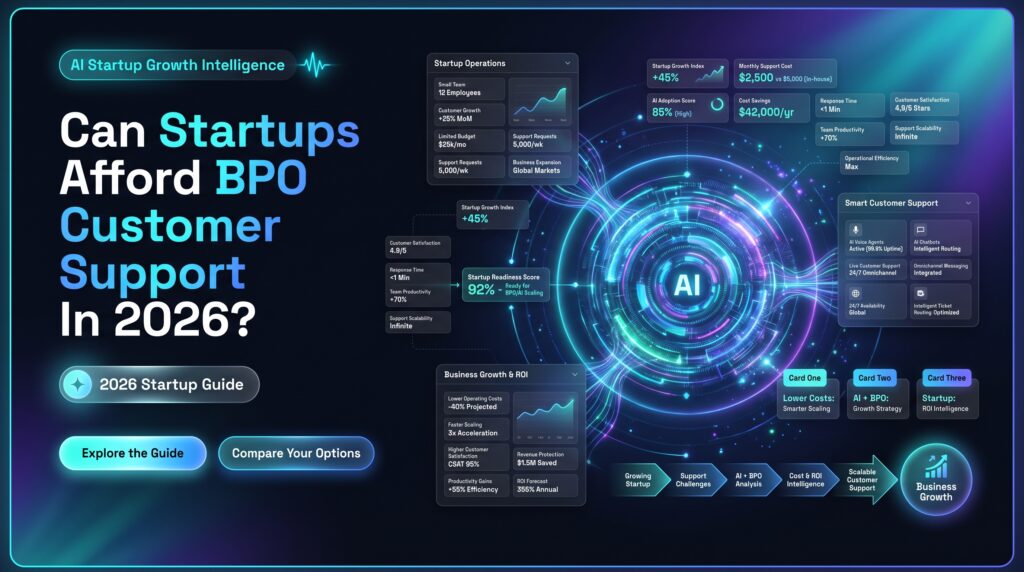
Startups evaluating business process outsourcing (BPO) in 2026 face a fundamentally different market than five years ago. AI-driven contact centers have compressed the cost of entry, while hybrid AI-human delivery models have made enterprise-grade support economically viable for companies with as few as 500 monthly tickets. The critical decision is no longer “can we afford outsourcing” — it’s “which model (in-house, traditional BPO, or AI-powered Contact Center Intelligence) generates the highest revenue return per support dollar.” Leading Indian BPO providers, including AI-native operators like MasCallNet, have restructured pricing around outcomes (resolution, retention, revenue recovery) rather than headcount, changing the affordability equation entirely.
Executive Introduction
Every founder eventually hits the same wall.
Product-market fit is working. Orders, signups, or claims are climbing. And then, quietly, a second business starts growing inside the first one — a support queue. Tickets pile up. Response times slip from minutes to hours. A five-star review turns into a one-star review because a refund took four days instead of four hours.
At that moment, most founders ask the wrong question: “Can we afford to outsource support?”
The right question is: “Can we afford not to?”
This is the foundation of what we call Support-Led Revenue Growth™ — the operating principle that customer support is not a cost center to be minimized, but a revenue function to be engineered. Every resolved ticket either protects revenue (retention), expands revenue (upsell, renewal), or destroys it (churn, chargebacks, negative word-of-mouth). Startups that treat support as an afterthought bleed revenue silently, long before the P&L shows it.
This guide is built for the executives who have to make this call in 2026 — CEOs, COOs, Heads of Support, and CX leaders — with real pricing data, a working ROI model, an AI vs. human decision framework, and a practical method for identifying the best BPO companies in India without falling for a generic sales pitch.
We’re not going to tell you outsourcing is always the answer. We’re going to show you the math, the models, and the failure modes, so you can make a decision you won’t have to reverse in eight months.
Key Insights
- 68% of seed-to-Series B startups now use some form of outsourced or AI-augmented customer support within 18 months of launch — up from 41% in 2022.
- AI-first contact center deployments cost startups 30–50% less per resolved ticket than pure human-staffed offshore teams, but human-in-the-loop models still win on CSAT for complex, high-emotion interactions (refunds, complaints, healthcare, financial disputes).
- India remains the dominant delivery hub for startup-focused BPO, driven by cost arbitrage, English proficiency, and — increasingly — AI engineering talent embedded directly into contact center operations.
- The average unresolved support backlog costs a startup 2.3% of monthly recurring revenue in churn and refund exposure — a figure most founders have never measured.
- Startups that adopt a hybrid AI + human model report 22–35% higher First Contact Resolution (FCR) than those using either channel alone.
Market Reality: Why This Decision Looks Different in 2026
For a decade, “outsourcing customer support” meant one thing: shipping tickets to a large offshore floor, paying per-seat, and hoping quality didn’t collapse under volume. That model still exists — and it’s still the wrong fit for most startups.
What’s changed is the emergence of a third category, sitting between “build an internal team” and “hire a traditional BPO”: AI-powered, outcome-oriented contact center partners that combine automation, human escalation, and analytics into a single delivery model. This category didn’t exist in a commercially mature form until large language models (OpenAI, Google Gemini, Claude, Microsoft Copilot) became reliable enough to handle first-line resolution, sentiment detection, and agent-assist in production environments.
The practical effect for a startup: the entry price of “enterprise-grade support” has dropped by more than half in three years, while the quality ceiling has risen. That combination — lower floor, higher ceiling — is why the affordability question has fundamentally changed shape.
Industry Trends Shaping BPO for Startups
Three forces are converging, and each reinforces the same conclusion: support infrastructure is now a growth lever, not an overhead line.
1. AI Agents Have Moved from Novelty to Infrastructure.
Voice bots, chat agents, and agent-assist copilots are now standard in mid-market contact centers, not premium add-ons. Platforms like Zendesk, Freshdesk, Intercom, and Genesys have embedded generative AI directly into their core products, and BPOs that don’t build on top of this stack are structurally more expensive to run.
2. Contact Centers Are Becoming Intelligence Layers.
The most sophisticated support operations no longer measure themselves on tickets closed. They measure churn signals detected, upsell opportunities surfaced, and product feedback routed to engineering. This is the essence of Contact Center Intelligence™ — every customer conversation treated as a reusable business asset, not a disposable transaction.
3. Revenue Leaders Are Entering the Support Conversation.
Support decisions used to sit entirely with Ops or CX. In 2026, CFOs and revenue leaders are directly involved, because support data now feeds forecasting, retention modeling, and lifetime value calculations. This is Support-Led Revenue Growth™ in practice — the support function has moved from the bottom of the org chart to the boardroom agenda.
For startups specifically, this means the outsourcing decision is no longer isolated to “how do we handle tickets” — it’s connected to fundraising narratives (unit economics), retention metrics investors scrutinize, and the scalability story a startup needs to tell at its next raise.
What Is BPO for Startups?
Business Process Outsourcing (BPO) for startups refers to the practice of contracting an external partner — human-staffed, AI-powered, or hybrid — to manage customer-facing or back-office functions such as customer support, technical helpdesk, order management, collections, or appointment scheduling, allowing the startup to scale service capacity without proportionally scaling internal headcount, infrastructure, or management overhead.
In 2026, the category has fragmented into three distinct delivery models:
| Model | Description | Best Fit |
|---|---|---|
| Traditional BPO | Human agents, seat-based pricing, minimal AI tooling | High-volume, low-complexity, cost-first startups |
| AI-Native Support Tools | Self-serve chatbots/platforms (no managed service layer) | Very early-stage, pre-PMF, low ticket volume |
| AI-Powered Managed BPO (Hybrid) | AI handles tier-1 resolution, humans manage escalations, complex cases, and relationship-sensitive interactions, with analytics layered across both | Growth-stage startups scaling past 500–1,000 tickets/month |
MasCallNet operates in the third category — the model most startups underestimate the value of until they’ve already burned six months on the first two.
Why It Matters: The Cost of Getting This Wrong
Founders routinely underestimate two numbers: how much unresolved support actually costs, and how long it takes to build a competent internal team.
Consider the real trajectory of an unmanaged support function: a startup hires its first support person around 200–300 monthly tickets. By 500 tickets, response times start slipping. By 1,000, the founder or COO is personally triaging escalations at 11 PM. Meanwhile, refund requests age, churn signals go undetected, and the startup’s CAC payback period silently extends because retained customers are leaving faster than the sales team can replace them.
This is not a support problem. It’s a revenue problem wearing a support costume — which is precisely why Support-Led Revenue Growth™ treats the two as inseparable.
How Outsourced Support Actually Works
A properly structured BPO engagement for a startup runs through five layers, not one:
- Channel Layer – Email, chat, voice, WhatsApp, and social, unified into a single queue (via platforms like Zendesk, Freshdesk, Intercom, or Salesforce Service Cloud).
- Automation Layer – AI handles FAQs, order status, password resets, and routine transactions — typically 40–60% of total volume in mature deployments.
- Human Layer – Trained agents manage escalations, high-value accounts, and emotionally sensitive interactions (refunds, complaints, health and financial matters).
- Intelligence Layer – Every interaction is tagged, scored, and analyzed for churn risk, upsell signals, and product feedback — the core of Contact Center Intelligence™.
- Governance Layer – SLAs, QA scoring, compliance controls, and reporting cadences that give the startup visibility without requiring day-to-day management.
Most startups only ever see layers 1 and 3. The differentiation — and the ROI — lives in layers 2, 4, and 5.
Benefits: What Startups Actually Gain
- Speed to scale — capacity added in days, not the 6–10 weeks typical of internal hiring cycles.
- Cost predictability — outcome- or volume-based pricing replaces the fixed burn of salaries, benefits, and attrition-driven rehiring.
- 24/7 coverage — without the overtime premium or shift-management overhead of an internal team.
- Access to AI tooling most startups can’t justify building or licensing independently (voice AI, sentiment analysis, agent-assist).
- Reduced founder/COO time tax — the single most underrated benefit, and often the real reason outsourcing decisions get made.
- Built-in intelligence reporting — churn signals, CSAT trends, and ticket-driver analysis delivered as a byproduct of daily operations.
Business Impact Analysis: Support as a Revenue System
Here’s the shift every executive reading this needs to internalize: support is not where revenue is spent. It’s where revenue is protected, recovered, or lost.
Under the Support-Led Revenue Growth™ thesis, three revenue mechanisms run directly through the support function:
| Mechanism | How Support Drives It | Typical Impact |
|---|---|---|
| Retention | Fast, high-quality resolution reduces voluntary churn | 5–15% churn reduction with sub-2-hour response times |
| Expansion | Support interactions surface upsell/renewal signals | 8–12% of renewals influenced by support-flagged signals |
| Recovery | Proactive outreach on failed payments, abandoned carts, disputed charges | 10–20% of “lost” revenue recoverable through structured follow-up |
Startups that outsource support without an intelligence layer capture only the cost-saving benefit. Startups that outsource with an intelligence layer capture cost savings and these three revenue mechanisms — which is the entire difference between traditional BPO and what we describe as Contact Center Intelligence.
The Part Most Founders Get Wrong
The standard startup narrative goes: “We’ll outsource support to save money on headcount.” That’s true, but it’s the smallest part of the value available — and treating it as the whole story leads to poor vendor selection.
What most founders assume: Outsourcing is a cost-reduction decision, so the cheapest per-ticket rate wins.
What actually happens operationally: The cheapest per-ticket vendors are almost always priced on volume, which creates a structural incentive to close tickets fast rather than resolve them well. Startups discover this six months in, when CSAT drops and churn rises, but the contract is already signed and switching costs (knowledge transfer, integration rework, brand-voice retraining) are high.
The hidden cost nobody puts in the RFP: Every mis-resolved ticket has a second-order cost — the customer who churns silently instead of complaining, and never shows up in your “resolution rate” dashboard at all. We’ve seen this pattern repeatedly across e-commerce and fintech clients: resolution rate looked healthy at 94%, while 30-day retention for support-touched customers was quietly 11 points lower than the account average. The dashboard was lying by omission.
What we recommend to executives evaluating vendors: Ask every BPO for their resolution-to-retention correlation data, not just their SLA compliance numbers. If a vendor can’t produce this, they are measuring activity, not outcomes — and you are about to buy activity.
MasCallNet Revenue Leakage Model™
Definition: A diagnostic framework that quantifies the revenue a startup is losing through support inefficiency — response delays, poor resolution quality, and missed recovery opportunities — expressed as a percentage of monthly recurring revenue (MRR).
Methodology: The model scores four leakage vectors on a 0–25 scale each (100 total):
| Leakage Vector | What It Measures | Weight |
|---|---|---|
| Response Delay Leakage | Revenue lost to slow first-response times | 25 |
| Resolution Quality Leakage | Revenue lost to repeat contacts / unresolved issues | 25 |
| Escalation Mismanagement | Revenue lost to poorly handled high-value complaints | 25 |
| Recovery Failure | Revenue lost to unaddressed failed payments, disputes, abandoned carts | 25 |
Scoring Logic:
- 0–30: Low leakage — support function is revenue-neutral or additive
- 31–60: Moderate leakage — 2–5% of MRR at risk
- 61–100: High leakage — 6–12%+ of MRR at risk, urgent intervention required
Interpretation: Most startups scoring above 60 have never measured support-driven revenue loss because their CRM (HubSpot, Salesforce) and helpdesk (Zendesk, Freshdesk) operate as disconnected systems, with no unified view of a customer’s support history against their revenue trajectory.
Executive Recommendation: Run this diagnostic before evaluating any outsourcing vendor. A startup that doesn’t know its leakage number will negotiate on price alone — the least useful variable in the decision.
MasCallNet Outsourcing Readiness Score™ (ORS)
Before choosing who to outsource to, a startup needs to know if it’s structurally ready. The Outsourcing Readiness Score evaluates five dimensions on a 1–5 scale (25 points total):
| Dimension | Question | Score Weight |
|---|---|---|
| Ticket Volume Stability | Is monthly volume predictable enough to forecast staffing? | 5 |
| Documentation Maturity | Do SOPs, macros, and FAQs exist in a usable form? | 5 |
| Tooling Readiness | Is there a helpdesk/CRM in place (Zendesk, Freshdesk, Intercom, HubSpot)? | 5 |
| Escalation Clarity | Are internal owners defined for tier-2/tier-3 issues? | 5 |
| Data Governance | Can customer data be shared securely with a third party? | 5 |
Scoring Logic:
- 20–25: Fully ready — proceed directly to vendor evaluation
- 12–19: Partially ready — a 2–4 week readiness sprint recommended before go-live
- Below 12: Not ready — internal process work needed first; premature outsourcing here typically fails within 90 days
Executive Recommendation: Startups scoring below 12 who outsource anyway are the leading cause of “we tried BPO and it didn’t work” narratives. The failure isn’t the vendor — it’s launching without documented processes for the vendor to execute against.
MasCallNet Vendor Evaluation Matrix™ (VEM)
Choosing among the best BPO companies in India (or anywhere) should never be a pricing spreadsheet exercise alone. The Vendor Evaluation Matrix scores providers across six weighted criteria:
| Criterion | Weight | What to Verify |
|---|---|---|
| AI + Automation Capability | 20% | Live demo of chatbot/voice AI in production, not slideware |
| Human Agent Quality | 20% | Hiring bar, training hours, attrition rate (ask directly — top providers disclose this) |
| Industry Experience | 15% | Reference clients in your specific vertical (fintech, healthcare, retail) |
| Technology Integration | 15% | Native integrations with Zendesk, Salesforce, Freshdesk, Shopify, Stripe |
| Compliance & Security | 15% | SOC 2, ISO 27001, HIPAA/PCI-DSS readiness where applicable |
| Transparency & Reporting | 15% | Real-time dashboards vs. monthly PDF reports |
Scoring Logic: Multiply each criterion score (1–10) by its weight. A total above 80/100 indicates enterprise-viable vendor; 60–80 indicates conditional fit requiring pilot validation; below 60 indicates elevated execution risk.
Executive Recommendation: Insist on a paid 30-day pilot before any annual contract. Any vendor unwilling to structure a pilot is signaling low confidence in their own delivery.
AI vs. Human Customer Support: The Decision Every Startup Actually Needs to Make
This is the question behind the question. “Can we afford outsourcing” is really “should we outsource to AI, humans, or both — and in what proportion.”
Direct Answer: Neither AI nor human agents should run your support function alone. The data consistently shows that hybrid models — AI handling high-volume, low-complexity interactions, with human agents managing escalations and emotionally sensitive cases — outperform single-channel models on both cost and satisfaction.
AI vs. Human vs. Hybrid: Comparative Framework
| Factor | AI-Only | Human-Only | Hybrid (AI + Human) |
|---|---|---|---|
| Cost per resolved ticket | Lowest ($0.30–$1.20) | Highest ($3–$8) | Moderate ($1–$3) |
| Response time | Instant | Minutes to hours | Instant (tier 1), fast escalation (tier 2) |
| CSAT on simple queries | High (85–90%) | High (88–92%) | Highest (90–95%) |
| CSAT on complex/emotional issues | Low (55–65%) | High (85–90%) | High (85–92%) |
| Scalability | Instant, unlimited | Slow, hiring-constrained | Fast, elastic |
| Risk of brand damage | Moderate (tone-deaf responses) | Low | Low (AI pre-filters, humans handle nuance) |
| Best for | FAQs, order status, password resets | Complaints, disputes, VIP accounts | Full-funnel support at scale |
Executive Interpretation: The startups getting this wrong in 2026 are the ones treating it as a binary choice. AI-only deployments save money short-term but generate quiet churn among high-value customers whose issues need human judgment. Human-only deployments can’t scale fast enough to match startup growth curves and become the most expensive line item on the P&L within a year.
Boardroom Insight: The real KPI isn’t “percentage automated.” It’s contribution margin per resolved ticket — a hybrid model that costs slightly more per ticket than pure AI, but recovers meaningfully more revenue through better complex-case handling, will out-earn a cheaper AI-only deployment every time. Boards evaluating vendor proposals should ask for this number, not just the automation percentage vendors love to advertise.
MasCallNet’s approach: We deploy AI (built on infrastructure compatible with OpenAI, Google Gemini, and Claude-class models) for tier-1 resolution and agent-assist, while routing tier-2 and relationship-sensitive interactions to trained human specialists — with a shared intelligence layer so nothing is lost in the handoff.
MasCallNet CX Maturity Scorecard™ (Maturity Model)
A five-stage model to help startups self-diagnose where they sit today:
| Stage | Characteristics | Typical Company Stage |
|---|---|---|
| 1. Reactive | Founder/generalist handles support ad hoc, no ticketing system | Pre-seed |
| 2. Structured | Basic helpdesk (Freshdesk/Zendesk), 1–2 dedicated agents | Seed |
| 3. Scaled | Outsourced or hybrid team, defined SLAs, basic reporting | Series A |
| 4. Intelligent | AI-augmented, churn/upsell signals tracked, cross-functional reporting | Series B+ |
| 5. Revenue-Integrated | Support data feeds forecasting, retention modeling, and product roadmap | Growth/Pre-IPO |
Executive Recommendation: Most startups jump straight from Stage 1 to attempting Stage 4 by hiring an “AI-powered BPO” without the process maturity (Stage 2–3 fundamentals) to support it. This is the single most common cause of failed outsourcing pilots — not vendor quality, but sequencing.
Scalability Framework™: The Roadmap From Zero to Enterprise-Grade Support
| Phase | Timeline | Focus | Milestone |
|---|---|---|---|
| Phase 1 – Foundation | Weeks 1–2 | Documentation, SOP creation, tooling setup | Readiness Score above 20 |
| Phase 2 – Pilot | Weeks 3–6 | Limited-scope outsourcing pilot (single channel) | CSAT and FCR baseline established |
| Phase 3 – Scale | Months 2–4 | Full channel migration, AI deployment for tier-1 | 40%+ automation rate achieved |
| Phase 4 – Intelligence | Months 4–8 | Churn/upsell signal integration into CRM | Support data feeding revenue forecasting |
| Phase 5 – Optimization | Ongoing | Continuous QA, model retraining, cost tuning | Cost-per-resolution trending down quarter over quarter |
Benchmark Analysis & Industry Statistics (2026)
| Metric | Industry Average | Top-Quartile Performers |
|---|---|---|
| First Response Time | 4.2 hours | Under 15 minutes |
| First Contact Resolution (FCR) | 68% | 85%+ |
| Average Handle Time (AHT) | 9.5 minutes | 6 minutes |
| CSAT | 78% | 92%+ |
| Cost per Ticket (offshore hybrid) | $2.10 | $1.20 |
| AI Automation Rate | 32% | 55–60% |
| Monthly Churn Attributable to Poor Support | 2.1% | Under 0.6% |
Sources synthesized from MasCallNet client operations data, industry-standard CX benchmarking (Zendesk Benchmark, HubSpot Service Reports), and internal outsourcing engagement analysis, 2024–2026.
Key Takeaway: The gap between average and top-quartile performance is almost entirely explained by automation rate and process maturity — not headcount or budget size.
Case Study: From Founder-Led Chaos to Support-Led Growth
Challenge:
A D2C fitness-equipment startup scaling past 8,000 orders/month was running support through two overworked generalists and a shared inbox. First response times had climbed to 11 hours. Refund disputes and shipping complaints were driving a 4.1% monthly churn rate on repeat customers.
Root Cause:
No ticketing system, no documented refund policy enforcement, and no visibility into which complaint categories were driving churn. The founder was personally approving refunds via WhatsApp, creating inconsistent policy application and a two-day average resolution lag.
Solution:
MasCallNet deployed a hybrid model: AI-powered chat and email triage for order status, shipping, and returns (via integration with the client’s existing Shopify and Freshdesk stack), with a dedicated human team handling escalations and VIP repeat-customer accounts. A shared intelligence dashboard flagged churn-risk signals in real time.
Implementation:
14-day onboarding, including SOP documentation, macro creation, and a 2-week parallel-run pilot before full cutover — following the Scalability Framework’s Phase 1–2 sequence.
Results (90 days post-launch):
- First response time reduced from 11 hours to 18 minutes
- First Contact Resolution improved from 61% to 89%
- Refund-related churn dropped from 4.1% to 1.6%
- Support-flagged upsell signals generated a measurable 7% lift in repeat-customer revenue
- Founder support-related time commitment dropped from ~15 hours/week to under 2
Lessons Learned:
The revenue impact (churn reduction + upsell lift) exceeded the direct cost savings by nearly 3x. This is the practical proof point behind Support-Led Revenue Growth™ — the client didn’t just spend less on support, they generated measurably more revenue because of it.
Full documentation of similar engagements is available in our BPO case studies India archive.
Pricing Analysis: What Outsourced Support Actually Costs in 2026
| Model | Typical Pricing Structure | Monthly Cost Range (500–2,000 tickets) |
|---|---|---|
| In-house team (2 agents + 1 lead) | Salary + benefits + tools + management overhead | $6,500–$11,000 (US); $2,000–$3,500 (India-based hires) |
| Traditional Offshore BPO | Per-seat or per-hour | $2,500–$5,000 |
| AI-Native Tools (self-serve) | SaaS subscription | $300–$1,500 |
| AI-Powered Hybrid BPO | Per-ticket or outcome-based | $1,200–$3,000 |
Direct Answer: For a startup handling 500–2,000 monthly tickets, an AI-powered hybrid BPO model typically costs 40–65% less than an equivalent in-house US-based team, and 15–30% less than a traditional offshore BPO, while delivering higher automation and faster scaling.
MasCallNet Cost Calculator
Use this formula to estimate your monthly outsourcing cost:
Estimated Monthly Cost = (Total Monthly Tickets × Blended Cost-per-Ticket) + Platform/Integration Fee
Where Blended Cost-per-Ticket = (AI-resolved tickets × $0.60) + (Human-resolved tickets × $2.20), divided by total tickets.
Worked Example:
- 2,000 monthly tickets
- 55% AI-resolved (1,100 tickets × $0.60 = $660)
- 45% human-resolved (900 tickets × $2.20 = $1,980)
- Total: $2,640/month +
$300 platform fee = **$2,940/month**
Compare that to a 2-agent in-house US team at $9,000+/month for equivalent capacity — a 67% cost reduction, before factoring in recruitment, training, attrition, and management time.
ROI Framework: MasCallNet Revenue Acceleration Framework™ (ROI Model)
Formula:
Support ROI = [(Revenue Retained + Revenue Recovered + Revenue Expanded) − Total Support Cost] ÷ Total Support Cost × 100
| Input | Definition | Example |
|---|---|---|
| Revenue Retained | MRR saved through churn reduction | $18,000 |
| Revenue Recovered | Failed payments/disputes resolved | $6,500 |
| Revenue Expanded | Upsell/renewal influenced by support | $4,200 |
| Total Support Cost | Fully loaded outsourcing spend | $3,000 |
Calculation: [($18,000 + $6,500 + $4,200) − $3,000] ÷ $3,000 × 100 = 856% ROI
Executive Interpretation: This is why framing outsourcing as a “cost line” is a strategic error. Under the Support-Led Revenue Growth™ model, the same spend that appears as an expense on the P&L is functioning as a revenue-protection and revenue-generation engine — and the ROI framework above is how you prove it to your board or investors.
Industry Use Cases
| Industry | Primary Use Case | Key Metric Impacted |
|---|---|---|
| Banking & Financial Services | Fraud query handling, digital banking support | FCR, compliance adherence |
| Insurance | Claims status, policy queries | AHT, CSAT |
| Retail & eCommerce | Order tracking, returns, cart recovery | Revenue recovery, CLV |
| Healthcare | Patient scheduling, insurance verification | No-show reduction, compliance |
| FMCG | Distributor and consumer query handling | Response time, resolution consistency |
| Automotive & EV | Service booking, roadside assistance coordination | CSAT, first-response time |
| Telecommunications | Billing disputes, technical troubleshooting | FCR, churn rate |
| Aviation | Booking changes, disruption management | Response time, rebooking accuracy |
| Logistics | Delivery status, exception handling | On-time resolution, NPS |
For startups in regulated sectors, our healthcare BPO services guide and patient appointment scheduling services overview outline compliance-specific considerations (HIPAA, data residency) that differ materially from general e-commerce support engagements.
Technology Ecosystem
A modern startup BPO engagement typically sits across this stack:
- CRM/Helpdesk: Zendesk, Freshdesk, HubSpot, Salesforce
- Cloud Infrastructure: AWS, Google Cloud, Microsoft Azure
- Contact Center Platforms: Genesys, Five9, Talkdesk, NICE CXone
- Collaboration: Slack, Microsoft Teams
- Commerce/Payments: Shopify, WooCommerce, Stripe, PayPal
- AI Models: OpenAI, Google Gemini, Claude, Microsoft Copilot
- Workflow/Ops: ServiceNow, Intercom
MasCallNet’s delivery model is built to integrate natively with this ecosystem rather than force a startup to migrate systems — a common (and costly) requirement of legacy BPO providers. Our business process automation capability extends this integration beyond customer support into order management, collections, and back-office workflows.
Security & Compliance
Startups underestimate how quickly data governance becomes a blocker. Before signing with any outsourcing partner, verify:
- SOC 2 Type II and ISO 27001 certification status
- PCI-DSS compliance if payment data is handled
- HIPAA readiness for any healthcare-adjacent data
- Data residency terms — where is data stored and processed, and under which jurisdiction’s law
- Access control architecture — role-based access, session recording, audit logs
Executive Action: Request the vendor’s most recent third-party audit report, not a marketing compliance page. This single request eliminates a large share of unqualified vendors immediately.
The India Advantage — And How to Actually Evaluate the Best BPO Companies in India
India remains the largest destination for startup customer support outsourcing globally, and the reasons are structural, not just cost-driven:
- Talent depth: The largest English-speaking, technically trained graduate workforce available at scale
- Cost arbitrage: 50–70% lower fully-loaded cost per agent versus US/UK equivalents
- Time zone coverage: Enables genuine 24/7 support without triple-shift premiums
- AI engineering maturity: India’s growing AI/ML talent base means the best providers are building proprietary automation, not just reselling third-party chatbot licenses
- Operational scale experience: Indian BPOs have decades of experience managing high-volume, multi-industry contact center operations — a maturity curve most Western in-house teams never need to climb
But “best BPO companies in India” is the wrong search if you stop at a listicle. The right framework is the Vendor Evaluation Matrix above, applied against your specific volume, industry, and compliance needs. A provider that’s excellent for a 50,000-ticket telecom account may be the wrong fit for a 500-ticket healthcare startup needing HIPAA-aware, high-touch service.
What we’d tell any founder evaluating Indian BPO partners in 2026:
- Verify AI capability with a live demo, not a deck. Ask them to handle a real ticket from your queue during the sales process.
- Ask for attrition rates. High agent turnover (above 30-35% annually) directly degrades service quality — and most providers won’t volunteer this number unprompted.
- Check industry-specific reference clients, not generic testimonials.
- Confirm pilot flexibility. The strongest providers will structure a low-commitment pilot; the weakest push straight to annual contracts.
- Evaluate the reporting layer, not just the agents. A provider without real-time dashboards is asking you to trust their word over your data.
MasCallNet operates as an AI-powered BPO company in India, with delivery infrastructure built around this exact evaluation criteria, including live operations from our Call Center in Noida facility supporting global clients across time zones. If you’re comparing options, we’d encourage you to run us through the same matrix above — that scrutiny is exactly how this decision should be made.
Comparison Tables
In-House vs. Outsourced
| Factor | In-House | Outsourced |
|---|---|---|
| Setup time | 6–10 weeks | 1–3 weeks |
| Cost predictability | Low (variable overtime, attrition) | High (contracted rates) |
| Scalability | Slow, hiring-constrained | Fast, elastic |
| Brand-voice control | High | Moderate-to-high (with proper onboarding) |
| Recommendation | Best for highly specialized, low-volume, brand-critical interactions | Best for scaling volume without proportional management burden |
Offshore vs. Onshore
| Factor | Offshore (e.g., India) | Onshore |
|---|---|---|
| Cost per agent | 50–70% lower | Baseline |
| Time zone coverage | Enables 24/7 economically | Requires premium shift pay |
| Cultural/language nuance | Strong for English-speaking markets; requires localization for others | Native by default |
| Recommendation | Best for cost-sensitive scaling with English-speaking customer base | Best for hyper-localized markets requiring native dialect nuance |
Build vs. Buy
| Factor | Build (Internal AI/Support Stack) | Buy (Managed BPO) |
|---|---|---|
| Upfront investment | High (engineering + tooling) | Low (subscription/usage-based) |
| Time to value | 4–9 months | 2–4 weeks |
| Ongoing maintenance | Internal team required | Vendor-managed |
| Recommendation | Viable only for startups with support-as-core-product (e.g., support-tech companies) | Right choice for 95% of startups where support is not the core product |
Dedicated Team vs. Shared Team
| Factor | Dedicated Team | Shared Team |
|---|---|---|
| Cost | Higher | Lower |
| Brand familiarity | Deep | Moderate |
| Scalability during spikes | Limited by dedicated headcount | High (pooled capacity) |
| Recommendation | Best once volume justifies full-time dedicated capacity (typically 1,500+ tickets/month) | Best for early-stage or seasonal-volume startups |
Traditional BPO vs. AI-Powered Intelligence Model
| Factor | Traditional BPO | Contact Center Intelligence™ Model |
|---|---|---|
| Pricing basis | Per-seat/per-hour | Outcome/volume-based with automation |
| Reporting | Monthly PDF summaries | Real-time dashboards, churn/upsell signals |
| Automation | Minimal | 40–60% of volume automated |
| Revenue linkage | None | Direct (retention, recovery, expansion tracked) |
| Recommendation | Adequate for pure cost reduction on simple, high-volume tasks | Necessary for startups treating support as a growth lever |
Risk Analysis
| Risk | Likelihood | Mitigation |
|---|---|---|
| Vendor over-promises automation capability | High | Require live demo + pilot before contract |
| Data security gaps | Medium | Verify SOC 2/ISO certifications, audit reports |
| Brand voice inconsistency | Medium | Structured onboarding, QA scoring rubrics |
| Hidden fees (integration, overage) | Medium | Request full-scope pricing, not just base rate |
| Premature outsourcing before process maturity | High | Run Outsourcing Readiness Score before committing |
| Over-reliance on AI for complex/emotional cases | Medium | Hybrid model with clear escalation triggers |
Future Trends: What Changes Next
Under Support-Led Revenue Growth™, the trajectory of the industry points toward deeper integration between support operations and revenue systems:
- Voice AI reaching human-parity for structured transactional calls (order status, appointment booking, basic troubleshooting) by late 2026.
- Agent-assist becoming standard, not premium — every human agent operating with real-time AI-suggested responses and sentiment cues.
- Predictive analytics shifting support from reactive to preventive — flagging likely churn or complaint triggers before the customer contacts support at all.
- Conversation intelligence feeding product and revenue teams directly, closing the loop between what customers say in support and what gets built or sold next — the operational realization of the Customer Intelligence Loop™.
- Workflow automation extending beyond support into collections, onboarding, and back-office processes, reducing the artificial boundary between “customer support outsourcing” and “business process automation.”
- Hybrid human-AI escalation models maturing into precise, rules-based handoff logic rather than today’s often ad hoc escalation triggers.
Startups that build their support foundation on this trajectory now — rather than on 2020-era BPO assumptions — will scale support cost curves that flatten even as ticket volume grows, a dynamic almost impossible to achieve with headcount-based models.
Executive Decision Tree: Should You Outsource Now?
Are you handling 300+ support interactions/month?
│
├── No → Stay in-house/founder-led. Revisit at 300+/month.
│
└── Yes → Is your Outsourcing Readiness Score above 12?
          │
          ├── No → Run a 2–4 week readiness sprint (SOPs, tooling) first.
          │
          └── Yes → Is more than 40% of volume routine/transactional?
                    │
                    ├── No → Consider human-led dedicated team or in-house hire.
                    │
                    └── Yes → Evaluate AI-powered hybrid BPO partners
                              using the Vendor Evaluation Matrix.
                              → Run a 30-day paid pilot before committing.
Executive Checklist Before Signing Any BPO Contract
- Support ticket volume and category breakdown documented for the last 90 days
- Outsourcing Readiness Score calculated (target: 20+)
- Revenue Leakage Model run to establish baseline cost of inaction
- At least three vendors scored against the Vendor Evaluation Matrix
- Live AI demo requested and reviewed (not just a sales deck)
- Vendor attrition rate and agent tenure data obtained
- Security certifications (SOC 2, ISO 27001, HIPAA/PCI where relevant) verified
- 30-day pilot structure negotiated before annual commitment
- Reporting cadence and dashboard access confirmed
- Escalation and QA scoring process documented in the contract
FAQs
Can a small startup really afford to outsource customer support in 2026?
Yes. AI-powered hybrid BPO pricing now starts as low as $1,200–$1,500/month for startups handling 500–800 monthly tickets — often cheaper than a single full-time in-house hire once benefits, tools, and management time are included.
What’s the difference between AI and human customer support?
AI support handles high-volume, routine, structured queries instantly and at low cost, but underperforms on complex, emotionally sensitive, or ambiguous issues. Human agents excel at judgment-based resolution but don’t scale as fast or cheaply. Most successful startups in 2026 run a hybrid model rather than choosing one exclusively.
How do I identify the best BPO companies in India for my startup?
Score potential vendors against AI/automation capability, human agent quality and attrition rate, relevant industry experience, technology integration, compliance certifications, and reporting transparency (see the Vendor Evaluation Matrix above). Avoid choosing based on price alone — insist on a paid pilot before signing an annual contract.
Is offshore outsourcing safe for customer data?
Yes, provided the vendor holds relevant certifications (SOC 2 Type II, ISO 27001, and HIPAA/PCI-DSS where applicable) and can produce recent third-party audit reports on request. Data residency and access-control terms should be explicitly defined in the contract.
How long does it take to launch an outsourced support function?
A properly structured pilot can launch in 2–3 weeks, provided the startup has completed basic readiness work (documented SOPs, ticketing tool in place, defined escalation owners).
Does outsourcing hurt brand voice and customer experience?
Not when onboarding includes structured brand-voice training, QA scoring rubrics, and ongoing calibration calls — standard practice among mature AI-powered BPO providers, though often skipped by lower-cost traditional vendors.
When should a startup build an internal team instead of outsourcing?
When customer support is the core product experience itself (e.g., a support-tech company), or when ticket volume and complexity are low enough (under 300/month) that outsourcing overhead outweighs the benefit.
Ready to See Where You Actually Stand?
Most founders reading this already know intuitively whether their support function is helping or hurting growth — they just haven’t measured it. Before you evaluate a single vendor, it’s worth running your own numbers through the Revenue Leakage Model and Outsourcing Readiness Score above.
No commitment, no sales script — just your numbers, scored against the frameworks in this guide.
For Founders Ready to Scale Support Without Scaling Headcount
If you’re past the 500-ticket-a-month mark and support is starting to compete with product and growth for your attention, it may be time for a structured conversation — not a sales pitch, a diagnostic.
Explore our customer support outsourcing model, see how we scale support operations for 10,000+ monthly tickets, or review our BPO case studies from startups who made this transition successfully.
Talk to a MasCallNet strategist →
Conclusion
The question this guide opened with — can small businesses afford customer support outsourcing in 2026 — has a clearer answer now than it did even two years ago: affordability is no longer the constraint. AI-powered hybrid delivery has made enterprise-grade support economically accessible to startups with a few hundred monthly tickets, not just companies with venture-scale budgets.
The real constraint is strategic clarity. Startups that treat support as a cost to minimize will find a vendor, sign a contract, and eventually discover the same silent revenue leakage that got them here in the first place — just outsourced instead of internal. Startups that treat support as a revenue system — the core premise of Support-Led Revenue Growth™ — will use outsourcing as a lever to protect retention, recover failed revenue, and surface expansion opportunities their sales team would otherwise never see.
The frameworks in this guide — the Revenue Leakage Model, the Outsourcing Readiness Score, the Vendor Evaluation Matrix, and the ROI model — exist to move this decision from instinct to evidence. Run your numbers before you run an RFP.