
Call Center vs Contact Center: Key Differences, Benefits & Which to Choose in 2026
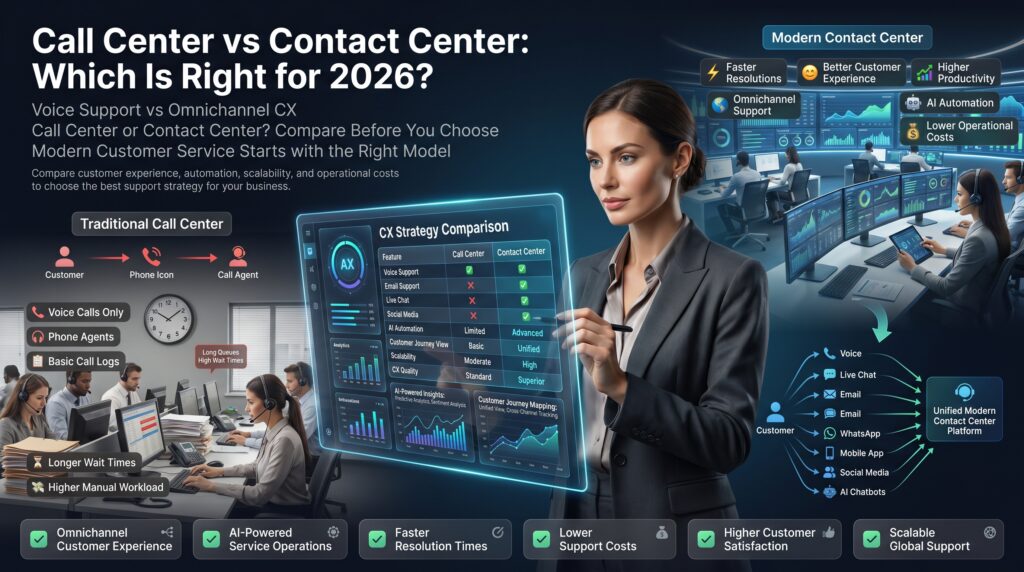
When businesses discuss customer service infrastructure, the terms “call center” and “contact center” are often used interchangeably — but they describe fundamentally different operations. Understanding the call center vs contact center distinction is critical for businesses making strategic customer experience investments in 2026.
This guide breaks down everything you need to know: definitions, key differences, technology stacks, cost considerations, and how to decide which model fits your business goals.
What Is a Call Center?
A call center is a centralized facility or team dedicated exclusively to handling inbound and outbound telephone calls. Agents communicate with customers through voice calls — that’s the entirety of the channel stack.
Call centers have been a cornerstone of customer service since the 1960s, when companies first began routing customer calls through dedicated phone lines. Today, traditional call centers still serve businesses that rely primarily on phone-based interactions, such as healthcare appointment scheduling, utilities, and financial services requiring verbal verification.
Core Characteristics of a Call Center
- Single channel: Voice and telephone only
- Inbound or outbound focus: Handles incoming support calls or makes outgoing sales, collection, or survey calls
- ACD systems: Uses Automatic Call Distribution to route calls to available agents
- IVR menus: Interactive Voice Response systems guide callers through menus before reaching a live agent
- Metrics focus: Average Handle Time (AHT), First Call Resolution (FCR), and calls-per-hour
Call centers remain effective for businesses where customers predominantly prefer phone communication and where interactions require the nuance of a live voice conversation.
What Is a Contact Center?
A contact center is an evolved, multi-channel customer service operation that handles interactions across voice, email, live chat, SMS, social media, video, and more — all managed from a unified platform.
The contact center definition has expanded significantly since its emergence in the 1990s, when email and internet adoption first forced businesses to manage customer interactions beyond the telephone. Today, modern contact centers are software-driven, cloud-based operations built on CCaaS (Contact Center as a Service) platforms that meet customers on every channel they use.
Core Characteristics of a Contact Center
- Omnichannel capability: Manages voice, email, live chat, SMS, social media, and video
- Unified agent desktop: One interface handles all channels simultaneously
- CCaaS platforms: Cloud-based software such as Five9, Genesys Cloud, NICE CXone, and Amazon Connect
- AI integration: Chatbots, virtual agents, sentiment analysis, and real-time agent guidance
- Advanced analytics: Customer journey tracking across all touchpoints and channels
- CRM integration: Full customer history visible to agents regardless of channel
What is a contact center in practical terms? It is a customer service ecosystem engineered for today’s multi-channel consumer — one who may start a conversation on chat, continue via email, and resolve it over the phone, expecting the agent to know the full context throughout.
Call Center vs Contact Center: The Key Differences
Here is a comprehensive breakdown of the call center vs contact center differences across every critical dimension:
| Feature | Call Center | Contact Center |
|---|---|---|
| Communication Channels | Voice/telephone only | Voice, email, chat, SMS, social, video |
| Technology Platform | ACD, IVR, PBX hardware | CCaaS cloud platform |
| Agent Interface | Single-channel phone system | Unified omnichannel desktop |
| Customer Journey View | Siloed, phone-only history | Unified cross-channel view |
| AI Capabilities | Basic IVR automation | Advanced AI, chatbots, real-time coaching |
| Scalability | Hardware-dependent, slow | Cloud-scalable on demand |
| Cost Structure | Lower setup cost | Higher investment, stronger ROI at scale |
| Analytics | Call metrics only | Cross-channel journey analytics |
| CRM Integration | Basic or manual | Deep, real-time integration |
| Deployment Model | On-premise common | Cloud-first standard |
| Best For | High-volume phone support | Omnichannel customer experience |
| Work-from-Home Ready | Limited | Fully supported |
Channels: Voice-Only vs Omnichannel
The most fundamental difference in the call center vs contact center debate is channel scope. This distinction shapes everything — technology, agent training, analytics, and customer satisfaction outcomes.
Call Center Channels
Call centers handle:
- Inbound voice calls: Customer support, technical help, billing queries
- Outbound voice calls: Sales outreach, appointment reminders, collections, post-service surveys
That is the complete channel inventory. When a customer sends an email or initiates a chat, that interaction exists entirely outside the call center’s scope — often creating disjointed, frustrating customer experiences.
Contact Center Channels
Modern contact centers manage every digital and voice channel a customer uses:
- Voice — inbound and outbound calls
- Email — ticketed, tracked, routed by agent skill
- Live chat — website and in-app conversations
- SMS and text messaging — mobile-first support
- Social media — Facebook, Instagram, Twitter/X, LinkedIn
- Messaging apps — WhatsApp, Apple Business Chat
- Video chat — high-touch support and visual troubleshooting
- Self-service portals and AI chatbots — automated Tier-1 resolution
The critical advantage: customers can switch channels mid-journey without starting over. An agent handling a voice escalation from a chat interaction sees the full conversation history in real time — no customer repetition, no agent confusion.
Research consistently shows that 71% of consumers expect personalized, channel-consistent interactions. A voice-only call center model structurally fails this expectation for a growing segment of the customer base.
Technology: Traditional ACD vs Modern CCaaS
Technology is where the call center vs contact center gap widens most dramatically. The infrastructure underpinning each model is fundamentally different.
Call Center Technology Stack
Traditional call centers are built around:
- PBX (Private Branch Exchange): The hardware routing system for all incoming and outgoing calls
- ACD (Automatic Call Distribution): Queues and routes calls to agents based on availability and skill
- IVR (Interactive Voice Response): Automated voice menus that guide callers before agent connection
- CTI (Computer Telephony Integration): Connects the phone system to agent workstations
- On-premise servers: Hardware-dependent infrastructure with fixed capacity ceilings
This stack operates reliably but requires significant capital expenditure, dedicated IT support, and months of lead time for scaling capacity. Maintenance windows and hardware failures create service disruptions that cloud systems eliminate.
Contact Center Technology Stack
Modern contact centers are built on CCaaS architecture:
- CCaaS platforms: Cloud-based, subscription-model contact center software deployed in weeks, not months
- Omnichannel routing engines: Intelligently route any interaction type to the best available agent based on skill, language, and customer history
- AI and machine learning: Real-time sentiment analysis, agent next-best-action coaching, and predictive routing
- Conversational AI: Virtual agents and chatbots that autonomously resolve Tier-1 inquiries across all channels
- Workforce Management (WFM): AI-driven forecasting, scheduling, and real-time adherence monitoring
- Real-time analytics dashboards: Live visibility into KPIs across every channel simultaneously
- Open API architecture: Pre-built connectors to CRM, ERP, e-commerce platforms, and custom tools
Leading CCaaS platforms in 2026 include Genesys Cloud CX, NICE CXone, Five9, Talkdesk, Amazon Connect, and Twilio Flex. These platforms eliminate on-premise hardware and scale elastically to match demand spikes without procurement cycles.
Cost Comparison: Call Center vs Contact Center
The cost calculus between these models is more nuanced than simple license pricing suggests.
Call Center Costs
- Lower initial investment: Simpler infrastructure with one channel to provision and manage
- Per-seat licensing: Single-channel tools run approximately $50–$150/month per agent for cloud-based solutions
- Hidden costs: On-premise hardware maintenance, limited scalability ceiling, agent inefficiency without self-service automation
- Churn risk: Customers who cannot reach support on preferred channels leave, and replacement acquisition costs far exceed retention costs
Contact Center Costs
- Higher per-seat licensing: Omnichannel CCaaS platforms run $80–$300+ per agent per month depending on feature tier
- AI automation ROI: Chatbots and virtual agents deflect 20–40% of contact volume, reducing headcount requirements significantly
- Efficiency gains: Unified agent desktops cut average handle time; integrated CRM eliminates after-call research
- CSAT and retention impact: Omnichannel CX reduces churn, increasing customer lifetime value
- Outsourcing economies: When partnering with a managed contact center provider, cost-per-interaction often beats building and operating in-house
The bottom line: Call centers cost less to start. Contact centers typically deliver superior total cost of ownership at scale, particularly when AI automation, reduced churn, and outsourcing efficiencies are factored into the ROI analysis.
When to Choose a Call Center
A traditional call center remains the right choice in specific scenarios:
- Voice-dominant customer base: Older demographics or regulated industries (legal, certain financial services) where customers consistently prefer telephone
- Highly complex interactions: Cases requiring verbal negotiation, legal nuance, or sensitive conversations that benefit from voice tone
- Constrained budget: Early-stage businesses where multichannel infrastructure investment cannot be justified yet
- Low digital demand: Markets where customers have not adopted chat or digital channels meaningfully
- Regulatory requirements: Industries where voice recordings serve as the primary compliance interaction record
- Simple, high-volume inquiries: Standardized interactions like appointment scheduling or order status where voice scripts are effective
Typical use cases: Local healthcare scheduling lines, regional utilities, legal intake services, small financial advisory firms.
When to Choose a Contact Center
A contact center is the strategic investment when:
- Digital-first customer expectations: Millennial, Gen Z, and digitally active customers expect chat, SMS, and social support as baseline capabilities
- Multi-channel contact volume: Email queues, social media mentions, and live chat volumes alongside phone demand an integrated management solution
- CX as a competitive differentiator: Customer experience is a top-three differentiator in most B2C and B2B markets today
- Scalability requirements: Seasonal spikes, rapid growth, or geographic expansion demands cloud elasticity
- AI-driven efficiency goals: Automation, chatbots, and agent assist tools require a modern CCaaS foundation
- Outsourcing strategy: Professional BPO and outsourcing partners universally operate contact center infrastructure, not legacy call center systems
- Remote and distributed teams: Cloud-based contact centers enable fully distributed, work-from-home agent deployments
Typical use cases: E-commerce retailers, SaaS companies, healthcare systems, financial services, travel and hospitality, telecommunications providers.
The Future: Why Businesses Are Moving to Contact Centers
The trajectory is unambiguous: businesses are migrating from call centers to contact centers at an accelerating pace. Several converging forces are driving this transition:
1. Evolving Customer Expectations
Customers now rate ease of contact and channel flexibility as primary drivers of brand loyalty. Restricting contact to a single voice channel is a structural CX disadvantage that grows more pronounced each year.
2. Digital Channel Volume Growth
Chat and messaging interaction volumes surpassed voice in many industries by 2024. Businesses without digital channel capabilities are losing customer touch points to competitors who offer them.
3. AI and Automation Maturity
Modern contact center AI resolves Tier-1 inquiries autonomously at scale, cutting cost-per-contact dramatically. Call-center-only operations lack the channel diversity to deploy these tools effectively.
4. Cloud Economics
CCaaS has democratized contact center technology. Infrastructure that once required multi-million-dollar on-premise investment now deploys in weeks for a predictable monthly subscription. The barrier to entry has collapsed.
5. Distributed Workforce Models
Cloud-based contact centers enable remote and distributed agent teams, cutting facility costs and expanding global talent pools simultaneously — a structural advantage call center on-premise models cannot match.
6. Competitive Pressure
When competitors offer omnichannel support and you offer voice-only, customers notice. In markets with low switching costs, this asymmetry becomes a measurable churn driver.
AI in Call Centers vs Contact Centers
Artificial intelligence is transforming customer service delivery — but the scope of impact differs significantly between the two models.
AI Applications in Call Centers
- Advanced IVR and voice bots: AI-powered voice systems handle more complex pre-agent routing and intent capture
- Speech analytics: Automatically transcribes and analyzes call recordings for quality assurance and trend identification
- Predictive dialing: AI optimizes outbound call timing and contact sequencing for maximum answer rates
- Post-call sentiment analysis: Assesses customer satisfaction and agent performance at the call level
AI Applications in Contact Centers
- Omnichannel virtual agents: AI chatbots and voice bots deployed simultaneously across every channel
- Real-time agent assistance: AI analyzes live conversations and surfaces knowledge articles, compliance alerts, and next-best-action recommendations
- Predictive routing: Matches customers to the optimal agent based on skill, sentiment, interaction history, and purchase intent
- Cross-channel conversational analytics: Identifies patterns, gaps, and coaching opportunities across all channels simultaneously
- Automated quality assurance: AI scores 100% of interactions vs. the 3–5% manual sampling typical in traditional QA programs
- Customer intent prediction: Identifies the reason for contact before the agent answers, enabling faster resolution
AI in a contact center compounds across channels — intelligence gathered from chat interactions improves voice AI, and vice versa. This cross-channel learning flywheel is unavailable in a voice-only call center environment.
How Outsourcing Fits Both Models
Outsourcing is a viable cost and capability strategy for both models, but the economics and outcomes differ materially.
Outsourced Call Centers
Traditional call center BPO (Business Process Outsourcing) has existed for decades. Offshore providers in the Philippines, India, Colombia, and Eastern Europe offer voice-only services at competitive per-agent rates. These operations are commoditized but effective for high-volume, standardized phone interactions where voice quality and script adherence are the primary variables.
Outsourced Contact Centers
Modern contact center outsourcing partners operate enterprise CCaaS infrastructure, delivering clients access to omnichannel technology without capital investment. The outsourcing partner manages:
- CCaaS licensing, configuration, and ongoing maintenance
- Omnichannel routing logic and AI implementation
- Workforce management, scheduling, and quality assurance
- 24/7 coverage across time zones and geographies
- Continuous technology upgrades without client disruption
For businesses that want contact center capabilities without building the infrastructure internally, outsourcing to a specialized partner delivers the best of both worlds: enterprise contact center technology with the cost efficiency and operational flexibility of outsourcing.
Mascallnet Contact Center Services
Mascallnet offers fully managed contact center services engineered for businesses ready to modernize their customer experience. Our model combines human expertise with advanced AI to deliver exceptional CX at scale — without requiring clients to build or maintain the underlying infrastructure.
Our core capabilities include:
- 360° Customer Support: Full-spectrum omnichannel support across voice, live chat, email, SMS, and social media — unified in a single operation
- CallMaster Platform: Proprietary contact center technology enabling intelligent routing, AI-driven agent assistance, and real-time performance analytics
- AI Automation: Automated Tier-1 resolution that reduces cost-per-contact by up to 40% while maintaining CSAT scores
- Hybrid Outsourced Support: 24/7 multichannel coverage combining AI automation and live agents for seamless escalation management
- Scalable Outsourcing Solutions: Handle high-volume contact at reduced cost while maintaining the flexibility to scale rapidly with business growth
Whether you are transitioning from a legacy call center to a modern contact center, or building a customer service operation from scratch, Mascallnet provides the infrastructure, technology, and expertise to execute at any scale.
Frequently Asked Questions
What is the main difference between a call center and a contact center?
The primary difference is channel scope. A call center handles only voice and telephone interactions. A contact center manages multiple communication channels — voice, email, live chat, SMS, social media, and more — from a single unified platform with a shared agent desktop and analytics infrastructure.
Is a contact center better than a call center?
For most modern businesses, yes. Contact centers deliver superior customer experience by meeting customers on their preferred channels and enabling seamless multi-channel journeys. However, call centers remain appropriate for businesses with predominantly voice-dependent customer bases or highly constrained technology budgets.
What does “contact center” mean exactly?
A contact center is a customer service operation that manages all forms of customer communication — not just phone calls. It uses cloud-based CCaaS software to route, track, and analyze interactions across every channel in a unified system, giving both agents and managers a complete view of the customer relationship.
What is the difference in technology between call centers and contact centers?
Call centers use traditional ACD, IVR, and PBX phone systems — often on-premise hardware with fixed capacity. Contact centers use cloud-based CCaaS platforms with omnichannel routing engines, AI automation, real-time analytics dashboards, and deep CRM integrations that work across all channels simultaneously.
Can a call center be converted into a contact center?
Yes. Many businesses migrate by adopting a CCaaS platform that adds digital channels alongside existing voice infrastructure. The transition can be phased — launching chat or email first — before expanding to full omnichannel capability. Outsourcing partners can accelerate this migration significantly.
What channels does a modern contact center support?
Modern contact centers support voice (inbound/outbound), email, live chat, SMS and text messaging, social media (Facebook, Instagram, Twitter/X, LinkedIn, WhatsApp), video chat, and AI-powered self-service chatbots — all managed from a unified platform.
Is a contact center more expensive than a call center to operate?
Per-seat licensing is typically higher for omnichannel CCaaS contact center software. However, contact centers frequently achieve lower total cost of ownership through AI-driven contact deflection (20–40%), higher first-contact resolution rates, reduced churn from superior CX, and the operational efficiency of managing all channels in one system.
What is a CCaaS platform and which ones lead the market?
CCaaS (Contact Center as a Service) is cloud-delivered contact center software offered on a subscription basis. It eliminates on-premise hardware and enables rapid scaling. Market leaders in 2026 include Genesys Cloud CX, NICE CXone, Five9, Talkdesk, Amazon Connect, and Twilio Flex.
How does AI improve contact centers compared to call centers?
Contact centers deploy AI across every channel simultaneously — chatbots for self-service, real-time agent assist tools during live interactions, predictive routing, omnichannel sentiment analysis, and automated QA covering 100% of interactions. Call centers access a narrower subset of these capabilities, primarily limited to voice AI. The cross-channel learning effect in contact centers compounds AI performance over time in ways that voice-only environments cannot replicate.
Which industries benefit most from contact centers vs call centers?
Contact centers are the optimal choice for e-commerce, SaaS, financial services, healthcare systems, travel and hospitality, and telecommunications — industries with high digital channel demand and customer expectations for seamless multi-channel journeys. Call centers remain well-suited for businesses like local healthcare scheduling services, legal intake operations, or niche financial products where phone-only interactions are the established customer norm.
Ready to upgrade from a call center to a full contact center operation? Explore Mascallnet’s contact center services to learn how we help businesses scale customer experience without the infrastructure overhead.