
Omnichannel Customer Support: The Complete Strategy Guide for 2026
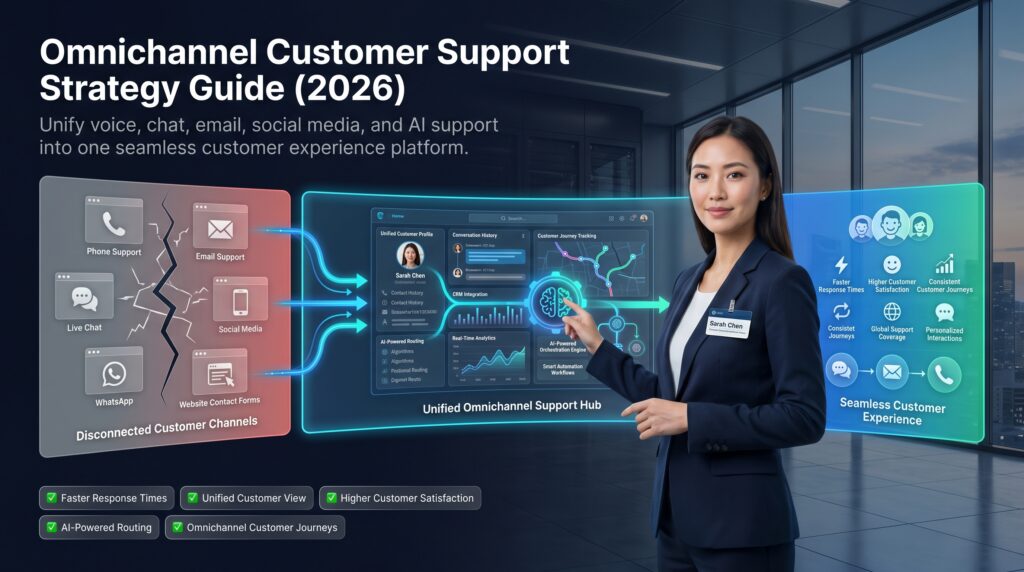
Omnichannel Customer Support: The Complete Strategy Guide for 2026
In 2026, omnichannel customer support is no longer a competitive advantage — it is the baseline expectation. Customers move seamlessly between phone, chat, email, social media, and SMS, and they expect your support team to follow them every step of the way with full context, zero repetition, and instant resolution. Organizations that fail to unify these touchpoints are losing customers silently: 73% of consumers will switch to a competitor after just one frustrating, disconnected support experience.
This guide breaks down exactly what omnichannel customer support means in practice, how it differs from multichannel approaches, the technology that powers it, and a proven seven-step framework for building a strategy that reduces costs, improves satisfaction scores, and scales with your business.
What Is Omnichannel Customer Support?
Omnichannel customer support is a unified approach to customer service where every communication channel — voice, live chat, email, social media, SMS, and self-service portals — shares a single, continuously updated record of each customer’s history and current issue.
When a customer opens a chat on Monday, calls on Tuesday, and sends a follow-up email on Wednesday, an omnichannel system ensures each agent picks up the thread exactly where it left off. No re-explaining. No re-verifying. No starting over.
The core principle is continuity of context. Every interaction, regardless of channel, feeds into a unified customer profile that is visible to every agent and every system in your support stack.
Key insight: Omnichannel is not just about being present on multiple channels — it is about connecting those channels so deeply that the customer experience feels like a single, continuous conversation.
Omnichannel vs. Multichannel Support: What Is the Difference?
The terms are often used interchangeably, but they describe fundamentally different architectures — and the gap in outcomes between them is significant.
| Dimension | Multichannel Support | Omnichannel Support |
|---|---|---|
| Channel integration | Each channel operates in its own silo | All channels share a unified data layer |
| Customer context | Lost when switching channels | Persists across all channel transitions |
| Agent experience | Separate queues and interfaces per channel | Single unified desktop with full history |
| Routing intelligence | Volume-based or skill-based per channel | Intent- and context-aware across channels |
| Customer effort | High — repeat context often required | Low — seamless handoffs with full context |
| Analytics capability | Siloed by channel; cross-channel view limited | Unified journey analytics across all touches |
| CSAT impact | Moderate — presence across channels helps | Strong — unified experience drives loyalty |
| Implementation complexity | Low — additive channel-by-channel | Higher — requires platform and data integration |
The practical implication: a multichannel approach checks the box of “being available” on many platforms. An omnichannel approach actually serves customers on those platforms in a way that builds trust and reduces resolution time.
The Business Case: Why Omnichannel Support Matters in 2026
Customer expectations have not merely risen — they have accelerated. Research published in the last two years paints a clear picture of where the market has landed:
- Customers who receive consistent cross-channel service are 3.9x more likely to purchase again and spend 30% more over their lifetime with a brand.
- Companies with strong omnichannel engagement strategies retain an average of 89% of their customers, compared to 33% for those with weak omnichannel capabilities.
- First-contact resolution rates improve by up to 27% when agents have full cross-channel context available at the moment of interaction.
- Average handling time drops by 15–20% when agents do not need to ask customers to repeat information they already provided on a previous channel.
- 67% of customers expect their issue to be resolved in a single interaction regardless of channel — a number that has risen sharply from 54% in 2022.
The cost case is equally compelling. When AI-assisted routing, shared knowledge bases, and self-service deflection are integrated across all channels, support organizations consistently report cost-per-contact reductions in the range of 20–35% without sacrificing quality.
For a deeper look at how these economics play out at enterprise scale, see our analysis of 24/7 customer support outsourcing as an enterprise growth engine.
Core Channels in an Omnichannel Support Strategy
A mature omnichannel strategy integrates all of the following touchpoints into a unified experience layer:
Voice (Phone)
Despite the rise of digital channels, phone support handles the highest-complexity, highest-emotion cases. In an omnichannel environment, inbound calls are enriched with the caller’s full digital history — recent chat transcripts, submitted tickets, and previous purchases — so agents can resolve issues faster without interrogating the customer on context they have already provided.
Live Chat and Messaging
Web chat and in-app messaging now account for the largest volume of digital support contacts across most industries. When integrated into an omnichannel platform, chat sessions can be transferred to voice or email mid-conversation without losing the thread, and AI copilots can surface relevant knowledge articles in real time to reduce agent handle time.
Email remains critical for complex, documentation-heavy cases. In an omnichannel model, email threads are linked to the same case record as all other channel interactions. Agents can see that a customer already called about the same issue and tailor their response accordingly.
Social Media
Public social channels — Instagram, X (formerly Twitter), Facebook — function as both a support channel and a reputation management layer. Omnichannel platforms pull social mentions and DMs into the same queue as all other contacts, enabling agents to respond consistently and track sentiment across the customer’s full journey.
SMS and Messaging Apps
SMS and WhatsApp have become preferred support channels for mobile-first customer segments. They offer conversational immediacy without requiring app downloads or desktop access. In an omnichannel stack, these channels are treated as first-class citizens with full context persistence.
Self-Service and Knowledge Base
Intelligent self-service — FAQs, interactive troubleshooting guides, AI-powered chatbots — is the most cost-efficient resolution path when properly integrated. Omnichannel self-service tracks what a customer tried before escalating to a live agent, so the agent immediately knows which solutions have already been attempted and can skip straight to next-level resolution.
How to Build an Omnichannel Support Strategy: The 7-Step Framework
Moving from multichannel presence to true omnichannel delivery is a structured transformation. Here is the framework our team uses when building or overhauling omnichannel customer support operations:
Step 1: Map the Customer Journey End-to-End
Before deploying any technology, document every touchpoint a customer encounters from first awareness through post-purchase support. Identify where channel transitions happen, where context is currently dropped, and where customer effort is highest. Journey mapping reveals the specific integration gaps that your omnichannel strategy needs to close.
Step 2: Consolidate Data Into a Unified Customer Profile
Every channel generates data — interaction history, sentiment signals, product usage, purchase records. True omnichannel requires a single customer data layer (typically a CRM or Customer Data Platform) that aggregates all of this in real time. Without unified data, you have channels but not a strategy.
Step 3: Select and Integrate an Omnichannel Platform
Choose a contact center platform that natively supports all your active channels with shared routing, shared case management, and shared analytics. Critical selection criteria include: pre-built CRM connectors, AI-native routing capabilities, open APIs for custom integrations, and real-time reporting across all channels from a single dashboard. Our contact center services infrastructure is built on exactly this kind of unified architecture.
Step 4: Design Intelligent Routing Across Channels
Context-aware routing is one of the highest-leverage capabilities in an omnichannel stack. Rather than routing based solely on channel or queue availability, intelligent routing uses customer history, intent signals, issue type, and agent skill profile to match every contact to the best available resource — regardless of which channel it arrives on.
Step 5: Train Agents for Channel-Agnostic Service Delivery
Agents in an omnichannel environment need to work across multiple channels within a single shift, often handling channel transfers mid-interaction. Training must cover both the technical operation of the unified desktop and the soft skills required to maintain conversation continuity when a customer moves from chat to phone. Staffing for omnichannel also differs from single-channel models — see our guide to hybrid outsourced customer support for 24/7 multichannel service.
Step 6: Deploy AI and Automation Strategically
AI in an omnichannel context serves three distinct functions: (1) deflection via intelligent self-service before escalation, (2) agent assistance via real-time knowledge surfacing and response suggestions during live interactions, and (3) post-interaction analytics to identify patterns, coaching opportunities, and systemic issues. Deploying AI across all three layers multiplies its impact. The CallMaster platform integrates all three AI layers natively into the omnichannel workflow.
Step 7: Measure, Iterate, and Optimize Continuously
Omnichannel is not a launch — it is a continuous improvement cycle. Establish baseline metrics before go-live, set 30/60/90-day improvement targets, and build a cadence of regular review that treats cross-channel journey analytics as the primary signal rather than per-channel performance in isolation.
Technology Requirements for Omnichannel Support
The technology stack underpinning a modern omnichannel customer support operation has five core layers:
CRM or Customer Data Platform
The source of truth for unified customer profiles. Must integrate bidirectionally with all channel systems to ensure every interaction updates the record in real time. Common choices include Salesforce Service Cloud, HubSpot Service Hub, and Zendesk with connected data integrations.
Omnichannel Contact Center Platform
The operational layer where agents work, queues are managed, and routing logic executes. Must support voice, digital channels, and back-office workflows from a single unified interface. Cloud-native platforms offer the integration flexibility and scalability that on-premise alternatives typically cannot match.
AI and Automation Layer
Encompasses conversational AI for self-service, AI-assisted routing and triage, agent copilot capabilities (real-time suggestions, knowledge retrieval, sentiment analysis), and post-call AI for QA automation and pattern detection.
Workforce Management
Omnichannel staffing is inherently more complex than single-channel scheduling. Workforce management tools must forecast demand across all channels simultaneously and account for the cross-channel blending that defines omnichannel operations.
Analytics and Reporting
Unified analytics that span all channels are non-negotiable. You need to track customer journey paths across channels, measure channel-switching rates, and attribute resolution outcomes to the full interaction sequence — not just the last channel used.
Our customer experience management solutions integrate all five layers into a managed service that can be deployed in weeks rather than months.
Omnichannel Metrics to Track
Measuring omnichannel performance requires a metrics framework that captures both individual channel performance and cross-channel journey health:
Customer Satisfaction Score (CSAT)
Track CSAT at the channel level and at the journey level — a customer who moved across three channels to get a resolution should be surveyed on the overall experience, not just the final touchpoint. Omnichannel CSAT should show improvement within 90 days of full integration going live.
First Contact Resolution (FCR)
In an omnichannel context, FCR must be measured across the entire case, not per channel. A customer who calls once, chats once, and gets resolved on email has a one-case FCR of 100% — tracking it correctly requires cross-channel case linkage.
Average Handle Time (AHT)
AHT typically drops when agents have full context available at the start of an interaction. Monitor AHT both pre- and post-omnichannel integration to quantify the efficiency gain from eliminating context recovery at the start of each contact.
Net Promoter Score (NPS)
NPS at the relationship level (measured quarterly or annually) reflects the cumulative effect of all interactions, not any single touchpoint. Omnichannel improvements show up in NPS over a 6–12 month horizon as the reduction in effort and friction compounds.
Channel Transfer Rate
The percentage of interactions that involve a customer moving from one channel to another within a single case. A high transfer rate is not inherently bad — it means channels are being used appropriately — but a high transfer rate with low FCR indicates the transitions are not being handled with adequate context handoff.
Customer Effort Score (CES)
CES directly measures the friction customers experience in getting issues resolved. In an omnichannel environment, CES improvements are the most direct indicator that cross-channel context continuity is working as intended.
Self-Service Containment Rate
The percentage of issues resolved via self-service without escalating to a live agent. In a well-integrated omnichannel stack, self-service containment rates of 40–60% are achievable for common issue types, with significant cost implications.
Common Omnichannel Challenges and How to Solve Them
Challenge: Data Silos Between Legacy Systems
Solution: Prioritize CRM integration as the first step of any omnichannel initiative. Use middleware or integration platforms (like MuleSoft or Boomi) to bridge legacy systems that do not have native connectors to your omnichannel platform. In the interim, build context summary workflows that pull key data points from siloed systems into a unified agent view.
Challenge: Agent Resistance to Multi-Channel Workflows
Solution: Involve agents in the platform selection and configuration process. Pilot with volunteer agents who are already comfortable with digital tools, then use their feedback and success stories to build buy-in across the broader team. Change management is as important as technology in omnichannel rollouts.
Challenge: Inconsistent Brand Voice Across Channels
Solution: Develop channel-specific tone guidelines that share a common core voice but adapt to the conventions of each medium — formal for email, conversational for chat, concise for SMS. Build these guidelines into agent onboarding and AI response templates from day one.
Challenge: Managing Peak Volume Across Multiple Channels Simultaneously
Solution: AI-assisted triage and self-service deflection are the most scalable tools for peak volume management. Invest in proactive communication — outbound SMS or email notifications during known service disruptions — to reduce inbound volume before it hits the queue.
Challenge: Measuring True Omnichannel ROI
Solution: Establish pre-integration baselines for CSAT, FCR, AHT, and cost-per-contact across all channels before go-live. Build a measurement model that attributes outcomes to the journey rather than the last channel. Quarterly business reviews should compare these baselines against current performance with full cross-channel data.
The Case for Omnichannel Support Outsourcing
For many organizations — particularly those scaling rapidly or operating across multiple geographies — building and managing omnichannel infrastructure in-house is not the fastest or most cost-effective path. Outsourced omnichannel support, when structured correctly, delivers several distinct advantages:
Faster Time to Deployment
An experienced omnichannel BPO partner brings pre-built platform integrations, trained agent pools, and established quality frameworks. What would take an in-house team 12–18 months to deploy can often be live within 8–12 weeks through an outsourcing arrangement.
Access to Specialized Technology
Leading omnichannel outsourcing providers operate at scale — which means access to enterprise-tier contact center technology, AI platforms, and workforce management tools that would be cost-prohibitive for most in-house operations to license and maintain independently.
Flexible Scaling
Outsourced omnichannel operations can scale agent capacity up or down in response to seasonal demand, product launches, or service disruptions without the hiring and training lag that internal expansion requires. This elasticity is particularly valuable for businesses with pronounced seasonal patterns.
24/7 Coverage Without Overnight Premiums
Global outsourcing partners distribute coverage across time zones, enabling genuine 24/7 omnichannel availability without the cost penalty of overnight shift differentials. Our 360 customer support services are designed specifically for organizations that require always-on omnichannel coverage at enterprise scale.
Omnichannel Support in Action: Industry Examples
Retail and E-Commerce
A customer places an order online, receives an automated email confirmation, then opens a chat to ask about delivery timing. When the item arrives damaged, they call customer service. In a true omnichannel environment, the agent answering the phone sees the chat transcript, the order details, and the delivery status without the customer saying a single word. Resolution — replacement shipping initiated — happens in under three minutes. Retailers deploying omnichannel support in this way report NPS improvements of 20–35 points and a measurable reduction in return-related costs as issues are resolved before they escalate to formal returns.
Banking and Financial Services
Financial services customers are among the most demanding when it comes to seamless cross-channel experiences — particularly when security and compliance add complexity to every interaction. Omnichannel in banking enables context-rich conversations that persist securely across mobile app chat, phone verification, and in-branch follow-up, reducing fraud resolution times and improving customer retention during high-stress interactions. Banks deploying unified omnichannel platforms have reported 40% reductions in fraud dispute resolution time and significant improvements in customer retention during the first 90 days post-incident.
Healthcare
In healthcare, omnichannel support serves both patient engagement and operational efficiency. Appointment scheduling, prescription inquiries, billing questions, and clinical follow-up all originate on different channels but relate to the same patient record. When these channels are unified — securely, within HIPAA-compliant frameworks — patient satisfaction scores improve and no-show rates decline as timely, context-aware outreach replaces impersonal, fragmented communications.
How Mascallnet Delivers Omnichannel CX at Scale
Mascallnet is built specifically for organizations that require enterprise-grade omnichannel customer support without the capital expense of building it in-house. Our managed omnichannel service integrates voice, chat, email, social, and SMS into a single unified operation, staffed by trained agents operating from a shared context platform with AI assistance at every touchpoint.
Key capabilities include:
- Unified agent desktop with real-time cross-channel customer history visible at every interaction
- AI-assisted routing and triage that matches contacts to the best available agent across all channels simultaneously
- Integrated self-service with seamless escalation paths that preserve conversation context
- 24/7 global coverage across time zones without overnight cost premiums
- Real-time analytics with journey-level reporting, not just per-channel dashboards
- Rapid deployment — most clients go live within 8–12 weeks from contract signature
Whether you need full omnichannel outsourcing, a hybrid model that extends your in-house team, or a managed technology layer that plugs into your existing operations, Mascallnet has a delivery model designed for your scale and industry. Explore our full suite of customer experience management capabilities, or review the specifics of our contact center services.
Ready to assess your current omnichannel maturity and identify the highest-leverage gaps? Our team delivers a no-cost omnichannel readiness assessment in 5 business days.
Frequently Asked Questions About Omnichannel Customer Support
What is omnichannel customer support?
Omnichannel customer support is an approach where all support channels — voice, chat, email, social media, SMS, and self-service — share a unified customer data layer, so every agent has full context for every interaction regardless of which channel the customer used previously. The defining characteristic is continuity: the customer’s journey is tracked and preserved across every touchpoint.
What is the difference between multichannel and omnichannel support?
Multichannel support means a company is accessible on multiple channels, but each channel operates independently with its own data and queues. Omnichannel support means those channels are integrated so that customer context, history, and case status flow seamlessly between them. Multichannel creates presence; omnichannel creates continuity.
Why is omnichannel support important for customer experience?
Customers routinely switch channels during a single support journey. Without omnichannel integration, they must re-explain their issue every time they switch — which drives up customer effort, extends resolution time, and significantly reduces satisfaction. Omnichannel eliminates this friction, which is why it consistently drives higher CSAT, NPS, and retention rates compared to siloed multichannel approaches.
What technology do I need for omnichannel support?
The core technology requirements are: a CRM or Customer Data Platform for unified customer profiles, an omnichannel contact center platform that manages all channels from a single interface, an AI and automation layer for routing and self-service, workforce management tools, and cross-channel analytics. Cloud-native platforms that combine several of these layers are typically the most practical path for organizations that are starting from a multichannel baseline.
How long does it take to implement an omnichannel support strategy?
In-house implementation typically takes 12–18 months when accounting for platform selection, integration development, agent training, and process redesign. Organizations that partner with a managed omnichannel provider can often accelerate this to 8–12 weeks by leveraging pre-built integrations and existing operational frameworks.
What are the key metrics for omnichannel support performance?
The most important omnichannel metrics are: CSAT (at both channel and journey level), First Contact Resolution (measured across the full case, not per channel), Average Handle Time, Customer Effort Score, Channel Transfer Rate, Net Promoter Score, and Self-Service Containment Rate. Tracking these metrics across channels rather than within them is what distinguishes omnichannel measurement from multichannel measurement.
Is omnichannel customer support suitable for small businesses?
Yes, but the implementation approach differs. Small businesses typically start by integrating two or three high-volume channels (email, chat, and phone) using a cloud-native platform with built-in CRM functionality, then expand to additional channels as volume justifies it. The key is starting with a platform architecture that is designed for omnichannel from the outset, rather than trying to bolt channels together after the fact.
What are the biggest challenges in omnichannel support implementation?
The most common challenges are: data siloes in legacy CRM or ticketing systems (making unified customer profiles difficult), agent adoption of multi-channel workflows, maintaining consistent brand voice across channel conventions, managing peak volume across channels simultaneously, and measuring true cross-channel ROI. Each of these challenges has established solutions, but they require deliberate planning and dedicated change management to address effectively.
How does AI improve omnichannel customer support?
AI contributes at three layers in an omnichannel environment: at the front end through intelligent self-service chatbots that resolve common issues before they reach a live agent; during live interactions through agent copilot tools that surface relevant knowledge and suggest responses in real time; and post-interaction through automated QA, sentiment analysis, and pattern detection that identify coaching opportunities and systemic issues. When deployed across all three layers, AI can reduce cost-per-contact by 20–35% while improving resolution quality.
Can omnichannel support be outsourced?
Yes — and outsourcing is often the fastest path to genuine omnichannel capability. Experienced BPO partners bring pre-integrated platform infrastructure, trained agent pools, and operational frameworks that take years to build in-house. The key is selecting a partner whose technology stack supports true channel integration (not just multi-channel presence) and whose SLAs are measured at the journey level, not just per channel. Mascallnet’s 360 customer support services are designed specifically for organizations seeking fully managed omnichannel outsourcing.