
FinTech Customer Support Outsourcing in 2026: AI-Powered 24/7 CX, Compliance & BPO Guide
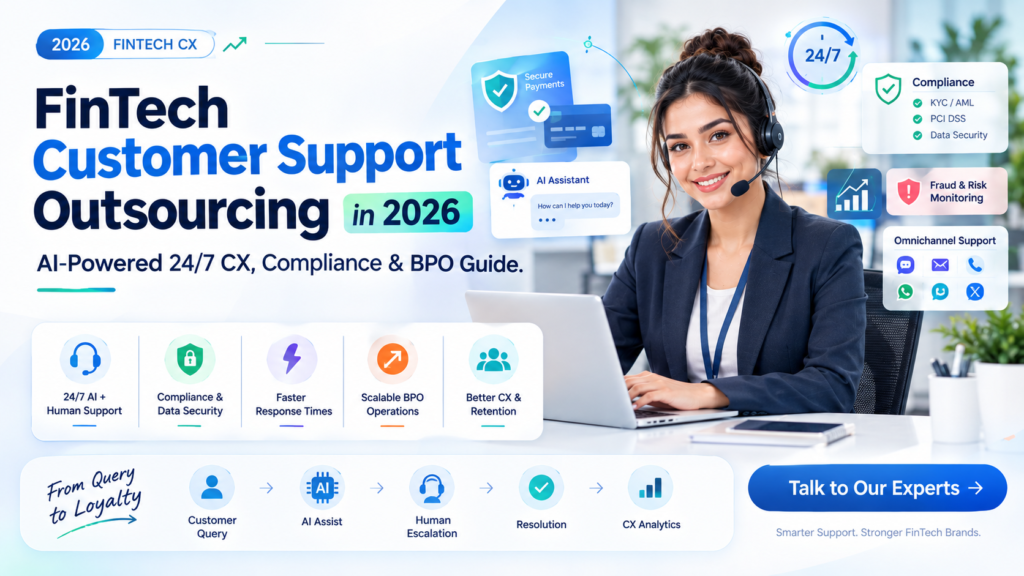
FinTech companies are under increasing pressure to deliver fast, reliable and secure customer service while managing growing transaction volumes, digital channels, regulatory requirements and increasingly demanding customer expectations.
A customer may need help with a failed payment, account access, KYC, card transaction, loan application, refund, suspicious transaction or technical issue at any time of the day. For a growing FinTech business, managing all these interactions through an internal team can become difficult and expensive to scale.
This is where FinTech customer support outsourcing becomes strategically important.
Modern outsourcing is no longer simply about moving customer-service jobs to an external provider. A well-designed model combines AI-powered customer support, trained human agents, omnichannel contact-centre technology, quality assurance, analytics, security and 24/7 operations.
For FinTech businesses, the objective is not simply to reduce the cost of answering customer queries. The objective is to build a support operation that can handle volume, protect customer experience, support appropriate compliance requirements and scale with the business.
This guide explains FinTech customer support outsourcing in 2026, including AI-powered support, 24/7 customer service, compliance, pricing, ROI, security, hybrid support, vendor selection and outsourcing in India.
AI Overview: What Is FinTech Customer Support Outsourcing?
FinTech customer support outsourcing is the use of an external BPO, contact-centre or customer-experience provider to manage defined customer-support processes for a FinTech business.
The outsourced operation may include voice support, email support, live chat, WhatsApp, ticket management, technical support, transaction-related queries, customer onboarding assistance, complaint management and back-office support.
In 2026, the most practical model is increasingly AI + human customer support.
AI can manage predictable, repetitive and high-volume interactions, while trained customer-service agents handle complex, sensitive and higher-risk conversations.
The FinTech company, however, does not simply hand over responsibility to the BPO. Appropriate governance, oversight, security, compliance and customer-protection responsibilities remain important.
The strongest model is therefore:
AI automation + human expertise + secure technology + quality management + analytics + governance.
Key Takeaways
- FinTech customer support outsourcing can help businesses scale customer service without building every operational capability internally.
- AI-powered customer support can automate repetitive queries, assist agents, classify interactions and improve routing.
- Human agents remain important for disputes, fraud-related complaints, escalations and complex customer situations.
- 24/7 FinTech customer support requires workforce planning, escalation coverage, technology and operational governance.
- Financial-services businesses should evaluate BPO partners on security, compliance, technology, quality and scalability—not only price.
- FinTech BPO services in India can provide access to customer-support talent, technology infrastructure and scalable delivery models.
- Pricing can be structured around agents, minutes, tickets, interactions, dedicated teams, shared services or hybrid models.
- AI should be introduced according to process risk and complexity rather than simply maximising automation.
- A strong outsourcing programme measures customer experience, operational performance, quality, compliance and cost together.
- The right BPO partner should function as an extension of the FinTech’s customer-experience operation, not simply as a low-cost call-centre vendor.
What Is FinTech Customer Support Outsourcing?
At its simplest, FinTech customer support outsourcing means engaging a specialist external provider to manage defined customer-service activities.
The scope can range from a small outsourced helpdesk to a complete omnichannel customer-support operation.
Typical outsourced services include:
- FinTech call centre services
- Voice customer support
- Email customer support
- Live chat support
- WhatsApp customer support
- Ticket management
- Customer onboarding support
- KYC-related customer assistance
- Payment support
- Transaction-status enquiries
- Refund support
- Card support
- Wallet support
- Digital lending support
- EMI and repayment support
- Fraud-related customer escalation
- Technical support
- Complaint management
- Back-office processing
- Quality assurance
- Customer feedback management
Businesses evaluating a broader customer support outsourcing model can use outsourcing to manage fluctuating customer volumes while maintaining defined service levels and operational processes.
The correct outsourcing scope depends on the FinTech’s business model, customer journeys, risk profile, regulatory environment and internal capabilities.
Why FinTech Customer Support Is Different
FinTech customer service is different from conventional customer service because support interactions can directly involve financial transactions, personal information, authentication, fraud, disputes and regulatory obligations.
Consider the difference between:
“Where is my order?”
and:
“Why has my ₹2 lakh transaction failed?”
Both require customer support, but the second interaction can involve significantly greater financial and operational risk.
A FinTech customer service outsourcing programme therefore needs to account for:
| Customer Issue | Example | Key Operational Requirement |
|---|---|---|
| Payment | Failed or pending transaction | Transaction investigation |
| Account | Login or account access | Authentication |
| Fraud | Suspicious transaction | Security-sensitive escalation |
| KYC | Documentation issue | Process and compliance alignment |
| Lending | Loan or EMI query | Accurate financial information |
| Card | Card transaction problem | Secure customer verification |
| Refund | Refund not received | Transaction investigation |
| Complaint | Service dissatisfaction | Escalation and resolution |
| Technical | App malfunction | Troubleshooting |
| General enquiry | Product information | Accurate knowledge management |
This is why selecting a financial services BPO purely on cost can create unnecessary operational risk.
The Evolution of FinTech BPO Services in 2026
Traditional BPO outsourcing was primarily based on labour arbitrage.
The basic model was:
More customers → more agents → more seats → higher cost.
The modern model is different:
More customers → automation + intelligent workflows + human specialists + analytics + scalable operations.
The shift means that FinTech BPO services should increasingly be evaluated as an operating capability rather than simply as an outsourced workforce.
A modern provider may contribute:
- AI automation
- Conversational AI
- Voice support
- Omnichannel customer experience
- Workforce management
- Quality assurance
- Analytics
- Knowledge management
- Customer-experience reporting
- Escalation management
- Back-office support
The commercial question consequently changes from:
“How much does an agent cost?”
to:
“What does it cost to reliably resolve a customer interaction?”
AI-Powered Customer Support for FinTech Companies
AI is changing how FinTech customer support services are delivered.
AI can potentially handle or assist with:
- Frequently asked questions
- Account-information requests
- Transaction-status queries
- Basic troubleshooting
- Product information
- Ticket classification
- Intent detection
- Customer routing
- Conversation summaries
- Knowledge retrieval
- Agent assistance
- Quality monitoring
- Customer sentiment analysis
MasCallNet’s AI-powered customer support outsourcing content provides additional context around AI-enabled customer-support operations.
However, AI should not automatically replace human support.
The better question is:
Which interactions should AI handle, which should AI assist with, and which should always involve a human?
Where AI Works Best
AI is generally most suitable for high-volume, predictable and repeatable interactions.
Examples include:
- FAQs
- Basic account information
- Transaction-status requests
- Routine product information
- Basic troubleshooting
- Ticket classification
Where Human Agents Add More Value
Human agents remain important for:
- Fraud complaints
- Complex disputes
- Sensitive financial issues
- Escalated complaints
- Exceptions
- High-value customer interactions
- Emotionally sensitive conversations
- Situations requiring judgement
This makes the AI vs human customer support debate less useful than designing the correct hybrid operating model.
AI vs Human vs Hybrid FinTech Customer Support
AI-Only Support
Advantages:
- High scalability
- 24/7 availability
- Consistent responses
- Lower dependence on manual handling for routine queries
Limitations:
- Difficult edge cases
- Incorrect interpretation
- Limited judgement
- Customer frustration when escalation is poorly designed
Human-Only Support
Advantages:
- Human judgement
- Flexible problem-solving
- Better handling of complex situations
Limitations:
- Higher workforce dependency
- Limited scalability
- Training requirements
- Shift-management complexity
Hybrid AI + Human Support
A hybrid model combines both.
The customer journey can look like:
Customer → AI → Authentication → Intent detection → Automated resolution → Human escalation where required → QA → Analytics
MasCallNet also provides information on hybrid outsourced customer support for 24/7 multichannel customer service, which is relevant when evaluating a combined AI and human operating model.
This approach allows a FinTech to automate suitable interactions without treating every customer problem as an automation problem.
What FinTech Companies Should Outsource
Not every support function should automatically be outsourced.
A useful classification framework considers:
Volume + Complexity + Risk + Repeatability
High Volume + Low Risk + High Repeatability
Strong automation candidates.
Examples:
- FAQs
- Basic status queries
- Product information
- Routine notifications
High Volume + Medium Risk
Good candidates for AI-assisted support.
Examples:
- Payment queries
- Account queries
- Technical support
Low Volume + High Complexity
Better suited to trained human specialists.
Examples:
- Complex disputes
- Escalated complaints
- Sensitive fraud cases
High Risk + High Consequence
Require carefully defined workflows and human oversight.
This approach prevents a common outsourcing mistake: automating a process simply because it is expensive rather than determining whether it is safe and appropriate to automate.
FinTech Call Centre Outsourcing and 24/7 Support
Voice remains important for financial-services customer service, particularly when customers need immediate assistance with account access, transactions, fraud concerns or complex issues.
FinTech call centre outsourcing can provide:
- Inbound customer support
- Outbound customer communication
- 24/7 customer service
- Escalation management
- Complaint handling
- Technical support
- Transaction-related assistance
- Customer verification workflows
- Quality monitoring
MasCallNet’s banking call centre outsourcing services specifically address customer support for banks, FinTechs and NBFCs.
A 24/7 model should nevertheless be designed around actual customer demand.
It should consider:
- Peak hours
- Geography
- Time zones
- Language requirements
- Weekend demand
- Escalation coverage
- Workforce planning
- Business continuity
For organisations specifically evaluating 24/7 customer support outsourcing, the operating model should combine continuous availability with appropriate workforce and escalation coverage.
Omnichannel FinTech Customer Support
Customers increasingly move between channels during the same service journey.
For example:
WhatsApp → Website → Chat → Phone → Email
If each channel operates independently, the customer may need to explain the same problem repeatedly.
An effective omnichannel customer support model should therefore connect:
- Voice
- Live chat
- Web
- Mobile application
- Social channels
- Ticketing
The objective is not simply to offer more channels.
The objective is to provide a consistent customer journey across channels.
MasCallNet’s contact center services provide a broader reference point for organisations evaluating omnichannel contact-centre operations.
FinTech Customer Support and Regulatory Considerations
Outsourcing financial-services support requires appropriate governance.
For RBI-regulated entities, applicable RBI outsourcing requirements should be considered when designing the operating model.
RBI outsourcing directions address areas including risk management, contractual arrangements, monitoring, customer protection, access to records, audit rights, business continuity and exit arrangements.
The principle is straightforward:
Outsourcing an activity does not mean outsourcing accountability.
The regulated entity needs appropriate oversight of the outsourced operation.
What the Outsourcing Agreement Should Cover
A FinTech outsourcing agreement should consider:
- Scope of services
- SLAs
- Performance standards
- Data confidentiality
- Access controls
- Audit rights
- Regulatory access
- Incident management
- Business continuity
- Disaster recovery
- Subcontracting
- Data handling
- Record retention
- Escalation
- Termination
- Exit management
The precise requirements should be determined according to the organisation’s regulatory status, processes and legal obligations.
Data Protection in FinTech Customer Support Outsourcing
Customer support operations can involve significant quantities of personal and financial information.
Depending on the process, agents may interact with:
- Customer identity information
- Contact details
- Account information
- Transaction information
- KYC information
- Complaint records
- Call recordings
- Chat transcripts
- Support tickets
MeitY published the Digital Personal Data Protection Rules, 2025, together with related implementation information. FinTech businesses and their service providers should assess the requirements applicable to their particular processing activities and implementation timelines.
A FinTech customer support outsourcing company should therefore be assessed on:
Access Control
Agents should have access only to information necessary for their role.
Authentication
Customer authentication should be incorporated into relevant workflows.
Data Security
Customer information should be protected through appropriate technical and operational controls.
Call Recording
Recording, storage and access should follow applicable requirements.
Auditability
The organisation should be able to understand who accessed relevant systems and information.
Incident Management
There should be a defined process for identifying and escalating security incidents.
FinTech BPO Pricing Models
There is no single standard price for FinTech customer support outsourcing.
The appropriate commercial model depends on volume, complexity, channel, operating hours, technology and staffing requirements.
Per-Minute Pricing
Suitable for some voice-heavy operations.
Per-Agent Pricing
The client pays for dedicated agents or seats.
Per-Ticket Pricing
Commonly used for email, helpdesk and back-office work.
Per-Interaction Pricing
The client pays according to defined customer interactions.
Dedicated Team Model
A dedicated team works primarily for one client.
Shared Model
Resources are shared across suitable processes or clients.
Hybrid Pricing
Combines dedicated resources, shared resources and technology or automation.
Technology or Implementation Charges
Depending on the programme, there may also be costs for:
- Implementation
- Integration
- AI
- Platforms
- Reporting
- Customisation
- Programme management
A FinTech should therefore compare total cost per resolved interaction, not simply the advertised agent rate.
How to Calculate the ROI of FinTech Customer Support Outsourcing
Consider an illustrative example.
Illustrative Example — Not MasCallNet Performance Data
Suppose a FinTech handles:
- 100,000 interactions per month
- Current average cost per interaction: ₹60
Current monthly support cost:
100,000 × ₹60 = ₹60 lakh
A redesigned model reduces the effective cost to ₹45 per interaction.
New monthly cost:
100,000 × ₹45 = ₹45 lakh
Illustrative monthly difference:
₹15 lakh
Illustrative annual difference:
₹1.8 crore
This is only a modelling example.
Actual ROI depends on:
- Interaction complexity
- Automation rate
- AHT
- Staffing
- Technology costs
- Integration
- Training
- Quality requirements
- Escalations
- Pricing model
The right FinTech BPO partner should help model the complete operating economics rather than promise an arbitrary percentage saving.
KPIs for FinTech Customer Support Outsourcing
A strong FinTech customer service outsourcing programme should measure more than cost.
Customer Experience KPIs
- CSAT
- Customer Effort Score
- NPS where appropriate
- Complaint resolution
- Customer retention indicators
Contact Centre KPIs
- First Contact Resolution
- Average Handling Time
- Service Level
- Abandonment Rate
- Average Speed of Answer
- Occupancy
- Schedule Adherence
Quality KPIs
- QA score
- Critical-error rate
- Compliance adherence
- Escalation accuracy
- Monitoring coverage
AI KPIs
- Automation rate
- AI containment
- AI-assisted resolution
- Human escalation rate
- Failed automation rate
- Knowledge accuracy
Commercial KPIs
- Cost per interaction
- Cost per resolution
- Cost per customer
- Operational scalability
The goal should not be to maximise automation.
The goal should be to maximise appropriate resolution while protecting customer experience and operational risk.
Technology Stack for AI-Powered FinTech Customer Support
A modern outsourced FinTech contact centre can be organised into six layers.
Customer Channels
Voice, email, chat, WhatsApp, web, mobile and social.
Conversational AI
Chatbots, voicebots, intent detection and natural-language processing.
Customer Context
CRM, ticketing, customer history and relevant transaction information.
Workflow Automation
Routing, case creation, notifications, escalation and assignment.
Human Operations
Agents, supervisors, quality analysts and specialist escalation teams.
Intelligence and Governance
Analytics, reporting, QA, compliance monitoring, audit trails and operational dashboards.
This is why Contact Center as a Service (CCaaS) can be relevant for FinTech businesses that want to combine technology and outsourced operations.
MasCallNet’s Contact Center as a Service (CCaaS) guide provides additional context on the technology and operating model.
Traditional BPO vs AI-Powered FinTech BPO
| Area | Traditional BPO | AI-Powered BPO |
|---|---|---|
| Routine queries | Human agents | AI + human |
| Customer routing | Rule-based | AI-assisted |
| Knowledge retrieval | Manual | AI-assisted |
| Quality monitoring | Manual/sample based | Technology-assisted |
| Reporting | Periodic | More continuous |
| Scalability | Workforce dependent | Workforce + automation |
| Availability | Shift based | AI + human coverage |
| Customer journey | Channel specific | Omnichannel |
| Agent productivity | Manual | AI-assisted |
AI does not automatically make a BPO better.
The provider still needs:
- Strong processes
- Accurate knowledge
- Trained agents
- Good integrations
- Quality management
- Governance
- Security
How to Choose a FinTech Customer Support Outsourcing Company
Choosing a FinTech customer support outsourcing company should be treated as a strategic procurement decision.
A practical evaluation framework is:
| Category | Weight |
|---|---|
| Security & Data Protection | 20% |
| Compliance & Governance | 15% |
| Customer Experience | 15% |
| AI & Technology | 15% |
| Operational Scalability | 10% |
| Quality Management | 10% |
| Business Continuity | 5% |
| Analytics & Reporting | 5% |
| Commercial Model | 5% |
Security
Ask:
- How is customer data protected?
- What access controls exist?
- How are recordings handled?
- What audit rights are available?
Compliance
Ask:
- What financial-services processes are supported?
- How are compliance-sensitive interactions handled?
- How are escalations documented?
- How is vendor governance managed?
Technology
Ask:
- Can the platform integrate with our CRM?
- What AI capabilities are available?
- How is the knowledge base managed?
- Can AI interactions be transferred to human agents?
Operations
Ask:
- How quickly can capacity scale?
- What training is provided?
- What is the workforce-management model?
- What happens during demand spikes?
Quality
Ask:
- How is QA performed?
- How are critical errors identified?
- How is agent coaching conducted?
- What reporting is available?
For a broader perspective on provider quality, MasCallNet also provides a guide on how a BPO provider can deliver high-quality customer service.
Why India Is Important for FinTech Customer Support Outsourcing
India is a major destination for global BPO and customer-support operations.
For FinTech companies, the value proposition can include:
- Large talent pools
- Multilingual capabilities
- Technology skills
- Established BPO infrastructure
- 24/7 operating capability
- Global delivery experience
- Scalable workforce models
However, choosing FinTech customer support outsourcing in India should not be based solely on labour cost.
The provider should also be evaluated on:
- Security
- Compliance
- Technology
- Quality
- Business continuity
- Training
- Scalability
- Governance
For businesses specifically evaluating AI-enabled support delivery from India, MasCallNet’s guide on AI customer support outsourcing to India provides a supporting resource.
When Should a FinTech Outsource Customer Support?
Outsourcing can make sense when:
Customer Volumes Are Growing
Internal teams are struggling to keep up.
24/7 Support Is Required
The business needs customer service beyond conventional working hours.
The Business Is Expanding
The FinTech is entering new markets or serving multiple time zones.
Support Is Becoming Expensive
Internal headcount and management requirements are increasing faster than the business.
AI Transformation Is Required
The company wants to introduce automation without building the complete operational infrastructure internally.
Specialist Capabilities Are Missing
The business needs contact-centre operations, QA, workforce management, analytics or multilingual support.
When Should a FinTech Keep Support In-House?
Outsourcing is not always the correct answer.
A company may keep a process internal where:
- The process is strategically differentiating.
- The process requires highly specialised internal knowledge.
- The risk is difficult to manage externally.
- Internal systems cannot support secure integration.
- Volumes are insufficient to justify outsourcing.
- Appropriate governance cannot be established.
The better question is:
Which processes should we outsource, which should we automate and which should remain internal?
A Practical FinTech Outsourcing Readiness Framework
Before approaching a BPO provider, assess five areas.
Process Documentation
Are SOPs, workflows and escalation procedures documented?
Data Integration
Can an external team securely access the systems it needs?
Compliance Clarity
Are compliance requirements documented and understood?
Escalation Governance
Does every high-risk interaction have a clear escalation path?
Performance Measurement
Are existing KPIs defined and measured consistently?
If these foundations are weak, outsourcing may simply expose internal process problems faster.
The best time to fix process documentation is before migration, not after the BPO team goes live.
FinTech Customer Support Outsourcing Transition Plan
A phased implementation reduces operational risk.
Phase 1: Discovery
Map:
- Customer journeys
- Volumes
- Channels
- SLAs
- Escalations
- Technology
- Existing KPIs
Phase 2: Process Classification
Determine what should be:
- Automated
- Outsourced
- Retained
- Outsourced with specialist oversight
Phase 3: Technology Integration
Connect:
- CRM
- Ticketing
- Voice
- Chat
- Knowledge base
- Reporting
Phase 4: Training
Build:
- SOPs
- FAQs
- Knowledge articles
- Escalation matrices
- QA scorecards
- Compliance procedures
Phase 5: Pilot
Start with a controlled process or customer segment.
Phase 6: Scale
Expand after performance, quality and operational stability have been validated.
The Future of AI-Powered FinTech Customer Support
The next phase of AI customer support outsourcing is likely to move beyond answering questions toward completing defined customer-service tasks.
For example, instead of merely answering:
“Where is my refund?”
an AI-enabled workflow could potentially:
- Authenticate the customer.
- Identify the transaction.
- Retrieve the refund status.
- Explain the available information.
- Detect whether the case requires escalation.
- Create the appropriate case.
- Transfer the customer to a human specialist when required.
This creates a new governance question:
Not “Can AI do this?” but “Under what controls should AI be allowed to do this?”
That distinction is particularly important in financial services.
AI Governance in FinTech Customer Service
As AI becomes more capable, FinTech businesses should establish controls around:
- Identity
- Authentication
- Permissions
- Data access
- Audit trails
- Human oversight
- Escalation
- Error handling
- Model monitoring
- Knowledge accuracy
The objective is not maximum automation.
It is controlled automation.
How MasCallNet Fits Into the FinTech Customer Support Outsourcing Model
MasCallNet India Private Limited provides BPO, contact-centre and customer-experience services, including AI-enabled customer-support capabilities.
For a FinTech evaluating an outsourced support model, relevant capabilities can include:
- Customer support outsourcing
- FinTech and banking support
- Contact-centre operations
- Omnichannel customer experience
- AI-enabled customer support
- 24/7 support
- Quality assurance
- Customer interaction management
- Reporting and analytics
- Scalable BPO delivery
The company’s banking and financial-services solution is relevant for organisations evaluating outsourced support within banking and financial-services environments.
The right operating model should ultimately be determined by:
- Interaction volume
- Customer journeys
- Risk
- Channels
- Operating hours
- Technology
- Compliance requirements
- Automation opportunity
FinTech Customer Support Outsourcing: Executive Decision Guide
If your primary objective is cost efficiency, evaluate cost per resolution rather than only agent rates.
If your objective is customer experience, evaluate FCR, CSAT, customer effort and complaint resolution.
If your objective is scalability, evaluate workforce capacity, 24/7 coverage, multilingual support and technology.
If your objective is risk reduction, evaluate security, governance, auditability and escalation management.
If your objective is AI transformation, evaluate automation, AI-assisted agents, conversational AI, knowledge management and human escalation.
The strongest FinTech customer support outsourcing solution should address all five.
FinTech Customer Support Outsourcing Checklist
Strategy
-
Define outsourcing objectives
-
Identify processes for outsourcing
-
Identify processes to retain
-
Identify automation opportunities
Operations
-
Define operating hours
-
Define staffing requirements
-
Establish escalation paths
-
Establish training requirements
-
Define SLAs
Technology
-
CRM integration
-
Ticketing
-
Voice
-
Chat
-
WhatsApp
-
AI
-
Knowledge base
-
Reporting
Security
-
Authentication
-
Access control
-
Data protection
-
Recording controls
-
Incident management
-
Auditability
Compliance
-
Applicable regulatory requirements
-
Vendor governance
-
Audit rights
-
Customer grievance handling
-
Business continuity
-
Exit management
Commercials
-
Pricing model
-
Implementation cost
-
Technology cost
-
Scaling mechanism
-
Minimum commitments
-
Termination provisions
Frequently Asked Questions About FinTech Customer Support Outsourcing
What is FinTech customer support outsourcing?
FinTech customer support outsourcing is the practice of engaging an external BPO or contact-centre provider to manage defined customer-support processes for a FinTech business.
Why do FinTech companies outsource customer support?
Common reasons include scalability, 24/7 coverage, access to specialist capabilities, technology, workforce flexibility and operational efficiency.
Can FinTech customer support be outsourced to India?
Yes. India provides an established BPO ecosystem, customer-support talent, technology capabilities and scalable delivery models. Provider selection should nevertheless consider security, compliance and service quality in addition to cost.
What services can a FinTech BPO provide?
Depending on the provider, services can include voice support, email, chat, WhatsApp, ticket management, technical support, payment support, complaint management, customer onboarding and back-office processing.
Can AI handle FinTech customer service?
AI can handle many predictable interactions and assist human agents. Complex, sensitive or higher-risk cases may require human involvement.
Is AI better than human customer support?
Neither is universally better. AI is suited to predictable, high-volume interactions, while human agents are important for complex, sensitive and judgement-based interactions. A hybrid model can combine both.
How much does FinTech customer support outsourcing cost?
Pricing depends on interaction volume, channel, complexity, operating hours, staffing, technology and commercial structure. Models can include per-minute, per-agent, per-ticket, per-interaction and dedicated-team pricing.
What should I look for in a FinTech BPO partner?
Look at security, compliance, technology, AI capability, quality, scalability, business continuity, analytics and commercial transparency.
Does outsourcing transfer regulatory responsibility to the BPO?
No. Outsourcing an operational process does not automatically transfer the regulated entity’s regulatory responsibilities.
Can a FinTech BPO provide 24/7 support?
Yes, where the provider has the required workforce, technology, escalation coverage and operational infrastructure.
What is hybrid FinTech customer support?
Hybrid support combines AI automation with human agents. AI handles suitable routine interactions while people manage complex or sensitive cases.
What KPIs should a FinTech monitor?
Important KPIs include FCR, CSAT, AHT, service level, abandonment rate, QA, complaint resolution, escalation rates, automation performance and cost per resolution.
Should a FinTech outsource all customer support?
Not necessarily. Processes should be evaluated individually based on risk, complexity, volume, strategic importance and automation potential.
What is the advantage of FinTech customer support outsourcing in India?
India can provide scalable talent, established BPO infrastructure, multilingual capabilities and technology-enabled service delivery.
How can a FinTech calculate outsourcing ROI?
Compare the complete current-state cost with the proposed operating model, including labour, technology, management, training, automation, quality and implementation costs.
How should AI be used in financial customer support?
AI should be used according to interaction complexity and risk. Routine interactions can be automated, while higher-risk or judgement-based interactions should have appropriate human oversight.
Conclusion: The Future of FinTech Customer Support Is AI + Human + Governance
FinTech customer support outsourcing in 2026 is no longer simply a question of reducing the number of customer-service agents.
The more important question is how to build a support operation that can scale while maintaining customer experience, operational control, security and appropriate governance.
AI can automate repetitive interactions.
Human agents can manage complexity.
Analytics can reveal customer problems.
Quality assurance can identify operational weaknesses.
And an experienced FinTech BPO partner can bring these capabilities together into a scalable operating model.
The strongest approach is therefore:
AI + Human Expertise + Omnichannel Technology + Quality + Security + Governance.
For a FinTech considering outsourcing, the next step should not be to immediately move every customer interaction to an external provider.
Instead:
- Map the customer journeys.
- Analyse interaction volume and complexity.
- Identify automation opportunities.
- Determine which processes require human specialists.
- Define security and compliance requirements.
- Establish KPIs.
- Compare BPO providers against those requirements.
- Start with a controlled pilot.
- Measure the results.
- Scale only after the operating model has been validated.
If your organisation is evaluating FinTech customer support outsourcing, AI-powered customer service, 24/7 customer support or banking BPO services, the first step is to assess the current operation and identify where automation, outsourcing and human expertise can create the greatest operational value.
Evaluate Your FinTech Customer Support Outsourcing Model
MasCallNet can help FinTech and financial-services businesses assess their customer-support requirements across channels, volumes, operating hours, technology, automation and workforce requirements.
A structured assessment can help determine:
- What should be automated
- What should be handled by human agents
- What should be outsourced
- What should remain internal
- Which KPIs should be measured
- Which operating model is commercially appropriate
- How a 24/7 customer-support operation can be structured
The objective is simple:
Build a FinTech customer-support operation that is scalable, measurable, secure and designed around the customer journey—not merely around the number of agents required to answer it.