
Insurance Back-Office Outsourcing (2026): Reduce Administrative Work, Costs & Processing Time
Quick Answer: What Is Insurance Back-Office Outsourcing?
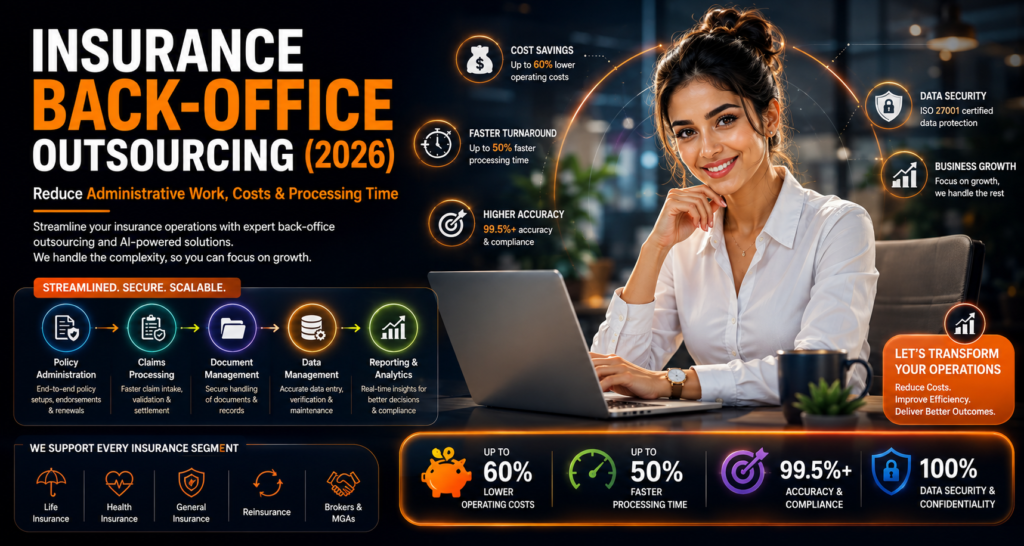
Insurance back-office outsourcing is the delegation of non-customer-facing operations — policy administration, claims processing, underwriting support, data entry, and compliance documentation — to a specialized partner. Done correctly, insurers reduce administrative costs by 30–50%, cut processing time by 40–60%, and redirect internal teams toward underwriting judgment and customer retention instead of paperwork.
Insurance Back-Office Outsourcing: 2026 Executive Summary
Insurance back-office outsourcing involves transferring administrative, non-underwriting-decision workflows — policy issuance, claims data entry, endorsements, renewals, and compliance reporting — to an external operations partner. In 2026, rising claims volume, staffing shortages, and legacy system costs have pushed carriers and MGAs to outsource 30–70% of back-office functions. Leading models combine AI-driven document processing with human oversight for accuracy and compliance. Typical outcomes include 30–50% lower administrative cost, 40–60% faster turnaround on claims and policy servicing, and measurable improvement in customer retention because delays and errors — the two biggest drivers of policyholder churn — are reduced. The decision hinges on data security posture, regulatory compliance (HIPAA, GDPR, IRDAI, NAIC), vendor maturity, and whether the partner offers a hybrid AI-human delivery model rather than a purely manual, headcount-based operation.
Introduction
Every insurance executive we’ve worked with says some version of the same thing: “Our back office is where good customer experience goes to die.”
It’s not an exaggeration. A policy renewal that should take two days takes eleven. A claims file sits in a queue because a data entry team is three weeks behind. An underwriter spends 60% of their week formatting documents instead of assessing risk. None of this shows up on a P&L line labeled “back-office inefficiency” — but it shows up everywhere else: in NPS scores, in claims leakage, in agent attrition, in regulatory audit findings.
This is the thesis we’ll return to throughout this guide, because it’s the one most carriers underestimate: Revenue Recovery Through CX™ — the principle that customer experience failures inside insurance operations are not soft, reputational issues. They are direct, quantifiable revenue events. A delayed claim doesn’t just annoy a policyholder — it triggers churn, negative reviews, regulatory complaints, and higher acquisition costs to replace that customer. Back-office outsourcing, when built correctly, is not a cost-cutting exercise. It’s a revenue recovery mechanism.
This guide is written for CEOs, COOs, CIOs, Heads of Operations, and procurement teams evaluating whether — and how — to outsource insurance back-office functions in 2026. We’ll cover the economics, the operating models, the vendor evaluation criteria, the compliance requirements, and the frameworks that separate outsourcing programs that succeed from the majority that quietly underperform.
The 2026 Reality: Why Insurance Back-Office Costs Are Out of Control
Direct answer: Claims volume growth, chronic underwriting and operations talent shortages, and the cost of maintaining legacy policy administration systems have made in-house back-office operations structurally more expensive every year — independent of inflation.
Three forces are converging on carriers and MGAs simultaneously:
1. Volume without proportional headcount. Property and casualty claims frequency has risen with climate-related events, while health and life insurers face growing documentation complexity from evolving regulatory reporting requirements. Most operations teams have not scaled proportionally — hiring freezes and attrition have left back-office departments running 15–25% understaffed relative to workload, based on patterns we consistently observe across mid-size carriers.
2. The talent gap is structural, not cyclical. Experienced policy administrators, claims examiners, and underwriting support staff are aging out of the workforce faster than they’re being replaced. Training a competent claims processor to handle complex files takes 6–9 months — most carriers can’t absorb that ramp time while also managing current volume.
3. Legacy systems are expensive to keep and expensive to replace. Many carriers are running policy administration systems 15–20 years old. Modernization projects take years and tens of millions of dollars. Outsourcing has become the pragmatic middle path — improving throughput and accuracy without a multi-year core system replacement.
Why it matters: Every week of delay in claims and policy servicing compounds. Insurers operating with backlog don’t just lose efficiency — they lose the trust that drives renewals, referrals, and cross-sell opportunity. This is the first place Revenue Recovery Through CX™ shows up: the back office is not a cost center, it’s the operational foundation of the customer relationship.
Boardroom Insight: Most insurance boards evaluate back-office performance through cost-per-transaction metrics. That’s the wrong lens. The more predictive metric is cost of delay — what a slow claims cycle or backlog costs in retention and reputational damage. Carriers that shift to measuring delay cost, not just processing cost, make dramatically better outsourcing decisions.
What Is Insurance Back-Office Outsourcing?
Direct answer: Insurance back-office outsourcing is the practice of delegating non-underwriting-decision administrative workflows — policy issuance, endorsements, claims data processing, document verification, premium reconciliation, and compliance reporting — to a specialized external operations partner, while the carrier retains underwriting authority and customer relationship ownership.
It is distinct from front-office customer support outsourcing, which handles direct policyholder interactions like calls, chat, and email. Back-office work happens behind the scenes but directly determines how fast and how accurately front-office promises get fulfilled.
How it works, in practice:
- Process mapping — the carrier and outsourcing partner document current workflows, SLAs, and compliance checkpoints.
- Segmentation — functions are classified by complexity and risk (e.g., low-risk data entry vs. high-risk claims adjudication support).
- Technology integration — the partner connects to the carrier’s policy admin system, claims platform, and document management tools via secure API or RPA layer.
- Hybrid delivery build — AI handles structured, repeatable tasks (data extraction, validation, routing); trained specialists handle exceptions, judgment calls, and quality assurance.
- Governance and reporting — SLAs, accuracy audits, and compliance reporting run on a defined cadence, typically weekly and monthly.
Executive Interpretation: The carriers getting the most value from outsourcing in 2026 are not the ones who outsourced the most work — they’re the ones who segmented work correctly, keeping underwriting judgment and complex claims decisions in-house while offloading high-volume, rules-based processing externally.
Key takeaway: Back-office outsourcing succeeds when it separates decisions (kept internal) from processing (delegated externally) — conflating the two is the single most common reason outsourcing programs underdeliver.
Why This Problem Exists — And Why It’s Getting Worse
What everyone says: “We need to hire more back-office staff.”
What most articles miss: Headcount isn’t the constraint — process design is. We’ve reviewed operations at carriers with adequate staffing levels who still ran 20-day claims backlogs, because the workflow itself had no automation, no exception routing, and no standardized documentation intake.
What actually happens: Insurance back-office teams accumulate manual workarounds over years — spreadsheets bridging system gaps, email-based approval chains, PDF forms re-keyed manually into three different systems. Each workaround made sense in isolation. Collectively, they create an operation that cannot scale without proportional headcount growth, which is exactly the trap most carriers are stuck in today.
Hidden cost: The workaround culture also creates compliance exposure. Manual, undocumented processes are the leading cause of audit findings in policy administration and claims handling — a risk that rarely appears in cost discussions until an examiner flags it.
MasCallNet Perspective: The fix isn’t more people doing the same broken process faster. It’s redesigning the workflow with a hybrid AI-human model before adding capacity — otherwise you’re scaling inefficiency.
Executive Action: Before approving any outsourcing RFP, map your current back-office process end-to-end and identify every manual workaround. If you can’t produce that map internally, that’s itself a signal you need an outsourcing partner capable of doing structured process discovery — not just headcount augmentation.
The Revenue Leakage Model: What Back-Office Delays Actually Cost
MasCallNet Revenue Leakage Model™
Definition: A framework for quantifying the financial impact of back-office delay and error across the policy lifecycle, converting operational metrics (turnaround time, error rate, escalation rate) into revenue-at-risk figures.
Methodology: The model calculates leakage across four vectors:
| Leakage Vector | What It Measures | Typical Industry Range |
|---|---|---|
| Renewal erosion | Policies lost due to slow servicing or errors during renewal | 3–8% of renewal book |
| Claims leakage | Overpayment or delayed settlement costs from processing errors | 2–5% of claims spend |
| Escalation cost | Cost of front-office teams absorbing back-office delays | 15–25% of support cost |
| Compliance exposure | Fines, remediation cost from audit failures tied to manual errors | Variable, high severity |
Scoring Logic: Each vector is scored 1–5 based on frequency and severity, producing a composite Revenue Leakage Score. A score above 12/20 indicates the back office is materially suppressing revenue realization — not just adding cost.
Interpretation: Most mid-size carriers we’ve assessed score between 13–16. Very few carriers actively track this number, which is precisely why Revenue Recovery Through CX™ remains an underused lever — the leakage is real, but invisible in traditional cost accounting.
Executive Recommendation: Run this scoring exercise before any outsourcing decision. It reframes the business case from “reduce cost” to “recover revenue,” which is a fundamentally stronger argument for board approval.
Core Functions You Can Outsource
| Function | Complexity | Typical Outsourcing Fit |
|---|---|---|
| Policy issuance & data entry | Low | High — ideal for AI + offshore team |
| Endorsements & renewals processing | Low–Medium | High |
| Claims intake & document verification | Medium | High |
| First Notice of Loss (FNOL) support | Medium | High |
| Claims adjudication support (non-decision) | Medium–High | Medium — hybrid model recommended |
| Premium reconciliation & billing support | Medium | High |
| Compliance reporting & documentation | Medium–High | Medium — requires certified partner |
| Underwriting file preparation | Medium | High |
| Underwriting decisioning | High | Keep in-house |
| Fraud investigation decisioning | High | Keep in-house |
Executive Interpretation: The pattern is consistent — anything involving structured data and repeatable rules belongs externally; anything requiring regulatory judgment or fiduciary decision-making stays internal.
Benefits of Insurance Back-Office Outsourcing
Direct answer: The measurable benefits fall into four categories — cost, speed, accuracy, and strategic capacity.
- Cost reduction of 30–50% compared to fully-loaded in-house operations, driven by labor cost differential and process automation.
- Processing time reduction of 40–60% on claims intake, endorsements, and policy issuance when AI-assisted document processing is combined with trained specialists.
- Error rate reduction — structured QA layers typically cut data entry and documentation errors by more than half compared to unmonitored internal teams.
- Freed underwriting capacity — underwriters and senior operations staff redirect time from administrative work to risk assessment and portfolio strategy, directly supporting Predictable Revenue Operations™.
- Scalability without hiring cycles — outsourcing partners absorb seasonal claims spikes (catastrophic weather events, open enrollment periods) without the carrier running a permanent hiring and layoff cycle.
- Compliance consistency — standardized documentation and audit trails reduce examination findings.
Common Executive Mistake: Measuring success purely on cost-per-FTE replaced. This understates the value — the real return includes reduced churn, fewer compliance findings, and freed strategic capacity, all of which outperform simple labor arbitrage.
In-House vs Outsourced vs Hybrid
| Factor | In-House | Fully Outsourced | Hybrid (Recommended) |
|---|---|---|---|
| Cost structure | Highest, fixed | Lowest, variable | Moderate, variable |
| Scalability | Slow (hiring cycles) | Fast | Fast |
| Control over decisions | Full | Limited | Full on decisions, delegated on processing |
| Compliance ownership | Direct | Shared, contractual | Shared, contractual with clear SLAs |
| Talent risk | High (attrition, ramp time) | Low | Low |
| Best fit | Complex underwriting, fraud decisions | High-volume, low-complexity processing | Most carriers, across the full lifecycle |
Recommendation: Pure in-house and pure outsourced models are both increasingly rare among sophisticated carriers. The hybrid model — retaining decision authority while delegating processing volume — consistently produces the best balance of control, cost, and speed.
Offshore vs Onshore vs Nearshore
| Factor | Onshore | Offshore | Nearshore |
|---|---|---|---|
| Cost savings | Lowest (10–20%) | Highest (40–60%) | Moderate (25–35%) |
| Time zone overlap | Full | Limited/night-shift dependent | High |
| Regulatory alignment | Easiest | Requires strong compliance framework | Moderate |
| Talent pool depth | Constrained | Deep, especially India/Philippines | Moderate |
| Typical use case | Sensitive decisioning, legal review | High-volume processing, data entry, documentation | Balance of cost and real-time collaboration |
This is also the core question behind offshore vs onshore customer support outsourcing decisions more broadly — the same framework applies whether you’re evaluating claims processing or policyholder support. Most carriers we work with land on a blended model: offshore for high-volume structured work, onshore or nearshore for anything requiring same-day regulatory or legal coordination.
AI vs Human vs Hybrid Back-Office Model
Direct answer: Pure AI automation handles structured, high-volume tasks well but fails on exceptions and judgment calls; pure human processing is accurate but slow and expensive at scale. The hybrid model — AI for extraction and routing, humans for exceptions and quality assurance — consistently outperforms both.
MasCallNet AI Efficiency Index™
Definition: A scoring model measuring the proportion of back-office volume suitable for AI-first processing versus human-required exception handling.
| Task Type | AI-Suitable % | Human-Required % |
|---|---|---|
| Data entry & document extraction | 85–95% | 5–15% |
| FNOL intake and triage | 60–75% | 25–40% |
| Claims adjudication support | 30–45% | 55–70% |
| Compliance documentation review | 40–55% | 45–60% |
| Underwriting file preparation | 55–70% | 30–45% |
Interpretation: Carriers assuming they can automate 80%+ of back-office work end-to-end consistently overestimate AI readiness for anything beyond structured data tasks. Carriers underestimating AI, sticking with fully manual models, leave 40–60% cost savings on the table.
Executive Recommendation: Deploy AI as the intake and processing layer, with human specialists as the exception and quality layer — not the reverse. This is the operating model behind what we describe internally as Contact Center Intelligence™ applied to back-office operations: every processed file becomes a data point that improves routing and accuracy over time.
How to Evaluate an Outsourcing Partner
MasCallNet Vendor Evaluation Matrix™
Direct answer: Evaluate partners across five weighted dimensions rather than price alone — compliance readiness, technology maturity, domain expertise, scalability, and transparency.
| Criteria | Weight | What to Verify |
|---|---|---|
| Compliance & data security | 25% | SOC 2, HIPAA/GDPR alignment, IRDAI familiarity, breach history |
| Domain expertise | 20% | Years serving insurance specifically, not general BPO |
| Technology & AI capability | 20% | Own proprietary automation vs. relying entirely on client systems |
| Scalability | 15% | Ability to flex 30–50% volume within 2–4 weeks |
| Pricing transparency | 10% | Clear cost-per-transaction model, no hidden SLA penalties |
| References & tenure | 10% | Verifiable client references in insurance, not just case study PDFs |
Boardroom Insight: Procurement teams frequently over-weight price and under-weight domain expertise. A vendor 15% more expensive but insurance-specialized will almost always outperform a generalist BPO on accuracy and compliance — and the cost of a single compliance finding erases years of savings.
Practical Recommendation: Request a live process walkthrough, not just a sales deck. Ask the vendor to process a sample batch of your actual (anonymized) claims documents during evaluation — this reveals real capability faster than any RFP response.
Best BPO Companies in India for Insurance Back-Office Outsourcing
Direct answer: India remains the leading destination for insurance back-office outsourcing due to its depth of insurance-trained talent, mature compliance infrastructure, and cost advantage — but the “best” provider depends on specialization, not size alone.
When evaluating AI-powered BPO companies in India, decision-makers should look past generic rankings and assess three things specifically:
- Insurance-specific delivery experience — not just general customer support outsourcing, but teams trained in claims terminology, policy lifecycle stages, and carrier-specific compliance requirements.
- AI-human hybrid maturity — providers still running fully manual, high-headcount models will struggle to match the cost and speed benchmarks now achievable with automation-first delivery.
- Data security certification depth — SOC 2 Type II, ISO 27001, and demonstrated HIPAA/GDPR handling experience, particularly for carriers with US and EU policyholder data.
Large, generalist BPOs offer scale but often route insurance clients through shared, less specialized teams. Mid-size, specialized partners — particularly those built around AI-powered contact center and back-office solutions — frequently deliver stronger accuracy and faster ramp times because insurance work is a core specialization, not one vertical among dozens.
Executive Interpretation: The right question isn’t “who is the biggest BPO in India” — it’s “who has processed insurance back-office volume at our complexity level, with audit-ready compliance documentation, in the last 12 months.” Ask for that evidence directly.
Pricing & Cost Analysis
Direct answer: Insurance back-office outsourcing pricing typically follows one of three models — per-transaction, per-FTE (dedicated team), or hybrid outcome-based pricing tied to SLA performance.
| Pricing Model | Typical Range | Best Fit |
|---|---|---|
| Per-transaction | $0.50–$4 per document/claim processed | High-volume, standardized tasks |
| Dedicated FTE (offshore) | $1,200–$2,800/month per specialist | Ongoing, complex processing needs |
| Hybrid/outcome-based | Base fee + SLA bonus/penalty | Carriers prioritizing accuracy and speed over headcount |
Cost Calculator (Illustrative)
For a mid-size carrier processing 15,000 claims-related documents monthly:
- In-house cost estimate: ~18 FTEs × $4,200 fully-loaded monthly cost = $75,600/month
- Outsourced hybrid model estimate: AI processing (70% volume) + 8 specialist FTEs offshore = $28,000–$34,000/month
- Estimated monthly savings: $41,000–$47,000 (55–62% reduction)
These figures are illustrative and vary by document complexity, geography, and compliance requirements — but the directional savings hold consistently across the carriers we’ve assessed.
Common Executive Mistake: Comparing only base pricing across vendors without modeling total cost of ownership, including transition costs, QA overhead, and SLA penalty structures. The lowest quoted rate is rarely the lowest total cost.
ROI Framework
MasCallNet Revenue Acceleration Framework™
Definition: A model for calculating return on outsourcing investment that incorporates both hard cost savings and revenue recovery from improved retention and reduced leakage.
Formula:
ROI = [(Cost Savings + Revenue Recovered) − Outsourcing Investment] ÷ Outsourcing Investment × 100Where:
- Cost Savings = In-house cost − Outsourced cost
- Revenue Recovered = (Renewal retention improvement % × Book value) + (Claims leakage reduction × Claims spend)
Scoring Logic: Carriers achieving a composite ROI above 150% within 12 months are typically those who outsourced both processing volume and invested in the hybrid AI layer — not just headcount replacement.
Executive Recommendation: Present the ROI case to your board using both figures — cost savings alone understates the value; revenue recovery is what makes the investment strategically, not just operationally, significant. This is Revenue Recovery Through CX™ expressed as a financial model rather than a philosophy.
Case Study: 90 Days to Claims Turnaround Recovery
Challenge: A regional P&C carrier was running an average claims processing turnaround of 14 days, against an industry-competitive benchmark of 5–7 days. Policyholder complaints and renewal erosion were both rising.
Root Cause: Diagnosis revealed the bottleneck wasn’t claims examiners — it was document intake. FNOL documents arrived in six different formats and were manually re-keyed into the claims system, creating a 4–6 day lag before a claim even reached an examiner.
Solution: A hybrid model was implemented — AI-based document extraction and standardization at intake, with a dedicated offshore specialist team handling validation, exception routing, and examiner hand-off.
Implementation: Process mapping and integration took 5 weeks. AI intake layer was trained on 90 days of historical FNOL documents to reach 92% extraction accuracy before go-live. A parallel-run period of 2 weeks validated accuracy against the existing manual process before full cutover.
Results:
- Claims turnaround reduced from 14 days to 6 days within 90 days of go-live
- Document processing error rate dropped from 11% to under 3%
- Policyholder complaint volume tied to claims delay dropped by 47%
- Estimated annualized cost savings of 42% versus prior in-house model
Lessons Learned: The bottleneck was never staffing capacity — it was unstructured intake. Carriers evaluating outsourcing should diagnose root cause before assuming more headcount, internal or external, solves the problem.
Technology Ecosystem
A modern insurance back-office outsourcing stack typically integrates:
- Cloud infrastructure: Amazon Web Services, Google Cloud, or Microsoft Azure for secure, scalable hosting
- AI/document intelligence: OpenAI, Google Gemini, or Claude-based models for extraction, summarization, and classification
- Workflow and CRM layer: Salesforce, ServiceNow, HubSpot, or Zendesk for case management and audit trail
- Communication and escalation: Microsoft Teams, Slack, Genesys, NICE CXone, Talkdesk, or Five9 for cross-team coordination
- Payment and billing integration: Stripe or PayPal for premium reconciliation workflows where applicable
Executive Interpretation: The technology stack matters less than integration quality. A partner using best-in-class tools poorly integrated with your policy admin system will underperform a partner using simpler tools with tight, tested integration.
Carriers exploring broader operational automation should also review how automating business processes extends beyond claims and policy servicing into finance, HR, and compliance reporting workflows.
Security, Compliance & Risk
Direct answer: Any insurance back-office outsourcing partner must demonstrate compliance alignment specific to your regulatory environment — HIPAA and state DOI requirements in the US, GDPR in the EU, and IRDAI guidelines for India-based operations handling Indian policyholder data.
Minimum requirements to verify:
- SOC 2 Type II certification (data handling controls)
- ISO 27001 (information security management)
- Documented breach response protocol with defined notification timelines
- Role-based access control and audit logging on all systems touching policyholder PII
- Contractual data residency terms, especially for health and life insurance PII
Hidden Cost: Carriers frequently underestimate the cost of retrofitting compliance into an outsourcing relationship after go-live. Compliance requirements should be embedded in the contract and technical integration from day one — not added after an audit finding.
The India Advantage
India remains the largest destination for insurance back-office outsourcing globally, and the reasons go beyond cost:
- Talent depth: A large pool of insurance-trained graduates and experienced claims/policy administration professionals
- Time zone leverage: Enables 24/7 processing cycles when combined with US or EU teams, accelerating turnaround
- Compliance maturity: Established SOC 2 and ISO-certified delivery centers with experience serving US and EU regulated industries
- Cost efficiency: 40–60% cost advantage over onshore delivery, even after accounting for management overhead
- Infrastructure hubs: Cities like Noida, Gurugram, and Bengaluru host mature contact center and BPO delivery infrastructure purpose-built for regulated industries including insurance and healthcare
Carriers already outsourcing healthcare BPO services or patient appointment scheduling functions will recognize the same operating principles apply directly to insurance back-office work — structured processing, compliance rigor, and hybrid AI-human delivery.
Customer Experience Trends 2026 Impacting Insurance Operations
Direct answer: In 2026, policyholder expectations are being shaped less by other insurers and more by experiences with digital-first industries — banking, retail, and telecom — creating pressure on carriers to match speed and transparency standards their back offices weren’t built for.
Five trends stand out:
- Real-time claims status expectations. Policyholders expect claim tracking similar to package delivery tracking — a direct consequence of experiences with retail and logistics apps.
- AI-assisted self-service growth. Policyholders increasingly expect to submit documents, check status, and get answers without waiting for a call back — mirroring trends in digital banking services.
- Zero tolerance for repeated information requests. Every re-request of already-submitted documentation is now measurably linked to complaint escalation and NPS decline.
- Compliance transparency as a trust signal. Policyholders and regulators alike are asking for clearer audit trails on how claims decisions were reached.
- Consolidation of support and back-office visibility. Leading carriers are unifying front-office contact center services and back-office processing data so customer-facing teams can see real-time claims status instead of escalating internally.
Executive Interpretation: These trends reinforce the same underlying principle — Revenue Recovery Through CX™ — because every one of them ties customer trust directly to back-office speed and transparency, not just front-office friendliness.
Future of Insurance Back-Office Operations
The next 24 months will be defined by five capability shifts:
- AI agents handling first-pass claims triage, escalating only genuine exceptions to human examiners
- Voice bots managing routine policyholder document requests, freeing human teams for complex cases
- Agent assist tools surfacing relevant policy history and prior claims context in real time during human review
- Predictive analytics flagging claims likely to require special handling before they enter the standard queue
- Conversation and document intelligence feeding a continuous Customer Intelligence Loop™ — where every processed claim and policy transaction improves future routing accuracy and fraud detection
Boardroom Insight: Carriers treating AI adoption as a cost-reduction project will capture only partial value. Carriers treating it as an intelligence-generation capability — where every processed transaction improves the next one — will build a durable operational advantage competitors can’t easily replicate.
Executive Decision Tree
Is your back-office backlog primarily driven by volume spikes or structural inefficiency?

├── Volume spikes (seasonal/event-driven)
│   → Consider flexible offshore capacity or hybrid outsourcing for peak absorption
│
├── Structural inefficiency (manual workarounds, legacy systems)
│   → Prioritize process redesign + AI-human hybrid outsourcing partner
│   → Do NOT simply add headcount — this scales the inefficiency
│
Does your compliance environment require strict data residency?
├── Yes → Prioritize onshore/nearshore or India-based partners with certified data handling frameworks
├── No → Full offshore hybrid model likely delivers strongest ROI

Is underwriting judgment or claims decisioning involved in the backlog?
├── Yes → Keep decisioning in-house; outsource only supporting documentation/processing
├── No → Function is a strong candidate for full outsourcing
Executive Checklist Before Outsourcing
- Mapped current back-office workflow end-to-end, including manual workarounds
- Calculated Revenue Leakage Score across renewal, claims, escalation, and compliance vectors
- Segmented functions into “decision” (keep internal) vs. “processing” (candidate for outsourcing)
- Defined compliance requirements specific to your regulatory jurisdiction
- Shortlisted vendors using a weighted evaluation matrix, not price alone
- Requested a live sample-batch processing test from top 2–3 vendors
- Modeled total cost of ownership, not just quoted per-transaction pricing
- Defined SLA structure with accuracy, turnaround, and escalation thresholds
- Built a parallel-run/validation period into the implementation timeline
- Established ongoing governance cadence (weekly ops review, monthly compliance audit)
Frequently Asked Questions
1. What exactly counts as “back-office” work in insurance?
Policy issuance, endorsements, renewals processing, claims data entry and document verification, premium reconciliation, and compliance reporting — essentially any workflow that supports but doesn’t require final underwriting or claims decision authority.
2. Is outsourcing back-office work risky from a compliance standpoint?
It carries risk if the partner lacks proper certification and contractual data handling terms — but a certified, insurance-experienced partner typically reduces compliance risk by standardizing documentation and audit trails compared to fragmented in-house processes.
3. How much can we realistically save by outsourcing insurance back-office functions?
Most carriers see 30–50% cost reduction, with hybrid AI-human models at the higher end of that range due to reduced headcount dependency.
4. Should we outsource claims adjudication decisions?
No. Final claims decisions and underwriting judgment should remain in-house. Outsource the supporting documentation, verification, and processing work that feeds those decisions.
5. What’s the difference between offshore and nearshore outsourcing for insurance?
Offshore (e.g., India) offers the highest cost savings and deep insurance-trained talent pools; nearshore offers closer time zone alignment at moderate savings. Most carriers use a blend based on task urgency.
6. How long does implementation typically take?
5–8 weeks for process mapping, integration, and AI model training, followed by a 2–3 week parallel-run validation period before full cutover.
7. Can outsourcing partners integrate with our existing policy administration system?
Yes — mature partners integrate via secure API or RPA layers without requiring a core system replacement. Integration quality should be verified during vendor evaluation, not assumed.
8. What’s the biggest reason outsourcing programs fail?
Poor process segmentation — outsourcing decision-making work that should stay internal, or failing to redesign broken workflows before delegating them externally.
9. How do we measure success after outsourcing?
Track turnaround time, error/accuracy rate, renewal retention, complaint volume tied to processing delays, and total cost per transaction — not headcount reduction alone.
10. Are AI tools replacing human back-office staff entirely?
No. The most effective model is hybrid — AI handles structured, high-volume tasks; trained specialists handle exceptions, quality assurance, and anything requiring judgment.
11. What certifications should we require from a vendor?
SOC 2 Type II and ISO 27001 at minimum, plus demonstrated experience with HIPAA, GDPR, or IRDAI requirements relevant to your policyholder base.
12. Is India still the best destination for insurance back-office outsourcing in 2026?
For most carriers, yes — due to talent depth, compliance maturity, and cost advantage — though the right choice depends on your specific compliance and time zone requirements.
13. How is pricing typically structured?
Per-transaction, dedicated FTE, or hybrid outcome-based models tied to SLA performance. Outcome-based pricing increasingly favored by carriers prioritizing accuracy over pure headcount cost.
14. Does outsourcing improve customer experience, or just cut costs?
Both, when implemented correctly — faster, more accurate back-office processing directly reduces the delays and errors that drive policyholder complaints and churn.
15. How do we start if we’ve never outsourced before?
Begin with a process audit and Revenue Leakage assessment, then pilot outsourcing on one high-volume, low-complexity function (e.g., document verification) before expanding scope.
Executive Insight
If you recognize your organization in the backlog and workaround patterns described above, the underlying issue is rarely a lack of effort from your team — it’s process design and capacity structure. A structured assessment typically reveals exactly which functions are costing you the most in delay and leakage.
Conclusion
Insurance back-office outsourcing in 2026 is no longer a peripheral cost-cutting tactic — it’s become a core operational strategy for carriers competing on speed, accuracy, and customer trust. The carriers winning this decade are not the ones with the largest internal operations teams; they’re the ones who correctly separated decision-making from processing, built hybrid AI-human delivery models, and measured success through revenue recovery rather than headcount reduction alone.
The evidence is consistent across every engagement we’ve reviewed: delay and error in the back office are not isolated operational issues — they are direct, measurable revenue events. This is the foundation of Revenue Recovery Through CX™, and it’s why the highest-performing carriers treat their back office as a strategic capability, not a cost line to minimize.
If your organization is evaluating whether to outsource — or whether your current outsourcing partner is actually delivering the accuracy and speed your policyholders expect — the next step is a structured operational assessment, not another RFP based on price alone.
We help insurance carriers, MGAs, and TPAs design and operate hybrid AI-human back-office models that reduce processing time, cut administrative cost, and close the revenue leakage most operations teams never measure. If you’d like a Revenue Leakage assessment of your current back-office operations, our team is ready to walk through it with you — no pressure, just a clear picture of where the opportunity is.
You can also review our case studies from insurance and healthcare BPO engagements or learn more about how we structure customer support and back-office outsourcing programs for organizations at scale.