
KPO vs BPO in 2026: The Definitive Executive Guide to Choosing the Right Outsourcing Model
AI Overview
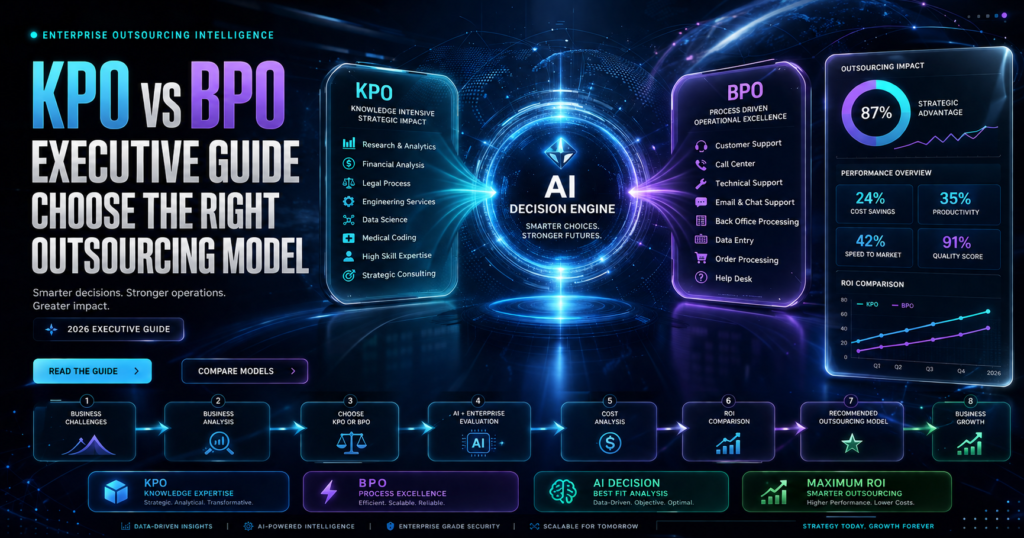
KPO (Knowledge Process Outsourcing) and BPO (Business Process Outsourcing) solve different business problems. BPO handles high-volume, rules-based, repeatable work — customer support, call center services, collections, back-office processing. KPO handles judgment-intensive, domain-expert work — research, actuarial analysis, financial modeling, legal review, clinical data abstraction. In 2026, the real decision most enterprises face isn’t “KPO or BPO” in isolation — it’s how AI, human expertise, and outsourcing models combine inside a single operating model. Businesses generating high ticket volumes with structured workflows should evaluate BPO with embedded AI. Businesses requiring specialized judgment, compliance interpretation, or analytical output should evaluate KPO. Most mid-market and enterprise buyers actually need a hybrid: a BPO partner capable of KPO-grade quality on select workflows, backed by AI-assisted human agents rather than either pure automation or pure headcount.
Executive Introduction
Every CEO who has sat through a quarterly business review knows the moment: support costs are rising, CSAT is flat or slipping, and someone in the room asks, “Should we just outsource this?” The honest answer is almost never that simple — because “outsourcing” isn’t one decision. It’s three or four distinct decisions dressed up as one.
Is this a volume problem or a judgment problem? That’s the KPO vs BPO question. Is this a technology problem or a people problem? That’s the AI vs human question. Is this a vendor selection problem or an operating model problem? That’s the question most companies skip entirely — and it’s the one that determines whether outsourcing becomes a cost lever or a liability.
We’ve spent years inside contact centers, collections floors, and CX transformation programs across banking, healthcare, retail, and telecom. What we’ve consistently observed is this: companies don’t fail at outsourcing because they picked the wrong vendor. They fail because they never correctly diagnosed what kind of work they were outsourcing in the first place.
This guide exists to fix that. It’s built around a thesis we’ve validated across dozens of outsourcing engagements: customer conversations are not a cost line — they are an enterprise intelligence asset. Every support ticket, every collections call, every renewal conversation contains signal about churn risk, revenue opportunity, product friction, and forecast accuracy. Organizations that treat outsourcing as a way to offload conversations lose that signal. Organizations that treat outsourcing as a way to capture and act on that signal build what we call Contact Center Intelligence™ — and it compounds into measurable revenue advantage, not just cost savings.
By the end of this guide, you’ll be able to answer four questions with precision: what to outsource, how to structure it (KPO, BPO, or hybrid), how to evaluate whether AI, humans, or a blended model fits your workflows, and how to select — and financially justify — a partner.
Market Reality: Why This Decision Matters More in 2026
Direct Answer: The global BPO market is projected to exceed $525 billion by 2030 (Grand View Research), while the KPO market — smaller but faster-growing on a percentage basis — is expanding at a CAGR above 16% as enterprises push more analytical and compliance-heavy work offshore. The convergence of generative AI with both models is the single biggest structural shift the industry has seen since the shift from voice-only to omnichannel in the 2010s.
Why It Matters: Boards are no longer asking “should we outsource support?” They’re asking “why are we still paying full-time headcount rates for work that AI-assisted teams can do at higher quality and lower cost?” That question changes budget conversations, vendor RFPs, and internal reporting lines.
Framework — The Three Forces Reshaping Outsourcing in 2026:
- AI compression — Generative AI (OpenAI, Google Gemini, Claude, Copilot) is compressing the time required for research, summarization, and first-response drafting inside both KPO and BPO workflows, shrinking headcount requirements per unit of output by 20–40% in mature deployments.
- Quality convergence — Offshore delivery quality (India in particular) has closed the gap with onshore delivery to the point where the primary differentiator is no longer accent or time zone, but data security posture and AI maturity.
- Buyer sophistication — Procurement and CX leaders now evaluate outsourcing partners on outcome metrics (revenue recovery, retention, forecast accuracy) rather than seat cost alone.
Table: Market Snapshot (2026)
| Metric | BPO Market | KPO Market |
|---|---|---|
| Global market size (est.) | $400B+ | $50B+ |
| Projected CAGR (2025–2030) | 8–9% | 15–17% |
| India’s global outsourcing share | ~55% of voice/back-office | ~40% of analytical/research |
| AI-augmented delivery (enterprise adoption) | 60%+ piloting or scaled | 45%+ piloting or scaled |
| Primary buyer objection | Data security, quality consistency | IP protection, domain expertise gaps |
Executive Interpretation: The market isn’t shrinking because of AI — it’s restructuring. Budget is shifting away from pure headcount toward AI-augmented delivery models, and vendors that haven’t invested in that shift are losing enterprise deals even at lower price points.
Boardroom Insight™: The most dangerous assumption in outsourcing right now is “AI will replace our BPO spend.” It won’t. It will replace undifferentiated BPO spend — the vendors selling seats, not outcomes. Spend on outcome-linked, AI-augmented delivery is growing, not shrinking.
Summary: The outsourcing market in 2026 is bifurcating into commodity seat-selling and intelligence-driven delivery. Buyers need to know which one they’re purchasing.
Key Takeaway: The question isn’t whether to outsource — it’s whether your outsourcing partner is selling you headcount or intelligence.
KPO vs BPO: The Real Definitions
Direct Answer: BPO (Business Process Outsourcing) is the delegation of standardized, high-volume, rules-based business functions — customer support, call center operations, data entry, collections, back-office processing — to a third-party partner. KPO (Knowledge Process Outsourcing) is the delegation of judgment-intensive, domain-expert functions — market research, financial analysis, actuarial services, legal process support, clinical data review — that require specialized qualifications and independent analysis, not just execution.
Why It Matters: Conflating the two leads to bad vendor selection. Companies that need KPO-grade analytical output frequently hire BPO vendors optimized for volume and get generic, templated deliverables. Companies that need BPO-grade support scale frequently hire boutique KPO firms and get high cost, low throughput.
The Core Distinction
| Dimension | BPO | KPO |
|---|---|---|
| Nature of work | Repeatable, process-driven | Analytical, judgment-driven |
| Skill requirement | Trained agents, SOPs | Domain specialists (CA, actuaries, analysts, clinicians, legal researchers) |
| Output | Transactions completed, tickets closed | Insights, reports, recommendations |
| Value driver | Volume × efficiency | Accuracy × expertise |
| Typical functions | Customer support, call center services, collections, data entry, back-office | Equity research, actuarial modeling, legal research, clinical coding, market intelligence |
| Pricing model | Per seat, per ticket, per FTE | Per project, per hour of expertise, per deliverable |
| AI impact | High — automates first-line resolution | Moderate — augments analysis, doesn’t replace judgment |
| Risk profile | Operational (SLA misses, CSAT drops) | Reputational and compliance (analytical errors) |
Framework — The Work Classification Test: Before choosing KPO or BPO, classify the workflow using three questions:
- Does this task require the same decision logic every time? If yes → BPO.
- Does the output require professional judgment that varies by case? If yes → KPO.
- Does the task require both — structured execution most of the time, with escalation to expert judgment for edge cases? If yes → you need a hybrid delivery model, not a pure KPO or BPO engagement.
Most enterprises land on question three and don’t realize it. That’s why the KPO-vs-BPO framing, taken literally, misses how outsourcing actually works in a modern operation.
Executive Interpretation: If your leadership team is debating “KPO or BPO” as a binary, you’re asking the wrong question. The right question is: which parts of this function are repeatable, which require expertise, and which require both in sequence?
Boardroom Insight™: Vendors love the binary because it lets them sell you a single-service engagement. The vendors worth trusting will tell you upfront that your workflow needs a blended model — even if it means a smaller initial contract.
Summary: BPO scales execution. KPO scales expertise. Most real business problems need both.
Key Takeaway: Classify the work before you classify the vendor.
Why the KPO vs BPO Framing Is Already Outdated
What Everyone Says: “Choose KPO for knowledge work, BPO for process work.”
What Most Articles Miss: That framing assumes the split is static. It isn’t. AI has moved a meaningful share of what used to require KPO-level judgment — first-pass legal document review, preliminary financial variance analysis, initial clinical data abstraction — into AI-assisted BPO territory, where a trained agent using an AI co-pilot can now handle work that previously required a specialist.
What Actually Happens: In our engagements, we consistently see the highest-performing outsourcing programs are structured as a tiered intelligence model, not a KPO-or-BPO choice:
- Tier 1: AI-assisted BPO agents handle volume — routine queries, standard transactions, first-pass documentation.
- Tier 2: Senior BPO agents or hybrid specialists handle exceptions and moderate complexity, supported by AI-generated context and recommendations.
- Tier 3: True KPO specialists handle only the cases that genuinely require independent professional judgment — the 5–10% of volume that AI and Tier 1/2 teams correctly escalate.
Hidden Cost: Companies that outsource everything to either a pure BPO or pure KPO vendor typically overpay by 25–40% — either paying specialist rates for routine work, or accepting quality gaps because a volume-optimized vendor is handling work it isn’t equipped to judge.
MasCallNet Perspective: We don’t sell “BPO” or “KPO” as separate products, because your customers don’t experience your business in separate categories. A customer calling about a billing dispute needs fast resolution (BPO) but occasionally needs a judgment call on a refund policy exception (KPO-adjacent). The partner that can flex across that spectrum — inside a single operating model — is the one that protects both your cost structure and your customer relationship.
Executive Action: Before your next RFP, map your top 10 workflows by volume and complexity. Anything under 15 minutes of resolution time and low judgment variance belongs in a BPO/AI-assisted tier. Anything requiring domain certification or case-by-case interpretation belongs in a KPO or hybrid tier. Everything else needs an escalation path, not a separate vendor.
How Outsourcing Actually Works: The Operating Model
Direct Answer: A modern outsourcing engagement — whether BPO, KPO, or hybrid — operates in five layers: intake and classification, AI-assisted triage, human execution, quality and compliance oversight, and intelligence feedback into the client’s business. Most legacy BPO vendors stop at layer three. That’s the gap that determines whether outsourcing feels like a cost center or a growth partner.
The Five-Layer Operating Model
Layer 1 — Intake & Classification: Every interaction (call, chat, email, ticket) is captured and classified by intent, urgency, and complexity — increasingly done by AI models rather than manual tagging.
Layer 2 — AI-Assisted Triage: Routine, high-confidence cases are resolved by AI agents or AI-assisted human agents (using platforms like Zendesk, Freshdesk, Intercom, or Genesys and NICE CXone as the interaction backbone). Complex or ambiguous cases are routed to the next layer.
Layer 3 — Human Execution: Trained agents (BPO) or domain specialists (KPO) handle the interaction, supported by AI-generated summaries, sentiment scoring, and next-best-action recommendations.
Layer 4 — Quality & Compliance Oversight: Every interaction is scored against SLA, compliance, and sentiment benchmarks. This is where PCI-DSS, HIPAA, GDPR, and RBI/IRDAI-aligned controls are enforced operationally, not just contractually.
Layer 5 — Intelligence Feedback: This is the layer almost every legacy BPO skips. Interaction data is converted into structured business intelligence — churn signals, product friction themes, revenue-at-risk flags — and reported back to the client’s leadership team, not buried in a monthly SLA report.
This fifth layer is the operational definition of what we call the Contact Center Intelligence™ thesis: every customer conversation is a data asset, and the partner who fails to extract and return that intelligence to you is leaving value on the table — your value, not theirs.
Table: Layer-by-Layer Ownership
| Layer | Typical Legacy BPO | Contact Center Intelligence™ Model |
|---|---|---|
| Intake & Classification | Manual tagging | AI-driven, real-time |
| Triage | Rule-based IVR | AI-assisted, intent-based routing |
| Execution | Agent scripts | Agent + AI co-pilot, dynamic guidance |
| Quality | Random call audits | 100% interaction scoring via AI + human QA |
| Intelligence Feedback | Monthly SLA PDF | Live dashboards, revenue-risk flags, trend reporting |
Executive Interpretation: If your current vendor’s reporting stops at SLA compliance (average handle time, first call resolution, CSAT), you’re getting layers 1–4. You’re not getting layer 5 — and layer 5 is where the ROI conversation actually lives.
Boardroom Insight™: SLA compliance tells you whether your vendor is doing their job. Intelligence feedback tells you whether your business is getting healthier. Most contracts only measure the first.
Summary: Outsourcing operates in five layers, but most vendors are only built for four.
Key Takeaway: Ask any prospective partner one question: “What do you tell me about my business that I didn’t already know?” If they can’t answer, they’re selling seats, not intelligence.
Business Impact Analysis
Direct Answer: The business impact of outsourcing, done correctly, shows up in four places: cost structure, service quality, revenue retention, and forecasting accuracy. Done incorrectly, it shows up as hidden revenue leakage that never appears on a P&L line labeled “outsourcing cost.”
Why It Matters: Most cost-benefit analyses for outsourcing stop at cost-per-ticket or cost-per-seat comparisons. That’s an incomplete model. A support interaction that resolves a billing dispute in five minutes but fails to catch the customer’s frustration signal — the one that predicts a cancellation in 60 days — looks efficient on the SLA report and looks like a revenue loss on the renewal report three months later.
This is the essence of Revenue Recovery Through CX™: the financial impact of customer experience isn’t limited to satisfaction scores. It shows up directly in renewal rates, expansion revenue, and collections recovery — and it’s measurable if you’re looking at the right data.
Framework — The Four Business Impact Zones
| Zone | What It Measures | Where It’s Usually Missed |
|---|---|---|
| Cost Structure | Cost per contact, cost per resolution, blended labor cost | Ignoring quality-adjusted cost (cheap but high repeat-contact rate) |
| Service Quality | CSAT, NPS, FCR, AHT | Treating these as vendor metrics instead of leading revenue indicators |
| Revenue Retention | Churn correlation with support experience, save-rate on cancellation calls | Rarely connected to support data at all |
| Forecast Accuracy | Collections predictability, demand signal from support volume trends | Almost never captured — this is Predictable Revenue Operations™ territory |
What MasCallNet Has Observed: Across collections and CX programs, we’ve seen companies celebrate a 15% reduction in cost-per-ticket while missing that first-contact resolution dropped 12 points in the same period — which quietly increased churn risk by driving customers to repeat contact, a well-documented satisfaction killer. The P&L looked better. The customer base got weaker.
Common Executive Mistakes:
- Evaluating vendors purely on cost-per-seat or cost-per-ticket.
- Treating CSAT as a vanity metric instead of a leading indicator tied to renewal and expansion revenue.
- Not requiring vendors to report churn-correlated data, only operational SLA data.
What High-Performing Organizations Do Differently: They require outsourcing partners to report on save rates, sentiment trends, and escalation root causes — not just SLA compliance — and they tie a portion of vendor compensation to those outcomes, not headcount hours.
Practical Recommendation: Add two non-negotiable metrics to every outsourcing contract: (1) first-contact resolution rate, and (2) a quarterly “revenue-risk signal report” summarizing themes from customer interactions that correlate with cancellation, downgrade, or complaint escalation.
Boardroom Insight™: If your outsourcing vendor cannot tell you which support themes correlate with churn, they are not managing your customer experience — they are managing your ticket queue. Those are not the same job.
Summary: The real cost of outsourcing isn’t the invoice — it’s the revenue signal you fail to capture when the engagement is designed around throughput instead of intelligence.
Key Takeaway: Measure outsourcing success in retained revenue, not just reduced cost.
AI vs Human Customer Support: The Debate Leadership Teams Are Getting Wrong
Direct Answer: AI customer support excels at speed, availability, and consistency for structured, high-volume queries. Human customer support excels at empathy, judgment, negotiation, and handling ambiguity — particularly in high-stakes moments like collections, complaints, and complex account issues. The organizations winning in 2026 aren’t choosing between AI and human support; they’re designing a deliberate handoff model between the two, and that design decision has more impact on CSAT and cost than either channel alone.
Why It Matters: This is currently the single most consequential decision facing Heads of Customer Support and CCOs. Get it wrong in the “over-automate” direction, and you generate customer frustration, brand damage, and increased escalations. Get it wrong in the “under-automate” direction, and you carry unnecessary labor cost while competitors scale faster and cheaper.
What Everyone Says
“AI will replace human agents.” Or the opposite extreme: “Customers hate bots, keep everything human.” Both are wrong, and both come from vendors and commentators who have an incentive to oversimplify.
What Most Articles Miss
The real variable isn’t AI vs human — it’s stakes and ambiguity. Low-stakes, low-ambiguity interactions (order status, password reset, appointment confirmation) should be AI-first, always. High-stakes, high-ambiguity interactions (a customer threatening to cancel a $50,000 annual contract, a patient anxious about a delayed diagnosis result, a collections call involving financial hardship) need human judgment, ideally supported — not replaced — by AI.
What Actually Happens
Most companies deploy AI support based on what’s technically easiest to automate, not what’s strategically safest to automate. This produces bots that handle FAQ-level queries well and then fail spectacularly the moment a customer expresses frustration, ambiguity, or an edge-case request — the exact moments where a bad experience has the highest cost.
Hidden Cost
The hidden cost of over-automation isn’t just a bad review. It’s the compounding effect of “silent churners” — customers who don’t complain, don’t escalate, and simply don’t renew, because the AI failed to detect their frustration and no human was in the loop to catch it. In collections specifically, this shows up as the “premature automation” trap: AI can send reminders efficiently, but negotiating a payment plan with a distressed customer requires human trust-building that automation actively undermines if deployed without escalation logic.
Table: AI vs Human — Where Each Wins
| Scenario | Best Fit | Why |
|---|---|---|
| Order status, tracking, FAQs | AI | High volume, zero ambiguity, 24/7 expectation |
| Password reset, account verification | AI | Structured, secure, instant |
| Billing dispute (standard) | AI-assisted human | Needs verification but low emotional stakes |
| Cancellation / retention call | Human, AI-supported | Requires negotiation, empathy, judgment |
| Collections — early stage | AI (reminders, scheduling) | Efficiency without emotional complexity |
| Collections — late stage / hardship | Human, AI-assisted | Requires trust-building, policy judgment |
| Complex B2B account escalation | Human specialist | High stakes, relationship continuity matters |
| After-hours basic support | AI | Coverage without incremental headcount cost |
| Healthcare appointment scheduling | AI-assisted human | Efficiency plus compliance sensitivity — see our patient appointment scheduling services |
| Insurance claims inquiry | Hybrid | Structured intake, judgment-heavy resolution |
MasCallNet Perspective
We don’t deploy AI to replace agents. We deploy AI to protect agents’ time for the interactions that actually require them — and to make sure every AI-handled interaction is silently monitored for escalation signals a bot would otherwise miss. This is the operational core of what we call the Customer Intelligence Loop™: every AI interaction still generates data that improves the next human interaction, and every human interaction generates data that improves the AI’s judgment about when to escalate.
Executive Action
Audit your current support volume by stakes and ambiguity, not by channel. Anything low-stakes and low-ambiguity should already be AI-first. Anything high-stakes should have a documented, tested escalation trigger — not a hope that the bot “figures it out.” If you can’t produce that audit today, that’s the gap to close before your next AI deployment decision, not after.
Boardroom Insight™: The companies that lose the AI vs human debate aren’t the ones who under-invest in AI. They’re the ones who deploy AI without designing the handoff to humans — because that’s the part that actually protects revenue.
Summary: AI and human support aren’t competitors. The escalation design between them is the actual product decision.
Key Takeaway: Don’t ask “AI or human” — ask “at what point does this conversation need a human, and does our system actually know that in real time?”
Explore how we structure this inside live programs: AI-powered customer support outsourcing.
MasCallNet Revenue Leakage Model™
Definition: A diagnostic model that quantifies the revenue lost when customer support and outsourcing operations fail to convert service interactions into retention, expansion, or recovery outcomes.
Methodology: The model scores four leakage points on a 0–25 scale each (100 total):
- Escalation Leakage — revenue at risk when frustrated customers aren’t identified and escalated in time.
- Resolution Leakage — revenue at risk when first-contact resolution is low, driving repeat contact and dissatisfaction.
- Collections Leakage — revenue at risk when collections contact strategy doesn’t match customer segment (e.g., automated-only outreach to high-value accounts).
- Insight Leakage — revenue at risk when support data isn’t fed back into product, sales, or retention teams.
Scoring Logic:
| Score Range | Leakage Severity | Estimated Revenue Impact |
|---|---|---|
| 80–100 | Low leakage | <2% of serviceable revenue at risk |
| 60–79 | Moderate leakage | 2–5% of serviceable revenue at risk |
| 40–59 | High leakage | 5–10% of serviceable revenue at risk |
| Below 40 | Severe leakage | 10%+ of serviceable revenue at risk |
Interpretation: Most mid-market companies we’ve assessed score between 45–65 — meaning a meaningful share of revenue is being lost not to competitors, but to unmanaged customer experience gaps inside their own support operation.
Executive Recommendation: Run this assessment before any vendor RFP. It reframes the outsourcing conversation from “how do we cut cost” to “how much revenue are we currently leaking, and which model — AI, human, hybrid, KPO, BPO — closes that gap fastest.”
Boardroom Insight™: Cost-cutting outsourcing decisions optimize the wrong side of the P&L. The Revenue Leakage Model exists because the larger number is almost always on the revenue side, not the cost side.
MasCallNet Outsourcing Readiness Score™
Definition: A pre-engagement diagnostic that determines whether an organization is structurally ready to outsource a given function — and whether it should pursue a BPO, KPO, or hybrid model.
Methodology: Score each dimension 1–5 (25 max):
- Process Documentation — Are SOPs defined well enough to transfer?
- Data Readiness — Is customer/case data clean, structured, and accessible to a partner?
- Compliance Clarity — Are regulatory requirements (HIPAA, PCI-DSS, GDPR, RBI, IRDAI) clearly defined for the function?
- Escalation Design — Is there a tested model for when work should move from AI/BPO to KPO/specialist judgment?
- Executive Sponsorship — Is there a named internal owner accountable for outcomes, not just vendor management?
Scoring Logic:
| Score | Readiness Level | Recommendation |
|---|---|---|
| 21–25 | High readiness | Proceed to full-scale outsourcing, BPO or hybrid |
| 15–20 | Moderate readiness | Pilot program recommended before full rollout |
| 10–14 | Low readiness | Fix process/data gaps internally first |
| Below 10 | Not ready | Outsourcing will amplify internal dysfunction, not fix it |
Executive Recommendation: Never outsource a broken process expecting the vendor to fix it. A partner can execute a documented, imperfect process well. No partner can execute an undocumented one well — regardless of price or reputation.
Vendor Evaluation Framework™ — Best BPO Companies in India
Direct Answer: India remains the world’s largest and most mature outsourcing delivery hub for both BPO and KPO work, combining English-language proficiency, large-scale talent availability, mature AI adoption, and cost efficiency that no other region currently matches at the same scale. When evaluating “best BPO companies in India,” the right lens isn’t brand recognition — it’s fit against five weighted criteria.
The MasCallNet Vendor Evaluation Matrix™
| Criterion | Weight | What to Actually Check |
|---|---|---|
| AI + Human Delivery Maturity | 25% | Do they use AI to augment agents, or just sell headcount with an AI marketing layer? |
| Domain/Industry Expertise | 20% | Do they have live case studies in your specific vertical (healthcare, BFSI, retail)? |
| Security & Compliance Posture | 20% | ISO 27001, SOC 2, HIPAA/PCI readiness — documented, not claimed |
| Scalability & Flexibility | 15% | Can they scale from a 10,000-ticket pilot to 100,000+ without re-negotiating the entire model? |
| Intelligence Reporting | 20% | Do they report business outcomes (churn signal, save rate) or only SLA metrics? |
What Everyone Says: “Choose a BPO with the lowest cost-per-seat and the biggest client logos.”
What Most Articles Miss: Logo-driven credibility often reflects volume capacity, not fit for your specific complexity or industry. A vendor optimized for high-volume telecom support may be the wrong partner for a healthcare provider needing HIPAA-aligned patient scheduling, even if their brand is more recognizable.
What Actually Happens: Enterprises frequently select a large, generalist BPO based on brand safety, then spend the first six months of the engagement building the domain-specific playbooks the vendor should have already had — effectively paying to train their own vendor.
Table: Evaluation Checklist for Any BPO Shortlist in India
| Check | Why It Matters |
|---|---|
| Do they show measurable outcomes (CSAT, FCR, retention impact), not just seat count? | Confirms outcome orientation |
| Do they have documented AI-assisted workflows, not just chatbot demos? | Confirms real AI maturity |
| Can they show industry-specific case studies (see our BPO case studies)? | Confirms domain readiness |
| Is their compliance documentation available before signing, not after? | Confirms trustworthiness |
| Do they offer a pilot before a multi-year contract? | Confirms confidence in their own delivery |
| Do they report business intelligence back to you, or only SLA compliance? | Confirms Contact Center Intelligence™ maturity |
MasCallNet Perspective: We built our delivery model around the fifth column of that matrix because it’s the one most frequently ignored — and the one that determines whether outsourcing becomes a strategic asset or a recurring invoice. Learn more about our approach as an AI-powered BPO company in India.
Executive Action: Request a pilot scoped to a single workflow (e.g., 60–90 days, one product line, one region) with pre-agreed outcome metrics — not just SLA metrics — before committing to an enterprise-wide contract. If a vendor resists a pilot, treat that as a signal, not an inconvenience.
Boardroom Insight™: The “best” BPO company in India isn’t a fixed list — it’s whichever partner scores highest on the matrix against your workflow complexity, industry, and compliance profile. Brand recognition is a weak proxy for fit.
AI vs Human vs Hybrid Model™
Direct Answer: Hybrid delivery — AI handling structured volume, humans handling judgment and escalation, with a documented handoff protocol — consistently outperforms pure-AI and pure-human models on both cost and CSAT in operations we’ve observed above 5,000 monthly interactions.
Table: Full Comparison
| Dimension | Pure AI | Pure Human | Hybrid (Recommended) |
|---|---|---|---|
| Cost per interaction | Lowest | Highest | Low-moderate |
| Availability | 24/7 native | Shift-dependent | 24/7 with human coverage during peak/escalation hours |
| Handling ambiguity | Poor | Strong | Strong (AI flags, human resolves) |
| Consistency | Very high | Variable by agent | High, with AI-assisted standardization |
| Customer trust in high-stakes moments | Low | High | High |
| Scalability | Instant | Constrained by hiring/training | Fast, with human capacity as the flexible layer |
| Best fit | FAQs, status checks, scheduling | Legal, clinical, high-value retention | Everything in between — the majority of enterprise volume |
Executive Interpretation: If your current model is “pure human,” you are almost certainly overpaying for volume that doesn’t need judgment. If your current model is “pure AI,” you are almost certainly under-protecting your highest-value and highest-risk interactions. Hybrid isn’t a compromise — it’s the mathematically correct allocation of cost against risk and volume.
Boardroom Insight™: The companies publicly claiming “full AI automation” of support are, in our operational experience, almost always quietly running human escalation teams behind the scenes. The honest version of that story — a well-designed hybrid model — is a better brand position than the exaggerated one, and it performs better on CSAT.
CX Maturity Scorecard™
Direct Answer: Organizations progress through five maturity stages in how they manage customer experience and outsourcing. Most mid-market companies sit at Stage 2 or 3; category leaders operate at Stage 5.
| Stage | Description | Characteristic |
|---|---|---|
| 1. Reactive | Support exists only to close tickets | No metrics beyond ticket volume |
| 2. Managed | SLA-driven, vendor-managed | CSAT/AHT tracked, no revenue link |
| 3. Optimized | AI-assisted, cost and quality balanced | FCR and CSAT actively managed |
| 4. Predictive | Support data feeds forecasting and retention | Churn signals identified proactively |
| 5. Intelligence-Led | Support is a revenue and strategy input | Contact Center Intelligence™ fully operational; executive team reviews CX data alongside sales pipeline |
Executive Recommendation: Identify your current stage honestly before selecting a vendor. A Stage 2 organization hiring a Stage 5-capable partner will underuse the partnership. A Stage 4 organization hiring a Stage 2 vendor will stall its own progress.
Comparison Tables
In-House vs Outsourced
| Factor | In-House | Outsourced |
|---|---|---|
| Cost predictability | Lower (fixed overhead, benefits, attrition cost) | Higher (variable, scalable pricing) |
| Speed to scale | Slow (hiring cycles) | Fast (partner can flex capacity in weeks) |
| Domain control | Full | Shared, contractually defined |
| Technology investment | Borne entirely by company | Often shared or partner-provided |
| Best for | Highly proprietary, strategic functions | High-volume, benchmarkable functions |
Recommendation: Keep core strategic judgment in-house (pricing decisions, product strategy). Outsource execution-heavy, benchmarkable functions — call center outsourcing, collections, back-office processing.
Offshore vs Onshore Customer Support Outsourcing
| Factor | Offshore (e.g., India) | Onshore |
|---|---|---|
| Cost | 40–60% lower | Baseline |
| Talent pool depth | Very large, English-proficient | Smaller, higher wage pressure |
| Time zone coverage | Native 24/7 advantage | Requires shift premiums |
| Compliance alignment | Mature (ISO, SOC 2, HIPAA-ready vendors widely available) | Mature, but at higher cost |
| Cultural/language nuance | Strong for most Western markets; requires vendor vetting for niche dialects | Native |
Recommendation: For most English-speaking markets (US, UK, Canada, Australia), offshore India-based delivery offers the strongest cost-to-quality ratio when the vendor demonstrates AI maturity and compliance readiness — not just cost.
Build vs Buy
| Factor | Build (In-House Team) | Buy (Outsourced Partner) |
|---|---|---|
| Time to launch | 4–9 months | 4–8 weeks |
| Upfront investment | High (hiring, tech stack, training) | Low-moderate (partner absorbs infrastructure) |
| Risk of underutilization | High if volume is unpredictable | Low — pay for actual usage |
| Long-term cost at scale | Can be lower at very high, stable volume | Typically lower at variable or growing volume |
Dedicated Team vs Shared Team
| Factor | Dedicated Team | Shared Team |
|---|---|---|
| Cost | Higher | Lower |
| Brand/process familiarity | Deep, exclusive focus | Moderate, split attention |
| Best for | Complex, high-touch, brand-sensitive support | Predictable, standardized, lower-complexity volume |
Traditional BPO vs Contact Center Intelligence™
| Factor | Traditional BPO | Contact Center Intelligence™ Model |
|---|---|---|
| Primary metric | Cost per seat | Revenue recovered, retention improved |
| Reporting | SLA compliance | SLA + business intelligence |
| AI role | Minimal or bolt-on | Embedded across triage, QA, and escalation |
| Data use | Closed at ticket resolution | Fed back into retention, product, and forecasting |
| Client relationship | Vendor | Strategic operating partner |
Case Study: From Cost Center to Revenue Recovery Engine
Challenge: A mid-sized D2C retail brand was processing roughly 8,000 monthly support tickets through an in-house team supplemented by a generic offshore BPO vendor. CSAT had plateaued at 78%, average handle time was inconsistent, and — critically — the leadership team had no visibility into why churn among first-90-day customers was rising.
Root Cause: Diagnostic review found that support agents were resolving tickets efficiently on paper (FCR looked acceptable) but weren’t capturing or escalating early churn signals — comments about shipping delays, product confusion, and pricing frustration were closed as resolved tickets with no downstream visibility to the retention or product teams. This is a textbook example of Insight Leakage in the MasCallNet Revenue Leakage Model™.
Solution: A hybrid delivery model was implemented: AI-assisted triage for order status, shipping, and returns (roughly 65% of volume), with trained agents handling billing disputes and retention-sensitive conversations, supported by real-time sentiment scoring that flagged at-risk interactions for supervisor review within the same shift.
Implementation: Phase 1 (60 days) — pilot on returns and shipping queries only, with weekly reporting on FCR, CSAT, and flagged churn signals. Phase 2 (90 days) — expansion to full ticket volume with a defined escalation path from AI/BPO to a small specialist retention team for high-value accounts.
Results (Measured Over Two Quarters):
- CSAT improved from 78% to 91%.
- First-contact resolution improved by 22 percentage points.
- Flagged churn-risk conversations resulted in a documented 14% improvement in 90-day retention among customers who had at least one flagged interaction.
- Cost per ticket decreased by 18%, driven by AI handling routine volume, while overall support-linked retention improved — demonstrating Revenue Recovery Through CX™ in a measurable, quarter-over-quarter figure rather than a satisfaction survey abstraction.
Lessons Learned: The cost savings were real but secondary. The retention improvement — worth significantly more in lifetime value than the cost reduction — only became visible once the reporting model was redesigned to surface churn signals instead of just SLA compliance. This is precisely the difference between a traditional BPO engagement and a Contact Center Intelligence™ engagement: the operational execution was similar; the intelligence layer was what changed the financial outcome.
Pricing Analysis & Cost Calculator
Direct Answer: Outsourced customer support pricing in 2026 typically falls into three models — per-seat/FTE, per-ticket/transaction, and outcome-linked hybrid pricing — with India-based delivery generally priced 40–60% below onshore US/UK equivalents for comparable quality.
Table: Indicative Pricing Ranges (India-Based Delivery, USD)
| Model | Typical Range | Best For |
|---|---|---|
| Per-seat (FTE), voice support | $700–$1,400/agent/month | Predictable, steady volume |
| Per-ticket, email/chat | $0.80–$2.50/ticket | Variable volume, digital-first support |
| Per-minute, voice | $0.12–$0.30/minute | High call-volume operations |
| Hybrid/outcome-linked | Base fee + performance bonus tied to CSAT/retention | Enterprises prioritizing revenue outcomes over pure cost |
| KPO/specialist project work | $25–$75/hour of specialist time | Research, analysis, compliance review |
MasCallNet Cost Calculator Framework
To estimate your realistic outsourcing cost, calculate:
Monthly Cost Estimate = (Ticket Volume ÷ Agent Productivity Rate) × Blended Agent Cost + Technology/Platform Fee + QA/Management Overhead
Example: 10,000 monthly tickets ÷ 250 tickets/agent/month = 40 agents. At a blended cost of $1,000/agent/month (India-based, AI-assisted) = $40,000/month, plus roughly 10–15% for platform and QA overhead = approximately $44,000–$46,000/month for a fully managed, AI-augmented support operation.
Executive Interpretation: Compare this not to your current headcount cost alone, but to your current headcount cost plus the estimated revenue leakage identified in the Revenue Leakage Model. In most cases we’ve assessed, the true cost of an under-optimized in-house or legacy BPO model — including hidden churn — exceeds the cost of a well-structured, AI-augmented outsourced model by a meaningful margin.
Boardroom Insight™: The lowest per-ticket price is rarely the lowest total cost. Total cost includes repeat contacts, churn from poor resolution, and management overhead spent correcting vendor quality gaps — none of which appear on the invoice.
ROI Framework
Direct Answer: ROI on outsourcing should be calculated across three horizons — immediate cost savings (0–6 months), operational efficiency gains (6–18 months), and revenue recovery/retention impact (12–36 months). Evaluating outsourcing ROI only on the first horizon systematically undervalues the investment.
MasCallNet Support-to-Revenue Framework™
Definition: A three-horizon ROI model connecting support operations to measurable financial outcomes.
Methodology:
- Horizon 1 (Cost): (In-house fully-loaded cost − Outsourced cost) ÷ In-house cost = immediate savings percentage.
- Horizon 2 (Efficiency): Improvement in FCR, AHT, and CSAT translated into reduced repeat-contact cost.
- Horizon 3 (Revenue): Retention rate improvement × average customer lifetime value × affected customer base = recovered revenue.
Interpretation: In the case study above, Horizon 1 savings were 18%. Horizon 3 revenue recovery — driven by a 14% retention improvement among flagged accounts — represented a multiple of the Horizon 1 savings once calculated against lifetime value. This is consistently the pattern we observe: the revenue horizon outweighs the cost horizon, but almost no RFP asks about it.
Executive Recommendation: Require any outsourcing proposal to include a Horizon 3 projection, even if directional. A vendor unwilling or unable to discuss retention/revenue impact is positioning themselves as a cost vendor, not a strategic partner.
Boardroom Insight™: If your ROI model only measures Horizon 1, you will always select the cheapest vendor — and you will consistently underestimate the value of the right one.
Industry Use Cases
Banking & Financial Services: Fraud query handling, KYC processing, and digital banking services support — where AI-assisted verification combined with human judgment on flagged accounts reduces both fraud exposure and customer friction simultaneously.
Insurance: Claims intake automated via AI, with KPO-level specialists handling claims adjudication and complex policy interpretation — a clear example of the hybrid tiering model in practice.
Healthcare: Patient scheduling, insurance verification, and post-discharge follow-up calls, where HIPAA-aligned outsourcing reduces no-show rates and administrative burden on clinical staff. See our detailed breakdown in healthcare BPO services for US hospitals.
Retail & eCommerce: Order support, returns, and post-purchase engagement integrated with platforms like Shopify, WooCommerce, Stripe, and PayPal — where response speed directly correlates with repeat purchase rate.
FMCG: Distributor and retailer query handling, supply chain coordination support, and consumer helpline management at high volume with seasonal spikes.
Automotive & EV: Service scheduling, warranty claim processing, and EV charging support queries — an emerging category requiring both technical knowledge and high-volume scalability.
Telecommunications: Billing disputes, plan changes, and technical troubleshooting at extremely high volume, where AI-first triage is essential to cost management.
Aviation: Booking changes, refund processing, and disruption management — high-stakes, high-emotion interactions requiring strong human escalation design.
Logistics: Shipment tracking, delivery exception handling, and B2B account support, where proactive AI-driven notifications reduce inbound volume significantly.
Technology Ecosystem
Direct Answer: A modern outsourcing operation integrates CRM/helpdesk platforms, cloud infrastructure, AI models, and communication tools into a single connected stack — not a patchwork of disconnected point solutions.
| Layer | Representative Platforms |
|---|---|
| CRM & Helpdesk | Salesforce, Zendesk, Freshdesk, HubSpot, Intercom, ServiceNow |
| Contact Center Infrastructure | Genesys, Five9, Talkdesk, NICE CXone |
| Cloud Infrastructure | Amazon Web Services, Microsoft Azure, Google Cloud |
| AI/LLM Layer | OpenAI, Google Gemini, Claude, Microsoft Copilot |
| Internal Collaboration | Slack, Microsoft Teams |
| Commerce Integration | Shopify, WooCommerce, Stripe, PayPal |
Executive Interpretation: The specific platform stack matters less than the integration quality between layers. A vendor running Zendesk with no AI layer connected is not the same as a vendor running Zendesk with a properly integrated Gemini- or Claude-based summarization and sentiment layer feeding real-time agent guidance. Ask vendors to demonstrate the integration, not just list the tool names.
Boardroom Insight™: Platform names on a vendor’s slide deck are marketing. Ask to see a live dashboard showing AI-assisted triage in action before signing anything.
Security & Compliance
Direct Answer: Any outsourcing partner handling customer data must demonstrate documented compliance with the standards relevant to your industry and geography — including ISO 27001, SOC 2, PCI-DSS (payments), HIPAA (US healthcare), GDPR (EU data), and where applicable, RBI and IRDAI guidelines for Indian BFSI operations.
Executive Checklist:
- Vendor holds current ISO 27001 certification
- SOC 2 Type II report available for review
- PCI-DSS compliance documented if handling payment data
- HIPAA-aligned processes documented if handling US healthcare data
- GDPR data processing agreement available for EU customer data
- Role-based access controls and audit logging demonstrated, not just claimed
- Data residency and cross-border transfer terms clearly defined in contract
- Incident response and breach notification SLA specified in writing
Boardroom Insight™: Compliance certificates prove a vendor passed an audit at a point in time. Ask for their most recent internal security incident (even minor) and how it was handled — the answer tells you more about real-world security maturity than any certificate.
The India Advantage
Direct Answer: India remains the leading global destination for both BPO and KPO delivery due to a combination of talent scale, English proficiency, cost efficiency, mature compliance infrastructure, and — increasingly — AI implementation maturity that rivals or exceeds Western delivery centers.
Why It Matters for a “Best BPO Companies in India” Search: Buyers researching this topic are typically comparing India-based delivery against onshore or other offshore alternatives (Philippines, Eastern Europe, Latin America). India’s specific advantages:
| Factor | India’s Position |
|---|---|
| Talent pool | Largest English-speaking graduate talent pool globally, with deep BFSI, healthcare, and IT domain experience |
| Cost | 40–60% lower than US/UK onshore equivalents |
| Time zone coverage | Strong 24/7 coverage capability for US, UK, and APAC markets |
| AI adoption maturity | Rapidly closing the gap with Western delivery hubs; many Indian BPOs now lead in AI-agent deployment |
| Regulatory infrastructure | Mature data protection frameworks (DPDP Act) alongside global certification adoption (ISO, SOC 2) |
| Vertical specialization | Deep specialization available across BFSI, healthcare, retail, and telecom outsourcing |
MasCallNet Perspective: As a customer support outsourcing company based in India, we see the market shifting away from cost-only positioning toward AI-and-compliance-led positioning. Buyers researching “best BPO companies in India” in 2026 should weight AI maturity and compliance documentation as heavily as cost — the price gap between providers has narrowed, but the capability gap has widened.
Risk Analysis
Direct Answer: The primary risks in outsourcing are data security exposure, quality inconsistency, over-automation damaging customer trust, vendor lock-in, and cultural/communication misalignment — each manageable with the right contractual and operational controls.
| Risk | Mitigation |
|---|---|
| Data security breach | Require ISO 27001/SOC 2, role-based access, encrypted data handling |
| Quality inconsistency | Require 100% AI-assisted QA scoring, not sample-based audits |
| Over-automation eroding trust | Mandate documented, tested human escalation paths |
| Vendor lock-in | Negotiate data portability and transition-assistance clauses upfront |
| Cultural/communication mismatch | Run a paid pilot before full contract commitment |
| Compliance drift over contract lifetime | Require quarterly compliance re-certification, not one-time at signing |
Boardroom Insight™: The biggest unmanaged risk isn’t vendor failure — it’s contract design that never anticipated change. Build renegotiation triggers into every outsourcing contract tied to volume shifts, new compliance requirements, and AI capability upgrades.
Future Trends: 2026–2030
Direct Answer: Over the next four years, expect AI agents to handle a majority of Tier 1 interactions across BPO operations, agent-assist technology to become standard rather than differentiated, and the value of outsourcing partners to shift decisively toward their ability to convert conversations into predictive business intelligence.
- AI Agents: Increasingly capable of end-to-end resolution for structured queries, with human review only on edge cases.
- Voice Bots: Near-human-quality voice AI expanding into collections reminders, appointment confirmations, and basic troubleshooting.
- Agent Assist: Real-time AI coaching during live calls becomes a baseline expectation, not a premium feature.
- Predictive Analytics: Support and collections data increasingly feeding demand forecasting and revenue prediction models — the operational heart of Predictable Revenue Operations™.
- Workflow Automation: End-to-end automation of back-office processes tied to support resolution (refunds, credits, account updates).
- Knowledge Management: AI-curated, self-updating knowledge bases replacing static SOP documents.
- Human Escalation Models: Increasingly formalized, with AI systems trained specifically to detect emotional and financial risk signals, not just intent.
- Hybrid Operations: Becomes the default operating model, not an emerging trend.
- Conversation Intelligence: Sentiment, intent, and churn-risk scoring applied to 100% of interactions, not samples.
- Customer Intelligence: The connective layer between support, sales, product, and finance — the full realization of the Customer Intelligence Loop™.
Boardroom Insight™: By 2028, the question won’t be “should we use AI in support” — it will be “why does our outsourcing partner still require this much manual QA.” Vendors who haven’t built AI-native quality assurance will struggle to justify their pricing.
Executive Decision Tree
- Is the work repeatable and rules-based?
→ Yes: Proceed to BPO evaluation.
→ No: Proceed to Question 2. - Does the work require certified domain expertise or independent judgment?
→ Yes: Evaluate KPO or specialist hybrid delivery.
→ No: Reassess — it may be a process documentation gap, not a KPO need. - Does volume exceed what AI-assisted automation can reliably handle without human escalation?
→ Yes: Design a hybrid AI + human model.
→ No: AI-first deployment is appropriate, with monitored escalation. - Is your organization’s Outsourcing Readiness Score above 20?
→ Yes: Proceed to full-scale vendor evaluation.
→ No: Run an internal process and data readiness sprint first. - Does the shortlisted vendor report business intelligence, not just SLA metrics?
→ Yes: Proceed to pilot.
→ No: Continue evaluation — SLA-only vendors will cap your long-term ROI.
Executive Checklist
- Classified target workflows as BPO, KPO, or hybrid using the Work Classification Test
- Completed the MasCallNet Outsourcing Readiness Score™
- Completed the MasCallNet Revenue Leakage Model™ assessment
- Defined AI vs human escalation logic for every workflow in scope
- Verified compliance documentation (ISO 27001, SOC 2, HIPAA/PCI/GDPR as applicable) for all shortlisted vendors
- Requested a paid pilot before committing to a multi-year contract
- Required Horizon 3 (revenue impact) projections in vendor proposals
- Established quarterly intelligence reporting requirements, not just SLA reporting
- Built renegotiation triggers into the contract for volume and compliance changes
- Identified an internal executive owner accountable for outcomes, not just vendor management
Frequently Asked Questions
1. What is the main difference between KPO and BPO?
BPO handles repeatable, rules-based processes like customer support and data entry. KPO handles judgment-intensive, expert-driven work like research, analysis, and compliance review. The skill requirement, pricing model, and risk profile differ significantly between the two.
2. Is AI replacing human customer support agents?
No — AI is replacing undifferentiated, low-complexity volume, but high-stakes, ambiguous, and relationship-critical interactions still require human judgment, ideally supported by AI tools rather than fully automated.
3. What are the best BPO companies in India for customer support outsourcing?
Rather than a fixed list, the right approach is evaluating any shortlisted provider against AI maturity, industry-specific experience, compliance documentation, scalability, and intelligence reporting — using a structured matrix rather than brand recognition alone.
4. How much does outsourced customer support cost in India?
Pricing typically ranges from $700–$1,400 per agent per month for dedicated voice support, or $0.80–$2.50 per ticket for digital channels, depending on complexity, AI augmentation, and compliance requirements.
5. Should a startup choose BPO or KPO?
Most early-stage companies need BPO for support and operational scaling. KPO becomes relevant once specialized functions — financial modeling, legal research, actuarial work — exceed internal team capacity.
6. What industries benefit most from KPO?
Banking and financial services, insurance, healthcare, and legal services benefit most, given their reliance on specialized analysis, regulatory interpretation, and domain expertise.
7. Is offshore outsourcing to India safe for sensitive customer data?
Yes, when the vendor holds current ISO 27001 and SOC 2 certifications, has documented compliance with relevant frameworks (HIPAA, PCI-DSS, GDPR), and provides transparent data handling terms in the contract.
8. What is a hybrid outsourcing model?
A hybrid model combines AI-assisted automation for structured, high-volume work with human specialists handling complex, high-stakes, or judgment-intensive interactions, connected by a defined escalation protocol.
9. How do I calculate ROI on outsourcing customer support?
Calculate across three horizons: immediate cost savings, operational efficiency gains (FCR, AHT, CSAT improvements), and revenue impact from improved retention and reduced churn — the third horizon typically delivers the largest financial impact.
10. What’s the risk of over-automating customer support with AI?
The primary risk is missing emotional or financial distress signals in customer interactions, leading to “silent churn” — customers who disengage without complaining, which is harder to detect and recover than an escalated complaint.
11. What certifications should a BPO/KPO vendor have?
At minimum, ISO 27001 and SOC 2 Type II. Depending on industry: PCI-DSS for payments, HIPAA for US healthcare, GDPR compliance for EU data, and alignment with RBI/IRDAI guidelines for Indian BFSI work.
12. What is the difference between offshore and onshore customer support outsourcing?
Offshore outsourcing (e.g., India) typically costs 40–60% less with strong 24/7 coverage and large talent availability, while onshore outsourcing offers native cultural and linguistic alignment at a premium cost. The right choice depends on customer base, industry sensitivity, and budget.
13. Can KPO functions be automated with AI?
Partially. AI can accelerate research, drafting, and preliminary analysis within KPO workflows, but final judgment on complex, high-stakes decisions still requires certified human expertise, particularly in regulated industries.
14. How long does it take to implement an outsourced customer support program?
A focused pilot can typically launch in 4–8 weeks, with full-scale rollout following successful pilot validation over 60–120 days, depending on complexity and integration requirements.
15. What metrics should I require from an outsourcing vendor beyond SLA compliance?
Require first-contact resolution trends, sentiment and churn-risk signal reporting, save rates on retention-sensitive interactions, and quarterly business intelligence summaries — not just average handle time and ticket closure rates.
16. Is it better to outsource to a dedicated team or a shared team?
Dedicated teams suit complex, brand-sensitive, high-touch support; shared teams suit predictable, standardized, lower-complexity volume where cost efficiency is the priority.
17. What’s the biggest mistake companies make when choosing between KPO and BPO?
Treating it as a binary choice instead of classifying individual workflows by complexity and volume — most organizations need a blended model, not a single category.
18. How does automating business processes fit into a BPO or KPO strategy?
Business process automation is the connective layer — it reduces manual workload in both BPO and KPO functions, freeing human capacity for judgment-intensive work. Learn more about our approach to automating business processes.
A Note on How to Actually Use This Guide
If you’ve read this far, you’re not casually researching a blog topic — you’re evaluating a real operational or financial decision. Here’s the honest, non-promotional truth: the frameworks in this guide will get you 80% of the way to a confident decision on your own. The remaining 20% — accurately scoring your own readiness, correctly classifying ambiguous workflows, and negotiating outcome-linked pricing with a vendor — is where an experienced outside perspective consistently saves companies both money and time.
If you’d like a second opinion on where your organization sits on the Outsourcing Readiness Score or the Revenue Leakage Model, we’re glad to walk through it with you — no pressure, no obligation, just a structured conversation grounded in the same frameworks used throughout this guide. You can review our work across customer support outsourcing services, explore our call center operations in Noida, or simply reach out to our team directly to discuss your specific situation.
Conclusion
KPO and BPO are not competing categories — they’re two ends of a spectrum that most real business workflows straddle. The organizations getting the most value from outsourcing in 2026 aren’t the ones who pick a side; they’re the ones who classify their work correctly, design a deliberate AI-and-human handoff model, and hold their outsourcing partner accountable for revenue outcomes, not just SLA compliance.
The single idea worth carrying out of this guide is the one we opened with: customer conversations are not a cost line — they are an enterprise intelligence asset. Every framework here — the Revenue Leakage Model, the Readiness Score, the Vendor Evaluation Matrix, the Support-to-Revenue Framework — exists to help you extract that intelligence instead of losing it to a vendor who only reports how fast tickets closed.
Whether your next step is a KPO engagement for specialized analysis, a BPO partnership for scaling support, or — most likely — a hybrid model spanning both, the decision that matters most isn’t which acronym you choose. It’s whether the partner you choose treats your customer conversations as intelligence worth protecting, or as volume worth processing.