
In-House Call Center vs Outsourcing in 2026: Which Saves More, Scales Faster, and Delivers Better ROI?
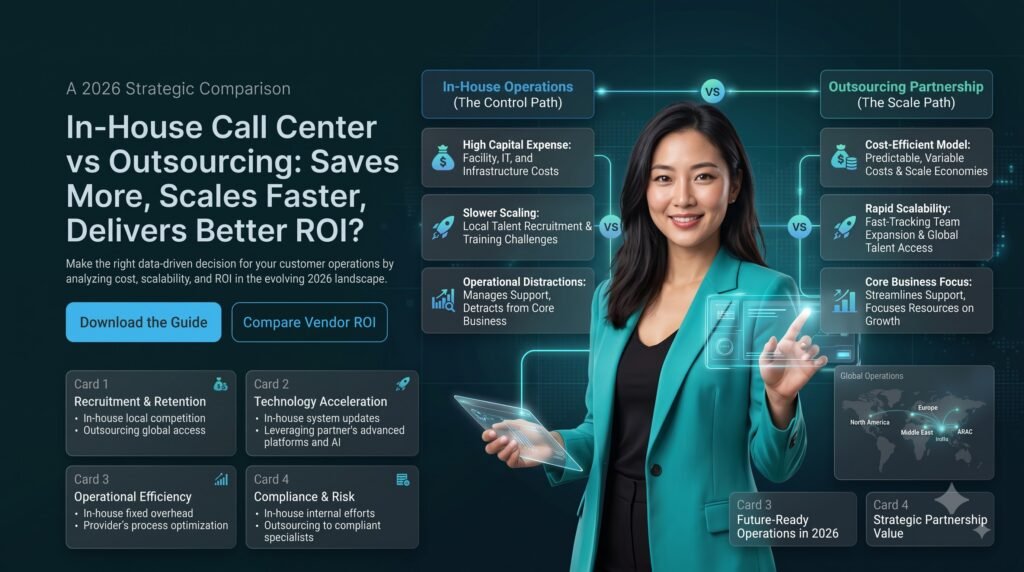
Short answer: At any meaningful volume, outsourcing wins on cost per contact, usually by a wide margin, and wins on speed to scale. In-house wins on knowledge depth, control over hiring, and protection of complex or regulated work. The decision is rarely binary, and the number that should decide it is not cost per contact. It is the amount of customer churn your savings can absorb before the business case collapses. This guide shows you how to calculate that number.
Key takeaways
- Comparing an outsourced hourly rate to an internal salary is the most common error in this decision. The correct comparison is fully loaded cost per productive hour, then cost per resolved contact.
- In-house support teams typically lose 25–35% of paid hours to shrinkage (leave, training, breaks, meetings, absence) before a single contact is handled. Most internal business cases ignore this.
- Outsourcing carries real client-side costs that vendors do not quote: vendor management headcount, transition fees, integration work, governance time, and a year-one quality drag.
- Small teams are structurally expensive. Queueing mathematics penalises low-volume operations, and 24/7 coverage requires roughly five to six full-time employees for every single concurrently staffed seat.
- If you already run a contact centre with spare supervisory capacity, your marginal cost per additional seat is far below your average cost per seat. Benchmarking a vendor against your average will produce a false saving.
- AI changes the mix, not just the cost. Automating the easy 30–40% leaves a harder residual, which raises cost per human-handled contact even as total cost falls.
- For most businesses between 30,000 and 500,000 annual contacts, the correct answer is neither pure model. It is a deliberately designed hybrid.
Why this decision looks different in 2026 than it did in 2019
Three things have changed materially, and each one shifts the maths.
Labour cost and availability diverged from volume growth. Contact volumes in digital-first businesses have kept climbing while the domestic pool of people willing to do shift-based, metric-managed voice and chat work has not kept pace. Wage pressure in US, UK and Australian contact centre roles has outrun the productivity gains most in-house teams achieved. That widens arbitrage, but it also makes in-house recruitment the binding constraint rather than in-house budget.
The technology stack became rentable. Building an in-house contact centre used to mean buying telephony, a workforce management system, a QA platform and integration effort. Cloud platforms turned that into a per-seat monthly line item. This cut the capital barrier to staying in-house, which is a genuine argument in favour of internal teams that competitor content rarely credits. The counterweight is that the stack is now only the entry fee. Operating it well (routing design, forecast accuracy, QA calibration, knowledge management) is where the cost sits, and that expertise is scarce.
AI moved from pilot to line item. Automated resolution now removes a meaningful slice of repetitive contacts in many operations. This is where most 2026 content becomes lazy. Deflection does not reduce your cost proportionally, because the contacts AI handles best are the cheapest ones you had. We will come back to this, because it is the single most misunderstood part of the current business case.
The models you are actually choosing between
“In-house versus outsourced” is a simplification. There are six operating models in practical use, and the trade-offs differ sharply between them.
| Model | What it is | Cost profile | Speed to scale | Best fit |
|---|---|---|---|---|
| In-house (domestic) | Your employees, your premises or remote, your management | Highest per contact; fully fixed | Slow (6–14 weeks per hiring wave) | Low volume, high complexity, regulated or brand-critical work |
| Captive / GCC | Your own offshore entity and employees | Lower labour cost, high fixed overhead and setup | Very slow to establish, fast once built | Large enterprises with 300+ seats and long horizons |
| Outsourced — dedicated team | Named agents working only your brand, managed by the provider | Variable, mid-range | Fast (4–10 weeks) | Most mid-market and enterprise CX operations |
| Outsourced — shared / pooled | Agents supporting multiple clients | Lowest cost per contact | Fastest | Simple, scripted, low-variance contact types and overflow |
| Hybrid | Internal core team plus outsourced tiers, channels or hours | Blended; fixed core, variable edge | Fast at the edge | 30k–500k annual contacts, seasonal or multi-channel |
| Outcome / BPaaS | Provider owns process, technology and outcome, priced per resolution or per outcome | Variable, aligned to volume | Moderate | Mature processes with clean definitions of “resolved” |
Two observations worth keeping in mind as you read on. First, most companies that describe themselves as “in-house” are already hybrid, because they use an overflow provider at peak or an after-hours answering service. Second, the shared-versus-dedicated choice inside outsourcing often matters more to your outcome than the in-house-versus-outsourced choice itself.
How to build the real cost comparison
Direct answer: Build cost per productive hour for both models, then divide by contacts handled per productive hour to get cost per contact, then divide by first contact resolution rate to get cost per resolved issue. Comparing an hourly bill rate to a salary will overstate in-house savings by a factor of roughly 1.6 to 2.2.
Here is the sequence, with the arithmetic exposed so you can substitute your own inputs.
Step 1: Convert salary to fully loaded cost
Wages are not the cost of an employee. In the United States, the Bureau of Labor Statistics’ Employer Costs for Employee Compensation series has consistently shown benefits accounting for roughly 30–31% of total compensation for civilian workers, with wages making up the remaining ~69–70%. That implies a load factor of approximately 1.45× base wage before you add anything operational. (Verify the current release; BLS updates this quarterly.)
If your agent base rate is $20.00 per hour, your fully loaded hourly cost is roughly $29.00 before management, technology or facilities.
Step 2: Convert paid hours into productive hours
This is the step almost every internal business case skips.
A full-time agent is paid for approximately 2,080 hours per year. They are not available to handle contacts for 2,080 hours. Paid time off, statutory holidays, sick leave, breaks, team meetings, coaching sessions, system downtime, and training all consume paid time. Contact centre workforce planners refer to this as shrinkage, and planning assumptions in the 25–35% range are common industry practice. Use your own timekeeping data if you have it.
At 30% shrinkage:
2,080 paid hours × (1 − 0.30) = 1,456 productive hours
So your $29.00 fully loaded hourly wage is actually costing you:
(2,080 × $29.00) ÷ 1,456 = $41.43 per productive hour
You have not yet paid for a supervisor, a QA analyst, a workforce planner, a licence, a laptop or a recruiter.
Step 3: Add the operating envelope
The costs below are the ones that make in-house support genuinely expensive. Figures are illustrative assumptions for a 20-agent US team, shown so you can replace them with your own.
Illustrative Example — Not MasCallNet Performance Data. Assumptions stated; substitute your own inputs.
| In-house cost line (per agent, per year) | Illustrative value | Basis |
|---|---|---|
| Fully loaded wage (2,080 hrs × $29.00) | $60,320 | $20/hr base × 1.45 benefits load |
| Team lead / supervisor allocation | $7,083 | 1 lead per 12 agents at $85,000 loaded |
| WFM, QA and training allocation | $3,600 | 1 specialist per 25 agents at $90,000 loaded |
| Operations management allocation | $3,250 | 0.5 FTE manager at $130,000 loaded across 20 agents |
| Recruitment and replacement cost | $3,794 | 35% attrition × ~$10,840 per replacement (see note) |
| Technology per seat (CCaaS, CRM seat, QA, WFM) | $1,800 | $150 per user per month, indicative |
| Facilities, equipment, IT support | $2,400 | Blended on-site/remote assumption |
| Total fully loaded cost per agent | $82,247 | |
| Cost per productive hour | $56.49 | $82,247 ÷ 1,456 hours |
Replacement cost note: built as average cost per hire (SHRM’s talent acquisition benchmarking has commonly reported figures in the region of $4,700 per hire; verify the current publication) plus four weeks of unproductive training at loaded cost (~$4,640) plus approximately $1,500 in coverage and ramp inefficiency. Attrition in contact centre roles is widely reported in industry surveys at 30–45% annually; use your own rate, because this line is highly sensitive.
Step 4: Convert to cost per contact
Productive hours are still not handling hours. Agents wait for contacts. The proportion of productive time actually spent on interactions is occupancy, and running above roughly 85% sustained occupancy is generally regarded as a burnout and attrition risk.
At 80% occupancy and a 12-minute average handle time including wrap:
1,456 productive hours × 0.80 = 1,165 handling hours
1,165 × 5 contacts per hour = 5,824 contacts per agent per year
$82,247 ÷ 5,824 = $14.12 per contact
That is your real in-house number. Not $20 an hour.
Step 5: Build the outsourced number honestly
Now do the same discipline on the other side. Outsourced bill rates vary enormously by geography, complexity, channel and shift pattern. Rather than reproduce rate cards here, benchmark against a dedicated reference on outsourced customer support pricing and, critically, treat any published range as indicative until you have written quotes against your own scope.
The part that matters is what the rate excludes. A bill rate is not a total cost. Budget these client-side lines:
| Outsourced cost line (per seat, per year) | Illustrative value | Note |
|---|---|---|
| Vendor fees (1,456 productive hours × indicative $12) | $17,472 | Offshore dedicated, illustrative only |
| Client-side vendor management | $2,400 | 1 manager per 50 seats at $120,000 loaded |
| Transition / implementation, amortised | $833 | $50,000 over 20 seats over 3 years |
| Client-provided tooling and integration | $1,800 | Where you supply CRM/CCaaS seats |
| Governance, audits, QA calibration, travel | $500 | |
| Year-one quality drag allowance | $874 | ~5% of fees for rework and escalation |
| Total per seat | $23,879 | |
| Cost per contact (same 5,824 contacts) | $4.10 |
Two honest observations about this comparison.
The saving is real and it is large. On these illustrative assumptions, the gap is roughly 71% per contact, which is materially better than the ~59% you would have estimated by naively comparing a $12 bill rate to a $29 loaded wage. The reason is that the in-house overhead envelope (supervision, QA, WFM, attrition, facilities) is larger than most finance teams model, and vendors absorb it into their rate.
Onshore outsourcing compresses this sharply. Substitute an onshore bill rate and the vendor fee line multiplies by roughly 2.5 to 3.5. The saving narrows to something in the region of 30–40% and becomes sensitive to your assumptions. Onshore outsourcing is generally not a cost play. It is a flexibility, speed and capability play. If someone is selling it to you primarily on savings, interrogate the model.
The mistake that breaks most internal business cases: average cost versus marginal cost
Direct answer: If you already operate a contact centre with unused supervisory span, spare licences and existing facilities, the cost of adding one more in-house seat is far lower than your average cost per seat. Comparing a vendor’s price to your average cost will show a saving that does not exist in your P&L.
Consider the 20-agent team above at $82,247 per agent on average. Now assume you have supervisors at a 1:12 ratio and only 20 agents, meaning your second supervisor is running at half capacity. Adding agents 21 through 24 consumes existing supervisory capacity, existing management time and existing facilities. The marginal cost of those seats is closer to the loaded wage plus licence plus replacement cost: roughly $66,000, not $82,000.
Run the comparison the other way as well. If you outsource 10 of your 20 seats, you do not remove half your overhead. You remove ten salaries. The supervisor, the QA analyst, the manager and the facility mostly remain, now spread across ten agents instead of twenty, which means your remaining in-house cost per seat rises. This is the stranded cost problem, and it is the most common reason that projected outsourcing savings fail to appear in the actual accounts.
Rule to apply: model the savings on the post-transition organisational chart you will genuinely operate, not on a proportional reduction of today’s cost base.
Why small teams are structurally expensive
Direct answer: Queueing mathematics penalises low-volume operations. A team of 8 agents needs proportionally more staff to hit a given service level than a team of 80, because there is less statistical pooling of idle time. This is why in-house economics deteriorate below roughly 15–25 seats and why overflow arrangements exist.
This is not an opinion, it is a property of the Erlang C model used in workforce planning. When arrival patterns are random, a small team has fewer agents available to absorb a simultaneous cluster of contacts. To maintain an 80/20 service level, a small team must carry more slack, which shows up as lower occupancy, which raises cost per contact.
The practical implication is uncomfortable for small internal teams: you can be fully staffed on paper and still miss service level, because your team is too small to absorb variance. Hiring one more person is a step change in cost for a small team and a rounding error for a large one.
The 24/7 coverage calculation almost nobody does before committing
If you have promised customers round-the-clock support, this is the arithmetic that will decide your headcount plan.
- A week contains 168 hours.
- One full-time employee is paid for 40 hours per week.
- At 30% shrinkage, that employee delivers roughly 28 productive hours per week.
- To keep one seat continuously staffed for 168 hours:
168 ÷ 28 = 6 FTE.
Six full-time employees, fully loaded, to keep a single chair occupied around the clock. Before you account for the fact that you need at least two agents on the overnight shift for redundancy and escalation, and before you add a night-shift supervisor.
At the illustrative loaded cost above, continuous coverage of two concurrent seats is approximately 12 FTE and roughly $987,000 per year in-house, for an operation that may handle very low overnight volume. This is the single most frequent trigger for outsourcing among mid-market companies, and it is a capability argument rather than a cost argument. A provider running follow-the-sun delivery staffs your overnight from a location where it is daytime, at daytime rates and with a natural talent pool. That structural advantage cannot be replicated by an in-house team of any size without either shift premiums or a second geography. If geography is the decision you are working through, the comparison between offshore vs onshore customer support outsourcing models is where that analysis belongs.
The FCR Tax: why cost per contact is the wrong metric
Direct answer: Cost per resolved issue equals cost per contact divided by first contact resolution rate. A seven-point drop in FCR increases the number of contacts per issue by roughly 10%, which raises your effective cost by the same proportion and degrades customer experience at the same time.
If an issue is resolved on the first contact 75% of the time, the average number of contacts required per issue is 1 ÷ 0.75 = 1.33. At 68% FCR, it becomes 1 ÷ 0.68 = 1.47. That is a 10.5% increase in total contact volume generated by the same number of underlying customer problems.
Apply it to the illustrative numbers:
| In-house | Outsourced (offshore, illustrative) | |
|---|---|---|
| Cost per contact | $14.12 | $4.10 |
| Assumed FCR | 75% | 68% |
| Cost per resolved issue | $18.83 | $6.03 |
The gap narrows but does not close. On pure economics, at scale, offshore outsourcing usually still wins even after a meaningful quality discount. Which leads directly to the point that most articles on this subject never reach.
The cost case for outsourcing rarely fails on the cost line. It fails on the revenue line.
The Churn Break-Even Line
Direct answer: Divide your projected annual savings by (customer count × average customer lifetime value). The result is the percentage increase in annual churn that would consume the entire saving. If that number is small relative to your realistic quality risk, do not outsource that workload.
This is the calculation that should sit on the first slide of your board paper.
Formula:
Break-even churn delta (%) = Annual savings ÷ (Customers × LTV) × 100
Worked illustration (assumptions stated, not actual performance data):
- 20 seats moved from in-house to outsourced
- In-house cost: 20 × $82,247 = $1,644,940
- Outsourced cost: 20 × $23,879 = $477,580
- Annual saving: $1,167,360
- Customer base: 100,000 · Average LTV: $1,200 → base value $120,000,000
$1,167,360 ÷ $120,000,000 × 100 = 0.97%
Interpretation: a 0.97 percentage point increase in annual churn wipes out every dollar of saving. A 0.5 point increase halves it. A 2 point increase makes the decision value-destructive even though the cost line looks excellent.
How to use this:
- If your break-even churn delta is above ~3%, the decision is cost-led and low risk. Outsource, manage quality with normal governance.
- If it sits between ~1% and ~3%, outsource selectively. Keep high-value, retention-sensitive and cancellation-intent contacts in-house or on a dedicated, tenured outsourced pod with rigorous QA.
- If it is below ~1%, the business case is fragile. Either restructure the scope toward genuinely low-risk contact types, or stay in-house and attack cost through automation and process redesign instead.
This single calculation does more to protect a CX leader than any vendor scorecard, because it reframes the question from “how much can we save” to “how much quality can we afford to lose.”
What AI actually does to the comparison in 2026
Direct answer: AI reduces total cost but usually increases cost per human-handled contact, because automation removes the simplest interactions first. It also shifts effort from labour to engineering, governance and knowledge management, which favours whichever party already owns that capability.
Three mechanisms matter, and they are frequently conflated in vendor material.
Mix shift. Suppose AI resolves 35% of your contacts end to end. Those will disproportionately be password resets, order status checks and delivery queries: short, scripted, low-AHT. The residual 65% is longer, more complex and more emotionally loaded. Your average handle time on human-handled contacts rises, your agents need greater tenure and authority, and your cost per human contact goes up. Total cost still falls. Unit cost does not. Build your forecast accordingly, or your year-two budget will be wrong.
Containment is not resolution. When a provider quotes a deflection or containment figure, ask what happens next. A contact that was contained by a bot and then re-raised through email 40 minutes later has not been resolved, it has been delayed and duplicated. The metric to contract on is automated resolution rate measured at 72-hour recontact, not containment.
The capability shifts, it does not disappear. An in-house team that automates properly now needs knowledge base engineering, retrieval quality monitoring, prompt and policy governance, hallucination controls, escalation design, and a QA process that evaluates AI output as well as human output. That is real headcount and real specialist skill. Some organisations genuinely want to own it, because customer conversation data is a strategic asset. Many discover eighteen months in that they have built a small, expensive AI operations team to support a support function. That trade-off is the honest core of the modern build-versus-buy question, and it is explored in more depth in this analysis of customer support outsourcing with AI in the delivery model.
One further caution. AI performs best where knowledge is well structured. If your internal documentation is fragmented and out of date, automation will amplify the inconsistency rather than fix it. Sequencing matters: fix knowledge, then automate, then decide sourcing. Doing it in the reverse order is how organisations end up paying a vendor to operate a broken process. The same logic applies when automating business processes in back-office and fulfilment workflows that feed contact volume.
The control question, examined honestly
The standard argument for keeping support in-house is control. It deserves more scrutiny than it usually gets.
What you genuinely control in-house: hiring standards, compensation design, career pathways, cultural alignment, direct access to product and engineering, the speed at which a policy change reaches the floor, and where customer conversation data lives.
What you do not control in-house, despite believing you do:
- Attrition. You control your offer, not the local labour market. A 38% attrition rate means your team is entirely replaced in under three years and your average tenure never reaches the point where expertise compounds.
- Arrival patterns. You control the roster. Customers control the queue.
- Management attention. When support is not the core business, support leadership competes for executive time against product, sales and finance. The number of in-house contact centres that are under-invested because they are a cost centre in a growth company is not small.
- Coverage continuity. A snowstorm, an outage or a flu wave hits a single-site in-house team in a way it does not hit a multi-site provider.
What you lose when you outsource, stated plainly:
- Knowledge accumulation inside your own walls. The agent who has handled 4,000 of your tickets has genuine institutional knowledge. If that person is a vendor employee and the vendor reassigns them, that knowledge leaves. Contract for named-agent continuity if the work is complex.
- Speed of informal escalation. An in-house agent can walk to a product manager. An outsourced agent files a ticket.
- The feedback loop to product. This is the most commonly under-protected asset in outsourcing. Design it explicitly into the contract with structured voice-of-customer reporting, or it will not happen.
The mature position is that control is not a property of the model, it is a property of the governance. Well-governed outsourcing beats poorly governed in-house on almost every measure. Poorly governed outsourcing beats nothing.
How outsourcing actually fails
Naming failure modes is more useful than listing benefits. These are the patterns that recur.
The 90-day knowledge cliff. Transition goes well. Agents pass certification. Month four arrives, the vendor’s trainers have moved to the next client, attrition begins replacing the trained cohort, and nobody owns knowledge refresh. Quality degrades quietly. Mitigation: contract for a permanent embedded trainer and require knowledge base ownership with a named client-side counterpart.
The scope-creep spiral. You signed for tier-1 email support. Eighteen months later the team is handling refunds, retention offers and social escalations at the original rate, and quality reflects that. Mitigation: formal change control with re-pricing triggers.
Pricing model mismatch. Per-ticket pricing punishes you for your own product quality: a buggy release generates more tickets and a larger invoice. Per-hour pricing gives the vendor no incentive to reduce handle time. Mitigation: per-hour for complex and variable work, per-ticket only where contact drivers are stable, outcome-based only where “resolved” is unambiguously definable by both parties.
The vendor management vacuum. The single strongest predictor of outsourcing failure is having nobody senior on the client side who owns the relationship. One under-powered coordinator managing a 60-seat programme is not governance. Mitigation: budget one experienced vendor manager per 40–60 seats and give them authority.
Optimising the wrong metric. AHT targets without FCR targets produce fast, unhelpful interactions and repeat contacts. Mitigation: contract on a balanced scorecard where FCR and CSAT carry more weight than AHT.
Transition underestimation. Every programme looks worse in weeks one to eight than the in-house baseline. Organisations that do not plan for this panic and intervene, which extends the dip. Mitigation: set an explicit stabilisation period with different metrics from steady state.
And how in-house fails
For balance, the in-house failure modes are equally predictable: hiring cycles that cannot keep pace with growth, service level collapse during unplanned volume spikes, supervisor span of control degrading as the team grows without structural investment, no workforce management discipline so forecasts are guesses, QA reduced to a compliance checkbox, and a cost base that becomes politically difficult to reduce when volumes fall. In-house teams have one particularly dangerous characteristic: their costs are fixed, so a demand downturn hits margin immediately and headcount reduction is slow, expensive and culturally damaging.
Data protection and regulated industries
Direct answer: Outsourcing does not transfer regulatory responsibility. Under GDPR, you remain the controller and the provider is a processor with obligations flowing through an Article 28 contract. In regulated financial services, supervisory frameworks in the EU, UK and India explicitly hold the regulated entity accountable for outsourced functions.
Requirements vary by jurisdiction and sector, and you should take current legal advice rather than rely on any article, including this one. The following are the frameworks most commonly in scope:
- GDPR (EU/UK). Article 28 sets mandatory processor contract terms. International transfers require an appropriate mechanism, such as Standard Contractual Clauses with a transfer risk assessment, or reliance on an adequacy decision where one exists for the destination.
- DORA, Regulation (EU) 2022/2554. Applies from 17 January 2025 and imposes structured ICT third-party risk management, contractual content requirements and a register of information for EU financial entities.
- UK FCA. SYSC 8 outsourcing rules and the operational resilience framework introduced under PS21/3 require firms to identify important business services and remain accountable for them regardless of who performs them.
- Reserve Bank of India. The Master Direction on Outsourcing of Information Technology Services (April 2023) and the longer-standing guidance on outsourcing of financial services set expectations for regulated entities in India, including audit and inspection rights.
- HIPAA (US healthcare). A Business Associate Agreement is mandatory where protected health information is accessible.
- PCI DSS v4.x. Applies where cardholder data is handled. Future-dated requirements became effective 31 March 2025; confirm current applicability with your QSA.
Independent assurance such as ISO/IEC 27001:2022 certification or a SOC 2 Type II report is useful evidence of control maturity, but neither is a substitute for your own due diligence, your own risk assessment, or the right to audit.
Practical clauses to insist on regardless of sector: named sub-processor disclosure and approval rights, data residency commitments, breach notification within a defined window, defined data retention and deletion on exit, recorded-call access and retention terms, background check standards, clean-desk and BYOD policy for remote agents, and an exit plan with data return in a usable format. For firms in regulated financial services, sector-specific delivery considerations sit alongside broader digital banking services requirements around authentication, complaint handling and audit trail integrity.
The MasCallNet Sourcing Decision Matrix
An analytical framework developed for this guide. It is not an external industry standard. Use it to structure internal debate, not to replace judgement.
Score each criterion from 1 to 5, where 1 strongly favours keeping the work in-house and 5 strongly favours outsourcing it. Multiply by the weight, then total.
| # | Criterion | Score 1 (in-house) | Score 5 (outsource) | Weight |
|---|---|---|---|---|
| 1 | Annual contact volume | Under 20,000 | Over 250,000 | 3 |
| 2 | Volume variability | Flat and predictable | Highly seasonal or spiky | 2 |
| 3 | Coverage requirement | Business hours, one region | 24/7 or multi-timezone | 3 |
| 4 | Contact complexity | Deep product or domain expertise required | Process-driven, documentable | 3 |
| 5 | Regulatory sensitivity | Heavily restricted or supervisory constraints | Standard commercial data | 2 |
| 6 | Revenue exposure per contact | Contacts influence retention or sale directly | Low individual revenue impact | 3 |
| 7 | Knowledge documentation maturity | Tribal, undocumented | Structured, current, accessible | 3 |
| 8 | Internal recruitment capability | Strong local pipeline, low attrition | Cannot hire or retain at required rate | 2 |
| 9 | Management bandwidth | Experienced CX ops leadership in place | No dedicated ops leadership | 2 |
| 10 | Growth trajectory | Stable | Rapid or entering new markets | 2 |
| 11 | Churn break-even delta (see formula above) | Below 1% | Above 3% | 3 |
| 12 | Technology position | Modern stack, well configured | Legacy, fragmented or absent | 2 |
Maximum score: 160.
Interpretation:
- Below 65 — Keep in-house. Your constraints are structural, not financial. Focus on process improvement, knowledge management and selective automation.
- 65 to 95 — Hybrid. Identify the specific contact types, channels or hours that score highest individually and outsource only those. This is where the majority of mid-market organisations genuinely sit.
- 96 to 125 — Outsource the majority of volume with a retained internal core covering escalations, product liaison and quality oversight.
- Above 125 — Full outsourcing with a strong client-side vendor management function. Your constraint is execution capability, not strategy.
Important caveat: criterion 7 is a veto in practice. If your knowledge is undocumented, no provider will succeed regardless of your total score. Fix documentation before transition, not during it.
When to keep it in-house
Stay internal when the following are true:
- Volume is below roughly 20,000 contacts per year and coverage is business hours only. At that scale, the overhead of governing a vendor relationship consumes much of the arbitrage.
- Support conversations are a primary revenue mechanism rather than a cost of service. If an interaction routinely results in an upsell, a renewal decision or a material retention outcome, the economics of quality dominate the economics of cost.
- The work requires expertise that takes longer than six months to build and cannot be documented, such as complex clinical, engineering or advisory content.
- Regulatory constraints or client contracts restrict where data may be processed or who may access it.
- Your support team functions as the primary product feedback channel and that loop is genuinely operationalised rather than aspirational.
- You have a strong local talent pipeline and attrition below roughly 20%, which means tenure and expertise actually compound.
When outsourcing makes sense
Outsource when:
- Coverage requirements exceed what your hiring can sustainably support, particularly nights, weekends and public holidays.
- Volume varies by more than roughly 40% between peak and trough, so fixed internal capacity is either overstaffed or underwater for most of the year.
- You are entering new markets, languages or timezones faster than you can build local teams.
- Your contact types are well documented and process-driven, even if individually complex.
- Recruitment is the binding constraint. If you cannot fill roles, budget is irrelevant.
- You need a technology and workforce management capability faster than you can build it internally. Rather than procuring and configuring a platform from scratch, evaluate what a managed model offers by reviewing how modern contact center services are delivered on a CCaaS foundation.
- Growth is outpacing your operations leadership capacity. Buying managed operations buys management, not just agents.
Scaling scenarios are where the difference becomes tangible. The operational mechanics of moving a support function to handle ten thousand tickets a month, including ramp planning, tiering and QA design, are set out in this guide to using outsource call center services at that volume.
The hybrid model: what good design looks like
Most organisations between 30,000 and 500,000 annual contacts should not choose. They should split the work along deliberate lines. Four patterns work reliably.
| Pattern | Split | Keep in-house | Outsource | Works best when |
|---|---|---|---|---|
| Tiered | By complexity | Tier 2 and 3, technical escalation, complaints | Tier 1, FAQs, account and order queries | Contact drivers are well understood and tiering criteria are objective |
| Temporal | By hours | Core business hours | Nights, weekends, public holidays | You have promised 24/7 but overnight volume is thin |
| Channel | By medium | Voice, or high-touch chat | Email, social, order tracking, review responses | Channels differ materially in complexity or brand sensitivity |
| Elastic | By volume band | Baseline capacity | Peak, seasonal, campaign and incident overflow | Volume swings by more than 40% seasonally |
The tiered model is the most common and the most frequently botched. It fails when the handoff criteria are subjective. “Escalate if complex” is not a criterion. “Escalate if the account has an active enterprise contract, or if a refund exceeds $250, or if the customer has contacted more than twice about the same issue” is a criterion. Write the tiering rules before the first agent is trained, and instrument them so you can see escalation rate by driver.
Sector context matters here too. Subscription software has a distinctive contact profile, with technical depth, renewal sensitivity and product-linked escalation paths that shape the split. The design considerations specific to that environment are covered in this guide to customer support outsourcing for SaaS businesses.
What the first 120 days actually look like
Transition timelines quoted in sales conversations are usually optimistic. A realistic plan for a 20 to 40 seat programme:
Weeks 1–3: Discovery and design. Contact driver analysis, volume and pattern forecasting, process documentation review, systems access mapping, security review, tiering and escalation design, metric baseline agreement. The most valuable thing that happens in this phase is the discovery that your documented process and your actual process differ.
Weeks 4–6: Build. Environment setup, access provisioning, knowledge base construction, curriculum development, QA framework and scorecard calibration, routing and telephony configuration, reporting build.
Weeks 7–10: Pilot. A small cohort handles live contacts under intensive supervision. Expect handle times 40–70% above target and FCR below baseline. This is normal and should be planned for, not treated as a crisis.
Weeks 11–16: Ramp. Cohorts added in waves. QA intensity stays high. Weekly calibration sessions between your QA lead and the provider’s. Escalation paths get tested under real conditions.
Weeks 17–20: Stabilisation. Metrics converge toward baseline. Governance cadence settles into weekly operational and monthly business reviews. Only now should you measure against steady-state SLA.
Two planning points. First, keep in-house capacity running in parallel through week 12 at minimum. Overlap costs money and prevents disasters. Second, agree explicitly that SLA measurement and any service credits begin at stabilisation, not at go-live, and document the transition metrics separately.
Vendor evaluation: what to ask that most RFPs omit
Standard RFPs ask about experience, certifications and references. These are the questions that actually predict outcomes:
- What is your annualised attrition on comparable accounts, measured at the programme level rather than company-wide?
- What is your average agent tenure on accounts of our size and complexity?
- Who specifically will manage this account, what else do they manage, and can we interview them before signing?
- What is your supervisor to agent ratio, and does it change after the first six months?
- How many QA evaluations per agent per month, and who calibrates against our standards?
- What is your training curriculum length and what is your certification pass rate?
- If we are unhappy with an individual agent, what is the process and timeline for replacement?
- How do you handle a contact type that was not in scope at contract signing?
- What is your unplanned downtime record, and what is your business continuity arrangement across sites?
- What does your reporting look like on day one, and can we see a live example rather than a mockup?
- If we terminate, what is the exit process, what do we get back, in what format, and over what period?
- What does your pricing exclude? Ask explicitly about telecom pass-through, shift premiums, minimum billing increments, reporting tiers, change requests and implementation fees.
- How do you measure automated resolution, and do you measure recontact within 72 hours?
- Can we speak to a client who left you?
That last question is the most informative one in the list. A provider willing to facilitate it is telling you something about their confidence and their honesty.
Contract terms worth fighting for
- Exit assistance obligation of at least 90 days at contracted rates, with knowledge transfer and data return in a usable format specified in the agreement.
- Benchmarking clause permitting a market rate review at 24 months.
- Named account management continuity with notice and approval rights on replacement.
- Balanced scorecard with FCR and CSAT weighted above AHT.
- Service credits that actually bite, expressed as a meaningful percentage of monthly fees rather than a token amount.
- Volume flexibility bands, typically permitting plus or minus 20% adjustment without re-pricing.
- Right to audit including physical site and information security review.
- Sub-processor approval rights with disclosure of any onward delegation.
Reversibility: the cost of changing your mind
Almost no article on this subject discusses what it costs to reverse the decision, which is remarkable given how often it happens.
Bringing work back in-house requires rehiring at current market rates (which will be higher than when you left), rebuilding knowledge that has been living in a vendor’s systems, re-establishing a technology stack if the provider supplied it, and absorbing a service level dip during ramp. Realistic budget: four to seven months of the target run-rate cost, plus recruitment.
Switching providers is faster but not cheap. Budget a new implementation fee, a 10 to 14 week overlap period paying both providers, and a quality dip during ramp. Realistic budget: two to four months of run-rate cost.
Two protective actions cost almost nothing at contract stage and save a great deal later. First, maintain your knowledge base in a system you own, with the provider contributing to it rather than maintaining their own parallel version. Second, ensure customer conversation data, recordings and transcripts sit in a platform you control or can extract in bulk in a standard format. These two decisions are the difference between a manageable transition and a hostage situation.
The India question, stated without hype
India remains a significant global delivery location for customer operations. NASSCOM’s annual Strategic Review documents the scale of the Indian IT-BPM sector and its workforce; consult the current edition for present figures rather than relying on numbers quoted in secondary sources.
The genuine structural advantages are specific rather than general: a large English-speaking graduate workforce, deep process and quality management maturity built over three decades of delivering for global enterprises, a timezone position that supports European mornings and North American nights within normal local working hours, an established regulatory and legal framework for outsourced service delivery, and a labour cost structure substantially below US, UK and Australian equivalents.
The qualifications matter equally. India is not automatically the cheapest location; several other destinations compete closely on rate. Accent and cultural alignment vary significantly by provider, by city and by the seniority of the agents assigned to your account, and a low rate frequently signals a junior, high-turnover team. Voice-heavy consumer support for certain US market segments may perform better nearshore. Timezone advantage for Australian business hours is stronger than for US West Coast daytime coverage.
Choose the location after you have decided the model and defined the work, not before. A structured view of the considerations involved is set out in this assessment of the best customer support outsourcing companies and delivery models serving US businesses from India.
Executive checklist before you decide
Work through this before the business case reaches your board.
- Calculated fully loaded in-house cost per productive hour, not per paid hour
- Applied a shrinkage assumption based on your own timekeeping data
- Applied an occupancy assumption to derive contacts per agent per year
- Modelled marginal rather than average cost for any partial transition
- Identified all stranded costs that will remain after transition
- Added client-side vendor management headcount to the outsourced case
- Included transition, integration and year-one quality drag in the outsourced case
- Converted cost per contact into cost per resolved contact using FCR
- Calculated the Churn Break-Even Line and stress-tested it
- Confirmed knowledge documentation is current enough to transfer
- Segmented contact types by complexity and revenue exposure
- Decided which contact types must never leave the building
- Modelled 24/7 coverage using the FTE-per-concurrent-seat calculation
- Reviewed the data protection and regulatory position with counsel
- Defined exit terms and reversibility cost before signing anything
- Assigned a named internal owner with authority for vendor governance
If more than three boxes remain unchecked, the decision is not ready.
Frequently asked questions
Is outsourcing always cheaper than running an in-house call center?
No. Offshore outsourcing is usually substantially cheaper per contact at scale. Onshore outsourcing typically saves 30–40% and can be more expensive than in-house for organisations that already have supervisory capacity, facilities and technology in place. At very low volumes, the cost of governing a vendor relationship can exceed the labour saving.
At what volume does an in-house team stop making economic sense?
There is no universal threshold, but below roughly 15–25 seats, queueing mathematics and management overhead make in-house support expensive per contact. Above that, in-house becomes viable but requires genuine workforce management, quality assurance and recruitment capability to remain efficient.
What percentage can we realistically expect to save by outsourcing?
Compare like with like. Against a fully loaded in-house cost including shrinkage, attrition and overhead, offshore dedicated delivery commonly produces savings in the 50–70% range, nearshore roughly 35–55%, and onshore roughly 20–40%. These are indicative planning ranges, not quotes. Your actual figure depends on complexity, coverage hours, language requirements and how much stranded cost remains.
What hidden costs should we budget for on the outsourced side?
Client-side vendor management headcount, implementation and transition fees, systems integration effort, telecom pass-through charges, shift premiums for out-of-hours coverage, minimum billing increments, charges for enhanced reporting tiers, change request fees, travel for governance and audit, and a year-one quality allowance for rework and escalation.
How long does a transition take?
For a 20 to 40 seat programme, plan 16 to 20 weeks from contract to stabilised steady state. Go-live may occur at week 10 to 12, but metrics will not match baseline until stabilisation. Treat any promise of full steady state in under 8 weeks with scepticism unless the scope is very simple.
Will quality drop when we outsource?
Almost always in the first 60 to 90 days, and the size and duration of the dip depend heavily on how well your processes are documented. Whether it recovers to or beyond baseline depends on three things: knowledge management discipline, the tenure of the assigned team, and whether you resourced vendor governance properly. Plan for the dip contractually rather than being surprised by it.
Can we outsource part of our support and keep the rest in-house?
Yes, and for most mid-market organisations this is the strongest option. Split by tier, by hours, by channel or by volume band. The critical requirement is objective, written handoff criteria. Subjective escalation rules such as “escalate if complex” reliably cause the model to fail.
Should we automate before outsourcing, or outsource before automating?
Fix knowledge management first, then decide sourcing, then automate. Automation applied to poorly documented processes amplifies inconsistency. If you lack the internal capability to build and govern AI in support, that argues for a provider who already operates it rather than for delaying the decision.
Does AI eliminate the need to outsource?
No. Automation typically resolves the simplest portion of contact volume. The residual becomes more complex and requires more capable agents, not fewer. AI reduces total cost while often increasing cost per human-handled contact. It changes the size and shape of the team you need rather than removing the need for one.
Who is legally responsible for data protection when support is outsourced?
The accountability remains with you. Under GDPR you are the controller and the provider is a processor bound by an Article 28 contract. Financial services frameworks including DORA in the EU, FCA rules in the UK and RBI directions in India explicitly maintain the regulated entity’s accountability for outsourced functions. Take current legal advice for your jurisdiction and sector.
What contract length should we sign?
Two to three years balances the provider’s need to recover investment against your need for flexibility. Insist on a benchmarking clause at 24 months, volume flexibility bands, and termination for convenience with 90 days notice after an initial commitment period. Five-year terms without benchmarking are rarely in the buyer’s interest.
Should we choose dedicated or shared agents?
Dedicated for anything requiring product knowledge, brand voice or regulatory care. Shared for simple, scripted, high-variance overflow where the cost advantage genuinely matters and the risk of a generic interaction is acceptable. Many programmes use both: a dedicated core with shared overflow capacity for peaks.
How should we measure an outsourced team’s performance?
Use a balanced scorecard weighted toward first contact resolution and CSAT, with average handle time monitored rather than targeted. Add quality score from calibrated evaluations, schedule adherence, escalation rate by driver, and for automated components, resolution rate measured at 72-hour recontact. Review weekly at operational level and monthly at business level.
What happens if the outsourcing relationship fails?
That depends almost entirely on decisions you made at contract stage. If your knowledge base lives in a system you own and your conversation data is extractable in a standard format, switching providers takes 10 to 14 weeks with a cost of roughly two to four months of run-rate. If both live in the provider’s environment, the transition is materially harder and more expensive. Negotiate exit terms before signing, not when you need them.
Can we bring outsourced support back in-house later?
Yes, though it is the more expensive reversal. Budget four to seven months of target run-rate cost covering recruitment at current market rates, knowledge rebuilding, technology reinstatement and a service level dip during ramp. It is done successfully, most often by companies whose product has become significantly more complex or whose support function has become a revenue driver.
Should a regulated financial services firm outsource customer support at all?
Many do, within supervisory frameworks that permit it subject to governance requirements. What is not permitted is treating outsourcing as a transfer of accountability. Expect to demonstrate due diligence, contractual control, audit rights, business continuity arrangements, sub-processor oversight and a documented exit plan to your regulator.
Where to go from here
If you have worked through the Churn Break-Even Line and the Sourcing Decision Matrix and landed somewhere in the hybrid range, the useful next step is not a vendor pitch. It is a structured look at your own contact data: which drivers generate volume, which of those are genuinely documentable, where your escalation criteria would need to be written, and what your fully loaded cost per resolved contact actually is today.
MasCallNet works with organisations at exactly that point in the decision, as a provider of call center outsourcing and managed customer operations. If you would like a considered view on which parts of your support operation are suited to an external model and which are better retained internally, including the parts we would advise against outsourcing, that is a conversation worth having before you issue an RFP.
Bring your contact volumes, your coverage requirements and your current cost base. We will bring the operational reality.