
When Should You Outsource Customer Service? 12 Signs Your Business Is Ready in 2026
AI Overview
Outsourcing customer service is no longer a cost-cutting decision — it is a revenue infrastructure decision. In 2026, the businesses outsourcing successfully are not replacing human agents with AI or shipping problems offshore; they are building hybrid AI-human contact center operations that convert support interactions into retention, upsell, and forecasting data. This guide defines the 12 operational, financial, and strategic signs that indicate outsourcing readiness, compares AI vs human customer support economics, evaluates the best BPO companies in India by evaluation criteria (not by name), and provides pricing, ROI, and vendor-selection frameworks for CEOs, COOs, and Heads of Customer Support.
Executive Introduction
Every CEO eventually asks the same question in a different disguise: “Why does supporting our customers cost more every quarter, and why does it feel like we’re getting less out of it?”
That question rarely gets answered by looking at headcount spreadsheets. It gets answered by looking at what customer support actually is inside a modern business — not a cost center to be minimized, but a live feed of customer intent, churn risk, and revenue signal that most organizations throw away every day.
This is the core thesis of this guide, and it is the operating principle behind how we advise clients at MasCallNet: Support-Led Revenue Growth™ — the idea that customer support, when built and operated correctly, is not an expense line. It is a revenue engine that predicts churn before it happens, surfaces upsell moments in real time, and compounds customer lifetime value with every resolved interaction.
Outsourcing is not the automatic answer to every support problem. But for a specific, identifiable set of businesses — usually somewhere between Series B growth stage and enterprise scale — in-house customer support becomes structurally incapable of keeping pace with the business it’s meant to protect. This article defines exactly when that inflection point arrives, what to do about it, and how to separate outsourcing partners who reduce cost from partners who compound revenue.
We wrote this for CEOs, COOs, CIOs, CTOs, Chief Customer Officers, Heads of Support, Heads of Operations, and procurement leaders evaluating whether — and who — to outsource to in 2026.
Key Insights
- The outsourcing decision has shifted from cost arbitrage to capability arbitrage. Businesses no longer outsource just to pay less per ticket — they outsource to access AI infrastructure, workforce elasticity, and 24/7 coverage they cannot build internally at the same speed.
- AI vs human customer support is a false binary. The highest-performing contact centers in 2026 run hybrid models where AI resolves 40–65% of Tier-1 volume and humans own judgment-based, high-value, and emotionally sensitive interactions.
- The best BPO companies in India are winning on infrastructure, not headcount. India’s outsourcing advantage has moved from labor-cost arbitrage to AI-enabled service delivery, multilingual scale, and time-zone coverage for US, UK, and EU markets.
- Most companies underestimate the true cost of in-house support because they measure salary and tools but not attrition, hiring cycles, management overhead, and opportunity cost of leadership attention.
- Every unresolved or delayed customer interaction is a revenue leakage event — not just a service failure. This is the foundation of what we call the MasCallNet Revenue Leakage Model™, detailed below.
The Market Reality in 2026
Three forces are converging to change how leadership teams think about customer support:
1. Customer expectations have decoupled from company size. A 40-person DTC brand is now judged against the response speed of a company with a 500-person support org, because AI has compressed the resolution-time curve industry-wide.
2. AI has made “average” support economically indefensible. When a competitor can resolve a billing question in 90 seconds using an AI agent layered over Zendesk or Salesforce Service Cloud, a business running email-only support with a 24-hour SLA is not just slower — it is losing the customer’s trust in the same conversation it’s trying to save.
3. Support data has become a forecasting asset. Sales, product, and finance teams increasingly want structured signal from support conversations — churn indicators, sentiment trends, feature requests — but most in-house teams have no system to extract or route that intelligence. This is the operational gap behind our second core principle: Contact Center Intelligence™ — the idea that every customer conversation is an enterprise data asset, not a closed ticket.
These three forces are why outsourcing decisions in 2026 are made by CFOs and COOs jointly, not delegated purely to support managers.
Industry Trends Shaping the Outsourcing Decision
| Trend | What’s Changing | Business Implication |
|---|---|---|
| AI-first Tier-1 resolution | AI agents (built on OpenAI, Google Gemini, and Claude-based models) now resolve routine queries without human involvement | Support cost per ticket drops, but only if infrastructure is built correctly |
| Consolidation of CX platforms | Zendesk, Salesforce, Freshdesk, HubSpot, Intercom increasingly integrate native AI and workflow automation | In-house teams need platform + AI expertise, not just agents |
| Omnichannel expectation | Customers move between WhatsApp, chat, email, and voice within a single issue | Requires unified platforms (Genesys, NICE CXone, Talkdesk, Five9) most SMBs can’t afford to build alone |
| Support-to-revenue accountability | CFOs now ask support leaders to justify headcount against retention and expansion revenue | Reinforces Support-Led Revenue Growth™ as the operating model, not a marketing phrase |
| India’s AI-BPO maturity | Leading Indian BPOs have moved from voice-only delivery to AI-augmented, analytics-driven service | The “best BPO companies in India” question is now an infrastructure question, not a labor-cost question |
Executive take: The businesses treating this as a staffing decision are already behind. The businesses treating it as an infrastructure and revenue-intelligence decision are the ones scaling support cost sub-linearly to revenue growth — the practical definition of Support-Led Revenue Growth™ in action.
What Is Customer Service Outsourcing?
Customer service outsourcing is the practice of contracting a specialized third-party provider — a Business Process Outsourcing (BPO) company — to manage some or all customer-facing support functions, including voice, chat, email, and social support, typically combined with technology infrastructure, workforce management, and quality assurance systems the client does not need to build internally.
Modern outsourcing (2026-standard) includes:
- Multichannel support delivery (voice, chat, email, WhatsApp, social)
- AI-augmented resolution (chatbots, voice bots, agent-assist tools)
- Workforce management and shift-based coverage across time zones
- Integration with the client’s existing CRM/helpdesk stack (Zendesk, Salesforce, Freshdesk, HubSpot)
- Reporting layers that feed CSAT, NPS, FCR, and AHT data back into the client’s business intelligence systems
Key takeaway: Outsourcing in 2026 is an infrastructure partnership, not a headcount rental — and businesses evaluating vendors purely on hourly rate are optimizing for the wrong variable.
Why This Decision Matters More Than Ever
Every quarter a business delays this decision, three things compound simultaneously:
- Cost-per-ticket rises as internal teams scale linearly with volume instead of leveraging AI-driven deflection.
- Customer churn risk increases silently, because unresolved friction rarely shows up as a complaint — it shows up as a non-renewal three months later.
- Leadership bandwidth erodes, as founders and COOs get pulled into escalation management instead of strategic execution.
This is the mechanism behind Revenue Recovery Through CX™ — our second core thesis. Every delayed resolution, every dropped call, every unresolved billing dispute is not a service metric failure; it is unrealized revenue sitting on the table. Businesses that treat support as a cost center systematically underinvest in the one function capable of recovering revenue that sales and marketing have already spent money to acquire.
How Outsourced Customer Support Actually Works
Direct answer: Outsourced support works by transferring day-to-day ticket handling, staffing, and channel operations to a specialized partner while the client retains ownership of brand voice, escalation policy, and business outcomes.
Framework — The Four Operating Layers:
| Layer | Owned By | Function |
|---|---|---|
| Strategy & SLA definition | Client (with vendor input) | Defines what “good” looks like: CSAT targets, resolution time, escalation rules |
| Delivery infrastructure | Vendor | Staffing, shift coverage, platform configuration (Zendesk, Freshdesk, Genesys, etc.) |
| AI + automation layer | Vendor, client-approved | Chatbots, agent-assist, IVR, predictive routing |
| Intelligence & reporting | Shared | Ticket data converted into churn signals, product feedback, and forecasting inputs — the Customer Intelligence Loop™ |
Executive interpretation: The most common failure point isn’t vendor competence — it’s clients treating the relationship as “set and forget” instead of retaining ownership of the strategy layer. Outsourcing execution; never outsource accountability for the customer relationship.
Key takeaway: Outsourcing succeeds when the client retains strategic control and delegates operational execution — not the reverse.
The Business Case: Benefits of Outsourcing Customer Support
| Benefit | In-House Reality | Outsourced Reality |
|---|---|---|
| Scalability | Hiring cycle of 30–90 days per agent | Elastic capacity, often within days |
| Coverage | Business-hours only unless overstaffed | Native 24/7 across time zones |
| Technology access | Enterprise CX stack often cost-prohibitive | Shared infrastructure (AI, CRM, QA tools) already deployed |
| Attrition management | Full cost borne by client (hiring, training, knowledge loss) | Absorbed and managed by vendor |
| Language/geo coverage | Limited by local hiring market | Multilingual, multi-geo delivery |
| Focus | Leadership manages support operations | Leadership manages strategy; vendor manages delivery |
Boardroom insight: The benefit that matters least to most boards — cost per hour — is the one most vendors lead with in pitches. The benefit that matters most — variance reduction in customer experience during growth spikes — is rarely quantified until it’s tested by a bad quarter.
Business Impact Analysis
Customer support quality has a measurable, compounding effect on three financial outcomes:
Retention: A 5-point improvement in CSAT typically correlates with measurably lower churn in subscription and services businesses, because dissatisfaction accumulates before it’s voiced.
Expansion revenue: Support interactions are frequently the first point where a customer signals readiness for upsell (usage growth, feature requests, integration questions). Teams without a structured intelligence layer miss this signal entirely — a direct cost under our Revenue Leakage Model™.
Forecast accuracy: Support ticket trends (volume spikes, complaint clustering, sentiment shifts) are leading indicators of churn, often visible 30–60 days before a renewal event. This is the operational basis of Predictable Revenue Operations™ — using support data to make revenue forecasting more accurate, not just retrospective.
Executive interpretation: If your finance team cannot answer “what percentage of our churn was preceded by a support signal in the prior 60 days?” — your support function is generating intelligence and throwing it away. This is the single most common blind spot we observe across mid-market and enterprise clients.
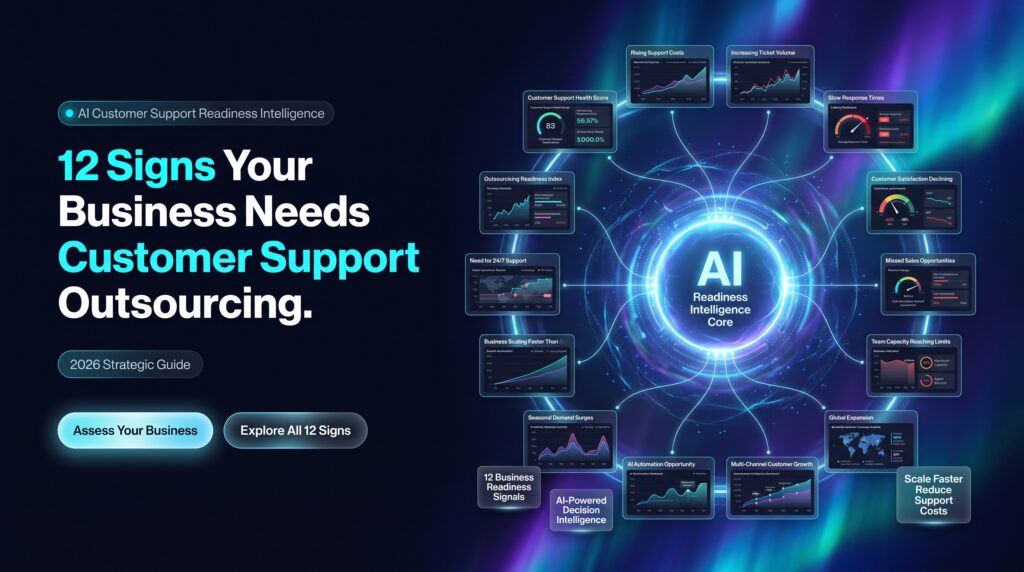
The 12 Signs Your Business Is Ready to Outsource Customer Service in 2026
Direct answer: Businesses should outsource customer service when internal cost, quality, and scale can no longer move independently of each other — when growth in ticket volume forces a proportional increase in cost or a decline in quality, rather than both improving together.
Below are the 12 operational signals we use with clients to assess readiness, organized by category.
Cost Signals
1. Cost-per-ticket is rising faster than revenue per customer.
If your fully loaded cost per resolved ticket has increased over the last 3–4 quarters while average revenue per customer has stayed flat, your support model is structurally mismatched to your growth stage.
2. You are hiring faster in support than in any other department.
When support headcount growth outpaces sales, engineering, or product hiring, it signals a scaling model built on linear labor addition instead of process and automation — the opposite of what elastic outsourcing delivers.
3. Agent attrition exceeds 25–30% annually.
High attrition compounds hidden costs — retraining, inconsistent quality, and knowledge loss — that rarely appear on a P&L line but show up in declining CSAT.
Quality & Experience Signals
4. First Contact Resolution (FCR) is below industry benchmark (70%+ for most sectors).
Low FCR means customers are re-contacting for the same issue — a direct multiplier on both cost and dissatisfaction.
5. Average handle time (AHT) and response time are increasing simultaneously.
This is a classic signal of an overloaded team without AI-assisted triage — a problem infrastructure solves faster than hiring does.
6. You cannot offer 24/7 or multi-time-zone coverage.
Any business selling into US, UK, EU, or Middle East markets from a single-country team is structurally capped on coverage without outsourcing or extreme overstaffing.
7. Customers are escalating to founders/executives regularly.
When leadership is fielding tier-1 or tier-2 issues personally, support has already outgrown the current operating model.
Strategic & Scale Signals
8. You’re entering new markets or launching new products.
New geographies and product lines multiply support complexity (language, compliance, product knowledge) faster than internal teams can be trained.
9. Seasonal or promotional volume spikes 3x+ baseline.
Retail, eCommerce, and travel businesses facing predictable seasonal surges pay a premium to overstaff internally for demand that lasts weeks, not months.
10. You lack AI/automation infrastructure and can’t justify building it internally.
Building a proprietary AI-assisted support stack (chatbots, agent-assist, predictive routing) requires investment most businesses under $50M revenue cannot justify building solo — but can access immediately through an outsourced partner already running that infrastructure across clients.
11. Support data isn’t reaching product, sales, or leadership.
If customer feedback trends live in a ticketing tool no one outside support reads, you are losing the Customer Intelligence Loop™ — the compounding value of support as a business intelligence source.
12. Leadership time is going into support management, not strategy.
This is the clearest and most under-discussed signal: if your COO or Head of Support spends more time on staffing, scheduling, and escalation triage than on process improvement, the function has become an operational drag rather than a growth lever.
Table — Sign-to-Action Mapping:
| Sign Category | Signals | Immediate Action |
|---|---|---|
| Cost | #1, #2, #3 | Run a fully loaded cost audit including attrition and management overhead |
| Quality | #4, #5, #6, #7 | Benchmark FCR, AHT, CSAT against industry standards |
| Strategic | #8, #9, #10, #11, #12 | Conduct a formal readiness assessment (see below) |
Executive interpretation: No single sign is a trigger on its own. The trigger is when three or more signs appear within the same two-quarter window — that’s the pattern indicating structural, not seasonal, strain.
Key takeaway: Outsourcing readiness isn’t about company size — it’s about whether cost, quality, and scale are moving together or pulling apart.
MasCallNet Outsourcing Readiness Score™
Definition: A weighted diagnostic model scoring an organization’s readiness to outsource across four dimensions: Cost Pressure, Quality Erosion, Scale Constraint, and Strategic Opportunity Cost.
Methodology: Score each of the 12 signs above from 0 (not present) to 3 (severe/chronic). Sum totals within each category.
| Category | Max Score | Weight |
|---|---|---|
| Cost Pressure (signs 1–3) | 9 | 25% |
| Quality Erosion (signs 4–7) | 12 | 30% |
| Scale Constraint (signs 8–9) | 6 | 20% |
| Strategic Opportunity Cost (signs 10–12) | 9 | 25% |
Scoring Logic:
| Total Weighted Score | Interpretation |
|---|---|
| 0–25% | Monitor. Build internal process discipline first. |
| 26–50% | Early readiness. Begin vendor evaluation and pilot planning. |
| 51–75% | High readiness. Outsourcing will likely produce measurable ROI within 2 quarters. |
| 76–100% | Urgent. Delay is actively costing revenue and leadership bandwidth. |
Executive Recommendation: Any organization scoring above 50% should move to a structured pilot (a single channel or region) within one quarter rather than a full-scale transition — this reduces vendor risk while validating the readiness signal against real performance data.
Get your organization scored. We run this assessment with leadership teams in under 45 minutes, using your own support data. If you want a second opinion on where your organization sits before making a build-vs-outsource decision, talk to our team — no obligation, just the numbers.
MasCallNet Revenue Leakage Model™
Definition: A framework quantifying revenue lost due to support failures that never appear as explicit churn events — delayed resolutions, missed upsell signals, and repeat-contact fatigue.
Methodology: Revenue leakage is calculated across three vectors:
- Churn-attributable leakage — customers who churned within 90 days of an unresolved or poorly handled ticket
- Expansion leakage — upsell/cross-sell signals present in support conversations but never routed to sales
- Efficiency leakage — cost of repeat contacts caused by low FCR
Formula:
Revenue Leakage = (Churned Accounts × Avg. Account Value × % Preceded by Support Failure)
                + (Missed Expansion Signals × Avg. Expansion Value)
                + (Repeat Contacts × Cost per Contact)
Scoring/Interpretation:
| Leakage as % of Support-Managed Revenue | Interpretation |
|---|---|
| Under 2% | Well-managed; support functioning as retention asset |
| 2–5% | Moderate leakage; process gaps likely in escalation or handoff |
| 5–10% | Material leakage; direct board-level financial impact |
| 10%+ | Severe; support function actively undermining revenue targets |
Boardroom insight: Most finance teams can quote CAC and LTV with precision but cannot quote revenue leakage from support failure — because no one is measuring it. This is the single highest-leverage number missing from most SaaS and DTC board decks.
Executive Recommendation: Calculate this once per quarter using your CRM and support platform data (Zendesk/Salesforce fields map directly to this model). It should become a standing line item in QBRs — this is the operational proof point behind Revenue Recovery Through CX™.
AI vs Human Customer Support: The Real Comparison
This is the question every executive asks before signing an outsourcing contract, and it’s usually framed incorrectly — as a replacement decision instead of an allocation decision.
Direct answer: AI customer support is faster and cheaper for repetitive, rules-based queries; human customer support is superior for judgment-based, emotionally sensitive, or high-value interactions. The highest-performing 2026 contact centers deploy both in a structured hybrid model, not one or the other.
| Dimension | AI Customer Support | Human Customer Support | Hybrid Model |
|---|---|---|---|
| Cost per interaction | Lowest (fraction of human cost) | Highest | Optimized — AI absorbs volume, humans absorb complexity |
| Speed | Instant (24/7, no queue) | Limited by staffing and shifts | Fast for routine, human-paced for complex |
| Accuracy on routine queries | Very high (order status, FAQs, password resets) | High but inconsistent under volume pressure | High across all query types |
| Handling of ambiguity/emotion | Weak — cannot read frustration nuance reliably | Strong | Strong — AI escalates ambiguous cases automatically |
| Scalability | Instant, unlimited | Constrained by hiring | Elastic |
| Trust/retention impact on high-value accounts | Risk of feeling impersonal | Builds relationship equity | Best of both — efficient triage, human closure |
| Data generation | Structured, consistent | Inconsistent unless tagged manually | Structured + human-validated |
MasCallNet AI Efficiency Index™
Definition: A scoring model measuring what percentage of a contact center’s total volume can be safely and effectively automated without degrading CSAT.
Methodology: Classify ticket types into three tiers:
- Tier 1 (Automatable): Order status, password resets, FAQs, appointment scheduling, basic billing — typically 40–60% of volume
- Tier 2 (AI-Assisted): Complex billing, account changes, technical troubleshooting — AI supports human agents via agent-assist tools
- Tier 3 (Human-Only): Complaints, retention conversations, high-value account escalations, compliance-sensitive interactions
Scoring Logic:
| AI Efficiency Index Score | Interpretation |
|---|---|
| Below 30% automatable | Support model is under-digitized; significant deflection opportunity available |
| 30–55% automatable | Standard maturity; hybrid model recommended |
| 55%+ automatable | Advanced; focus shifts to human agent quality on remaining complex volume |
Executive Interpretation: Businesses that try to push AI into Tier 3 interactions (complaints, cancellations, high-value escalations) consistently see CSAT decline, regardless of how advanced the underlying model (OpenAI, Google Gemini, or Claude-based) is. The failure isn’t the AI — it’s tier misclassification.
What actually happens in practice: Most companies overestimate how much they can automate and underestimate how much AI can assist human agents. The highest ROI isn’t full automation — it’s agent-assist: AI drafting responses, summarizing customer history, and surfacing sentiment in real time while a human makes the final call.
Hidden cost: Businesses that deploy AI chatbots without a clear human escalation path see support-driven churn increase, even as ticket volume and cost per ticket both go down — because the metrics improving are not the metrics that predict retention.
Executive Action: Before your next AI vendor conversation, classify 30 days of ticket history into these three tiers. This single exercise will tell you more about your automation ceiling than any vendor demo.
Key takeaway: AI vs human customer support isn’t a competition — it’s a resource allocation decision, and the businesses getting it wrong are automating for cost reduction alone instead of automating for capacity reallocation toward higher-value human conversations.
MasCallNet Vendor Evaluation Matrix™
Definition: A structured scorecard for evaluating outsourcing partners across technology, quality, compliance, and strategic fit — designed to prevent the most common vendor selection mistake: choosing on price alone.
| Evaluation Criterion | What to Assess | Weight |
|---|---|---|
| Technology stack compatibility | Native integration with Zendesk, Salesforce, Freshdesk, HubSpot, or your existing CRM | 20% |
| AI/automation maturity | Real deployment of chatbots, agent-assist, and predictive routing — not just marketing claims | 20% |
| Quality assurance framework | Documented QA scoring, calibration process, CSAT/NPS tracking cadence | 15% |
| Industry-specific experience | Prior work in your vertical (healthcare, BFSI, retail, telecom) with compliance awareness | 15% |
| Scalability and coverage | Ability to flex staffing ±30% within 2–4 weeks; time-zone/language coverage | 15% |
| Security and compliance posture | HIPAA, PCI-DSS, GDPR readiness depending on industry; data handling policy | 10% |
| Transparency and reporting | Real-time dashboards, not monthly PDF reports | 5% |
Scoring Logic: Score each vendor 1–5 per criterion, multiply by weight, sum for a total out of 5.
| Score | Interpretation |
|---|---|
| Below 3.0 | High risk — proceed only with strict pilot terms |
| 3.0–3.9 | Adequate — negotiate on weak criteria before signing |
| 4.0–4.5 | Strong partner candidate |
| 4.5+ | Category-leading — rare, worth premium pricing |
Boardroom insight: Procurement teams frequently over-weight price and under-weight AI maturity and QA framework — the two factors that determine whether cost savings survive past month six. A vendor 15% more expensive with a mature AI-assist layer typically delivers lower total cost of ownership within a year.
Executive Recommendation: Never sign a 12-month contract without a 60–90 day pilot on a single channel or region. Pilot performance against this matrix — not the sales pitch — should determine the full rollout decision.
CX Maturity Scorecard™
Definition: A five-stage model assessing how mature an organization’s customer experience operation is, independent of whether it’s in-house or outsourced.
| Stage | Characteristics | Typical Business Profile |
|---|---|---|
| 1. Reactive | Email/phone only, no SLAs, no reporting | Early-stage startups |
| 2. Structured | Helpdesk tool in place, basic SLAs, manual reporting | Growth-stage SMBs |
| 3. Measured | CSAT/NPS/FCR tracked, some automation (FAQ bots) | Scaling mid-market |
| 4. Intelligent | AI-assisted triage, omnichannel, data feeds product/sales | Enterprise-track companies |
| 5. Predictive | Support data drives forecasting, churn prediction, revenue recovery workflows | Category leaders (Predictable Revenue Operations™) |
Executive interpretation: Most companies outsource while still at Stage 1 or 2, expecting a vendor to leap them to Stage 4 or 5 automatically. That only happens when the client actively co-owns the transition — the vendor provides infrastructure, but maturity is a joint outcome, not a purchased one.
Key takeaway: Ask any vendor which stage they can realistically get you to in 12 months — not whether they “do AI.”
Scalability Framework™
Direct answer: Scalability in customer support is the ability to handle a 2–5x volume increase without a proportional increase in cost or degradation in quality — something in-house teams structurally cannot do without outsourcing or over-hiring in advance of demand.
| Scaling Trigger | In-House Response Time | Outsourced Response Time |
|---|---|---|
| Seasonal spike (Black Friday, tax season) | Weeks (hiring + training) | Days (existing bench capacity) |
| New market launch | Months (localized hiring) | Weeks (multilingual bench already trained on process) |
| Product launch volume surge | Overtime/burnout risk | Elastic shift reallocation |
| Sudden attrition event | Service degradation | Backfill from shared talent pool |
This is precisely the operational gap addressed through outsourced call center services — where businesses scaling past 10,000 monthly tickets need infrastructure, not just additional headcount.
Executive Recommendation: Model your next 12 months of expected volume (including seasonal and launch-driven spikes) before choosing between in-house scaling and outsourcing — the decision should be made against future volume, not current volume.
Benchmark Analysis & Industry Statistics
| Metric | Industry Average (In-House) | Industry Average (AI-Enabled Outsourced) |
|---|---|---|
| Cost per ticket | $4–$8 (US-based in-house) | $1–$3 (offshore AI-enabled) |
| First Contact Resolution | 65–72% | 75–85% with AI-assist |
| Average Handle Time (voice) | 8–12 minutes | 5–8 minutes with agent-assist |
| CSAT | 78–85% (varies widely by maturity) | 85–92% in mature hybrid models |
| Agent attrition (annual) | 30–45% (industry-wide, in-house support) | Managed within vendor SLA, transparent to client |
| Coverage | Business hours typical | 24/7 standard |
Executive interpretation: The gap between average in-house performance and mature AI-enabled outsourced performance is not marginal — it is the difference between a support function that drags on unit economics and one that improves them. Businesses evaluating “should we outsource” against their current internal metrics should benchmark against what mature hybrid delivery achieves, not against their own historical baseline.
Case Study: Healthcare Support Transformation
Challenge:
A US-based multi-location healthcare group was managing patient appointment scheduling and billing inquiries through an internal team of 12 agents. Call abandonment during peak hours exceeded 22%, and patient no-show rates were rising due to inconsistent appointment confirmation follow-ups.
Root Cause:
The internal team had no after-hours coverage, no AI-assisted scheduling logic, and no structured escalation path for insurance/billing disputes — creating a bottleneck that directly affected patient retention and revenue cycle timing.
Solution:
Implementation of AI-augmented healthcare BPO services, including 24/7 patient appointment scheduling services, HIPAA-compliant call handling, and AI-assisted triage routing billing disputes to specialized agents.
Implementation:
A 60-day pilot covered one location’s after-hours line and appointment confirmations, integrated with the client’s existing scheduling system, before expanding to all locations over 90 days.
Results:
- Call abandonment reduced from 22% to under 6%
- No-show rates declined meaningfully following automated confirmation and reminder workflows
- 24/7 coverage eliminated after-hours call overflow entirely
- Patient satisfaction scores improved measurably within the first two quarters
Lessons Learned:
The single highest-impact change wasn’t headcount — it was closing the after-hours coverage gap and adding automated confirmation workflows. This is a direct illustration of Support-Led Revenue Growth™: the healthcare group didn’t just reduce complaints, it recovered revenue that was previously lost to missed appointments and abandoned billing calls.
Pricing Analysis: What Does Customer Support Outsourcing Cost?
Direct answer: Outsourced customer support pricing in 2026 typically ranges from $8–$25 per hour per agent for offshore/India-based delivery (fully loaded, including technology and QA), compared to $25–$45 per hour fully loaded for US-based in-house agents. Pricing models vary by structure.
| Pricing Model | How It Works | Best For |
|---|---|---|
| Per-hour/FTE | Fixed hourly rate per agent | Predictable, steady volume |
| Per-ticket | Pay per resolved interaction | Variable, unpredictable volume |
| Hybrid retainer + volume | Base retainer covering infrastructure + per-ticket/overage | Growing businesses wanting cost predictability with flexibility |
| Outcome-based | Pricing tied to CSAT/SLA performance | Enterprise clients prioritizing quality guarantees |
Executive interpretation: Per-ticket pricing looks cheaper on paper but often incentivizes vendors to close tickets fast rather than resolve them well — watch FCR closely under this model. Hybrid retainer models generally produce the most stable long-term cost-per-outcome.
Hidden cost most businesses miss: Technology licensing (CRM seats, AI tooling) is sometimes billed separately from labor. Always request an all-in cost breakdown before comparing vendor quotes.
Cost Calculator: In-House vs. Outsourced Support
Formula:
In-House Annual Cost =
  (Agent Salary + Benefits) × Headcount
+ Management Overhead (typically 15–20% of team cost)
+ Technology Licensing
+ Recruitment & Training Cost (attrition-adjusted)
+ Office/Infrastructure Cost

Outsourced Annual Cost =
  (Per-hour or per-ticket rate × Volume)
+ Technology Integration Fee (often one-time)
+ Onboarding/Transition Cost (Year 1 only)| Cost Component | In-House (10 agents) | Outsourced (equivalent capacity) |
|---|---|---|
| Base labor cost | $350,000–$450,000/year | $120,000–$220,000/year |
| Management overhead | $60,000–$90,000/year | Included in vendor fee |
| Technology licensing | $40,000–$80,000/year | Often included/shared infrastructure |
| Recruitment/training (attrition-adjusted) | $30,000–$60,000/year | Absorbed by vendor |
| Estimated Total | $480,000–$680,000/year | $180,000–$320,000/year |
Executive Recommendation: Run this calculation with your actual numbers, including attrition costs most finance teams don’t isolate as a line item. The gap is almost always larger than initial estimates because in-house overhead is chronically under-measured.
Want this modeled against your actual ticket volume and team structure? Request a custom cost comparison — we’ll build it using your real data, not industry averages.
ROI Framework: MasCallNet Support-to-Revenue Framework™
Definition: A model connecting support investment to three revenue outcomes: retention, expansion, and forecast accuracy — moving support ROI conversations beyond cost savings alone.
Methodology:
Support-to-Revenue ROI =
  (Retention Revenue Protected)
+ (Expansion Revenue Captured via Support-Identified Signals)
+ (Cost Savings from Outsourcing/Automation)
– (Total Outsourcing Investment)| Component | How to Measure | Typical Impact Range |
|---|---|---|
| Retention revenue protected | Churned accounts avoided × avg. account value | Varies by industry; material in subscription models |
| Expansion revenue captured | Upsell signals routed to sales from support conversations | Often overlooked entirely without a formal process |
| Cost savings | In-house cost minus outsourced cost (from calculator above) | 35–60% reduction typical in mature engagements |
| Total investment | Outsourcing fees + transition/integration cost | One-time + ongoing |
Executive Interpretation: Businesses that measure ROI purely on the cost-savings line undervalue the engagement by half or more. The full picture — retention protected and expansion captured — is where Support-Led Revenue Growth™ becomes measurable, not aspirational.
Boardroom insight: If your outsourcing business case to the board only mentions cost reduction, you’re presenting the weakest argument available. The strongest argument is retention and expansion revenue protected — numbers that justify premium vendor investment rather than the cheapest bid.
Industry Use Cases
| Industry | Primary Support Challenge | Outsourcing Application |
|---|---|---|
| Banking & Financial Services | High-security, compliance-heavy inquiries; digital banking services support | AI-assisted fraud query triage, KYC support, secure voice/chat |
| Insurance | Claims-related volume spikes, complex policy questions | Claims status automation, human escalation for disputes |
| Retail & eCommerce | Seasonal volume, order/shipping queries | AI deflection for order status; human support for returns/disputes |
| FMCG | Distributor and consumer query volume, multilingual demand | Multilingual contact center services across regions |
| Healthcare | Appointment scheduling, billing, HIPAA compliance | AI-assisted scheduling, compliant call handling (see case study above) |
| Automotive & EV | Service scheduling, warranty inquiries, charging support (EV) | Technical triage with human escalation for warranty disputes |
| Telecommunications | High-volume billing and technical support | AI-first Tier 1 deflection, human Tier 2/3 |
| Aviation | Booking changes, high-emotion disruption support | Human-led for disruption events, AI for routine booking changes |
| Logistics | Shipment tracking, delivery exceptions | AI-first tracking queries, human escalation for exceptions/disputes |
Technology Ecosystem
A modern outsourcing partner should demonstrate working fluency — not just familiarity — across the following stack:
| Category | Platforms |
|---|---|
| CRM / Helpdesk | Zendesk, Salesforce, Freshdesk, HubSpot, ServiceNow |
| Contact Center Infrastructure | Genesys, NICE CXone, Five9, Talkdesk |
| Conversational/AI Layer | Intercom, OpenAI, Google Gemini, Claude, Copilot |
| Internal Collaboration | Slack, Microsoft Teams |
| Cloud Infrastructure | Amazon Web Services, Microsoft Azure, Google Cloud |
| eCommerce/Payments | Shopify, WooCommerce, Stripe, PayPal |
Executive interpretation: Ask any prospective vendor which of these platforms they’ve deployed in live production environments — not just “support” — versus which they list on a capabilities slide. This distinction alone eliminates a large share of vendor risk.
Security & Compliance
Outsourcing customer support means extending data access to a third party — this must be governed explicitly, not assumed.
| Industry | Compliance Requirement | What to Verify |
|---|---|---|
| Healthcare | HIPAA | Business Associate Agreement (BAA), encrypted data handling, access logs |
| Financial Services | PCI-DSS, RBI/regional banking regulations | Card data handling certification, secure voice recording policies |
| EU-serving businesses | GDPR | Data residency, right-to-erasure process, DPA in vendor contract |
| General enterprise | SOC 2 | Vendor’s own security audit posture and incident response protocol |
Executive Recommendation: Compliance verification should happen before commercial negotiation, not after. Request documentation, not verbal assurance, and confirm data handling terms are written into the master service agreement — not left to a side conversation.
The India Advantage: What Actually Makes the Best BPO Companies in India Stand Out in 2026
Direct answer: The best BPO companies in India in 2026 are distinguished not by labor cost alone, but by AI-enabled service delivery, multilingual and multi-time-zone coverage, mature compliance frameworks, and integration depth with global CX platforms.
India remains the largest global hub for outsourced customer support, but the value proposition has fundamentally shifted:
| Old India Advantage (2010s) | Current India Advantage (2026) |
|---|---|
| Lower hourly labor cost | AI-augmented delivery reducing cost and improving quality simultaneously |
| English-language voice support | Multilingual, omnichannel delivery across voice, chat, WhatsApp |
| Large talent pool | Large talent pool combined with structured AI/automation training |
| Time-zone coverage for US/UK | Time-zone coverage plus follow-the-sun hybrid AI-human models |
What to actually evaluate when selecting a BPO partner in India:
- AI infrastructure maturity — not just chatbot deployment, but agent-assist and predictive routing in live production
- Vertical-specific compliance experience — HIPAA for healthcare, PCI-DSS for finance/eCommerce
- Platform integration depth — proven, not claimed, experience with Zendesk, Salesforce, Freshdesk
- Physical and operational infrastructure — established delivery centers with documented uptime and business continuity plans
- Transparent reporting — real-time dashboards over monthly summary decks
MasCallNet operates as an AI-powered BPO company in India, including delivery infrastructure through our call center in Noida supporting global businesses across time zones with the hybrid AI-human model detailed throughout this guide. Our published BPO case studies document these outcomes in detail, including the healthcare engagement referenced above.
Boardroom insight: Procurement teams evaluating “best BPO companies in India” using cost-per-hour spreadsheets alone are optimizing for the metric that mattered a decade ago. The evaluation criteria that predict long-term outcome quality are AI maturity, compliance depth, and platform integration — the Vendor Evaluation Matrix™ above should be the actual scorecard used, not a rate card comparison.
Comparing India-based BPO partners for your business? Explore how MasCallNet’s customer support outsourcing services are structured around this exact evaluation framework — or talk to our team directly about your specific requirements.
Comparison Tables
In-House vs. Outsourced
| Factor | In-House | Outsourced |
|---|---|---|
| Control | Full, direct | Governed via SLA |
| Cost | Higher, fixed | Lower, variable |
| Scalability | Slow | Fast |
| Technology access | Self-funded | Shared infrastructure |
| Recommendation | Best for highly regulated, low-volume, brand-critical interactions only | Best for most businesses beyond early-stage, especially scaling operations |
AI vs. Human vs. Hybrid
(See full breakdown above.) Recommendation: Hybrid model for 90%+ of businesses; pure-AI only for extremely low-complexity, high-volume use cases; pure-human only for highly regulated or ultra-high-touch relationship businesses.
Offshore vs. Onshore
| Factor | Offshore (e.g., India) | Onshore |
|---|---|---|
| Cost | Significantly lower | Higher |
| Time-zone coverage | Naturally suited to 24/7 models | Requires overnight shift premiums |
| Cultural/language nuance | Strong for English-speaking markets; requires vetting for niche dialects | Native by default |
| Recommendation | Ideal for cost efficiency + 24/7 coverage with proper vendor vetting | Reserve for highly localized, regulatory-sensitive interactions |
Build vs. Buy
| Factor | Build (In-House AI/Support Stack) | Buy (Outsourced Partner) |
|---|---|---|
| Time to deploy | 6–18 months | Weeks |
| Capital requirement | High | Low, operational expense |
| Recommendation | Build only if support is a core product differentiator requiring proprietary IP | Buy for standard support operations |
Dedicated Team vs. Shared Team
| Factor | Dedicated Team | Shared Team |
|---|---|---|
| Cost | Higher | Lower |
| Consistency | Higher brand/product familiarity | Variable, but faster scaling |
| Recommendation | Dedicated for complex, high-touch B2B; shared for high-volume, standardized B2C |
Traditional BPO vs. Contact Center Intelligence™
| Factor | Traditional BPO | Contact Center Intelligence™ Model |
|---|---|---|
| Focus | Ticket closure, cost per hour | Ticket closure + structured business intelligence extraction |
| Reporting | Volume and SLA metrics | Volume, SLA, sentiment, churn signal, expansion signal |
| Client relationship | Vendor | Strategic partner |
| Recommendation | Sufficient for pure cost arbitrage needs | Required for businesses pursuing Support-Led Revenue Growth™ |
Risk Analysis
| Risk | Likelihood | Mitigation |
|---|---|---|
| Vendor quality inconsistency | Medium | Pilot period + Vendor Evaluation Matrix™ scoring |
| Data security exposure | Medium | Contractual compliance requirements + audit rights |
| Brand voice dilution | Medium | Detailed brand/tone guidelines, QA calibration sessions |
| Over-automation degrading CX | High if unmanaged | AI Efficiency Index™ tiering discipline |
| Vendor lock-in | Low-Medium | Contract terms allowing data portability and transition support |
Executive interpretation: Every risk above is manageable through contract structure and pilot design — none of them are reasons to avoid outsourcing, but all of them are reasons to avoid rushing vendor selection.
Future Trends: The Human + AI Future of Customer Support
The next 24 months will be defined by deeper integration, not replacement:
- AI agents handling full conversational resolution for defined use cases (order tracking, appointment scheduling, basic billing)
- Voice bots reaching near-parity with human agents for structured phone interactions
- Agent-assist becoming standard — AI drafting responses, summarizing history, flagging sentiment in real time
- Predictive analytics identifying churn risk from support interaction patterns before renewal conversations happen
- Workflow automation connecting support systems directly to billing, logistics, and CRM systems for one-touch resolution
- Knowledge management systems using AI to keep agent knowledge bases current automatically rather than manually
- Human escalation models becoming more precisely defined — not “AI fails, human takes over” but structured handoff based on interaction classification
- Hybrid operations becoming the default architecture, not an interim step toward full automation
- Conversation intelligence extracting structured data (sentiment, intent, topic) from every interaction automatically
- Customer intelligence feeding directly into product, sales, and finance systems — the full maturity of the Customer Intelligence Loop™
Executive interpretation: The businesses that win this transition won’t be the ones that automate fastest — they’ll be the ones that automate correctly, preserving human judgment where it matters and using AI to make human agents more effective rather than obsolete. This is the practical, operational form of Support-Led Revenue Growth™ over the next three years.
Executive Decision Tree
Is your cost-per-ticket rising faster than revenue per customer?
├── YES → Is FCR below 70% or AHT increasing?
│         ├── YES → Outsourcing Readiness Score likely HIGH → Begin vendor pilot
│         └── NO  → Monitor quarterly; reassess in 90 days
└── NO  → Are you entering new markets, launching products, or facing seasonal spikes?
          ├── YES → Evaluate outsourcing for scale/coverage, not cost
          └── NO  → Focus on internal process optimization before considering outsourcing
Executive Checklist
- Calculate fully loaded in-house cost per ticket (including attrition and management overhead)
- Benchmark FCR, AHT, and CSAT against industry standards
- Score your organization on the Outsourcing Readiness Score™
- Classify 30 days of tickets using the AI Efficiency Index™ tiering model
- Calculate current Revenue Leakage using the model above
- Shortlist 3 vendors and score them on the Vendor Evaluation Matrix™
- Confirm compliance requirements specific to your industry (HIPAA, PCI-DSS, GDPR)
- Negotiate a 60–90 day pilot before full commitment
- Define what support data must flow back into sales, product, and finance systems
- Set a 6-month review date to reassess ROI against the Support-to-Revenue Framework™
Frequently Asked Questions
When should a business outsource customer service?
When cost-per-ticket rises faster than revenue growth, quality metrics (FCR, CSAT, AHT) decline as volume increases, or leadership is spending measurable time managing support instead of strategy — typically when three or more of the 12 signs above appear within the same two-quarter period.
Is AI better than human customer support?
Neither is universally better — AI outperforms on speed, cost, and consistency for routine queries, while humans outperform on judgment, empathy, and complex or emotionally sensitive interactions. The highest-performing operations in 2026 use a hybrid model, not one exclusively.
What are the best BPO companies in India known for in 2026?
Leading Indian BPOs differentiate on AI-enabled service delivery, multilingual and multi-time-zone coverage, deep integration with platforms like Zendesk and Salesforce, and vertical-specific compliance experience — not on labor cost alone.
How much does customer support outsourcing cost?
Offshore, AI-enabled outsourced support typically costs $8–$25 per hour per agent fully loaded, compared to $25–$45 per hour for US-based in-house support, though pricing models vary between per-hour, per-ticket, and hybrid retainer structures.
What’s the difference between offshore and onshore customer support outsourcing?
Offshore outsourcing (e.g., India-based) offers significantly lower cost and natural 24/7 coverage advantages, while onshore outsourcing offers native cultural and regulatory alignment — the right choice depends on the sensitivity and localization requirements of the interactions being outsourced.
Will outsourcing hurt our customer experience?
Only if vendor selection and pilot testing are skipped. Businesses that use a structured evaluation framework (technology fit, AI maturity, QA process) and start with a pilot typically see CSAT improve, not decline, due to expanded coverage and AI-assisted resolution.
How long does it take to transition to an outsourced model?
A single-channel or single-region pilot can be live within 2–4 weeks; full-scale transition across all channels typically takes 60–120 days depending on integration complexity with existing CRM/helpdesk systems.
Ready to Know Where You Stand?
If two or more of the 12 signs above sound familiar, the cost of waiting is no longer hypothetical — it’s compounding every quarter in cost-per-ticket, churn risk, and leadership bandwidth.
Get a free Outsourcing Readiness Assessment — we’ll score your organization against the framework above using your own data, and tell you honestly whether outsourcing makes sense right now, in six months, or not yet.
For leadership teams further along in evaluation:
Review our BPO case studies to see documented outcomes across healthcare, retail, and financial services engagements.
Learn about our AI-powered customer support outsourcing model and how the hybrid AI-human framework described in this guide is implemented in practice.
Explore business process automation if your readiness gap extends beyond customer support into broader operational workflows.
Conclusion: The Decision Isn’t Whether to Outsource — It’s Whether to Keep Waiting
By 2026, outsourcing customer service is not a fringe cost-cutting tactic reserved for struggling companies — it is standard infrastructure strategy for any business scaling past the point where in-house teams can move cost, quality, and coverage in the same direction simultaneously.
The businesses winning this transition aren’t the ones automating everything or outsourcing everything. They’re the ones applying Support-Led Revenue Growth™ as an operating principle — treating every customer interaction as a chance to protect revenue, not just close a ticket. They’re building Contact Center Intelligence™ into their operations, so conversations generate reusable business data instead of disappearing into a closed ticket queue. And they’re practicing Revenue Recovery Through CX™ by measuring what unresolved friction actually costs, not assuming it’s a soft metric.
The 12 signs in this guide aren’t a checklist to complete once. They’re a diagnostic to revisit every two quarters, because the businesses that outsource successfully treat this as an ongoing operating decision — not a one-time procurement event.
Executive summary: If your cost-per-ticket is rising, your quality metrics are eroding under volume, and your leadership team is spending strategic time on operational firefighting — the readiness signal is already present. The only remaining question is which partner earns the right to own that relationship, and how quickly your organization moves from diagnosis to action.