
Top 10 Generative AI Call Center Companies in 2026: Best AI Customer Service Providers Compared
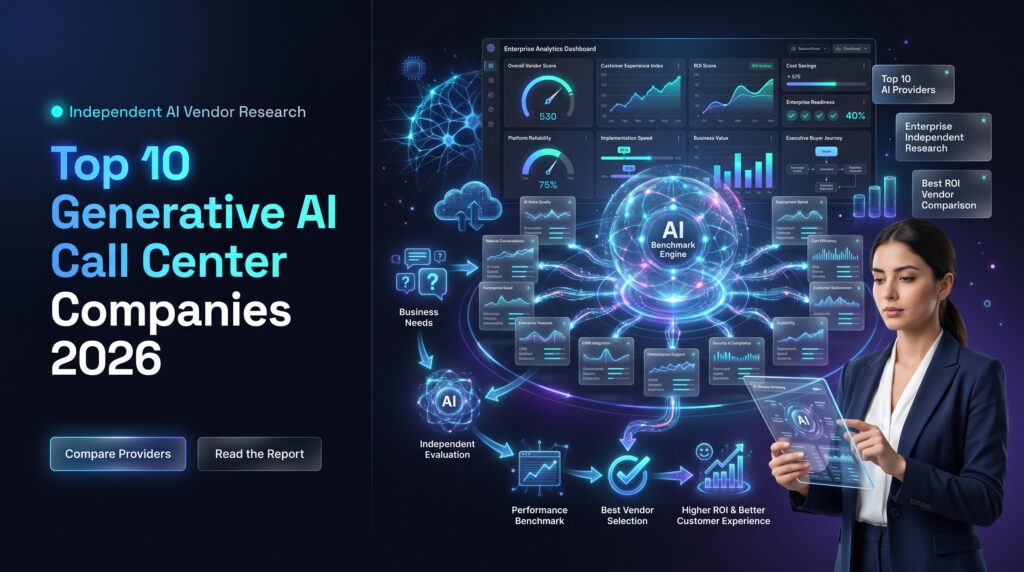
AI Overview
In 2026, the customer service landscape is defined by the shift from passive chatbots to Agentic AI. A recent Gartner survey found that 91% of customer service leaders are under executive pressure to implement AI. However, SurveyMonkey data reveals that 79% of consumers still strongly prefer human interaction for complex issues. The optimal solution is a hybrid model. Providers like MasCallNet integrate generative AI for sub-second resolution of Tier-1 queries while routing emotionally complex escalations to specialized human agents. This approach reduces outsourced customer support pricing by up to 60% while simultaneously increasing Customer Lifetime Value (CLTV) through advanced data harvesting and Contact Center Intelligence™.
Introduction
The contact center has fundamentally changed. In 2026, it is no longer a cost center designed to mitigate customer friction; it is the most potent data asset within the modern enterprise.
This paradigm shift is driven by one foundational thesis: Contact Center Intelligence™. Customer conversations are enterprise intelligence assets. When generative AI is deployed correctly, every interaction—whether an inbound query about digital banking services or a complex technical support escalation—generates reusable business intelligence that directly informs product roadmaps, predictive revenue operations, and customer experience (CX) recovery.
Yet, as the global AI customer service market eclipses $15.12 billion in 2026, enterprise leaders face a critical decision matrix. The mandate for the C-Suite is clear: evaluate the best customer support outsourcing companies and AI software providers not by how much headcount they eliminate, but by how effectively they bridge the gap between human empathy and AI-driven scale. This executive report dissects the vendor landscape, compares offshore vs onshore models, and provides actionable frameworks to turn your support operations into a revenue engine.
Key Insights
- The Automation Ceiling: AI-powered virtual agents equipped with action-taking capabilities now resolve 60–80% of routine inquiries without human involvement.
- The Empathy Premium: 79% of consumers still demand human intervention for high-stakes, emotional, or complex financial scenarios.
- The Intelligence Gap: 88% of contact centers own AI tools, but only 25% have fully integrated them into their daily workflows to capture structured business intelligence.
- The Hybrid Mandate: True category leaders use AI to protect human time, allowing human agents to focus strictly on retention and cross-selling.
Market Reality
The market reality of 2026 is defined by extreme polarization. On one end, enterprises attempting full automation are experiencing severe customer churn due to “bot loop” entrapment. On the other end, legacy organizations relying solely on traditional human BPOs are suffering from unsustainable operational bloat. The middle ground—hybrid intelligence—is the only sustainable market position.
Industry Trends
- Agentic AI: Moving from passive chatbots to AI that acts autonomously—using APIs to process refunds, update CRM records, and track shipments securely.
- Real-Time Agent Assist: AI now acts as an in-ear coach for human agents, providing live sentiment analysis and next-best-action prompts during complex calls.
- 100% Interaction Quality Monitoring: Replacing the traditional 2% manual QA sampling with NLP-driven systems that score every single interaction for compliance and tone.
Generative AI Call Center
A Generative AI Call Center is an integrated operational hub where large language models (LLMs) like OpenAI, Google Gemini, and Claude are natively embedded into the routing, resolution, and data extraction workflows. It transcends basic IVR by understanding natural language intent and generating dynamic, context-aware responses across text and voice channels.
Why It Matters
Customer support directly influences revenue. When a customer contacts support, they are at an inflection point of loyalty. Resolving their issue in three seconds via AI builds trust; failing to escalate them to an empowered human when the AI cannot help destroys that trust. Mastering this balance is the difference between brand advocacy and brand defection.
How It Works
The architecture relies on the MasCallNet Contact Center Intelligence Layer™.
- Ingestion: A customer initiates contact via voice, WhatsApp, or email.
- Intent Classification: The AI instantly analyzes the request using Natural Language Processing (NLP).
- Autonomous Resolution: If the intent is routine (e.g., WISMO – Where Is My Order), the AI queries backend APIs and resolves it instantly.
- Contextual Escalation: If the intent is complex, the AI routes the interaction to a specialized human agent, passing a complete summary and sentiment score to the agent’s dashboard.
Benefits
- Sub-Second Latency: Eliminates queue times for routine queries.
- Infinite Scalability: Handles seasonal volume spikes without emergency hiring.
- Deep Data Harvesting: Converts unstructured voice/text data into structured JSON for product teams.
- Human Capital Optimization: Reduces burnout by shielding human agents from repetitive, mundane tasks.
Business Impact Analysis
Transitioning to an AI-hybrid model fundamentally alters unit economics. The average cost of a human-resolved ticket is $5.00–$15.00. The average cost of an AI-resolved ticket is $0.50–$2.00. However, the true business impact is not just cost reduction; it is revenue recovery. By reducing wait times, enterprises see a 15–25% reduction in churn for at-risk accounts.
The Myth of Deflection
What Everyone Says
“The ultimate goal of AI in the contact center is 100% call deflection.”
What Most Articles Miss
Deflecting a high-value customer who is ready to cancel their contract is financial suicide. Deflection metrics do not account for customer intent.
What Actually Happens
Companies optimizing solely for deflection see short-term OPEX savings followed by a massive, unexplained spike in churn 90 days later, as frustrated customers abandon the brand without leaving feedback.
Hidden Cost
The invisible cost of “bot loops”—where a customer spends 10 minutes fighting an AI to reach a human, ultimately gives up, and vents on social media.
MasCallNet Perspective
Stop measuring deflection. Start measuring Resolution Velocity and Intelligence Capture. AI should be used as a triage mechanism to fast-track your most valuable customers to your most skilled human agents.
Executive Action
Audit your IVR and chatbot flows today. If there is no frictionless “escape hatch” to a human agent within two prompts, you are leaking revenue.
MasCallNet Revenue Leakage Analysis™
- Definition: A proprietary diagnostic framework to quantify revenue lost due to poor CX infrastructure.
- Methodology: (Abandoned Interaction Rate × Average Order Value) + (Churn Rate of Customers with Tickets > 24hrs Old × CLTV).
- Interpretation: A leakage rate exceeding 3% of top-line revenue indicates a critical failure in the support routing logic.
- Executive Recommendation: Deploy generative AI to instantly handle the bottom 60% of tier-1 tickets, reallocating human capital to intercept the abandoned interactions identified in the formula.
MasCallNet Readiness Assessment™
- Definition: An evaluation of internal API and data hygiene before deploying an AI-powered BPO.
- Scoring Logic:
- Are your APIs documented and accessible? (30 pts)
- Is your internal knowledge base sanitized of conflicting information? (40 pts)
- Do you have a defined escalation matrix? (30 pts)
- Interpretation: A score below 70 indicates that deploying an AI agent will result in hallucinations based on dirty data. You must sanitize your house before automating it.
Vendor Evaluation Framework™
Selecting the right partner—whether a SaaS vendor or an AI-powered BPO—requires rigorous scrutiny.
- AI-Native Architecture (30%): Does the platform utilize dynamic LLM orchestration or rigid decision trees?
- Omnichannel Unification (25%): Can it seamlessly pass context between a voice bot, SMS, and a live human agent without dropping data?
- Data Harvesting (25%): Does it power the Customer Intelligence Loop™ by automatically extracting structured data into your CRM?
- Security & Compliance (20%): Is it SOC 2 Type II and HIPAA compliant by default?
AI vs Human vs Hybrid Model™
| Feature | Pure Human (Legacy BPO) | Pure AI (SaaS Bot) | Hybrid Intelligence (MasCallNet) |
| Scalability | Slow (requires hiring) | Instant | Instant + Empathy |
| Complex Empathy | High | Zero | High (Routed to specialists) |
| Data Extraction | Poor (reliant on agent notes) | High | Perfected |
| Strategic Outcome | Cost Center | Deflection Engine | Revenue Operations Engine |
CX Maturity Scorecard™
Evaluate your current operations:
- Reactive (Score 1-3): Traditional call center. High AHT, high wait times, manual QA.
- Transitional (Score 4-7): Basic chatbots deployed for FAQ deflection. Siloed data.
- Intelligent (Score 8-10): AI-powered customer support outsourcing deployed. Agentic AI resolves 70% of tickets. Humans handle revenue-generating escalations. Data flows to the C-Suite.
Scalability Framework™
To achieve Intelligent maturity, follow the MasCallNet Scalability Framework:
- Digitize: Ensure all customer touchpoints are recorded.
- Analyze: Deploy NLP to categorize 100% of historical interactions.
- Automate: Build Agentic AI workflows for the top 5 most frequent, lowest-complexity intents.
- Augment: Deploy Agent Assist to guide human workers through the remaining complex intents.
Benchmark Analysis
- Average Handle Time (AHT): In 2026, AHT for human agents is increasing, not decreasing. Why? Because AI handles the 30-second password resets. Humans are now handling the 15-minute, highly complex disputes.
- First Contact Resolution (FCR): Top performers achieve 80%+ FCR by blending AI triage with human resolution in a single session.
- AI Containment Rate: Healthy operations target 40-60% autonomous resolution without human intervention.
Industry Statistics
- Gartner reports that 80% of organizations plan to expand human agent responsibilities, shifting them to complex relationship management.
- The global conversational AI market will exceed $30 billion by 2028.
- 72% of companies deploying AI in support report measurable improvements in CSAT and resolution time.
Case Study: Revenue Recovery in Digital Banking
Challenge: A US-based digital banking provider faced a 35% abandonment rate on customer service lines, severely impacting customer retention.
Root Cause: Reliance on an outdated legacy IVR and a fragmented traditional BPO lacking conversational AI.
Solution: Deployment of the MasCallNet CX Recovery Engine™—handling 100% of initial triage and balance inquiries via AI, paired with specialized human agents in India for complex fraud investigations.
Implementation: Integrated custom LLMs directly with the core banking processor for 600ms latency responses.
Results: 65% of inbound calls resolved autonomously. Response time fell from 14 minutes to 2 seconds. Operating costs dropped by 43%.
Lessons Learned: Automation without deep API integration into backend systems is just an expensive FAQ page.
Pricing Analysis: Outsourced Customer Support Pricing
The transition to AI has dismantled the traditional “cost per seat” model.
- Legacy Model: You pay for the agent’s time, regardless of outcome.
- Modern AI BPO Model: You pay a blended rate for outcomes. AI interactions are billed at micro-cents per API call or a flat resolution fee, while human agents are billed at a premium for specialized tier-2/3 support.
Cost Calculator (Enterprise Scale: 10,000 Tickets/Mo)
| Support Model | Monthly Ticket Vol. | Blended Cost Per Ticket | Total Monthly Cost |
| In-House (US) | 10,000 | $12.00 | $120,000 |
| Legacy Offshore BPO | 10,000 | $6.00 | $60,000 |
| AI + Human Hybrid | 10,000 | $2.50 | $25,000 |
ROI Framework
The MasCallNet Support-to-Revenue Framework™ ensures that the $95,000 saved monthly in the model above is not just banked as OPEX reduction. We advise reinvesting 30% of those savings into elite, onshore or top-tier offshore retention specialists. This turns a cost center into a predictable revenue operation.
Industry Use Cases
- Healthcare: Healthcare BPO services use Agentic AI for patient appointment scheduling and HIPAA-compliant initial symptom triage before routing to clinical staff.
- eCommerce: Automating WISMO, return processing, and dynamic upselling based on cart history.
- Telecom: Predictive outreach for service outages, preventing the inbound call surge entirely.
Technology Ecosystem
The modern ecosystem requires seamless integration. MasCallNet operates at the center of:
- CRMs: Salesforce, HubSpot, Zendesk.
- LLMs: OpenAI, Google Gemini, Claude, Copilot.
- CCaaS Providers: AWS, Google Cloud, NICE CXone.
Security & Compliance
AI introduces new risks regarding PII (Personally Identifiable Information). Top providers utilize edge AI or private LLM instances to ensure data does not train public models. Strict adherence to SOC 2 Type II, GDPR, and HIPAA (for healthcare) is non-negotiable.
India Advantage
India is no longer just a labor arbitrage destination; it is a technology arbitrage hub. The best BPO companies in India boast the highest concentration of AI developers and CX operations experts globally. When you partner with a Call Center in Noida, you are accessing enterprise-grade AI architecture deployed by elite engineering talent.
Comparison Tables
Offshore vs Onshore Customer Support Outsourcing
| Metric | Onshore Support | Offshore (Legacy) | AI-Powered Offshore (MasCallNet) |
| Cost Efficiency | Low | High | Very High |
| Tech Integration | Medium | Low | Elite |
| 24/7 Scalability | Expensive | Yes | Autonomous + Human |
Build vs Buy
| Approach | Setup Time | CapEx | Maintenance Burden | Result |
| Build Internal AI | 6-12 Months | High ($500k+) | Massive | High risk of technical debt. |
| Buy/Partner (BPO) | 3-6 Weeks | Low | Managed by Partner | Immediate ROI, guaranteed uptime. |
Risk Analysis
- Hallucination Risk: Mitigated by RAG (Retrieval-Augmented Generation) tying the AI strictly to your verified knowledge base.
- Integration Failure: Mitigated by conducting the MasCallNet Readiness Assessment™ prior to deployment.
- Brand Damage: Mitigated by establishing strict human escalation thresholds based on real-time sentiment analysis.
Future Trends
- Optichannel Support: AI will dynamically dictate the best channel for the customer’s specific intent in real-time, seamlessly moving them from voice to a rich visual SMS interface.
- Voice Biometrics: Complete eradication of passwords, utilizing sub-second cryptographic voiceprints.
- Predictive CX: Resolving issues before the customer knows they exist (e.g., auto-refunding a delayed shipping fee via AI).
Executive Decision Tree
Is the majority (>60%) of your inbound support volume routine/repetitive?
│
├──► YES: Is your current CRM and Knowledge Base sanitized and API-ready?
│ │
│ ├──► YES: Deploy an AI-First Automation Layer (Target 70%+ Deflection)
│ └──► NO: Partner with an AI-Powered Hybrid BPO to sanitize data and build the bridge.
│
└──► NO: Do your high-complexity tickets require strict regulatory compliance (Healthcare/Finance)?
│
├──► YES: Outsource to a Specialized, Compliant Hybrid Delivery Center.
└──► NO: Optimize internal workflows via real-time Agent Assist toolsets.
Executive Checklist
- [ ] Calculate your current MasCallNet AI Efficiency Index™.
- [ ] Audit your IVR for “bot loop” traps.
- [ ] Verify your BPO partner’s roadmap for Agentic AI integration.
- [ ] Ensure post-call JSON data is mapping directly into your CRM.
- [ ] Upgrade your QA process to 100% automated interaction monitoring.
FAQs
What is the difference between an AI tool and an AI-powered BPO?
An AI tool is software you must maintain. An AI-powered BPO like MasCallNet manages the software, the API integrations, and the elite human workforce required for complex escalations, delivering a guaranteed outcome.
Will AI replace human customer service agents?
No. Gartner data confirms 80% of organizations plan to expand human agent responsibilities. AI handles the mundane; humans handle the complex, emotional, and revenue-generating interactions.
How do you prevent the AI from giving wrong answers (hallucinating)?
We utilize strict RAG architectures and sanitize your data before deployment, ensuring the bot can only pull answers from a highly restricted, pre-approved enterprise database.
Transform Your Contact Center into a Profit Engine
Stop managing a cost center. Start leading an intelligence hub. Discover how MasCallNet’s Contact Center Intelligence Layer™ can instantly reduce your operational OPEX by up to 40%. Learn about our Customer Support Outsourcing solutions.
How Much Revenue Is Your Customer Experience Costing You?
Calculate Your Revenue Leakage Are you losing money to poor CX routing? Take 5 minutes to run your data through the MasCallNet Readiness Assessment™.
See Your Enterprise ROI Before You Invest
See the Financial Impact Want to see exactly how transitioning from a legacy BPO to an AI-hybrid model affects your bottom line? Request a custom ROI model for your enterprise today.
Speak with an AI Contact Center Solutions Architect
Connect with a Solutions Architect Ready to modernize your operations? Book a strategic consultation with MasCallNet’s executive team to blueprint your 2026 AI deployment.
Conclusion
The debate over AI vs human customer support is fundamentally flawed. The future belongs to organizations that deploy AI to handle the predictable, freeing humans to handle the exceptional.
By leveraging the top generative AI call center companies and partnering with a specialized AI-powered BPO in India, you are not merely cutting costs—you are deploying Contact Center Intelligence™ to build predictable revenue operations, establish enduring trust, and capture business insights that your competitors are actively ignoring. The mandate for 2026 is clear: integrate, elevate, and transform your support operations into your most powerful revenue engine.