
Scale Customer Support for Startups: Fast & Cost-Efficient Guide (2026)
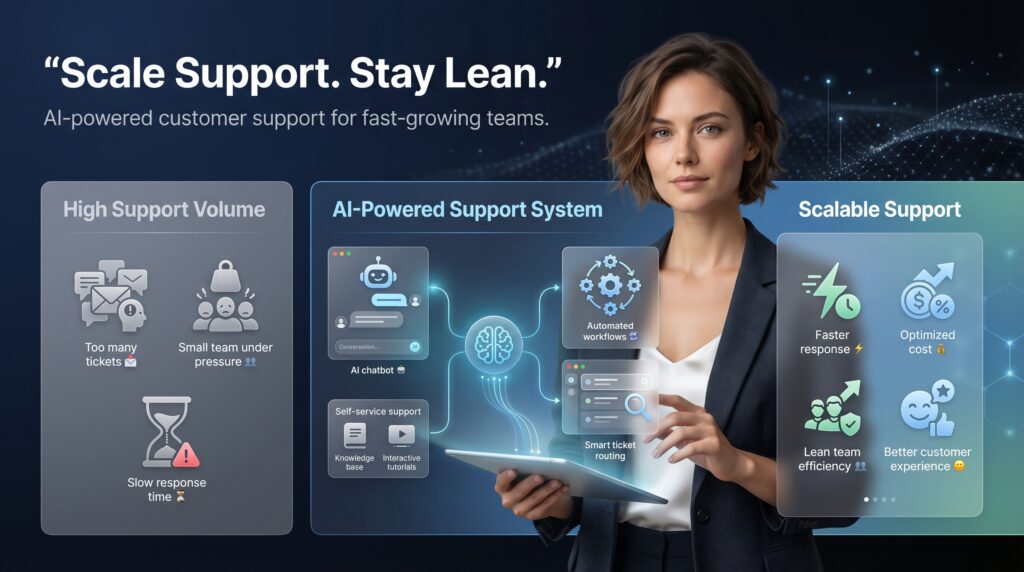
Customer support outsourcing enables businesses to handle high customer support volume without hiring by leveraging external teams, AI automation, and scalable infrastructure. It reduces costs by 30–60%, improves response times, and ensures 24/7 availability, making it the most efficient way to scale customer experience operations.
Businesses experiencing rapid growth often struggle to handle high customer support volume due to hiring limitations and rising operational costs. Customer support outsourcing offers a scalable solution by combining trained agents, AI automation, and global delivery models. Companies can reduce costs by 30–60% while improving response times and customer satisfaction.
Modern outsourcing integrates seamlessly with tools like Zendesk, Salesforce, and Freshdesk, enabling centralized workflows and real-time visibility. A hybrid model—combining AI chatbots with human agents—delivers the best balance of efficiency and personalization. Industries such as SaaS, eCommerce, fintech, and healthcare increasingly rely on offshore call center outsourcing services to scale support operations quickly.
For decision-makers, outsourcing is no longer optional—it is a strategic growth lever that improves scalability, cost efficiency, and customer experience simultaneously.
Introduction
Growth creates pressure. The faster you acquire customers, the harder it becomes to handle high customer support volume without breaking your operations.
Most companies respond by hiring more agents. This approach fails because hiring is slow, expensive, and difficult to scale during demand spikes.
This is why customer support outsourcing has become the default strategy for high-growth companies. Instead of building large internal teams, businesses leverage external expertise, AI automation, and global talent to scale instantly—while maintaining high-quality customer experience.
Key Insights
- 30–60% reduction in customer support costs
- 40% faster response and resolution times
- 24/7 support without internal hiring
- 25–35% increase in CSAT scores
- 2–3x scalability during peak demand
- Hybrid AI + human support delivers highest ROI
What is Customer Support Outsourcing?
Customer support outsourcing is the process of delegating customer service operations to a specialized provider to improve scalability, efficiency, and cost control.
It typically includes:
- Chat, email, and omnichannel support
- Technical and product support
- Social media and customer engagement
Why Businesses Struggle to Handle High Customer Support Volume
Businesses struggle because traditional hiring models cannot scale with exponential demand.
Core Challenges
- High hiring and training costs
- Limited operational hours (no 24/7 support)
- Slow response times during peak demand
- Inconsistent service quality
Business Impact
- Increased customer churn
- Negative reviews and brand damage
- Missed revenue opportunities
How to Handle High Customer Support Volume Without Hiring
The most effective strategy is to combine outsourcing, AI automation, and optimized workflows.
1. Outsource Core Support Operations
- Use offshore call center outsourcing services
- Scale instantly without recruitment delays
- Access experienced agents across time zones
2. Implement AI-Powered Automation
- Chatbots handle repetitive queries
- AI routing improves ticket resolution time
- Integration with Zendesk, Salesforce, Freshdesk
3. Adopt a Hybrid Support Model
- AI manages Tier-1 queries
- Human agents handle complex interactions
- Improves efficiency and customer experience
The SCALE CX Framework
Top-performing companies scale support using structured frameworks, not reactive hiring.
- S – Segment Queries: Identify which queries can be automated vs human-handled
- C – Centralize Systems: Use unified platforms like Zendesk and Salesforce
- A – Automate Tier-1 Support: Deploy chatbots and knowledge bases
- L – Leverage Global Talent: Use offshore outsourcing teams for scalability
- E – Evaluate Continuously: Track KPIs such as CSAT, FRT, resolution rate
Benefits of Customer Support Outsourcing
Outsourcing delivers measurable ROI across cost, performance, and scalability.
Cost Efficiency
- 30–60% cost reduction compared to in-house teams
- No infrastructure or hiring expenses
- Reduced overhead and operational costs
Faster Response Times
- 24/7 availability
- Reduced wait times
- SLA-driven performance metrics
Improved Customer Experience
- Skilled agents trained in CX best practices
- Faster issue resolution
- Consistent service quality
Scalability
- Handle sudden spikes in demand
- Expand globally without infrastructure investment
- Flexible team size based on volume
Why Most Customer Support Outsourcing Fails
Outsourcing fails when companies treat it as a cost-cutting tactic instead of a strategic system.
Common Failure Points
- No integration with CRM or support tools
- Poor onboarding and knowledge transfer
- Lack of performance tracking
- Vendor treated as external rather than integrated team
How High-Performing Companies Succeed
- Treat outsourcing partner as CX extension
- Integrate deeply with AWS or Google Cloud systems
- Use hybrid AI + human support from day one
- Monitor KPIs in real time
Real-World Use Cases
SaaS
SaaS companies use outsourcing to manage global user bases and technical queries.
- 24/7 support improves retention
- Integration with HubSpot and CRM platforms
eCommerce
eCommerce brands rely on outsourcing to handle high-volume customer interactions.
- Supports peak season demand
- Improves order management and returns
Fintech
Fintech companies require secure, compliant support operations.
- Fraud detection and transaction support
Healthcare
Healthcare providers need reliable and compliant customer support.
- Patient support and appointment scheduling
- Healthcare call center outsourcing services
Enterprise
Enterprises use outsourcing to optimize cost and scale globally.
- Multi-channel support systems
- Global CX delivery models
Step-by-Step Implementation Guide
Execution determines success. A structured approach is critical.
Step 1: Define Support Requirements
- Channels (chat, voice, email)
- Volume and peak patterns
- SLA expectations
Step 2: Select the Right Outsourcing Partner
- Industry expertise
- Proven performance metrics
- Technology compatibility
Step 3: Integrate Systems
- CRM platforms (Salesforce, Zendesk)
- Ticketing and workflow systems
Step 4: Train and Align Teams
- Product knowledge
- Brand tone and communication guidelines
- Escalation processes
Step 5: Monitor and Optimize
- Track KPIs (CSAT, response time, resolution rate)
- Continuous performance improvement
In-House vs Outsourcing vs Hybrid Models
Each model offers different trade-offs in cost, scalability, and control.
- In-house: High cost, limited scalability
- Outsourcing: Cost-efficient, highly scalable
- Hybrid: Balanced approach with best ROI
AI vs Human vs Hybrid Support
Hybrid support models consistently outperform standalone approaches.
- AI: Fast, scalable, cost-effective
- Human: Personalized, high empathy
- Hybrid: Combines efficiency with experience
Risks & Mitigation Strategies
Outsourcing risks can be minimized with proper planning and control.
Data Security
- Use secure infrastructure (AWS, Google Cloud)
- Enforce strict compliance protocols
Quality Control
- Continuous monitoring and audits
- SLA-based performance tracking
Vendor Dependency
- Diversify vendors
- Maintain internal oversight
Compliance
- Adhere to industry regulations
- Regular compliance checks
Future Trends in Customer Support
Customer support is evolving into an AI-driven, scalable ecosystem.
AI-Driven Customer Experience
- Predictive support systems
- AI copilots for agents
Automation at Scale
- Self-service portals
- Voice AI and conversational bots
Hyper-Personalization
- Data-driven insights
- Real-time customer recommendations
Global Workforce Models
- Offshore + nearshore hybrid teams
- Cost-efficient global talent
Conclusion
To handle high customer support volume, businesses must move beyond traditional hiring models. Customer support outsourcing provides a scalable, efficient, and cost-effective solution.
With the right strategy, companies can:
- Reduce costs by up to 60%
- Improve response times
- Deliver consistent, high-quality customer experience