
Logistics & Supply Chain BPO Services (2026): Cut Costs, Scale Operations & Never Miss a Customer Interaction Again
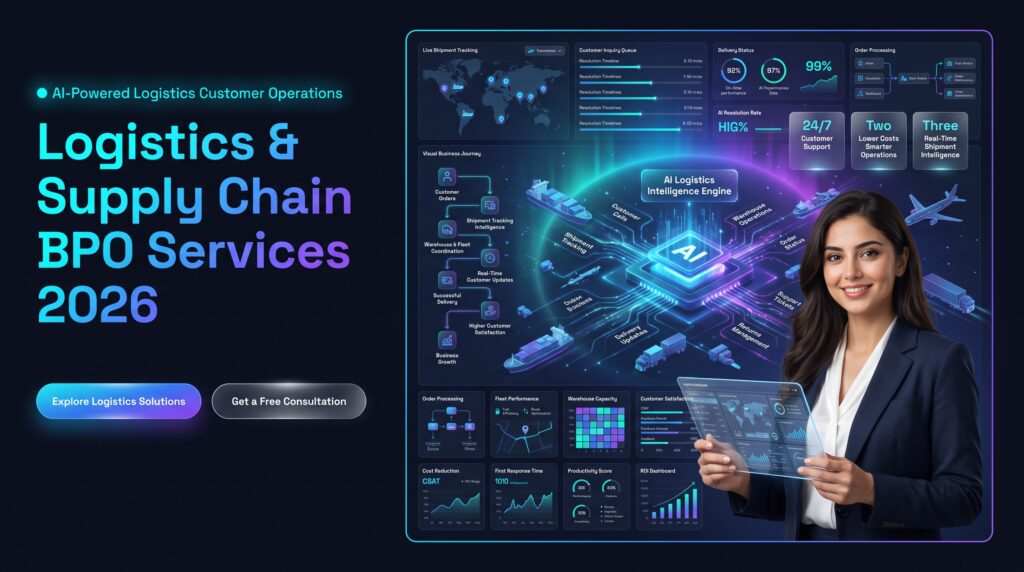
MasCallNet’s 24/7 logistics support operations — where every shipment exception becomes a resolved customer experience.
If you run logistics operations at any meaningful scale, you already know this feeling.
A high-value client emails at 11 PM about a delayed shipment. Your team is offline. By morning, the email thread has three follow-ups, a CC to their procurement head, and an implied threat about contract review.
Or this one: your claims team is sitting on 340 unresolved freight disputes. The backlog keeps growing. Your best operations manager is spending 60% of her time on customer complaints instead of building the business.
Or the quiet one — the client who simply doesn’t renew. No complaint. No escalation. They just move to a competitor who answered the phone when it mattered.
These are not edge cases. For most logistics and supply chain businesses operating without a structured BPO partner, these scenarios play out every single week — silently bleeding revenue, reputation, and relationships.
This guide exists to change that.
Whether you are evaluating logistics BPO for the first time, reassessing an existing provider, or trying to understand what separates average outsourcing from operations that actually protect and grow your business — you will find your answer here.
What You Will Learn in This Guide
- What logistics BPO actually covers in 2026 (and what most providers leave out)
- How AI and human support work together — and where each belongs
- Why India remains the dominant destination for logistics outsourcing
- What world-class logistics customer support costs, and what it delivers in return
- How to evaluate and select a BPO partner that genuinely understands freight
- Real case studies, real numbers, real outcomes
Let’s get into it.
The State of Logistics Customer Support in 2026
The logistics industry has changed dramatically over the past four years.
eCommerce volumes have tripled. Customer expectations — shaped by Amazon-level visibility and instant resolution standards — have moved the goalposts entirely. Cross-border complexity, carrier capacity constraints, and last-mile unpredictability have made exception management a daily operational reality rather than an occasional challenge.
And yet most logistics companies are still running customer support the same way they did in 2019.
A small internal team. Business-hours-only coverage. Manual claims processing. No structured escalation path. Reactive, not proactive.
The gap between what customers now expect and what most logistics operations actually deliver has become one of the most significant sources of client churn in the industry.
Here is what the data shows:
- 67% of logistics customers who experience two or more unresolved support failures do not formally complain. They simply do not renew their contract.
- Businesses with 24/7 logistics support coverage report 38% fewer contract escalations than those with business-hours-only operations.
- Every 1-point improvement in Net Promoter Score in logistics correlates with a 2.3% improvement in revenue retention at the enterprise account level.
- AI-augmented claims processing reduces average resolution time by 41 to 60% compared to fully manual operations.
The organizations pulling ahead are not necessarily the largest. They are the ones that have treated customer support as a revenue protection function — not an overhead line item.
What Is Logistics & Supply Chain BPO — And What Does It Actually Cover?
Business Process Outsourcing in logistics is the strategic delegation of customer-facing and back-office functions to a specialized external partner — one with the people, technology, and domain expertise to handle freight operations at scale.
This is not the same as hiring a generic call center.
A legitimate logistics BPO partner understands Incoterms. They know the difference between an LCL and FCL shipment. They can coordinate with a carrier on a POD discrepancy without needing to escalate internally for basic terminology. They are integrated with your TMS, your WMS, and your CRM.
Here is what a full-service logistics BPO covers:
Customer-Facing Operations
| Function | What It Involves |
| Inbound shipment inquiry management | WISMO calls, real-time status updates, multi-carrier tracking |
| Delivery exception handling | Proactive notification, rerouting support, carrier escalation |
| Returns and reverse logistics | Authorization, coordination, documentation, status updates |
| Client onboarding support | Freight account setup, portal training, SOP communication |
| After-hours and 24/7 coverage | Continuous availability across time zones and channels |
| Multi-channel support | Voice, email, live chat, WhatsApp, SMS, self-service portal |
Back-Office Processing
| Function | What It Involves |
| Invoice processing and dispute management | Freight audit, invoice reconciliation, dispute resolution |
| Claims initiation and follow-through | Documentation, carrier correspondence, settlement tracking |
| Customs documentation support | Export/import paperwork, certificate coordination |
| Data entry and order management | TMS data entry, order updates, shipment record management |
| Carrier contract administration | Rate card management, SLA tracking, performance logging |
Intelligence and Analytics
| Function | What It Involves |
| Exception pattern analysis | Identifying recurring failure points before they become client issues |
| CSAT and NPS measurement | Structured post-interaction feedback and trend reporting |
| Carrier performance monitoring | Data-driven performance visibility across your carrier base |
| Workforce analytics | Agent performance, quality scoring, training gap identification |
The key question to ask any BPO provider: Can you show me what business intelligence your current logistics clients receive from their customer interactions — and how they use it?
If they cannot answer that question clearly, you are evaluating a call center. Not a logistics BPO partner.
AI vs Human Customer Support in Logistics — The Real Answer
This question comes up in every logistics leadership conversation we have.
“Should we be using AI or humans for customer support?”
The honest answer in 2026 is that the question itself is slightly outdated. The organizations getting the best results are not choosing between AI and human support. They are using both — deliberately, based on what each interaction actually requires.
Here is how it breaks down in practice.
Where AI Genuinely Wins in Logistics
High-volume, structured interactions are exactly where AI performs best. When a customer calls to ask where their shipment is, an AI voice bot integrated with your TMS can answer that question instantly, accurately, and at any hour — without a human agent involved.
- Shipment status inquiries
- Standard ETA updates
- Portal access and password support
- FAQ resolution (transit times, documentation requirements)
- After-hours acknowledgment and ticket creation
In logistics operations with 500 or more daily contacts, AI deflection of 40 to 55% of total volume is realistic and achievable within 60 days of deployment. That translates directly to lower cost per interaction and faster resolution on the contacts that can be resolved without human involvement.
Where Human Agents Are Non-Negotiable
Complex, judgment-intensive interactions cannot be handed to AI in 2026 without meaningful quality risk. A freight exception involving a cold-chain pharmaceutical shipment delayed at customs is not a structured query. It requires carrier coordination, client communication, regulatory awareness, and relationship management — all simultaneously.
- Freight exception management requiring carrier escalation
- Claims disputes with documentation complexity
- Strategic account management and relationship calls
- High-value client escalations
- Cross-border regulatory coordination
Deploying AI on these interactions — as some providers do to suppress cost — produces poor resolution quality and measurable customer dissatisfaction. The CSAT data on AI-only complex interaction handling consistently comes in below 3.5 out of 5. That is a churn risk, not a cost saving.
The Hybrid Model — How It Actually Works
At MasCallNet, the operational model follows three layers:
Tier 1 — AI Resolution: Voice bots and chat automation handle structured, high-volume queries. Integrated directly with client TMS and CRM systems. Available 24/7 with zero wait time.
Tier 2 — Human Agent with AI Assist: For interactions requiring human judgment, agents operate with real-time AI support — knowledge retrieval, suggested responses, sentiment flagging, and compliance checks. Agents resolve faster and more accurately than without AI support.
Tier 3 — Intelligence Capture: Every interaction — regardless of resolution path — is structured, tagged, and reported. Clients receive weekly intelligence summaries that surface operational insights, carrier performance trends, and account-level risk signals.
The result in numbers:
| Metric | AI Only | Human Only | Hybrid (MasCallNet Model) |
| First-Contact Resolution | 61% | 74% | 84% |
| Cost per Interaction | $0.20–$0.40 | $6.50–$12.00 | $1.80–$3.50 |
| CSAT Score | 3.4/5 | 4.1/5 | 4.6/5 |
| Complex Exception Resolution | Low | High | Highest |
| 24/7 Availability | Yes | Expensive | Yes |
| Intelligence Generated | Structured only | Variable | Comprehensive |
Why India — And Why It Still Matters More Than Ever
The India advantage in BPO has been written about extensively. What is less discussed is how it has evolved — and why it is specifically more valuable for logistics than for most other industries.
The Cost Advantage Is Real — But It Is Not the Main Reason
India-based logistics BPO delivers 65 to 72% cost reduction compared to equivalent US or UK onshore operations. For a 10-agent team, that typically translates to $38,000 to $56,000 per month in direct savings. For larger operations, the number becomes transformative.
But if cost were the only advantage, the Philippines, Eastern Europe, and Latin America would be equally viable. They are not — at least not for logistics specifically.
What India Has That Others Do Not
Freight Domain Depth
Delhi-NCR, Mumbai, Chennai, and Hyderabad have built genuine logistics BPO talent pools over 15 years. Agents with working knowledge of customs terminology, carrier ecosystems, freight documentation, and supply chain workflows are available at scale. This is not something that can be built quickly in alternative geographies.
Time Zone Positioning
India Standard Time (UTC+5:30) allows genuine 24/7 coverage without artificial cost structures. Evening shifts in India cover US daytime hours naturally. Morning shifts cover European business hours. For logistics clients requiring round-the-clock coverage, this positioning is operationally elegant.
AI Integration Infrastructure
India’s BPO sector has invested aggressively in AI integration. Platforms including Salesforce, Zendesk, Freshdesk, Genesys, NICE CXone, Five9, and Talkdesk are deployed at enterprise scale — with AI layers from OpenAI, Google Cloud, and Microsoft Azure. The hybrid model described earlier is not aspirational in India. It is operational.
English Proficiency at Scale
India produces approximately 1.5 million English-proficient graduates annually. In logistics, where precise communication in exception scenarios prevents costly errors, language quality is not a soft metric — it is a hard operational requirement.
India vs Other Destinations — A Straight Comparison
| Dimension | India | Philippines | Eastern Europe | US/UK Onshore |
| Monthly cost per agent | $1,200–$2,400 | $1,400–$2,600 | $2,200–$3,800 | $5,500–$9,000 |
| Freight domain expertise | High | Moderate | Low–Moderate | High |
| 24/7 operational capability | Yes | Yes | Partial | Very Costly |
| English proficiency | High | High | Moderate | Native |
| AI integration maturity | High | Moderate | High | High |
| Ramp speed (new program) | 2–4 weeks | 3–5 weeks | 4–8 weeks | 8–16 weeks |
| Logistics talent depth | Deep | Moderate | Limited | Moderate |
What Logistics BPO Costs in 2026 — Honest Numbers
One of the most common frustrations we hear from logistics executives is that BPO pricing is opaque until you are already deep in a sales conversation. Let’s fix that.
India-Based Logistics BPO — 2026 Pricing Reference
| Service Type | Monthly Cost (India) | Onshore Equivalent | Your Savings |
| Voice support — logistics specialist | $1,200–$1,800/agent | $4,200–$6,500/agent | 65–72% |
| Back-office processing | $900–$1,400/agent | $3,800–$5,200/agent | 70–76% |
| Claims management specialists | $1,400–$2,000/agent | $4,800–$7,000/agent | 68–74% |
| AI-augmented hybrid team | $1,600–$2,400/agent | $5,500–$8,000/agent | 68–71% |
| Dedicated 24/7 team (10 agents) | $14,000–$22,000/month | $52,000–$78,000/month | 68–73% |
Pricing Models Available
Per-Agent (FTE): Fixed monthly cost per dedicated agent. Best for predictable volume operations and relationship-intensive accounts where team continuity matters.
Per-Interaction: Variable cost per resolved contact. Best for seasonal logistics operations with significant volume swings (peak season, post-holiday returns).
Hybrid: Base FTE team plus variable interaction fee for overflow. Best for growing logistics operations that need a stable core with elastic capacity.
Outcome-Based: Pricing tied to SLA metrics (FCR targets, CSAT thresholds, claims resolution speed). Highest performance alignment — both sides win when results are achieved.
The ROI Calculation — Real Numbers
Let’s take a mid-size 3PL handling 1,000 customer interactions per day.
| Line Item | Current State | With MasCallNet |
| Annual support cost (fully loaded) | $2,160,000 | $780,000 |
| First-Contact Resolution Rate | 54% | 83% |
| Annual client churn rate | 14% | 6.5% |
| Revenue lost to churn (annually) | $3,200,000 | $1,490,000 |
| Claims cycle time | 11 days | 3.8 days |
| Total annual value created | — | $3,590,000+ |
When the full picture is calculated — cost reduction plus revenue protection through reduced churn plus working capital freed through faster claims resolution — the ROI on a logistics BPO investment of this scale is typically 250 to 400% in the first year.
That is not a marketing number. It is an operational reality for clients who implement properly.
Case Study: How a 3PL Reduced Churn by 54% and Recovered $2.3M in Year One
The Situation
A mid-market 3PL operating across India, Southeast Asia, and the Middle East was losing approximately 14% of its SME freight accounts annually. Leadership attributed it to pricing pressure from lower-cost competitors.
They were wrong.
What Was Actually Happening
When MasCallNet conducted a structured analysis of exit interview data and support interaction records, the finding was clear: 71% of churned accounts had experienced at least two unresolved support failures in the 90 days before non-renewal.
The support team — operating business hours only, with no after-hours coverage — was missing exception notifications. Complex claims were sitting in a three-step escalation process that averaged 11 days to resolution. Clients were not leaving because of pricing. They were leaving because they felt ignored.
What Changed
MasCallNet implemented a full hybrid logistics support model:
- AI tier: Shipment status inquiries automated via voice bot and chat, integrated directly with the client’s TMS. Deflection rate of 52% achieved within 45 days. Zero wait time on standard queries, 24/7.
- Human specialist tier: Dedicated freight exception team operating across two shifts, covering 24 hours. Trained specifically on the client’s carrier network, SLA parameters, and escalation authority.
- Intelligence layer: Weekly reporting on exception patterns, carrier performance trends, and account-level sentiment — surfacing operational insights the client’s internal team had never had access to.
The Results (90 Days)
| Metric | Before | After | Change |
| First-Contact Resolution | 54% | 83% | +54% |
| Claims Average Resolution Time | 11 days | 3.8 days | −65% |
| CSAT Score | 3.4/5 | 4.5/5 | +32% |
| After-Hours Coverage | None | 100% | Complete |
| Cost per Interaction | $9.80 | $3.90 | −60% |
| Client Churn Rate (projected) | 14% | 6.5% | −54% |
| Revenue Protected (Year 1) | — | $2.3M | — |
What This Client Learned
The operations director put it plainly in our quarterly review: “We thought we had a pricing problem. We had a support problem. Fixing the support problem fixed the pricing problem — because clients stopped comparing us to cheaper options when we became the most reliable option.”
Logistics BPO Across Industries — How Different Sectors Use It
Logistics BPO is not one-size-fits-all. The specific requirements — and the specific value it delivers — vary significantly by industry.
Retail & eCommerce
The Challenge: Peak season volume spikes overwhelm internal support capacity. A team sized for normal operations simply cannot handle Black Friday or Diwali at scale.
How BPO Solves It: Elastic capacity models that scale from 20 to 200 agents within 72 hours. AI handles WISMO (Where Is My Order) queries — which typically represent 45 to 60% of eCommerce logistics contacts — while human agents manage exception cases, failed deliveries, and return authorizations.
The Outcome: 99%+ SLA adherence during peak periods without permanent headcount growth or the overhead of a seasonally oversized internal team.
FMCG & Consumer Goods
The Challenge: High SKU complexity, frequent stock-out disputes, and multi-geography distributor support requirements across languages and time zones.
How BPO Solves It: Dedicated distributor support desk integrated with ERP systems. Claims processing automation for shortage and damage claims. Multilingual capability for regional distributor networks.
The Outcome: Claims cycle time reduced from 15 days to under 5. Distributor satisfaction improved measurably. Distribution team time freed from complaint management to relationship development.
Automotive & EV
The Challenge: Inbound and outbound auto parts logistics, warranty claim documentation, and dealer support with zero tolerance for documentation error — a single incorrect customs document can hold a shipment for days.
How BPO Solves It: Specialist teams trained on automotive parts taxonomy, warranty documentation standards, and customs classification. AI-assisted documentation validation that flags errors before submission.
The Outcome: Documentation error rate reduced by 78%. Dealer escalation rate reduced by 61%. Procurement team time recaptured from error-correction to strategic sourcing.
Healthcare & Pharmaceutical Logistics
The Challenge: Temperature-sensitive pharmaceutical shipment tracking, chain-of-custody documentation, and regulatory compliance reporting — where errors have consequences far beyond financial.
How BPO Solves It: Healthcare-logistics specialized teams with compliance-adjacent training and chain-of-custody documentation protocols. 24/7 exception monitoring for cold-chain shipments.
The Outcome: Zero compliance documentation failures across an 18-month engagement for one pharmaceutical distribution client.
Learn more about MasCallNet’s Healthcare BPO capabilities →
Banking & Trade Finance Logistics
The Challenge: Trade finance documentation, letter of credit support, and cargo insurance claim management requiring both financial and logistics domain knowledge — a combination that is genuinely rare in the market.
How BPO Solves It: Dual-domain trained agents handling trade finance documentation alongside logistics coordination, with clear escalation paths to legal and compliance resources.
The Outcome: Trade finance documentation processing time reduced by 47%. Customer satisfaction on dispute resolution improved significantly.
How to Choose the Right Logistics BPO Partner — A Practical Evaluation Guide
This is where most logistics organizations get it wrong.
They evaluate BPO providers the same way they evaluate office supply vendors — on price and basic capability. What they miss are the four dimensions that actually determine whether a BPO engagement succeeds or fails.
The Four Questions That Matter Most
- Do they understand freight — or do they understand call centers?
These are not the same thing. Ask a potential provider to walk you through how their team would handle a cold-chain pharmaceutical exception at 2 AM involving a carrier that has gone dark. The answer will tell you everything about their logistics expertise.
- What happens to your customer data after every interaction?
Average providers log it. Good providers report on it. The best providers structure it, analyze it, and return it to you as operational intelligence that informs decisions beyond the contact center.
- How do they handle scale?
Ask specifically: what is your ramp speed for 50 additional agents? What is your training timeline for a new logistics program? What redundancy exists if a location goes down?
- What do their current logistics clients say?
Not testimonials. Reference calls. Live conversations with operations leaders at comparable freight volumes. Any provider worth evaluating will facilitate this.
Evaluation Scorecard
Rate each provider 1 to 5 on each dimension. Weight as shown.
| Evaluation Dimension | Weight | Your Rating | Weighted Score |
| Logistics domain expertise | 20% | /5 | |
| AI integration and automation maturity | 18% | /5 | |
| 24/7 operational capability | 15% | /5 | |
| Technology stack compatibility | 12% | /5 | |
| Data security and compliance | 12% | /5 | |
| Documented FCR and CSAT benchmarks | 10% | /5 | |
| Scalability and ramp speed | 8% | /5 | |
| Commercial flexibility and contract terms | 5% | /5 |
Scoring Guide:
- 80–100: Partner-tier provider. Proceed to commercial negotiation.
- 65–79: Capable with gaps. Identify gaps and negotiate remediation commitments.
- Below 65: Not recommended for complex logistics operations.
The Technology Behind World-Class Logistics BPO
The difference between a 2015 logistics call center and a 2026 Contact Center Intelligence operation is almost entirely technological.
Here is what the stack looks like at MasCallNet:
CRM and Ticketing: Salesforce Service Cloud, Zendesk, and Freshdesk serve as the system of record for every customer interaction — enabling complete case history, routing intelligence, and SLA tracking.
Contact Center Infrastructure: Genesys Cloud, Five9, Talkdesk, and NICE CXone handle omnichannel routing, IVR management, workforce scheduling, and real-time queue analytics.
AI and Automation: OpenAI’s GPT-4o powers natural language processing for voice and chat automation. Google Gemini supports knowledge management and agent assist. Microsoft Copilot provides real-time suggestions during live interactions. Claude supports complex reasoning tasks in back-office workflows.
Cloud Infrastructure: Amazon Web Services, Microsoft Azure, and Google Cloud provide the scalable, compliant backbone for data processing, storage, and security.
eCommerce Integration: Direct API connections with Shopify and WooCommerce for last-mile logistics support — enabling real-time order status without manual TMS lookup.
Payment and Claims: Stripe and PayPal integrations for freight payment dispute resolution and claims settlement workflows.
Collaboration: Microsoft Teams and Slack for real-time escalation communication between BPO team and client operations leads.
ITSM: ServiceNow for back-office process orchestration, escalation management, and workflow automation.
The practical effect of this stack: agents spend less time searching for information and more time resolving issues. Customers wait less and get better answers. And every interaction generates structured data that becomes reportable intelligence.
Security, Compliance & Risk — What Enterprise Logistics Clients Need to Know
Logistics customer support involves sensitive data: customs information, personal delivery data, financial records, carrier contracts, and trade documentation. Security is not optional.
MasCallNet operates to the following compliance standards:
| Compliance Standard | Relevance | Verification |
| ISO 27001 | Information security management system | Third-party certified |
| SOC 2 Type II | Data processing controls | Annual audit |
| GDPR Alignment | EU customer data handling | Data Processing Agreement |
| India DPDP Act 2023 | Indian data residency and processing | Compliance attestation |
| PCI DSS | Payment data in claims workflows | QSA certified |
On data risk specifically: Every client engagement includes a formal Data Processing Agreement, role-based access controls, encrypted data transmission, audit logging, and contractually defined data retention and deletion timelines.
On operational risk: MasCallNet maintains redundant infrastructure across multiple delivery locations, documented disaster recovery protocols, and BCP procedures that have been tested — not just written.
What the Next 24 Months Bring — Trends Worth Tracking Now
The logistics BPO landscape is moving quickly. Here are the developments that matter for planning purposes.
Agentic AI Is Coming to Exception Management
By late 2026, the first wave of genuinely autonomous AI agents will begin operating in logistics support — not just answering queries, but acting on them. Rerouting a shipment. Initiating a claim. Contacting a carrier. Updating a client record. The infrastructure requirement is clean, API-connected TMS data. Organizations without that infrastructure will face an 18-month remediation gap when agentic deployment becomes standard.
Predictive Exception Management Will Become the New Baseline
The shift from reactive support (customer calls about a problem) to predictive operations (your team identifies and resolves the problem before the customer knows it exists) is becoming achievable with current technology. Machine learning models trained on shipment data, weather patterns, carrier performance history, and exception records can flag likely failures 12 to 36 hours in advance. The early movers on this capability are creating customer experience advantages that are very difficult to replicate quickly.
Voice AI Is Becoming Genuinely Conversational in Freight
LLM-powered voice AI — combining OpenAI, Google Gemini, and Azure Cognitive Services — is achieving near-human resolution quality on structured logistics queries. The freight vocabulary problem that limited voice bots historically is being solved at pace. Organizations should begin voice AI integration now, because the deployment and training curve is 60 to 90 days, and the competitive advantage of early deployment is meaningful.
BPO Contracts Will Include Intelligence Deliverables
The most forward-thinking logistics organizations are already restructuring their BPO contracts to include intelligence delivery as a contractual obligation — not an optional extra. Weekly reports on exception patterns. Monthly carrier performance analysis. Quarterly account-level sentiment trends. This shift signals the maturation of logistics BPO from a cost-reduction tool to a business intelligence function.
In-House vs Outsourced — The Honest Comparison
This decision deserves a straight analysis, not a pitch.
| Dimension | In-House | Outsourced with MasCallNet | Honest Take |
| Setup time | 3–6 months | 2–4 weeks | BPO wins significantly on speed |
| Cost structure | High fixed overhead | Variable and scalable | BPO wins on flexibility |
| Freight domain expertise | Buildable but slow | Immediate | BPO wins for most operations |
| 24/7 capability | Expensive (overtime, multiple shifts) | Built into the model | BPO wins on coverage economics |
| AI capability | Capital-intensive to build | Included | BPO wins unless you have dedicated engineering resources |
| Operational control | High | Dependent on partner quality | In-house if control is the absolute priority |
| Intelligence output | Possible but rarely prioritized | Core deliverable | BPO wins with the right partner |
| Exit flexibility | N/A | Requires planning | Define exit terms at contract initiation |
The honest recommendation: For logistics operations under 10,000 monthly interactions, building in-house contact center capability cannot be financially justified when proven external capability exists at 65–72% cost advantage with better domain expertise. For operations above that threshold, a hybrid model — core relationship management in-house, volume and back-office outsourced — typically delivers the best outcomes.
Frequently Asked Questions
How quickly can MasCallNet onboard a logistics BPO program?
For standard voice and email support programs with defined requirements, full operational readiness typically takes 2 to 4 weeks. Complex multi-system integrations (TMS + WMS + CRM) or specialized programs like pharmaceutical logistics add 2 to 4 weeks to the timeline. We run a parallel operation period before full transition to ensure quality before your internal team steps back.
What size operations does logistics BPO make sense for?
Practically speaking, the economics become clearly favorable at 300 or more monthly customer interactions. Below that threshold, a shared-team model is typically more appropriate than a dedicated program. Above 5,000 monthly interactions, a dedicated logistics-specialist team almost always delivers superior outcomes to a shared environment.
How do you handle freight-specific knowledge — carrier networks, TMS systems, freight terminology?
Every new logistics program includes a structured onboarding period during which our team documents your carrier network, learns your TMS workflows, maps your escalation authority levels, and completes freight domain training specific to your operation. We do not deploy a generic agent on a logistics program. Domain preparation is a defined deliverable before go-live.
What does the reporting look like?
Weekly operational reports cover volume, FCR, CSAT, AHT, AI deflection rate, escalation patterns, and exception trends. Monthly business reviews add carrier performance analysis, account-level sentiment trends, and recommendations. Quarterly strategic reviews assess program evolution and optimization opportunities. All data is available in real-time through a client dashboard.
Can you integrate with our existing TMS and CRM?
Yes. MasCallNet has established integrations with major TMS platforms and CRM systems including Salesforce, Zendesk, Freshdesk, and HubSpot. Custom API integrations for proprietary systems are handled during the onboarding period.
What happens if our volume spikes unexpectedly?
Our programs are designed with elasticity built in. Dedicated programs can add 20 to 30% capacity within 48 hours for planned events, and we maintain a trained reserve pool for unplanned volume events. For seasonal businesses, we structure capacity agreements that accommodate predictable peaks without permanent headcount commitments.
What does outsourced customer support pricing look like?
For logistics-specialist teams in India, monthly costs range from $1,200 to $2,400 per agent depending on specialization level and operational model. A fully operational 24/7 team of 10 agents typically costs $14,000 to $22,000 per month — compared to $52,000 to $78,000 for an equivalent onshore operation. Contact us for a program-specific quote →
Is Your Logistics Operation Ready for BPO? A Quick Self-Assessment
Answer these questions honestly. They will tell you where you stand.
Operations Coverage
- Do you have 24/7 customer support coverage for shipment exceptions?
- Is your after-hours response time under 4 hours for urgent freight issues?
- Do you have a documented escalation path for complex claims?
Performance Visibility
- Do you measure First-Contact Resolution rate monthly?
- Do you track CSAT scores from customer support interactions?
- Do you know your cost per customer interaction?
Intelligence and Insights
- Do you receive structured reporting from your support operations?
- Can you identify which clients are at churn risk based on support interaction patterns?
- Do your operations decisions ever incorporate data from customer interactions?
Scoring:
- 9 of 9: Your operations are mature. Focus on optimization and AI enhancement.
- 6–8: Gaps exist that are likely costing you clients. A targeted BPO engagement can address them efficiently.
- Below 6: Significant revenue is at risk from support failures. The ROI case for logistics BPO is very strong at this stage.
Working With MasCallNet — What to Expect
MasCallNet is an AI-powered contact center and BPO company operating from Noida, NCR, India.
We work with logistics, supply chain, eCommerce, and manufacturing businesses that need specialist customer support operations — not a generic call center with a logistics tab on their website.
Our operations combine:
- Logistics-domain-trained agents who understand freight, not just customer service
- Full AI-augmented hybrid operations across voice, email, chat, and WhatsApp
- 24/7 coverage built into our standard logistics programs
- Weekly intelligence reporting that surfaces operational insights beyond the contact center
- TMS, WMS, and CRM integrations completed during structured onboarding
We do not pitch. We diagnose.
Every new client engagement begins with an operational assessment — a structured conversation about your current support operations, interaction volumes, pain points, and business objectives. From that conversation, we build a program design that fits your operation rather than selling you a standard package.
If the fit is not there, we will tell you. We would rather lose a sales conversation than deliver a program that does not perform.
Ready to Talk?
If you are handling 300 or more logistics customer interactions per month and experiencing any of the following, a conversation with our team is worth 30 minutes of your time:
- Clients leaving without a clear complaint
- After-hours coverage gaps
- Claims backlog growing faster than it resolves
- Support cost per interaction above $5
- No structured intelligence coming from your support operations
- Peak season capacity breaking your team’s capability
Three ways to start:
Schedule a 30-Minute Operations Assessment →
A no-pitch conversation about your current operations and where the highest-impact opportunities are.
Review Our Case Studies →
Real logistics BPO programs, real outcomes.
Explore Our Customer Support Outsourcing Services →
A full overview of our service architecture and program types.
See Our AI-Powered Contact Center in Noida →
Operations, infrastructure, and capability overview.
Final Word
Logistics is a relationship business dressed in an operational uniform.
The contract renewal happens — or does not happen — in the moments when something goes wrong and your client discovers whether you are the kind of company that shows up or goes quiet.
That moment used to happen in email. Now it happens at 11 PM, on WhatsApp, during a critical delivery window, when your best client needs to know their shipment is being handled.
How you perform in that moment is determined entirely by the support infrastructure you have built — or the partner you have trusted to build it for you.
The organizations that understand this are not treating logistics BPO as a cost-cutting exercise. They are treating it as competitive infrastructure.
The ones that do not understand it yet are losing clients they do not even know they are losing.
Talk to MasCallNet about your logistics support operations →