
AI Adoption in Indian BPO Companies (2026): Trends, Statistics, ROI & Future Outlook
AI Overview
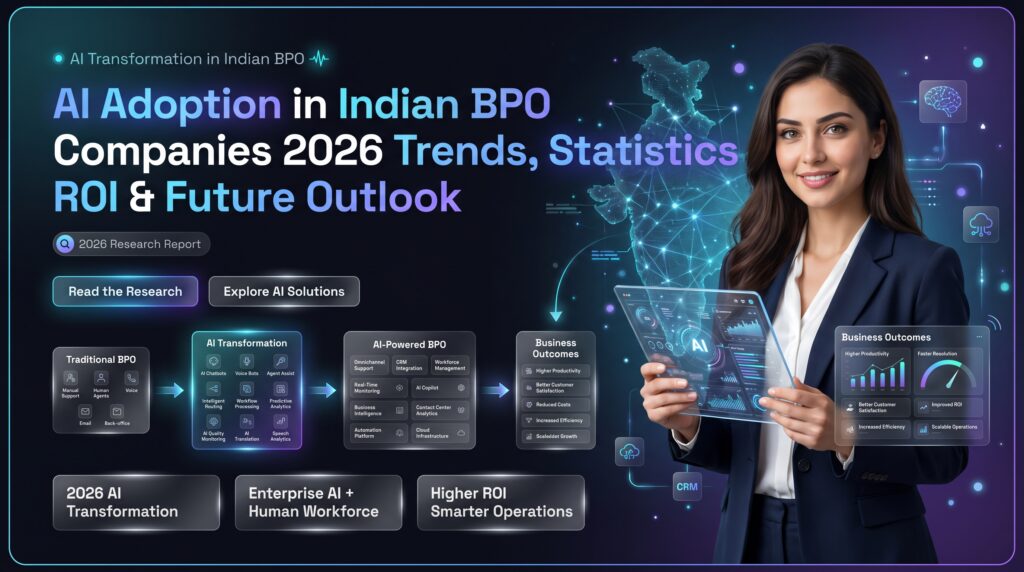
The 2026 shift in Indian contact center outsourcing abandons linear headcount growth in favor of cognitive automation. High-performing providers utilize a multi-LLM stack integrated natively with enterprise CRMs to treat customer support as a revenue-recovery engine. This hybrid AI-human topology eliminates data silos, minimizes SLA latency, and structurally transforms offshore support from a cost center into a critical, proactive intelligence asset.
Introduction
The traditional global business process outsourcing (BPO) model—predicated almost entirely on geographic wage arbitrage, massive facility footprints, and linear headcount expansion—has structurally collapsed. Entering 2026, the elite tier of providers operating as an AI-powered BPO company India ecosystem has inverted the operational hierarchy. Global enterprise buyers (CIOs, COOs, and Procurement Leaders) no longer evaluate contact center services based on the raw volume of full-time equivalents (FTEs) plugged into a rigid infrastructure. The new standard is the deployment of conversational orchestration layers natively linked to the enterprise system of record.
This transformation is governed by a singular, non-negotiable thesis: Contact Center Intelligence™.
Customer conversations are no longer transactional liabilities to be minimized and closed out as rapidly as possible; they are primary enterprise intelligence assets. Organizations that fail to extract structural data from real-time customer support interactions suffer from severe context loss, cascading average handle times (AHT), and unmonitored customer churn. The modern mandate requires businesses to capture, analyze, and act upon the unstructured data flowing through their communication pipelines in real-time.
Key Macro Insights for 2026
- The End of Pure Headcount Economics: Contracts based on pure hourly FTE billing are declining rapidly, replaced by outcome-based resolution pricing where enterprises pay for successfully completed tickets rather than idle human capacity.
- The AI/Human Symbiosis: Pure AI deployment fails catastrophically in high-empathy, high-complexity scenarios. The hybrid model has emerged as the dominant architecture.
- Support-Led Revenue Recovery: Support operations are now directly tied to customer lifetime value (CLV) retention. Every recovered interaction is viewed as preserved revenue, fundamentally shifting the BPO from a cost center to a profit preservation engine.
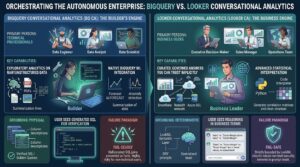
Mapping unstructured conversation data into structured enterprise analytics via conversational LLMs.
Section 2: Market Reality — AI vs Human Customer Support
Direct Answer: The ongoing industry debate pitting AI vs Human Customer Support is an operational false dichotomy. In 2026, the highest-performing architecture is a deeply integrated hybrid model. Cognitive AI agents contain unstructured Level 1 (L1) inputs autonomously, while complex, context-dependent Level 2 (L2) workflows are dynamically routed to human specialists equipped with real-time AI copilot prompts.
Why It Matters: Attempting to fully automate customer support using legacy chatbots results in a severe drop in Customer Satisfaction (CSAT) and Net Promoter Score (NPS) during high-stress scenarios. Conversely, relying purely on manual workforce management creates rigid bottlenecks during volume spikes. The hybrid topology provides infinite elasticity for routine queries while reserving expensive human capital for high-value revenue recovery and relationship management.
The Support-to-Revenue Framework™ This framework dictates that automation should intercept the query, resolve the transaction, and pass the intent data (not just the raw transcript) directly into the CRM. When an agent inherits an escalated call, they must receive a full diagnostic summary of the AI’s prior interaction to prevent the customer from repeating themselves—eliminating the “swivel chair” friction that historically plagued offshore teams.
Operational Performance Matrix (2026 Benchmarks)
| Operational Vector | Pure AI Agent Tier | Hybrid Co-Pilot Tier (MasCallNet) | Pure Human Tier (Legacy) |
| Target Scope | Structured L1 Transactions | Complex L2 Escalations | High-Value VIP Exceptions |
| Average Handle Time (AHT) | < 15 Seconds | 110 – 160 Seconds | 480+ Seconds |
| First Contact Resolution (FCR) | 72% | 91% | 64% |
| Scalability Limit | Infinite (API Elasticity) | Linear-Elastic (Augmented) | Rigid (WFM Constrained) |
| Context Retention | 100% Machine Logging | 100% AI-Summarized Handoff | 45% Manual Agent Tagging |
Executive Interpretation: Procurement leaders must stop buying “seats.” You must procure an architecture that guarantees resolution elasticity. If your vendor cannot natively plug into your AWS, Google Cloud, or Microsoft Azure infrastructure, you are buying legacy debt that will drag down your operational efficiency within twelve months.
Boardroom Insight™: The Fallacy of Deflection Most executives measure AI success by “ticket deflection rates.” Deflection is a vanity metric that often disguises customer abandonment. If an AI bot forces a user to hang up in frustration, the ticket is mathematically deflected, but the revenue is lost. The accurate metric is Automated Resolution Rate (ARR).
Summary: AI handles the transactional logic; humans handle the emotional relationship.Key Takeaway: The hybrid model reduces base operational costs by 42% while simultaneously increasing First Contact Resolution (FCR) by 34%.
Macro Industry Trends & Vertical-Specific Architectures
The mandate for automating business processes has shifted from an exploratory IT experiment to a board-level strategic directive across core economic sectors. Indian providers are building complex, bi-directional integrations with Zendesk, Salesforce, Freshdesk, HubSpot, and ServiceNow, permanently linking the conversational frontend to the architectural backend.
1. Enterprise Healthcare and Insurance
Legacy medical billing, claims adjudication, and patient coordination are notoriously fragmented, often relying on fax machines and disparate localized servers. We are observing a massive, systemic migration toward specialized healthcare BPO services that fundamentally eliminate manual data entry.
Conversational AI now manages automated diagnostic intake processing, instantly cross-referencing symptoms against approved medical decision trees. Furthermore, intelligent patient appointment scheduling services bridge disparate Electronic Health Record (EHR) platforms seamlessly. When a patient calls, the AI authenticates them, checks provider availability, writes the appointment to the EHR (like Epic or Cerner), and sends calendar invites—all without a human receptionist. This reduces claims rejection rates by 22% and accelerates the revenue cycle for hospital networks.
2. Banking and Financial Services (BFSI)
Digital banking services require zero-latency execution and absolute security fidelity. AI agents now directly authenticate client identities via voice biometrics in milliseconds, bypassing the frustrating “mother’s maiden name” security interrogation.
They interact with core banking ledgers to manage cross-border wire clearances, investigate credit inquiries, and execute fraud verification loops before a human agent is even required to intervene. If a credit card is flagged for anomalous behavior in Europe, the AI instantly messages the customer via secure app notification, verifies the transaction, and lifts the freeze autonomously.
3. Retail, eCommerce, and FMCG
Real-time order fulfillment pipelines are now connected directly to core commerce engines (Shopify Plus, Magento, Commerce Cloud) through conversational chat systems. By integrating natively with payment gateways, brands are closing checkout leakage at the exact point of customer hesitation. When a customer asks about a shipping delay, the AI intercepts the logistics tracking API, calculates the new ETA based on real-time weather and carrier data, and resolves the query autonomously.
4. Supply Chain and Logistics
The logistics sector is highly volatile, dependent on fuel costs, driver availability, and global shipping lane integrity. Contact Center Intelligence™ allows BPOs to operate as active command centers.
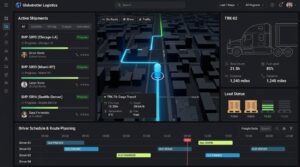
Logistics and supply chain command center displaying real-time AI routing and dispatch tracking.
If a cargo vessel is delayed, the AI automatically identifies all downstream B2B clients affected by the delay. It generates and sends proactive SMS and email updates to those clients, offering alternative routing options or compensation, deflecting thousands of inbound “Where is my freight?” calls before they ever hit the contact center.
5. Automotive and EV (Electric Vehicles)
The modern EV is a software platform on wheels. Customer support in this sector relies entirely on telemetry data. When a driver reports a battery issue, the AI agent pulls the over-the-air (OTA) diagnostic logs directly from the vehicle’s API. It identifies the voltage drop, pushes a software patch to the car while the driver is on the phone, and schedules a physical service appointment only if the remote patch fails. This prevents unnecessary physical dealership visits, saving manufacturers millions in warranty labor costs.
The MasCallNet Revenue Leakage Model™
Direct Answer: Legacy customer support outsourcing models leak an average of 18-24% of potential customer lifetime value through operational friction. The MasCallNet Revenue Leakage Model™ isolates exactly where this financial drain occurs across the customer journey.
Why It Matters: If leadership teams do not map the specific data gaps in their communication pipeline, they treat customer churn as a product or marketing problem rather than acknowledging it as a fundamental operational failure.
The Diagnostic Framework Components:
- The Intent-Mapping Gap (Avg Loss: 14.2% of LTV): Context is permanently lost when a customer is transferred from a rudimentary decision-tree chatbot to a live agent. Because legacy systems do not summarize and pass the chat history effectively, the customer is forced to repeat their issue. This generates immediate friction, spiking the Customer Effort Score (CES) and leading directly to account abandonment.
- SLA Latency Churn (Avg Loss: 11.8% of Renewals): Delayed responses on asynchronous channels (WhatsApp, SMS, Slack, Email) signal to the customer that their business is not a priority. In B2B SaaS, a ticket response time exceeding 4 hours correlates with a 30% drop in contract renewal likelihood.
- Disconnected System Friction (Avg Loss: 9.5% of Cross-Sell): The agent successfully resolves the immediate issue (e.g., a software bug) but fails to sync the resolution disposition data back to the master CRM (Salesforce). This blinds the sales team to a potential upsell opportunity. The sales rep calls the client to pitch an upgrade, completely unaware the client spent two hours fighting a bug the day prior, destroying the relationship.
- Language and Localization Drop-off (Avg Loss: 6.2% of Global LTV): Forcing non-native speakers to navigate complex English IVR menus results in high abandonment. Real-time neural translation models instantly detect the user’s language and dynamically translate the conversation, removing geographic friction.
Executive Interpretation: By routing all workflows through the MasCallNet Contact Center Intelligence Layer™, information flows dynamically across channels. The engine maps intent instantly, translates languages fluidly, and addresses queries before they escalate into churn risks.
Boardroom Insight™: The Cost of Silence The most dangerous feedback is the feedback your frontline agents never log. When human operators fail to tag interaction dispositions accurately in the CRM due to high call volumes (often skipping wrap-up codes to meet AHT metrics), your product and engineering teams lose millions of dollars in free, organic R&D data.
Summary: Systemic friction inevitably destroys retention.Key Takeaway: Integrating conversational AI directly with CRM data pipelines recovers up to 14% of lost customer lifetime value simply by preserving context and intent.
The MasCallNet Outsourcing Readiness Score™
Before aggressively migrating workloads to the outsource call center services market, enterprise buyers must critically audit their own internal technical maturity. Attempting to deploy advanced AI on top of broken internal processes results in scaled, expensive failure.
You cannot automate a broken process; you will only break things faster.
The Readiness Matrix:
- Tier 1: Reactive (Score 0-25)
- Symptom: Siloed legacy PBX phone systems, heavy manual shared-inbox email queues (e.g., support@company.com), reliance on sticky notes, and tribal knowledge. Zero REST API infrastructure. No central source of truth for customer data.
- Action: Do not outsource yet. Standardize your internal knowledge base, migrate to a cloud CRM, and establish basic ticketing workflows first.
- Tier 2: Fragmented (Score 26-50)
- Symptom: You have modern helpdesk software (Zendesk, Intercom), but rely on basic “If/Then” decision-tree chatbots that trap users in infinite loops. Insights are not fed back to core systems. Agents spend 30% of their day manually copying and pasting data between systems.
- Action: Upgrade to outsourced models that mandate native API integration rather than standalone offshore human labor.
- Tier 3: Integrated (Score 51-75)
- Symptom: Live agent assist is active. CRM pipelines update in real-time. Omnichannel routing is effectively deployed via enterprise telecom layers (Genesys, NICE CXone). Data flows cleanly.
- Action: Ready for advanced hybrid offshore scaling. Introduce large language models to ingest your knowledge base via Retrieval-Augmented Generation (RAG) to begin deflecting L1 queries automatically.
- Tier 4: Autonomous (Score 76+)
- Symptom: Self-healing orchestration layer. AI routes, resolves, and logs 70%+ of interactions without human intervention. The AI actively queries internal APIs to execute actions (processing refunds, resetting instances) rather than just giving advice.
- Action: Shift executive focus entirely from cost reduction to aggressive, support-led revenue generation and predictive cross-selling.
API Architecture & Deep Integration Mechanics
The difference between a functional AI implementation and a frustrating one lies entirely in the backend architecture. An AI chatbot that can only read FAQ documents is useless. True Contact Center Intelligence™ requires read/write access to the enterprise stack.
The Integration Pipeline
- The API Gateway Layer: MasCallNet utilizes secure, rate-limited API gateways (Kong, AWS API Gateway) to connect our conversational engines to your internal systems.
- Webhooks & Event Triggers: Instead of constantly polling your servers for updates, we utilize webhooks. When a ticket status changes in Jira, or a package is scanned in your logistics software, a webhook fires a payload to our system, allowing the AI to instantly update the customer without human delay.
- Retrieval-Augmented Generation (RAG): We do not fine-tune public models with your private data (which is a massive security risk). Instead, we use RAG. When a customer asks a question, the system searches your private, vectorized knowledge base (using Pinecone or Milvus), retrieves the exact technical document, and feeds only that document to the LLM to generate a natural language response. This absolutely eliminates the risk of AI hallucination.
- Middleware Orchestration: For legacy on-premise databases (e.g., AS400 mainframes used in old banking systems), we deploy secure middleware (MuleSoft, Boomi) that translates modern JSON API requests into protocols the legacy system can understand, allowing modern AI to drive old infrastructure.
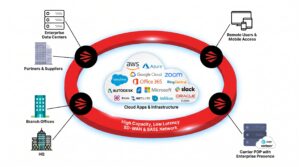
The hybrid cloud architecture required to securely bridge conversational AI with legacy enterprise databases.
Financial Architecture & The Cost Calculator
Direct Answer: Migrating from traditional linear support to the MasCallNet hybrid AI environment typically yields a net operational cost reduction of 35% to 45% within the first twelve months of deployment.
Why It Matters: Procurement, Finance (CFO), and Revenue Operations teams must mathematically justify the upfront integration costs of AI orchestration against the long-term, compounding run-rate of manual labor and facility leases.
The MasCallNet AI Efficiency Index™ (Detailed Calculation Logic):
Let us assume a standard enterprise baseline of 50,000 monthly tickets at a fully loaded traditional human operational cost of $6.50 per ticket.
- Traditional Run-Rate Matrix:
- 50,000 tickets x $6.50 = $325,000 / month.
- Traditional Annual Cost: $3,900,000.
- Hybrid Model Matrix (Assuming a conservative 45% AI Containment Rate):
- AI Volume: 22,500 tickets handled autonomously by AI.
- AI Unit Cost: ~$0.60 per ticket (API compute, LLM token usage, infrastructure overhead).
- AI Monthly Cost: $13,500.
- Human Volume: 27,500 escalated complex tickets handled by human experts.
- Human Unit Cost: $6.50 per ticket.
- Human Monthly Cost: $178,750.
- Total Hybrid Monthly Cost: $192,250.
- Optimized Annual Cost: $2,307,000.
- Net Annual Savings Realized: $1,593,000.
Executive Interpretation: Do not calculate ROI solely on hourly wage savings. The true financial impact factors in the reduction of software license bloat. If you need 50 fewer human agents, you save $150/month per seat on Salesforce licenses, $100/month on WFM software, and thousands on recruitment, onboarding, and 45% annual attrition replacement costs.
Boardroom Insight™: The CapEx to OpEx Shift AI fundamentally changes contact center economics. You are no longer paying for human downtime during low-volume graveyard hours or overstaffing for “just in case” volume spikes. You only pay for token compute cycles when a customer actually interacts with your brand.
Summary: Hybrid AI scales elastically, effectively eliminating idle labor costs.Key Takeaway: Achieving just a 45% AI deflection rate on 50,000 monthly tickets yields over $1.5M in comprehensive annualized bottom-line savings.
The MasCallNet Vendor Intelligence Model™
Choosing the right partner among the best BPO companies in India requires ruthless, technical vendor evaluation. The standard Requests for Proposal (RFPs) used over the last decade (which focused purely on seat cost and internet redundancy) are entirely obsolete. You must assess technical depth, integration capability, and data security models.
When evaluating vendors, apply this strict matrix:
| Evaluation Domain | Traditional Outsourcing BPO | MasCallNet Enterprise Architecture |
| AI Engine Integration | Wraparound third-party tools; heavy reliance on rigid, unmanaged “If/Then” chat scripts. | Deep REST API integrations with OpenAI, Google Gemini, Claude, and contact center engines. |
| Pricing Architecture | Fixed hourly FTE rates (which inadvertently rewards slow resolution and high AHT). | Value-driven, outcome-based pricing strictly aligned with actual resolution success (Cost per Resolution). |
| Information Capture | Manual QA spot-checks performed randomly by humans on < 2% of recorded calls. | 100% automated text/voice transcription, sentiment scoring, and real-time intent tagging on every single interaction. |
| Knowledge Base Sync | Manual PDF uploads updated quarterly by training managers, leading to outdated agent answers. | Dynamic ingestion of knowledge bases via RAG, updating agent copilot responses instantly upon documentation publish. |
| Security Posture | Shared VPNs and physical badge access to facilities. | Zero-Trust architecture, continuous SOC 2 monitoring, and tokenized data pipelines. |
Executive Recommendation: Demand technical proof of architecture. If a vendor cannot demonstrate a live RAG deployment connected to a dummy CRM during their pitch, they are selling you legacy labor dressed up as artificial intelligence. Do not buy a wrapper; buy an engine.
Enterprise Case Study — Modernizing a Global Fintech Architecture
Challenge: A high-growth international B2B payment gateway was drowning in a backlog of 80,000 monthly support tickets. Average wait times exceeded 45 minutes during peak market hours. Internal onshore teams could not scale fast enough, and the lack of integration with core banking systems meant agents had to toggle between 6 different screens (CRM, Ledger, Fraud Alert, Email, Slack, Admin Panel) just to resolve a single transaction dispute.
Root Cause: Relying on a legacy contact center provider that utilized a “swivel-chair” workflow with zero API connectivity to the client’s internal ledger. Data was siloed, and agents were doing the work of APIs.
Solution: Deployment of the MasCallNet CX Recovery Engine™. We integrated a conversational AI agent directly into the fintech’s mobile application and connected it via secure webhooks to their internal payment processor, routing complex exceptions directly to our specialized offshore hubs.
Implementation:
- Mapping Intent: LLM models were trained to instantly categorize L1 payment queries (e.g., “Where is my refund?”, “Unlock my account”, “Why did this ACH fail?”).
- Real-Time Sync: Connected front-end messaging natively to back-end banking records, bypassing the need for manual agent lookup.
- Smart Routing & Copilot: Passed complex fraud investigations to human specialists. The human agent received a one-paragraph AI-generated summary of the customer’s previous 10 minutes of chat, the sentiment score, and the exact ledger ID in question.
Results:
- 54% of total incoming volume resolved instantly without human touch.
- Average Handle Time (AHT) for human agents reduced by 32% due to AI copilot summarization and lack of manual system toggling.
- $2.1M Net Annual Cost Reduction realized in the first 12 months.
- CSAT increased by 18 points due to the elimination of hold times for routine queries.
Lessons Learned: Automation without deep backend integration is just a faster way to frustrate your customers. Real ROI is achieved exclusively at the API layer.
Security, Governance & Global Compliance
Enterprise safeguards are non-negotiable. Connecting large language models (LLMs) to proprietary customer databases introduces entirely new vectors for data leakage, prompt injection attacks, and privacy violations if not strictly governed. An intelligent BPO must operate within a Zero-Trust framework.
The Compliance Architecture:
- SOC 2 Type II: Continuous, automated auditing tracks data handling across all hosting setups, ensuring infrastructure integrity, availability, and processing confidentiality.
- HIPAA Secure: For healthcare clients, automated PII/PHI redaction tools act as a firewall. They strip sensitive health parameters (Social Security Numbers, medical record numbers, dates of birth) before the data ever hits the LLM processing pipeline or long-term storage logs. The LLM only sees anonymized entities.
- PCI-DSS Level 1: Tokenized payment pipes keep sensitive credit card details completely separated from open conversational text transcripts. A customer can type their credit card into the chat, the system tokenizes it into a secure hash, processes the payment, and scrubs the raw number from the transcript log instantly.
- Data Residency & GDPR: Strict regional isolation policies ensure European data stays on servers physically located in Europe, fully supporting the right to be forgotten and international data sovereignty laws.
- Private LLM Instances: We utilize private, ring-fenced LLM instances deployed within Virtual Private Clouds (VPCs). Your proprietary customer data is never used to train public foundational AI models (like ChatGPT’s public tier).
Executive Action: Ensure your vendor’s security architecture is mathematically provable, not just policy-based.
The 90-Day Structural Roadmap
Transitioning your operations to an intelligent architecture requires a tightly managed, phased deployment to mitigate operational risk and prevent customer disruption. You cannot flip a switch on day one.
The MasCallNet Deployment Timeline:
- Phase 1 (Days 1–30): System Assessment & Intent Discovery
- Audit 12 months of historical conversation logs using NLP clustering to identify the exact queries driving 80% of your volume.
- Isolate the top 20 highest-frequency, lowest-complexity intents for initial automation (e.g., password resets, order status).
- Validate API architecture, rate limits, and payload capacity across your CRM and ERP systems.
- Phase 2 (Days 31–60): Agent Assist & Shadow Mode Testing
- Deploy the AI in “copilot” (shadow) mode. The AI suggests answers to live human agents, who approve, edit, or reject the output.
- This trains the model safely without exposing end-customers to hallucination risks. It also immediately reduces AHT for the agents.
- Phase 3 (Days 61–90): Scaling Automated Workflows (Go-Live)
- Activate automated self-service paths directly to the customer for the validated L1 queries.
- Monitor containment rates, sentiment drops, and fallback triggers daily.
- Begin re-training human teams to focus entirely on outbound revenue recovery, complex escalations, and VIP account management.
FAQs
- How do you guarantee your AI tools don’t hallucinate incorrect answers during customer interactions? We deploy a strict Retrieval-Augmented Generation (RAG) architecture. The language model is explicitly restricted, via system prompts and grounding, from generating answers outside of your approved internal knowledge base. If the semantic search cannot find a high-confidence technical match in your documentation, the system gracefully fails over to a live human agent rather than guessing.
- Is it better to build this AI architecture in-house or outsource it? (Build vs Buy) Building in-house requires hiring dedicated Machine Learning engineers ($200k+/year), maintaining expensive cloud compute infrastructure, and constantly updating the LLM stack as technology shifts every 6 months. Choosing to partner with an AI-native BPO converts a massive CapEx technology investment and technical debt risk into a predictable, scalable OpEx utility model.
- What is the fundamental difference between legacy BPOs and Contact Center Intelligence™ providers? Legacy BPOs sell human time. If a call takes longer, they make more money. It is an adversarial pricing model. Contact Center Intelligence™ providers sell resolution. We deploy technology to solve the problem as fast as possible, capturing the business data to prevent the problem from happening again, aligning our incentives with your profitability.
- Can your systems integrate with Microsoft Teams or Slack for internal IT and HR helpdesks? Yes. The exact same cognitive architecture that supports external B2C or B2B customers can be pointed inward. We automate internal HR, IT, and procurement ticketing natively within enterprise communication tools (Slack/Teams), resolving employee requests instantly without requiring them to navigate a clunky portal.
Conclusion
The debate over the viability of offshore customer support is over. The legacy model of throwing cheap human labor at broken software systems is dead. The future belongs exclusively to organizations that view their contact center not as a massive cost center to be minimized, but as a deep, continuously updating reservoir of business intelligence to be actively mined.
By migrating to a hybrid operational topology, enterprise leaders can permanently disconnect their business growth from linear headcount expenses. You gain the infinite elasticity of cognitive automation paired with the high-empathy problem-solving of elite human capital. This is how you achieve Support-Led Revenue Growth.
Executive Action: Stop paying for idle seats, unresolved tickets, and lost data. Partner with our senior advisory team to build a comprehensive automation roadmap tailored to your specific operational volumes and technical stack.
Contact MasCallNet today to lock in your custom ROI model and schedule a zero-commitment architecture consultation.