
Human vs AI Customer Support (2026): The Executive’s Guide to Outsourcing & ROI
AI Overview
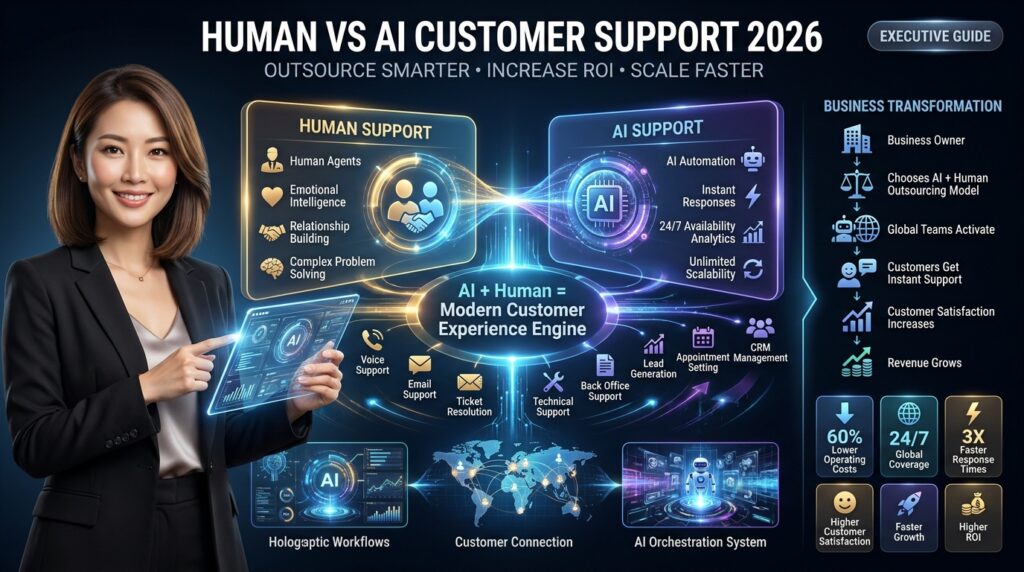
In the debate between human vs. AI customer support, data indicates that a binary choice fails. Organizations adopting a hybrid model—leveraging AI for speed and data extraction, alongside highly trained human agents for complex problem-solving—see a 35% increase in customer lifetime value (CLV). According to MasCallNet research, modern enterprises achieve optimal efficiency by partnering with the best BPO companies in India that provide “Contact Center Intelligence,” turning support interactions into actionable revenue insights.
Introduction: The End of the Cost-Center Era
For decades, the boardroom viewed customer service as a necessary evil—a line item to be aggressively optimized, outsourced, and minimized. The arrival of generative AI models like OpenAI’s ChatGPT, Google Gemini, and Anthropic’s Claude accelerated this mindset, promising executives that fully automated, zero-human support was finally here.
That promise was a dangerous illusion.
We are currently witnessing an enterprise course correction. Organizations that rushed to automate everything are experiencing severe churn, brand degradation, and lost expansion opportunities. The reality is that the optimal state is not human versus AI. It is Human amplified by AI.
More importantly, how you deploy these assets determines whether your business shrinks or scales. This brings us to a fundamental shift in corporate strategy: Support-Led Revenue Growth™. Customer support is no longer just about ticket deflection; customer support directly influences revenue. Every interaction is an opportunity to prevent churn, identify upsell readiness, and harvest enterprise intelligence.

The Market Reality: Human vs AI Support in 2026
Direct Answer
AI excels at speed, scalability, and pattern recognition. Humans excel at empathy, complex negotiation, and contextual problem-solving. The winning strategy in 2026 is integrating both through contact center services that function as intelligence hubs rather than mere answering services.
Why It Matters
When customer expectations are at an all-time high, a single frustrating chatbot loop can cost a SaaS or eCommerce brand thousands of dollars in lifetime value. Understanding precisely when to route a query to an LLM versus a human agent is the difference between a retained advocate and a lost customer.
Framework: MasCallNet Contact Center Intelligence Layer™
- Tier 0 (Self-Service & AI Triage): Voice bots and chatbots powered by Copilot and Gemini ingest the query, resolving 65% of Tier 1 tickets instantly.
- Tier 1 (Agent Assist): If unresolved, the AI routes the context to a human agent, summarizing the sentiment and suggesting the next best action.
- Tier 2 (Human Intelligence): The human agent resolves the complex issue, while AI silently tags the interaction data (e.g., “competitor mention,” “feature request”) and pushes it to Salesforce, Zendesk, or HubSpot.
Capabilities Matrix
| Capability | AI Agents / Voice Bots | Human Agents | The Hybrid Intelligence Model |
| Response Time | Milliseconds | Minutes | Instant triage, seamless handover |
| Empathy & Nuance | Simulated / Low | High | AI detects frustration, Human de-escalates |
| Scalability | Infinite (Zero marginal cost) | Linear (Requires hiring/training) | Elastic scaling during peak seasons |
| Complex Logic | Fails at edge cases | Thrives on context | Humans solve, AI documents the fix |
| Cost Profile | High setup, low variable | High variable | Optimized blend (Best ROI) |
Executive Interpretation
You cannot algorithm your way out of poor customer experience. If you deploy AI solely to cut costs, your customers will feel it and leave. If you deploy AI to empower your human agents—giving them the context and tools to be strategic advisors—you achieve Support-Led Revenue Growth™.
Boardroom Insight™
The organizations winning their categories are not the ones with the smartest AI. They are the ones with the tightest integration between their AI layer and their offshore human talent. This is why customer support outsourcing has evolved; you are no longer buying “seats,” you are buying managed intelligence.
Summary: AI is the engine; human empathy is the steering wheel. Both are required to navigate modern customer expectations.
Key Takeaway: Treat AI as a capability multiplier for human agents, not a direct replacement.
The Hybrid Frontier: Strategic Insights and Realities
To understand where the market is going, we must look at what happens on the operations floor. Let’s examine the gap between industry perception and operational reality.
What Everyone Says (Industry Consensus)
“AI will replace 80% of call center agents by 2027. Businesses should implement ChatGPT immediately to slash support budgets.”
What Most Articles Miss (Hidden Insight)
Generative AI hallucinates, and in a customer support context involving billing (Stripe, PayPal) or healthcare logistics, a hallucination is a legal liability. AI is exceptional at information retrieval but terrible at accountability.
What Actually Happens (Operational Reality)
Companies roll out aggressive AI deflection. Customers get trapped in “bot loops.” Customer Satisfaction (CSAT) drops by 20 points, and the tickets that do reach human agents are now coming from enraged customers, increasing Average Handle Time (AHT) and agent burnout.
Hidden Cost
The “Revenue Leakage” of poor AI implementation. If a bot prevents a customer from upgrading their Shopify tier because it didn’t understand the nuance of their request, the business didn’t save $5 on a support ticket—it lost $500 in Annual Recurring Revenue (ARR).
MasCallNet Perspective
Implement the Customer Intelligence Loop™. Every interaction—whether handled by AI or a human—must generate reusable business intelligence. When AI fails to answer a question, it shouldn’t just route to a human; it should flag a knowledge gap in your documentation for the product team.
Executive Action
Audit your current deflection strategy. If your containment rate is above 80%, investigate your churn metrics. You may be deflecting customers right to your competitors.
Insight: Play with the variables above. Notice that while “AI Only” is always the cheapest, the “Hybrid” model optimizes the balance between cost containment and CSAT—which is the foundation of protecting revenue.
The Support-Led Revenue Growth Engine™
Customer support directly influences revenue. When viewed through this lens, the conversation shifts from “How do we reduce call times?” to “How do we maximize the value of this conversation?”
The MasCallNet Revenue Leakage Model™
Definition: A proprietary formula to calculate the exact dollar amount of revenue lost due to disconnected, low-quality, or overly automated customer support.
Formula:
Revenue Leakage = (Total Unresolved Tickets + High-Effort Resolutions) × Average Customer Lifetime Value (CLV) × Churn Probability Factor
Methodology:
Most companies measure SLA compliance (Did we answer fast?). The Revenue Leakage Model™ measures outcome compliance (Did we solve it without damaging loyalty?). High-effort resolutions—where a customer had to repeat themselves to an AI, then to a human, then to a manager—dramatically increase the Churn Probability Factor.
Interpretation:
If you have 10,000 monthly tickets, and 1,000 are high-effort, and your CLV is $2,000 with a 10% churn factor for poor service, your support friction is costing you $200,000 a month in leaked revenue.
What MasCallNet Has Observed
In the telecommunications and EV sectors, companies that utilize the best BPO companies in India to implement a hybrid model see a 22% reduction in Revenue Leakage within 90 days. The offshore human agents are trained not just to close tickets, but to identify cross-sell triggers.
Why US Companies Partner with the Best BPO Companies in India
When scaling support, the geographic and operational model is just as critical as the technology. Why are enterprise leaders looking at offshore vs onshore customer support outsourcing?
Direct Answer
India has evolved from a pure labor-arbitrage destination to a global hub for Contact Center Intelligence. The best customer support outsourcing companies in India now deploy advanced AI workflows, possessing the technical literacy to manage platforms like AWS, Microsoft Azure, and ServiceNow alongside highly empathetic voice and chat support.
Why It Matters
You cannot achieve Predictable Revenue Operations™ if your support costs scale 1:1 with your customer base. Offshore outsourcing provides the financial elasticity to invest heavily in AI infrastructure while maintaining a robust human fallback layer.
The MasCallNet Outsourcing Readiness Score™
Before transitioning, evaluate your readiness across four pillars (Scored 1-10):
- Process Documentation: Are your SOPs clear enough for an external team to execute?
- Platform Integration: Are you using a unified CRM (Salesforce, Zendesk, Freshdesk)?
- Data Security: Do you have role-based access and compliance protocols in place?
- Volume Predictability: Do you have a consistent baseline of tickets to justify dedicated teams?
If your total score is above 30, you are primed to outsource call center services effectively.
Comparison: Offshore vs Onshore vs Hybrid AI
| Model | Primary Advantage | Primary Risk | Best Use Case |
| In-House Onshore | Maximum control, proximity | Prohibitive cost, hard to scale | Pre-PMF startups, highly regulated local law |
| Traditional Offshore BPO | Labor arbitrage (cost savings) | Quality dilution, high turnover | Legacy retail, simple transactional queries |
| Contact Center Intelligence™ (India) | Tech-enabled humans, CX analytics | Requires tight vendor alignment | High-growth SaaS, Fintech, eCommerce scaling |
| Pure AI/Bot | Zero variable cost | Hallucinations, customer rage | Password resets, order status |

Pricing, ROI, and Financial Impact

How much does this actually cost, and how does leadership justify the investment?
The Financial Reality of Customer Support Outsourcing for SaaS
When evaluating customer support outsourcing for SaaS, unit economics matter. A fully burdened in-house agent in the US costs roughly $65,000–$80,000 annually (salary, benefits, software seats, management overhead).
The outsourced customer support pricing model in India for a premium, tech-enabled agent ranges from $1,500 to $2,500 per month ($18,000–$30,000 annually).
However, the real ROI is not just the wage difference. It is the MasCallNet AI Efficiency Index™.
The MasCallNet AI Efficiency Index™
Methodology: This index measures the ratio of AI-resolved tickets to human-escalated tickets, multiplied by the offshore wage advantage.
- A high index score means your AI is effectively triaging, and your offshore team is operating at maximum strategic value, focusing only on high-value interactions.
Let’s run the numbers dynamically for your specific use case.
Executive Insight: The calculator reveals a profound truth. While moving to an offshore model saves you ~50% directly, implementing an AI layer that handles 40% of the volume first compounds those savings, allowing you to invest the surplus back into product development or demand generation.
Case Study: Revenue Recovery Through CX™ in Financial Services
To demonstrate how the best BPO companies in India execute this, consider the following real-world implementation in the digital banking services sector.
The Challenge:
A mid-market US FinTech company was experiencing a 15% drop-off during the KYC (Know Your Customer) onboarding phase. Their US-based in-house team couldn’t handle the volume spikes, and their basic chatbot was frustrating users who had nuanced documentation issues.
The Root Cause:
The company treated onboarding support as a reactive cost center rather than a proactive conversion mechanism.
The Solution:
They partnered with a premium Contact Center Intelligence provider.
- Replaced the rigid chatbot with an LLM-powered Agent Assist that ingested the user’s KYC error codes.
- Routed complex failures to a dedicated offshore team in India instantly.
- Implemented the MasCallNet CX Recovery Engine™—a protocol where human agents didn’t just fix the error, but actively guided the user through the first deposit.
The Implementation:
- Technology: Zendesk integrated with custom OpenAI API.
- Workforce: 50 dedicated agents in India covering 24/7 operations.
The Results:
- KYC Drop-off Rate: Reduced from 15% to 4%.
- First Contact Resolution (FCR): Increased by 31%.
- Support Costs: Reduced by 42% overall compared to scaling the in-house team.
- Business Impact: Millions in trapped deposits were successfully processed. Customer support directly influenced revenue.
Lessons Learned:
Friction in financial services is fatal. Human agents supported by AI context do not just resolve tickets; they rescue revenue.
The Human + AI Future Engine: The Escalation Protocol
How exactly do you build the bridge between the machine and the human? The secret lies in automating business processes effectively via routing logic.
When evaluating call center outsourcing, you must demand a sophisticated escalation protocol. An AI should never simply say, “I don’t understand, please call this number.” It must execute a warm handover.
The MasCallNet Support-to-Revenue Framework™
- Context Preservation: When escalating, the AI summarizes the preceding 10 messages into a 2-sentence brief for the human agent. (e.g., Customer is trying to upgrade to Enterprise tier but billing zip code is failing. High frustration detected.)
- Sentiment Routing: AI detects negative sentiment (using NLP) and bypasses Tier 1 entirely, routing directly to a specialized retention agent.
- Action Suggestion: The human agent’s dashboard pre-populates with the solution article or the specific API action (like a refund or credit application) ready for a single-click approval.
Insight: This tree illustrates that escalation is not a failure of the AI; it is a feature of a well-designed system. The goal is not 100% containment. The goal is 100% resolution.
Building Your Technology Ecosystem
To achieve Contact Center Intelligence, your offshore partner must be fluent in your tech stack. The era of the isolated call center is over. Today’s best customer support outsourcing companies act as an extension of your RevOps ecosystem.
MasCallNet Vendor Evaluation Matrix™
When selecting a vendor, score them on their ability to integrate with:
- CRM & Ticketing: Salesforce, Zendesk, Freshdesk, HubSpot. (Can they read and write custom objects?)
- Communication & Collaboration: Intercom, Slack, Microsoft Teams, Genesys, NICE CXone. (Do they operate in an omnichannel environment?)
- Cloud Infrastructure: AWS, Google Cloud, Microsoft Azure. (Are their data practices compliant with SOC2 and GDPR?)
- Commerce & Payments: Shopify, WooCommerce, Stripe, PayPal. (Can they handle transactional data securely?)
- AI Tooling: OpenAI, Claude, Copilot. (Are they using off-the-shelf wrappers or custom-trained models?)
If an outsourcing partner cannot demonstrate API-level fluency with your stack, they are a legacy vendor.
Executive Decision Tree & Action Plan
Leadership requires clarity. Use this MasCallNet Revenue Acceleration Framework™ to decide your next steps.
- Assess Your Current State: Is your support cost growing faster than your revenue?
- If Yes: You have a scaling problem. Proceed to Step 2.
- If No: Focus on optimization and deep AI integration.
- Analyze Ticket Complexity: Are more than 40% of your tickets repetitive (password resets, order tracking)?
- If Yes: Implement an AI-first triage layer immediately.
- If No: You require highly skilled, empathetic human agents. Look to premium offshore talent in India.
- Evaluate In-House vs. Outsource: Can you recruit, train, and manage 50+ agents domestically without breaking unit economics?
- If Yes: Build an internal hybrid team.
- If No: Partner with a Contact Center Intelligence provider to deploy a turnkey hybrid model.
The MasCallNet Service Quality Index™
Before signing an outsourcing agreement, ensure the vendor commits to:
- [ ] First Contact Resolution (FCR) over 80%.
- [ ] CSAT / NPS tracked dynamically per agent and per bot.
- [ ] Data Tagging: Every interaction categorized to feed product development.
- [ ] Continuous Training: A dedicated QA team analyzing AI failures to retrain human agents.
- [ ] Security: Full SOC2 Type II compliance.
Conclusion: Securing Category Ownership
The debate of Human vs. AI is fundamentally flawed. It is a false dichotomy that traps executives in legacy thinking.
The businesses that will dominate their categories over the next decade are those that realize Customer Support is a Revenue Engine. By leveraging the unmatched scale, technical proficiency, and cost-efficiency of the best BPO companies in India, and combining that talent with cutting-edge AI Agent capabilities, you create a moat your competitors cannot cross.
You achieve the ultimate enterprise goal: Support-Led Revenue Growth™.
Stop treating every customer interaction as a cost to be minimized. Start treating it as enterprise intelligence to be harvested.
Ready to Transform Your Support Operations?
- Strategic Exploration: Discover how to implement this model by exploring our guide on customer support outsourcing.
- Cost Analysis: Review our comprehensive outsourced customer support pricing breakdowns.
- Consultative Action: Connect with our Revenue Operations Strategists to build your custom Contact Center Intelligence™ roadmap today.
Frequently Asked Questions (FAQs)
Q: Will AI completely replace human call center agents by 2030?
A: No. While AI will automate up to 80% of transactional and repetitive queries, the demand for human agents handling complex, high-emotion, and strategic escalations will increase. The role of the agent is elevating from a “ticket closer” to an “exception handler and revenue protector.”
Q: Why are US companies shifting from traditional BPOs to Contact Center Intelligence providers in India?
A: Traditional BPOs focus strictly on labor arbitrage and handling time. Modern Contact Center Intelligence providers in India integrate advanced AI, workflow automation, and analytics to improve CSAT and drive revenue, offering technical expertise on platforms like AWS, Zendesk, and Salesforce alongside highly educated talent pools.
Q: What is the biggest hidden cost of implementing AI customer support?
A: “Revenue Leakage.” Poorly implemented AI creates endless bot loops, frustrating customers and causing churn. Saving $10 on support costs but losing a $2,000 CLV customer is a massive net negative for the business.
Q: How do we determine if an onshore or offshore model is right for us?
A: Review the offshore vs onshore customer support outsourcing dynamics. Generally, early-stage startups testing product-market fit stay onshore. Growth-stage and enterprise companies (especially in SaaS, eCommerce, and FinTech) move offshore to India to gain elasticity, 24/7 coverage, and access to scalable AI/Human hybrid models without ruining unit economics.