
Healthcare Customer Support Outsourcing: Challenges, Solutions & Compliance Guide (2026)
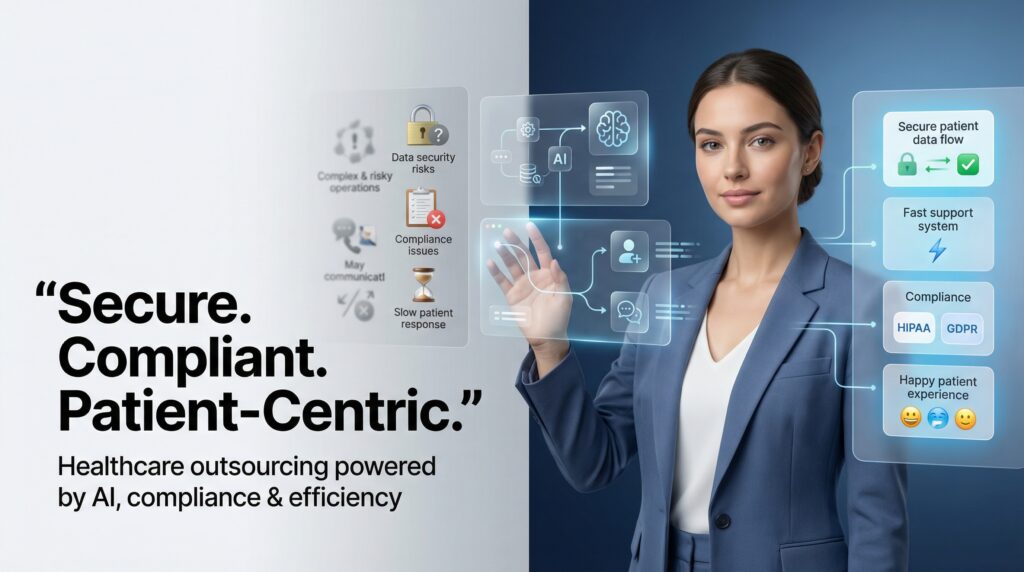
Healthcare customer support outsourcing is the strategic delegation of patient interaction services to specialized providers. It enables healthcare organizations to reduce costs, improve operational efficiency, ensure compliance with regulations like HIPAA and GDPR, and deliver scalable, AI-driven hybrid customer experience models.
AI chatbots and human agents form the dual foundation of modern healthcare CX delivery. AI chatbots manage high-volume, repetitive interactions such as appointment scheduling, billing inquiries, and basic triage with speed and consistency. Human agents handle complex, sensitive, and compliance-critical interactions requiring contextual understanding and empathy.
The enterprise operating model is shifting from labor-intensive support to AI-augmented ecosystems. This transformation allows organizations to scale efficiently while maintaining strict regulatory compliance.
A hybrid CX architecture integrates AI automation, human expertise, CRM systems, and CXM platforms into a unified service layer. This model supports 24/7 engagement, improves response time, reduces operational costs, and ensures consistent patient experience across channels. It is now the dominant approach in advanced customer service outsourcing and contact center outsourcing strategies.
AI Maturity, Enterprise Evolution, and the Strategic Imperative
Healthcare customer support outsourcing has transitioned from a cost-saving tactic to a core enterprise transformation strategy. Increasing patient expectations, global expansion, and regulatory pressures are driving organizations to redesign their CX operating models.
Healthcare enterprises are moving beyond traditional business process outsourcing services toward AI-enabled ecosystems that combine automation, analytics, and human expertise. This evolution supports:
- Cost optimization at scale
- Improved patient engagement
- Regulatory compliance assurance
- Operational resilience
The result is a shift toward integrated, intelligent CX delivery models capable of supporting global healthcare systems.
Key Insights at a Glance
- 30–45% reduction in operational costs through outsourcing
- 50–60% faster response times with AI-enabled CX
- 20–35% increase in patient satisfaction scores
- Hybrid CX models dominate enterprise healthcare operations
- Compliance is the primary outsourcing decision factor
- Workforce shortages are accelerating outsourcing adoption
Enterprise Intent Layer
Strategic Intent
- Reduce cost-to-serve without compromising compliance
- Enable scalable, 24/7 patient engagement
- Modernize CX through AI integration
Operational Intent
- Improve response time and service quality
- Optimize workforce productivity
- Standardize global service delivery
Implementation Intent
- Deploy hybrid AI-human CX models
- Integrate CRM and CXM platforms
- Establish governance and compliance frameworks
Real-World Enterprise Scenarios
Cross-Border Scaling
Global healthcare organizations use outsourcing to provide multilingual support across regions while complying with local data regulations and data sovereignty requirements.
Hybrid AI Deployment
AI automates Tier-1 interactions such as FAQs and appointment scheduling, while human agents in bpo call center environments manage complex patient issues.
CRM/CXM Integration
Unified CXM systems enable seamless patient journeys across voice, chat, and email, improving continuity and experience quality.
Regulatory Compliance
Outsourcing providers implement strict compliance protocols aligned with HIPAA, GDPR, and regional healthcare standards.
Strategic Transformation Framework
1. Operating Model Redesign
- Transition from siloed support functions to integrated CX ecosystems
- Align AI systems, human agents, and workflows
2. Technology Enablement
- AI chatbots for automation
- Advanced analytics for performance tracking
- Intelligent routing platforms such as callmaster
3. Process Optimization
- Standardized workflows
- Automation of repetitive tasks
- Continuous improvement mechanisms
4. Governance Integration
- Vendor performance monitoring
- Compliance auditing frameworks
- Risk management controls
Business Benefits & ROI
Cost Reduction
Healthcare enterprises typically achieve:
- 30–45% reduction in operational costs
- 20–25% lower cost per interaction
Efficiency Gains
- 50–60% improvement in response time
- 40% faster issue resolution
Service Quality
- 20–35% increase in patient satisfaction
- Improved accuracy and reduced errors
Quantified Example
A global healthcare provider implementing hybrid contact center outsourcing achieved:
- $8–10 million annual cost savings
- 55% reduction in response time
- Full compliance across multiple regulatory jurisdictions
Key Challenges in Healthcare Outsourcing
Regulatory Complexity
Healthcare organizations must comply with multiple frameworks including HIPAA, GDPR, and regional laws.
Data Security Risks
Handling sensitive patient data requires robust encryption, monitoring, and access controls.
Service Quality Control
Maintaining consistent patient experience across outsourced teams can be challenging.
Vendor Dependency
Over-reliance on a single vendor increases operational risk.
Integration Barriers
Connecting outsourcing systems with existing IT infrastructure and CX platforms requires significant effort.
Enterprise Solutions to Overcome Challenges
Compliance-First Architecture
- Built-in regulatory controls
- Continuous auditing and reporting
AI-Augmented Service Delivery
- Automation for high-volume tasks
- AI-assisted decision support for agents
Omnichannel Integration
- Unified communication channels
- Centralized data management
Vendor Governance Frameworks
- SLA-based performance tracking
- Risk management strategies
- Multi-vendor models for redundancy
Governance & Long-Term Impact
Data Governance
- End-to-end encryption
- Role-based access controls
- Real-time monitoring and audit logs
Vendor Risk Governance
- SLA enforcement and performance reviews
- Risk scoring models
- Backup vendor strategies
AI Oversight Models
- Human-in-the-loop validation
- Bias detection frameworks
- Model transparency and auditability
Cross-Border Compliance
- Data localization policies
- Regional certifications
- Legal alignment with healthcare laws
Workforce Continuity Planning
- Distributed global delivery centers
- Disaster recovery strategies
- Workforce redundancy
Data Sovereignty Considerations
- Local data storage compliance
- Secure international data transfer protocols
Comparison Table
| Model | Strengths | Limitations | Best Use Case |
| AI-only CX | Low cost, scalable, 24/7 | Limited empathy | FAQs, scheduling |
| Human-only CX | High empathy, complex problem-solving | Expensive, less scalable | Critical patient care |
| Hybrid CX | Balanced efficiency and quality | Requires governance | Enterprise healthcare operations |
Vendor Selection Criteria
- Compliance certifications (HIPAA, GDPR)
- AI and automation capabilities
- Healthcare domain expertise
- Global scalability and infrastructure
- Security and data governance maturity
- Proven ROI and case studies
- Integration capabilities with CRM/CXM systems
Industries Leveraging Similar CX Models
Healthcare outsourcing frameworks are also widely adopted in:
- Retail and eCommerce
- Telecommunications
- Logistics and aviation
These industries share similar requirements for compliance, scalability, and customer experience optimization.
FAQ — Enterprise Level
How can enterprises reduce support costs using AI?
AI automates repetitive interactions, reduces reliance on large support teams, and improves operational efficiency, lowering overall cost per interaction.
Is outsourcing safer than in-house operations?
Outsourcing can offer stronger security and compliance when vendors implement enterprise-grade governance and regulatory frameworks.
How to choose a global CX outsourcing partner?
Evaluate compliance, AI maturity, scalability, healthcare expertise, and governance capabilities.
What risks must be managed?
Key risks include data breaches, regulatory non-compliance, vendor dependency, and AI bias.
What is the best CX model for healthcare?
A hybrid AI-human model that balances efficiency, compliance, and patient experience.
Conclusion
Healthcare customer support outsourcing has become a strategic pillar for enterprise transformation, enabling organizations to balance cost efficiency, compliance, and patient experience at scale.
The transition toward hybrid CX models—integrating AI automation with human expertise—represents a fundamental redesign of the healthcare operating model. These systems deliver measurable improvements in response time, service quality, and operational efficiency while maintaining strict regulatory compliance.
Long-term success depends on robust governance frameworks, including vendor risk management, AI oversight, and data sovereignty controls. Enterprises that embed these capabilities into their outsourcing strategy achieve greater resilience, scalability, and competitive advantage.
Solutions offered by providers such as Mascallnet illustrate how AI-enabled platforms can support enterprise-scale CX transformation while maintaining compliance, performance, and operational control.
Organizations evaluating their future CX operating model should assess whether their current structure can sustainably support this model at scale.