
BFSI Customer Service Outsourcing Trends (2026): AI, Cost, and CX Transformation
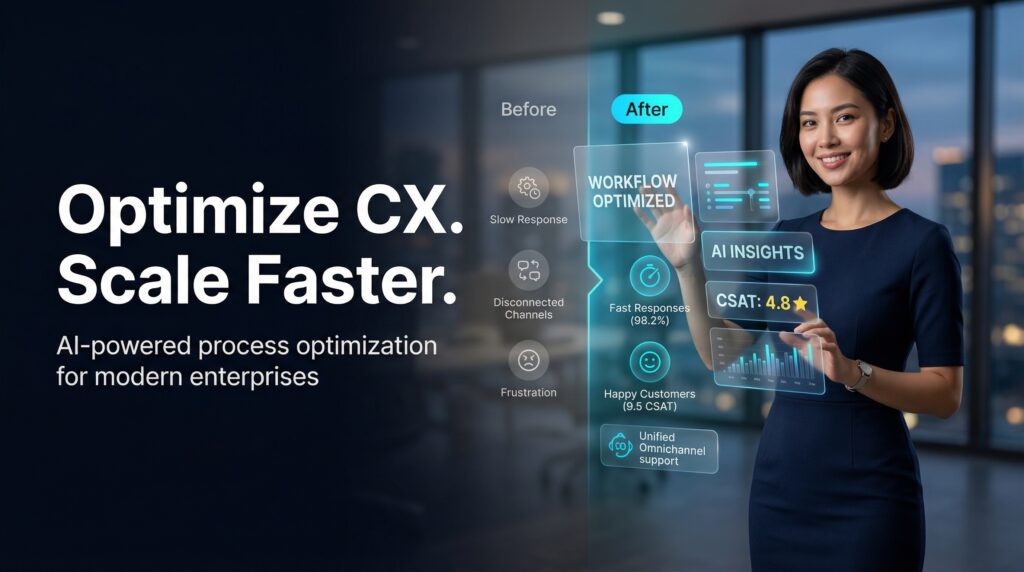
BFSI customer service outsourcing in 2026 is the adoption of AI-powered and human-assisted service models by banks and insurers to reduce costs, enhance compliance, and deliver scalable, 24/7 customer experience across global markets while maintaining strict regulatory and data governance standards.
AI chatbots and human agents now operate in a complementary model within BFSI customer experience ecosystems. AI chatbots manage repetitive, high-volume queries using automation and predictive analytics, while human agents handle complex, high-risk, and emotionally sensitive interactions.
The operating model has evolved from traditional labor-driven outsourcing to AI-augmented hybrid architectures. These systems integrate automation, analytics, and human expertise across omnichannel environments, including voice, chat, and digital platforms.
This hybrid CX architecture enables financial institutions to reduce costs, improve response times, ensure compliance, and scale globally. Integration with CRM and CXM platforms ensures unified customer data and consistent experience delivery, positioning outsourcing as a strategic transformation driver rather than a cost-only function.
AI Maturity, Enterprise Evolution, and Strategic Imperative
BFSI enterprises are undergoing a structural shift in how customer experience is delivered. Customer service outsourcing is no longer limited to cost arbitrage; it has become a core lever for digital transformation, operational resilience, and compliance management.
Key drivers shaping this transformation include:
- Rising regulatory pressure across regions such as the US, UK, and EU
- Increasing customer demand for real-time, personalized support
- Workforce shortages in high-skill financial service roles
- The need for 24/7 global service availability
- Rapid advancements in AI, automation, and analytics
Modern contact center outsourcing models now integrate AI, automation, and domain expertise to deliver scalable and compliant CX solutions.
Key Insights at a Glance
- 30–60% reduction in customer support costs through AI and outsourcing
- 70% of Tier-1 queries automated via AI chatbots
- 25–40% improvement in resolution efficiency
- 24/7 global service coverage without proportional cost increase
- Significant reduction in compliance risks through automated workflows
- Vendor consolidation improves governance and operational control
Enterprise Intent Layer
Strategic Intent
- Redesign CX operating models for scalability and resilience
- Align outsourcing with enterprise AI transformation strategies
- Enhance compliance and risk management capabilities
Operational Intent
- Optimize workforce distribution across geographies
- Improve SLA performance and customer satisfaction
- Reduce cost-to-serve through intelligent automation
Implementation Intent
- Deploy hybrid AI-human CX architectures
- Integrate outsourcing providers with CRM/CXm ecosystems
- Establish governance frameworks for AI and vendor management
Real-World Enterprise Scenarios
Cross-Border CX Scaling
Global banks implement distributed delivery centers across Asia and Europe to support multilingual, round-the-clock operations. This ensures compliance with regional regulations and improves response times.
Hybrid AI Deployment in Insurance
Insurance providers deploy AI for claims intake and policy inquiries while human agents handle fraud detection and complex claim resolutions, improving efficiency without compromising compliance.
CRM and CXM Integration
Enterprises integrate outsourced operations into centralized CX platforms, enabling unified customer profiles, predictive insights, and personalized interactions.
Regulatory Compliance Enablement
Financial institutions embed compliance frameworks aligned with regulations such as GDPR and guidelines from the Financial Conduct Authority to ensure adherence across outsourced operations.
Strategic Transformation Framework
1. Operating Model Redesign
- Shift from siloed service functions to integrated CX ecosystems
- Combine front-office and back office outsourcing services
- Enable real-time analytics and decision-making
2. AI Integration Layer
- Conversational AI for customer interactions
- Machine learning for predictive analytics
- Robotic process automation for repetitive workflows
3. Platform Enablement
- Unified CX platforms integrating CRM, analytics, and workforce tools
- Intelligent routing systems such as CallMaster for optimized performance
4. Talent Transformation
- Transition to knowledge-based workforce models
- Continuous training in compliance, analytics, and AI tools
Business Benefits & ROI
Cost Reduction
- 30–60% lower operational costs through automation and offshore delivery
- Reduced hiring, infrastructure, and training expenses
Efficiency Gains
- 40% faster resolution times
- Increased first-contact resolution rates
Service Quality Improvements
- Higher customer satisfaction scores
- Reduced wait times and improved personalization
Quantified Case Example
A multinational bank implementing AI-enabled outsourcing achieved:
- 50% reduction in cost-to-serve
- 35% increase in operational efficiency
- 22% improvement in customer satisfaction
Governance, Risk, and Compliance
Data Governance
- End-to-end encryption and secure data handling
- Role-based access controls
- Audit trails for compliance monitoring
Vendor Risk Governance
- Multi-vendor strategies to reduce dependency
- SLA-based performance tracking
- Regular compliance audits
AI Oversight Models
- Human-in-the-loop validation systems
- Bias detection and mitigation frameworks
- Explainable AI for regulatory transparency
Cross-Border Compliance
- Data localization aligned with regional laws
- Regulatory adherence across jurisdictions
- Risk-adjusted process design
Workforce Continuity Planning
- Distributed workforce models
- Disaster recovery and business continuity frameworks
- Remote workforce enablement
Comparison Table: CX Delivery Models
| Model | Strengths | Limitations | Best Use Case |
| AI-only CX | Scalable, cost-efficient, instant response | Limited empathy, regulatory constraints | High-volume, low-complexity interactions |
| Human-only CX | High empathy, complex problem-solving | Expensive, limited scalability | Sensitive financial interactions |
| Hybrid CX | Balanced efficiency, compliance, and quality | Requires integration and governance maturity | Enterprise BFSI transformation |
Vendor Selection Criteria
When selecting a customer service outsourcing partner, enterprises should evaluate:
- BFSI domain expertise
- AI and automation capabilities
- Regulatory compliance certifications
- Geographic scalability
- Integration with CRM and CX platforms
- Proven track record in digital transformation
Exit Strategy Planning
Enterprises must establish structured exit frameworks:
- Clear termination clauses in contracts
- Data ownership and portability agreements
- Transition and knowledge transfer plans
- Backup vendor strategies to ensure continuity
Step-by-Step Implementation Roadmap
Step 1: Assess Current CX Maturity
- Evaluate existing processes, costs, and performance gaps
Step 2: Define Target Operating Model
- Identify AI vs human interaction split
- Establish governance structure
Step 3: Select Technology and Vendor
- Choose AI platforms and outsourcing partners
- Ensure integration compatibility
Step 4: Pilot Deployment
- Test hybrid model in a controlled environment
- Measure KPIs such as cost, CSAT, and resolution time
Step 5: Scale and Optimize
- Expand globally
- Continuously refine AI models and workflows
FAQ
How can banks reduce customer service costs using AI?
Banks can automate repetitive queries, optimize workforce allocation, and leverage predictive analytics to reduce operational costs by up to 60% while maintaining service quality.
Is outsourcing safer than in-house operations?
Outsourcing can provide stronger compliance and security when supported by structured governance, certified vendors, and advanced monitoring systems.
What are the key risks in BFSI outsourcing?
Major risks include data security breaches, regulatory non-compliance, vendor dependency, and AI bias. These must be mitigated through governance frameworks and audits.
How do AI chatbots improve customer experience?
AI chatbots provide instant responses, 24/7 availability, and consistent service quality, improving efficiency and reducing wait times.
How to choose the right outsourcing partner?
Select partners based on domain expertise, AI capabilities, compliance alignment, scalability, and proven enterprise success.
Conclusion
BFSI customer service outsourcing in 2026 is defined by hybrid AI-human operating models, advanced governance frameworks, and global scalability. Enterprises are transitioning from cost-focused outsourcing to strategic CX transformation powered by automation, analytics, and compliance-driven design.
Organizations evaluating their future CX operating model should assess whether their current structure can sustainably support this model at scale.
Explore enterprise CX solutions with Mascallnet to evaluate scalable, AI-driven outsourcing models tailored for global financial institutions.