
How to Manage Customer Support During Product Launches
AI Overview
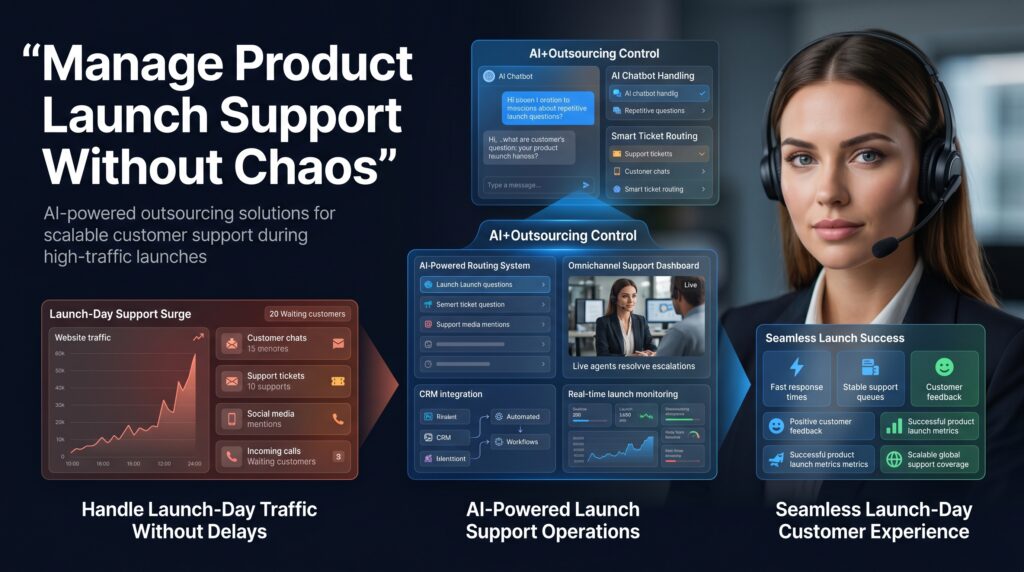
Product launches create unpredictable demand spikes that overwhelm internal support teams, delay response times, and negatively impact customer retention. To solve this, high-growth companies increasingly rely on call center outsourcing and scalable contact center services to handle rapid increases in customer inquiries without increasing fixed operational overhead.
Modern outsourcing providers combine AI-driven automation, automating business processes, cloud infrastructure, and globally distributed support teams to improve launch performance. Platforms such as Zendesk, Salesforce, Freshdesk, HubSpot, Amazon Web Services, and Google Cloud allow businesses to scale omnichannel support operations efficiently during high-volume launch cycles.
Companies that operationalize customer support outsourcing correctly achieve lower operational costs, higher CSAT scores, faster issue resolution, stronger customer retention, and more predictable launch scalability.
Introduction
A successful product launch is no longer determined only by product quality.
It is determined by how effectively a business supports customers during high-volume demand spikes.
When launches generate sudden increases in onboarding requests, billing questions, login failures, shipping inquiries, technical issues, and refund requests, internal support teams often become overwhelmed within hours. Slow responses damage customer trust, increase churn, reduce reviews, and negatively impact recurring revenue.
This is why enterprise organizations increasingly use customer support outsourcing to scale customer experience operations before launch demand arrives.
Instead of rapidly hiring and training large internal teams, companies leverage call center outsourcing partners capable of handling:
- Omnichannel support
- Voice and chat operations
- Technical troubleshooting
- Multilingual customer service
- Tier-1 and Tier-2 ticket management
- 24/7 customer coverage
- AI-assisted workflows
The outsourcing industry itself has evolved significantly.
Modern contact center services are no longer limited to traditional call handling. They now combine cloud infrastructure, automation, analytics, AI-driven workflows, and workforce optimization systems to create scalable launch-ready customer support ecosystems.
As a result, businesses increasingly outsource customer support to India and other offshore delivery markets to reduce operational costs while improving service availability and scalability.
For SaaS companies, fintech brands, healthcare organizations, eCommerce platforms, and enterprise software providers, customer support has become a critical growth infrastructure layer.
Key Insights
- Product launches can increase support ticket volume by 300–500% within days
- Customer support outsourcing reduces operational costs by 30–60%
- AI-assisted support models improve first-response times by 2–3x
- Offshore support operations provide scalable multilingual coverage
- Hybrid AI + human support models outperform fully automated systems
- Omnichannel contact center services improve customer retention during launch cycles
- Businesses using scalable support operations grow faster without excessive hiring
Why Product Launches Break Internal Support Teams
Most internal support teams are optimized for predictable operational demand.
Product launches create the opposite.
Launch-related demand spikes often include:
- New customer onboarding
- Billing confusion
- Feature adoption issues
- Password reset surges
- Payment failures
- Shipping delays
- Technical escalations
- Negative social media feedback
- High inbound call volume
Without scalable support infrastructure, companies experience:
| Operational Issue | Business Impact |
| Slow response times | Customer churn |
| Ticket backlog growth | Revenue leakage |
| Poor onboarding support | Lower product adoption |
| Negative reviews | Brand damage |
| Support burnout | Employee turnover |
| Inconsistent communication | Reduced customer trust |
According to multiple CX industry benchmarks, customers increasingly expect responses within minutes rather than hours.
Businesses that fail to meet these expectations during launch periods risk losing customers before long-term retention even begins.
The Market Shift Toward Customer Support Outsourcing
The global outsourcing market has shifted from cost reduction alone toward operational scalability and customer experience optimization.
Today’s contact center services combine:
- AI-powered ticket routing
- Workforce management systems
- Omnichannel customer engagement
- Knowledge base automation
- Predictive analytics
- Sentiment analysis
- Self-service workflows
At the same time, organizations are increasingly automating business processes to reduce operational friction during product launches.
Modern support operations now use AI systems for:
- Ticket categorization
- Intent recognition
- Chatbot triage
- Agent assistance
- Workflow automation
- Escalation routing
- Forecasting customer demand
This hybrid operational model allows companies to scale support capacity rapidly while maintaining quality standards.
The result is faster customer resolution at lower operational cost.
What Is Customer Support Outsourcing?
Customer support outsourcing is the process of partnering with a third-party provider to manage customer service operations.
This can include:
- Voice support
- Live chat
- Email management
- Technical troubleshooting
- Social media support
- Back-office processing
- Omnichannel support operations
Companies that outsource call center services gain immediate access to trained support infrastructure without building large internal teams.
Modern offshore call center outsourcing services typically include:
- AI-assisted workflows
- CRM integrations
- Quality assurance monitoring
- Workforce forecasting
- Analytics dashboards
- Compliance management
- Cloud-based infrastructure
This operational flexibility is particularly valuable during product launches where demand changes rapidly.
How Customer Support Outsourcing Works During Product Launches
Step 1: Forecast Customer Demand
High-performing organizations begin with forecasting.
This includes:
- Expected user acquisition
- Traffic projections
- Conversion estimates
- Historical support trends
- Geographic demand analysis
- Channel forecasting
Forecasting prevents under-resourcing during launch windows.
Step 2: Build Omnichannel Support Coverage
Modern customers expect support across multiple channels.
Scalable contact center services typically include:
- Phone support
- Live chat
- Email support
- Social media engagement
- WhatsApp support
- Community moderation
- Help center management
Centralized omnichannel support improves consistency and response speed.
Step 3: Integrate CRM and Cloud Infrastructure
Most outsourcing providers integrate with:
- Zendesk
- Salesforce
- Freshdesk
- HubSpot
Cloud infrastructure powered by Amazon Web Services and Google Cloud enables elastic scalability during traffic spikes.
This infrastructure supports:
- High-volume ticket processing
- Real-time reporting
- Distributed workforce management
- Global customer routing
- Automated workflows
Step 4: Deploy AI + Human Hybrid Support
AI systems handle repetitive workflows such as:
- FAQ automation
- Ticket tagging
- Routing
- Customer verification
- Basic troubleshooting
Human agents manage:
- Escalations
- Emotional interactions
- Technical troubleshooting
- Billing disputes
- High-priority enterprise requests
Hybrid support models outperform AI-only systems because customers still require empathy and contextual problem-solving.
Step 5: Monitor Performance Continuously
Successful launch operations monitor:
- Average response time
- First-contact resolution
- Ticket backlog
- CSAT score
- Escalation volume
- SLA compliance
- Customer sentiment
Continuous optimization improves operational efficiency throughout the launch cycle.
Benefits of Customer Support Outsourcing During Product Launches
1. Faster Response Times
Outsourced support teams provide elastic staffing models capable of scaling rapidly.
Typical performance improvements include:
- 2–3x faster response times
- Lower queue volumes
- Faster ticket resolution
- Reduced escalation delays
What this means for your business
Customers receive assistance quickly during critical onboarding moments, improving retention and reducing churn.
2. Lower Operational Costs
Customer support outsourcing significantly reduces:
- Recruitment costs
- Training expenses
- Infrastructure investments
- Workforce management overhead
Industry benchmarks show businesses often reduce support costs by 30–60%.
What this means for your business
Organizations preserve capital for growth initiatives such as product development, acquisition, and expansion.
3. 24/7 Global Customer Support
Product launches generate international customer demand immediately.
Offshore support operations provide:
- Round-the-clock support
- Multilingual coverage
- Weekend operations
- Holiday staffing
- Follow-the-sun service models
What this means for your business
Global customers receive faster assistance regardless of location or time zone.
4. Better Customer Satisfaction Scores
Strong contact center services improve:
- CSAT scores
- Net Promoter Scores
- First-contact resolution
- Customer retention
- Brand reputation
What this means for your business
Positive launch experiences improve long-term customer lifetime value.
5. Operational Scalability Without Overhiring
Launch demand is temporary for many businesses.
Outsourcing allows companies to scale support operations without permanently increasing internal headcount.
What this means for your business
Businesses remain operationally lean while still supporting aggressive growth.
Customer Support Outsourcing Pricing
Understanding call center outsourcing pricing is essential before selecting a vendor.
Average Pricing Models
| Pricing Model | Estimated Cost |
| Shared support agents | $8–$18/hour |
| Dedicated offshore agents | $1,200–$2,500/month |
| US-based dedicated agents | $3,500–$7,000/month |
| AI-assisted hybrid support | Usage-based pricing |
| Technical support specialists | Higher due to expertise |
Customer support outsourcing pricing depends on:
- Industry complexity
- Required technical knowledge
- Support channels
- Language requirements
- Compliance standards
- Operating hours
- Ticket volume
India vs US Cost Comparison
| Location | Estimated Monthly Agent Cost |
| United States | $4,000–$7,000 |
| Western Europe | $3,500–$6,000 |
| India | $1,000–$2,500 |
| Philippines | $1,200–$3,000 |
This cost advantage is one reason businesses increasingly outsource customer support to India.
Industry Use Cases
SaaS and eCommerce
SaaS and eCommerce launches often create:
- Login failures
- Refund requests
- Shipping inquiries
- Subscription questions
- Onboarding support demand
Modern contact center services help brands maintain customer retention during rapid user growth.
Fintech and Digital Banking Services
Fintech support operations require:
- Secure identity verification
- Fraud monitoring workflows
- Regulatory compliance
- Transaction support
- Escalation management
Providers supporting digital banking services combine automation with human escalation teams to balance security and customer experience.
Healthcare and Patient Support
Healthcare organizations require compliance-driven support operations.
Healthcare outsourcing services commonly support:
- Appointment scheduling
- Claims support
- Prescription coordination
- Patient onboarding
- Insurance verification
- Compliance workflows
Healthcare support environments demand strong security and operational accuracy.
Why Businesses Outsource Customer Support to India
India remains one of the largest global outsourcing destinations because it combines:
- Skilled English-speaking talent
- Large workforce scalability
- Strong technical expertise
- Mature outsourcing ecosystems
- Lower operational costs
- Advanced IT infrastructure
Modern offshore call center outsourcing services in India support:
- AI-enabled customer service
- Omnichannel operations
- Enterprise analytics
- Workforce optimization
- Compliance management
- Cloud-native support environments
Companies that outsource customer support to India gain operational flexibility while reducing customer acquisition support costs.
Real-World Example: SaaS Product Launch Scaling
A fast-growing SaaS company preparing for a global feature launch expected support demand to increase by 400% within two weeks.
Instead of hiring internally, the company partnered with an outsourcing provider to deploy:
- 24/7 multilingual chat support
- AI-driven ticket routing
- Dedicated onboarding specialists
- Escalation workflows
- CRM-integrated customer tracking
Results achieved within 60 days:
| Metric | Before Outsourcing | After Outsourcing |
| Average response time | 8 hours | 35 minutes |
| CSAT score | 78% | 92% |
| Ticket backlog | High | Minimal |
| Support cost growth | Unsustainable | Controlled |
The company improved customer onboarding while avoiding large internal hiring costs.
Implementation Framework for Product Launch Support
Phase 1: Audit Existing Support Operations
Evaluate:
- Ticket categories
- Current response times
- Escalation bottlenecks
- Workforce limitations
- Existing customer sentiment
This establishes operational benchmarks.
Phase 2: Select the Right Outsourcing Partner
Evaluate providers based on:
- Industry specialization
- AI capabilities
- Workforce scalability
- Security certifications
- Compliance standards
- CRM integrations
- Reporting capabilities
Vendor selection directly impacts launch performance.
Phase 3: Build the Technology Stack
Core support infrastructure includes:
- CRM platform
- Ticketing software
- AI chatbot layer
- Workforce analytics
- Knowledge base systems
- QA monitoring tools
Strong technology infrastructure improves scalability.
Phase 4: Run a Pilot Launch
Before scaling fully:
- Test workflows
- Validate SLA performance
- Monitor escalation quality
- Review reporting accuracy
- Assess automation effectiveness
Pilot programs reduce operational risk.
Phase 5: Scale Strategically
Expand support operations gradually:
- Increase agent capacity
- Add languages
- Expand support hours
- Introduce advanced automation
- Improve knowledge management
Successful scaling is controlled and data-driven.
In-House vs Call Center Outsourcing
| Factor | In-House Support | Call Center Outsourcing |
| Hiring speed | Slow | Fast |
| Scalability | Limited | High |
| Infrastructure investment | Expensive | Lower |
| Global support coverage | Difficult | Easier |
| Workforce flexibility | Lower | Higher |
| Operational cost | Higher | Lower |
| AI integration support | Variable | Stronger with specialized vendors |
Outsourcing provides operational flexibility that internal teams often cannot match during rapid growth periods.
AI vs Human vs Hybrid Customer Support
| Model | Advantages | Limitations |
| AI-only support | Low cost, fast responses | Limited empathy |
| Human-only support | Better emotional intelligence | Higher operating cost |
| Hybrid AI + human support | Balanced scalability and CX quality | Requires orchestration |
Hybrid support is increasingly dominant because it combines efficiency with customer trust.
Risks and Mitigation Strategies
Data Security Risks
Potential concerns include:
- Customer data exposure
- Unauthorized access
- Compliance failures
Mitigation strategies:
- SOC 2 compliance
- Encryption protocols
- Access controls
- Vendor audits
- Secure cloud infrastructure
Vendor Dependency Risks
Overreliance on a single vendor can reduce operational flexibility.
Mitigation strategies:
- Multi-vendor frameworks
- Internal escalation ownership
- SLA governance
- Operational documentation
Compliance Risks
Industries such as healthcare and fintech require strong compliance controls.
Mitigation strategies:
- Regulatory training
- Compliance monitoring
- Dedicated QA teams
- Secure infrastructure
Future Trends in Customer Support Outsourcing
The outsourcing industry is shifting toward automation-first customer experience operations.
Key trends include:
- AI-powered customer resolution
- Predictive workforce planning
- Voice AI systems
- Autonomous support workflows
- Real-time sentiment analytics
- AI-assisted agent coaching
- Self-service optimization
The biggest operational shift involves automating business processes across customer support ecosystems.
Organizations combining AI infrastructure with scalable outsourcing operations will outperform competitors on both cost efficiency and customer experience.
Decision Clarity: When Should You Outsource?
You SHOULD outsource if:
- Product launches create unpredictable support spikes
- Customer response times are declining
- Hiring internally is too slow
- Operational costs are rising rapidly
- Global support coverage is required
- Your internal team lacks scalability
You SHOULD NOT outsource if:
- Support volume remains extremely low
- Internal workflows are undocumented
- Compliance restrictions prohibit outsourcing
- Operational processes are immature
The best outsourcing strategies treat customer support as a growth infrastructure function rather than a cost center.
FAQ
What is customer support outsourcing?
Customer support outsourcing is the practice of using an external provider to manage customer service operations such as voice support, chat support, email management, and technical assistance.
How much does call center outsourcing pricing cost?
Call center outsourcing pricing typically ranges from $8–$18/hour for shared agents and $1,200–$2,500/month for dedicated offshore support agents.
Is customer support outsourcing safe?
Yes. Modern outsourcing providers use encrypted infrastructure, compliance frameworks, quality assurance systems, and access management controls to maintain enterprise-grade security.
Why outsource customer support to India?
Businesses outsource customer support to India because of lower operational costs, strong technical expertise, scalable talent availability, and mature outsourcing ecosystems.
What are offshore call center outsourcing services?
Offshore call center outsourcing services involve using support teams in international delivery markets to manage customer interactions at lower operational cost.
How does AI improve contact center services?
AI improves contact center services by automating ticket routing, customer verification, repetitive inquiries, workforce forecasting, and operational analytics.
Mid-Content Strategic CTA
Product launches fail operationally when businesses treat customer support as an afterthought.
High-growth companies build scalable customer experience infrastructure before demand spikes arrive.
Explore enterprise-grade customer support outsourcing strategies at: mascallnet
Final Strategic Recommendations
To manage customer support effectively during product launches, businesses should:
- Forecast customer demand accurately
- Build omnichannel support infrastructure
- Deploy AI-assisted workflows
- Implement hybrid human + AI support
- Use scalable outsourcing models
- Monitor operational performance continuously
- Optimize customer experience aggressively
Customer support has evolved into a direct revenue protection function.
Organizations that fail to scale support operations during launches risk damaging retention, reviews, customer trust, and long-term growth.
Businesses that operationalize customer support outsourcing effectively gain:
- Faster response times
- Lower operational costs
- Better customer retention
- Higher CSAT scores
- Global scalability
- Greater operational resilience
In highly competitive markets, support quality increasingly determines customer loyalty.
Conclusion
Modern product launches create operational complexity that internal support teams often cannot handle alone.
Customer support outsourcing provides the scalability, flexibility, automation, and workforce infrastructure necessary to support rapid growth without sacrificing customer experience.
As AI-driven workflows, omnichannel engagement, and automating business processes continue transforming customer service operations, businesses that combine human expertise with scalable outsourcing infrastructure will dominate future customer experience performance.
The companies that win product launches consistently are not simply building better products.
They are building better customer support ecosystems.