
Handle Sudden Customer Support Spikes Without Hiring (2026 Guide)
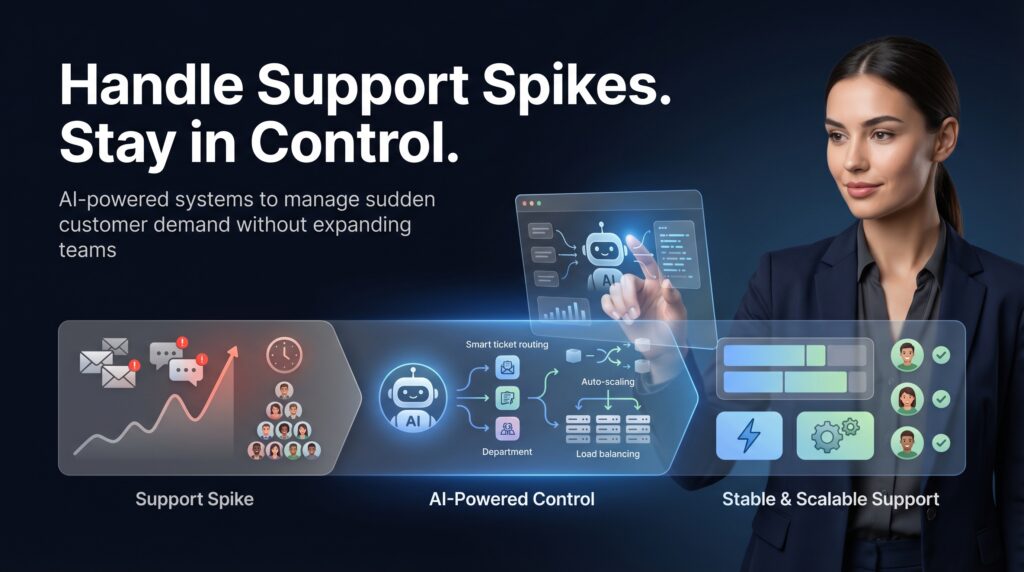
Managing sudden spikes in customer queries requires a scalable support system built on customer support outsourcing, AI automation, and hybrid delivery models. Businesses can reduce costs by 30–60%, improve response times by up to 3x, and maintain consistent service quality without hiring by leveraging offshore teams and cloud infrastructure.
Sudden spikes in customer queries expose structural limitations in traditional support models. Fixed-capacity, in-house teams cannot scale quickly enough, leading to delayed responses, increased costs, and declining customer satisfaction. Customer support outsourcing, combined with AI automation and cloud infrastructure, provides a scalable alternative that enables organizations to manage high volumes efficiently.
Platforms such as Zendesk, Salesforce, and Freshdesk automate workflows, while Amazon Web Services and Google Cloud enable global scalability. Organizations adopting hybrid support models—combining AI with human expertise—achieve significant cost reductions, faster response times, and improved customer satisfaction. This approach is becoming essential for enterprises operating in high-growth, high-demand environments.
Introduction
Sudden spikes in customer queries are no longer operational anomalies—they are a defining characteristic of modern digital businesses.
Growth, product launches, outages, seasonal demand, and global expansion all contribute to unpredictable surges in customer interactions. The traditional response—scaling through hiring—fails to keep pace with this volatility.
Organizations attempting to handle high customer support volume through internal expansion face structural constraints:
- Hiring cycles lag behind demand
- Training reduces speed and consistency
- Costs increase disproportionately
- Service quality deteriorates under pressure
The result is not just operational inefficiency—it is a direct impact on revenue, retention, and brand perception.
Leading enterprises are addressing this challenge differently. They are not scaling teams; they are scaling systems.
At the center of this shift is customer support outsourcing, integrated with AI-driven automation and hybrid delivery models. This is not a tactical adjustment. It is a strategic redesign of how customer experience is delivered at scale.
Key Insights
- Customer support outsourcing reduces operational costs by 30–60%
- Hybrid support models improve response times by 2–3x
- AI can deflect 40–70% of repetitive queries
- 24/7 support becomes achievable without infrastructure expansion
- Scalable systems directly improve retention and lifetime value
- Organizations that fail to scale support systems experience declining CX as they grow
Market Reality: Demand Has Outpaced Traditional Support Models
Customer support demand is expanding at a rate that exceeds the capacity of traditional operational models.
Three structural shifts are driving this change:
- Always-on customer expectations
Customers expect immediate responses across channels—regardless of time zone or volume. - Growth of digital and subscription-based businesses
SaaS, eCommerce, fintech, and platform-based models create continuous support demand rather than episodic interactions. - Global customer distribution
Support is no longer localized. It must operate across regions, languages, and time zones.
Strategic Implication
Support is no longer a back-office function.
It is a frontline growth driver.
Organizations that cannot scale support proportionally to demand will experience:
- Increased response times
- Declining customer satisfaction
- Higher churn rates
- Reduced revenue efficiency
What Is Customer Support Outsourcing?
Customer support outsourcing is a scalable operating model in which organizations delegate customer interaction management to external, specialized teams capable of delivering support across channels and geographies.
Scope
- Omnichannel support (voice, chat, email)
- Offshore call center outsourcing services
- AI-assisted workflows
- Multilingual support capabilities
Strategic Perspective
Outsourcing is often misunderstood as a cost-reduction tactic.
In reality, it is a capacity and capability multiplier.
It allows organizations to:
- Decouple growth from internal constraints
- Access specialized expertise
- Scale operations in real time
Why In-House Models Fail During Demand Spikes
In-house support models are inherently limited by their structure.
They are designed for predictability, not volatility.
Core Limitations
- Fixed headcount vs variable demand
- High marginal cost for expansion
- Limited operating hours
- Dependency on recruitment and training cycles
Impact on Business Performance
When demand spikes:
- Backlogs increase
- Resolution times extend
- Customer experience declines
- Operational costs rise
Critical Insight
In-house support models do not fail because they are poorly managed.
They fail because they are structurally incapable of scaling at the speed of demand.
How to Handle High Customer Support Volume: A System-Level Approach
Handling high customer support volume requires a shift from resource-based scaling to system-based scaling.
The most effective model integrates three components:
- Customer support outsourcing
- AI-driven automation
- Cloud-based infrastructure
1. Outsource Call Center Services for Elastic Capacity
Outsourcing transforms support operations from fixed to flexible.
Organizations can:
- Scale teams up or down based on demand
- Access trained agents without onboarding delays
- Provide multilingual, global support
This is particularly relevant for:
- Ecommerce customer support outsourcing services
- Healthcare call center outsourcing services
- Call center outsourcing for banking
Business Impact
Capacity becomes dynamic rather than constrained.
2. Deploy AI to Reduce Incoming Volume
AI is not just a productivity tool—it is a volume reduction mechanism.
Using platforms such as Zendesk and Freshdesk:
- Repetitive queries are automated
- Tickets are categorized and routed
- Response times are reduced
Integration with Salesforce and HubSpot ensures:
- Workflow automation
- Customer data synchronization
- Faster resolution cycles
Strategic Insight
The most efficient support organizations do not handle more tickets.
They eliminate unnecessary tickets.
3. Use Cloud Infrastructure for Scalability
Cloud platforms provide the backbone for scalable support operations.
Using Amazon Web Services and Google Cloud:
- Systems scale automatically with demand
- Downtime is minimized
- Global accessibility is ensured
Outcome
Infrastructure is no longer a bottleneck to growth.
4. Implement Hybrid Support Models
Hybrid models combine AI efficiency with human expertise.
- AI handles high-volume, low-complexity queries
- Human agents handle complex, high-value interactions
Result
- Reduced cost per interaction
- Improved service quality
- Faster resolution times
Business Impact: Measurable Outcomes
Organizations adopting customer support outsourcing and hybrid models achieve:
- 30–60% reduction in operational costs
- 2–3x improvement in response times
- 20–30% increase in customer satisfaction
- Significant improvement in operational scalability
Interpretation
Support evolves from a cost center into a strategic growth function.
Industry Applications
SaaS
Improved onboarding, reduced churn, and faster issue resolution.
eCommerce
Efficient handling of high transaction volumes and seasonal demand.
Fintech
Secure, compliant, real-time customer support.
Healthcare
Reliable patient communication and operational efficiency.
Enterprise
Global, multilingual, high-volume support delivery.
Implementation Framework
Step 1: Analyze Demand Patterns
Identify peak volumes and bottlenecks.
Step 2: Select a Call Center Outsourcing Company
Evaluate scalability, technology integration, and industry expertise.
Step 3: Define KPIs
- Response time
- Resolution time
- Customer satisfaction
Step 4: Integrate Systems
Align CRM, AI tools, and support platforms.
Step 5: Deploy Hybrid Model
Start with high-volume segments.
Step 6: Optimize Continuously
Monitor performance and refine processes.
In-House vs Outsourcing vs Hybrid
In-house models provide control but lack scalability.
Outsourcing provides scalability but may lack integration if not managed properly.
Hybrid models combine the strengths of both, delivering:
- Scalability
- Cost efficiency
- Service quality
Customer Support Outsourcing Pricing
Customer support outsourcing pricing is typically 30–60% lower than in-house operations.
Pricing Models
- Per agent
- Per ticket
- Dedicated team
Strategic Insight
Cost savings are significant, but the primary advantage is speed and scalability.
Risks and Mitigation
Risks
- Data security concerns
- Quality inconsistency
- Vendor dependency
Mitigation Strategies
- Strong SLAs and governance frameworks
- Continuous quality monitoring
- Data protection and compliance measures
Future Outlook
Customer support is evolving into a fully integrated, AI-driven ecosystem.
Key trends include:
- Predictive support systems
- AI-led resolution engines
- Hyper-personalized customer experiences
- Globally distributed support operations
Organizations that adopt these models early will gain a structural advantage.
FAQ
What is customer support outsourcing?
It is the delegation of customer service operations to external teams to improve scalability, efficiency, and cost management.
How much does call center outsourcing cost?
Typically 30–60% lower than in-house operations, depending on scope and scale.
Is outsourcing customer support safe?
Yes, when supported by strong compliance, data security, and quality assurance frameworks.
Why outsource customer support to India?
India offers cost efficiency, skilled talent, and 24/7 operational capabilities.
Conclusion
Managing sudden spikes in customer queries is not a temporary operational challenge—it is a permanent structural requirement.
Organizations that rely solely on in-house scaling will continue to face:
- Rising operational costs
- Slower response times
- Declining customer experience
In contrast, those that adopt customer support outsourcing, AI automation, and hybrid delivery models build systems capable of scaling with demand—efficiently and sustainably.
The competitive advantage is clear:
Scalable customer support is no longer optional.
It is a foundational capability for growth.