
Offshore Customer Support Cost in 2026: India vs US vs Philippines — Pricing, Savings & ROI
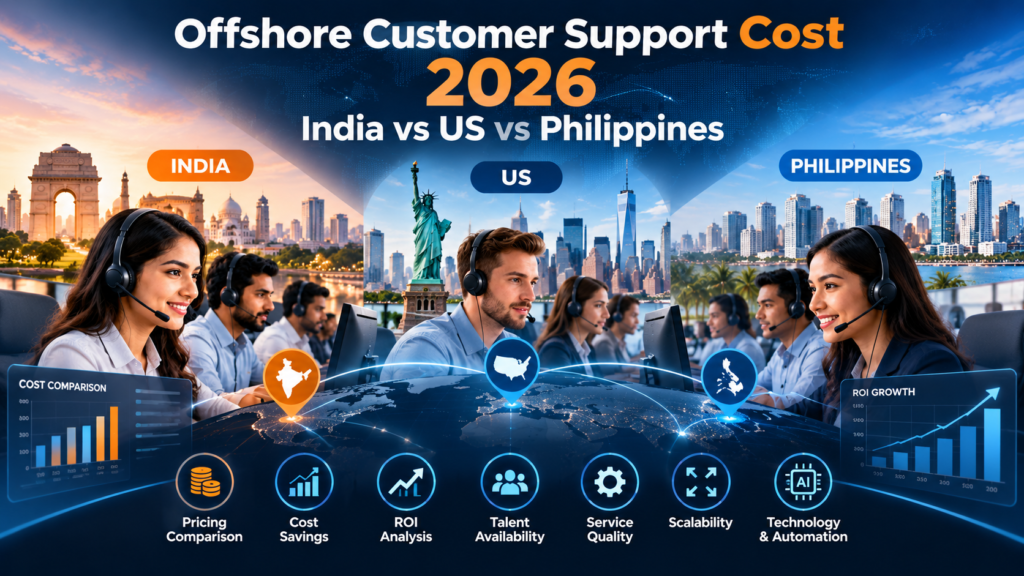
Short answer: In 2026, offshore customer support is generally far less expensive than US onshore delivery, but the lowest hourly rate is not automatically the lowest total cost. Current market benchmarks put India roughly around $7–$14/hour for voice customer support and the Philippines around $8–$16/hour, while US onshore support can be roughly $25–$45/hour, depending on channel, complexity, service levels and what is included in the rate. The right comparison is therefore cost per resolved contact, SLA performance, quality, staffing risk and ROI—not agent price alone.
Offshore Customer Support Cost in 2026: India vs US vs Philippines
Customer support outsourcing has moved beyond a simple labor-arbitrage decision. Buyers now compare offshore customer support cost, customer experience, AI automation, technical capability, coverage hours, compliance, scalability and measurable business outcomes.
For a US-based company evaluating delivery locations, the practical question is not simply “Is India cheaper than the US?” It is:
- How much will I pay per productive support hour?
- How much will I pay per resolved customer issue?
- How quickly can the team reach target productivity?
- What happens to CSAT, first-contact resolution and response time?
- How much management overhead remains with my internal team?
- Can the provider scale during peaks without rebuilding the operation?
- Can AI automation reduce repetitive contacts and agent workload?
This guide answers those questions using 2026 market benchmarks and a buyer-focused ROI framework.
2026 Customer Support Outsourcing Cost: Quick Comparison
| Delivery market | Indicative voice support | Typical positioning | Best fit |
|---|---|---|---|
| India | $7–$14/hour | Low-to-mid cost, large talent pool | High-volume CX, technical support, back office, AI-enabled operations |
| Philippines | $8–$16/hour | Strong voice-CX specialization | English voice support, customer care, sales and service |
| United States | $25–$45/hour | Premium onshore delivery | Domestic presence, complex or high-touch programs |
These are indicative market ranges, not MasCallNet quotations. Actual pricing changes with language, volume, hours, technology, complexity, security requirements, SLA, staffing model and contract structure.
Recent 2026 industry benchmarks show India and the Philippines materially below US onshore customer-support rates. One 2026 comparison places voice CX at approximately $8–$14/hour in India, $10–$16/hour in the Philippines and $26–$40/hour in the US, while another customer-service pricing guide places India around $7–$12/hour, the Philippines around $8–$14/hour and the US around $25–$45/hour. The ranges overlap because providers package technology, management, facilities and service levels differently.
What Does Offshore Customer Support Cost in 2026?
The phrase offshore customer support cost can describe several different pricing structures. A vendor may quote per agent-hour, dedicated FTE, monthly seat, ticket, resolution, minute or outcome.
1. Per-agent or per-hour pricing
This is common for dedicated customer support outsourcing. The client pays for an agreed staffing capacity, usually with technology, management and facilities included to some degree.
2. Dedicated FTE pricing
A dedicated FTE model is useful when you need predictable staffing, fixed schedules and clear ownership. The monthly price usually reflects salary, statutory costs, recruitment, training, supervision, technology, workspace and provider overhead.
3. Per-ticket or per-resolution pricing
Per-interaction models can work for predictable support workflows, but buyers must define what counts as a ticket, escalation, repeat contact and successful resolution. Otherwise, a low headline price can conceal operational inefficiency.
4. Outcome-based or hybrid pricing
More mature programs combine a base staffing component with measurable KPIs such as service level, quality, first-contact resolution, collections, sales conversion or customer satisfaction.
For a broader view of outsourcing economics, see BPO pricing per agent per month in India vs Philippines.
India vs Philippines vs US: Why the Price Gap Exists
The price difference is driven by more than wages. A managed contact-center rate can include recruitment, training, supervisors, quality assurance, workforce management, telecom, CRM/helpdesk integrations, office infrastructure, security controls, reporting, management overhead and profit margin.
That is why comparing an employee salary in India or the Philippines with a US BPO invoice is misleading. You are comparing different cost stacks.
India Customer Support Outsourcing Cost in 2026
India remains one of the most cost-competitive locations for customer support outsourcing while also offering substantial scale across customer service, technical support, back-office processing, analytics and IT-enabled operations.
Indicative 2026 market benchmarks put Indian voice CX around $7–$14 per hour, with lower ranges possible for standardized, high-volume programs and higher rates for complex, multilingual, technical or heavily managed operations.
Why India can deliver strong ROI
- Large customer-service and technology talent pool.
- Strong fit for technical and process-heavy support.
- Ability to combine customer support with back-office BPO.
- Multiple delivery locations and scalable staffing.
- Strong ecosystem for CRM, cloud, analytics and automation.
- Ability to blend human agents with AI voice, chat and quality-assurance tools.
For companies evaluating an India delivery model, our BPO services in India guide provides additional context.
Philippines Customer Support Outsourcing Cost in 2026
The Philippines remains a major global destination for customer service outsourcing, particularly for English-language voice operations.
Current 2026 benchmarks generally place Philippine voice support around $8–$16 per hour. The premium versus some Indian programs can be justified when voice quality, cultural alignment, customer conversation skills and first-contact outcomes produce better economics for the specific program.
Where the Philippines can be especially strong
- English-language voice customer service.
- Customer-facing support programs.
- Sales and service conversations.
- Programs where conversational quality is a primary KPI.
- US-market customer experience operations.
The correct question is therefore not “Which country is cheaper?” but “Which country delivers the lower cost per successful customer outcome?”
US Customer Support Cost in 2026: The Onshore Baseline
The US should be treated as the onshore benchmark in this comparison. A 2026 outsourced customer-service market guide puts US delivery broadly around $25–$45 per agent-hour, with specialized programs potentially higher.
US delivery can still make commercial sense when the premium creates measurable value through:
- Domestic customer perception.
- Specialized industry expertise.
- Complex escalation handling.
- High-value or high-risk customer interactions.
- Regulatory or contractual requirements.
- Very tight collaboration with domestic teams.
But for standardized, high-volume customer service, the US labor premium can be substantial. This is where offshore customer support becomes financially attractive.
How Much Can Offshore Customer Support Save?
Using a simple illustrative comparison, a company requiring 20 full-time equivalent support agents could see a very large difference between US onshore and offshore delivery.
| Model | Illustrative hourly rate | 20 FTE annualized labor-hours* | Illustrative annual service cost |
|---|---|---|---|
| US onshore | $30/hour | 41,600 | $1,248,000 |
| Philippines offshore | $12/hour | 41,600 | $499,200 |
| India offshore | $10/hour | 41,600 | $416,000 |
*Illustration only: 20 FTE × 2,080 hours. Actual billable hours, holidays, shrinkage, overtime, training, occupancy and contract terms vary.
On those illustrative rates, the offshore model would reduce direct service cost by approximately 60% versus the $30/hour US benchmark in the example. The actual percentage can be much lower or higher depending on the program.
Cost per Agent Is Not the Same as Cost per Resolution
This is the most important financial distinction in an outsourcing decision.
Suppose Vendor A charges $8/hour and Vendor B charges $10/hour. If Vendor A requires more repeat contacts, has lower first-contact resolution or creates more escalations, the cheaper hourly rate may produce a higher total cost.
A better calculation is:
Cost per resolved contact = Total support operating cost ÷ Successfully resolved contacts
For a mature outsourcing program, buyers should monitor:
- Cost per contact.
- Cost per resolved contact.
- First-contact resolution.
- Average handle time.
- Customer satisfaction.
- Service level.
- Quality score.
- Repeat contact rate.
- Escalation rate.
- Agent occupancy and shrinkage.
See our customer support SLA management guidance for a KPI-driven approach.
India vs Philippines: Cost Is Only One Part of ROI
| Factor | India | Philippines | US |
|---|---|---|---|
| Direct labor cost | Usually lowest | Low | Highest |
| Voice CX | Strong | Very strong | Very strong |
| Technical support | Strong | Strong | Strong |
| Back-office BPO | Very strong | Strong | High-cost |
| Scale | Very strong | Strong | Strong but expensive |
| AI/automation ecosystem | Strong | Strong | Very strong |
| Cost efficiency | Very strong | Strong | Lowest |
This table is a decision framework, not a universal country ranking. The right location depends on the service mix and business outcomes.
AI-Powered Customer Support Can Change the Economics
In 2026, offshore customer support should not be evaluated as a pure headcount decision. AI can reduce repetitive workload and allow human agents to focus on complex interactions.
A modern AI-powered customer support outsourcing operation can combine:
- AI voice bots for routine conversations.
- Agent assist and real-time knowledge retrieval.
- Automated quality monitoring.
- Speech analytics.
- Sentiment and intent detection.
- Intelligent routing.
- CRM auto-tagging.
- Automated call summaries.
- Self-service chat and messaging.
Our AI Call Center Solutions in India page explains how automation can be combined with human customer support operations.
24/7 Offshore Customer Support: Does It Really Cost Less?
24/7 support can be cheaper offshore, but the calculation must include shift premiums, staffing coverage, occupancy, holidays, workforce management and overnight demand.
A good operating model does not simply staff three shifts and hope volume appears. It forecasts demand by hour, channel and day, then combines workforce scheduling with automation and self-service.
For global businesses, this can create a cost-efficient model in which offshore teams handle overnight or peak periods while AI handles predictable requests.
Which Customer Support Services Are Best to Outsource Offshore?
Offshore customer support works particularly well when workflows are repeatable, measurable and supported by clear knowledge and escalation procedures.
| Service | Offshore suitability | Why |
|---|---|---|
| Inbound customer service | High | Structured workflows and measurable SLAs |
| Technical support | High | Strong process and specialist talent pools |
| Chat and email | Very high | Easy to standardize and automate |
| Back-office processing | Very high | Process-driven and scalable |
| Collections | High | Script, compliance and QA can be standardized |
| Outbound sales | High | Performance can be measured by conversion |
| Complex executive support | Case-by-case | Requires stronger domain and escalation controls |
For broader service coverage, see MasCallNet Contact Center Services and our Call Center Outsourcing Services guide.
How to Calculate Offshore Customer Support ROI
A practical ROI model should compare the fully loaded current-state cost against the fully loaded outsourced-state cost.
Annual savings = Current annual support cost − Outsourced annual support cost
ROI = (Annual savings − transition/investment cost) ÷ transition/investment cost × 100
But financial ROI alone is incomplete. Add operational benefits such as:
- Reduced time to hire.
- Reduced recruitment burden.
- Lower facility cost.
- Faster scaling.
- Longer coverage hours.
- Better analytics and QA.
- Lower management workload.
- Higher automation rates.
- Improved customer retention or revenue where measurable.
Example: 50-Agent Customer Support Program
Consider a hypothetical 50-agent program requiring 2,080 hours per FTE per year.
| Model | Example rate | Annual agent-hours | Illustrative annual cost |
|---|---|---|---|
| US onshore | $32/hour | 104,000 | $3,328,000 |
| Philippines offshore | $12/hour | 104,000 | $1,248,000 |
| India offshore | $10/hour | 104,000 | $1,040,000 |
The illustrative difference between US and India is $2.288 million annually before accounting for differences in productivity, management, technology, transition costs and service outcomes. That last sentence is critical: the table is a scenario, not a promised saving.
What Should Be Included in an Offshore BPO Quote?
Before comparing vendors, ask for a clear commercial breakdown covering:
- Agent/FTE rate.
- Supervision and workforce management.
- Quality assurance.
- Training and nesting.
- Recruitment and replacement.
- Telephony and telecom charges.
- CRM/helpdesk licenses.
- AI and automation charges.
- Reporting and analytics.
- Information-security controls.
- Holiday and overtime treatment.
- Minimum volume commitments.
- Ramp-up and ramp-down terms.
- Notice periods.
A quote that excludes several of these components may appear cheaper while producing a higher total cost.
How to Choose Between India, Philippines and US Support
Choose India when:
- Cost efficiency and scale are major priorities.
- You need technical or process-heavy support.
- You need customer support plus back-office operations.
- You want AI-enabled contact center automation.
- You need multilingual or multi-process delivery.
Choose the Philippines when:
- Voice customer experience is the dominant requirement.
- English conversational quality is a critical KPI.
- Your program is heavily customer-facing.
- You are willing to pay a modest premium for the right voice-CX profile.
Choose US onshore delivery when:
- Domestic presence is strategically important.
- The workflow requires specialized US-based expertise.
- Customer value justifies the labor premium.
- Regulatory, contractual or operational requirements favor domestic staffing.
Buyer Checklist: Compare Vendors on Total Cost, Not Headline Rate
- Request a fully loaded price.
- Define exactly what one productive FTE means.
- Separate training, nesting and production hours.
- Model shrinkage and absenteeism.
- Measure first-contact resolution.
- Measure quality and CSAT.
- Calculate cost per resolved contact.
- Check technology and integration charges.
- Review security and compliance controls.
- Run a controlled pilot before committing to scale.
Frequently Asked Questions
What is the average offshore customer support cost in 2026?
Indicative 2026 market benchmarks commonly place offshore voice customer support around $7–$16 per hour across major Asian delivery markets, with India generally toward the lower end and the Philippines slightly higher for many voice programs. Actual rates depend on scope, complexity and service model.
Is India cheaper than the Philippines for customer support?
India is often slightly cheaper on a fully loaded hourly basis, but the difference varies by process. For voice-heavy customer experience, the Philippines can justify a higher rate when quality and resolution performance produce better total economics.
How much does customer support cost in the US?
Current 2026 market guides commonly show roughly $25–$45 per hour for outsourced US onshore customer service, with specialized programs potentially higher.
How much can offshore customer support save?
Offshore delivery can reduce direct service cost substantially versus US onshore delivery, but savings vary. A defensible business case should calculate the difference using actual staffing, productivity, technology, management and transition costs.
Is offshore customer support safe for customer data?
It can be, provided the provider has appropriate security controls, access management, data handling procedures, monitoring, contractual protections and applicable compliance processes. Buyers should assess the provider rather than assume safety based on location alone.
Is India or the Philippines better for US customer support?
Neither is universally better. India often has an advantage for scale, technical support, back-office work and cost efficiency; the Philippines can be especially strong for English-language voice customer experience. The best choice depends on the service mix and KPIs.
Can AI reduce offshore customer support costs?
Yes. AI can automate repetitive interactions, assist agents, improve routing, summarize conversations and increase QA coverage. The financial benefit depends on automation rate, containment, resolution quality and how the operating model redeploys agent capacity.
Final Verdict: India vs US vs Philippines for Customer Support in 2026
For businesses primarily seeking lower customer support cost with scalable delivery, India is usually the strongest starting point. The Philippines remains a compelling choice for voice-centric customer experience, while US onshore support remains appropriate when domestic presence, specialized expertise or customer value justifies the premium.
The strongest 2026 operating model is not necessarily “India versus Philippines” or “offshore versus onshore.” It is increasingly AI + human agents + offshore delivery + measurable outcomes.
If your goal is to reduce customer support cost without sacrificing customer experience, evaluate vendors using cost per resolved contact, SLA, CSAT, FCR, quality, scalability and automation—then validate the economics with a controlled pilot.
Looking for a scalable customer support outsourcing partner? Explore MasCallNet Contact Center Services or Customer Support Outsourcing Services.
Sources and Further Reading
- Globalify — Customer Service Outsourcing Costs by Country (2026)
- Contact Center USA — How Much Does It Cost to Outsource Customer Service? (2026)
- PITON-Global — Philippine vs Indian Call Center & BPO Industry 2026
- MasCallNet — Offshore Customer Support Cost per Agent (2026)
Pricing figures in this guide are market indicators gathered from published 2026 sources and illustrative scenarios. They are not a quotation, guarantee or universal market price. Buyers should obtain current, scope-specific proposals.