
eCommerce Virtual Assistant vs BPO (2026): Cost, ROI, Scalability & Performance Compared
AI Overview
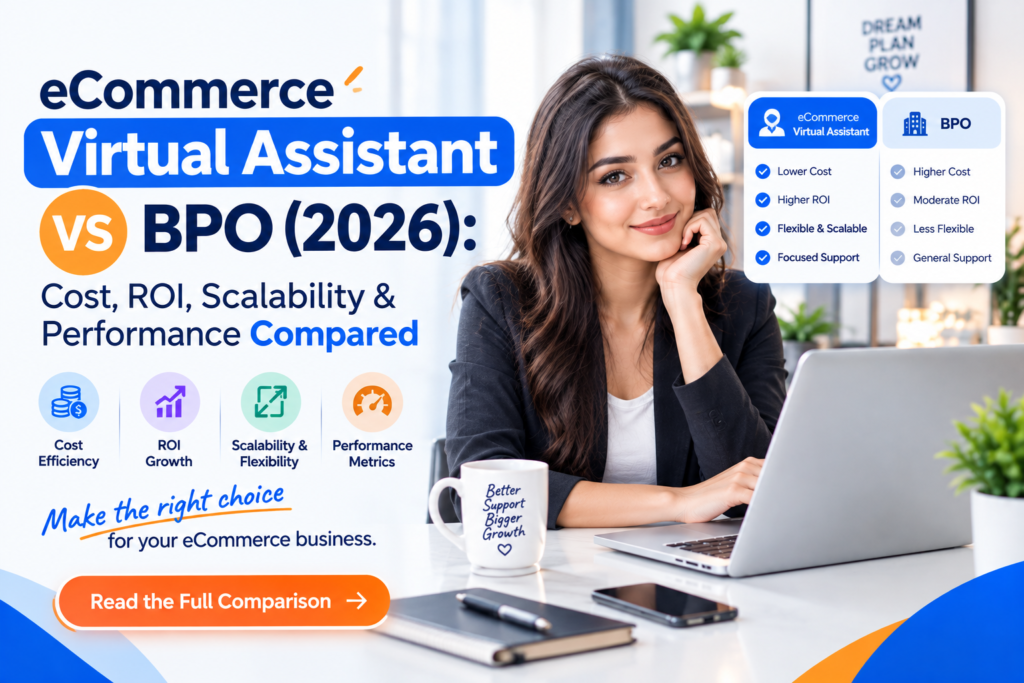
Choosing between an eCommerce virtual assistant and a BPO partner is one of the most consequential operational decisions a growing online retailer makes. Virtual assistants offer low entry cost and flexibility for early-stage stores handling under 300 tickets a month, but they lack scalability, quality assurance, technology stacks, and multi-shift coverage. BPO partners provide trained agent pools, omnichannel infrastructure (Zendesk, Freshdesk, Shopify, WooCommerce integrations), AI-assisted resolution, workforce management, and measurable SLAs — making them the stronger fit once order volume, ticket complexity, or seasonal demand grows. Cost per resolved ticket is often lower with BPO despite higher headline pricing, because BPO reduces churn, cart abandonment follow-up losses, and refund mishandling. This guide compares both models across cost, ROI, scalability, technology, compliance, and India-based outsourcing economics — with frameworks, benchmarks, and a decision tree to help eCommerce leaders choose correctly the first time.
Introduction
Every eCommerce founder eventually hits the same wall. Orders climb. Support tickets multiply. WhatsApp, email, Instagram DMs, marketplace chats, and phone calls start arriving faster than one person — or even three — can handle. At this point, most businesses make the decision by instinct rather than analysis: hire another virtual assistant, or sign with a BPO.
That decision quietly determines your cost structure, your customer retention curve, and your ability to scale for the next 24 months.
We’ve sat across the table with eCommerce operators — from single-founder D2C brands to multi-warehouse retailers processing 40,000 orders a month — and the pattern is consistent: businesses that treat customer support as a cost line to minimize eventually bleed revenue through refunds, churn, and negative reviews. Businesses that treat support as a revenue-retention function consistently outgrow their competitors. This is the foundation of what we call Support-Led Revenue Growth™ — the principle that every support interaction is either recovering revenue or quietly losing it.
This guide is not a sales pitch dressed up as an article. It’s the same framework we walk enterprise clients through before they sign anything — covering cost, ROI, scalability, technology, and the operational realities that generic comparison blogs skip entirely.
Key Insights for Decision-Makers
- Virtual assistants are cost-efficient only below ~300 monthly tickets; beyond that, hidden costs (rework, missed SLAs, refund errors) exceed BPO pricing.
- BPO cost per resolved ticket is typically 30–45% lower than the true cost of a growing VA team once management overhead, tools, and turnover are factored in.
- 24/7 and multilingual coverage is structurally impossible for a single VA — it requires a shift-based team, which is a BPO characteristic by definition.
- AI-assisted BPO models now resolve 35–55% of eCommerce tickets without human intervention, reshaping the cost curve entirely.
- Offshore BPO in India delivers 40–60% cost savings versus onshore teams, without a proportional drop in CSAT when the partner uses proper quality frameworks.
- The real differentiator in 2026 isn’t headcount — it’s Contact Center Intelligence™: how well a partner turns conversation data into retention, upsell, and forecasting signals.
Market Reality: eCommerce Support in 2026
Direct Answer: eCommerce support in 2026 is no longer judged on response time alone — it’s judged on resolution accuracy, channel consistency, and its measurable effect on repeat purchase rate.
Why It Matters: Customer acquisition costs across paid and organic channels have risen steadily for four consecutive years. Retaining an existing customer is significantly cheaper than acquiring a new one, which means support quality now sits directly on the P&L, not just the operations sheet.
Framework: We classify eCommerce support maturity into three market stages:
| Stage | Monthly Tickets | Typical Model | Primary Risk |
|---|---|---|---|
| Early | Under 300 | Founder or single VA | Inconsistent tone, no coverage after hours |
| Growth | 300–3,000 | VA team or small BPO | Quality variance, no forecasting |
| Scale | 3,000+ | Managed BPO with AI layer | Requires governance, not just headcount |
Executive Interpretation: Most brands stay in the “Growth” stage far longer than they should, absorbing avoidable losses because switching models feels disruptive. It isn’t — when the transition is engineered correctly.
Boardroom Insight™: The real cost of staying too long in a VA-only model isn’t the ticket backlog. It’s the customers who never complain — they simply don’t reorder.
Summary: eCommerce support has shifted from a reactive cost center to a measurable revenue function.
Key Takeaway: If support quality isn’t tied to a retention or revenue metric on your dashboard, you’re already behind.
Customer Experience Trends 2026
Direct Answer: The dominant customer experience trends 2026 are AI-assisted resolution, conversational commerce, proactive support (contacting customers before they complain), and unified omnichannel identity across marketplaces, D2C sites, and social commerce.
Five trends are reshaping how eCommerce brands structure support this year:
- AI agent-assist becomes standard, not premium. Human agents are increasingly paired with AI tools that draft responses, surface order history instantly, and flag sentiment risk in real time.
- Proactive support overtakes reactive support. Leading brands now message customers about delays before the customer opens a ticket — a direct application of what we call the Customer Intelligence Loop™, where every interaction feeds forward into the next one.
- Voice is returning for high-value transactions. While chat dominates volume, voice and video support are re-emerging for high-ticket eCommerce purchases (furniture, electronics, automotive accessories) where trust matters more than speed.
- Marketplace and social commerce support fragmentation is being centralized. Brands selling on Shopify, WooCommerce, Amazon, and Instagram simultaneously need a single support layer — not five disconnected inboxes.
- Support data is feeding business forecasting. Return rates, complaint categories, and sentiment trends are increasingly used by operations and merchandising teams, not just support managers — a shift toward Predictable Revenue Operations™.
Boardroom Insight™: Most companies still measure customer experience trends 2026 as a support KPI. The brands pulling ahead treat it as a demand-planning input.
Related reading: For a deeper breakdown of how AI is restructuring outsourced support delivery, see our guide on customer support outsourcing.
Definitions: Virtual Assistant vs BPO vs Contact Center Intelligence
Direct Answer: A virtual assistant is one remote individual performing defined tasks under your direct supervision. A BPO is a managed service provider delivering a trained team, technology, quality assurance, and SLAs under a service contract. Contact Center Intelligence™ is the layer above both — where conversations generate structured business data used for retention and revenue decisions.
| Model | What It Is | Who Manages Quality | Typical Scale |
|---|---|---|---|
| eCommerce Virtual Assistant | One person, task-based, hired directly or via freelance platform | You | 1 person, limited hours |
| Traditional BPO | Outsourced team handling tickets under contract | Vendor’s team lead | 5–500+ agents |
| Contact Center Intelligence™ (MasCallNet Model) | Managed team + AI layer + analytics feeding back into revenue decisions | Joint governance with data visibility | Scales with AI-assisted efficiency |
Executive Interpretation: Founders often compare “a VA” to “a BPO” as if they’re the same category at different price points. They are not the same category. One is a person. The other is a system.
Key Takeaway: You’re not choosing between cheap and expensive labor — you’re choosing between an individual and an operating system for customer support.
How Each Model Actually Works
Virtual Assistant Workflow: You hire directly (Upwork, referral, agency), train them yourself, provide login access to your helpdesk or inbox, and manage their output daily. There is no redundancy — if they’re sick, on leave, or resign, coverage stops.
BPO Workflow: You define SLAs and brand voice guidelines. The BPO recruits, trains, and manages a dedicated or shared team, integrates with your existing stack (Shopify, WooCommerce, Zendesk, Freshdesk, HubSpot), and reports performance against agreed metrics (CSAT, FCR, AHT, resolution time). Quality assurance, workforce scheduling, and escalation management are handled by the vendor — not you.
What Most Articles Miss: The comparison usually stops at “cost per hour.” It should start with “who owns quality control when something goes wrong?” With a VA, that’s you. With a properly managed BPO, that’s a contractual obligation with measurable consequences.
What Actually Happens: Businesses hire a second and third VA as volume grows, assuming linear scaling. What actually happens is quality fragmentation — three VAs answering the same question three different ways, with no shared knowledge base, no QA layer, and no consistency in tone or policy application.
Hidden Cost: Re-training replacement VAs after turnover (average VA tenure in informal arrangements is short) resets your quality baseline every few months — a cost that never appears on an invoice but shows up in inconsistent CSAT scores.
MasCallNet Perspective: The moment you’re managing more than one VA, you’re already doing the job of a BPO operations manager — without the tools, the redundancy, or the accountability structure a proper BPO provides.
Executive Action: If you’re spending more than 3–4 hours a week managing your support team’s quality, you’re already paying the “management cost” of a BPO without receiving the benefits of one.
Business Impact Analysis
Direct Answer: Support model choice directly impacts three financial outcomes: repeat purchase rate, refund/chargeback rate, and customer acquisition cost efficiency (since poor support undermines the value of the marketing spend that brought the customer in the first place).
Why It Matters: A delayed or inconsistent response to a shipping complaint doesn’t just cost you that sale — it costs you the reviews, referrals, and repeat orders that sale would have generated.
Framework — The Support-to-Revenue Framework™:
- Response Layer — speed and channel coverage
- Resolution Layer — accuracy and policy consistency
- Retention Layer — post-resolution follow-up and sentiment recovery
- Revenue Layer — upsell/cross-sell opportunities surfaced during support interactions
Most VA-only setups operate only at the Response Layer. Mature BPO partnerships operate across all four.
Table: Business Impact by Support Model
| Metric | VA-Only Model | Managed BPO Model |
|---|---|---|
| Average response time (peak season) | Delayed, inconsistent | SLA-bound, consistent |
| After-hours coverage | None or minimal | 24/7 shift-based |
| Refund/return handling consistency | Varies by individual | Standardized policy application |
| Upsell during support interaction | Rarely captured | Actively tracked and coached |
| Data visibility for leadership | Minimal, manual reporting | Dashboarded, real-time |
Executive Interpretation: The revenue impact of support isn’t visible in a support dashboard — it shows up in your repeat purchase rate three months later.
Boardroom Insight™: If your CFO has never asked your support team a question, your support team probably isn’t being measured on revenue impact — only on ticket closure.
Summary: Support model choice is a revenue decision disguised as an operational one.
Key Takeaway: Support-Led Revenue Growth™ only happens when support is measured past the point of “ticket closed.”
What Everyone Gets Wrong About This Decision
What Everyone Says: “BPOs are for big companies; VAs are for small ones.”
What Most Articles Miss: Company size is the wrong variable. Ticket volume, channel complexity, and order value are the right ones. A 15-person team selling a $300 average order value product across four channels needs BPO-grade support infrastructure regardless of headcount.
What Actually Happens: Small, fast-growing D2C brands frequently outgrow their VA setup within 6–9 months of scaling ad spend, because ticket volume grows faster than founders expect — and quality collapses before anyone notices the cost.
Hidden Cost: Brands often calculate “we save $2,000/month with a VA” without calculating the refund and chargeback cost of mishandled disputes, which frequently exceeds that saving in a single bad month (e.g., a holiday season fulfillment delay handled inconsistently).
MasCallNet Perspective: We’ve onboarded multiple eCommerce clients who came to us not because their VA was “bad,” but because their VA was good — and had simply outgrown what one person could structurally deliver.
Executive Action: Stop asking “is our VA good enough?” Start asking “does our current model have a ceiling, and have we already hit it?”
MasCallNet Revenue Leakage Analysis™
Definition: The MasCallNet Revenue Leakage Model™ quantifies revenue lost through support failures that never appear as a direct cost — delayed responses, inconsistent refund handling, and missed upsell moments.
Methodology: We calculate leakage using three inputs — unresolved-on-first-contact rate, average resolution delay beyond SLA, and post-support repeat purchase drop-off.
Formula:
Revenue Leakage % = (Tickets Unresolved on First Contact ÷ Total Tickets) × Average Order Value × Repeat Purchase Drop-off Rate
Scoring Logic:
| Leakage Score | Interpretation |
|---|---|
| Under 5% | Healthy — support is protecting revenue |
| 5–12% | Moderate leakage — process gaps exist |
| 12%+ | Critical — support is actively eroding LTV |
Interpretation: Most VA-only eCommerce operations we’ve assessed score between 9% and 18% on this model, largely due to inconsistent first-contact resolution during peak periods.
Executive Recommendation: Run this calculation quarterly. If leakage exceeds 10%, the cost of switching to a managed model is almost always lower than the cost of continuing leakage.
MasCallNet Outsourcing Readiness Assessment™
Definition: The MasCallNet Outsourcing Readiness Score™ evaluates whether a business is structurally prepared to transition from informal support (founder-led or VA-led) to a managed BPO model.
Methodology: Scored across five dimensions — ticket volume trend, channel complexity, documented policies, seasonal variability, and current support cost predictability.
Scoring Logic (0–10 per dimension, 50 total):
| Score Range | Readiness Level | Recommendation |
|---|---|---|
| 0–20 | Not ready | Strengthen internal documentation first |
| 21–35 | Transition-ready | Begin structured evaluation of BPO partners |
| 36–50 | Urgent | Delay is actively costing revenue |
Common Executive Mistakes: Leaders often wait for a “perfect time” to outsource — after the next product launch, after the next funding round. In our experience, the businesses that wait longest are the ones already scoring 36+ and losing revenue every month they delay.
Practical Recommendation: If your business scores “Transition-Ready” or higher, begin vendor evaluation immediately — even if implementation is planned for a later quarter. Evaluation and negotiation take time; delaying the start delays the savings.
Vendor Evaluation Framework™ (Including Best BPO Companies in India)
Direct Answer: When evaluating the best BPO companies in India for eCommerce support, prioritize four factors above price: eCommerce platform expertise (Shopify/WooCommerce), AI-assisted resolution capability, transparent QA reporting, and proven scalability during peak seasons (sale events, festive demand).
Framework — MasCallNet Vendor Evaluation Matrix™:
| Evaluation Criteria | Weight | What to Verify |
|---|---|---|
| Platform & tech integration | 20% | Native Shopify/WooCommerce/Zendesk experience |
| AI + automation maturity | 20% | Chatbot, agent-assist, and self-service capability |
| Quality assurance transparency | 20% | Real-time dashboards, not monthly PDF reports |
| Scalability proof | 15% | Track record handling 3–5x seasonal spikes |
| Pricing structure clarity | 15% | Per-ticket, per-agent, or hybrid — no hidden fees |
| Compliance & data security | 10% | ISO 27001, GDPR readiness, PCI-DSS awareness |
What Most Articles Miss: “Best BPO companies in India” listicles typically rank by size or brand recognition, not by fit. A large enterprise BPO built for banking clients is often a poor operational fit for a mid-market eCommerce brand needing agile, marketplace-savvy agents.
Executive Interpretation: The right question isn’t “who’s the biggest BPO in India?” It’s “who has actually managed eCommerce ticket volume through a Black Friday or Diwali sale without SLA breach?”
MasCallNet Perspective: Our model is built specifically around eCommerce and digital-first businesses — meaning our teams are trained on marketplace policies, return/refund nuances, and platform-specific workflows from day one, not retrofitted from a generic contact center script. Learn more about our approach as an AI-powered BPO company India businesses trust for scalable support.
AI vs Human vs Hybrid Model™
Direct Answer: For eCommerce in 2026, a hybrid model — AI handling repetitive, high-volume queries (order status, tracking, returns policy) with human agents managing complex, emotional, or high-value interactions — consistently outperforms pure-AI or pure-human models on both cost and CSAT.
MasCallNet AI Efficiency Index™ — Methodology: Measures the percentage of tickets resolved without human intervention, weighted against customer satisfaction on those same tickets.
| Model | Ticket Deflection | Avg. CSAT | Best Fit |
|---|---|---|---|
| Human-only | 0% deflection | High, but slow at scale | Under 300 tickets/month |
| AI-only (chatbot) | 40–60% deflection | Lower on complex issues | High-volume, low-complexity queries only |
| Hybrid (MasCallNet Model) | 35–55% deflection | High across ticket types | Growth to enterprise-scale eCommerce |
Executive Interpretation: Pure-AI models save cost but damage CSAT on emotionally sensitive issues (damaged goods, delayed medical or gifting orders). Pure-human models protect CSAT but cap scalability. Hybrid protects both.
Boardroom Insight™: The question isn’t “AI or human?” — that framing is already outdated. The real question is: which 40% of your ticket volume should never reach a human agent in the first place?
Key Takeaway: Hybrid isn’t a compromise — it’s currently the highest-performing model on both cost and quality simultaneously.
CX Maturity Scorecard™
Definition: The MasCallNet Service Quality Index™ benchmarks a brand’s support operation against five maturity levels.
| Level | Characteristics |
|---|---|
| 1 – Reactive | Founder/VA answers tickets as they arrive, no metrics tracked |
| 2 – Structured | Basic helpdesk tool in use, response time tracked |
| 3 – Managed | SLAs defined, QA scoring in place, multi-channel coverage |
| 4 – Intelligent | AI-assisted resolution, sentiment tracking, proactive outreach |
| 5 – Revenue-Integrated | Support data feeds forecasting, retention, and merchandising decisions |
Common Executive Mistakes: Most eCommerce brands overestimate their maturity level by one or two stages because they measure activity (tickets closed) rather than outcomes (retention impact).
What High-Performing Organizations Do Differently: They treat Level 4–5 maturity as a growth lever, not a cost center upgrade — actively using support insights in product and marketing planning meetings.
Practical Recommendation: Assess your current level honestly before choosing a vendor. A Level 2 business jumping straight to a Level 5 partner needs a structured 90-day onboarding, not an overnight switch.
Scalability Framework™
Direct Answer: Scalability should be measured by how fast a support model can absorb a 3–5x volume spike (typical during sale events) without SLA breach or quality collapse — not by how many people can theoretically be added.
MasCallNet Revenue Acceleration Framework™ evaluates scalability across three dimensions: speed to add capacity, quality retention under load, and cost linearity (does cost per ticket rise or fall as volume increases?).
| Dimension | VA Model | BPO Model |
|---|---|---|
| Speed to add capacity | Weeks (hiring, training) | Days (existing bench strength) |
| Quality retention under load | Degrades sharply | Maintained via QA and shift management |
| Cost linearity | Cost per ticket rises with overtime/burnout | Cost per ticket typically falls with volume |
Hidden Cost: VA-based teams often absorb seasonal spikes through unpaid overtime or founder intervention — both of which are real costs that rarely appear in a spreadsheet.
Executive Action: Before your next major sale event, stress-test your current model against a 4x volume scenario. If the honest answer involves “we’ll manage somehow,” that’s your scalability ceiling revealing itself. Related resource: outsource call center services built specifically for high-volume scaling.
Industry Benchmarks & Statistics
Direct Answer: Well-managed eCommerce support operations in 2026 typically target a first-response time under 2 minutes on chat, first-contact resolution above 75%, CSAT above 90%, and average handle time under 6 minutes for standard queries.
| Metric | Industry Benchmark | Below-Average Performance |
|---|---|---|
| First Response Time (chat) | Under 2 minutes | Over 10 minutes |
| First Contact Resolution (FCR) | 75%+ | Below 55% |
| CSAT | 90%+ | Below 75% |
| Average Handle Time (AHT) | Under 6 minutes | Over 12 minutes |
| Ticket deflection via self-service/AI | 35–55% | Under 15% |
According to industry research from organizations including Gartner and Deloitte, customer experience continues to rank among the top three factors influencing repeat purchase behavior in digital retail — reinforcing why Revenue Recovery Through CX™ has become a board-level conversation rather than a support-desk metric.
Case Study: From Virtual Assistant Chaos to Managed BPO Growth
Challenge: A mid-sized D2C home goods brand selling on Shopify and two marketplaces was running support through two freelance virtual assistants. During a festive sale event, ticket volume jumped 4.5x, response times exceeded 24 hours, and refund requests were being approved inconsistently.
Root Cause: No shared knowledge base, no shift coverage beyond standard business hours, and no quality oversight — meaning both VAs applied refund policy differently, creating customer distrust and social media complaints.
Solution: The brand transitioned to a managed support model with structured SLAs, a shared knowledge base, AI-assisted first response for order status and tracking queries, and human escalation for refund and complaint handling — anchored in the MasCallNet CX Recovery Engine™ to stabilize sentiment during the transition period.
Implementation: A 3-week onboarding covered platform integration (Shopify + Zendesk), policy documentation, and a soft-launch period running the new team alongside the existing VAs before full cutover.
Results (90 days post-implementation):
- First response time reduced from 24+ hours to under 4 minutes on chat
- First contact resolution improved from 52% to 81%
- Refund-related complaints dropped by 63%
- Repeat purchase rate among customers who contacted support increased by 22%
Lessons Learned: The brand’s biggest realization wasn’t cost savings — it was that consistent policy application alone recovered more revenue than any marketing campaign run that quarter. This is Support-Led Revenue Growth™ demonstrated in a single case: the support function became a measurable contributor to repeat revenue, not just a resolver of complaints.
Pricing Analysis & Cost Calculator
Direct Answer: Virtual assistant pricing typically ranges $4–$10/hour depending on experience and geography, while managed BPO pricing for eCommerce support ranges from $600–$2,500+ per agent per month (offshore) depending on channel mix, AI integration, and coverage hours — with per-ticket and hybrid pricing models increasingly common in 2026.
Cost Calculator Framework:
True Monthly Cost = (Hourly Rate × Hours) + Management Overhead + Tool/Software Cost + Turnover/Retraining Cost (amortized)
| Cost Component | VA Model (Est.) | BPO Model (Est.) |
|---|---|---|
| Base labor cost (monthly) | $700–$1,600 (1–2 VAs) | $600–$2,500 per agent (India-based) |
| Management overhead (your time) | High (unmeasured but real) | Low (vendor-managed) |
| Helpdesk/CRM tools | Often billed separately | Frequently included or subsidized |
| Turnover/retraining cost | Recurs every few months | Absorbed by vendor’s bench strength |
| 24/7 coverage cost | Requires 3x headcount | Included in shift-based pricing |
Executive Interpretation: Headline hourly rates make VAs appear cheaper, but once management time, tool costs, and turnover are amortized, the true cost gap narrows significantly — often disappearing entirely once ticket volume exceeds 500/month.
MasCallNet Perspective: We encourage every prospective client to run this calculation with their own numbers before any conversation with us. Transparency at this stage builds the trust that makes the eventual partnership work. Explore transparent customer support outsourcing pricing models designed around eCommerce ticket volume, not generic seat pricing.
ROI Framework
Direct Answer: ROI on a BPO investment should be measured through the MasCallNet Support-to-Revenue Framework™, combining cost savings, retention lift, and refund/chargeback reduction — not cost-per-ticket alone.
ROI Formula:
Support ROI = (Retention Revenue Gained + Cost Savings + Refund Loss Avoided) ÷ Total Support Investment
| Input | How to Measure |
|---|---|
| Retention revenue gained | (Repeat purchase rate increase) × (Average customer LTV) |
| Cost savings | Difference between current model cost and BPO cost, fully loaded |
| Refund loss avoided | Reduction in refund/chargeback rate × average order value |
Executive Interpretation: Brands that calculate ROI using only “cost per hour saved” consistently undervalue outsourcing by 2–3x, because they ignore the retention and refund-avoidance components entirely.
Boardroom Insight™: If your ROI model for support outsourcing doesn’t include a retention variable, you’re measuring savings, not return.
Industry Use Cases
- Fashion & Apparel: High return-rate management, size/fit query handling, and proactive shipping updates during peak seasons.
- Electronics & Gadgets: Technical query triage, warranty and replacement coordination, multilingual support for cross-border sales.
- Health & Wellness eCommerce: Sensitive, empathetic handling of subscription cancellations and delivery delays.
- FMCG & Grocery Delivery: High-volume, low-complexity ticket handling ideal for AI-first deflection with human escalation.
- D2C Home & Furniture: High-order-value support requiring careful complaint handling and damage/replacement coordination.
Brands operating across banking-adjacent financial products, insurance add-ons at checkout, or EV and automotive accessory eCommerce lines increasingly require the same layered support model — proving that Contact Center Intelligence™ is not industry-specific, but volume- and complexity-specific.
Technology Ecosystem
A modern eCommerce support operation typically integrates:
- Helpdesk & CRM: Zendesk, Freshdesk, HubSpot, Intercom
- Commerce Platforms: Shopify, WooCommerce
- Payments: Stripe, PayPal
- Contact Center Infrastructure: Genesys, Five9, Talkdesk, NICE CXone
- Collaboration & Escalation: Slack, Microsoft Teams, ServiceNow
- Cloud Infrastructure: AWS, Google Cloud, Microsoft Azure
- AI Layer: OpenAI, Google Gemini, Claude, Copilot — powering agent-assist drafting, sentiment detection, and self-service deflection
Executive Interpretation: The technology stack matters less than the integration discipline behind it. A BPO with access to every tool on this list but poor workflow design will underperform a leaner setup with tight process governance.
Learn how this technology layer supports broader operational efficiency through automating business processes across support, fulfillment, and returns workflows.
Security & Compliance
eCommerce support handles sensitive data — payment details, addresses, order history — making compliance non-negotiable. At minimum, evaluate any partner (VA or BPO) against:
- Data handling protocols and access controls
- PCI-DSS awareness for payment-related queries
- GDPR readiness for EU customers
- ISO 27001 certification (standard for enterprise-grade BPOs, rarely applicable to independent VAs)
Hidden Cost: Independent VAs, especially those working across multiple client accounts on personal devices, represent a data security blind spot most founders never formally assess until an incident occurs.
The India Advantage
Direct Answer: India remains a leading destination for eCommerce BPO outsourcing due to a combination of English proficiency, cost efficiency (40–60% savings versus onshore teams), mature technology talent, and time-zone advantages for serving US, UK, and Middle East markets.
| Advantage | Detail |
|---|---|
| Cost efficiency | 40–60% lower fully-loaded cost vs. US/UK onshore teams |
| Talent depth | Large pool of English-proficient, tech-literate support professionals |
| Time zone coverage | Enables genuine 24/7 coverage for Western markets |
| Technology maturity | Strong ecosystem of AI, cloud, and CRM-skilled talent |
When evaluating the best BPO companies in India for eCommerce, prioritize partners with dedicated eCommerce vertical experience over generalist call centers. Explore our Call Center in Noida operations built specifically for global eCommerce and digital-first brands, or review our BPO case studies India for measurable outcomes across industries.
Comparison Tables
In-House vs Outsourced
| Factor | In-House Team | Outsourced (BPO) |
|---|---|---|
| Setup speed | Slow (hiring, training) | Fast (existing infrastructure) |
| Cost predictability | Variable | Contractual, predictable |
| Scalability | Limited by hiring capacity | High, shift-based |
| Recommendation | Best for highly regulated, low-volume, brand-sensitive core functions | Best for eCommerce support at volume |
AI vs Human vs Hybrid
| Factor | AI-Only | Human-Only | Hybrid |
|---|---|---|---|
| Cost efficiency | Highest | Lowest | High |
| Complex query handling | Weak | Strong | Strong |
| Recommendation | Never as sole model past 500 tickets/month | Only for very low volume | Best fit for 2026 |
Offshore vs Onshore Customer Support Outsourcing
| Factor | Offshore (e.g., India) | Onshore |
|---|---|---|
| Cost | 40–60% lower | Higher |
| Coverage hours | Naturally enables 24/7 | Requires overtime premiums |
| Recommendation | Ideal for cost-sensitive scaling with proper QA | Consider for highly localized, culturally nuanced markets only |
Build vs Buy
| Factor | Build In-House | Buy (BPO Partnership) |
|---|---|---|
| Time to value | 3–6 months | 2–4 weeks |
| Capital requirement | High (hiring, tools, management layer) | Low (operational expense) |
| Recommendation | Buy first; build proprietary capability only once volume justifies it |
Dedicated Team vs Shared Team
| Factor | Dedicated Team | Shared Team |
|---|---|---|
| Cost | Higher | Lower |
| Brand-specific training depth | Deep | Moderate |
| Recommendation | Dedicated for 1,000+ tickets/month; shared for growth-stage brands |
Traditional BPO vs Contact Center Intelligence™
| Factor | Traditional BPO | Contact Center Intelligence™ |
|---|---|---|
| Focus | Ticket closure | Revenue and retention signal generation |
| Reporting | Volume metrics | Business intelligence dashboards |
| Recommendation | Choose Contact Center Intelligence™ if support data should inform business decisions, not just operational ones |
Risk Analysis
| Risk | VA Model | BPO Model |
|---|---|---|
| Single point of failure | High (one person) | Low (team redundancy) |
| Data security exposure | Often unmanaged | Contractually governed |
| Brand voice inconsistency | High at scale | Managed via QA and training |
| Vendor lock-in | None, but no continuity either | Mitigate via clear contract exit terms |
Executive Action: Any BPO contract should include clearly defined exit clauses, data portability terms, and knowledge transfer obligations — protecting against the one legitimate risk of outsourcing: dependency without flexibility.
Future Trends (2026–2028)
- Predictive support will overtake reactive ticketing — flagging at-risk orders before customers reach out, reinforcing Predictable Revenue Operations™.
- Conversation intelligence will become a standard deliverable, not an add-on, as BPOs increasingly package sentiment and trend analysis alongside ticket resolution.
- Voice AI will handle a growing share of order-status and tracking calls, freeing human agents for complex, high-value interactions.
- Support-influenced merchandising will grow — return reason data directly informing product and sizing decisions.
- Support-Led Revenue Growth™ will formalize as a board-reported metric in eCommerce, moving support out of the operations appendix and into the growth narrative.
Executive Decision Tree
- Are you handling under 300 tickets/month with single-channel volume? → A virtual assistant may suffice, with a documented growth trigger point.
- Are you handling 300–3,000 tickets/month across 2+ channels? → Begin structured evaluation of a managed BPO partner.
- Do you experience seasonal spikes of 3x or more? → BPO is required; VA models cannot structurally absorb this.
- Is support data currently disconnected from business forecasting? → Prioritize a Contact Center Intelligence™-capable partner over a traditional BPO.
- Is your current model costing more in refunds/churn than in labor? → Immediate transition warranted, regardless of ticket volume.
Executive Checklist
- Calculate current true cost per ticket, including management overhead
- Run the Revenue Leakage Model™ against last quarter’s data
- Score your business on the Outsourcing Readiness Assessment™
- Shortlist 3 BPO partners using the Vendor Evaluation Matrix™
- Confirm platform integration capability (Shopify/WooCommerce/Zendesk)
- Verify AI-assist and self-service deflection capability
- Request real-time QA dashboard access, not monthly PDF reports
- Define SLA and exit clause terms before signing
- Plan a 3-week phased onboarding, not an overnight cutover
- Set a 90-day review checkpoint against CSAT, FCR, and retention metrics
Frequently Asked Questions
1. What’s the main difference between an eCommerce virtual assistant and a BPO?
A virtual assistant is one individual handling tasks you assign directly. A BPO is a managed team with technology, quality assurance, and contractual SLAs — built for scale rather than individual task execution.
2. At what order volume should I move from a VA to a BPO?
Most eCommerce brands hit the ceiling of a VA model between 300–500 monthly tickets, or sooner if they sell across multiple channels or experience seasonal spikes.
3. Is BPO more expensive than hiring virtual assistants?
Headline hourly rates are often higher, but true cost — including management time, tool costs, and turnover — is frequently lower with BPO once volume exceeds a few hundred tickets monthly.
4. Can a BPO integrate with Shopify and WooCommerce?
Yes. Established eCommerce-focused BPOs integrate directly with Shopify, WooCommerce, and helpdesk tools like Zendesk and Freshdesk, giving agents real-time order and customer data.
5. Do BPOs use AI, or is it all human agents?
Modern BPOs use a hybrid model — AI handles repetitive queries (order status, tracking) while human agents manage complex or emotionally sensitive interactions.
6. What is offshore vs onshore customer support outsourcing, and which is better?
Offshore outsourcing (e.g., India-based) typically delivers 40–60% cost savings with comparable quality when proper QA frameworks are in place; onshore may suit highly localized markets requiring deep cultural nuance.
7. How is outsourced customer support pricing structured?
Pricing models include per-agent monthly rates, per-ticket pricing, and hybrid models combining a base fee with volume-based components — increasingly common in 2026 for cost predictability.
8. What are the best BPO companies in India for eCommerce brands?
The best fit isn’t always the largest brand name — prioritize providers with proven eCommerce platform expertise, AI-assisted resolution capability, and transparent QA reporting over generalist call centers.
9. How quickly can a BPO partnership be implemented?
A well-structured onboarding typically takes 2–4 weeks, including platform integration, policy documentation, and a soft-launch period alongside existing support operations.
10. Will switching to a BPO hurt my brand voice consistency?
No — when properly onboarded with documented brand guidelines and QA scoring, BPO teams typically improve consistency compared to multiple informally managed VAs.
11. What security certifications should I look for in a BPO partner?
Look for ISO 27001 certification, PCI-DSS awareness for payment data, and GDPR readiness if serving EU customers.
12. Can a BPO handle multilingual eCommerce support?
Yes, most established BPOs, particularly those based in India, support multiple languages, making them well-suited for cross-border eCommerce brands.
13. What happens to my support data if I switch BPO providers?
This should be defined contractually before signing — data portability and knowledge transfer clauses are standard in properly structured BPO agreements.
14. How do I measure ROI from outsourcing customer support?
Use a framework combining cost savings, retention revenue gained, and refund/chargeback loss avoided — not cost-per-ticket alone.
15. Is a hybrid AI-human model better than pure automation for eCommerce?
Yes. Pure automation reduces cost but often damages CSAT on complex or emotionally sensitive issues; hybrid models protect both cost efficiency and customer satisfaction.
16. Can I start with a smaller, dedicated BPO team before scaling further?
Yes — most BPO partnerships, including ours, are structured to scale from a small dedicated pod to a larger team as ticket volume and channel complexity grow.
Conclusion
The choice between an eCommerce virtual assistant and a BPO isn’t about which is cheaper on paper — it’s about which model your current and near-future order volume actually requires. Virtual assistants work well early, within a narrow ticket volume and single-channel context. Beyond that point, the hidden costs — quality inconsistency, refund mishandling, missed retention opportunities — quietly outweigh the apparent savings.
This is the core of Support-Led Revenue Growth™: customer support isn’t a cost to minimize, it’s a lever that directly protects and grows revenue when structured correctly. The businesses winning in 2026 aren’t the ones with the cheapest support line item — they’re the ones treating every customer conversation as an opportunity to retain revenue, surface intelligence, and build the kind of trust that drives repeat purchases.
If you’ve read this far, you already suspect where your current model sits on that curve. The next step isn’t guesswork — it’s a structured assessment.
Ready to find out where your support operation actually stands? Talk to our team about a complimentary Outsourcing Readiness Assessment, and see exactly where cost, scalability, and revenue opportunity intersect for your business.
For businesses ready to move beyond ticket-closing toward measurable revenue protection, explore our Customer Support Outsourcing Services built specifically for scaling eCommerce brands.