
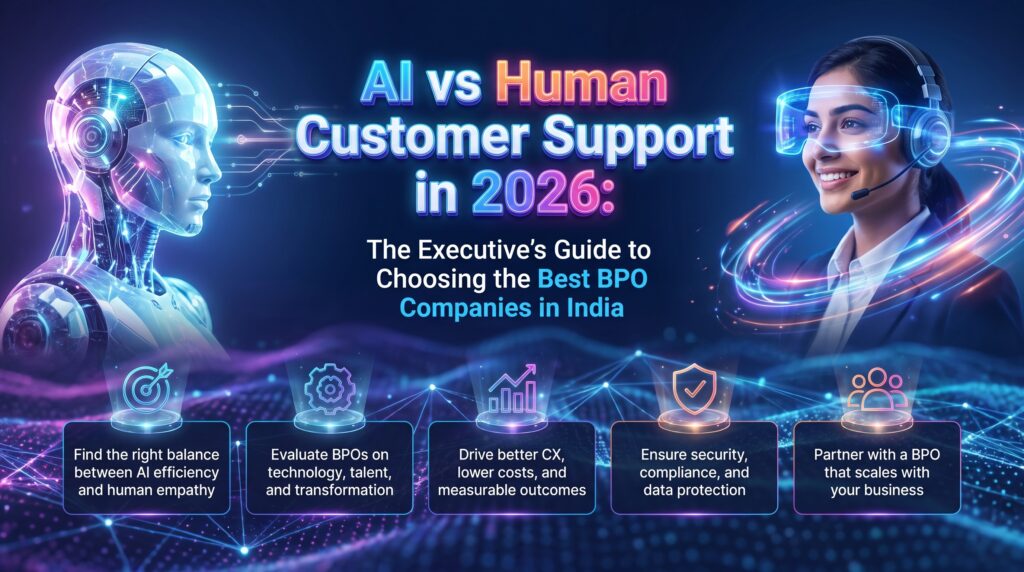
AI vs Human Customer Support in 2026: The Executive’s Guide to Choosing the Best BPO Companies in India
AI Overview
This guide examines the AI vs human customer support debate through an operational and financial lens, not a theoretical one. It defines how hybrid contact center models actually perform against pure-AI and pure-human models across cost, CSAT, resolution time, and revenue retention. It provides a vendor evaluation framework for selecting a BPO partner in India, benchmark data across industries (banking, insurance, retail, healthcare, telecom, logistics), a cost calculator, an ROI model, and a decision tree for CEOs, COOs, and CX leaders evaluating whether to build in-house, outsource, or hybridize their customer support operations in 2026.
Executive Introduction
Every board conversation about customer support eventually turns into a conversation about revenue. That shift has happened quietly over the last three years, and most organizations have not caught up to it.
For a decade, customer support was budgeted as a cost center — a line item to be minimized. That assumption is now actively damaging companies. Support interactions are one of the few places in a business where a customer tells you, in real time, whether they intend to renew, churn, upgrade, or complain publicly. Every unresolved ticket, every long hold time, every poorly handled billing dispute is a small, measurable act of revenue leakage.
This is the foundation of Support-Led Revenue Growth™ — the operating principle that customer support, when designed correctly, is not a cost function but a revenue function. It doesn’t just protect existing revenue through retention; it actively creates new revenue through upsell signals, churn prediction, and customer intelligence that sales and product teams never see unless someone captures it.
This guide was built to answer two questions that keep showing up in the same breath in CEO and COO search behavior: “Should we use AI or human agents for customer support?” and “Which BPO company in India should we trust with this function?” These questions are connected. The answer to the first question determines the answer to the second, because most BPO companies in India have not actually rebuilt their delivery model around AI — they’ve simply added a chatbot widget to a legacy call center operation and called it “AI-powered.”
We wrote this as the resource we wished existed when we were building MasCallNet’s own delivery architecture — grounded in operational reality, not vendor marketing.
Key Insights
- AI resolves volume; humans resolve value. The highest-performing contact centers in 2026 route by conversation risk, not by channel.
- Offshore no longer means “cheaper and worse.” India-based hybrid AI-human centers now match onshore CSAT benchmarks at 40–60% lower cost.
- The real cost of bad support isn’t the complaint — it’s the silent churner who never files a ticket and simply doesn’t renew.
- Most “AI-powered BPO” claims are marketing, not architecture. Fewer than a third of vendors have AI genuinely embedded in agent workflows rather than bolted onto a website widget.
- Support-Led Revenue Growth™ requires treating every conversation as a data asset, not a closed ticket.
- Healthcare, banking, and insurance show the steepest revenue impact from poor support because their transactions are trust-dependent, not habit-dependent.
Market Reality
The BPO and contact center outsourcing industry has bifurcated into two categories that look identical on a sales call but are operationally unrecognizable from each other.
Category one is the legacy BPO — large headcount, seat-based pricing, AI positioned as an add-on, and reporting built around AHT (average handle time) and occupancy rather than outcomes. These vendors are under margin pressure because AI has commoditized the exact work they built their business on: routine, repetitive, low-context queries.
Category two is the AI-native contact center — smaller, faster to deploy, priced on outcomes or hybrid models, and structured so that human agents are deployed only where judgment, empathy, or revenue sensitivity matters. This is where the market is moving, and it’s where Contact Center Intelligence™ — the idea that every customer conversation is an enterprise intelligence asset, not just a resolved ticket — becomes a competitive differentiator rather than a buzzword.
India remains the largest global hub for both categories, which is precisely why “best BPO companies in India” is such a high-stakes, high-confusion search query. Buyers are not comparing vendors on a level field. They’re comparing a 2015 delivery model against a 2026 delivery model, both wearing the same marketing language.
Industry Trends Shaping 2026
- Outcome-based pricing is replacing per-seat pricing. Enterprise buyers are pushing vendors toward pricing tied to resolution, CSAT, or retained revenue — a direct expression of Support-Led Revenue Growth™, where the vendor’s incentive is aligned with the client’s revenue outcome, not headcount utilization.
- Agent-assist AI is scaling faster than fully autonomous AI. Boards are more comfortable funding AI that makes human agents faster than AI that replaces them entirely — at least through 2026–2027.
- Regulated industries (banking, insurance, healthcare) are the fastest adopters of hybrid models, because pure-AI deployments carry compliance risk they are not yet willing to absorb.
- Digital banking services and neobanks are outsourcing support earlier in their lifecycle than traditional banks did, treating contact center intelligence as a founding infrastructure decision rather than a later cost-cutting exercise.
- Voice is being rebuilt around conversation intelligence, not IVR trees — every call is transcribed, scored, and mined for churn and upsell signals.
- India’s cost advantage is narrowing on price but widening on capability, as India-based BPOs invest in proprietary AI layers rather than reselling third-party chatbot tools.
What Is AI vs Human Customer Support?
Direct Answer
AI customer support uses machine learning models, natural language processing, and automation to handle customer queries without a live agent — through chatbots, voice bots, and self-service systems. Human customer support relies on trained agents to manage conversations that require empathy, judgment, negotiation, or complex problem-solving. The distinction that matters in 2026 is not “which is better” but “which is right for this specific conversation, at this specific moment in the customer journey.”
Why It Matters
Getting this allocation wrong in either direction is expensive. Over-automating drives customers to abandon high-value interactions (loan disputes, medical billing questions, insurance claims) in frustration. Over-staffing with humans for routine password resets and order-status checks burns budget that should be funding retention and revenue-recovery work.
Framework: The Conversation Risk Matrix
MasCallNet classifies every inbound interaction along two axes: complexity and revenue sensitivity.
| Conversation Type | Complexity | Revenue Sensitivity | Recommended Model |
|---|---|---|---|
| Order status, tracking, FAQs | Low | Low | AI / self-service |
| Password reset, account access | Low | Low | AI |
| Billing dispute | Medium | High | Hybrid (AI triage + human close) |
| Claims processing (insurance/healthcare) | High | High | Human-led, AI-assisted |
| Cancellation / retention conversation | Medium | Very High | Human, AI-briefed |
| Technical troubleshooting | High | Medium | Hybrid |
| Complaint escalation | High | High | Human |
Executive Interpretation
Leadership teams that mandate a single model — “go all-AI to cut cost” or “keep everything human for quality” — are optimizing for the wrong variable. The conversation risk matrix should determine channel allocation, not a company-wide policy.
The Board-Level View
The real board-level question isn’t “AI or human.” It’s: “Do we know, conversation by conversation, which model protects the most revenue?” Most companies don’t have this visibility because their support data lives in disconnected systems — Zendesk tickets in one place, Salesforce revenue data in another, call recordings nowhere searchable. Fixing that visibility gap is worth more than any single AI tool purchase.
Summary
AI and human support are not competitors — they’re two instruments that need a conductor. The conductor is a conversation-routing framework built on risk and revenue sensitivity, not cost alone.
Key Takeaway
The organizations winning in 2026 aren’t choosing AI or human — they’re building the intelligence layer that knows which one to deploy, when.
Why It Matters: The Business Case for Getting This Right
What Most Companies Assume
Most leadership teams assume support quality is a customer satisfaction issue — nice to have, hard to quantify, easy to deprioritize against sales and product investment.
What Actually Happens
In our work across banking, retail, and healthcare clients, the pattern is consistent: churn rarely announces itself. A customer who has a poor support experience doesn’t call back to complain a second time — they quietly switch providers at renewal. By the time churn shows up in a board deck, the revenue is already gone and the root cause (a bad support interaction three months earlier) is untraceable without conversation-level data.
The Hidden Cost
The hidden cost isn’t the refund issued or the discount given to retain an angry customer. It’s the customer lifetime value that silently erodes because nobody connected a support ticket to a renewal decision. In subscription and recurring-revenue businesses, this is frequently the single largest unmodeled revenue risk on the P&L.
Our View
This is exactly why we built the MasCallNet Revenue Leakage Model™ (detailed below) — because you cannot fix what your reporting structure doesn’t surface. Support-Led Revenue Growth™ only works if support data is connected to revenue systems, not siloed in a helpdesk tool.
Executive Action
Before evaluating any BPO vendor or AI tool, ask your current support operation one question: “Can you tell me, by ticket, which customers who contacted support in the last 90 days have since churned or downgraded?” If the answer is no, you have a data architecture problem, not a vendor problem — yet.
How It Works: The Hybrid Delivery Model
Direct Answer
A modern hybrid contact center routes every inbound interaction through an AI triage layer that resolves what it can, enriches what it can’t, and hands off to a human agent with full context — not a cold transfer.
Framework: The MasCallNet Support-to-Revenue Framework™
Definition: A four-stage operating model connecting support interactions to measurable business outcomes.
Methodology:
- Capture — every interaction (voice, chat, email, social) is logged and transcribed via conversation intelligence tools.
- Triage — AI classifies intent, sentiment, urgency, and revenue sensitivity in real time.
- Route — low-risk queries resolve via AI/self-service; medium-to-high-risk queries route to trained human agents with AI-generated context briefs (agent-assist).
- Convert — resolved interactions are tagged for downstream use: retention signal, upsell signal, product feedback, or compliance flag — feeding back into CRM and revenue systems (Salesforce, HubSpot).
Scoring Logic: Each interaction receives a Revenue Sensitivity Score (1–10) based on account value, sentiment, and issue type, determining routing priority and escalation speed.
Interpretation: A high score with a slow response time is the clearest early indicator of at-risk revenue in your entire business — earlier than most churn models.
Executive Recommendation: Require your support vendor or internal team to report Revenue Sensitivity Scores monthly, not just CSAT and AHT.
Table: Where AI and Humans Fit in the Journey
| Customer Journey Stage | AI Role | Human Role |
|---|---|---|
| Awareness / pre-sale query | Chatbot qualification | Consultative follow-up on high-intent leads |
| Onboarding | Automated setup guidance | Complex configuration support |
| Active use / support | Self-service, FAQ deflection | Technical and billing escalations |
| Renewal / retention | Predictive churn flagging | Retention conversation, negotiation |
| Complaint / crisis | Sentiment detection, instant routing | Full resolution ownership |
| Collections (BFSI) | Automated reminders, payment links | Negotiation, hardship cases |
Boardroom Perspective
Vendors who present AI and human agents as a menu of “channels” are missing the point. The value isn’t in the channel — it’s in the handoff. A cold transfer from bot to human, where the customer repeats their issue, destroys more trust than a slow response ever could. The handoff quality is the actual product.
Summary
Hybrid delivery works when AI absorbs volume and enriches context, and humans are deployed with that context already loaded — not when AI is simply a gate customers have to get past to reach a person.
Key Takeaway
The quality of the AI-to-human handoff, not the AI itself, is what separates a good hybrid contact center from a frustrating one.
Benefits: What Changes When You Get This Right
- Cost efficiency without CSAT collapse — AI absorbs 50–70% of ticket volume, freeing budget for senior agents on high-value conversations.
- Faster resolution on complex issues — agent-assist tools cut average handle time by giving agents instant access to account history, policy documents, and suggested responses.
- Revenue recovery visibility — for the first time, leadership can trace which support interactions preceded upsells, renewals, or churns.
- 24/7 coverage without 24/7 headcount cost — critical for global businesses running support across US, UK, and APAC time zones from an India-based delivery center.
- Compliance consistency — AI-assisted quality monitoring flags compliance risks (in banking, insurance, healthcare) far faster than manual call audits.
- Scalability during demand spikes — hybrid teams absorb seasonal or promotional volume surges without emergency hiring.
Business Impact Analysis
Support-Led Revenue Growth™ shows up on the P&L in three specific places: cost of service, retention rate, and expansion revenue.
| Impact Area | Legacy Human-Only Model | Pure-AI Model | Hybrid Model (Recommended) |
|---|---|---|---|
| Cost per resolved ticket | Highest | Lowest | Mid, but lowest effective cost when weighted for outcomes |
| CSAT on complex issues | High | Low | High |
| CSAT on simple issues | Medium | High | High |
| Retention signal capture | Manual, inconsistent | None (transactional only) | Systematic, data-driven |
| Scalability during spikes | Poor | Excellent | Excellent |
| Compliance risk (regulated industries) | Medium (human error) | High (unmonitored automation) | Low (AI-monitored, human-verified) |
The pattern across every client engagement we’ve run is the same: organizations that treat support as Support-Led Revenue Growth™ infrastructure — not a cost center — see retention improvements within two to three quarters of implementing hybrid routing, because the biggest driver of churn (unresolved or poorly handled interactions) is addressed structurally rather than reactively.
What the Market Gets Wrong About AI vs Human Support
What everyone says: “AI will replace human agents within a few years.”
What most articles miss: The economics don’t support full replacement in regulated or high-value industries, and customers actively resist it for anything involving money, health, or legal outcomes. The real trend isn’t replacement — it’s re-allocation. Human headcount is shrinking in low-complexity queues and growing in retention, escalation, and complex-resolution roles.
What actually happens operationally: Companies buy an AI chatbot, deploy it on their website, watch containment rates look great on a dashboard, and then discover three months later that customer complaints about the bot have quietly increased and NPS has dropped — because the bot was deployed without an escalation path that actually worked.
The hidden cost: Every customer who gets stuck in a bot loop and gives up doesn’t file a complaint. They churn silently. This is the single most under-reported metric in AI customer support deployments today.
Our perspective: AI without a well-designed human escalation model isn’t automation — it’s customer abandonment with a chat interface. The MasCallNet CX Recovery Engine™ exists specifically to catch these failure points before they become churn.
Executive action: Before deploying or renewing any AI support tool, audit your bot-to-human escalation rate and the average wait time once escalated. If escalation takes longer than your old phone queue did, you’ve made the experience worse, not better.
MasCallNet Revenue Leakage Analysis™
Definition: A diagnostic model that quantifies revenue lost due to poor support experiences — a category most companies don’t track because it doesn’t appear as a discrete line item anywhere.
Methodology: Cross-reference support interaction data (ticket volume, resolution time, sentiment, escalation) against CRM outcomes (renewal, churn, downgrade, upsell) over a 90–180 day window.
Scoring Logic:
Revenue Leakage Index (RLI) = (Churned Accounts with Prior Negative Support Interaction) ÷ (Total Churned Accounts) × Average Account Value
Interpretation Table:
| RLI Result | Interpretation |
|---|---|
| Under 15% | Support is not a material driver of churn |
| 15–35% | Moderate leakage — support process gaps exist |
| Above 35% | Support experience is a primary churn driver requiring immediate redesign |
Executive Recommendation: Run this analysis quarterly. In our client engagements, RLI above 35% almost always traces back to one of three root causes: unresolved first-contact issues, inconsistent escalation handling, or a support team with no visibility into account value — meaning a ₹50,000/month enterprise account is handled with the same urgency as a one-time small purchase.
MasCallNet Outsourcing Readiness Score™
Definition: A pre-engagement diagnostic to determine whether an organization is structurally ready to outsource customer support — because outsourcing a broken process simply makes the breakage faster and more expensive.
Methodology: Score your organization from 1–5 on each dimension:
| Dimension | Score 1 (Not Ready) | Score 5 (Fully Ready) |
|---|---|---|
| Documented processes / SOPs | None exist | Fully documented and version-controlled |
| CRM/helpdesk data quality | Fragmented, inconsistent | Centralized, clean, integrated |
| Escalation clarity | Undefined | Clear tiered escalation matrix |
| Leadership sponsorship | Delegated to procurement only | Active CX/COO sponsorship |
| Success metrics defined | Vague (“improve support”) | Specific (CSAT, FCR, RLI targets) |
Scoring Logic: Total score out of 25.
Interpretation:
- Under 12: Fix internal process gaps before outsourcing — a vendor cannot compensate for undefined SOPs.
- 12–18: Ready for a phased pilot outsourcing engagement.
- 19–25: Ready for full-scale outsourcing or hybrid deployment.
Executive Recommendation: Most companies score in the 10–15 range and outsource anyway, which is why so many outsourcing engagements underperform in year one. Fix data and process gaps in parallel with vendor selection, not after.
Vendor Evaluation Framework™: Choosing the Best BPO Companies in India
Direct Answer
The best BPO companies in India in 2026 are evaluated not on seat count or price per hour, but on their AI architecture, data security posture, vertical expertise, and ability to report outcomes tied to revenue — not just tickets closed.
MasCallNet Vendor Evaluation Matrix™
| Evaluation Criteria | Weight | What to Look For |
|---|---|---|
| AI integration depth | 25% | Native AI in agent workflows, not a bolted-on chatbot; integrations with tools like Zendesk, Salesforce, Freshdesk, Intercom, Genesys, Five9, Talkdesk, NICE CXone |
| Vertical/industry expertise | 20% | Proven experience in your regulatory environment (BFSI, insurance, healthcare, telecom) |
| Data security & compliance | 20% | SOC 2, ISO 27001, HIPAA readiness (for healthcare), PCI-DSS (for payments) |
| Pricing transparency | 15% | Clear cost-per-resolution or outcome-based pricing, not hidden seat markups |
| Reporting & analytics maturity | 10% | Real-time dashboards connecting support to revenue metrics, not just AHT/CSAT |
| Scalability & flexibility | 10% | Ability to flex from 50 to 5,000 tickets/month without re-negotiation delays |
How to Use It
Score each shortlisted vendor 1–10 on every criterion, multiply by weight, and compare total scores. This removes the sales-pitch bias that dominates most vendor selection processes and forces an apples-to-apples comparison.
Executive Interpretation
Procurement teams often default to the lowest cost-per-seat vendor. That’s the wrong optimization. The right optimization is cost-per-resolved-outcome, adjusted for the compliance and reputational risk of the account. A cheaper vendor with weak data security in a healthcare or BFSI engagement isn’t cheaper — it’s a liability with a lower invoice.
Boardroom Insight
The phrase “AI-powered BPO company India” appears on almost every vendor’s homepage today. It means almost nothing without evidence. Ask any shortlisted vendor for a live walkthrough of their AI layer — not a slide, an actual screen — and watch how many can’t produce one. That single test eliminates more than half the market instantly.
Explore how this evaluation applies in practice through our customer support outsourcing framework and review BPO case studies India for documented outcomes rather than promised ones.
AI vs Human vs Hybrid Model™
| Factor | Pure AI | Pure Human | Hybrid (Recommended) |
|---|---|---|---|
| Cost per interaction | Lowest | Highest | Mid, lowest at scale |
| Speed (simple queries) | Instant | Slower | Instant |
| Speed (complex queries) | Poor (loops, misroutes) | Fast if skilled | Fast (AI-briefed agent) |
| Empathy / negotiation | None | Strong | Strong, where needed |
| Consistency | Perfect | Variable | High |
| Scalability | Unlimited | Constrained by hiring | High |
| Compliance risk | High if unmonitored | Medium (human error) | Low (AI-monitored) |
| Customer trust (high-stakes issues) | Low | High | High |
| Best fit | FAQs, order status, resets | Legal, medical, high-value disputes | Everything else — the majority of volume |
Interpretation: Roughly 60–70% of contact volume across most industries qualifies for AI resolution. The remaining 30–40% is where human skill drives retained revenue, and it’s disproportionately where competitors differentiate.
Recommendation: Don’t ask “AI or human.” Ask your vendor to show you their routing logic and what percentage of volume it actually automates versus deflects to a frustrated customer giving up.
CX Maturity Scorecard™
A five-level maturity model to benchmark your organization’s customer experience operation.
| Level | Name | Characteristics |
|---|---|---|
| 1 | Reactive | Support exists only to close tickets; no metrics beyond volume |
| 2 | Measured | CSAT/NPS tracked, but not connected to revenue |
| 3 | Integrated | Support data linked to CRM; basic AI deflection in place |
| 4 | Predictive | AI flags churn risk and revenue opportunity in real time; human agents briefed automatically |
| 5 | Support-Led Revenue Growth™ | Support function is a recognized revenue driver with board-level reporting and dedicated ROI tracking |
Executive Recommendation: Most enterprises sit at Level 2. Moving from Level 2 to Level 4 is typically achievable within two to three quarters with the right vendor and data architecture — and is where the majority of measurable ROI is unlocked.
Scalability Framework™
For organizations scaling from hundreds to tens of thousands of monthly tickets, the constraint is rarely technology — it’s workforce planning and knowledge management. Our approach to scaling support without proportional cost increase is detailed in how we outsource call center services for high-growth clients, using a phased model:
- Phase 1 (0–2,000 tickets/month): Core team + AI self-service for top 10 FAQ categories.
- Phase 2 (2,000–10,000 tickets/month): Dedicated hybrid pod with agent-assist AI and tiered escalation.
- Phase 3 (10,000+ tickets/month): Multi-shift, multi-channel operation with predictive workforce management and dedicated QA/compliance layer.
Benchmark Analysis & Industry Statistics
| Metric | Industry Range (2025–2026) | High-Performing Hybrid Operations |
|---|---|---|
| First Contact Resolution (FCR) | 65–72% | 82–88% |
| Average Handle Time (voice) | 6–9 minutes | 4–6 minutes |
| CSAT | 75–82% | 88–93% |
| AI containment rate (deflection without escalation) | 30–45% | 55–68% |
| Cost per resolved ticket (offshore hybrid) | $1.20–$2.50 | $0.80–$1.50 |
| Agent attrition (India BPO industry average) | 30–45% annually | 15–22% (hybrid, better-designed roles) |
These figures are directional industry ranges based on operational patterns observed across BFSI, retail, and healthcare engagements — used here to establish realistic planning benchmarks, not vendor-specific guarantees.
Case Study: From Reactive Support to Revenue Recovery
Challenge: A mid-sized D2C retail brand scaling across US and UK markets was handling roughly 8,000 support tickets a month with an in-house team of 12 agents. CSAT had dropped to 74%, and the CX leadership team couldn’t explain a rising churn rate despite stable product quality.
Root Cause: Diagnostic analysis revealed that 40% of churned customers had contacted support in the 30 days prior to cancellation — and none of those interactions had been resolved on first contact. Support was purely reactive; no data connected tickets to renewal outcomes. This was Support-Led Revenue Growth™ operating in reverse — support was actively driving revenue loss, invisibly.
Solution: A hybrid model was deployed: AI triage for order status, returns, and FAQs (roughly 55% of volume), with a dedicated escalation pod for billing and shipping disputes — the two categories most correlated with churn — staffed by senior agents with account-value visibility via Salesforce integration.
Implementation: Phased rollout over eight weeks — AI layer deployed first against historical ticket data to validate deflection accuracy before going live, followed by agent-assist tooling and a revised escalation matrix.
Results:
- FCR improved from 58% to 84% within one quarter.
- CSAT rose from 74% to 91%.
- Revenue Leakage Index dropped from 41% to 17%.
- Support-driven churn declined by an estimated 23% quarter-over-quarter.
Lessons Learned: The technology wasn’t the bottleneck — visibility was. Once support and revenue data were connected, the fix was a targeted escalation redesign, not a wholesale AI replacement of the team.
Pricing Analysis: What Outsourced Customer Support Actually Costs
Outsourced customer support pricing in India in 2026 generally falls into three models:
| Pricing Model | How It Works | Typical Range | Best For |
|---|---|---|---|
| Per-seat / FTE | Fixed monthly cost per agent, regardless of output | $800–$1,800/agent/month | Stable, predictable volume |
| Per-ticket / per-interaction | Pay per resolved ticket or call | $0.80–$3.50/ticket | Variable or seasonal volume |
| Outcome-based / hybrid | Base fee + performance bonus tied to CSAT, FCR, or retention | Base $1,000–$2,500/month + performance tier | Enterprises prioritizing Support-Led Revenue Growth™ over headcount |
Executive Interpretation
Per-seat pricing incentivizes the vendor to keep agents busy, not to resolve issues quickly — a direct conflict of interest with your CSAT goals. Outcome-based pricing aligns incentives but requires clean baseline data to structure fairly. This is precisely why the Outsourcing Readiness Score™ matters before contract negotiation, not after.
Cost Calculator: In-House vs Outsourced Support
| Cost Component | In-House (10 agents, US-based) | Outsourced Hybrid (India, 10 agent equivalent) |
|---|---|---|
| Salary + benefits | $35,000–$55,000/agent/year | $6,000–$12,000/agent-equivalent/year |
| Hiring & training | $3,000–$6,000/agent | Included in vendor onboarding |
| Technology stack (helpdesk, AI tools) | $15,000–$40,000/year (separate procurement) | Typically bundled |
| Management overhead | 1 FTE manager per 8–10 agents | Included in vendor delivery model |
| Estimated Annual Total (10-agent equivalent) | $400,000–$650,000 | $90,000–$180,000 |
Figures are illustrative planning ranges; actual costs vary by geography, industry compliance requirements, and volume. Use this as a directional model, not a quote.
Executive takeaway: The cost differential is real, but the more important number is cost-per-resolved-outcome once you factor in AI containment rates and revenue leakage prevention — not the raw headcount comparison alone.
ROI Framework
MasCallNet Revenue Acceleration Framework™
ROI = [(Retained Revenue from Improved CSAT/FCR + Cost Savings from AI Deflection) − Total Outsourcing/Technology Investment] ÷ Total Investment
Worked Example:
- Annual support investment (hybrid outsourced model): $150,000
- Estimated revenue retained through reduced churn (based on Revenue Leakage Index improvement): $420,000
- Cost savings from AI deflection vs. fully staffed in-house model: $280,000
- Net ROI: approximately 366% in the modeled scenario.
This is the clearest expression of Support-Led Revenue Growth™ in financial terms: the ROI isn’t just cost avoided — it’s revenue actively protected and, in many engagements, revenue actively expanded through upsell signals captured during support conversations.
Executive Recommendation: Insist that any vendor proposal includes a revenue-retention estimate, not just a cost-savings estimate. A proposal built only on cost savings is a procurement pitch. A proposal built on revenue retention is a growth partnership.
Industry Use Cases
| Industry | Primary Use Case | Why It Matters |
|---|---|---|
| Banking & Financial Services | Digital banking services support, fraud query handling, KYC assistance | Trust-sensitive interactions; compliance-heavy; high revenue-per-account |
| Insurance | Claims status, policy queries, renewal outreach | High emotional stakes; poor handling directly drives non-renewal |
| Retail & eCommerce | Order tracking, returns, Shopify/WooCommerce/Stripe/PayPal transaction support | High volume, seasonal spikes, cart-abandonment recovery via proactive support |
| Healthcare | Patient scheduling, insurance verification, billing queries | Directly tied to patient satisfaction and provider reputation; requires strict compliance |
| Telecommunications | Plan changes, outage support, billing disputes | Extremely high ticket volume; AI containment delivers outsized cost impact |
| Automotive & EV | Service scheduling, charging support, warranty queries | Emerging category with limited legacy infrastructure — greenfield opportunity for hybrid design |
| Logistics | Shipment tracking, delivery exceptions, claims | Time-sensitive; proactive AI notifications reduce inbound volume significantly |
For organizations in healthcare specifically, support and billing operations intersect directly with revenue cycle performance — patient scheduling, insurance verification, and billing query resolution all influence collections and patient retention. Our healthcare BPO services work and patient appointment scheduling services are built on the same hybrid principles outlined in this guide, adapted for HIPAA-aligned workflows.
Technology Ecosystem
A modern hybrid contact center doesn’t run on one platform — it runs on an integrated stack:
- CRM / Helpdesk: Zendesk, Freshdesk, HubSpot, ServiceNow
- Sales & Revenue Systems: Salesforce
- Cloud Infrastructure: Amazon Web Services, Google Cloud, Microsoft Azure
- Conversational AI / Messaging: Intercom
- Contact Center Platforms: Genesys, Five9, Talkdesk, NICE CXone
- Internal Collaboration: Slack, Microsoft Teams
- eCommerce & Payments: Shopify, WooCommerce, Stripe, PayPal
- Generative AI Layer: OpenAI, Google Gemini, Claude, Copilot — increasingly used for agent-assist drafting, summarization, and knowledge retrieval rather than fully autonomous customer-facing deployment in regulated industries.
The vendors who integrate these tools into a single operating layer — rather than operating each in isolation — are the ones delivering the Contact Center Intelligence Layer™ that makes Support-Led Revenue Growth™ operationally possible.
Security & Compliance
Data security is not optional in support outsourcing — it is the single fastest disqualifier when it’s absent. At minimum, evaluate any BPO or AI vendor against:
- SOC 2 Type II compliance for data handling
- ISO 27001 information security certification
- HIPAA readiness for any healthcare-adjacent engagement
- PCI-DSS for any workflow touching payment data
- GDPR / data residency commitments for UK and EU customer bases
- Role-based access controls and audit logging on every AI and human touchpoint
Executive Recommendation: Request evidence, not assurances. A compliance-mature vendor will produce audit reports and access-control documentation without hesitation. Hesitation is itself a signal.
The India Advantage
India remains the most structurally advantaged geography for outsourced customer support delivery in 2026, for reasons that go beyond cost:
- Talent depth — the largest English-speaking, technically trained support workforce globally, with deep experience across BFSI, retail, and healthcare verticals.
- Time zone coverage — enables genuine 24/7 support for US and UK clients without overnight shift premiums that onshore models require.
- AI infrastructure maturity — India-based delivery centers have moved faster than many onshore counterparts in embedding generative AI into agent workflows, largely because cost pressure forced earlier automation adoption.
- Regulatory experience — mature data security practices developed over two decades of serving regulated Western clients.
The caveat: this advantage only holds with a genuinely AI-native vendor. A legacy BPO in India offers the same cost advantage with none of the capability advantage — which is exactly why vendor evaluation matters more than geography alone. This is the operating model behind our AI-powered BPO company India approach and our call center in Noida delivery center serving global clients across time zones.
Comparison Tables
In-House vs. Outsourced
| Factor | In-House | Outsourced |
|---|---|---|
| Control | Highest | Moderate (contractually defined) |
| Cost | Highest | Lower, especially at scale |
| Speed to scale | Slow (hiring cycles) | Fast (days to weeks) |
| Expertise breadth | Limited to internal hires | Broad, cross-industry |
| Recommendation | Best for highly proprietary, low-volume, strategic accounts | Best for scaling volume without proportional cost or hiring risk |
Offshore vs. Onshore Customer Support Outsourcing
| Factor | Offshore (India) | Onshore |
|---|---|---|
| Cost | 50–70% lower | Baseline |
| Time zone coverage | Excellent for 24/7 | Limited without shift premiums |
| Cultural/accent alignment | Improving via training, still a factor for some markets | Native |
| Compliance familiarity | High, with mature vendors | High |
| Recommendation | Best for cost-sensitive, high-volume, 24/7 operations with a vetted AI-native vendor | Best where deep cultural nuance is mission-critical (e.g., certain legal or luxury segments) |
Build vs. Buy
| Factor | Build (Internal AI/Support Stack) | Buy (Outsource to BPO) |
|---|---|---|
| Time to deploy | 6–18 months | 4–8 weeks |
| Capital investment | High upfront | Operational expense |
| Ongoing innovation | Dependent on internal roadmap | Vendor-driven, continuously updated |
| Recommendation | Build only if support is a core product differentiator (e.g., a CX-first SaaS company) | Buy for most operational support functions |
Dedicated Team vs. Shared Team
| Factor | Dedicated Team | Shared Team |
|---|---|---|
| Cost | Higher | Lower |
| Brand/product knowledge depth | Deep | Shallower |
| Flexibility during low volume | Fixed cost regardless of volume | Scales down naturally |
| Recommendation | Dedicated for complex, high-touch products; shared for standardized, high-volume support |
Traditional BPO vs. Contact Center Intelligence™
| Factor | Traditional BPO | Contact Center Intelligence™ Model |
|---|---|---|
| Reporting | Volume, AHT, occupancy | Revenue Sensitivity Score, RLI, retention correlation |
| AI role | Add-on chatbot | Embedded in agent workflow and routing logic |
| Pricing | Per-seat | Outcome-aligned |
| Strategic role | Cost center | Revenue function |
| Recommendation | Legacy BPO is adequate for pure cost reduction with no revenue insight requirement; Contact Center Intelligence™ is required wherever support touches retention or expansion revenue |
Risk Analysis
| Risk | Likelihood | Impact | Mitigation |
|---|---|---|---|
| Over-automation causing silent churn | High if unmonitored | High | Track escalation abandonment rate, not just containment rate |
| Vendor data security gaps | Medium | Severe | Require SOC 2/ISO certifications pre-contract |
| Poor AI-human handoff design | High | Medium-High | Audit handoff context transfer before go-live |
| Agent attrition disrupting service continuity | Medium | Medium | Choose vendors with attrition below industry average and cross-trained pods |
| Compliance failure in regulated industries | Low with mature vendor, High otherwise | Severe | Vertical-specific vendor experience is non-negotiable |
Future Trends
The next 24 months will be defined by five shifts, each reinforcing Support-Led Revenue Growth™ as the dominant operating philosophy rather than a niche framework:
- Voice AI reaching human-parity on routine calls, pushing human agents further into judgment-heavy conversations.
- Predictive analytics replacing reactive escalation — flagging at-risk accounts before they contact support at all.
- Conversation intelligence becoming a standalone data asset, sold and reported on independently of ticket resolution metrics.
- Outcome-based contracting becoming the default, not the exception, in enterprise BPO agreements.
- Regulatory scrutiny of autonomous AI in customer-facing regulated interactions increasing, reinforcing the hybrid model as the compliant default in banking, insurance, and healthcare for the foreseeable future.
Executive Decision Tree
Should you build in-house, outsource fully, or hybridize?
- Is support core to your product differentiation?
- Yes → Build a strong internal team, augment with AI tools.
- No → Continue to Q2.
- Is your ticket volume above 1,000/month or growing fast?
- No → Internal team with AI self-service may suffice.
- Yes → Continue to Q3.
- Do you operate in a regulated industry (BFSI, insurance, healthcare)?
- Yes → Hybrid model with a vertical-experienced, compliance-certified vendor.
- No → Continue to Q4.
- Is your internal process/data maturity above 12 on the Outsourcing Readiness Score™?
- Yes → Outsource to a hybrid AI-human vendor now.
- No → Fix process/data gaps first, then outsource in a phased pilot.
Executive Checklist
- Ran a Revenue Leakage Index diagnostic on the last 6 months of support data
- Scored organizational Outsourcing Readiness (target: 19+/25 before full-scale outsourcing)
- Mapped ticket categories against the Conversation Risk Matrix
- Shortlisted vendors scored on the Vendor Evaluation Matrix™, not price alone
- Verified SOC 2 / ISO 27001 / HIPAA / PCI-DSS status of shortlisted vendors
- Requested a live AI workflow demo, not a slide deck
- Defined outcome-based KPIs (FCR, RLI, retention correlation) in the contract, not just CSAT and AHT
- Reviewed vendor’s AI-to-human escalation design and abandonment rate
- Modeled ROI using both cost savings and revenue retention, not cost savings alone
- Established a quarterly review cadence tied to Support-Led Revenue Growth™ metrics
Frequently Asked Questions
Is AI better than human customer support?
Neither is universally better. AI is faster and cheaper for high-volume, low-complexity queries. Humans outperform on empathy, negotiation, and high-stakes conversations. The best-performing operations in 2026 use both, routed by conversation risk.
What are the best BPO companies in India for customer support outsourcing?
The best vendors are distinguished by AI depth embedded in actual workflows (not just a chatbot), verified compliance certifications, vertical industry experience, and outcome-based reporting — not by size or price alone. Use the Vendor Evaluation Matrix™ in this guide to score any shortlist objectively.
How much does outsourced customer support cost in India?
Pricing typically ranges from $0.80–$3.50 per ticket, or $800–$1,800 per agent-equivalent per month, depending on complexity, industry compliance requirements, and whether pricing is seat-based or outcome-based.
Is offshore or onshore outsourcing better?
Offshore (India) delivery offers 50–70% cost advantages and stronger 24/7 coverage, and is the better choice for most cost-sensitive, high-volume operations when paired with a vetted, AI-native vendor. Onshore may be preferable where deep cultural or regulatory nuance is mission-critical.
Will AI eventually replace human customer support agents entirely?
Unlikely in the near term, particularly in regulated industries like banking, insurance, and healthcare, where trust, compliance, and judgment-based conversations remain human-led. The trend is re-allocation of human effort toward higher-value conversations, not full replacement.
How do I know if my organization is ready to outsource customer support?
Run the Outsourcing Readiness Score™ in this guide. A score below 12/25 indicates internal process and data gaps that should be fixed before outsourcing, regardless of vendor quality.
See This Model Applied to Your Business
If you’re evaluating whether to outsource, automate, or restructure your customer support operation, the fastest way to find clarity isn’t another vendor call — it’s an honest diagnostic of where your current model is leaking revenue. Explore how our customer support outsourcing services apply the Support-to-Revenue Framework™ to operations like yours.
For Leadership Teams Evaluating Vendors This Quarter
If you’re building a shortlist, request the same evidence this guide recommends — live AI demos, compliance documentation, and outcome-based pricing options — from every vendor, including us. Learn more about our approach as a customer support outsourcing company in India built specifically around the hybrid model.
Calculate Your Own ROI
Use the ROI Framework above with your own support volume and current cost structure. If you’d like a tailored version of this model run against your actual data, our team will build it with you at no cost as part of an initial consultation — no commitment required.
Ready for a Direct Conversation
If this guide raised questions specific to your operation — your ticket volume, your industry’s compliance requirements, or your current vendor’s performance — we’d rather have a direct conversation than have you guess. Reach out through our BPO case studies India page to see documented outcomes first, then talk to our team when you’re ready.
Conclusion
The AI vs human customer support debate has outlived its usefulness as a framing. The organizations pulling ahead in 2026 stopped asking which one to choose and started asking a better question: how do we build a support operation that protects and grows revenue, conversation by conversation? That is the entire premise of Support-Led Revenue Growth™ — and it’s the standard against which every BPO vendor, AI tool, and internal support strategy should now be measured.
Choosing the best BPO company in India isn’t about finding the cheapest seat rate or the flashiest AI demo. It’s about finding a partner who can show you, with data, where your support operation currently leaks revenue — and a clear architecture for closing that gap. Everything else is marketing language dressed up as strategy.