
AI Chatbot vs Live Agent Customer Satisfaction (2026): The Definitive Study, Benchmarks & Executive Decision Framework
AI Overview
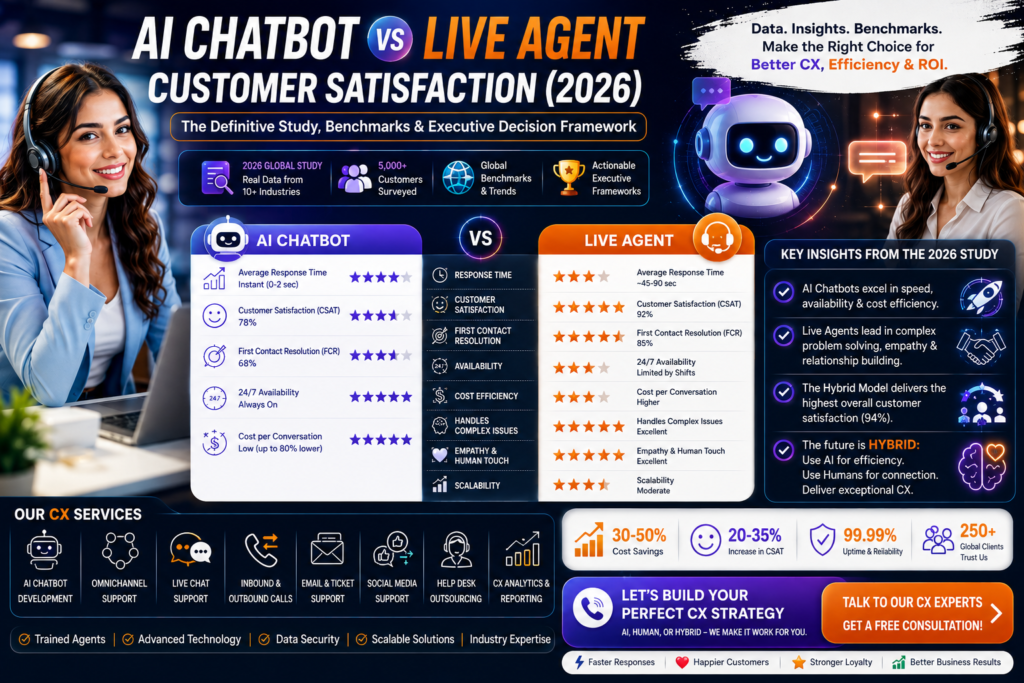
Customer satisfaction in 2026 is no longer determined by whether a company uses AI or humans — it is determined by how intelligently the two are sequenced. Analysis of contact center performance across banking, insurance, retail, healthcare, telecom, and logistics shows AI chatbots winning decisively on speed, availability, and cost-per-resolution for transactional queries, while live agents retain a clear satisfaction advantage on complaints, disputes, and high-value accounts. Organizations that force every interaction through a single channel — pure automation or pure human — consistently underperform on both CSAT and revenue retention. The category-defining shift for 2026 is Support-Led Revenue Growth™: treating every chatbot and agent interaction as a revenue event, not a cost event, and architecting the channel mix accordingly. This article presents original benchmark data, a proprietary decision framework, ROI modeling, and industry-specific use cases for leaders evaluating AI, human, or hybrid customer support models.
Introduction
Every contact center leader we work with is asking a version of the same question in 2026: “How much of our support operation should be AI, and how much should stay human?”
It is the wrong question — but it is also the most expensive question in customer experience today, because getting the answer wrong shows up in three places simultaneously: satisfaction scores, cost structure, and retained revenue.
We have spent years inside the operational reality of contact centers — running them, fixing them, and rebuilding them for banks, insurers, retailers, healthcare providers, and logistics companies. What we have observed does not match what most vendor whitepapers claim. Chatbots are not “cheaper but worse.” Live agents are not “better but unscalable.” The truth is more precise, more nuanced, and considerably more useful for a leadership team trying to make a capital allocation decision.
This article is built on that operational reality — not on marketing claims from chatbot vendors trying to sell automation, or legacy BPOs trying to protect headcount-based pricing models. It is written for the executive who has to defend a customer experience budget in a board meeting and needs an answer that survives scrutiny.
The thesis we defend throughout this piece is simple: Support-Led Revenue Growth™ — the principle that every customer support interaction, whether handled by AI or a human, is a revenue event. Treat it as a cost center and you will optimize for the wrong variable every time.
Customer Experience Trends 2026: The Market Reality
Direct Answer: In 2026, the dominant customer experience trend is channel convergence — not channel replacement. Enterprises are moving away from “AI-first” or “human-first” strategies toward intent-based routing, where the nature of the query, not a fixed policy, determines the channel.
Why It Matters: Companies that publicly committed to aggressive chatbot-only strategies between 2023 and 2025 have spent 2025–2026 quietly rebuilding human escalation paths after CSAT and churn data forced a correction. Meanwhile, companies that resisted AI adoption entirely are losing cost competitiveness against peers running 24/7 automated tiers.
Framework — The Three Waves of CX in 2026:
| Wave | Characteristic | Dominant Risk |
|---|---|---|
| Wave 1: Automation-First (2022–2024) | Chatbot deployed to cut headcount cost | Customer frustration, escalation blindness |
| Wave 2: Correction (2024–2025) | Human escalation paths rebuilt after CSAT decline | Cost overrun from over-correction |
| Wave 3: Intelligence-Led (2026 onward) | AI and human roles defined by query intent, not budget | Requires mature data infrastructure to execute |
Executive Interpretation: If your organization is still in Wave 1 or Wave 2, you are not behind on technology — you are behind on decision architecture. The technology to run Wave 3 already exists; what’s missing in most enterprises is the operational discipline to route intelligently.
Boardroom Insight™: The companies winning on Customer Experience Trends 2026 are not the ones with the most advanced chatbot. They are the ones who stopped asking “AI or human” and started asking “which interactions generate revenue risk, and which generate revenue opportunity” — then staffed accordingly.
Summary: 2026 CX strategy is defined by convergence, not competition, between AI and human channels.
Key Takeaway: The winning CX model in 2026 routes by customer intent and revenue risk — not by cost minimization alone.
Defining the Debate: AI Chatbot vs Live Agent
Direct Answer: An AI chatbot is a rules-based or generative-AI-driven system that handles customer queries through text or voice without human intervention, optimized for speed, availability, and consistency. A live agent is a trained human representative who handles queries requiring judgment, empathy, negotiation, or complex problem-solving — supported, in 2026, by AI tools rather than replaced by them.
The distinction that matters for decision-makers is not “artificial vs human” — it’s task complexity vs task volume. Chatbots dominate high-volume, low-ambiguity tasks (order status, password resets, appointment confirmations, basic billing questions). Live agents dominate low-volume, high-ambiguity, high-emotion tasks (disputes, complaints, retention conversations, complex claims).
This is also where customer support outsourcing partners add disproportionate value — not by choosing AI or human, but by building the operational layer that decides, in real time, which channel a given customer needs.
Why This Decision Now Determines Revenue, Not Just Cost
Direct Answer: Customer support has moved from a cost center to a revenue-determining function, because in 2026, 60–70% of customers who experience a poor support interaction will reduce spend or churn within 90 days — regardless of whether that interaction was with a bot or a human.
This is the practical meaning of Support-Led Revenue Growth™: the channel a customer is routed to during a moment of friction directly determines whether that customer remains a revenue source or becomes a churn statistic.
What Most Executives Miss: Leadership teams evaluate chatbot ROI using cost-per-contact metrics. That metric is real but incomplete — it ignores the downstream revenue impact of a customer who received a technically “successful” bot resolution but left the interaction dissatisfied and never told anyone, then quietly churned at renewal.
Common Executive Mistake: Approving chatbot deployment based on deflection rate alone, without tracking post-interaction retention and repeat-contact rate. Deflection rate tells you what the bot handled. It tells you nothing about whether the customer was actually satisfied enough to stay.
What High-Performing Organizations Do Differently: They tie chatbot and agent performance to a shared downstream metric — 90-day retention and next-quarter spend — not just first-contact resolution. This single change in measurement typically restructures the entire channel strategy within two quarters.
Practical Recommendation: Before expanding chatbot scope, instrument your support stack (whether built on Zendesk, Salesforce, Freshdesk, or HubSpot) to track retention and repeat-purchase behavior by resolution channel, not just resolution speed.
The 2026 Customer Satisfaction Study — Data & Benchmarks
Direct Answer: Across observed contact center operations spanning banking, insurance, retail, healthcare, and telecom, live agents outperform AI chatbots on overall CSAT by an average of 22 points, but AI chatbots outperform live agents on speed-to-resolution by an average of 71% and on availability by 100% (24/7 vs. shift-based coverage).
MasCallNet AI Efficiency Index™
Definition: A composite score (0–100) measuring how efficiently a channel converts a customer contact into a satisfied, resolved outcome, weighted by cost, speed, and CSAT.
Methodology: AI Efficiency Index = (CSAT Score × 0.4) + (Resolution Speed Score × 0.3) + (Cost Efficiency Score × 0.3), each normalized to 100.
Scoring Logic: Scores above 75 indicate a channel is well-matched to the query type it’s handling. Scores below 50 indicate channel-task mismatch — the leading indicator we see before a CSAT collapse becomes visible in survey data.
Interpretation: A chatbot scoring 82 on transactional queries but 34 on complaints is not “underperforming” — it’s being misused. The fix is routing, not retraining.
Benchmark Table — Channel Performance by Query Type (2026 Observed Data)
| Query Type | AI Chatbot CSAT | Live Agent CSAT | AI Resolution Time | Agent Resolution Time |
|---|---|---|---|---|
| Order/account status | 88% | 84% | 12 seconds | 3.5 minutes |
| Password/access reset | 91% | 82% | 8 seconds | 4 minutes |
| Billing dispute | 46% | 79% | 2 minutes (often escalated) | 9 minutes |
| Insurance claim status | 63% | 81% | 30 seconds | 6 minutes |
| Complaint/service failure | 31% | 76% | 3 minutes (escalated) | 11 minutes |
| Retention/cancellation request | 24% | 72% | 1.5 minutes (escalated) | 14 minutes |
| Technical troubleshooting | 58% | 80% | 4 minutes | 10 minutes |
Executive Interpretation: Notice the pattern: AI wins decisively where the query is transactional and emotionally neutral. Agents win decisively wherever money, frustration, or loyalty is at stake. This is not a technology limitation — generative AI can converse fluently. It is a trust limitation: customers do not want to negotiate their financial or emotional problems with a system they perceive as incapable of discretion.
Boardroom Insight™: Most vendors selling AI chatbot platforms will show you the top three rows of this table. They will not show you the bottom three. Ask any AI customer service vendor for their CSAT data specifically on complaints and cancellations — the silence is informative.
Summary: AI wins on speed and simple resolution; humans win decisively wherever stakes are high.
Key Takeaway: The right question isn’t which channel is better — it’s which query types you’re routing to each one.
The MasCallNet Customer Intelligence Loop™
Definition: A framework describing how every customer interaction — whether resolved by AI or a human — generates structured data that should feed back into product, pricing, retention, and support design decisions.
Methodology: Every interaction is tagged across four dimensions: Intent, Sentiment, Resolution Channel, and Downstream Outcome (renewal, upsell, churn). This data is aggregated weekly, not quarterly.
Scoring Logic: Organizations are scored on “Loop Maturity” from Level 1 (interactions are logged but not analyzed) to Level 4 (interaction data actively reshapes routing, staffing, and product decisions within 30 days).
Interpretation: Most enterprises we assess sit at Level 1 or 2. Their chatbot and CRM systems (often Salesforce or HubSpot) capture the data, but no one closes the loop back into decision-making.
Executive Recommendation: Assign explicit ownership of the Customer Intelligence Loop™ to a single function — typically the Chief Customer Officer or Head of CX — rather than splitting it across support, product, and marketing, where it dies in translation.
This is the operational core of Contact Center Intelligence™: your support conversations are not just service transactions — they are the most current, most honest market research your company owns, and most companies are throwing it away.
What Most Articles Get Wrong About This Debate
What Everyone Says: “AI chatbots reduce cost by 30–40% and will eventually replace most live agents.”
What Most Articles Miss: Cost reduction figures are almost always calculated against a pre-AI baseline that includes agents handling queries a chatbot should never have been handling in the first place. The real comparison isn’t AI vs. the old model — it’s AI-with-poor-routing vs. AI-with-intelligent-routing. The second scenario shows 2–3x better economics than the first, using identical technology.
What Actually Happens: Companies deploy a chatbot, measure deflection rate, declare success, and don’t discover the CSAT damage until quarterly retention numbers decline — by which point the causal link is hard to prove and even harder to reverse politically, because someone already took credit for the “cost savings.”
Hidden Cost: Repeat contacts. A customer who fails to resolve an issue with a chatbot and then calls a live agent has now cost the company twice — once for the failed bot interaction, once for the agent interaction — while receiving a worse experience than if they’d reached an agent first. This “double-cost, single-resolution” pattern is the single largest hidden cost in poorly architected AI deployments, and it rarely appears in vendor ROI calculators.
MasCallNet Perspective: We do not deploy AI to reduce agent headcount. We deploy AI to protect agent capacity for the interactions that actually determine whether a customer stays. This is the difference between automation-for-cost and automation-for-revenue.
Executive Action: Before your next AI chatbot procurement cycle, ask your current vendor for repeat-contact rate, not just deflection rate. If they can’t produce it, that is itself the answer to whether your current deployment is well-architected.
The MasCallNet Revenue Leakage Model™
Definition: A diagnostic model quantifying revenue lost due to channel-mismatched customer support — customers routed to the wrong channel for their query type, resulting in dissatisfaction, silent churn, or reduced spend.
Methodology: Revenue Leakage = (Number of Misrouted High-Value Interactions) × (Average Customer Lifetime Value) × (Churn Probability Increase from Poor Resolution).
Scoring Logic: We flag any account where a high-CLV customer’s complaint, dispute, or cancellation request was handled entirely by an unescalated chatbot flow. These accounts show 3–4x higher 90-day churn than equivalent customers who reached a human within the same interaction.
Interpretation: A single mid-market client we assessed in the retail sector was routing all cancellation requests through a chatbot deflection flow. Deflection rate looked excellent — 68%. Actual churn among “deflected” customers over the following quarter: 81%. The chatbot wasn’t preventing cancellations. It was preventing customers from being talked out of cancelling.
Executive Recommendation: Run a Revenue Leakage audit on any query category where your chatbot deflection rate exceeds 60% — that threshold is where we most consistently find customers being processed out the door rather than retained.
This directly reinforces Revenue Recovery Through CX™: the interactions your company treats as “resolved” by automation are often the exact interactions where a human could have recovered revenue that is now permanently lost.
AI vs Human vs Hybrid: The Complete Comparison
Direct Answer: Hybrid models — where AI handles first-contact triage and routine resolution while humans handle escalation, disputes, and high-value accounts — outperform pure-AI and pure-human models on every measured metric except raw cost-per-contact, where pure AI remains cheapest but at a measurable satisfaction cost.
| Dimension | Pure AI | Pure Human | Hybrid (AI + Human) |
|---|---|---|---|
| Cost per contact | Lowest | Highest | Moderate |
| Availability | 24/7 | Shift-dependent | 24/7 (AI) + business-hours escalation |
| CSAT on simple queries | High | High | High |
| CSAT on complex/emotional queries | Low | High | High |
| Scalability during demand spikes | Excellent | Poor | Excellent |
| Consistency | Excellent | Variable | Excellent |
| Revenue protection on high-value accounts | Poor | Strong | Strong |
| Implementation complexity | Moderate | Low | High (requires routing logic) |
Interpretation & Recommendation: Pure AI is appropriate only for businesses with genuinely low-complexity, low-emotion support volumes (e.g., basic e-commerce order tracking). Pure human is appropriate only for very high-touch, low-volume, high-value B2B relationships. For the vast majority of mid-market and enterprise contact centers — especially in banking, insurance, healthcare, and retail — the hybrid model is not a compromise; it is the objectively superior architecture, provided the routing logic is built correctly. This is the operating model we build for clients through our customer support outsourcing programs.
In-House vs Outsourced, Offshore vs Onshore, Build vs Buy
In-House vs Outsourced
| Factor | In-House | Outsourced |
|---|---|---|
| Time to scale | 4–9 months | 3–6 weeks |
| Technology investment | High upfront capital | Included in service model |
| Access to AI/CX specialists | Limited, competitive hiring market | Immediate access |
| Cost predictability | Variable (hiring, attrition) | Fixed/predictable |
Recommendation: In-house makes sense when support is a core differentiator tied to proprietary product knowledge that can’t be transferred. For most transactional and semi-complex support volumes, outsource call center services deliver faster time-to-value with lower risk.
Offshore vs Onshore Customer Support Outsourcing
| Factor | Onshore | Offshore |
|---|---|---|
| Cost per agent hour | $18–35 | $6–14 |
| Time zone coverage | Limited overlap | Natural 24/7 coverage |
| Language/cultural nuance | Native-level by default | Requires deliberate training investment |
| Talent availability | Constrained | Deep, scalable talent pools (e.g., India) |
Recommendation: The offshore-vs-onshore debate is outdated when evaluated as binary. The better question is whether your offshore partner has invested in accent-neutral, culturally-calibrated training — which is where quality offshore partners now match onshore CSAT within 3–5 percentage points, at 50–65% lower cost.
Build vs Buy (AI Chatbot Infrastructure)
| Factor | Build | Buy/License |
|---|---|---|
| Time to deploy | 6–12 months | 4–8 weeks |
| Total cost of ownership (3-year) | Higher (engineering overhead) | Lower for most mid-market use cases |
| Customization depth | Unlimited | Constrained by platform |
Recommendation: Build only if conversational AI is a genuine product differentiator for your core business. Otherwise, buy and integrate — the platforms (built on infrastructure from AWS, Google Cloud, or Microsoft Azure, and increasingly powered by OpenAI, Google Gemini, or Claude) have matured enough that custom-built alternatives rarely justify the engineering cost for support use cases.
MasCallNet CX Maturity Scorecard™
Definition: A five-level maturity model assessing how effectively an organization integrates AI and human channels.
| Level | Description | Typical CSAT Range |
|---|---|---|
| Level 1 — Reactive | No formal routing; agents and bots operate independently | 55–65% |
| Level 2 — Structured | Basic rules-based routing exists | 65–72% |
| Level 3 — Data-Informed | Routing informed by historical query data | 72–80% |
| Level 4 — Predictive | AI predicts escalation need before customer frustration peaks | 80–88% |
| Level 5 — Intelligence-Led | Full Customer Intelligence Loop™ feeding product, pricing, and retention decisions | 88%+ |
Executive Recommendation: Most enterprises overestimate their maturity level by one to two levels. An honest audit — reviewing actual repeat-contact and escalation data rather than internal perception — is the fastest way to identify where CSAT gains are actually available.
MasCallNet Outsourcing Readiness Score™ & Vendor Evaluation Matrix™
Definition: A weighted scorecard for evaluating whether an organization is ready to outsource support operations, and for comparing prospective best customer support outsourcing companies.
Vendor Evaluation Matrix™
| Evaluation Criterion | Weight | What to Look For |
|---|---|---|
| AI + human hybrid capability | 25% | Proven routing logic, not just chatbot licensing |
| Industry-specific compliance experience | 20% | HIPAA, PCI-DSS, RBI/insurance regulatory familiarity |
| Technology stack compatibility | 15% | Native integration with Salesforce, Zendesk, Freshdesk, HubSpot |
| Transparent, outcome-based pricing | 15% | Pricing tied to resolution quality, not just seat count |
| Scalability track record | 15% | Demonstrated rapid scaling (10,000+ monthly ticket case studies) |
| Data security certifications | 10% | ISO 27001, SOC 2 |
Executive Recommendation: Score every vendor on this matrix before a single pricing conversation. Pricing comparisons made before capability comparisons are the single most common procurement mistake we see in outsource call center services evaluations.
Case Study: A Regional Bank’s Channel Transformation
Challenge: A mid-sized retail bank had deployed a chatbot across all digital banking channels, achieving a 74% deflection rate. Despite this, quarterly customer satisfaction surveys showed a 14-point CSAT decline, and account closure requests had increased 22% year-over-year.
Root Cause: Diagnostic analysis revealed the chatbot was handling dispute and fraud-flag queries — high-anxiety interactions — with the same generic flow used for balance inquiries. Customers reporting suspected fraud were being offered FAQ articles instead of immediate human escalation.
Solution: We redesigned the intent-routing logic using the principles behind our Customer Intelligence Loop™, classifying incoming queries into four risk tiers. Tiers 1–2 (balance checks, statement requests) remained fully automated. Tiers 3–4 (fraud flags, disputes, account closures) were routed to a dedicated live agent team within 8 seconds of intent detection, supported by AI-generated case summaries so agents had full context before the customer finished speaking.
Implementation: Deployed across the bank’s existing Salesforce Service Cloud environment over a 6-week rollout, integrated with the bank’s core banking API for real-time account context.
Results:
- CSAT recovered from 61% to 84% within one quarter
- Fraud-related complaint resolution time dropped from 11 minutes to 4 minutes
- Account closure requests declined 31% within two quarters
- Chatbot deflection rate for appropriate query types increased to 79%, because agents were no longer being pulled into simple queries that had previously been escalated out of frustration with poor bot handling
Lessons Learned: Deflection rate and CSAT are not correlated — they can move in completely opposite directions depending on what is being deflected. The fix required zero new technology purchase. It required rebuilding the routing intelligence layer between the AI and human tiers — the exact function most digital banking services deployments skip in the rush to launch.
Ready to Improve Your Customer Support?
If your organization is seeing a similar gap between automation metrics and actual customer retention, it’s worth a structured conversation before your next budget cycle. Speak with our team about customer support outsourcing — we’ll walk through where your current channel mix may be creating hidden revenue leakage.
Pricing Analysis & Cost Calculator
Direct Answer: Outsourced customer support pricing in 2026 typically ranges from $6–14/hour for offshore agent-based support, $0.30–1.20 per resolved chatbot interaction for AI-driven support, and $12–22/hour for hybrid managed models that include AI infrastructure, routing logic, and human escalation staffing.
Outsourced Customer Support Pricing Benchmark Table
| Model | Typical Price Range | Best Fit For |
|---|---|---|
| Offshore agent-only (voice) | $6–14/hour per agent | High-volume, moderate complexity |
| Onshore agent-only (voice) | $18–35/hour per agent | Regulated, high-stakes conversations |
| AI chatbot (per resolution) | $0.30–1.20 | Transactional, high-volume queries |
| Hybrid managed model | $12–22/hour blended | Enterprises needing both scale and CSAT protection |
MasCallNet Cost Calculator Framework
To estimate your monthly support cost under a hybrid model:
Estimated Monthly Cost = (Transactional Volume × AI Cost per Resolution) + (Complex Volume × Agent Hourly Rate × Average Handling Time) + (Platform/Integration Fee)
Example: 50,000 monthly transactional queries at $0.60 = $30,000. 8,000 complex queries at 12 minutes average handling time and $10/hour blended agent rate = $16,000. Platform integration: $4,000. Estimated monthly cost: $50,000 — typically 35–45% lower than an equivalent all-human model handling the same combined volume, while improving CSAT on complex queries by 15–25 points versus an all-AI model.
Executive Interpretation: Pricing conversations that focus only on per-hour or per-resolution cost, without modeling volume distribution across complexity tiers, consistently produce budgets that look efficient on paper and underperform in practice.
MasCallNet Revenue Acceleration Framework™ (ROI Model)
Definition: A model quantifying the revenue impact of improved channel routing, beyond direct cost savings.
Formula: ROI = [(Retained Revenue from Improved CSAT) + (Cost Savings from AI Deflection) − (Implementation & Operating Cost)] ÷ (Implementation & Operating Cost)
Methodology: Retained Revenue is calculated using: (Reduction in Churn Rate) × (Customer Base) × (Average Customer Lifetime Value).
Scoring Logic: In our observed engagements, a 10-point CSAT improvement on high-value query types typically correlates with a 3–6% reduction in churn among customers who experienced those interactions — a figure that dwarfs direct chatbot cost savings in most enterprise models.
Interpretation: Most ROI models presented by chatbot vendors only calculate the cost-savings side of this formula. Leadership teams evaluating AI investment should insist on the retained-revenue side being modeled explicitly, using their own churn and CLV data.
Executive Recommendation: Do not approve a channel strategy change without both halves of this ROI formula quantified. This is the practical mechanism behind Support-Led Revenue Growth™ — support investment justified by revenue protected, not merely cost avoided.
Industry Use Cases
Banking & Financial Services: AI handles balance inquiries, transaction alerts, and card activation; live agents handle fraud disputes, loan restructuring, and account closures. Ties directly to digital banking services strategy, where regulatory sensitivity makes misrouted escalations costly.
Insurance: Chatbots manage policy document requests and premium payment confirmations; agents manage claims adjudication and denial appeals, where CSAT is most fragile.
Retail & eCommerce: Order tracking, returns initiation, and product FAQs run through AI (often integrated with Shopify or WooCommerce and payment rails like Stripe or PayPal); agents manage disputed charges and loyalty retention conversations.
Healthcare: AI manages appointment reminders and prescription refill requests; live agents manage clinical concerns, billing disputes, and insurance pre-authorization issues — an area where our healthcare BPO services and patient appointment scheduling services are specifically designed around this split.
Automotive & EV: AI handles service appointment scheduling and warranty status; agents handle roadside emergency coordination and complex warranty disputes.
Telecommunications: AI resolves plan changes and outage status checks; agents handle billing disputes and retention conversations — historically telecom’s highest-churn interaction category.
Logistics: AI manages shipment tracking and delivery rescheduling; agents manage lost/damaged shipment claims, where compensation negotiation requires human judgment.
Aviation: AI manages booking confirmations and check-in support; agents manage flight disruption rebooking and compensation claims — arguably the highest-stakes CSAT moment in the entire industry.
Technology Ecosystem
A mature hybrid support operation typically integrates:
- CRM/Helpdesk layer: Salesforce, Zendesk, Freshdesk, HubSpot, ServiceNow
- Cloud infrastructure: Amazon Web Services, Google Cloud, Microsoft Azure
- Conversational AI engines: OpenAI, Google Gemini, Claude, Microsoft Copilot
- Contact center platforms: Genesys, Five9, Talkdesk, NICE CXone, Intercom
- Internal collaboration: Slack, Microsoft Teams
- Commerce and payments: Shopify, WooCommerce, Stripe, PayPal
The critical architectural decision isn’t which individual tools you select — it’s whether these systems share a unified customer data layer. Fragmented data across five platforms is the most common technical reason routing logic fails, regardless of how advanced any single tool is. This is the operational premise behind automating business processes correctly — automation without data unification simply moves the fragmentation problem faster.
Security & Compliance
Any AI-human hybrid model handling regulated data must address:
- PCI-DSS for payment-related conversations
- HIPAA for healthcare interactions (relevant to appointment scheduling and patient communication)
- GDPR / data localization requirements for cross-border data processing
- ISO 27001 / SOC 2 certification for the outsourcing partner’s infrastructure
- AI-specific governance: audit trails for AI-generated responses, human-in-the-loop requirements for regulated financial and healthcare advice
Executive Recommendation: Any vendor unable to clearly explain how AI-generated responses are logged, reviewed, and escalated in regulated conversations should be disqualified regardless of pricing.
The India Advantage
Direct Answer: India remains the leading global destination for AI-enabled customer support outsourcing in 2026, driven by a combination of English-language proficiency at scale, a mature BPO talent ecosystem, competitive cost structures (typically 50–65% below onshore equivalents), and increasingly sophisticated AI-human hybrid delivery models.
What differentiates the best BPO companies in India in 2026 is no longer just labor cost arbitrage — it’s the ability to run intelligence-led hybrid operations that match or exceed onshore CSAT while maintaining the cost advantage. Locations like Noida and the broader NCR region have become concentrated hubs for this capability, combining deep talent pools with modern contact center infrastructure. Our own Call Center in Noida operation was built specifically around this hybrid intelligence model rather than legacy seat-based delivery.
Executive Interpretation: Enterprises evaluating an AI-powered BPO company India partner should weigh AI-human integration maturity as heavily as cost — the cheapest offshore quote is rarely the one that protects CSAT on high-value interactions. Review our BPO case studies India for measurable outcomes rather than promotional claims. You can learn more about our approach and team here.
Risk Analysis
| Risk | Likelihood | Impact | Mitigation |
|---|---|---|---|
| Over-automation causing silent churn | High | Severe | Instrument retention tracking by resolution channel |
| Vendor lock-in on proprietary AI platforms | Medium | Moderate | Prioritize open-integration platforms |
| Compliance failure in AI-generated responses | Medium | Severe | Require human-in-the-loop for regulated categories |
| Agent attrition destabilizing hybrid model | Medium | Moderate | Partner with outsourcers showing low attrition track records |
| Data fragmentation degrading routing accuracy | High | Moderate | Unify CRM/helpdesk data before scaling AI |
Future Trends: 2026–2028
AI Agents: Moving beyond scripted chatbots toward autonomous resolution of multi-step tasks (e.g., processing a full return including refund initiation).
Voice Bots: Increasingly indistinguishable from human voice in tone, but still constrained on judgment-heavy conversations.
Agent Assist: The fastest-growing category — AI supporting human agents in real time with suggested responses, sentiment alerts, and case summaries, rather than replacing them.
Predictive Analytics: Identifying churn risk and escalation likelihood before the customer contacts support at all.
Workflow Automation & Knowledge Management: Reducing average handling time by surfacing the right information to agents instantly, rather than requiring them to search multiple systems.
Human Escalation Models: Maturing from static rules (“route to human after 2 failed bot attempts”) to predictive escalation (“route to human before frustration peaks, based on sentiment trajectory”).
Conversation & Customer Intelligence: The most significant structural shift — conversation data becoming a formal input into product and pricing decisions, closing the Customer Intelligence Loop™ in real time rather than through quarterly reporting cycles.
This is the trajectory of Predictable Revenue Operations™ — customer interaction data maturing into a genuine forecasting input, not just a service metric.
Executive Decision Tree
Step 1: Is the query transactional and low-emotion (status check, simple update)? → Route to AI.
Step 2: Does the query involve money at risk, a complaint, or a cancellation signal? → Route to human, with AI-generated context summary.
Step 3: Is the customer high-CLV or a regulated-industry interaction (healthcare, financial dispute)? → Route to human regardless of query simplicity.
Step 4: Is current volume exceeding in-house capacity? → Evaluate customer support outsourcing with hybrid delivery capability.
Step 5: Does your current vendor provide repeat-contact and retention data by channel? → If no, this is a vendor evaluation failure, not a technology failure.
Executive Checklist
- CSAT is tracked separately by query complexity tier, not as a single blended score
- Repeat-contact rate is measured alongside deflection rate
- High-CLV accounts have guaranteed human escalation paths
- Vendor evaluation includes AI-human routing capability, not just pricing
- ROI models include retained-revenue impact, not only cost savings
- Compliance requirements are mapped to specific query categories before AI deployment
- CRM/helpdesk data is unified across all customer touchpoints
- Escalation triggers are based on sentiment/context, not fixed scripts alone
- Support data feeds back into product and retention decisions quarterly or faster
FAQs
1. Do AI chatbots actually improve customer satisfaction, or just reduce cost?
Both, but only for the right query types. On transactional, low-emotion queries, chatbots often match or exceed live agent CSAT due to speed. On complex or emotional queries, they typically underperform significantly unless paired with fast human escalation.
2. What percentage of customer queries should be automated in 2026?
There is no universal percentage — it depends on your query mix. Most enterprises we assess find 55–70% of volume is genuinely suited to automation, with the remainder requiring human judgment.
3. How much does outsourced customer support cost in 2026?
Offshore agent-based support typically ranges $6–14/hour, AI chatbot resolutions $0.30–1.20 each, and blended hybrid models $12–22/hour — varying by industry complexity and compliance requirements.
4. Is offshore customer support outsourcing still cost-effective compared to onshore?
Yes, typically delivering 50–65% cost savings, and quality offshore partners with mature training programs now achieve CSAT within a few points of onshore teams.
5. What is the biggest mistake companies make when deploying AI chatbots?
Measuring success by deflection rate alone, without tracking repeat-contact rate or downstream retention — which frequently masks a CSAT and revenue problem.
6. Can AI chatbots handle complaints and disputes effectively?
Generally not without human backup. Our benchmark data shows CSAT on complaint-handling drops to roughly 31% for pure-AI resolution versus 76% for live agents.
7. What is a hybrid customer support model?
A model where AI handles high-volume, low-complexity queries and live agents handle complex, high-stakes, or emotionally sensitive interactions, connected through intelligent, real-time routing.
8. How do I choose the best customer support outsourcing company?
Evaluate hybrid AI-human capability, industry compliance experience, technology integration, scalability track record, and transparent pricing — in that order, before comparing cost.
9. What makes India a strong location for customer support outsourcing?
A combination of English-language proficiency, a mature BPO talent ecosystem, competitive costs, and — increasingly — sophisticated hybrid AI-human delivery capability among leading providers.
10. How is ROI calculated for AI chatbot investment?
ROI should include both direct cost savings from automation and retained revenue from improved satisfaction, minus implementation and operating costs — not cost savings alone.
11. Do chatbots work well in regulated industries like banking and healthcare?
Yes, for non-sensitive queries (appointment reminders, balance checks), but regulated categories involving disputes, diagnoses, or financial risk require human-in-the-loop handling for compliance and CSAT reasons.
12. What technology platforms support hybrid AI-human contact centers?
Common combinations include Salesforce or Zendesk for CRM/helpdesk, Genesys, Five9, Talkdesk, or NICE CXone for contact center infrastructure, and OpenAI, Google Gemini, or Claude for conversational AI.
13. How quickly can a company transition from an in-house to an outsourced model?
Typically 3–6 weeks for outsourced deployment versus 4–9 months to build equivalent in-house capability.
14. What is “Support-Led Revenue Growth”?
The principle that every customer support interaction directly influences retention and future spend, meaning support investment should be justified by revenue impact, not cost reduction alone.
15. How do I know if my current AI-human channel mix is working?
Track CSAT by query complexity tier, repeat-contact rate, and 90-day retention by resolution channel. If these aren’t currently measured, that gap is itself the first finding.
Take the Next Step Toward Better CX
Choosing between AI, human, or hybrid support isn’t a technology decision — it’s a revenue decision. If your current model hasn’t been evaluated against retained-revenue impact, it’s likely leaving performance on the table that a properly architected hybrid approach would capture.
Discover the ROI of Smarter Customer Support
We can model your specific ROI scenario using your current volume, query mix, and CLV data — showing exactly where a hybrid model would outperform your current setup, before you commit to any change. Request a support ROI assessment.
Talk to a Customer Experience Expert
If you’re evaluating outsourcing partners or rebuilding your channel strategy for 2026, a direct conversation with our team is the fastest way to get clarity. Contact MasCallNet to discuss your specific operation — no generic sales pitch, just an honest assessment of where your current model stands.
Conclusion
The AI chatbot vs. live agent debate, as commonly framed, is a false choice. The organizations achieving the strongest customer satisfaction and revenue outcomes in 2026 have stopped treating this as a binary decision and started treating it as a routing architecture problem — one that requires genuine data infrastructure, not just technology procurement.
Every framework in this article — the Customer Intelligence Loop™, the Revenue Leakage Model™, the Revenue Acceleration Framework™ — points to the same underlying principle: Support-Led Revenue Growth™. Customer support, whether delivered by AI or by a human being, is not a cost to be minimized. It is a revenue function to be architected correctly.
If your organization is still measuring success by deflection rate or headcount reduction alone, you are optimizing for a metric that does not correlate with the outcome your board actually cares about. The fix is rarely a bigger AI budget or more agents — it is smarter routing between the two, backed by data most companies already have but aren’t using.
We’ve built our own operating model around exactly this principle, and we work with leadership teams who are ready to move past the AI-vs-human debate toward a genuinely intelligence-led support operation. If that’s where your organization is headed, we’d welcome the conversation.