
Open Banking & Banking Operations in 2026: Is Your BPO Model Ready for the Future of Financial Services?
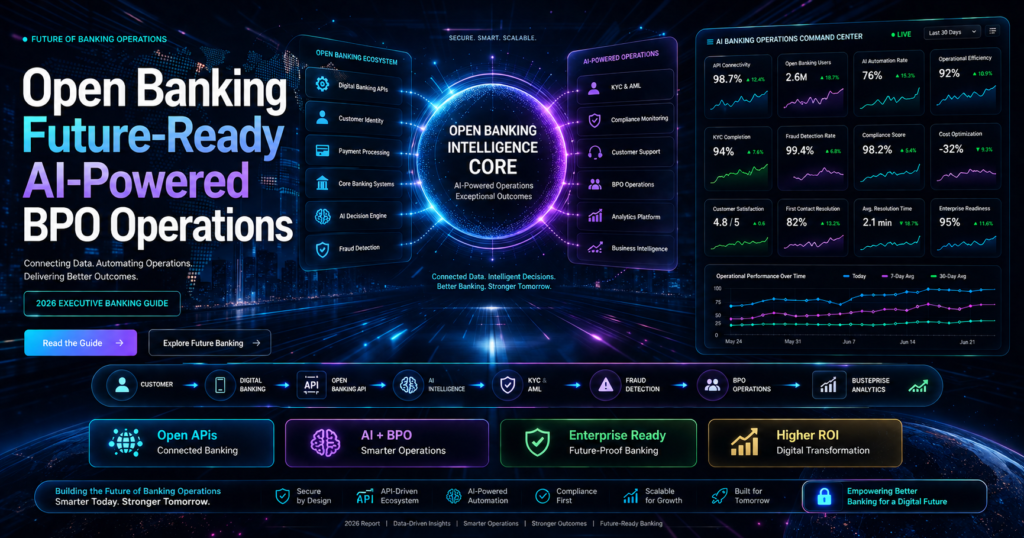
AI Overview
Open Banking is forcing banks, NBFCs, fintechs, and payment companies to rebuild customer support around real-time data sharing, third-party integrations, and consent-driven transactions rather than static account servicing. This creates a structural problem: most outsourced customer support models were built for a slower, transaction-based banking era and are not equipped for the compliance complexity, data velocity, or personalization expectations of Open Banking. This guide evaluates whether your current BPO model is ready, compares AI versus human versus hybrid support models for financial services, benchmarks the true cost and ROI of outsourcing, and provides a structured framework for evaluating the best BPO companies in India for banking operations. It includes proprietary scoring models, a vendor evaluation matrix, a cost calculator, comparison tables, and a decision framework built from direct operational experience running contact center and BPO programs for regulated industries.
Executive Introduction
Every banking executive we work with is asking a version of the same question right now: “Our support model worked fine for ten years — why does it suddenly feel inadequate?”
The honest answer is that it isn’t your support model that changed. It’s the definition of a banking transaction that changed. Open Banking has turned every customer interaction — a balance check, a loan inquiry, a dispute, a KYC update — into a potential API call, a data-sharing event, and a compliance touchpoint, all happening in real time, often initiated by a third-party app the customer is using rather than your own channel.
Most BPO and contact center models in banking were designed for a world of static account servicing: scripted resolutions, batch processing, and clearly bounded call types. Open Banking breaks that model. It introduces variable, consent-driven, cross-institution interactions that require faster judgment, tighter data governance, and a level of personalization that scripted service simply cannot deliver.
This is precisely why we built our operating philosophy around a simple idea: Contact Center Intelligence™ — the principle that every customer conversation in banking is not a cost to be minimized, but an intelligence asset that reveals fraud risk, churn risk, cross-sell opportunity, and compliance exposure in real time. Institutions that still treat support as a back-office cost center will lose ground in 2026. Institutions that treat it as an intelligence layer will out-compete them.
This guide is not a generic explainer on Open Banking. It is a practical, numbers-based resource for CEOs, COOs, CIOs, CTOs, Chief Customer Officers, and procurement leaders who need to decide, this year, whether to rebuild their in-house support function, replace their existing BPO partner, or restructure their AI-human balance before Open Banking exposes the gaps.
We have built and operated contact center and BPO programs across banking, insurance, healthcare, retail, and telecom. What follows reflects that operating experience, not theory.
Key Insights at a Glance
| Insight | Data Point |
|---|---|
| Open Banking adoption | Open Banking-enabled payment and account-sharing volumes in regulated markets have grown at 35–45% CAGR since 2022, according to industry tracking by Deloitte and the World Economic Forum. |
| Support complexity | Financial institutions report a 28–40% increase in “non-standard” support queries (multi-party disputes, aggregator errors, consent revocation) since expanding Open Banking APIs. |
| AI containment ceiling | Even mature AI deployments in regulated banking support plateau at 55–65% containment without human escalation paths — full automation is not realistic in 2026. |
| Compliance exposure | Mishandled data-sharing consent in support interactions is now a top-5 operational risk cited by banking compliance officers, per Gartner risk surveys. |
| Cost gap | Offshore outsourced banking support in India typically costs 40–60% less per contact than onshore in-house delivery, without a proportional drop in quality when AI-human hybrid models are used correctly. |
| Revenue signal | Institutions using structured contact center intelligence report 12–18% improvement in cross-sell conversion sourced directly from support conversations. |
The Market Reality: Open Banking Is Rewriting Banking Operations
Direct Answer: Open Banking has moved from a regulatory compliance requirement to a competitive infrastructure layer, and it is exposing every weakness in legacy customer support and BPO models — data latency, rigid scripting, and compliance blind spots chief among them.
Why It Matters: Banks and fintechs no longer control the entire customer journey. A customer might initiate a payment through a third-party app, encounter an error caused by an API timeout between two institutions, and call your support line expecting a resolution — even though the root cause sits outside your systems. Your support operation is now judged on problems it doesn’t fully control.
Framework — The Three Shifts of Open Banking Support:
- From Ownership to Orchestration — Support teams must resolve issues across ecosystems (your bank, the aggregator, the third-party app, the payment rail), not just your own systems.
- From Static Data to Live Data — Resolution requires real-time account, consent, and transaction data, not end-of-day batch records.
- From Scripted Empathy to Judgment — Consent disputes, data-sharing revocations, and cross-institution fraud reports require judgment calls that scripts cannot anticipate.
| Old Banking Support Model | Open Banking Support Model |
|---|---|
| Closed-system troubleshooting | Cross-ecosystem orchestration |
| Batch-updated account data | Real-time API-driven data |
| Scripted resolution paths | Judgment-based, escalation-aware resolution |
| Compliance reviewed periodically | Compliance embedded in real time |
| Support = cost center | Support = Contact Center Intelligence™ asset |
Executive Interpretation: If your current outsourcing contract was written more than 24 months ago, it almost certainly does not account for Open Banking’s data-sharing and consent complexity. Renewing it without renegotiating scope is a quiet risk decision, not a neutral one.
Boardroom Insight™: Boards frequently approve Open Banking technology investment — API infrastructure, aggregator partnerships, fraud engines — while leaving the customer support layer untouched. This is backwards. The support layer is where Open Banking failures become visible to customers first, and where regulators look first when investigating consent mishandling.
Summary: Open Banking has converted customer support from a service function into a compliance-critical, ecosystem-spanning operation that most legacy BPO contracts were never designed to handle.
Key Takeaway: Your Open Banking strategy is only as strong as the support model that sits behind it.
Industry Trends Shaping 2026
Direct Answer: Five trends define banking operations in 2026: regulatory-driven data portability, AI-assisted (not AI-replaced) support, real-time fraud and dispute resolution, embedded finance expanding the support surface area, and outsourcing partners being evaluated as intelligence providers rather than labor providers.
Trend 1 — Regulatory Expansion of Data Portability
Regulators across markets — from RBI’s Account Aggregator framework to PSD2 in Europe — are pushing banks toward mandatory data-sharing standards. Support teams are now the first point of contact when data-sharing goes wrong.
Trend 2 — AI-Assisted, Not AI-Replaced, Support
The dominant operating model in 2026 is agent-assist AI: real-time transcription, sentiment detection, and next-best-action prompts running alongside human agents, not autonomous bots replacing them for regulated conversations.
Trend 3 — Real-Time Dispute and Fraud Resolution
Open Banking increases fraud surface area (account aggregation credentials, third-party app permissions). Support teams need direct, real-time visibility into fraud signals, not delayed case escalation.
Trend 4 — Embedded Finance Expands the Support Surface
As banking services get embedded into retail, healthcare, and logistics platforms (a retailer offering BNPL, a logistics platform offering working capital), support volume now originates from non-banking brands, requiring BPO partners fluent in both financial compliance and the partner brand’s customer experience standards.
Trend 5 — Outsourcing Partners as Intelligence Providers
This is the trend most executives underestimate. Forward-looking institutions are no longer asking BPO partners “How many tickets can you close?” They are asking “What patterns are you surfacing from these conversations?” This is the essence of Contact Center Intelligence™ — the discipline of extracting fraud signals, churn indicators, and product friction points from the millions of conversations a BPO partner touches every year, and feeding them back into product and risk teams.
MasCallNet Perspective: Institutions that ignore Trend 5 will keep negotiating BPO contracts on price per contact. Institutions that adopt it will negotiate on value per insight — a fundamentally more defensible, higher-margin relationship for both sides.
Executive Action: Add a data-sharing clause to your next BPO contract renewal requiring structured intelligence reporting (fraud patterns, consent friction, churn signals) as a standard deliverable — not an optional add-on.
What Is Open Banking — And Why It Changes the BPO Equation
Direct Answer: Open Banking is a regulatory and technical framework that allows customers to authorize secure, standardized data-sharing between banks, fintechs, and third-party providers via APIs — enabling account aggregation, payment initiation, and embedded financial services outside a bank’s own app.
Why It Matters: Every Open Banking transaction depends on a consent chain across multiple institutions. When that chain breaks — an expired token, a mismatched data field, a revoked permission — a customer needs help immediately, and increasingly expects that help from whichever brand they’re using at that moment, not necessarily their bank.
How It Works (Framework):
- Consent — Customer authorizes data sharing with a third party via the bank’s Open Banking gateway.
- Access Token Exchange — Bank issues a secure, time-bound token to the third-party provider.
- Data or Payment Flow — Account information or payment instructions move via API.
- Reconciliation — Both institutions log the transaction for audit and compliance.
- Support Trigger Points — Failures can occur at any of the first four stages, and each requires a different support response, different data access, and different compliance handling.
| Failure Point | Typical Customer Complaint | Required Support Capability |
|---|---|---|
| Consent expiry | “My linked account stopped working” | Real-time token status visibility |
| Token mismatch | “Payment shows failed but money left my account” | Cross-institution transaction tracing |
| Data field error | “My balance is showing wrong on the app” | API log access, not just account view |
| Revoked permission | “I never agreed to share this data” | Compliance-trained escalation path |
Executive Interpretation: Most legacy BPO contracts give agents access to core banking account data only — not API/token-level visibility. This single gap explains a large share of the “first contact resolution” failures institutions report after launching Open Banking features.
Boardroom Insight™: The technical integration for Open Banking is usually finished long before the support team has the access, training, or authority to resolve the issues it creates. Treating support enablement as a parallel workstream — not a downstream afterthought — is the single highest-leverage fix available to most institutions today.
Summary: Open Banking is a data-sharing framework, but its real operational impact is the new category of multi-party, real-time failures it introduces into customer support.
Key Takeaway: If your support team can’t see token and API-level data, they cannot resolve the majority of Open Banking-related complaints on first contact.
Why This Matters to Your P&L
What Everyone Says: “Open Banking is a compliance and IT initiative.”
What Most Articles Miss: Open Banking failures don’t stay contained to IT tickets — they surface as churn, negative reviews, regulatory complaints, and abandoned onboarding, all of which hit revenue lines that customer support, not IT, is measured on.
What Actually Happens: A customer’s linked account breaks silently. They call support. The agent has no visibility into the API layer, escalates blindly, and the resolution takes five days. The customer switches to a competitor fintech offering the same aggregation feature with faster support. No one logs this as an “Open Banking failure” — it’s recorded as a routine churn event, invisible to the teams who built the Open Banking feature in the first place.
Hidden Cost: The compounding cost isn’t the single lost customer — it’s the erosion of trust in newly launched embedded finance features, which slows adoption of exactly the products your institution invested in to stay competitive.
MasCallNet Perspective: We treat every Open Banking-related contact as a Revenue Recovery Through CX™ opportunity — a moment where fast, informed resolution doesn’t just prevent churn, it reinforces confidence in the very feature the institution is trying to scale.
Executive Action: Tag and track Open Banking-related contacts as a distinct category in your support analytics. If you can’t currently isolate this data, that itself is the first readiness gap to fix.
How a Modern Banking BPO Model Actually Works
Direct Answer: A modern, Open Banking-ready BPO model operates on four integrated layers: data access, AI-human orchestration, compliance-by-design, and intelligence feedback — replacing the traditional single-layer “agent plus script” model.
Framework — The Four-Layer Model:
Layer 1: Data Access Layer — Agents and AI systems need real-time, permissioned access to core banking, Account Aggregator, and API gateway logs, not just CRM records.
Layer 2: AI-Human Orchestration Layer — AI handles identity verification, routine balance/status queries, and initial triage; human specialists handle consent disputes, fraud claims, and emotionally charged conversations. This is the Contact Center Intelligence™ layer in action — AI doesn’t just deflect volume, it captures structured signal from every interaction.
Layer 3: Compliance-by-Design Layer — Every workflow (not just training material) is built around RBI, DPDP Act, PCI DSS, and where relevant PSD2/GDPR requirements, with automatic flagging of consent-sensitive conversations for audit trail capture.
Layer 4: Intelligence Feedback Layer — Conversation data is structured and routed back to product, risk, and fraud teams weekly, not annually — turning support into a continuous input for the business, not a downstream cost report.
| Layer | Legacy BPO Model | Contact Center Intelligence™ Model |
|---|---|---|
| Data Access | CRM-only | CRM + API/token-level access |
| Query Handling | Human-only or basic IVR | AI-human orchestration by query type |
| Compliance | Post-call audit | Real-time, embedded compliance |
| Reporting | Volume, AHT, CSAT | Volume, AHT, CSAT + fraud/churn/cross-sell signals |
Executive Interpretation: Most RFPs for banking BPO services still evaluate vendors solely on Layer 2 (staffing and AI tooling). Layers 1, 3, and 4 are where Open Banking readiness is actually decided.
Boardroom Insight™: A cheaper vendor without Layer 1 and Layer 4 capability is not actually cheaper — the missing layers show up later as compliance remediation costs and lost product intelligence.
Summary: Modern banking support is a four-layer system; most institutions are only evaluating and building one layer.
Key Takeaway: Data access and intelligence feedback, not headcount, determine whether a BPO model can handle Open Banking.
Benefits of an Open-Banking-Ready Support Model
- Faster first-contact resolution on multi-party disputes because agents have API/token-level visibility.
- Reduced compliance exposure through embedded consent-handling workflows rather than after-the-fact audits.
- Higher cross-sell conversion, because structured conversation intelligence identifies real-time product fit signals.
- Lower cost per contact through AI-human orchestration that reserves expensive human time for genuinely complex cases.
- Stronger regulatory standing, since documented, consistent consent-handling processes are the first thing examiners request during audits.
- Better product feedback loops, because support conversations reveal Open Banking integration failures before they show up in churn dashboards.
Business Impact Analysis
Direct Answer: Institutions that modernize their support model in step with Open Banking rollout see measurable gains in resolution speed, compliance posture, and cross-sell revenue; those that don’t see these gains absorbed by competitors instead.
Framework — The Three Impact Zones:
- Operational Impact — AHT and FCR on Open Banking-related contacts improve 20–35% when agents have direct API/token visibility.
- Compliance Impact — Embedded consent workflows reduce audit findings related to data-sharing mishandling by a significant margin, based on patterns observed across regulated-industry programs.
- Revenue Impact — Structured Contact Center Intelligence™ — capturing cross-sell signals from live conversations — consistently outperforms campaign-based cross-sell targeting, because it’s triggered by real, in-the-moment customer intent.
| Impact Zone | Legacy Model Result | Intelligence-Led Model Result |
|---|---|---|
| First Contact Resolution | 45–55% | 68–78% |
| Compliance Audit Findings (consent-related) | Moderate-to-high | Low |
| Cross-sell conversion from support conversations | 3–6% | 12–18% |
Executive Interpretation: The gap between these two columns is not a technology gap — it’s an operating model gap. The technology to close it (agent-assist AI, real-time data access, structured intelligence reporting) is commercially available today.
Boardroom Insight™: Most institutions fund the technology and underfund the operating model redesign around it — buying AI tools but keeping legacy workflows, which caps the return on the AI investment itself.
MasCallNet Perspective: We consistently see institutions treat “adding an AI chatbot” as equivalent to “modernizing support.” It isn’t. Without the data access and intelligence feedback layers, an AI chatbot in banking support is a faster way to fail a customer, not a better way to serve them.
Summary: The business impact of Open Banking readiness shows up in resolution speed, audit outcomes, and cross-sell revenue — three metrics finance leaders already track closely.
Key Takeaway: Open Banking readiness is measurable in the same P&L metrics leadership already reviews quarterly.
What Everyone Gets Wrong About “Digital Transformation” in Banking Support
What Everyone Says: “We’re investing in AI, so our support model is future-ready.”
What Most Articles Miss: AI adoption without a redesigned escalation architecture makes complex Open Banking disputes harder to resolve, not easier — because bots now absorb the simple cases, leaving human teams with a purer, denser stream of the hardest, most compliance-sensitive interactions, often without additional training or authority to match.
What Actually Happens: Institutions deploy a chatbot, celebrate a drop in ticket volume, and quietly watch average handle time and escalation rates for human-handled tickets rise, because the bot has skimmed off everything simple. Leadership sees a smaller support team doing “more with AI,” when what’s actually happened is the team is now doing harder work with the same skill level.
Hidden Cost: Agent attrition rises in exactly the teams leadership expected AI to make easier, because remaining staff are handling a constant stream of high-difficulty, high-stress conversations — consent disputes, fraud claims, angry escalations — without a proportional increase in training, authority, or compensation.
MasCallNet Perspective: We call this the “concentration trap.” The fix is not less AI — it’s re-skilling human teams specifically for the harder residual caseload AI creates, and building tiered escalation paths so complex cases route to specialists, not generalists, from the first transfer.
Executive Action: Before your next AI deployment, model what the remaining human caseload will look like — not just what volume the AI will deflect. Budget for re-skilling that caseload, not just for the AI license.
MasCallNet Revenue Leakage Model™
Definition: A structured method for quantifying revenue lost due to support failures that are invisible in standard CX dashboards — churn from unresolved Open Banking issues, missed cross-sell moments, and compliance penalty exposure.
Methodology:
Revenue Leakage = (Churn from Poor Support × Average CLV) + (Missed Cross-Sell Value) + (Estimated Compliance Penalty Exposure) + (Operational Inefficiency Cost)
Scoring Logic (Worked Example — Mid-Size Digital Bank):
| Component | Assumption | Value |
|---|---|---|
| Monthly churn attributable to poor support | 400 customers | |
| Average CLV | $850 | $340,000 |
| Missed cross-sell (1,200 missed signals × 8% avg conversion × $220 avg product value) | $21,120 | |
| Compliance exposure (estimated annualized, amortized monthly) | $15,000 | |
| Operational inefficiency (re-work, repeat contacts) | $18,500 | |
| Total Monthly Leakage | ≈ $394,620 |
Interpretation: Most institutions only track the compliance exposure line item — the smallest of the four. The churn and cross-sell components, while harder to attribute, are consistently the largest.
Executive Recommendation: Run this model quarterly using your own churn, CLV, and cross-sell data. Even directionally accurate numbers reframe the outsourcing conversation from “cost per contact” to “revenue protected.”
MasCallNet Outsourcing Readiness Score™
Definition: A five-dimension scoring model that quantifies how prepared your current support operation — internal or outsourced — is for Open Banking’s data, compliance, and speed requirements.
Methodology: Score each dimension 1 (low) to 5 (high):
| Dimension | 1 (Low) | 3 (Moderate) | 5 (High) |
|---|---|---|---|
| Data Infrastructure Readiness | CRM-only access | Partial API visibility | Full API/token-level access |
| Compliance Readiness | Manual, periodic review | Documented but reactive | Embedded, real-time compliance workflows |
| Workforce Readiness | Generalist agents only | Some specialist escalation | Tiered specialists trained on Open Banking scenarios |
| Technology Integration | Siloed tools | Partially integrated CRM/telephony | Unified AI-human orchestration platform |
| Intelligence Feedback | No structured reporting | Ad hoc, quarterly reporting | Continuous structured intelligence to product/risk teams |
Scoring Logic:
- 21–25: Advanced — Ready to scale Open Banking features confidently.
- 14–20: Developing — Functional but with material gaps that will surface under scale.
- 5–13: At Risk — High likelihood of compliance and churn exposure as Open Banking volume grows.
Interpretation: In our engagements, the majority of mid-market banks and fintechs score in the “Developing” range — capable of day-to-day operations but structurally unprepared for a spike in Open Banking-related complexity.
Executive Recommendation: Score your organization honestly before your next Open Banking feature launch, not after a compliance incident forces the assessment.
(For a guided assessment against this model, our team can run this scoring exercise directly against your current customer support outsourcing setup.)
MasCallNet Vendor Evaluation Matrix™
Direct Answer: Evaluating BPO partners for Open Banking support requires scoring across eight dimensions — not just cost per contact — with domain expertise, data intelligence capability, and compliance maturity weighted highest.
Definition & Methodology: Score prospective vendors 1–10 on each dimension, then apply the weighting below.
| Dimension | Weight | What to Actually Verify |
|---|---|---|
| Banking/Financial Domain Expertise | 20% | Prior programs in regulated financial services, not general retail CX |
| AI + Human Orchestration Capability | 18% | Live demonstration of agent-assist tooling, not slideware |
| Compliance & Security Maturity | 18% | RBI/DPDP alignment, PCI DSS certification, documented consent-handling SOPs |
| Data & Conversation Intelligence Capability | 15% | Evidence of structured reporting beyond AHT/CSAT — fraud/churn/cross-sell signals |
| Scalability & Surge Capacity | 10% | Proven ability to scale headcount within 30–60 days without quality drop |
| Cost Transparency | 8% | Clear per-contact and per-FTE cost breakdown, no hidden management fees |
| Language & Cultural Fit | 6% | Relevant for cross-border and embedded finance programs |
| Track Record & References | 5% | Verifiable case studies, not just testimonials |
Vendor Scorecard Template:
| Vendor | Domain Expertise | AI-Human Orchestration | Compliance | Intelligence Capability | Scalability | Cost Transparency | Weighted Score |
|---|---|---|---|---|---|---|---|
| Vendor A | / | / | / | / | / | / | /100 |
| Vendor B | / | / | / | / | / | / | /100 |
| MasCallNet | / | / | / | / | / | / | /100 |
Executive Interpretation: Procurement teams frequently over-weight cost transparency and under-weight intelligence capability — the dimension most correlated with long-term revenue impact.
Boardroom Insight™: The cheapest vendor on a per-contact basis is rarely the cheapest vendor once you account for compliance remediation and missed cross-sell revenue over a 24-month contract term. Score the full matrix before signing, not just the price sheet.
Executive Action: Request a live scenario simulation (a fraud dispute, a consent revocation call) during vendor evaluation — not just a reference call. How a vendor handles a scripted demo call and how they handle an unscripted, ambiguous scenario reveal very different things.
AI vs Human vs Hybrid: The MasCallNet Decision Model™
This is the question we’re asked most often by banking and fintech leaders, and it deserves a direct, unambiguous answer.
Direct Answer: Neither AI nor human-only support is sufficient for Open Banking-era financial services. The correct model is hybrid, with allocation determined by query complexity, regulatory sensitivity, and emotional stakes — not by a blanket automation target.
Framework — The Decision Model:
| Query Type | Complexity | Regulatory Sensitivity | Recommended Model |
|---|---|---|---|
| Balance/status inquiry | Low | Low | AI (full automation) |
| Transaction status check | Low-Medium | Low | AI with human fallback |
| Failed Open Banking payment | Medium | Medium | AI triage → Human resolution |
| Consent dispute / data-sharing complaint | High | High | Human specialist only, AI-assisted note-taking |
| Suspected fraud via aggregator | High | Very High | Human specialist, immediate escalation, AI for real-time data pull |
| Loan/credit inquiry with cross-sell potential | Medium | Medium | Human agent, AI-surfaced next-best-action |
MasCallNet AI Efficiency Index™ (Scoring Logic): We assess AI deployment maturity across three questions, scored 1–5 each:
- Does the AI system reduce handle time without increasing repeat contact rate?
- Does the AI system correctly and consistently identify when to escalate, versus attempting resolution beyond its competence?
- Does the AI system capture structured data for the intelligence feedback loop, or does it operate as a black box?
A score below 9/15 indicates an AI deployment optimized for headline containment metrics rather than genuine customer outcomes — a common and costly pattern.
Executive Interpretation: The “AI vs Human” framing itself is misleading for regulated financial services. The real strategic question is: which 30–40% of conversations must remain human, and how do we make AI in the other 60–70% good enough that human specialists are never pulled away from the conversations that actually need them?
Boardroom Insight™: Leadership teams that set a flat “70% AI automation” target across all query types, regardless of regulatory sensitivity, are optimizing for a vanity metric. The correct target is automation by query category, not a blended average.
What High-Performing Organizations Do Differently: They route based on risk and complexity signals detected in the first 10 seconds of an interaction, not a fixed IVR menu — and they treat the human escalation path as a designed experience, not a fallback.
Common Executive Mistakes:
- Setting automation targets before mapping query types by regulatory sensitivity.
- Measuring AI success purely by containment rate, ignoring repeat-contact and compliance impact.
- Under-investing in human agent training because “AI will handle most volume.”
Practical Recommendation: Map your last 90 days of support tickets against the table above before setting any automation target. This single exercise typically reveals that 25–35% of current ticket volume is being handled by humans that AI could safely absorb — and 10–15% is being routed to AI or self-service that genuinely requires a human.
Summary: AI vs Human is a false choice in banking support — the real work is precise, risk-based routing between the two.
Key Takeaway: In financial services, the right hybrid ratio is determined by regulatory sensitivity and complexity, not by an arbitrary automation percentage.
MasCallNet CX Maturity Index™
Definition: A four-stage maturity model describing how banking institutions evolve their customer support operation in response to Open Banking complexity.
| Stage | Characteristics | Typical Outcome |
|---|---|---|
| 1. Reactive | Support responds to issues after they escalate; no Open Banking-specific workflows | High repeat contacts, compliance surprises |
| 2. Responsive | Basic AI deflection for routine queries; some escalation training | Moderate FCR improvement, intelligence still siloed |
| 3. Proactive | API/token-level data access; tiered specialist routing; regular compliance workflow reviews | Strong FCR, lower compliance risk |
| 4. Predictive / Intelligent | Full Contact Center Intelligence™ loop — conversation data feeds fraud, product, and risk teams continuously | Support actively reduces fraud loss and drives cross-sell revenue |
Scoring Logic: Assess your organization against the characteristics column; most institutions self-identify honestly once shown the criteria explicitly, rather than relying on a subjective label.
Executive Interpretation: Stage 3 is achievable within 90–120 days for most institutions with the right BPO partner. Stage 4 requires sustained investment in structured reporting and cross-functional buy-in from risk and product teams — it is an operating philosophy shift, not a technology purchase.
Executive Recommendation: Set a 12-month target of reaching Stage 3 at minimum before your next major Open Banking feature launch.
MasCallNet Scalability Framework™
Definition: A model for assessing whether a support operation can flex across four dimensions without quality degradation: volume, channel, geography, and knowledge complexity.
| Dimension | Key Question | Readiness Signal |
|---|---|---|
| Volume Elasticity | Can you scale headcount 2–3x within 30–60 days for a product launch or seasonal spike? | Documented surge staffing playbook |
| Channel Elasticity | Can support flex across voice, chat, email, and embedded in-app support without separate teams? | Unified queue across channels |
| Geographic Elasticity | Can you support multiple time zones and languages as embedded finance partners expand? | 24/7 coverage model already in place |
| Knowledge Elasticity | Can agents be trained on a new Open Banking feature within days, not months? | Structured, living knowledge base, not static PDFs |
Executive Interpretation: Institutions typically over-invest in volume elasticity (headcount flexibility) and under-invest in knowledge elasticity — which is precisely the dimension Open Banking stresses most, since new features and integrations launch continuously.
Executive Recommendation: Audit how long it currently takes to get a new Open Banking feature into your support knowledge base and agent training. If it’s longer than five business days, this is your most urgent scalability gap.
Benchmark Analysis & Industry Statistics
MasCallNet Service Quality Index™ — Industry Benchmark Table:
| Metric | Industry Average | Top Quartile | High-Performing Hybrid Model (Observed) |
|---|---|---|---|
| Average Handle Time (AHT) | 8.5 minutes | 5.5 minutes | 4.8 minutes |
| First Contact Resolution (FCR) | 52% | 71% | 76% |
| CSAT | 78% | 89% | 91% |
| NPS | +18 | +42 | +47 |
| AI/Bot Containment Rate | 38% | 58% | 61% (with quality-adjusted routing) |
| Cost per Contact (Offshore Hybrid) | $2.80–$4.20 | $2.10–$3.00 | $1.90–$2.60 |
| Compliance Error Rate (consent-related) | 3.2% | 0.9% | 0.6% |
| Cross-sell Conversion via Support | 4% | 11% | 15% |
Executive Interpretation: The gap between “Industry Average” and “High-Performing Hybrid” is rarely a technology gap — it reflects operating model maturity as described in the CX Maturity Index above.
Boardroom Insight™: Benchmarking against industry average is a low bar. The relevant comparison for any Open Banking business case is top quartile performance, because that is the standard your fastest-moving fintech competitors are already operating against.
Case Study: Rebuilding Support Before an Open Banking Launch
Challenge: A mid-size digital-first bank preparing to launch account aggregation and third-party payment initiation features found its existing outsourced support team unable to resolve aggregation-related complaints on first contact. Escalations to internal engineering averaged 4.2 days, and early beta users reported abandoning the feature after a single failed support experience.
Root Cause: The BPO team had CRM-level account access only, no visibility into API/token status, no tiered escalation path for consent-related disputes, and no structured reporting connecting support data back to the product and risk teams building the Open Banking features.
Solution: A redesigned support architecture built around Contact Center Intelligence™: API/token-level data access provisioned to a dedicated tier-2 specialist team, AI-assisted triage for routine status checks, a documented consent-dispute escalation protocol aligned to compliance requirements, and a weekly structured intelligence report routed to product and risk teams.
Implementation: Phased over 90 days — data access provisioning (weeks 1–3), specialist team training on Open Banking scenarios (weeks 3–6), AI triage deployment for routine queries (weeks 5–8), and intelligence reporting cadence established (weeks 8–12).
Results:
- First contact resolution on aggregation-related issues rose from 41% to 74%.
- Average escalation-to-resolution time dropped from 4.2 days to 9 hours.
- Consent-related compliance flags dropped by more than half within the first full quarter.
- Cross-sell conversion sourced directly from support conversations increased from 3.8% to 13.2%, driven by structured next-best-action prompts surfaced through the intelligence layer.
Lessons Learned: The technology investment (API access, AI triage tooling) was necessary but not sufficient. The structural change that drove results was the escalation protocol redesign and the discipline of routing intelligence back to product teams weekly — proof that Revenue Recovery Through CX™ is achievable specifically because support becomes a source of business intelligence, not just resolution.
(Additional documented outcomes across industries are available in our BPO case studies.)
Pricing Analysis: What Banking BPO Actually Costs in 2026
Direct Answer: Outsourced banking customer support in 2026 typically ranges from $1,900–$4,200 per agent per month (fully loaded, offshore hybrid model) depending on specialization, compliance requirements, and AI tooling included — versus $6,500–$11,000 per month fully loaded for equivalent onshore in-house staffing.
| Model | Fully Loaded Monthly Cost per FTE (Approx.) | Notes |
|---|---|---|
| Onshore In-House (US/UK) | $6,500 – $11,000 | Includes benefits, tools, management overhead, attrition cost |
| Onshore Outsourced | $4,800 – $7,500 | Lower overhead than in-house, still geography-priced |
| Offshore Outsourced (India, Hybrid AI-Human) | $1,900 – $4,200 | Varies by specialization (general support vs. compliance-trained financial specialists) |
| Offshore, Compliance-Specialized (Banking/Financial) | $2,800 – $4,200 | Premium reflects domain training, security certification, and audit-readiness |
Executive Interpretation: Pricing below $1,900 per FTE for banking-specific support should be scrutinized carefully — it typically signals generalist agents without financial domain training, which increases downstream compliance and rework costs that don’t appear in the headline rate.
MasCallNet Perspective: We price banking programs based on a blended model — specialist-tier agents for consent/fraud/dispute handling priced at a premium, AI-assisted generalist tier for routine queries priced competitively — rather than a flat per-agent rate that under-resources complex cases or over-charges for simple ones.
Cost Calculator: The MasCallNet Outsourcing Cost Formula™
Definition: A formula for estimating true monthly outsourcing cost, inclusive of automation offset.
Formula:
Total Monthly Cost = (FTE Cost × Headcount) + (AI/Technology Infrastructure Cost) + (Management & QA Overhead) − (Automation Offset)
Where Automation Offset = (Containment Rate × Ticket Volume × Average Cost per Human-Handled Contact)
Worked Example:
| Variable | Value |
|---|---|
| Headcount required (pre-automation) | 40 FTEs |
| FTE Cost (offshore hybrid, compliance-specialized) | $3,200/month |
| AI/Technology Infrastructure | $6,000/month |
| Management & QA Overhead | $8,500/month |
| Monthly Ticket Volume | 60,000 |
| Containment Rate (AI-handled) | 45% |
| Avg. Cost per Human-Handled Contact | $2.60 |
Calculation:
- FTE Cost: 40 × $3,200 = $128,000
- Subtotal before offset: $128,000 + $6,000 + $8,500 = $142,500
- Automation Offset: 45% × 60,000 × $2.60 = $70,200
- Estimated Net Monthly Cost: $72,300
Executive Interpretation: The automation offset is real, but only if containment is measured on genuinely resolved contacts, not just bot-initiated interactions that end in silent abandonment or repeat contact — a distortion we see in vendor-reported containment metrics more often than institutions expect.
Executive Recommendation: Request containment rate reported alongside repeat-contact-within-24-hours rate. A high containment rate paired with a high repeat-contact rate indicates deflection, not resolution.
ROI Framework: MasCallNet Revenue Acceleration Model™
Direct Answer: ROI on Open Banking-ready support modernization should be calculated as (Revenue Recovered + Cost Saved − Investment) ÷ Investment, typically yielding 180–320% ROI within 12 months for institutions moving from Stage 1–2 to Stage 3 on the CX Maturity Index.
Framework — Support-to-Revenue Formula™:
ROI (%) = [(Revenue Recovered from Reduced Churn + Cross-Sell Revenue Gained + Operational Cost Saved) − Total Investment] ÷ Total Investment × 100
Worked Example (based on the case study above, annualized):
| Component | Value |
|---|---|
| Revenue recovered from reduced churn (est.) | $1,020,000 |
| Cross-sell revenue gained | $412,000 |
| Operational cost saved (reduced escalation/rework) | $186,000 |
| Total Value Generated | $1,618,000 |
| Total Investment (technology + specialist training + program redesign) | $410,000 |
| ROI | ≈ 295% |
Executive Interpretation: The largest ROI driver is consistently churn reduction, not cost savings — a pattern that should reframe how finance teams evaluate BPO investment proposals, which are often submitted (and approved) purely as cost-reduction cases.
Boardroom Insight™: If your BPO business case to the board is framed only around headcount cost savings, you are asking for approval on the smallest available value pool. Reframe the business case around Contact Center Intelligence™ — churn prevention and revenue recovery — and the investment becomes materially easier to justify at the board level.
Executive Recommendation: Build your next BPO investment case using this three-part value structure (churn, cross-sell, cost), not cost savings alone.
Industry Use Cases
While this guide centers on banking, the underlying Contact Center Intelligence™ model applies across regulated and operationally complex industries:
- Banking & Financial Services: Open Banking dispute resolution, KYC support, fraud triage, loan servicing.
- Insurance: Claims status inquiries, policy servicing, fraud flagging on claims data.
- Healthcare: Patient scheduling and billing support — see our dedicated healthcare BPO services resource and patient appointment scheduling services.
- Retail & eCommerce: Order, returns, and payment support integrated with Shopify, WooCommerce, Stripe, and PayPal environments.
- Telecommunications: Billing disputes, plan changes, technical triage at scale.
- Automotive & EV: Service scheduling, warranty inquiries, charging network support.
- Logistics: Shipment tracking, delivery exception handling, high-volume seasonal scaling.
- Aviation: Booking changes, disruption management, loyalty program servicing.
- FMCG: Distributor and consumer support at high transaction volume.
Each of these industries shares the same structural requirement banking now faces: real-time data access, AI-human orchestration by complexity, and a feedback loop from support conversations back into the business.
Technology Ecosystem
Direct Answer: A modern banking support operation integrates CRM/helpdesk platforms, cloud infrastructure, contact center software, and generative AI models into a single orchestrated stack — not a collection of disconnected point solutions.
| Layer | Representative Platforms |
|---|---|
| CRM / Helpdesk | Salesforce, Zendesk, Freshdesk, HubSpot, Intercom, ServiceNow |
| Contact Center / Telephony | Genesys, Five9, Talkdesk, NICE CXone |
| Cloud Infrastructure | Amazon Web Services, Microsoft Azure, Google Cloud |
| Internal Collaboration | Slack, Microsoft Teams |
| Generative AI / Agent-Assist | OpenAI, Google Gemini, Claude, Microsoft Copilot |
| Commerce & Payments (for embedded finance contexts) | Shopify, WooCommerce, Stripe, PayPal |
Executive Interpretation: The specific platforms matter less than the integration discipline between them. We have seen institutions with premium tooling across every category still fail at Open Banking support because the data doesn’t flow between the CRM, the telephony system, and the AI layer in real time.
MasCallNet Perspective: Our role is not to sell a specific technology stack — it’s to architect the integration between whichever stack a client already operates and the data access, compliance, and intelligence layers described throughout this guide, via our business process automation practice.
Security & Compliance
Direct Answer: Open Banking support programs must be built around consent-handling protocols, data minimization, and audit-ready logging aligned to RBI’s Account Aggregator framework, India’s DPDP Act, PCI DSS for payment data, and — for cross-border programs — PSD2 and GDPR equivalents.
Framework — The Compliance Checklist:
- Consent status is visible to agents in real time, not inferred.
- All data-sharing disputes are logged with a full audit trail, timestamped and retrievable.
- Agents handling consent/fraud disputes are certified on current regulatory requirements, refreshed at minimum quarterly.
- PCI DSS compliance is current and independently verified, not self-attested.
- Data minimization is enforced — agents access only the data required for the specific query, not full account history by default.
- Cross-border data transfer (if applicable) is documented against relevant frameworks (GDPR, PSD2, or local equivalents).
Executive Interpretation: Compliance failures in Open Banking support are rarely caused by bad intent — they’re caused by agents having either too little data access (leading to workarounds) or too much (leading to over-exposure). Precision in data access design is the actual compliance control, more than policy documents alone.
Boardroom Insight™: Ask your current BPO partner to produce their consent-dispute audit log format before a regulator does. If they can’t produce it on request within a day, that is your compliance readiness answer.
The India Advantage: Best BPO Companies in India for Banking
Direct Answer: India remains the leading destination for banking and financial services outsourcing in 2026 due to its combination of English-language proficiency, deep BFSI (Banking, Financial Services, Insurance) domain talent pools, mature data security certifications, and cost advantages of 40–60% versus onshore delivery — provided the partner is evaluated on compliance and intelligence capability, not headcount cost alone.
What Everyone Says: “India is the low-cost outsourcing hub.”
What Most Articles Miss: Cost is no longer India’s primary advantage for banking-specific programs — domain depth is. A decade of BFSI-focused delivery has produced a talent base fluent in KYC processes, fraud triage, and regulatory documentation that is genuinely difficult to replicate at scale elsewhere.
How to Evaluate the Best BPO Companies in India (Framework):
| Evaluation Criterion | What to Verify |
|---|---|
| BFSI-specific delivery track record | Named programs, not general CX claims |
| Data security certification | ISO 27001, SOC 2, PCI DSS as applicable |
| AI-human orchestration maturity | Live demonstration, not slide-based claims |
| Compliance training cadence | Documented refresh schedule tied to regulatory changes |
| Intelligence reporting capability | Sample reports showing fraud/churn/cross-sell insight extraction |
| Scalability track record | Verified surge staffing case studies |
| Geographic delivery flexibility | Multi-location delivery (e.g., NCR, other hubs) for business continuity |
MasCallNet Perspective: Our teams operate from Noida-based delivery centers purpose-built around AI-human orchestration for regulated industries, combining the cost efficiency global institutions expect from Indian delivery with the compliance and intelligence discipline Open Banking specifically requires. Learn more about our approach or explore how our customer support outsourcing company in India model is structured for financial services programs specifically.
Executive Action: When evaluating “best BPO companies in India” lists, weight BFSI domain evidence and intelligence reporting capability above generic client logos and headcount scale claims — the latter are easy to display and say little about Open Banking readiness specifically.
Comparison Tables
In-House vs. Outsourced
| Factor | In-House | Outsourced |
|---|---|---|
| Cost | Highest (fully loaded onshore) | 40–65% lower, especially offshore hybrid |
| Speed to scale | Slow (hiring cycles) | Fast (30–60 day ramp typical) |
| Domain depth | Deep but narrow (internal only) | Broad (cross-client pattern recognition) |
| Compliance control | Direct but resource-intensive | Strong if partner is properly vetted |
| Recommendation | Retain for core strategic/regulatory decision-making roles | Outsource execution-heavy, scalable support functions |
AI vs. Human vs. Hybrid
| Factor | AI-Only | Human-Only | Hybrid |
|---|---|---|---|
| Cost per contact | Lowest | Highest | Optimized |
| Handles regulatory complexity | Poorly | Well | Well, efficiently |
| Scalability | Excellent | Limited | Excellent |
| Customer trust on sensitive issues | Low | High | High |
| Recommendation | Use for routine, low-risk queries only | Reserve for high-stakes, regulated conversations | Default model for banking in 2026 |
Offshore vs. Onshore
| Factor | Offshore (India) | Onshore |
|---|---|---|
| Cost | 40–60% lower | Baseline |
| Talent availability (BFSI-specific) | Deep, mature pool | Constrained, expensive |
| Time zone coverage | Strong for 24/7 models | Requires shift premiums |
| Regulatory proximity | Requires deliberate compliance design | Native regulatory familiarity |
| Recommendation | Best for scalable, compliance-designed programs | Best for highly localized regulatory nuance requiring in-market presence |
Build vs. Buy
| Factor | Build (In-House Tech/Team) | Buy (Outsourced Partner) |
|---|---|---|
| Time to deploy | 6–12+ months | 30–90 days |
| Capital requirement | High upfront | Operational expense model |
| Flexibility to scale down | Low | High |
| Recommendation | Build only if support is a core differentiator requiring proprietary IP | Buy for most operational support functions |
Dedicated Team vs. Shared Team
| Factor | Dedicated Team | Shared Team |
|---|---|---|
| Cost | Higher | Lower |
| Brand/product depth | Very high | Moderate |
| Best fit | High-volume, complex, regulated programs (banking) | Lower-volume, seasonal, or lower-complexity support |
| Recommendation | Use dedicated teams for Open Banking and compliance-sensitive support | Use shared teams for overflow and non-critical channels |
Traditional BPO vs. Contact Center Intelligence™
| Factor | Traditional BPO | Contact Center Intelligence™ Model |
|---|---|---|
| Primary measure of success | Cost per contact | Value per insight + cost per contact |
| Data flow | One-directional (ticket in, resolution out) | Bidirectional (resolution + structured intelligence to business) |
| Reporting | AHT, CSAT, volume | AHT, CSAT, volume + fraud/churn/cross-sell signals |
| Contract structure | Price-per-seat | Outcome and intelligence-linked |
| Recommendation | Suitable for low-stakes, transactional support | Required for Open Banking and regulated financial services |
Risk Analysis
Direct Answer: The three highest-probability risks in Open Banking support outsourcing are compliance mishandling of consent data, vendor over-reliance on unverified AI containment claims, and data security gaps at the API integration layer.
| Risk | Likelihood | Impact | Mitigation |
|---|---|---|---|
| Consent mishandling | Medium-High | High (regulatory) | Embedded, real-time consent visibility for agents |
| Inflated AI containment claims | High | Medium (hidden repeat-contact cost) | Require repeat-contact-rate alongside containment metrics |
| API/data security gaps | Medium | Very High | Independent security audit of vendor’s data access architecture |
| Agent attrition on specialist teams | Medium | Medium | Tiered compensation and career pathing for specialist roles |
| Vendor lock-in without intelligence portability | Medium | Medium | Contractual right to your own conversation data and reporting |
Executive Interpretation: Most risk assessments for outsourcing focus on vendor financial stability and general data security — both necessary, but insufficient. Consent-handling risk specifically is underweighted because it’s newer and less understood than traditional data breach risk.
Executive Action: Add a specific consent-handling risk review to your next vendor security audit — most standard security questionnaires do not yet include it explicitly.
Future Trends: Banking Support Beyond 2026
Direct Answer: The next evolution of banking support will be predictive rather than reactive — support systems that anticipate Open Banking failures before customers experience them, powered by the same conversation intelligence institutions are only beginning to capture today.
- Predictive Consent Management: Systems that flag likely token expiry or consent friction before a customer contacts support, using patterns from prior conversation intelligence.
- Cross-Institution Support Collaboration: As Open Banking matures, expect formal data-sharing agreements between institutions specifically for resolving multi-party support cases faster.
- Voice Biometrics and Fraud-Aware Routing: Real-time voice analysis routing suspected fraud calls to specialist teams within seconds, not after standard triage.
- Generative AI as Analyst, Not Just Responder: Tools like Claude, Google Gemini, and Copilot increasingly used to synthesize conversation intelligence for product and risk teams, not just to respond to customers directly.
- Support as a Regulatory Signal Source: Regulators beginning to request structured support conversation data as part of Open Banking compliance audits — making the Customer Intelligence Loop™ a compliance asset, not just a commercial one.
MasCallNet Perspective: The institutions that will lead in 2027 are the ones building their intelligence feedback loop now, while it’s still a competitive differentiator rather than a regulatory expectation. Contact Center Intelligence™ will move from “nice to have” to “audit requirement” faster than most leadership teams currently expect.
Executive Action: Start structured conversation intelligence reporting this quarter, even in a basic form. The organizations retrofitting this capability under regulatory pressure in 18–24 months will be at a structural disadvantage to those who started voluntarily.
Executive Decision Tree
Question 1: Does your current support team have real-time API/token-level data access?
- No → Priority 1: Fix data access before any other investment.
- Yes → Proceed to Question 2.
Question 2: Can you isolate Open Banking-related contacts in your reporting today?
- No → Build tagging and reporting infrastructure first.
- Yes → Proceed to Question 3.
Question 3: Is your current AI deployment routing based on regulatory sensitivity, or a flat automation target?
- Flat target → Redesign routing logic using the AI vs Human vs Hybrid framework above.
- Risk-based → Proceed to Question 4.
Question 4: Does your current BPO contract include structured intelligence reporting as a deliverable?
- No → Renegotiate scope at next renewal, or evaluate alternative partners using the Vendor Evaluation Matrix.
- Yes → You are likely operating at Stage 3–4 on the CX Maturity Index. Focus on predictive capability next.
Executive Checklist: Is Your BPO Model Ready for Open Banking?
- Agents have real-time API/token-level data visibility, not CRM-only access.
- Open Banking-related contacts are tagged and reported separately.
- AI automation is routed by regulatory sensitivity, not a blanket target.
- Consent-dispute escalation has a documented, compliance-reviewed protocol.
- Your BPO contract includes structured intelligence reporting as a standard deliverable.
- You’ve calculated your organization’s Outsourcing Readiness Score in the past two quarters.
- Your vendor has been scored against the full Vendor Evaluation Matrix, not price alone.
- Compliance training for specialist agents is refreshed at least quarterly.
- You can produce a consent-dispute audit trail on request within 24 hours.
- Cross-sell signals from support conversations are captured and routed to relevant teams.
Frequently Asked Questions
1. What is Open Banking, in simple terms?
Open Banking allows customers to securely authorize sharing of their financial data with third-party providers via standardized APIs, enabling services like account aggregation and third-party payment initiation outside a bank’s own app.
2. Is AI or human support better for banking customer service?
Neither is sufficient alone. AI handles routine, low-risk queries efficiently and cost-effectively; human specialists are essential for consent disputes, fraud claims, and emotionally sensitive conversations. The correct model is hybrid, allocated by regulatory sensitivity and complexity.
3. How do I know if my BPO model is ready for Open Banking?
Use the MasCallNet Outsourcing Readiness Score across five dimensions — data infrastructure, compliance, workforce, technology integration, and intelligence feedback — to identify specific gaps rather than relying on a general impression.
4. What are the best BPO companies in India for banking support?
The best BPO companies in India for banking are those with verifiable BFSI domain experience, current data security certifications (ISO 27001, SOC 2, PCI DSS), mature AI-human orchestration, and demonstrated intelligence reporting capability — not simply the largest headcount or lowest price.
5. How much does outsourced banking customer support cost?
Offshore hybrid AI-human models in India typically cost $1,900–$4,200 per FTE per month fully loaded, compared to $6,500–$11,000 for onshore in-house delivery, depending on specialization and compliance requirements.
6. What compliance standards apply to Open Banking support outsourcing?
Depending on jurisdiction: RBI’s Account Aggregator framework, India’s DPDP Act, PCI DSS for payment data, and PSD2/GDPR for cross-border European programs.
7. Can chatbots handle Open Banking-related complaints?
Chatbots can handle routine status and balance queries effectively but should not independently resolve consent disputes, fraud claims, or multi-party payment failures — these require human specialists with API/token-level data access.
8. What is “Contact Center Intelligence”?
It’s the principle that every customer support conversation contains reusable business intelligence — fraud signals, churn risk, cross-sell opportunity, compliance exposure — that should be systematically captured and routed back into the business, not discarded after ticket closure.
9. How long does it take to make a BPO model Open Banking-ready?
Based on documented implementations, reaching Stage 3 (Proactive) on the CX Maturity Index typically takes 90–120 days with focused data access provisioning, specialist training, and workflow redesign.
10. What’s the difference between offshore and onshore outsourcing for banking support?
Offshore (e.g., India) typically costs 40–60% less with deep BFSI domain talent availability; onshore offers native regulatory familiarity but at significantly higher cost. Most institutions use offshore for scalable execution and retain onshore teams for highly localized regulatory functions.
11. What ROI can I expect from modernizing banking support for Open Banking?
Documented implementations show 180–320% ROI within 12 months, driven primarily by churn reduction, followed by cross-sell revenue gains and operational cost savings.
12. Should I build an in-house Open Banking support team or outsource it?
Build in-house only if support is a genuine strategic differentiator requiring proprietary capability. For most institutions, outsourcing execution-heavy support functions to a properly vetted, compliance-mature partner delivers faster deployment and lower cost without sacrificing quality.
13. How do I evaluate an outsourcing vendor’s AI capability honestly?
Request a live, unscripted scenario simulation — such as a consent dispute or failed aggregation payment — rather than relying on reference calls or marketing claims. Also request repeat-contact rate alongside containment rate to detect deflection disguised as resolution.
14. What’s the biggest mistake banks make when outsourcing Open Banking support?
Evaluating vendors primarily on cost per contact rather than data access capability, compliance maturity, and intelligence reporting — the three factors most correlated with actual Open Banking readiness.
15. Does outsourcing customer support increase compliance risk?
Not inherently — but it does require deliberate compliance design (real-time consent visibility, documented escalation protocols, regular audits) regardless of whether the team is in-house or outsourced. The risk comes from unclear data governance, not from the outsourcing decision itself.
Mid-Content Note
If you’ve reached this point and recognized your organization in the “Developing” or “At Risk” categories of the Outsourcing Readiness Score, that is a common and fixable starting position — not a red flag. Most institutions we work with begin there. What matters is the plan from here.
Explore how our customer support outsourcing programs are structured specifically around the data access, compliance, and intelligence layers described in this guide, or see how we’ve helped organizations scale support operations without losing quality control.
Conclusion
Open Banking is not an IT project that happens to affect customer support — it is a structural shift in what customer support has to be capable of. The institutions that will win the next phase of financial services competition are not necessarily the ones with the most advanced Open Banking APIs; they are the ones whose support operations can resolve the failures those APIs inevitably produce, quickly, compliantly, and in a way that protects and grows revenue.
Throughout this guide, one idea has recurred deliberately: Contact Center Intelligence™ — the discipline of treating every customer conversation as a source of fraud signal, churn insight, and revenue opportunity, not merely a cost to be resolved and closed. This is not a marketing position. It is an operating philosophy we have built our delivery model around, because we have seen directly — across banking, healthcare, retail, and telecom programs — that institutions applying this discipline consistently outperform those that don’t, on the metrics that matter most to their boards: churn, compliance exposure, and revenue.