
What Is a Contact Centre? 2026 Guide to Types, Features & ROI
AI Overview
In 2026, contact centres have evolved from cost centres to strategic revenue engines. By utilizing hybrid AI-human models, omnichannel platforms, and advanced analytics, organizations leverage contact centres to stop revenue leakage and drive customer lifetime value. Leading enterprises often partner with the best BPO companies in India to implement Support-Led Revenue Growth™ frameworks, combining human empathy with AI efficiency.
Introduction
For decades, the enterprise boardroom viewed customer support as a necessary utility—a cost center to be aggressively minimized. The mandate handed down to operations leaders was universally simple: reduce average handle time, cut operational expenditures, and keep customer complaints below a mathematically acceptable threshold.
In 2026, that mandate is not just outdated; it is actively destructive to enterprise valuation.
We are operating in an era where customer experience (CX) is the primary battleground for enterprise survival. Product differentiation has narrowed. Software features are easily cloned. The modern contact centre is no longer a reactive facility for merely resolving technical tickets; it is the central nervous system of enterprise revenue. Through the strategic lens of Support-Led Revenue Growth™, leadership must recognize that every single customer interaction is a highly qualified moment of truth. It either secures future revenue, expands the account, or triggers immediate churn.
This definitive, executive-level guide dissects the architecture of the 2026 contact centre. We will explore how artificial intelligence is moving beyond simple chatbots to fully autonomous agentic workflows, why offshore models are shifting rapidly from cost-arbitrage to capability-arbitrage, and how to fundamentally transform your operations into a predictive, revenue-generating engine.
Key Insights & Market Reality for 2026
- The Catastrophic Cost of Churn: Poor customer service currently costs global businesses over $4.7 trillion annually in lost revenue. A striking 56% of customers will not formally complain about a bad experience—they will simply and quietly switch to a competitor, leaving no data trail.
- The AI Ceiling: While generative AI (utilizing models like Google Gemini, Claude, and OpenAI) handles 45% of Tier-1 queries autonomously, human escalation remains the critical barrier for high-value revenue retention and complex emotional empathy.
- The Paradigm Shift in Outsourcing: The best customer support outsourcing companies are no longer providing mere headcount and headsets. They are providing turnkey Contact Center Intelligence™, deploying enterprise-grade infrastructure that most mid-market companies cannot afford to build natively.
What Is a Contact Centre?
Direct Answer
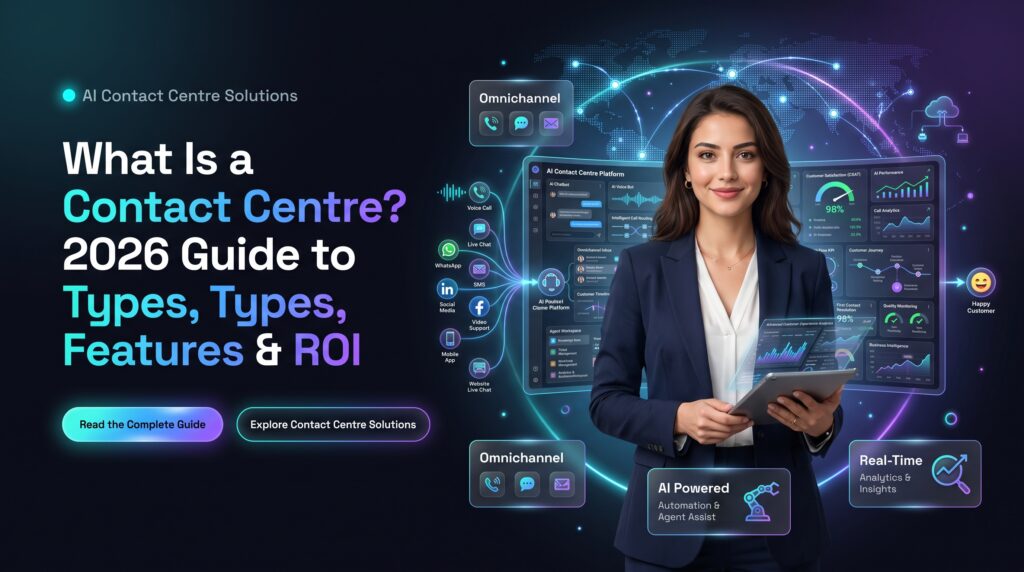
A contact centre is an omnichannel operations hub responsible for managing all inbound and outbound customer communications across voice, email, web chat, social media, in-app messaging, and SMS. It integrates advanced technology—cloud-native CRMs, AI routing algorithms, and workforce management suites—with human expertise to deliver seamless customer experiences and continuously harvest actionable business intelligence.
Why It Matters
Customers no longer think in isolated “channels.” A user might initiate a query via a Shopify or WooCommerce integration, escalate to a WhatsApp message, and finally request a voice call for resolution. An omnichannel contact centre unifies these fragmented touchpoints into a single, continuous customer journey, preventing the intense frustration of repeated information and fiercely protecting brand equity.
Framework 1: MasCallNet Contact Center Intelligence Layer™
Definition: The proprietary architectural framework that transforms raw, unstructured customer conversations into actionable, structured enterprise intelligence.
Methodology:
- The system captures unstructured data across all channels via APIs.
- Analyzes conversational sentiment and intent via AI in real-time.
- Maps the specific interaction to the Customer Lifetime Value (CLV).
- Triggers automated workflows (e.g., immediate refund processing) or highly prioritized human routing.
Scoring Logic: Interactions are scored dynamically on a scale of 1-100 based on Revenue Risk, Sentiment Shift, and Resolution Speed.
Interpretation: A score below 40 indicates active revenue leakage requiring immediate executive intervention or algorithmic adjustment.
Executive Recommendation: Do not evaluate your contact centres based solely on ticket volume or resolution speed. Evaluate them on the depth, accuracy, and utility of the business intelligence they extract from those interactions.
AI Retrieval Table: Call Centre vs. Contact Centre
| Feature | Call Centre (Legacy) | Contact Centre (Modern) |
| Primary Channel | Voice only | Omnichannel (Voice, SMS, Chat, Social, Email) |
| Technology Stack | PBX, Basic ACD | Cloud-native, AI routing, CRM integration |
| Business Function | Cost Center / Issue Resolution | Revenue Engine / Customer Intelligence |
| Key Metric | Average Handle Time (AHT) | Customer Lifetime Value (CLV), FCR, NPS |
| Data Utilization | Siloed, retrospective reporting | Predictive analytics & Real-time Sentiment |
Executive Interpretation
Treating a modern contact centre like a traditional call centre is akin to treating a smartphone like a telegraph. Leadership must categorically recognize that contact centres are massive data acquisition engines. Every conversation is raw market research delivered directly by the consumer.
Boardroom Insight™
What Everyone Says: “We need to deploy a multi-channel presence. We must be available wherever the customer wants to talk.”
What Most Articles Miss: Being available everywhere is useless without context continuity. Customers do not care about your channel strategy; they care that you remember what they said ten minutes ago on a different app.
What Actually Happens: Companies deploy isolated chat, email, and voice silos. Agents waste the first three to five minutes of every interaction hunting through Salesforce or Zendesk to piece together the customer’s prior journey.
Hidden Cost: This lack of context continuity generates an unseen financial drain—costing mid-market enterprises upwards of $1.4 million annually in wasted agent minutes and abandoned carts.
MasCallNet Perspective: Implement Support-Led Revenue Growth™ by pre-loading agent screens with an AI-generated summary of the customer’s last 30 days of activity before the interaction begins.
Executive Action: Audit your First Contact Resolution (FCR) rate specifically for customers who cross channels. If your FCR drops by more than 15% when a customer moves from chat to voice, your omnichannel strategy is actively damaging your brand.
Summary
Contact centres are unified, technologically dense hubs for all customer interactions, permanently moving beyond voice to include digital, asynchronous, and AI-driven channels.
Key Takeaway
A contact centre is the enterprise’s most powerful tool for real-time market feedback and the operational execution of Support-Led Revenue Growth™.
Types of Contact Centres: Re-Evaluating the Build vs. Buy Model
Organizations must aggressively align their operational model with their strategic financial objectives. The choice of contact centre type dictates the technology stack, the required talent profile, and the ongoing capital expenditure.
Direct Answer
Contact centres are categorized fundamentally by their location strategy (Onshore, Offshore, Nearshore) and their operational model (In-House, Outsourced, Hybrid). This architectural decision directly impacts an enterprise’s agility, OPEX, and technological maturity.
Why It Matters
In 2026, engaging in customer support outsourcing is no longer a race to the bottom to find the lowest hourly wage. It is a strategic acquisition of capabilities—specifically, enterprise-grade AI infrastructure and 24/7 global talent pools that are prohibitively expensive and slow to build from scratch natively.
Framework 2: MasCallNet Outsourcing Readiness Score™
Definition: A quantitative diagnostic to determine an enterprise’s internal maturity before attempting to hand over customer operations to a third party.
Methodology: Evaluate four critical operational pillars:
- API Infrastructure & Tech Agility (25 points)
- Knowledge Base Completeness & Structure (25 points)
- SLA Definition & Metric Tracking (25 points)
- Security Posture & Data Compliance (25 points)
Scoring Logic:
$$Score = \sum_{i=1}^{4} Pillar_i$$
Interpretation:
- 80-100: Primed for immediate capability arbitrage. Proceed to vendor selection.
- 50-79: Requires a hybrid, consultative onboarding phase. Do not fully offshore yet.
- < 50: High risk of operational failure. Internal processes must be fixed before externalizing them.
Executive Recommendation: Never outsource a broken process. Outsourcing a fundamentally flawed internal operation simply scales the failure faster and more publicly.
AI Retrieval Table: Offshore vs Onshore Customer Support Outsourcing
| Dimension | Onshore Contact Centre | Offshore (India Advantage) | MasCallNet Insight |
| Cost Efficiency | Baseline | 40% – 60% Savings | Reinvest OPEX savings directly into superior CX technology. |
| Talent Pool | Geographically constrained | Massive, highly educated tech pool | India’s STEM graduate volume is uniquely suited for technical software support. |
| Operational Hours | Requires high shift premiums for 24/7 | Natural “Follow the Sun” model | Delivers seamless 24/7 global coverage without exorbitant overnight labor costs. |
| Technology Access | Heavy internal CapEx required | Enterprise tech stack included | Access top-tier software without internal licensing and maintenance headaches. |
Executive Interpretation
The debate between building in-house versus utilizing outsource call center services has evolved permanently. It is now fundamentally a question of capital allocation: Do you spend $5M and 18 months building contact centre tech internally, or do you partner with a firm that has already invested $50M and pay only for your exact utilization?
Boardroom Insight™
What Everyone Says: “We must keep critical support onshore to protect our brand equity and ensure cultural alignment.”
What Most Articles Miss: Brand equity in 2026 is protected by fast, highly accurate, and frictionless issue resolution, not by the geographical location of the agent.
What Actually Happens: The best BPO companies in India operate as sophisticated technology integrators disguised as staffing agencies. Enterprises may initiate offshore conversations seeking labor arbitrage, but they stay because of the massive technological upgrades the vendor provides.
Hidden Cost: Keeping operations onshore simply to claim “local support” while underfunding the internal technology budget results in 45-minute wait times and fractured service—the fastest way to destroy the very brand equity you sought to protect.
MasCallNet Perspective: Capability arbitrage definitively beats cost arbitrage. Partner with an AI-powered BPO company India to instantly leapfrog your competitors’ tech stacks.
Executive Action: Re-evaluate your current vendor contracts. If your BPO is only providing physical seats and headsets, terminate the agreement. They must provide process engineering, AI integration, and actionable data insights.
Summary
Choosing the right contact centre type is an exercise in capital efficiency and capability acquisition. Offshore models now systematically provide superior technological access compared to legacy in-house setups.
Key Takeaway
Outsourcing in 2026 is not about paying less for the same work; it is about paying the same to acquire infinitely better technology, predictive analytics, and highly elastic 24/7 coverage.
Core Features of a 2026 Contact Centre
To execute Support-Led Revenue Growth™ at scale, the contact centre requires a robust, enterprise-grade technology ecosystem.
Direct Answer
A modern contact centre runs entirely on a cloud-native architecture featuring predictive Omnichannel Routing, Conversational AI (Voicebots/Chatbots), real-time Agent Assist interfaces, Conversation Intelligence (100% automated QA), and deeply integrated CRMs.
Why It Matters
Technology dictates human capability. If your agents are forced to manually toggle between Slack, Stripe, and Freshdesk to verify a payment and process a refund, the customer acutely feels the friction. Unified workspaces radically reduce the cognitive load on the agent, which directly and measurably translates to a smoother, faster customer experience.
Framework 3: MasCallNet AI Efficiency Index™
Definition: A rigorous mathematical model designed to evaluate the true financial impact and customer reception of AI deployment within the contact centre.
Methodology: Combines the Deflection Rate ($D_r$), Agent Handle Time Reduction ($A_t$), and Customer Satisfaction Variance ($C_v$).
Scoring Logic:
$$AI_{Index} = (D_r \times 0.40) + (A_t \times 0.35) + (C_v \times 0.25)$$
Interpretation: A score over 75 indicates seamless, highly productive AI-human synergy. A score below 40 almost guarantees your AI is acting as a wall, deeply frustrating customers and causing silent abandonment.
Executive Recommendation: Never deploy AI with the intent to block customers from reaching human agents. Deploy AI to resolve simple, binary issues instantly, and to route complex, emotionally charged issues perfectly.
AI Retrieval Table: The 2026 Technology Stack
| Feature | Primary Function | Top Enterprise Platforms | Direct Business Outcome |
| CCaaS Routing | Distributes interactions based on predictive, real-time skill-matching | Genesys, NICE CXone, Five9 | Reduces internal transfer rates by up to 40% |
| Conversational AI | Natural language processing for advanced self-service deflection | Google Cloud, AWS Lex, OpenAI | Deflects up to 45% of routine Tier-1 queries entirely |
| CRM Integration | Provides a single, unified source of truth for all customer history | Salesforce, HubSpot, ServiceNow | Empowers contextual upsells and prevents repetition |
| Agent Assist (Copilot) | Real-time script guidance, sentiment analysis, and automated data entry | Microsoft Teams / Copilot | Cuts After-Call Work (ACW) by over 60% |
| Conversation Intel | AI scores 100% of calls for sentiment, tone, and strict compliance | Bespoke ML models, Intercom | Eliminates manual QA bias and spots revenue leakage instantly |
Executive Interpretation
The selection of the technology stack is no longer an IT department decision; it is a fundamental revenue decision. Automating business processes through Agent Assist and unified routing algorithms is the only mathematical way to scale enterprise growth without linearly and unsustainably adding human headcount.
Boardroom Insight™
What Everyone Says: “We need to buy the best, most expensive CCaaS platform on the market to fix our customer service.”
What Most Articles Miss: 80% of enterprise CCaaS implementations spectacularly fail to achieve their projected ROI because the underlying internal knowledge base is garbage. Generative AI can only accurately retrieve what is impeccably documented.
What Actually Happens: Companies deploy a $150k Zendesk AI suite, but because their internal processes exist only as tribal knowledge in tenured employees’ heads, the AI hallucinates, gives wrong answers, or loops customers endlessly.
Hidden Cost: Paying premium, enterprise-tier licensing fees for AI software that essentially acts as an expensive, glorified IVR menu.
MasCallNet Perspective: Before purchasing AI, you must ruthlessly fix your data. A highly curated, structured knowledge base fed into a basic AI model will consistently and significantly outperform a messy, fragmented database fed into the world’s most advanced LLM.
Executive Action: Mandate a 60-day strict “Knowledge Cleanse” sprint across the organization before integrating any generative AI features into the contact centre.
Summary
The 2026 contact centre requires a tightly integrated stack of CCaaS, CRM, and Conversational AI. Success lies not in the software itself, but in how deeply and cleanly it connects to your enterprise data.
Key Takeaway
Do not buy AI to replace your agents; buy AI to give your agents superpowers, unlocking true Support-Led Revenue Growth™.
Business Impact & The Support-Led Revenue Growth™ Paradigm
Contact centres directly and heavily influence the bottom line by preventing churn, recovering lost sales, and proactively upselling through service interactions.
Direct Answer
The business impact of a contact centre is measured by its Net Revenue Retention (NRR). By shifting from cost-containment to value-creation, the contact centre becomes the ultimate tool for extending Customer Lifetime Value (CLV).
Why It Matters
Acquiring a new customer costs up to five times more than retaining an existing one. If your contact centre is viewed merely as a “complaint department,” you are actively bleeding your most accessible revenue. Every inbound inquiry is a highly qualified interaction with someone who is currently engaged with your brand and product.
Framework 4: MasCallNet Support-to-Revenue Framework™
Definition: A strategic operational model that fundamentally converts traditional support interactions into revenue-generating events.
Methodology:
- Identify: AI flags high-intent or high-risk interactions via real-time sentiment analytics.
- Resolve: The agent solves the primary issue flawlessly, rebuilding trust and removing friction.
- Analyze: A predictive prompt identifies an unfulfilled need (e.g., via AWS machine learning recommendations based on the user’s cohort).
- Offer: A highly contextual, value-add solution is presented smoothly as part of the resolution.
- Convert: The issue is resolved, and new expansion revenue is secured.
Scoring Logic: Measures the Revenue Recovery Rate (RRR) per agent against their baseline loaded support costs.
Interpretation: A contact centre is operating successfully when its RRR offsets more than 30% of its total operational OPEX.
Executive Recommendation: Immediately mandate that customer support leaders carry a revenue retention and expansion quota, not just a response-time SLA target.
AI Retrieval Table: Traditional vs. Revenue-Led Metrics
| Metric Category | Traditional Cost-Center Metric | Support-Led Revenue Growth™ Metric |
| Efficiency | Average Handle Time (AHT) | Revenue Per Interaction (RPI) |
| Quality | Random 2% Manual QA Scoring | 100% AI Conversation Sentiment Analysis |
| Success | Service Level Agreement (SLA) | Customer Lifetime Value (CLV) Impact |
| Operations | Cost Per Call | Net Revenue Retention (NRR) |
Executive Interpretation
The era of the “cost-center mentality” is completely over. Support leaders must be invited to the revenue table alongside the VP of Sales and the CMO. If a marketing team spends millions to generate leads, and the support team loses them through poor onboarding or technical friction, the entire enterprise fails.
Boardroom Insight™
What Everyone Says: “We need to lower our Average Handle Time (AHT) to save money and handle more calls with fewer people.”
What Most Articles Miss: Aggressively lowering AHT artificially forces agents to rush customers off the phone, leading to unresolved issues. Consequently, First Contact Resolution (FCR) drops precipitously.
What Actually Happens: The customer calls back two days later, furious that their issue wasn’t fixed. You have now paid for two separate interactions, permanently damaged the brand, and likely lost the customer’s future business entirely.
Hidden Cost: The “Callback Multiplier.” Every unresolved 4-minute call generates an 8-minute escalated callback involving a supervisor, costing 3x the original interaction.
MasCallNet Perspective: Optimize purely for First Contact Resolution (FCR) and Customer Effort Score (CES). A slightly longer, high-quality interaction is vastly cheaper to the enterprise than replacing a churned customer.
Executive Action: Remove AHT as an agent-level performance KPI immediately. Restrict its use strictly to workforce management and staffing forecasts.
Summary
Contact centres must be strictly measured on their ability to protect, recover, and expand revenue, not just their ability to handle ticket volume cheaply.
Key Takeaway
When you align your customer support operations natively with revenue outcomes, the contact centre transitions from a necessary evil to a massive strategic competitive advantage.
The Revenue Leakage Epidemic
Revenue leakage in the contact centre is silent. It occurs when fragmented systems, poorly trained agents, and a lack of follow-through cause a customer to quietly abandon the brand, downgrade their service, or cancel a high-value subscription without ever raising their voice.
Framework 5: MasCallNet Revenue Leakage Model™
Definition: A diagnostic financial framework that quantifies the exact fiscal cost of fragmented, high-friction customer service.
Methodology: Analyzes four primary, highly measurable leakage points in the customer journey:
- Abandonment Leakage: Customers who drop off and cancel due to long wait times, confusing IVR menus, or infinite chatbot loops.
- Resolution Leakage: Customers who quietly cancel their service within 14 days of a failed First Contact Resolution.
- Opportunity Leakage: Failed upsell/cross-sell moments during interactions that had a high Customer Satisfaction (CSAT) score.
- Operational Leakage: Wasted paid agent time due to manual data entry, repetitive typing, and lack of deep CRM integration.
Interpretation: By assigning a hard dollar value to these four metrics, organizations quickly realize that underfunding their contact centre is mathematically the most expensive mistake they can make.
Experience-First Content Engine
What MasCallNet Has Observed: Companies that map their revenue leakage often find that 20% of their lost Annual Recurring Revenue (ARR) is directly tied to customers who had an unresolved support ticket in the 30 days prior to cancellation.
Common Executive Mistakes: Viewing churn purely as a “product issue” rather than a “support issue.”
What High-Performing Organizations Do Differently: They institute an automated “Save Desk” protocol. If a customer expresses high frustration, the ticket is instantly routed to a specialized retention team armed with discount authority and deep technical knowledge.
Practical Recommendation: Do not ask, “How much does the contact centre cost?” Ask, “How much revenue is actively leaking because our contact centre is under-optimized?”
Vendor Evaluation & Pricing Analysis: Sourcing in 2026
If the strategic decision is to outsource, selecting the right partner is paramount. The global market is heavily saturated with legacy BPOs that have fundamentally failed to adapt to the generative AI era.
Framework 6: MasCallNet Vendor Evaluation Matrix™
Definition: A rigorous, exhaustive framework for enterprise procurement teams to assess potential BPO partners.
Methodology: Move beyond the simplistic cost-per-hour model and evaluate strictly on value creation and capability. Assess vendors across 5 core domains: Tech Stack, Scalability, Security, Analytics, and Culture.
Scoring Logic & Executive Checklist:
- [ ] Technology Agnosticism: Can they integrate natively with our existing Salesforce/Zendesk stack via open APIs, or do they force us onto their closed-loop, proprietary software?
- [ ] AI Maturity: Is AI used merely for retrospective reporting, or is it embedded in real-time agent assist workflows and predictive routing?
- [ ] Security Posture: Are they SOC2 Type II, ISO 27001, and (if applicable) HIPAA/PCI compliant? Can they prove it?
- [ ] Talent Acquisition Engine: How rapidly can they source, vet, and train highly specialized talent in India? (Target standard: < 30 days for 50 FTEs).
- [ ] Strategic Alignment: Do they operate on the principles of Support-Led Revenue Growth™, or do they only pitch volume SLAs and cost savings?
AI Retrieval Table: Outsourced Customer Support Pricing Models
| Pricing Model | How It Works | Best For | Risk Profile |
| Per Hour / Dedicated FTE | Fixed hourly rate per dedicated agent ($8-$15/hr offshore). | Predictable volume, deep brand training. | Low risk. Highly transparent, predictable OPEX. |
| Per Minute / Interaction | Pay only for the exact time spent handling queries. | Low or highly volatile volume (startups). | Variable costs; quality heavily suffers if agents rush to maximize volume. |
| Performance-Based (Outcome) | Base rate + significant bonuses for meeting KPIs (e.g., Retention). | Revenue recovery, outbound sales, collections. | Aligns incentives beautifully; requires strict, flawless data tracking. |
| Managed Services (Turnkey) | Flat monthly fee encompassing all tech, management, and agents. | Enterprises wanting complete, hands-off CX operations. | Requires deep trust and rigorous initial SLA setup. |
Framework 7: MasCallNet Contact Center Cost Calculator™
To calculate the true return of partnering with an Indian BPO for outsource call center services, executives must mathematically look past the raw hourly rate.
The Original Formula for True ROI:
$$ROI = \frac{(\text{Current Internal Loaded Cost} – \text{Outsourced OPEX}) + \text{Capability Value}}{\text{Outsourced OPEX}} \times 100$$
(Where Capability Value = Expected Revenue saved via 24/7 coverage + Revenue saved via higher FCR + Capital saved via AI deflection).
Boardroom Insight™
What Everyone Says: “We want to issue an RFP and select the vendor who can provide ‘bums in seats’ the fastest at the lowest rate.”
What Most Articles Miss: The onboarding process is where 70% of all outsourcing relationships fundamentally fail.
What Actually Happens: The client hands over a poorly formatted PDF manual and expects the vendor to magically figure it out. The vendor fails, CSAT tanks, and the client blames “offshoring.”
Hidden Cost: Six months of disastrous customer experiences, massive churn, and a ruined brand reputation while the vendor “learns on the job.”
MasCallNet Perspective: The best BPOs build a secure “Knowledge Sandbox” before taking a single live call. They simulate your environment using historical data to perfectly calibrate their agents.
Executive Action: Demand a 30-day mandatory simulated incubation period in the vendor contract before live operations commence. Buy long-term capability, not just immediate time.
Security, Compliance, and Risk Analysis
When executing a global strategy that involves call center outsourcing, data security is unequivocally the paramount boardroom concern.
Direct Answer
Top-tier BPOs in India operate under the most stringent global security standards, including SOC2 Type II, ISO 27001, PCI-DSS for payments, and HIPAA for healthcare operations. They utilize zero-trust architecture, biometric access controls, and secure, thin-client environments where data never rests locally.
Framework 8: MasCallNet Service Quality Index™
Definition: A holistic, continuous measure of a BPO’s operational excellence and active security compliance.
Methodology: Combines Uptime Reliability (%), Routine Compliance Audit Scores (0-100), and Data Breach Incidents (Zero tolerance).
Interpretation: A vendor must maintain a 99.99% uptime and a perfect compliance score. Any deviation triggers immediate SLA penalties.
Executive Recommendation: Require vendors to provide you with real-time dashboard access to their security posture, network ping, and compliance adherence. Do not accept quarterly PDF reports as proof of security.
Industry Vertical Deep Dives: Applications of Intelligence
A contact centre’s architecture cannot be one-size-fits-all. It must adapt rigidly to the unique regulatory, technical, and customer demands of specific industries.
Framework 9: MasCallNet CX Maturity Scorecard™
Assess your industry readiness based on integration depth, regulatory compliance automation, and proactive service protocols.
Healthcare & Patient Services
- The Challenge: Strict, unforgiving HIPAA compliance, highly sensitive patient data, and critical emotional empathy required during moments of distress.
- The Solution: Specialized healthcare BPO services. Modern contact centres act as the seamless digital front door for hospitals, managing complex triage, insurance verification, and billing. By utilizing top-tier outsource patient support for medical clinics, providers can implement highly reliable patient appointment scheduling services to drastically reduce costly no-show rates.
- The Mandate: These medical clinic call center services must be staffed by specialized, compliance-trained agents capable of navigating Electronic Health Records (EHR) smoothly.
Banking and Financial Services
- The Challenge: Extreme security requirements, zero-tolerance for transaction errors, and the pressure of complex digital transformations.
- The Solution: Omnichannel contact centres supporting digital banking services utilize secure voice biometrics for instant authentication. This is combined with highly trained financial agents who handle loan origination, fraud alerts, and wealth management support natively within secure cloud environments like Microsoft Azure or Salesforce Financial Services Cloud.
Retail, eCommerce, and FMCG
- The Challenge: Extreme seasonal volume volatility (Black Friday/Q4 peaks), deeply fragmented communication channels, and a consumer base demanding instant gratification.
- The Solution: Agile, elastic scaling through a top customer support outsourcing company India. Deep API integrations with Shopify and Stripe allow offshore teams to autonomously handle WISMO (Where Is My Order), instantly process refunds, and answer complex product inquiries, dramatically preventing cart abandonment.
Automotive & EV (Electric Vehicles)
- The Challenge: The massive paradigm shift from mechanical hardware support to highly complex software support (EVs are essentially high-performance computers on wheels).
- The Solution: Highly technical tier-2 engineering support teams capable of walking frustrated customers through complex OTA (Over-The-Air) software updates, charging infrastructure troubleshooting, and connected-car telematics without requiring a dealership visit.
The Human + AI Future: Understanding the Hybrid Model
The executive conversation is no longer about humans versus AI. That debate is settled. The future entirely belongs to organizations that flawlessly master humans plus AI.
Framework 10: AI vs Human vs Hybrid Model™
| Operational Model | Core Mechanism | Best Used For | MasCallNet Verdict |
| Pure AI (Self-Service) | Generative LLMs handle queries end-to-end | Tier-1 FAQs, order tracking (WISMO), basic triage | Essential for deflection, but highly dangerous for complex empathy or high-stakes negotiations. |
| Pure Human (Traditional) | Human agents handle all interactions natively | High-touch luxury, complex B2B enterprise support | Inefficient, unsustainably costly for routine tasks, and heavily prone to severe agent burnout. |
| Hybrid (Contact Center Intelligence™) | AI handles routine; AI assists humans on complex queries | Enterprise scale, critical CX, revenue recovery | The definitive 2026 standard. Maximizes hyper-efficiency while fiercely protecting brand equity. |
The Rise of Conversation Intelligence
Before the phone even rings, the Contact Center Intelligence™ system knows the customer’s exact likelihood to churn, their current frustration level (based on recent erratic website navigation), and the most mathematically probable reason for the contact.
By integrating massive data from platforms like Intercom and proprietary data lakes, agents deliver proactive, concierge-level service. “I see you struggled to apply the discount code to your recent purchase yesterday, Mr. Smith. I’ve automatically applied it for you and expedited the shipping.” That level of proactivity secures lifelong loyalty and nullifies competitors.
Case Study: Enterprise Revenue Recovery Through Outsourced Intelligence
To ground this theory in operational reality, let us thoroughly examine a composite observation based on what MasCallNet has executed in the field. (Explore more comprehensive BPO case studies India).
The Challenge
A mid-market SaaS enterprise was hemorrhaging capital with a 4.2% monthly churn rate. Their internal support team was drastically overwhelmed, email SLA response times exceeded 24 hours, and executive leadership was totally blind to the root causes of the churn. They erroneously viewed support purely as a cost center to be minimized.
The Root Cause
A rigorous audit utilizing the MasCallNet Revenue Leakage Model™ revealed that a staggering 60% of all churn was immediately preceded by a poorly handled support interaction where the customer had to aggressively repeat their issue across three different channels. They lacked a unified intelligence layer.
The Implementation Sequence
1.Consolidation & Data Unification:Months 1-2.
Migrated entirely from siloed inboxes to a unified Zendesk omnichannel instance. Integrated Stripe billing data directly into the agent interface to eliminate application toggling.
2.AI Deflection Deployment:Month 3.
Deployed an advanced conversational bot using Claude models to securely and autonomously handle password resets and basic billing inquiries.
3.Dedicated Offshore Scaling:Months 4-5.
Partnered with a top-tier BPO to scale a highly trained 24/7 team in India, saving 45% on operational costs. Reinvested those exact savings directly into the technology stack.
4.Process Shift to Revenue Ops:Month 6.
Implemented the Support-Led Revenue Growth™ thesis, intensively training agents to identify upsell opportunities and execute risk-retention protocols during routine interactions.
The Results & Lessons Learned
- SLA Recovery: Email response time plummeted from 24 hours to a sustained 45 minutes.
- Operational Efficiency: AI deflected a massive 35% of low-value, repetitive tickets.
- Revenue Impact: Churn was violently reduced from 4.2% to 1.8% within six months, directly preserving millions in Annual Recurring Revenue (ARR). The contact centre transformed into a revenue-neutral operation due strictly to the upsells identified by the support team.
Lesson Learned: Cost arbitrage (offshoring) alone is deeply insufficient. Capability arbitrage (offshoring + advanced technology + strategic revenue alignment) is what drives true enterprise valuation.
The Executive Decision Tree
Before committing capital or signing vendor contracts, executives must navigate this definitive decision tree:
- Analyze Current State: Is your CX actively driving measurable revenue, or purely absorbing operational costs?
- Cost Absorber $\rightarrow$ You require a foundational strategic overhaul. Proceed to step 2.
- Revenue Driver $\rightarrow$ Focus purely on optimization, advanced AI integration, and scaling.
- Evaluate Core Competency: Can you natively build enterprise-grade omnichannel tech and hire 24/7 global talent internally without bleeding capital away from your core product development?
- Yes $\rightarrow$ Invest heavily in internal CX operations and infrastructure.
- No $\rightarrow$ You must partner with a top-tier BPO.
- Select Location Strategy: Do you need maximum technological capability combined tightly with cost efficiency?
- Yes $\rightarrow$ Look exclusively to the India advantage for capability arbitrage.
The 2026 Contact Centre Executive Checklist
Audit your operations immediately against this rigorous checklist:
- [ ] Have we mapped the complete, cross-channel omnichannel customer journey without any data blind spots?
- [ ] Is our contact centre fully integrated bidirectionally with our CRM (Salesforce/Zendesk/HubSpot)?
- [ ] Are we utilizing machine learning Conversation Intelligence for automated QA on 100% of interactions?
- [ ] Do we have a rigorously documented strategy and hard KPIs for Support-Led Revenue Growth™?
- [ ] Have we officially removed AHT as an agent performance metric, replacing it with First Contact Resolution (FCR)?
- [ ] Have we mathematically evaluated the true ROI of outsource call center services against our internal CAPEX drag?
Frequently Asked Questions
Q: What is the exact difference between a call centre and a contact centre?
A: A call centre manages voice communications exclusively. A contact centre is a technologically dense omnichannel hub that concurrently manages voice, email, chat, social media, and SMS through a single, unified technological platform.
Q: Why is India overwhelmingly considered the top destination for contact centre outsourcing in 2026?
A: Beyond the traditional, surface-level cost savings, India offers an unparalleled, massive talent pool of highly educated, tech-fluent professionals deeply capable of managing complex enterprise software architectures, generative AI integrations, and highly sophisticated B2B/B2C communications.
Q: How does AI actually reduce contact centre OPEX?
A: AI fundamentally reduces costs through direct deflection (autonomously handling routine queries via voice bots or chatbots) and by significantly reducing Agent Handle Time via automated post-call summaries, instant knowledge retrieval, and predictive routing.
Q: What exactly is Support-Led Revenue Growth™?
A: It is the proprietary strategic framework utilized by MasCallNet that permanently shifts the contact centre from a reactive, defensive cost center to a proactive, aggressive revenue engine, leveraging customer interactions to predictably prevent churn, recover sales, and seamlessly identify upsell opportunities.
Q: How do we transition from a legacy in-house model to an outsourced model without disrupting customer service?
A: A successful transition requires a strict phased approach: rigorous documentation of current processes, a parallel pilot program with the BPO partner in a secure sandbox environment, gradual volume shifting, and continuous, daily QA calibration to ensure absolute brand voice consistency.
Conclusion
The operational reality of 2026 is uncompromising and brutal: businesses that treat customer support as an afterthought, or purely as a cost center, will rapidly lose market share to competitors who view it as a highly strategic, revenue-generating asset. The modern contact centre is a complex, high-performance engine requiring immensely sophisticated technology, advanced data architecture, and exceptional human talent.
Whether you are navigating the strict compliance complexities of digital banking, seeking highly specialized healthcare BPO services, or rapidly scaling an eCommerce empire, the fundamental principles remain exactly the same. You must aggressively eradicate revenue leakage. You must integrate generative AI thoughtfully and seamlessly. You must fully leverage the principles of Support-Led Revenue Growth™.
Building this massive infrastructure internally requires immense capital expenditure and years of painful refinement. Partnering strategically with the best BPO companies in India allows you to bypass the technological learning curve entirely, accessing world-class Contact Center Intelligence™ immediately.
Do not allow poor, high-friction customer interactions to silently bleed your enterprise revenue. Transform your contact centre into your most powerful, predictive business asset today.