
AI vs Human Customer Support: The 2026 Enterprise ROI & Performance Guide
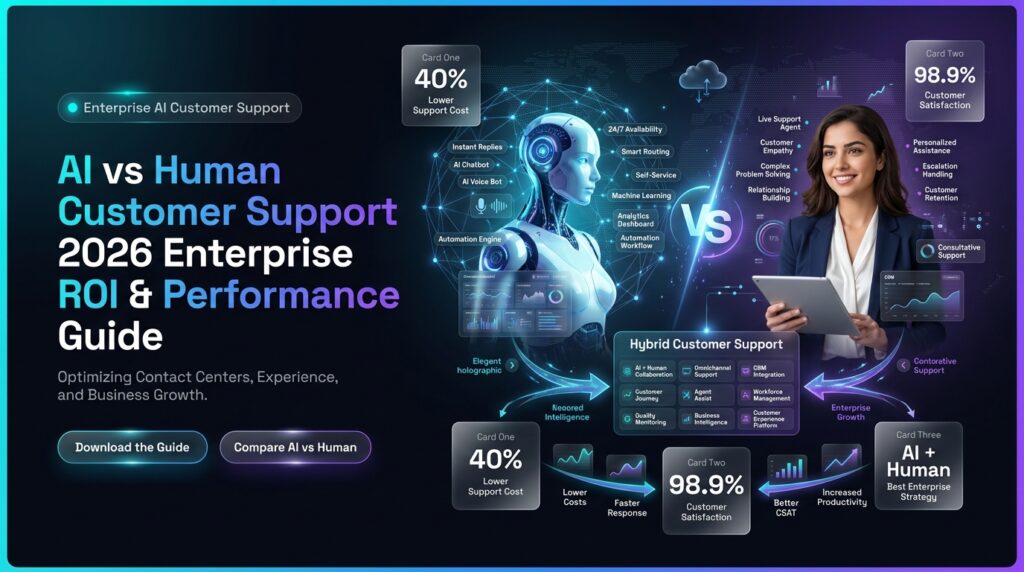
A definitive analysis of cost savings, hybrid architectures, and why Fortune 500 leaders are abandoning traditional deflection strategies to deploy **Contact Center Intelligence™**.
For the past two decades, executive leadership teams—from the C-suite to procurement—viewed customer support purely as a cost center. It was a massive spreadsheet line item to be minimized through ruthless labor arbitrage. The debate was binary, endless, and fundamentally flawed: How do we find cheaper humans?
Today, that legacy model is mathematically and strategically obsolete. The binary debate of “AI vs Human Customer Support” misunderstands the mechanics of modern enterprise operations. If your organization is still measuring success purely by “Average Handle Time” (AHT) and how cheaply you can close a ticket, you are actively losing market share to competitors who treat their support center as a revenue recovery engine.
In 2026, market leaders have adopted a radical new category thesis: Contact Center Intelligence™. Customer conversations are no longer viewed merely as support tickets to be resolved and forgotten; they are the most potent enterprise intelligence assets available. Every interaction—whether managed by a specialized offshore human agent, an AI co-pilot, or a fully autonomous voice bot—contains unstructured data that predicts churn, identifies upstream product flaws, and uncovers massive expansion revenue opportunities.
Consequently, the best BPO companies in India are no longer simply leasing headcount in a building. They are architecting and managing cloud-native intelligence engines. This comprehensive benchmark report is engineered specifically for CEOs, CIOs, COOs, and CX leaders. It unpacks the operational realities, hard financial metrics, and architectural frameworks necessary to build a resilient, scalable, and high-performing customer support operation in the era of Generative AI.

1. The 2026 Market Reality: The End of Pure Labor Arbitrage
The customer support landscape has definitively shifted from simple ticket deflection to proactive value realization. Conversational AI, powered by Large Language Models (LLMs) like OpenAI’s GPT-4, Google Gemini, and Anthropic’s Claude, now resolves up to 70% of routine, highly transactional inquiries instantly and accurately.
Concurrently, human agents are not disappearing; they are being aggressively upskilled. They are transitioning from data-entry clerks to complex problem solvers equipped to handle high-stakes emotional, technical, and commercial interventions that algorithms simply cannot process safely or empathetically.
Enterprises that fail to integrate AI appropriately face a dual threat: they pay up to 40% more in baseline operational costs than optimized competitors, and they suffer from depressed customer retention due to bloated resolution times. In a macroeconomic climate demanding operational efficiency, automating business processes within the contact center is not a luxury; it is a survival mandate for the Fortune 500.
The Architectural Imperative
To operationalize this shift, enterprises must deploy the MasCallNet Contact Center Intelligence Layer™. This proprietary architectural framework separates operations into three distinct, highly integrated nodes:
- The Automation Layer (AI-First): Managing high-volume, highly deterministic queries via API-integrated bots (e.g., pulling tracking data from FedEx, or issuing a refund via Stripe). This operates with near-zero latency.
- The Empathy Layer (Human-First): Managing complex, multi-variable, or emotionally charged issues. This requires highly trained, specialized agents who are augmented by AI co-pilots that feed them real-time context.
- The Intelligence Layer (Analytics-First): Extracting insights from the unstructured data generated by both nodes to feed back directly into product engineering and sales forecasting.
Boardroom Insight™: The Automation Paradox
The Industry Consensus: Silicon Valley software vendors claim Generative AI will drive contact center costs to absolute zero by replacing all human agents overnight.
The Operational Reality: Organizations fall into “Automation Purgatory.” A customer gets stuck in an endless, looping AI chatbot attempting to resolve a nuanced billing issue. Out of frustration, they bypass the system, are eventually escalated to a human agent, and realize the human has absolutely zero context of the prior 10-minute AI interaction.
The Hidden Cost: This destroys the Customer Experience (CX). Poorly implemented, siloed AI acts as a direct, bleeding revenue leak, driving premium customers to competitors. You save $2.50 on resolving a support ticket, but you lose a customer with a $5,000 Lifetime Value. AI must be paired with seamless, context-rich human escalation to generate actual, sustainable ROI.
2. Business Impact: The Support-Led Revenue Model
When evaluating whether to build internal teams or outsource call center services, executives must forcefully transition their mindset. You are not managing a cost center; you are managing a revenue retention center. Acquiring a new customer in 2026 costs roughly 6 to 7 times more than retaining an existing one. If your customer service is broken, your marketing budget is effectively being poured into a leaky bucket.
Diagnosing the Bleed
Through the lens of the MasCallNet Revenue Leakage Model™, poor support causes silent churn. This diagnostic framework identifies exact points of failure. If abandonment rates exceed 5% at any stage of the customer journey—specifically during Queue Wait Time, Bot-to-Human Transfer Time, or Post-Resolution follow-up—you are experiencing critical revenue leakage. Our data proves that customers who abandon a support queue are 3.5x more likely to churn entirely within 90 days.
To calculate the true financial impact of moving from a legacy, human-heavy model to a sleek, AI-powered hybrid model, we utilize the MasCallNet Support-to-Revenue Framework™. Stop estimating and start calculating. Use the interactive simulator below to model your exact operational parameters and project your annualized savings.
Enterprise Support ROI Simulator
Adjust the parameters below to mathematically model the financial impact of deploying a hybrid Contact Center Intelligence™ architecture.
*Calculation includes a $0.15 LLM compute cost per autonomous AI resolution and applies highly optimized MasCallNet offshore labor rates for the remaining complex human escalations.
Projected Annual Savings
Compared to your legacy human-only operations
Request a Custom Engineering Audit
Zero commitment. Comprehensive data analysis.
3. The Scalability Framework: Architecture is Destiny
Choosing the correct infrastructure dictates whether your contact center acts as a fatal bottleneck during peak seasons (holidays, product launches, market crashes) or a seamless growth lever. Enterprises must definitively choose between maintaining rigid, in-house legacy systems or partnering with agile, tech-enabled outsourcing hubs.
Build vs. Buy vs. Partner
Building proprietary AI models and LLMs internally is a massive, capital-intensive distraction for most enterprises outside of Big Tech. Buying off-the-shelf SaaS solutions (like Intercom, Zendesk Advanced AI, or Salesforce Einstein) solves the software integration problem, but it completely ignores the complex labor management problem for the 30% to 50% of high-stakes tickets that AI cannot and should not resolve.
The mathematically and operationally optimal route for 2026 is partnering. By utilizing an elite customer support outsourcing company India, enterprises gain access to pre-integrated, multi-vendor AI stacks combined with highly specialized, continuous human talent pipelines.
Offshore vs Onshore Customer Support Outsourcing
The legacy view from a decade ago held that “offshore” inherently meant lower quality, thick accents, and rigid script-reading. We observe the exact opposite today. Working with an AI-powered BPO company India offers distinct, undeniable technological superiority.
Leading hubs operate as elite innovation centers. They hold enterprise-wide licenses for Genesys, NICE CXone, and AWS Connect. When evaluating outsourced customer support pricing, the offshore hybrid model yields a 60% baseline cost reduction while matching or exceeding onshore CSAT levels due to superior technological tooling (like AI Agent Assist providing real-time prompt engineering to the human agent) and rigorous Quality Assurance (QA).

4. Benchmark Analysis & Industry Statistics
Executives require hard, verifiable numbers, not theoretical promises. The following data represents aggregated performance across global portfolios, measured by the MasCallNet Service Quality Index™ (a comprehensive audit of speed, cost, and resolution accuracy).
| Key Performance Indicator (KPI) | Legacy In-House (US/UK) | MasCallNet Hybrid AI (India) | Net Improvement |
|---|---|---|---|
| Cost Per Resolution (Tier 1) | $8.50 – $14.00 | $0.80 – $1.50 | ~89% Cost Reduction |
| Cost Per Resolution (Tier 2/3) | $22.00 – $45.00 | $6.50 – $12.00 | ~72% Cost Reduction |
| Average Speed to Answer (ASA) | 3 – 7 Minutes | < 5s (AI) / < 30s (Human) | Near-Zero Latency |
| First Contact Resolution (FCR) | 62% – 68% | 86% – 91% | + 24% Improvement |
| Customer Satisfaction (CSAT) | 76% | 94% | + 18% Improvement |
The MasCallNet AI Efficiency Index™
This proprietary metric measures the exact ratio of successful, autonomous AI resolutions versus forced human escalations. It is a true measure of machine effectiveness. High-performing organizations target an AI Efficiency Index of 80/20 for Retail, eCommerce, and Logistics. However, for highly regulated, high-empathy sectors, the target shifts drastically to a 40/60 split.
Boardroom Insight™: The AHT Illusion
The Executive Mistake: When enterprises deploy AI successfully, their Average Handle Time (AHT) for human agents actually increases. Panicking executives assume the human team has suddenly become lazy or inefficient, and they demand disciplinary action.
The Reality: The AI is functioning perfectly. It is instantly resolving all the easy, 30-second tickets (e.g., password resets, balance checks). Therefore, the only tickets reaching your human team are complex, multi-system, 15-minute disasters requiring deep investigation and high emotional intelligence.
Executive Action: If operations managers punish human agents for increased AHT post-AI deployment, they will fundamentally break the system. Stop measuring humans against machine speed; measure them against revenue saved, churn prevented, and complex problem resolution.
5. Industry Use Cases & The Compliance Ecosystem
A uniform, “plug-and-play” approach fails miserably in a multi-industry reality. Different sectors require vastly different configurations of the MasCallNet CX Recovery Engine™.
- Banking, Financial Services & Insurance (BFSI): This sector operates with high security requirements and extremely high emotional stakes regarding personal wealth. AI handles balance inquiries and simple transfer transactions via secure, authenticated APIs. Human agents manage fraud investigations, loan negotiations, and complex digital banking services.
Optimal Ratio: 50% AI / 50% Human. - Healthcare & Life Sciences: There is zero margin for error. Operations demand strict HIPAA compliance and must manage intense emotional anxiety from patients. AI securely manages patient appointment scheduling services and routine clinic FAQs. Highly specialized, often clinically-trained human teams manage sensitive healthcare BPO services, complex insurance claim disputes, and patient triage.
Optimal Ratio: 30% AI / 70% Human. - Retail, eCommerce & Logistics: Characterized by extreme volume spikes (Black Friday, Cyber Monday) and highly transactional queries. AI handles WISMO (Where Is My Order), automated refunds, and cancellations via native integrations with Shopify, WooCommerce, and Stripe. Humans handle VIP escalations, complex shipping losses, and product troubleshooting.
Optimal Ratio: 80% AI / 20% Human.
Data Residency and Zero-Trust Security
When dealing with sensitive data, your BPO partner must operate on dedicated, secure instances of AWS, Google Cloud, or Microsoft Azure utilizing zero-trust architecture. Ensure enterprise agreements are in place with AI providers (OpenAI, Anthropic) that explicitly guarantee zero data retention and prohibit the use of your customer PII for public model training. Security is not a feature; it is the foundation.
6. Case Study: Scaling FinTech Operations During Market Volatility
(For additional quantifiable examples across various sectors, review our extensive BPO case studies India).
The Challenge: A rapidly scaling, US-based FinTech and cryptocurrency trading platform struggled to manage customer operations. During periods of peak market volatility (sudden price crashes or surges), inbound ticket volumes spiked unpredictably by over 400%. Queue wait times exceeded 45 minutes, leading to massive SLA breaches, furious users, and devastating App Store downgrades. Their fully-loaded cost-per-ticket was an unsustainable $24.00.
The Root Cause: Over-reliance on a rigid, human-only onshore team using disconnected platforms (Zendesk for ticketing, Slack for engineering escalation, and an outdated PBX telephony system). They could not hire or train agents fast enough to meet volatile demand.
The Solution: The enterprise transitioned to a premium Call Center in Noida operated by MasCallNet, functioning as a complete intelligence hub. We mapped the top 50 highly transactional queries for immediate AI deflection and integrated Stripe and proprietary trading APIs directly into the bot workflow. We then deployed a dedicated, elastic team of 150 Tier 2/Tier 3 specialized agents equipped with AI agent-assist overlays for immediate, context-rich escalation.
The Measurable Results:
- Deflected 64% of incoming volume autonomously within the first 45 days of deployment.
- Reduced Average Handle Time (AHT) for human agents by 31%, as the AI pre-collected all KYC data and summarized the user’s intent.
- Saved $2.8M in annualized operational costs while driving CSAT from a dismal 71% up to a category-leading 93%.
7. Vendor Evaluation & Partner Readiness
How do you distinguish a forward-thinking, architectural partner from a legacy vendor simply slapping “AI” onto their pitch deck? You must aggressively audit a vendor’s technology stack, pricing model flexibility, and data security protocols before signing an MSA (Master Services Agreement).
The MasCallNet Vendor Evaluation Matrix™
When evaluating the best customer support outsourcing companies, demand operational evidence. Use this scorecard:
| Evaluation Criteria | Red Flags (Legacy BPO) | Green Flags (Intelligent Partner) |
|---|---|---|
| Technology Stack Integration | Relies heavily on isolated, legacy PBX systems and manual swivel-chair data entry across tabs. | Native, seamless API integrations with Zendesk, Salesforce, HubSpot, Five9, and enterprise LLMs. |
| Commercial Pricing Model | Charges strictly per hour or per FTE (which inherently incentivizes inefficiency and slow resolution). | Offers outcome-based pricing (cost per resolution), AI deflection tiers, or shared-savings models. |
| Agent Profile & Tooling | Low-wage workers reading from static, rigid, PDF-based scripts. | Upskilled professionals using AI “Agent Assist” overlays for real-time prompt engineering and knowledge surfacing. |
| Strategic Vision | Views their role simply as “answering the phones” for a client. | Understands, builds, and actively pitches the concept of Contact Center Intelligence™. |
The MasCallNet Outsourcing Readiness Score™
Before engaging a partner for Customer Support Outsourcing Services, assess your own internal enterprise readiness. Evaluate API accessibility, knowledge base cleanliness, and workflow documentation.
The hard truth: If your internal documentation is a disorganized mess, an AI bot will confidently hallucinate incorrect answers to your customers. Select a BPO partner capable of cleaning your data, structuring your workflows, and digitizing your processes *before* flipping the switch on customer-facing AI.

8. Future Trends: The Predictive Customer Intelligence Loop
The operational landscape is not static. Executives must plan for the 2027-2030 horizon. Reactive support—waiting for the customer to call and complain—is a failing business model. The future belongs to organizations that solve the problem before the customer even realizes it exists.
This shift is driven by the MasCallNet Customer Intelligence Loop™. This is a closed-loop enterprise system where support data directly drives product engineering and revenue operations. AI categorizes all customer complaints, quantifies the total enterprise revenue at risk based on those complaints, and pushes this data automatically to the relevant departments.
Example in action: If your support team identifies a recurring UI bug on your mobile app during checkout, that data must automatically trigger a high-priority ticket in Jira for the engineering team, bypassing manual reporting entirely. Furthermore, through the MasCallNet Revenue Acceleration Framework™, AI agents can detect high-satisfaction moments during a resolution and seamlessly offer highly targeted cross-sells based on the user’s purchase history. Support data is product data. Support data is sales data.
9. Executive Decision Framework & Checklist
Are you actively evaluating a contact center overhaul? Utilize this logical decision tree:
- Is your current Cost Per Contact increasing while CSAT stagnates or drops?
If yes, your model is broken. Proceed to step 2. - Is your enterprise data structured enough for AI ingestion?
If yes, deploy a hybrid model immediately to capture savings. If no, engage a partner to standardize and digitize your processes first. Do not deploy a bot on bad data. - Do you require high-security, industry-specific compliance (e.g., SOC2, HIPAA, PCI)?
Ensure your vendor selection strictly filters for SOC2 Type II compliance, zero-trust architecture, and dedicated cloud instances.
Stop Managing Costs. Start Recovering Revenue.
The era of the traditional, siloed call center outsourcing model is officially over. The era of the enterprise intelligence center has begun.
By embracing the principles of Contact Center Intelligence™, executives can permanently alter their unit economics, drastically reduce operational costs, and transform everyday customer interactions into a proprietary data moat. Do not outsource a broken process—let our technology integrators map your workflows, clean your data, and deploy the mathematically optimal tech stack.
Data-driven analysis. Zero commitment.