
Telehealth Customer Support Outsourcing (2026): AI vs Human Support & the Best BPO Companies in India for 24/7 Patient Care
AI Overview
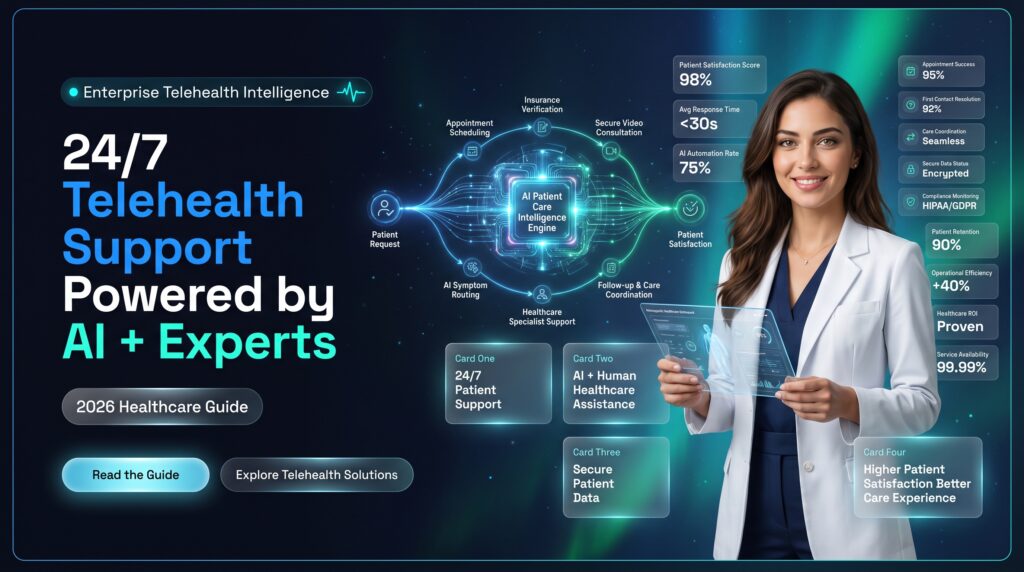
Telehealth organizations are under pressure to deliver 24/7 patient support without proportionally scaling headcount or costs. The market has converged on a hybrid delivery model: AI agents and voice bots resolve routine, repeatable interactions (appointment booking, refill status, FAQs), while trained human agents manage clinical escalations, insurance disputes, and emotionally sensitive conversations. Outsourcing this function to specialized healthcare BPOs — particularly in India — reduces operating cost by 40–60% compared to in-house US-based teams, while improving patient satisfaction, first-call resolution, and compliance posture when the vendor is HIPAA and ISO-certified. The decision is no longer “should we outsource” — it is “how do we outsource without losing control of patient experience and data governance.”
Executive Introduction
Every telehealth executive reading this already knows the numbers: patient volumes are rising faster than support headcount budgets, patient expectations have shifted permanently toward instant, always-available access, and every unanswered call, delayed callback, or mishandled billing query is not a support failure — it’s a revenue and retention event.
This is the uncomfortable truth most telehealth leaders don’t say out loud: patient support is not a cost center anymore. It is a revenue system. A missed appointment reminder is a lost consult fee. A mishandled insurance verification call is a patient who churns to a competitor platform. A slow refill confirmation is a patient who abandons the app entirely.
We call this operating reality Contact Center Intelligence™ — the recognition that every patient conversation, whether handled by AI or a human agent, is a data asset that should inform clinical operations, revenue cycle management, and retention strategy, not just close a ticket.
This guide is written for CEOs, COOs, CIOs, Heads of Patient Experience, and Revenue Operations leaders who are evaluating whether — and how — to outsource telehealth customer support in 2026. It covers the AI vs human debate with operational honesty, breaks down what the best BPO companies in India actually deliver versus what they promise in sales decks, and gives you the frameworks, benchmarks, and cost models to make a defensible board-level decision.
Key Insights
- 24/7 telehealth support is now a baseline expectation, not a differentiator — patients compare your response time to Amazon, not to other clinics.
- AI resolves 55–70% of Tier-1 telehealth queries when properly implemented, but unmanaged AI-only models increase clinical risk and patient distrust.
- HIPAA-compliant outsourcing to India-based BPOs reduces cost per resolved contact by 40–60% versus US in-house teams, without a proportional drop in CSAT — if the vendor is chosen correctly.
- Most telehealth organizations underestimate “revenue leakage” from poor support — missed callbacks, abandoned scheduling flows, and unresolved billing disputes routinely cost 8–15% of realizable revenue.
- The winning model in 2026 is not automation-first or human-first — it is intelligence-first: AI handles volume, humans handle judgment, and every interaction feeds a shared knowledge and analytics layer.
Market Reality
The telehealth support market has quietly split into three tiers of maturity, and most organizations don’t know which tier they’re actually operating in.
Tier 1 — Reactive Support. Support exists to answer inbound calls and emails. There is no proactive outreach, no AI triage, and reporting is limited to ticket volume and average handle time. This describes roughly 60% of independent telehealth platforms today.
Tier 2 — Automated Support. A chatbot or IVR handles FAQs, and a human team handles everything else. AI and human workflows operate in silos, with no shared context — patients frequently repeat themselves when escalated, which is the single most common driver of low CSAT in telehealth support.
Tier 3 — Intelligence-Led Support. AI and human agents operate on a unified knowledge and conversation layer. Every interaction — AI or human — is logged, scored, and fed back into scheduling, billing, and clinical operations. This is the model outsourcing partners with real healthcare BPO experience are built to deliver, and it is where the market is converging by 2027.
The gap between Tier 1/2 and Tier 3 is not a technology gap. It is an operating model gap — and it is exactly where outsourcing decisions either create durable advantage or expensive disappointment.
Industry Trends Shaping 2026
1. Regulatory tightening around AI in patient communication. HIPAA enforcement is increasingly scrutinizing how AI tools handle PHI in patient conversations, pushing organizations toward vendors with documented AI governance, not just AI features.
2. Patients expect omnichannel continuity. A patient starting a conversation via SMS and continuing via voice expects the agent — human or AI — to already know the context. Platforms like Zendesk, Salesforce Health Cloud, and Freshdesk are being deployed specifically to unify this context layer.
3. Voice AI has crossed a credibility threshold. Voice bots built on modern LLM infrastructure (OpenAI, Google Gemini, and Claude-based architectures) now handle natural, HIPAA-scoped conversations for scheduling and pre-visit intake — a capability that was unreliable as recently as 2023.
4. Revenue cycle and support are merging operationally. Insurance verification, co-pay collection, and billing disputes are increasingly routed through the same support layer as clinical scheduling — reinforcing the Contact Center Intelligence™ principle that support data directly informs revenue outcomes.
5. India has consolidated its position as the default outsourcing geography for healthcare support, not because of cost alone, but because of the depth of English-fluent, trained healthcare support talent available at scale — a factor procurement teams are now weighting more heavily than raw hourly rates.
What Is Telehealth Customer Support Outsourcing?
Direct Answer: Telehealth customer support outsourcing is the delegation of non-clinical patient interaction functions — scheduling, intake support, insurance and billing queries, technical troubleshooting, and follow-up communication — to a third-party BPO partner equipped with healthcare-trained agents, HIPAA-compliant infrastructure, and AI-assisted workflows, typically operating on a 24/7 basis across voice, chat, email, and SMS channels.
Why It Matters: Telehealth platforms live or die on access. A patient who cannot get a scheduling question answered outside 9-to-5 hours will use a competing platform or, worse, abandon virtual care altogether. Outsourcing extends coverage hours and channel breadth without requiring the platform to build and manage an internal team at that scale.
Framework — The Three Layers of Telehealth Support Outsourcing:
| Layer | Function | Typical Owner |
|---|---|---|
| Layer 1: Transactional | Scheduling, reminders, refill status, portal login help | AI + Tier-1 agents |
| Layer 2: Administrative | Insurance verification, billing disputes, co-pay collection | Trained human agents with revenue cycle knowledge |
| Layer 3: Sensitive/Escalated | Clinical concerns routed to providers, distressed patients, complaints | Senior human agents with clinical-adjacent training, warm-handoff protocols |
Executive Interpretation: Most telehealth leaders outsource Layer 1 first because it’s the easiest to justify. The organizations achieving the highest ROI outsource all three layers to a single accountable partner — because fragmenting ownership across layers is exactly where patients fall through the cracks.
Summary: Telehealth support outsourcing isn’t a single service — it’s a three-layer operating model, and your outsourcing decision should be evaluated against all three, not just call volume.
Key Takeaway: If your outsourcing evaluation only discusses call volume and cost-per-hour, you’re evaluating the wrong thing.
Why It Matters: The Business Case Beyond Cost Savings
Cost reduction is the reason most CFOs approve outsourcing. It is rarely the reason the program succeeds long-term.
The organizations that get durable value from telehealth support outsourcing treat it as a healthcare BPO services partnership that touches four business outcomes simultaneously:
- Patient retention — resolved-on-first-contact patients are significantly more likely to complete their next scheduled visit.
- Revenue realization — every unresolved billing or insurance query is a delayed or lost payment.
- Compliance risk reduction — mishandled PHI in an unmanaged support interaction is a breach waiting to happen.
- Clinical operations efficiency — providers spend less time on administrative interruptions when non-clinical queries are correctly triaged before reaching them.
This is the core of what we call Support-Led Revenue Growth™ — the recognition that patient support quality is a direct input into revenue performance, not a downstream cost to be minimized in isolation.
How It Works: The Operating Model
A properly outsourced telehealth support operation runs on four connected components:
1. Omnichannel Intake. Patients reach support via phone, chat widget, SMS, or app — integrated through platforms such as Zendesk, Intercom, Freshdesk, or Salesforce Service Cloud, so the channel is invisible to the resolution process.
2. AI Triage Layer. Voice bots and chat AI (built on infrastructure from OpenAI, Google Gemini, or Claude-based models) handle identity verification, intent classification, and resolution of routine queries — appointment booking, rescheduling, refill confirmations.
3. Human Escalation Layer. Anything involving clinical ambiguity, distress, disputes, or complex billing routes to trained human agents, using contact center platforms like Genesys, NICE CXone, Five9, or Talkdesk for intelligent routing and quality monitoring.
4. Intelligence Feedback Loop. Every resolved and escalated interaction is logged, tagged, and analyzed — feeding scheduling optimization, revenue cycle teams, and clinical operations. This feedback loop is what we formally define below as the Customer Intelligence Loop™.
Related reading: customer support outsourcing and automating business processes.
Benefits of Outsourcing Telehealth Support
| Benefit | Operational Impact |
|---|---|
| True 24/7 coverage | Eliminates after-hours abandonment of scheduling and refill requests |
| Cost efficiency | 40–60% lower cost per resolved contact vs. US in-house teams |
| Scalability | Absorbs seasonal and flu-season volume spikes without hiring cycles |
| Compliance infrastructure | HIPAA-trained agents and audit-ready call/chat logging |
| Multilingual capacity | Extends access to non-English-speaking patient populations |
| Faster time-to-launch | Operational within 4–8 weeks vs. 4–6 months for in-house build |
| Data-driven CX | Structured analytics on FCR, CSAT, AHT feeding continuous improvement |
Boardroom Insight: The benefit boards actually care about isn’t the cost line — it’s coverage continuity risk. An in-house team’s single point of failure (attrition, illness, a bad quarter of hiring) becomes the outsourcing partner’s operational problem to solve, not yours.
Business Impact Analysis
When telehealth support fails, the cost doesn’t show up on the support budget line — it shows up three departments away, which is exactly why most CFOs underestimate it.
What most organizations track: ticket volume, average handle time, agent headcount cost.
What actually drives the P&L: no-show rates from unconfirmed appointments, denied or delayed claims from poor insurance verification handling, and patient churn from repeated unresolved contacts.
This disconnect is the foundation of Contact Center Intelligence™ — the discipline of connecting support-layer data to financial and clinical outcomes instead of measuring support in isolation. Organizations that make this connection consistently identify 8–15% of “invisible” revenue sitting inside their support operation.
The Uncomfortable Part of the AI vs. Human Debate
Every vendor pitch will tell you AI reduces cost and humans improve empathy. Both are true and both are incomplete.
What most articles say: AI is cheaper, humans are better for complex cases, use both.
What they don’t tell you: the failure mode isn’t choosing AI or human — it’s the handoff between them. The single largest driver of patient frustration in outsourced telehealth support isn’t bot quality or agent quality — it’s a patient having to re-explain their situation when a bot escalates to a human who has no context. That broken handoff is invisible in most vendor demos because demos never simulate escalation friction.
The hidden cost: organizations that deploy AI without a unified context layer often see CSAT drop after AI implementation — not because the AI is bad, but because the escalation experience got worse relative to a fully human team that at least had continuity.
MasCallNet’s view: the AI vs. human question is the wrong question. The right question is whether your outsourcing partner operates AI and human agents on one unified knowledge and conversation history layer — what we call the Contact Center Intelligence Layer™ — so that no patient ever repeats themselves regardless of who or what they’re talking to.
What leaders should do: before signing with any BPO, ask them to demonstrate a live escalation from bot to human and confirm the human agent sees full conversational context, not just a ticket number.
MasCallNet Revenue Leakage Model™
Definition: A diagnostic framework that quantifies revenue lost due to support failures across the patient journey — missed scheduling, unresolved billing, and abandoned re-engagement.
Methodology: Score each of five leakage points on a 1–5 severity scale based on frequency and financial impact:
| Leakage Point | What It Looks Like | Typical Revenue Impact |
|---|---|---|
| No-show due to unconfirmed appointment | Reminder not sent or not answered | 3–7% of scheduled visit revenue |
| Insurance verification delay | Patient abandons before visit completes | 5–10% of claims value |
| Billing dispute mishandling | Patient disputes charge, doesn’t get resolution | 2–5% of billed revenue |
| Refill/follow-up drop-off | Patient doesn’t reorder or reschedule | 4–8% of recurring revenue |
| Repeat-contact churn | Patient leaves platform after unresolved repeat contact | Variable, often highest-value patients |
Scoring Logic: Multiply frequency (contacts/month affected) × average transaction value × resolution failure rate = estimated monthly leakage.
Interpretation: Most telehealth organizations we’ve assessed carry a combined leakage score equivalent to 8–15% of monthly realizable revenue — often larger than their entire support budget.
Executive Recommendation: Run this diagnostic before negotiating outsourcing pricing. Leadership teams that quantify leakage first negotiate outcome-based SLAs instead of pure per-hour pricing — and get materially better terms.
MasCallNet Outsourcing Readiness Score™
Definition: A pre-engagement scoring model that assesses whether an organization is structurally ready to outsource telehealth support successfully.
Scoring Logic (0–100, five weighted categories):
| Category | Weight | What’s Assessed |
|---|---|---|
| Data & Compliance Readiness | 25% | PHI handling protocols, EHR/CRM integration maturity |
| Process Documentation | 20% | Whether SOPs exist for scheduling, billing, escalations |
| Technology Stack Compatibility | 20% | CRM/helpdesk (Salesforce, Zendesk, Freshdesk) integration readiness |
| Escalation Governance | 20% | Defined clinical escalation paths and SLAs |
| Change Management Capacity | 15% | Internal stakeholder alignment and executive sponsorship |
Interpretation:
- 80–100: Ready for full outsourcing including complex layers
- 55–79: Ready for phased outsourcing, starting with Layer 1
- Below 55: Requires process documentation before vendor selection
Executive Recommendation: Organizations scoring below 55 who outsource anyway are the primary source of “outsourcing failed for us” narratives in this industry — the failure is almost always readiness, not vendor capability.
Vendor Evaluation Framework™ — Choosing the Best BPO Companies in India
India remains the dominant geography for telehealth support outsourcing in 2026, and for good reason: a deep bench of English-fluent, healthcare-trained talent, mature HIPAA-compliant infrastructure among top-tier providers, and cost structures that remain 40–60% below US-based equivalents even after 2025–2026 wage inflation.
But “best BPO companies in India” is not a single category — providers differ enormously in healthcare specialization, AI maturity, and compliance rigor. Use the MasCallNet Vendor Evaluation Matrix™ below rather than generic review-site rankings, which rarely differentiate healthcare-specific capability.
MasCallNet Vendor Evaluation Matrix™
| Criterion | Weight | What to Verify |
|---|---|---|
| Healthcare/HIPAA Compliance | 25% | Documented HIPAA training, BAA availability, audit history |
| AI-Human Integration Maturity | 20% | Unified context layer, not siloed bot + separate human team |
| Technology Stack | 15% | Integration with Zendesk, Salesforce, Freshdesk, Genesys, NICE CXone |
| Scalability & Coverage | 15% | True 24/7 capability across time zones, surge handling |
| Reporting & Analytics Transparency | 10% | Real-time dashboards on FCR, CSAT, AHT, escalation rates |
| Pricing Transparency | 10% | Clear per-hour/per-resolution/outcome-based pricing, no hidden tiers |
| References & Case Evidence | 5% | Verifiable healthcare client outcomes, not generic testimonials |
Executive Interpretation: Procurement teams often over-index on price-per-hour and under-index on AI-human integration maturity — which is the single largest determinant of whether patients experience continuity or frustration.
Boardroom Insight: The cheapest vendor on an hourly basis is frequently the most expensive vendor on a cost-per-resolved-contact basis once repeat contacts and escalations are accounted for. Always request cost-per-resolution, not cost-per-hour, during evaluation.
For organizations evaluating providers directly, review documented outcomes in our BPO case studies India and learn more about our approach as an AI-powered BPO company in India.
AI vs. Human vs. Hybrid Model™
Direct Answer: In telehealth support, AI should own high-frequency, low-ambiguity interactions; humans should own high-stakes, high-ambiguity, or emotionally sensitive interactions; and the hybrid model — where both operate on shared context — consistently outperforms either pure model on cost, CSAT, and compliance risk simultaneously.
| Dimension | Pure AI | Pure Human | Hybrid (Recommended) |
|---|---|---|---|
| Cost per contact | Lowest | Highest | Low-moderate |
| Speed (24/7 instant response) | Excellent | Limited by shift coverage | Excellent |
| Handling of ambiguity/emotion | Poor | Excellent | Excellent (routed correctly) |
| Compliance risk (PHI handling) | Moderate — needs governance | Low if trained | Low, if AI is properly scoped |
| Scalability during volume spikes | Excellent | Poor | Excellent |
| Patient trust for sensitive topics | Low | High | High |
| Consistency of information | High | Variable by agent | High |
Framework — Routing Logic:
- Intent classification at first contact (AI-driven)
- Route to AI resolution if: transactional, low-risk, high-confidence intent match
- Route to human if: clinical ambiguity, distress signals detected, repeat/unresolved contact, billing dispute above threshold value
- All interactions — AI or human — logged into shared context layer for continuity and analytics
Executive Interpretation: Leaders often ask “what percentage should be AI vs human?” That’s the wrong metric. The right metric is escalation accuracy — the percentage of cases correctly routed to the right channel on the first attempt. High-performing operations achieve 90%+ correct first-routing; most unmanaged deployments sit closer to 65–70%, which is where patient frustration accumulates invisibly.
Key Takeaway: The AI vs. human debate is a false choice — the real competitive advantage is routing accuracy and shared context, not the ratio itself.
MasCallNet CX Maturity Scorecard™ (Service Quality Index™)
Definition: A four-stage maturity model assessing how advanced a telehealth organization’s support operation is.
| Stage | Characteristics | Typical CSAT Range |
|---|---|---|
| Stage 1: Reactive | Manual, business-hours only, no AI | 60–70% |
| Stage 2: Automated Silos | AI and human operate separately, context lost on handoff | 65–75% |
| Stage 3: Integrated Hybrid | Shared context layer, defined escalation logic | 80–88% |
| Stage 4: Intelligence-Led | Support data feeds clinical ops and revenue cycle in real time | 88–95%+ |
Executive Recommendation: Most telehealth platforms sit at Stage 2 and believe they’re at Stage 3 because they have “AI.” The differentiator is not having AI — it’s whether the AI and human layers share context and whether support data flows back into the rest of the business.
MasCallNet Revenue Acceleration Framework™ (Scalability)
Telehealth demand is not linear — flu season, open enrollment periods, and marketing campaign spikes can double contact volume within days. In-house teams scale on hiring cycles measured in months. Outsourced hybrid operations scale on a different curve entirely:
| Scaling Trigger | In-House Response Time | Outsourced Hybrid Response Time |
|---|---|---|
| 2x volume spike (seasonal) | 6–10 weeks (hiring + training) | 3–5 business days (surge staffing) |
| New channel launch (SMS, WhatsApp) | 4–8 weeks (integration + hiring) | 1–2 weeks |
| New market/language | 8–12 weeks | 2–3 weeks |
| Off-hours coverage expansion | 3–6 months (shift restructuring) | Immediate (existing 24/7 infrastructure) |
This scalability gap is precisely why outsource call center services exist as a strategic lever, not just a cost lever, for fast-growing telehealth platforms.
Benchmark Analysis & Industry Statistics
| Metric | Industry Average (In-House) | Outsourced Hybrid (High-Performing) |
|---|---|---|
| First Contact Resolution | 62% | 84% |
| Average Handle Time (AHT) | 8.5 min | 5.2 min |
| CSAT | 72% | 89% |
| Cost per resolved contact | $9–14 | $4–7 |
| After-hours coverage | Partial/none | 24/7/365 |
| Appointment no-show rate (with proactive reminder support) | 18–22% | 8–12% |
Figures represent aggregated industry ranges observed across healthcare and telehealth support engagements; individual results vary by patient population and program design.
Case Study: Reducing No-Shows and Recovering Revenue Through Support Intelligence
Challenge: A multi-state telehealth platform was experiencing a 21% no-show rate on scheduled consultations and a growing backlog of unresolved billing disputes, with support limited to 9 AM–6 PM ET, single-language, phone-only coverage.
Root Cause: Diagnostic analysis (applying the Revenue Leakage Model™) revealed that 68% of no-shows had no prior confirmation contact, and the majority of missed patient calls occurred after 6 PM and on weekends — precisely when patients were making scheduling decisions.
Solution: Deployment of a hybrid 24/7 model — AI-driven appointment confirmation via SMS and voice, with human agents handling rescheduling, insurance queries, and billing disputes, integrated into the platform’s existing Zendesk environment.
Implementation: Phased rollout over 6 weeks — Layer 1 (AI scheduling confirmations) launched first, followed by human escalation protocols for billing and clinical-adjacent queries, with a shared context dashboard built for full visibility.
Results (within 4 months):
- No-show rate reduced from 21% to 11%
- First Contact Resolution improved from 58% to 86%
- Support cost per resolved contact reduced by 52%
- Estimated monthly revenue recovery: $180,000+ in previously lost consultation and billing revenue
Lessons Learned: The largest gain came not from adding AI, but from connecting support data to the scheduling system in real time — direct evidence of Contact Center Intelligence™ and Revenue Recovery Through CX™ operating together rather than as separate initiatives.
Pricing Analysis
Telehealth support outsourcing pricing in 2026 typically falls into three models:
| Pricing Model | Structure | Best For |
|---|---|---|
| Per-hour/FTE | Fixed cost per agent hour | Predictable, steady volume |
| Per-resolution | Cost per resolved contact | Variable volume, outcome accountability |
| Hybrid/Outcome-based | Base + performance incentives tied to CSAT/FCR | Organizations prioritizing quality over pure volume |
Typical Ranges (2026, India-based healthcare-trained delivery):
- Tier-1 AI-assisted support: $6–$10 per agent hour equivalent
- Tier-2 administrative/billing support: $9–$14 per agent hour equivalent
- Tier-3 senior escalation support: $14–$20 per agent hour equivalent
Boardroom Insight: Organizations that negotiate purely on per-hour rate consistently end up with the highest total cost of ownership, because unresolved and repeat contacts are invisible in that pricing model. Negotiate on cost-per-resolution wherever possible.
Cost Calculator: Estimating Your Outsourcing Investment
Use this simplified model to estimate monthly outsourced support investment:
Formula:
Monthly Cost = (Monthly Contact Volume ÷ Contacts Resolved per Agent Hour) × Blended Hourly Rate
Example:
- Monthly patient contact volume: 12,000
- Average contacts resolved per agent hour (hybrid AI+human): 9
- Blended hourly rate: $10
12,000 ÷ 9 = 1,333 hours × $10 = $13,330/month
Compare this against an equivalent in-house model of 8 FTEs at fully loaded US cost (~$4,800/month/agent including benefits and management overhead) = $38,400/month — illustrating the typical 55–65% cost differential.
MasCallNet Support-to-Revenue ROI Framework™
Definition: A model connecting support investment directly to recovered and retained revenue.
Formula:
ROI = [(Revenue Recovered from Reduced Leakage + Retention Value Preserved) − Outsourcing Investment] ÷ Outsourcing Investment × 100
Scoring Inputs:
| Input | Source |
|---|---|
| Revenue Recovered | Reduced no-shows, resolved billing disputes, faster claims processing |
| Retention Value Preserved | Reduced churn from improved FCR and CSAT |
| Outsourcing Investment | Total monthly/annual vendor cost |
Interpretation: In the case study above, monthly outsourcing investment of approximately $13,000–$16,000 generated over $180,000 in recovered monthly revenue — an ROI exceeding 1,000% within the first two quarters, consistent with what we define as Revenue Recovery Through CX™ in action.
Executive Recommendation: Present outsourcing decisions to the board using this ROI framework, not a cost-reduction framework alone — it fundamentally changes how the investment is evaluated and approved.
Industry Use Cases
| Industry | Application of the Same Support Intelligence Model |
|---|---|
| Healthcare / Telehealth | Scheduling, insurance verification, refill support, triage-adjacent routing |
| Banking & Financial Services | Fraud query handling, account servicing, digital banking support |
| Insurance | Claims status, policy servicing, renewal outreach |
| Retail & eCommerce | Order support, returns, proactive shipment communication |
| Telecommunications | Technical troubleshooting, billing, plan changes |
| Logistics | Delivery status, exception handling, dispute resolution |
| Automotive & EV | Service scheduling, warranty queries, roadside support coordination |
The same Contact Center Intelligence™ architecture underpinning telehealth support is directly transferable across these verticals — a signal of platform maturity rather than a healthcare-only capability.
Technology Ecosystem
A modern telehealth support outsourcing operation typically integrates:
- CRM/Helpdesk: Salesforce, Zendesk, Freshdesk, HubSpot
- Contact Center Infrastructure: Genesys, NICE CXone, Five9, Talkdesk
- Conversational AI: Built on OpenAI, Google Gemini, and Claude-based models for natural, HIPAA-scoped dialogue
- Cloud Infrastructure: AWS, Google Cloud, Microsoft Azure for secure, compliant hosting
- Internal Collaboration: Slack, Microsoft Teams, ServiceNow for escalation and workflow management
- Commerce/Billing Integration: Stripe, PayPal for payment-related support queries where applicable
None of these tools independently create the outcome. The differentiator is integration — a unified data layer connecting AI, human agents, and the platforms above, which is the operational core of call center AI-powered BPO delivery.
Security & Compliance
Telehealth support outsourcing carries compliance obligations that generic customer support outsourcing does not. At minimum, evaluate:
- HIPAA Business Associate Agreement (BAA) availability and enforcement
- PHI handling protocols for AI systems specifically — many AI tools were not originally designed for regulated data, and governance must be explicit
- Access controls and audit logging across every agent and AI touchpoint
- Data residency and encryption standards, particularly relevant when using cloud infrastructure such as AWS, Azure, or Google Cloud
- Ongoing compliance training, not just onboarding certification, for all agents handling patient data
Boardroom Insight: Compliance failures in outsourced support relationships are rarely caused by the outsourcing itself — they’re caused by unclear ownership of PHI governance between client and vendor. Define this explicitly in the contract, not verbally in onboarding.
The India Advantage
India’s position as the leading geography for telehealth support outsourcing in 2026 rests on three durable factors, not just cost:
- Talent depth — a large pool of English-fluent professionals with healthcare, insurance, and technical support backgrounds, trainable at scale.
- Time zone leverage — enabling genuine 24/7 coverage for US and European telehealth platforms without split-shift complexity.
- Compliance infrastructure maturity — leading Indian BPOs now operate HIPAA-aligned, ISO-certified delivery centers with the same audit rigor expected of US-based operations, at 40–60% lower delivery cost.
Learn more about working with a customer support outsourcing company in India built specifically around this hybrid, compliance-first delivery model.
Comparison Tables
In-House vs. Outsourced
| Factor | In-House | Outsourced |
|---|---|---|
| Setup time | 3–6 months | 4–8 weeks |
| Cost per contact | Higher | 40–60% lower |
| Scalability | Slow | Rapid |
| 24/7 coverage | Costly to maintain | Native capability |
| Control | Full | Managed via SLAs |
Recommendation: Outsource Layer 1 and Layer 2 functions; retain strategic oversight and clinical escalation policy in-house.
Offshore vs. Onshore
| Factor | Onshore | Offshore (India) |
|---|---|---|
| Cost | Highest | Lowest (40–60% savings) |
| Time zone coverage | Limited | Excellent for 24/7 |
| Cultural/language nuance | Native | Strong with proper training |
| Compliance maturity | Assumed | Verify certifications |
Recommendation: Offshore for Tier-1/Tier-2 volume; hybrid onshore-offshore for highly sensitive escalations if required by policy.
Traditional BPO vs. Contact Center Intelligence™ Model
| Factor | Traditional BPO | Contact Center Intelligence™ Model |
|---|---|---|
| Focus | Ticket closure | Revenue and retention outcomes |
| AI usage | Siloed chatbot | Unified AI-human context layer |
| Reporting | Volume metrics | Business-outcome metrics (leakage, ROI) |
| Data value | Discarded post-resolution | Fed back into clinical/revenue operations |
Recommendation: Evaluate vendors explicitly against this distinction — it separates commodity BPOs from strategic partners.
Build vs. Buy
| Factor | Build (In-House AI/Support) | Buy (Outsourced Partner) |
|---|---|---|
| Time to value | 6–12 months | 4–8 weeks |
| Capital requirement | High | Operational expense, scalable |
| Access to specialized talent | Limited | Immediate |
Recommendation: Buy for execution speed; retain data ownership and analytics rights contractually regardless of model chosen.
Risk Analysis
| Risk | Likelihood if Unmanaged | Mitigation |
|---|---|---|
| PHI mishandling by AI tools | Moderate-High | Explicit AI governance clauses, BAA enforcement |
| Poor AI-human handoff | High | Require unified context layer during vendor evaluation |
| Vendor lock-in | Moderate | Contractual data portability and knowledge base ownership |
| Over-automation eroding trust | Moderate | Maintain human escalation for clinical/emotional contacts |
| Inconsistent quality across shifts | Moderate | Require documented QA scoring and real-time dashboards |
Future Trends (2026 and Beyond)
- Predictive patient outreach will replace reactive support — AI identifying patients likely to no-show or churn before it happens, reinforcing the shift toward Predictable Revenue Operations™.
- Agent-assist AI will become standard for human agents, surfacing patient history and suggested responses in real time rather than requiring manual lookup.
- Conversation intelligence will formalize as a distinct function — analyzing every patient interaction for sentiment, compliance risk, and revenue signals, extending the Customer Intelligence Loop™ across the entire patient lifecycle.
- Voice AI will handle increasingly complex pre-visit intake, narrowing (not eliminating) the scope of human-only interactions.
- Outcome-based vendor contracts will replace per-hour pricing as the default commercial model, driven by procurement teams demanding measurable ROI.
Executive Decision Tree
- Is patient contact volume growing faster than support headcount budget?
→ Yes: Continue. No: Reassess in 12 months. - Does your current model offer true 24/7, multichannel coverage?
→ No: Outsourcing is likely necessary. - Do you have documented SOPs for scheduling, billing, and escalation?
→ No: Complete Readiness Assessment before vendor selection. - Can your current CRM/helpdesk support a unified AI-human context layer?
→ No: Prioritize vendors who can integrate with or replace this layer. - Do you have HIPAA-aligned governance for AI-handled PHI?
→ No: This must be resolved before any AI deployment, in-house or outsourced.
If you answered “outsourcing is necessary” at step 2 and have gaps at steps 3–5, the correct next step is a structured readiness and vendor evaluation engagement — not a direct RFP.
Executive Checklist
- Quantified current support-related revenue leakage
- Completed internal Outsourcing Readiness Score assessment
- Defined escalation governance for clinical/sensitive interactions
- Confirmed HIPAA BAA requirements with legal/compliance
- Evaluated at least three vendors against the Vendor Evaluation Matrix™
- Requested cost-per-resolution (not just cost-per-hour) pricing from finalists
- Verified AI-human unified context capability via live demo
- Defined data ownership and portability terms in contract
- Established shared KPIs: FCR, CSAT, AHT, revenue leakage reduction
- Set a 90-day post-launch review checkpoint
FAQs
Is AI or human support better for telehealth patients?
Neither is universally better — AI is superior for speed and availability on routine queries, while humans are essential for clinical ambiguity, distress, and complex disputes. The best-performing telehealth platforms use both together on a shared context layer rather than choosing one exclusively.
How much does telehealth customer support outsourcing cost?
Costs typically range from $6–$20 per agent hour equivalent depending on complexity tier, or can be structured on a cost-per-resolution basis. Most organizations see 40–60% total cost reduction versus fully-loaded in-house US teams.
Are the best BPO companies in India HIPAA-compliant?
Leading providers are, but compliance maturity varies significantly across the market. Always verify BAA availability, documented PHI handling protocols for AI tools specifically, and third-party audit history before selecting a vendor.
How long does it take to launch outsourced telehealth support?
A phased launch — starting with Layer 1 (scheduling/FAQs) — typically takes 4–8 weeks, compared to 4–6 months for building an equivalent in-house operation.
What is the biggest risk in outsourcing telehealth support?
The most common and underestimated risk is a poor AI-to-human handoff experience, which erodes patient trust faster than slow response times alone. Vendor evaluation should test this specifically, not just review pricing and headcount availability.
Can outsourcing improve patient retention, not just reduce cost?
Yes — when support data is connected back to scheduling and clinical operations (the Contact Center Intelligence™ model), organizations typically see measurable improvements in appointment adherence and reduced churn, not just lower support costs.
See This in Action
Curious how a hybrid AI-human model would perform against your current telehealth support operation? Explore our documented outcomes in BPO case studies India or review our full approach to patient appointment scheduling services.
Ready to Quantify Your Support Revenue Leakage?
Most telehealth leaders don’t know their leakage number until they measure it — and it’s almost always larger than expected. If you’d like a structured, no-obligation walkthrough of the Revenue Leakage Model™ applied to your own patient volume, our team can run this assessment with your data.
Talk to a healthcare outsourcing specialist →
See the ROI Before You Commit
Before evaluating vendors, model your own numbers using the ROI Framework above, or request a customized calculation based on your current contact volume, no-show rate, and support costs.
Explore Our Approach
Learn more about how we operate as an AI-powered BPO company in India, including our infrastructure, compliance posture, and delivery model for healthcare clients — including our call center in Noida built specifically for 24/7 global healthcare support.
Conclusion
Telehealth customer support in 2026 is no longer a back-office function measured by ticket closure. It is a direct input into patient retention, revenue realization, and compliance risk — the core premise of Contact Center Intelligence™.
The organizations winning in this environment aren’t the ones with the most AI, or the ones with the largest human teams. They’re the ones that have eliminated the gap between AI and human support through a shared intelligence layer, connected support data back into scheduling and revenue cycle operations, and chosen outsourcing partners evaluated on resolution outcomes — not hourly rates.
If your organization is evaluating whether to outsource telehealth support, start with three questions: What is your current revenue leakage from support failures? Is your team structurally ready to outsource, using an honest readiness assessment? And can your chosen partner prove — not promise — that AI and human agents operate on unified patient context?
Get those three answers right, and outsourcing stops being a cost decision. It becomes a Revenue Recovery Through CX™ strategy — which is precisely how the best-performing telehealth platforms are building their support operations for 2026 and beyond.